.svg)

.svg)
.svg)



TL;DR: Day trading is not automatically gambling, but it becomes gambling-like when you trade without a tested edge, risk limits, or the ability to stop. A structured trader defines the setup, entry, exit, position size, maximum day loss, and conditions for no trade before placing an order. Then the trader measures results across many trades after fees and slippage. In a prop-firm evaluation or funded account, drawdown rules can strengthen that discipline, but they can also create pressure to force trades, size up, or chase the cost of a failed attempt. The real test is not whether one trade wins. It is whether your process is measurable, repeatable, controlled, and sustainable when the next outcome is unknown.
The short answer on day trading and gambling
You can follow your plan, take a clean loss, and immediately wonder whether the whole thing was just a bet.
That is the wrong moment to judge your process. One result cannot tell you whether you were trading or gambling. A valid setup can lose, and a reckless trade can win.
Day trading and gambling are not identical activities. Futures markets have economic functions. Hedgers use them to manage price risk, while speculators accept price risk in an attempt to profit from market moves. The CFTC’s futures market overview explains both roles and warns that futures speculation is volatile, complex, and risky.
The important distinction is behavioral. A trader can use a legitimate market in a gambling-like way. The warning signs appear when the goal shifts from executing an edge to getting action, recovering a loss, hitting a fixed daily profit target, or escaping drawdown pressure.
The better question is not simply, “Is day trading gambling?” Ask, “What evidence and controls make this next trade part of a trading process?”
Why day trading can feel like gambling
Day trading and gambling share several features that can affect your decisions:
- The next outcome is uncertain.
- Wins and losses arrive quickly.
- Money creates an emotional score.
- A win can reward a poor decision.
- A loss can punish a sound decision.
- Another opportunity is always close enough to tempt you.
Short feedback loops are powerful. After a loss, clicking again may feel easier than reviewing what happened. After a win, increasing size may feel earned even when the setup has not improved.
An academic review of problematic trading found meaningful overlap between short-term speculation and gambling-like behavior. It discusses loss chasing, impulsivity, illusion of control, and loss of control over money. It also makes an important distinction: day trading is not based solely on chance, and current evidence is not sufficient to define problematic trading as its own clinical diagnosis.
That nuance matters. Risk does not make an activity gambling by itself. Uncertainty does not make skill irrelevant. At the same time, calling yourself disciplined does not prove that you have an edge.
Structured trading and gambling-like trading
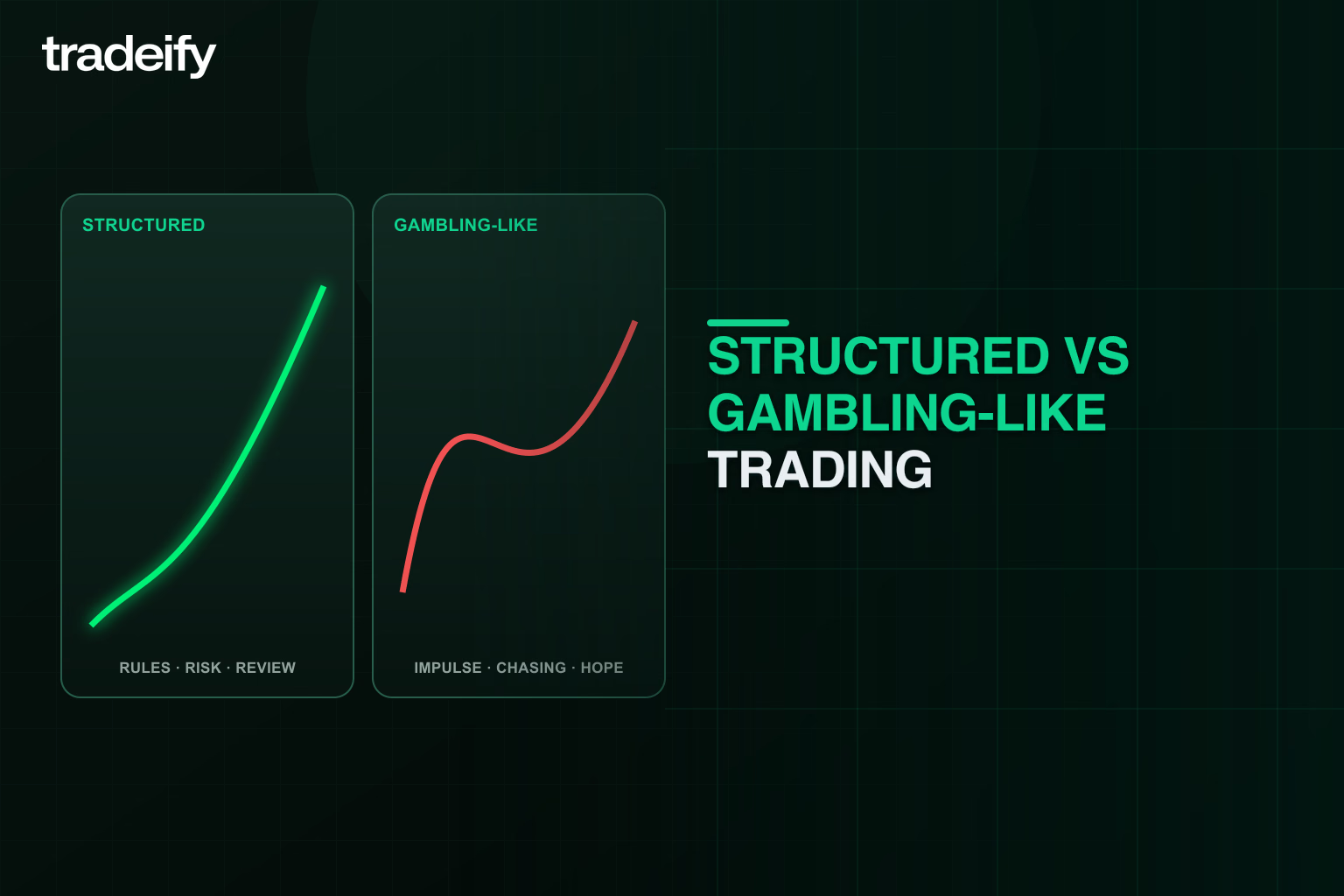
The difference shows up in what happens before, during, and after the order.
Decision area | Structured trading process | Gambling-like trading process |
|---|---|---|
Setup | Defined in advance and recognizable on a chart | Invented after price starts moving |
Edge | Measured across a meaningful sample after costs | Assumed from a few wins or a strong feeling |
Risk | Position size follows the stop distance and risk budget | Size follows confidence, frustration, or a profit target |
Exit | Invalidation and maximum loss are set before entry | The stop moves because the trader wants to be right |
Frequency | No trade is acceptable when conditions are absent | More trades are used to create action or recover losses |
Review | Results are logged by setup and rule adherence | Only the day’s profit or loss receives attention |
Stopping | A hard daily stop and cooldown end the session | Trading continues until the money is recovered |
No single row proves that someone has a gambling problem. Together, however, they show whether the process is designed to manage uncertainty or react to it.
This is also why a profitable day does not validate a trader. If you broke your size rule, moved your stop, and got rescued by a reversal, the money is positive but the process is negative. Record both.
When day trading becomes gambling-like
Gambling-like trading usually enters quietly. It sounds like, “One more trade,” “I only need to get back to flat,” or “This setup is close enough.”
Watch for these patterns.
Day trading starts to chase losses
You increase size, lower your setup standard, or trade a market you do not normally trade because you want to erase the last loss. The new position is serving an emotional debt, not a tested idea.
Loss chasing is one of the clearest overlaps between problematic gambling and problematic trading. It is especially dangerous near a daily loss limit or drawdown threshold because urgency rises as your room for error shrinks.
Day trading becomes constant action
You feel uncomfortable when you are flat. You scan for any reason to enter, switch markets repeatedly, or keep trading after your planned session.
More trades do not automatically produce more opportunity. They do create more exposure to fees, slippage, weak setups, and decisions made under pressure.
Trading risk changes with emotion
Your position size increases after losses, after a large win, or when you are close to a profit target. None of those events improves the next setup’s quality.
If the same chart pattern receives different risk because of your emotional state, your plan is no longer controlling the trade.
Day trading depends on needed money
You trade with money needed for rent, emergencies, debt payments, or other basic commitments. You may also treat a payout or daily profit target as income that must appear on schedule.
FINRA’s day-trading risk disclosure warns securities traders not to fund day trading with living expenses, emergency savings, retirement savings, or borrowed money. Futures and prop-firm accounts have different structures, but the behavioral principle still applies: needed money creates pressure that can distort decisions.
Trading continues despite broader harm
You hide results, lose sleep, neglect work or relationships, or repeatedly fail to stop when you intend to stop. At that point, the issue is bigger than strategy performance.
The National Council on Problem Gambling’s warning signs include preoccupation, escalating money or frequency, chasing losses, irritability when cutting down, and continuing despite negative consequences. The page also notes that the dollar amount alone does not determine whether behavior is problematic. If trading feels uncontrollable or harms your life, step away and seek help from a qualified professional.
Where to find help when trading starts to look like gambling
If the patterns above describe more than your trading, the response belongs outside the platform. A doctor, a licensed counselor, or a therapist can help you judge the behavior without the shame that keeps people quiet about it. Trying to out-discipline a compulsive loop on a live chart is not a treatment plan.
The National Problem Gambling Helpline at 1-800-MY-RESET is free, confidential, available 24/7, and works in all 50 states. You can call, text, or chat through the NCPG website, and NCPG also publishes a gambling self-assessment plus directories of counselors, treatment programs, and peer support if you want a structured place to start.
Use an outcome-blind day trading audit

A winning trade can reward gambling-like behavior. A losing trade can come from a controlled, testable process. If you grade the result first, those two lessons get reversed.
Review the decision before revealing or emphasizing the P&L:
Audit question | Structured loss | Impulsive win |
|---|---|---|
Was the setup written before entry? | Yes | No, the trader entered because price started moving |
Was risk fixed before entry? | Yes, and the planned stop was honored | No, size increased after a previous loss |
Was the exit tied to the original thesis? | Yes, price reached invalidation | No, the trader exited when the open profit felt large enough |
Can the decision be repeated and measured? | Yes | No, the entry depended on urgency and emotion |
Process grade | Pass | Fail |
The loss does not become good because it followed rules. It becomes useful data about a defined setup. The win does not become bad because it made money. It becomes dangerous evidence if it teaches the trader that chasing, oversizing, or ignoring a stop is acceptable.
Add one field to the journal: Would this decision pass if the outcome were hidden? Answer it before reviewing the dollars. Over a meaningful sample, compare process grades with results. That separates a strategy problem from a behavior problem without letting one lucky trade write the rules.
How to test a day trading edge
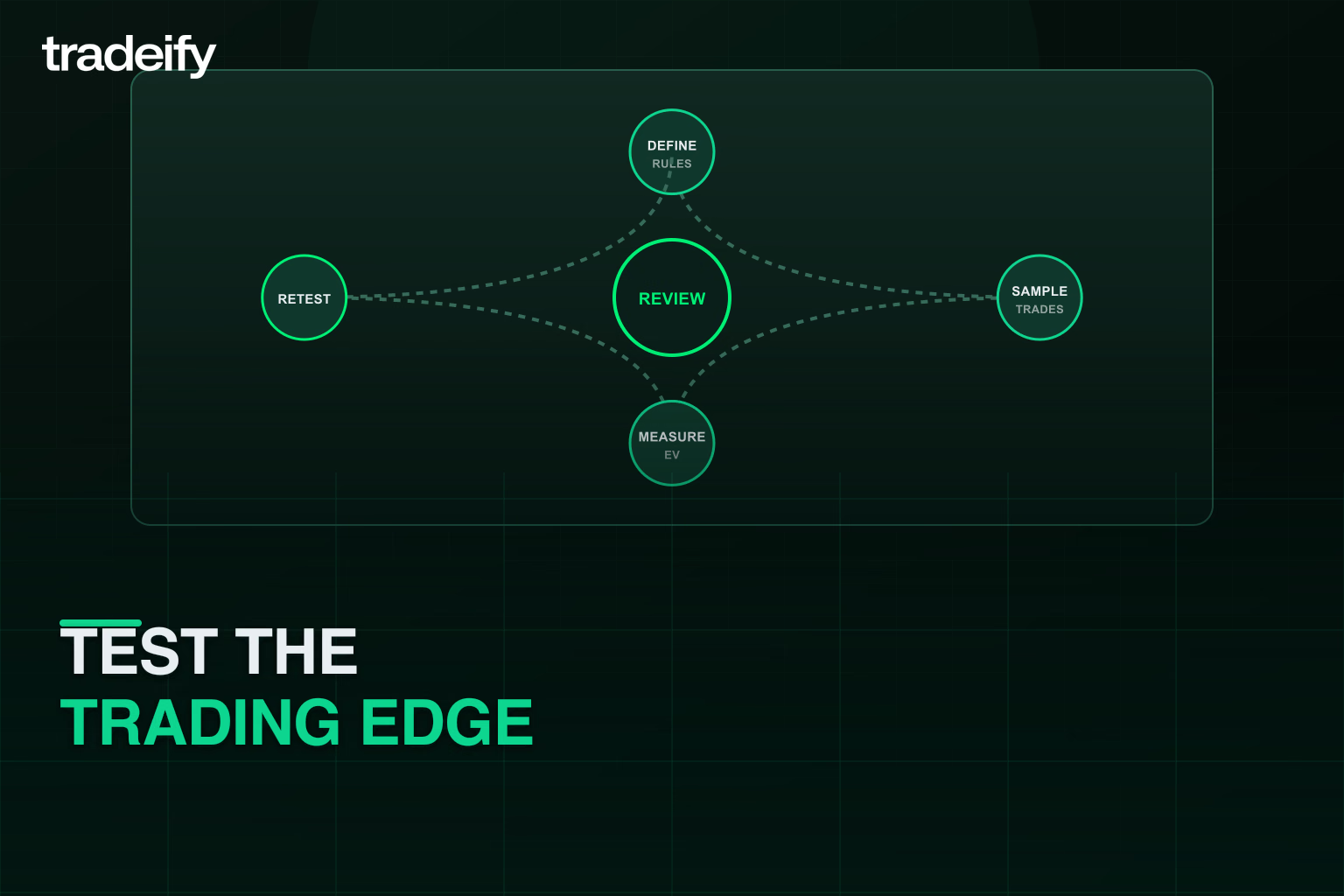
A strategy label is not evidence. “Breakout,” “trend,” and “support and resistance” describe broad ideas, not a complete decision process.
A testable setup needs enough detail that another careful trader could identify the same opportunity:
- Market and session
- Market condition
- Entry trigger
- Invalidation point
- Initial stop
- Profit-taking rule
- Position-sizing rule
- Conditions that cancel the trade
Then you need data.
Measure day trading expectancy
Expectancy estimates what the setup produces per trade across a sample:
Expectancy = (win rate × average win) − (loss rate × average loss) − average trading costs
Suppose a hypothetical setup wins 45% of the time. Its average win is $150, and its average loss is $100.
Before costs:
45% of $150 minus 55% of $100 equals twelve dollars and fifty cents per trade
If average fees and slippage total $8 per trade, the estimated expectancy falls to four dollars and fifty cents. That thin edge could disappear when volatility, execution, or trader behavior changes.
This example is not a profit claim. It shows why win rate alone is incomplete. A 70% win rate can still lose money when losses are too large. A lower win rate can be workable when wins are meaningfully larger and costs stay controlled.
Use enough day trading observations
Ten trades can be a hot streak or a cold streak. Review a larger sample from the same setup and market condition. Separate the data by session, volatility condition, direction, and rule adherence when those factors are part of the idea.
Do not mix disciplined trades with impulsive trades and call the average your strategy. Tag rule violations separately. Otherwise, you cannot tell whether the setup failed or your execution failed.
Challenge the day trading result
Test the idea on data or sessions that did not create the rules. Then track it in simulation before treating it as established.
Simulation is useful, but it does not reproduce every pressure or execution issue. Treat simulated results as evidence about the rules, not proof of future live performance.
Why day traders lose without gambling
Not every losing trader is gambling. That conclusion is too simple and unfair.
A disciplined trader can lose because:
- The setup never had a durable edge.
- The sample was too small.
- Market behavior changed.
- Fees and slippage consumed a thin edge.
- Position size was too large for normal variance.
- Stops executed beyond the planned price.
- The trader followed a sound process through an ordinary losing streak.
This is why the popular claim that “90% of day traders lose” should not be treated as a universal law. Studies use different markets, periods, definitions, account types, and measures of success. Regulators give a more defensible message: day trading is extremely risky, and futures speculation can produce severe losses.
Do not use a dramatic percentage to scare yourself or sell yourself a shortcut. Use your own clean data to decide whether a setup deserves more risk, less risk, more testing, or retirement.
Day trading in a prop firm account
Prop-firm trading changes the container, but it does not settle the gambling question.
An evaluation or simulated funded account gives you explicit boundaries. Those boundaries can improve discipline because drawdown, daily loss, consistency, and position rules make risk visible.
The same rules can also create emotional pressure:
- A trader near a target may force a trade to finish faster.
- A trader near drawdown may size up to save the account.
- A failed evaluation may lead to an immediate reset with no review.
- A simulated profit may create confidence unsupported by live execution.
- A payout goal may turn a normal session into a must-win day.
The firm’s maximum is a ceiling, not your personal risk plan. Build a smaller operating limit inside it.
For example, if your account rules allow a certain drawdown, do not divide the entire remaining buffer by the maximum number of contracts and call that risk management. Decide how many normal losing trades your process must survive. Then size from the trade’s invalidation point, not from the largest position the platform permits.
CME Group’s trade and risk management course makes the futures-specific sequence clear: know your exit and account equity before entry, then use the distance between entry and stop to determine the capital at risk.
Your prop-firm plan should also define:
- A per-trade risk cap
- A personal daily stop below the firm limit
- A maximum number of trades or losing attempts
- A rule for high-impact news and abnormal volatility
- A cooldown after a rule violation
- A review requirement before buying or starting another evaluation
These controls do not guarantee a passing result or payout. They keep one bad decision from demanding another.
A process that keeps trading structured
Use this five-step check before the next session.
Define the day trading setup
Write the exact conditions required for entry and the conditions that cancel it. If you cannot explain the setup without pointing at a chart after the move, it is not defined well enough.
Set trading risk before entry
Choose the invalidation point first. Convert that distance into dollars for the contract and size. Confirm that the loss fits both your per-trade plan and your remaining account buffer.
Set a hard day trading stop
Define the maximum day loss and maximum number of failed attempts before the session. Reaching either one ends the session. Do not leave the decision to your most frustrated state.
Record process and trading results
Log the setup, planned risk, actual execution, fees, slippage, rule adherence, and emotional state. A journal that records only profit and loss cannot show why the result happened.
Review trading before adding risk
Increase size only after a meaningful sample supports the setup and your rule adherence. Reduce size or return to simulation when behavior changes, the edge weakens, or execution costs rise.
Frequently asked questions about day trading and gambling
Is day trading just luck?
No single trade is fully predictable, and luck affects short-run results. A trading process becomes more than a guess only when its rules produce a repeatable positive expectancy across many trades after costs. Without that evidence, confidence is not an edge.
Can day trading become addictive?
Trading can become gambling-like and harmful for some people. Warning signs include constant preoccupation, increasing risk or frequency, chasing losses, failed attempts to stop, secrecy, and harm to sleep, work, finances, or relationships. Do not self-diagnose from one bad week, but do not ignore a repeated loss of control.
Does a stop loss mean day trading is not gambling?
No. A stop is one control. It does not validate the entry, position size, expectancy, or behavior. A trader can still gamble with tight stops by taking untested setups again and again.
Is prop firm day trading gambling?
Not automatically. A prop-firm account can support structured risk through clear rules and simulation. It becomes gambling-like when you chase targets, repeatedly reset without review, ignore drawdown, or trade for action instead of a tested setup.
Should day trading feel exciting?
Excitement can happen, but it should not be the reason for the trade. If boredom pushes you into marginal setups or larger size, the session is serving stimulation instead of execution.
Can you make $1000 a day with day trading?
Some sessions can produce that much, and some traders have those sessions. The mistake is treating it as a schedule, because a tested setup pays expectancy across many trades and the market owes no daily dollar figure. Anyone promising a fixed daily income from day trading is selling certainty the market does not offer. Build the estimate from your own sample instead: win rate, average win, average loss, and costs.
Why do 90% of day traders lose?
The percentage is a popular rule of thumb rather than a precise census, and the post above explains why it should not be treated as a law. Identifiable reasons explain most losing records: an untested setup, risk too large for the account, fees and slippage consuming a thin edge, and decisions that change with emotion. Each of those is measurable in your own results. If the number makes you more careful, it is useful. If it only scares you or sells you a shortcut, it is noise.
Trade the process, not the rush
You do not prove that day trading is different from gambling by winning the next trade.
You prove it through a process that can say no. No setup, no trade. Invalidated idea, exit. Daily stop reached, platform closed. Edge not supported by data, back to testing.
That can feel slow when a target, drawdown limit, or payout goal is on the screen. Slow is often the point. The goal is not to remove uncertainty. It is to stop uncertainty from controlling your behavior.
Futures trading involves substantial risk, and no strategy, evaluation, or risk rule guarantees profits, funding, or payouts.
.svg)
.svg)
.svg)
.svg)







.webp)