





TL;DR: Day trading means opening and closing every position in the same session, so the real question is whether your account can survive it. FINRA replaced the $25,000 pattern day trader rule on June 4, 2026, but brokers may keep it until October 20, 2027. Futures never had a PDT rule, and micro contracts such as MES ($1.25 per tick) let small accounts size risk sensibly. Research shows most day traders lose money, so start with a written risk plan, a cost budget and weeks of simulated practice.
Most people who ask what day trading is are really asking something else. Can I do this with the money I have, in the hours I have, without wrecking the account in the first month?
That is the decision this guide works through. It covers the definition, the stock rules that changed in 2026, the futures rules that never had a pattern day trader limit, the contract math that decides how much one trade can cost you, the costs that drain small accounts, and a first week that does not depend on luck.
Day trading is simple to describe and hard to do well. Simple is not the same as easy, and most of what follows is about the gap between the two.
What Day Trading Means
Day trading is buying and selling (or selling short and buying back) the same instrument within the same trading day. A day trader ends the session flat, with no open positions carried overnight.
The old FINRA margin rule used the same idea in narrower terms: a day trade was the purchase and sale, or sale and purchase, of the same security on the same day in a margin account. Brokers still count activity that way.
What separates day trading from other styles is the holding period and the reason for it.
- A swing trader holds for days or weeks and accepts overnight gaps as part of the trade.
- An investor holds for months or years and cares about the business or the asset, not the next hour.
- A day trader holds for seconds to hours and cares about intraday supply and demand, volatility and timing.
Ending flat removes one risk: the overnight gap you cannot react to. It adds others, and beginners tend to underestimate them. You trade more often, so costs and mistakes compound faster. You make more decisions under time pressure. And you need tighter risk control, because the moves you are trying to capture are smaller.
How a Day Trade Works From Entry to Exit

Every day trade has the same five parts, whether the instrument is a stock, an ETF or a futures contract.
- A reason to trade. A setup defined before the session, such as a break of the opening range or a pullback to a level that held earlier.
- An entry. The price and order type used to get in.
- A stop. The price where the reason for the trade is wrong, and the order that takes you out there.
- A target or exit rule. Where you take profit, or the condition that tells you the move is over.
- A size. How many shares or contracts, calculated from the distance between entry and stop.
A Worked Day Trade in Micro E-mini S&P 500 Futures
Here is one illustrative day trade in the Micro E-mini S&P 500 (MES). Per CME Group's contract specs, MES is $5 x the S&P 500 Index and moves in 0.25-point ticks, so each tick is worth $1.25 and each full point is worth $5.
Imagine a trader who sees price break above the morning range, pull back and hold the breakout level. They buy one MES contract at an illustrative 6,000.00, with a stop at 5,992.00 and a target at 6,016.00.
- Risk: 8 points x $5 = $40 per contract, before costs.
- Target: 16 points x $5 = $80 per contract, before costs.
- Reward to risk: 2 to 1.
The observation is the breakout. The interpretation is that buyers are defending the old range high. Confirmation is the pullback holding. Invalidation is price falling back into the range, which is why the stop sits below it.
Notice what is missing from that plan: any hope that the market goes up. The trade is defined by what would prove it wrong. If you cannot say where the idea fails before you enter, you do not have a day trade yet.
Day Trading Markets Compared
Beginners usually start day trading stocks because they know the names. Many active traders end up in futures because of the hours, the rules and the contract sizing. Neither is automatically better, but the differences change the plan.
| Factor | Stocks and ETFs | CME equity index futures |
|---|---|---|
| Main session | NYSE core session 9:30 a.m. to 4:00 p.m. ET | Sunday 6:00 p.m. to Friday 5:00 p.m. ET with a daily 5:00 to 6:00 p.m. ET break |
| Day trading rules | FINRA intraday margin standards, or the old PDT rule while a broker phases in | No pattern day trader rule |
| Leverage source | Broker margin under Regulation T and FINRA Rule 4210 | Performance bond margin set by the exchange and broker |
| Short selling | Needs a margin account and shares available to borrow | Selling first works the same way as buying first |
| Smallest common size | One share, sometimes fractional | One micro contract, such as MES at $5 per index point |
| US tax treatment | Short-term capital gains for positions held one year or less | Section 1256 contracts taxed 60% long-term and 40% short-term |
| Loss beyond deposit | Possible with margin | Possible, per the CFTC risk disclosure |
| Account protection if the firm fails | SIPC covers securities and cash up to its limits | SIPC does not cover futures contracts |
Options can be day traded too, and FINRA notes that its new intraday margin standard also covers margin used for zero-day-to-expiration (0DTE) options. Options add time decay and volatility pricing on top of direction. That is a lot for a first market. Most beginners learn faster on one instrument with a simple price-to-dollar relationship.
Day Trading Rules for Stock Accounts
The pattern day trader rule that most day trading guides still quote was replaced in 2026. For a US stock account, which day trading rules apply now depends on your broker.
The Old Pattern Day Trader Rule
Under the legacy version of FINRA Rule 4210, a customer who made four or more day trades within five business days in a margin account was a pattern day trader. The exception was when those day trades were 6% or less of the account's total trades for the five-day period.
Once flagged, the account needed at least $25,000 in equity before day trading could continue. Day-trading buying power was the prior day's closing equity minus the maintenance margin requirement, multiplied by four for equity securities.
That $25,000 line is why so many small stock accounts could not day trade freely, and why so many beginners still ask whether they need $25,000 to start.
FINRA's New Intraday Margin Standard for Day Trading
The SEC approved FINRA's rule change on April 14, 2026. FINRA Regulatory Notice 26-10, published April 20, 2026, set the effective date at June 4, 2026.
- The pattern day trader designation and the day trade count are gone.
- The $25,000 pattern day trader minimum equity is gone.
- Maintenance margin of 25% of the current market value of long margin-eligible stock applies throughout the trading day, not only at the close. Brokers can set higher requirements.
- A shortfall creates an "intraday margin deficit" you are expected to cover as promptly as possible, by depositing funds or closing positions.
- Per Notice 26-10, a deficit stays outstanding until it is met or until the 15th business day. A customer who makes a practice of missing deficits, and leaves one unmet past the fifth business day, faces a 90-day restriction.
The catch for a beginner in November 2026: brokers may phase in the new system until October 20, 2027. FINRA's own investor guidance says your firm might keep operating under the old day trading margin requirements during the transition. Ask your broker which regime your account is on before assuming the $25,000 rule no longer applies to you.
Two things did not change. You still need $2,000 in equity to trade on margin at all. And frequent trading with borrowed money is still one of the riskiest ways to use a brokerage account.
Day Trading in a Cash Account
A cash account avoids margin rules, but it has its own traps. Under the Federal Reserve's Regulation T, you must pay for a security before you sell it.
- Freeriding. Buying and selling before paying for the purchase. Your broker may freeze the cash account for 90 days, during which every purchase must be fully paid on the trade date.
- Good faith violation. Buying with proceeds from a sale that has not settled, then selling the new position before those proceeds settle.
Most stock trades settle one business day after the trade (T+1), the standard since May 28, 2024. A small cash account can day trade with settled cash, but the same dollars cannot be recycled trade after trade on the same day. That hard ceiling on activity is one some beginners end up valuing.
Day Trading Rules for Futures Accounts
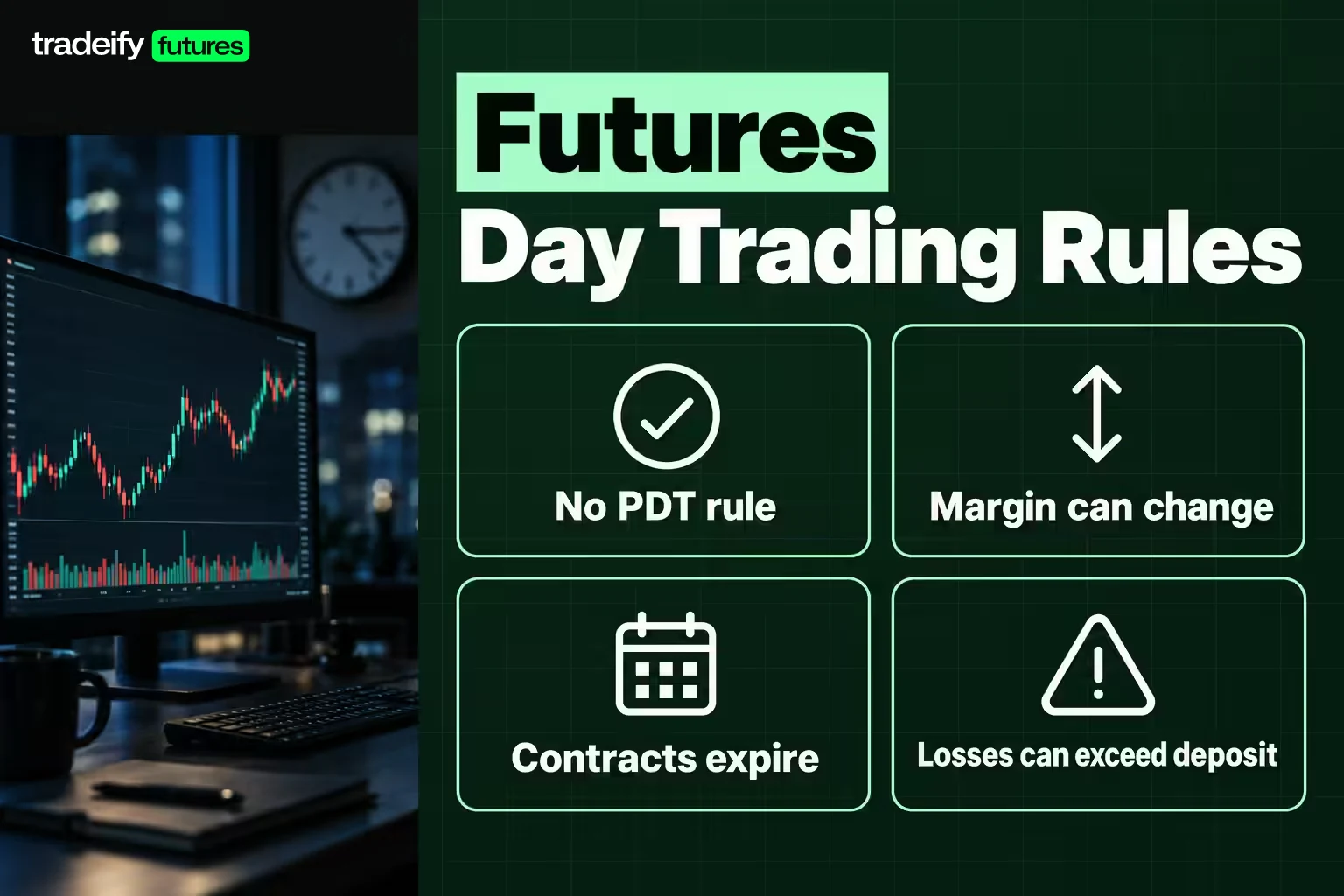
Futures day trading was never covered by the pattern day trader rule, because that rule was part of FINRA's securities margin rule. You can open and close as many futures positions in a day as your broker and margin allow.
That freedom comes with different rules.
- Margin is a performance bond, not a loan. The exchange sets minimum margins and brokers often set their own intraday margins. Both can change, especially when volatility rises, so never treat a margin figure as fixed.
- Losses can exceed your deposit. The CFTC-mandated risk disclosure says you may lose all the funds you deposit and may incur losses beyond those amounts, and your broker may call for more margin on short notice.
- Contracts expire. MES and ES list quarterly contracts (March, June, September, December), and trading in an expiring contract ends at 9:30 a.m. ET on the third Friday of the contract month. Check which month is active before you trade.
- Hours run nearly around the clock. CME Globex equity index futures trade Sunday 6:00 p.m. to Friday 5:00 p.m. ET, with a daily maintenance break from 5:00 to 6:00 p.m. ET. More hours does not mean more good trades.
- Account protection differs. SIPC does not cover commodity futures contracts, so the safeguards around a futures broker are different from those around a stock broker.
Leverage and Buying Power in Day Trading
Leverage is why day trading can produce meaningful results from small price moves. It is also why accounts disappear quickly. They are the same feature seen from two sides.
Stock Margin and Day Trading Buying Power
Regulation T sets initial margin for stock at 50% of the purchase price, so a margin account can generally borrow up to half. Under the legacy pattern day trader rule, intraday buying power could reach four times maintenance margin excess. Under FINRA's 2026 standard, intraday buying power depends on holding 25% maintenance (or the broker's higher house requirement) against your actual positions all day.
Run the sizing math before you think about buying power. Take an illustrative $10,000 account that risks 1% ($100) per trade. The trader buys a $50 stock with a stop 50 cents away. That is 200 shares, a $10,000 position, the whole account on one trade. Widen the stop to $1.00 and the size drops to 100 shares.
Tight stops on stocks quietly push a day trader toward margin. That is not a reason to use it. It is a reason to understand why your position sizes look the way they do before borrowed money makes them bigger.
Futures Day Trading Leverage and Notional Value
A futures contract controls a notional value far larger than the margin posted. The table uses an illustrative round index level of 6,000 for the S&P 500 contracts.
| Contract | Multiplier | Tick value | Notional at 6,000 | Value of a 1% index move |
|---|---|---|---|---|
| Micro E-mini S&P 500 (MES) | $5 x index | $1.25 | $30,000 | $300 |
| E-mini S&P 500 (ES) | $50 x index | $12.50 | $300,000 | $3,000 |
| Micro E-mini Nasdaq-100 (MNQ) | $2 x index | $0.50 | Index level x $2 | 1% of index x $2 |
| E-mini Nasdaq-100 (NQ) | $20 x index | $5.00 | Index level x $20 | 1% of index x $20 |
The multipliers and tick values come from CME Group's contract specifications. The notional figures are arithmetic on a round number, not a market quote.
One ES contract moves $50 per point. With an 8-point stop, one contract risks $400 before costs. On a $10,000 account, that is 4% on one idea, which is why small accounts that day trade the S&P 500 usually start with MES at one-tenth the size.
How Much Money You Need to Start Day Trading
There is no single right number. The useful question is what your account can trade while keeping each loss small enough to survive a normal losing streak.
A common starting framework is to risk about 1% of the account per trade. Losing streaks of five or more trades happen to sound strategies. At 1% per loss, five losses cost about 5%. At 5% per loss, the same streak costs close to a quarter of the account.
Day Trading Account Size and Contract Math
Here is what 1% risk buys with an illustrative 8-point stop on S&P 500 index futures, before costs.
| Account size | 1% risk per trade | MES contracts at $40 risk each | ES contracts at $400 risk each |
|---|---|---|---|
| $2,500 | $25 | 0 (one contract is 1.6% risk) | 0 |
| $10,000 | $100 | 2 | 0 |
| $25,000 | $250 | 6 | 0 |
| $50,000 | $500 | 12 | 1 |
Account size matters more than strategy for a beginner. A $2,500 account cannot hold even one MES contract with an 8-point stop inside a 1% rule. That trader has three honest choices: use a tighter stop the setup genuinely supports, accept a higher risk percentage knowingly, or keep practicing in simulation while saving capital.
The wrong choice is the common one: trading the bigger contract because the smaller one "doesn't move enough." That is how a reasonable idea becomes an account-ending loss. The trade idea was fine. The size was the mistake.
Capital for Day Trading Stocks
For stocks, the 2026 FINRA change lowers the barrier for margin accounts once your broker adopts it, but FINRA's $2,000 margin minimum still applies as of November 2026. A cash account has no minimum beyond the cost of the shares, but settlement limits how often the same money can be reused in a day.
Day Trading Costs and Taxes
Costs are where many beginner day trading plans quietly fail, because every cost repeats on every trade.
Day Trading Costs Beyond Commissions
- Commissions and exchange fees. Charged per share, per order or per contract, depending on the broker and market.
- Slippage. The gap between the price you expected and the price you got, especially on stop orders and fast news moves.
- Spreads. The difference between bid and ask, paid every time you cross it.
- Market data. Real-time feeds, and deeper order book data, often carry monthly fees.
- Platform and software. Some charting and order-entry platforms charge subscriptions or license fees.
Here is an illustrative cost model. Assume $2.00 all-in per round turn on one micro futures contract, plus one tick ($1.25) of slippage per round turn. That is $3.25 per contract per round trip. These are example numbers, so check your own broker's schedule.
- 10 trades a day at 2 contracts each = 20 contract round turns = $65 a day.
- Over 21 trading days = $1,365 a month.
- On a $10,000 account, that is about 13.7% of the account every month before a single winning trade.
Cut the activity to three trades a day and the same assumptions cost about $410 a month. The strategy has not changed. The break-even point has, and for a small account that is often the difference between a workable plan and a slow leak.
Day Trading Taxes in Brief
Taxes are not a reason to pick a market, but a beginner day trader should know the US basics before a profitable year. This is general information, not tax advice.
- Stock and ETF trades held one year or less produce short-term capital gains or losses, per IRS Topic 409. Short-term gains are taxed at ordinary income rates.
- The wash sale rule can disallow a stock loss if you buy substantially identical stock or securities within 30 days before or after the sale, per IRS Publication 550. Frequent traders in the same names trip it often.
- Regulated futures contracts are Section 1256 contracts. Per IRS Form 6781, their gains and losses are treated as 60% long-term and 40% short-term regardless of how long you held them.
Talk to a tax professional before assuming how your activity will be treated.
Day Trading Strategies Beginners Should Know
A day trading strategy is a repeatable reason to enter, a defined place to be wrong and a rule for getting out. The names below describe common families of setups. None of them work all the time, and each fails in a specific way.
| Strategy | What you look for | Where it usually fails | Fits a trader who |
|---|---|---|---|
| Momentum or trend following | Higher highs with volume behind them, then joining on a pullback | Entering late, after the move is extended | Can wait for a pullback instead of chasing |
| Opening range breakout | A break of the high or low of the first 15 to 30 minutes | False breaks that reverse back into the range | Accepts several small losses for occasional larger moves |
| Range or mean reversion | Price stretched to the edge of a well-defined range on a quiet day | Trend days, when the range simply breaks | Is patient and quick to exit when the range fails |
| Pullback to a reference level | A retest of VWAP, the prior day's high or low, or an earlier turning point | Treating every touch as a signal | Likes clear invalidation points |
| News or event trading | Scheduled releases such as the 8:30 a.m. ET jobs report or the 2:00 p.m. ET Fed statement | Slippage and whipsaw in the first seconds | Has a tested plan and accepts worse fills |
| Scalping | Very short trades for a few ticks | Costs consume the edge, and decision fatigue builds | Has low costs and fast, disciplined execution |
Two cautions apply to every day trading strategy in that table.
First, reading direction correctly is not the same as having an entry. You can be right that the market is strong and still have no trade, because price is in the middle of nowhere with no clear stop.
Second, a strategy is judged over a meaningful sample, not a week. Fifty or a hundred trades executed the same way tell you far more than the five you remember most.
Technical Analysis for Day Trading
Technical analysis for day trading is reading price, volume and time to decide where a trade is valid and where it is wrong. It does not predict. It gives you locations.
The tools most day traders actually use are simple.
- Support and resistance. Prices where the market turned before, such as the prior day's high, low and close, or the overnight range in futures. These become places to look for an entry or a stop.
- Opening range. The high and low of the first minutes after the US stock open. Many day trading plans are built around a break or a failure of that range.
- VWAP (volume-weighted average price). The average price weighted by volume since the session began. Intraday traders use it as a fair-value reference: price holding above it suggests buyers are in control for the day, price below it the opposite.
- Volume. Rising volume on a break suggests participation. A break on thin volume is more likely to fail.
- Trend structure. Higher highs and higher lows, or lower highs and lower lows, on the timeframe you trade.
Timeframes and Indicators for Day Traders
Pick one execution timeframe (for example a 1-minute or 5-minute chart) and one higher timeframe for context (for example a 15-minute or 60-minute chart). The higher timeframe tells you where the big levels are. The lower one tells you when to act.
Indicators such as moving averages, RSI or MACD are calculations on price. They can help you stay consistent, but they lag the price they are built from. If price is trapped in the middle of a range, adding another indicator does not create direction.
Here is a useful test for any chart tool. Does it change where you enter, where your stop goes or whether you trade at all? If it changes none of those, it is decoration, and decoration has a way of becoming a reason to take a trade you would otherwise skip.
Day Trading Brokers, Platforms and Tools
A day trader does not need a six-monitor desk. You need a broker you can trust, a platform that executes reliably and a few tools that do their job.
How to Choose a Day Trading Broker for Stocks or Futures
- For stocks, use a broker-dealer you can look up on FINRA's BrokerCheck. Ask which margin regime the account is on during the 2026 to 2027 phase-in, what the house margin requirement is, and how intraday margin deficits are handled.
- SIPC protects cash and securities at a failed SIPC-member brokerage up to $500,000, including a $250,000 limit for cash. It covers firm failure, not trading losses.
- For futures, the broker is a futures commission merchant. You can check registration in the National Futures Association's BASIC database. Ask about day trading margins, per-contract commissions and exchange fees, and what happens to open positions when margin runs short.
- Compare total cost per trade (commission, exchange fees, data), not the headline commission alone.
Day Trading Platforms, Market Data and Software
- A charting and order-entry platform. Common choices include TradingView, NinjaTrader, Tradovate, Sierra Chart and Quantower, plus broker-built platforms. Some are free with a broker, some charge subscriptions or license fees.
- Real-time data for the market you trade. Level 1 shows the best bid and ask. Level 2, or depth of market, shows more of the order book and often costs extra.
- Bracket orders (entry, stop and target placed together), so the stop exists the moment you enter.
- An economic calendar, so scheduled releases never surprise you mid-trade.
- A stock scanner if you day trade individual stocks, to find names that are moving with volume. Futures traders who stick to one contract rarely need one.
- A trade journal, even a spreadsheet, logging setup, entry, stop, exit, size, result and a one-line note on what you were thinking.
The journal matters more than any indicator. Confidence without a record is a story. With a journal you can test whether a setup pays or just feels good.
Best Times of Day for Day Trading
For US stocks, the NYSE core session runs from 9:30 a.m. to 4:00 p.m. ET. Activity and volatility usually cluster around the open and into the close, with the middle of the day often quieter.
Equity index futures trade nearly around the clock, but activity typically picks up around the US cash session. Several scheduled releases land before the stock open.
- 8:30 a.m. ET: many major US reports, including the Bureau of Labor Statistics jobs report and CPI. The next jobs report (October data) is due Friday, November 6, 2026, and the next CPI (October data) on Tuesday, November 10, 2026, per the BLS release schedules as of November 2, 2026.
- 9:30 a.m. ET: the US stock open, often the most active stretch of the day.
- 2:00 p.m. ET: Federal Reserve FOMC statements on decision days. The next meeting is December 8-9, 2026.
- 4:00 p.m. ET: the stock market close.
A beginner does not need to trade all of these. A better rule is to pick one window, often the first 60 to 90 minutes after the open, and trade only there. Fewer hours mean fewer impulse trades and a cleaner journal.
Choosing what to day trade follows the same logic. Pick instruments that are liquid (tight spreads, deep order books), that move enough to cover your costs, and that you can size inside your risk rule. For a small account, a liquid micro future or a heavily traded large-cap stock or ETF usually beats a thin, fast-moving small cap.
Day Trading Risks and Real Profit Odds
The best available research on individual day traders is not encouraging.
- A study of Taiwan's market by Barber, Lee, Liu and Odean, published in the Journal of Financial Markets, found that less than 1% of the day trader population could predictably and reliably earn positive abnormal returns net of fees.
- Chague, De-Losso and Giovannetti followed all 19,646 people who began day trading Brazilian equity index futures between 2013 and 2015. Only 7.9% kept going for more than 300 days. Of those who persisted at least 300 days, 97% lost money and only 0.4% earned more than a bank teller's pay, and the authors found no evidence that traders improved with experience.
Those studies cover specific markets and periods, and they do not say profitable day trading is impossible. They do say the default outcome is a loss, and that time spent trading does not automatically become skill.
Why Most Day Traders Lose Money
- Costs repeat on every trade, so a small edge before costs can turn negative after costs.
- Position sizes are too large for the account, so ordinary losing streaks become fatal.
- There is no defined edge, just reactions to price.
- Losses trigger revenge trades, and wins trigger overconfidence.
- Results are judged on a handful of trades instead of a meaningful sample.
What would change that conclusion for you is evidence, not hope. A journal of 100 or more trades, executed to the same rules, that shows a positive result after realistic costs is the first real sign of an edge. Before that, treat any profit as unproven.
Day Trading Risk Management Rules That Hold Up
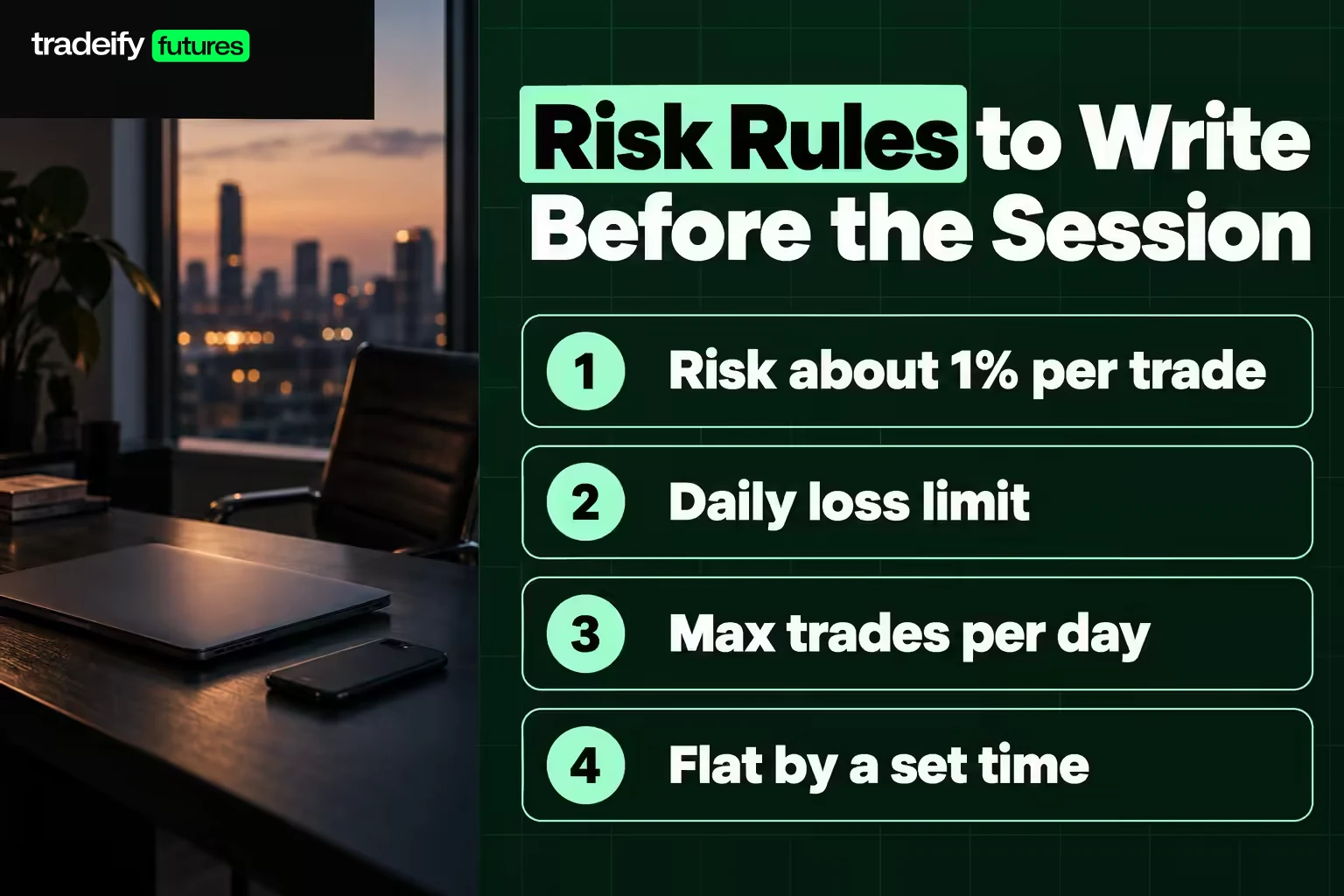
Day trading risk rules exist because the moment you need them is the moment you are least likely to decide well. Write them before the session, not during it.
- Risk per trade. Around 1% of the account is a common ceiling for beginners. Size every trade from that number: position size = dollar risk / (stop distance x value per point or per share).
- Daily loss limit. Stop trading for the day after a fixed loss, for example 2% to 3% of the account or two to three full losses. The day is over, however good the next setup looks.
- Maximum trades per day. A hard cap stops overtrading in a slow market, when inventing activity is most tempting.
- Stops that exist in the market. Use bracket or stop orders, not mental stops you can talk yourself out of.
- No adding to losing positions. Averaging down turns one wrong idea into a larger wrong idea.
- Flat by a set time. Decide when the trading day ends and close everything before then.
Here is where day traders usually get caught. The first loss of the day is rarely the problem. The second trade, taken a little bigger and a little faster to win it back, is.
Day Trading Psychology Traps
You do not need a psychology degree, but you do need to recognize three day trading behaviors early.
- Chasing. Missing the entry does not make the next price a good entry. It makes it a different trade, usually with a worse stop.
- Revenge trading. A clean loss does not require a response. It requires the same plan on the next qualified setup.
- Overconfidence after a good run. One strong week is one line in the sample, not proof that size should go up.
The fix for all three is the same: precommitted rules and a journal that shows whether you followed them.
Common Beginner Day Trading Mistakes
- Starting with real money before a written plan. If you cannot write the setup, stop and size on one page, you are improvising.
- Trading too many markets. Learning one instrument's behavior is hard enough.
- Using the full-size contract because micros "feel small." With an 8-point stop, one ES contract risks $400, which is 4% of a $10,000 account.
- Ignoring costs. A strategy that wins more often than it loses can still lose money once commissions and slippage are counted.
- Trading every hour the market is open. Most beginners do better with one focused window.
- Assuming the $25,000 pattern day trader rule is gone without asking the broker. Brokers may run the old system until their phase-in ends on October 20, 2027.
- Treating simulation like a game. Practice only helps if you trade it at the size and rules you would use with real money.
Your First Week of Day Trading
A realistic first week of day trading is not about making money. It is about building the process you will repeat.
- Choose one market and one account type. For example, one micro index future, or one liquid stock or ETF in a cash or margin account. Confirm your broker's day trading rules and whether it has moved to FINRA's intraday margin standard.
- Write your risk rules. Risk per trade, daily loss limit, maximum trades per day and the time you will be flat.
- Write one setup. What you look for, where you enter, where the trade is wrong and where you take profit.
- Write down your costs. Commissions, fees, data and platform charges, and an estimate of slippage per trade.
- Trade the setup in simulation for the full week, in the same time window each day, at the size your risk rule allows.
- Journal every trade: setup, entry, stop, exit, result and whether you followed the plan.
- At the end of the week, review one question only: did you follow the rules? Five days of profit or loss says little. Five days of rule-following says a lot.
After several weeks of consistent rule-following and a sample that holds up after costs, consider small real-money size. If the results only work at a size that breaks your risk rules, you do not have an edge yet.
If you want to practice inside hard limits rather than self-imposed ones, a futures evaluation is one way to add that structure. On our Tradeify accounts, every position must be closed by 4:45 PM ET, the end-of-day trailing drawdown is enforced in real time, our Growth evaluations carry a daily loss limit, and a 50K account caps size at 4 minis or 40 micros. Funded accounts are simulated and passing is never guaranteed, but those rules force the same habits this guide describes.
Day Trading FAQ
Is $100 enough to day trade?
$100 is enough to learn order entry with tiny stock positions in a cash account, but not enough to day trade with sensible risk. At 1% risk per trade you could lose $1, less than a single $1.25 tick on one MES contract, and margin trading in a stock account requires $2,000 in equity. Practicing in simulation while building capital is usually the better use of that time.
How much can a day trader make with $1,000?
Realistically, very little, and the risk rule is the reason. At 1% risk a $1,000 account can lose $10 per trade, which allows a stop of only 8 ticks (2 points) on one MES contract, so a 2 to 1 winner makes about $20 before costs. Treat a $1,000 account as a learning account, not an income source.
Do day traders make good money?
Most do not. Barber, Lee, Liu and Odean found that less than 1% of Taiwanese day traders predictably earned positive abnormal returns net of fees, and Chague, De-Losso and Giovannetti found that 97% of Brazilian mini-index futures day traders who persisted at least 300 days lost money. A small minority do profit, and they tend to have a tested edge, low costs and strict risk control.
Why is $25,000 required to day trade?
It came from FINRA's old pattern day trader rule: a margin account with four or more day trades in five business days needed $25,000 in equity. FINRA replaced that rule with intraday margin standards effective June 4, 2026, but brokers can phase in the change until October 20, 2027, so yours may still apply it. The rule never applied to futures or to cash accounts.
Can you make $1,000 a day with day trading?
It is possible on some days, but it is a size question before it is a skill question. $1,000 is 20 points on one ES contract or 200 points on one MES contract. At 2 to 1 reward to risk, that trade risks $500, which under a 1% rule implies an account of about $50,000, and the same plan will also produce losing days.
Can you make $500 a day with day trading?
On some days, yes, but only with an account large enough to carry the risk. $500 is 10 points on one ES contract or 100 points on one MES contract, and at 2 to 1 that means risking about $250 per trade, which fits a 1% rule on roughly a $25,000 account. The Taiwan study by Barber and colleagues and the Brazil study by Chague and colleagues both found that most day traders lose money, so treat any daily income target as a hope, not a plan.
How do you learn day trading as a beginner?
Pick one market, learn its share or contract math, and write one setup with a defined entry, stop and target. Trade it in simulation for several weeks, journal every trade and review whether you followed your rules before judging profit. Add real money only in small size once the journal shows consistent execution.
Can you day trade futures with a small account?
Yes, and there is no pattern day trader rule in futures, but the contract size still has to fit your risk. Micro contracts such as MES ($5 per point) and MNQ ($2 per point) exist for that reason. Broker margins vary and can change, and futures losses can exceed the money in the account, so size from your stop, not from the margin.
Your One-Page Day Trading Plan
Before you place a real day trade, write one page: one market, one setup, your risk per trade, your daily loss limit, your trade cap and your all-in cost per trade. Then trade that page in simulation for a full week and journal every decision.
If you followed the page on every trade, you have the start of a process. It is not proof of an edge yet, but it is the only foundation one can be built on. If you did not, you have found the first thing to fix, and you found it without paying the market for the lesson.