




TL;DR: Cash vs physical settlement decides whether an expiring futures position ends as a cash adjustment or as a delivery obligation. Cash-settled contracts like ES, NQ and MCL pay or charge the difference to a final settlement price. Physically delivered contracts like CL, GC, LE and ZC end with real goods, warrants or certificates changing hands. Your deadline depends on the contract: some delivery risk starts before the last trading day. Check the settlement method in the contract specs before you hold anything near expiry.
Every futures contract has an ending written into it. Most traders never see it, because they close the trade hours or days before it arrives. The few who do meet it usually meet it by accident, holding one contract a few days too long.
Settlement is that ending. It is where the obligation you took on when you clicked buy or sell gets fulfilled, either with money or with the actual asset. The exchange decides which one in the contract rules. You do not get a vote at expiry, so the time to know is before you size the trade.
What Settlement Means in a Futures Contract
Settlement in a futures contract is how an open obligation is finally resolved. The CFTC's glossary describes cash settlement as the seller paying the buyer a cash value based on an index or price, and physical delivery as delivery of the actual commodity or underlying instrument to satisfy the contract.
There are really two kinds of settlement happening in any futures position, and mixing them up causes confusion.
- Daily settlement. Every trading day the exchange publishes a settlement price. Positions are marked to it, losers pay winners, and margin is recalculated. CME describes the daily settlement as the price that drives mark-to-market transfers, margin and price limits.
- Final settlement. When a contract month expires, the exchange sets a final settlement price. In a cash-settled contract, that is the last price every open position is marked to. In a physically delivered contract, that price becomes the invoice price for the goods that change hands.
Because every exchange-traded future is centrally cleared, the clearing house sits between the two sides. It collects from the losing side and pays the winning side each day, and at expiry it either runs the final cash transfer or matches longs with shorts for delivery.
So the difference between cash settlement and physical delivery comes down to one question. When the contract ends, does money settle the last price difference, or does an asset move from the short to the long? Everything else in this guide follows from the answer.
Related lesson: How the clearing house stands between buyer and seller
How Cash Settlement Works at Expiry
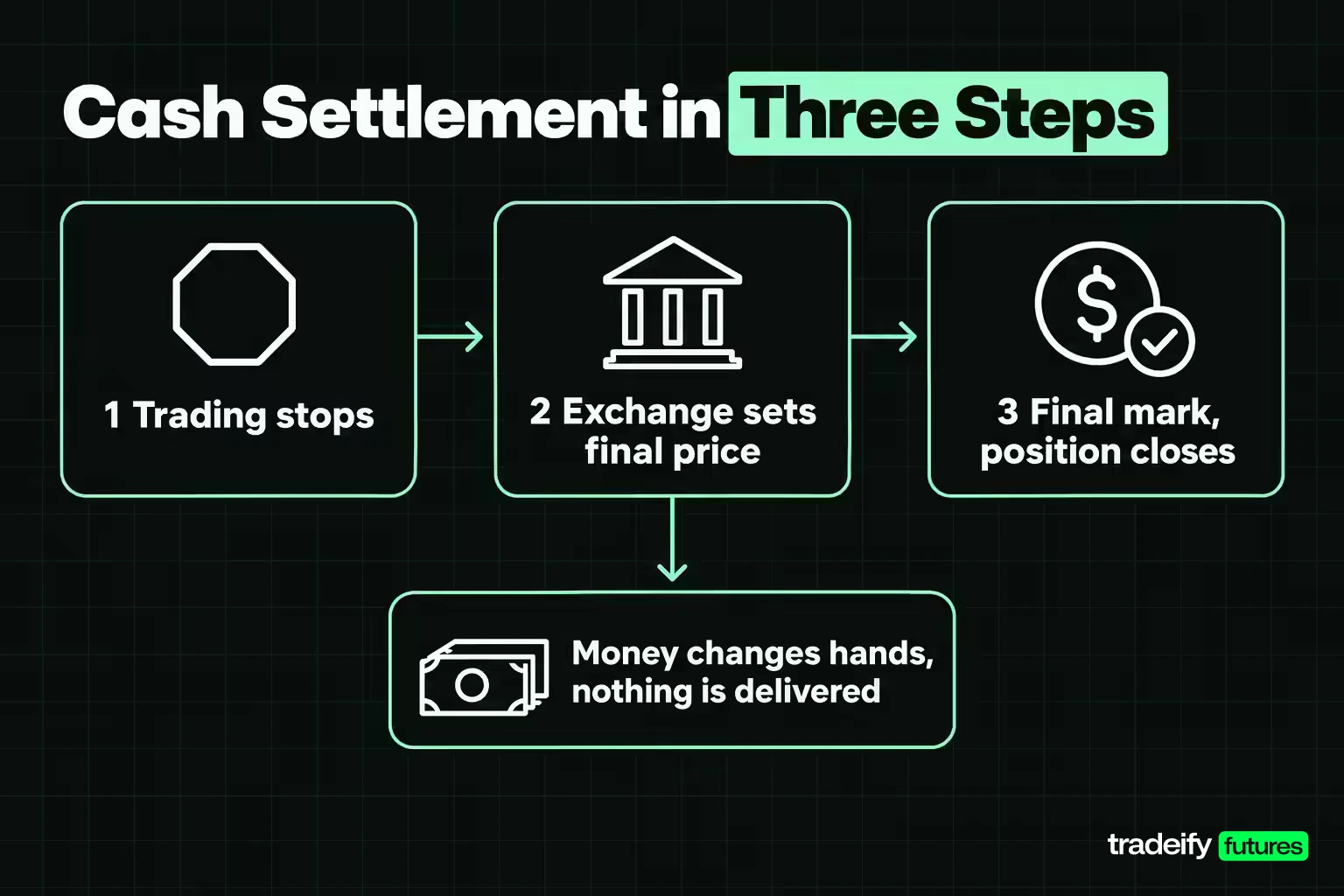
Cash settlement ends a futures contract with a single money transfer and no delivery. CME puts it simply: at expiry a final settlement price is determined, and each side is either owed money or pays money. Nobody can be forced to make or take delivery of anything.
The process runs in three steps.
- Trading stops. Each contract has a fixed last trading moment. For the E-mini S&P 500 (ES) and E-mini Nasdaq-100 (NQ), trading terminates at 9:30 AM ET on the third Friday of the contract month.
- The exchange sets the final settlement price. The method is written into the contract's rulebook chapter, and it differs by product.
- Open positions are marked one last time. The difference between the previous daily settlement and the final settlement price is credited or debited, and the position disappears.
Because daily settlement has already paid out every earlier move, the final cash transfer only covers the last step. Your total profit or loss still equals the final settlement price minus your entry price, times the contract multiplier.
Where the Final Cash Settlement Price Comes From
The final cash settlement price is not always the last price you saw on a chart. Each product defines it differently.
- Equity index futures. CME Rule 35803.A sets the ES final settlement price at a special opening quotation of the S&P 500, calculated from the opening prices of the component stocks on the third Friday. NQ follows the same approach under Rule 35903.A. The quotation is built from that morning's opening prints, so it can sit some distance from Thursday's close.
- Micro WTI Crude Oil (MCL). NYMEX Chapter 309 sets the MCL final settlement at the WTI crude (CL) final settlement price for the matching month, taken on the MCL last trading day. MCL stops trading one business day before CL does.
- Feeder Cattle (GF). CME Rule 10203.A says there is no delivery of feeder cattle at all. Open contracts are cash settled on the CME Feeder Cattle Index for the seven calendar days ending on the last trading day, an index built from USDA-reported cattle sales across a 12-state region.
- Thinly traded agricultural contracts. CME explains that some cash-settled agricultural products use assessments from price reporting agencies, because there is not enough screen trading to set a settlement price from trades alone.
Here is the practical point. Hold a cash-settled contract to expiry and you accept a price the exchange calculates, at a time you do not choose. That is fine if you planned for it. It is an unpleasant surprise if you assumed the chart's last print was your exit.
How Physical Delivery Settlement Works
Physical delivery settlement turns an open futures position into an obligation to exchange the actual asset. The short has to deliver it, the long has to accept it and pay for it, and the location, grade, quantity and timing are all fixed by the exchange.
CME's education material describes the trigger plainly. In a physically delivered contract, anyone still holding a position after the close on first position day is eligible to be matched for delivery, and anyone holding after expiration has to deal with the delivery process.
The details are product-specific, and the differences matter more than most traders expect.
Crude Oil Delivery Timeline
WTI crude oil (CL) is the clearest example of a delivery contract with a hard calendar.
- Last trading day. CL trading ends three business days before the 25th calendar day of the month before the delivery month, or four business days before if the 25th is not a business day.
- Notices. Under NYMEX Rule 200105, clearing members holding open longs file a Notice of Intention to Accept, and those holding open shorts file a Notice of Intention to Deliver, by 3:00 PM on the first business day after the final trading day.
- Delivery window. Delivery takes place no earlier than the first calendar day and no later than the last calendar day of the delivery month, free on board at a pipeline or storage facility in Cushing, Oklahoma.
- Payment. The final settlement price is the basis for delivery, and the buyer pays the short on the payment date, the twentieth day of the month after the delivery month.
There is one narrow exit after trading stops. NYMEX allows an expired CL position to be liquidated through an exchange for related position (EFRP) until 2:00 PM on the first business day after termination. An EFRP pairs the futures with a related physical or over-the-counter position, so it is a tool for commercial participants, not an escape hatch for a forgotten speculative trade.
Gold Delivery Timeline
COMEX gold (GC) works on a different clock, and this is where many traders get caught. Under COMEX Rule 706.C, first notice day is the last business day of the month before the delivery month. From that day, a long can be assigned delivery, even though GC trading continues until 12:30 PM CT on the third last business day of the contract month.
Delivery arrives as a warrant for gold stored at an exchange-approved depository. Each contract covers 100 troy ounces with a weight tolerance of 5% either way, and the gold must assay at a minimum of 995 fineness. The seller chooses the delivery day within the month.
Micro Gold (MGC) is also deliverable, at 10 troy ounces per contract. A smaller contract does not mean cash settlement.
Live Cattle and Corn Delivery Process
Live Cattle (LE) is a physically delivered contract on 40,000 pounds of cattle. CME Chapter 101 allows delivery on any business day of the contract month and the first eleven business days of the next month once a certificate has been tendered. A par delivery unit is 40,000 pounds of cattle graded USDA Yield Grade 3, 70% Choice, with a USDA acceptance certificate.
Corn (ZC) delivers through shipping certificates issued by regular warehouses or shipping stations under CBOT Chapter 10. Trading ends on the business day before the 15th of the contract month, and the last delivery date is the second business day after that.
Related lesson: The full notice and termination calendar
Cash vs Physical Settlement Compared
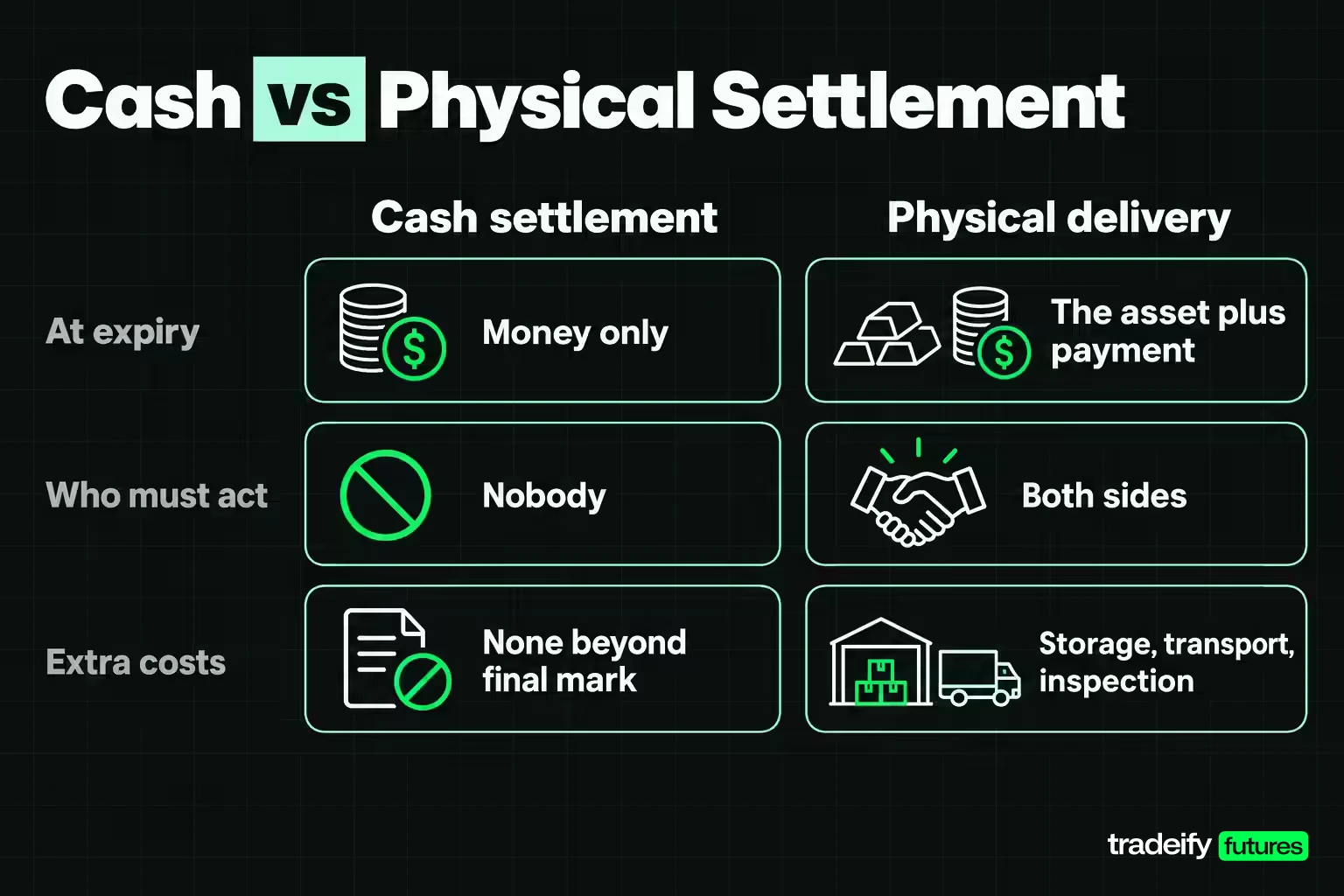
Cash vs physical settlement is a choice the exchange makes when it designs a contract, and each method fits a different kind of market. The table compares the two on the points that change what a trader has to do.
| Feature | Cash settlement | Physical delivery |
|---|---|---|
| What changes hands at expiry | Money only | The asset, a warrant or a certificate, plus payment |
| Final price used | Final settlement price set by exchange rules | Final settlement price becomes the invoice price |
| Key dates to watch | Last trading day and settlement time | First notice or position day, last trading day, delivery window |
| Who must act near expiry | Nobody, though the final price is not your choice | Both sides, through clearing members, notices and logistics |
| Extra costs if held | None beyond the final mark | Storage, transport, inspection and full payment for the goods |
| Typical underlyings | Indexes, cash-settled look-alikes, assessed prices | Storable commodities, currencies, Treasury notes |
Advantages and Drawbacks of Each Settlement Method
Cash settlement has three clear advantages. CME notes that cash-settled contracts are simpler to design, they work for markets where reliable price assessments already exist, and they let traders stay involved late into a contract's life without worrying about notice days or delivery timing.
The drawback is that the final price is a calculation. If that calculation is built on an index or assessment rather than heavy trading, the contract depends on the quality of that number.
Physical delivery has the opposite strength. The CFTC explains that the delivery provision exists to make the futures price and the cash market price converge. If futures drift too far from the physical market at expiry, someone can buy one and deliver against the other, and that threat pulls the prices together.
The drawback is the obligation itself. A delivered contract asks the holder for money, logistics and timing that a screen trader usually does not have.
Which Futures Contracts Use Each Settlement Method
The settlement method for a futures contract comes from its underlying. An index is a number, so there is nothing to deliver. A storable commodity with a deep physical market can be delivered, and delivery keeps the futures honest.
The table lists widely traded CME Group contracts with the settlement method shown in CME Group's contract specifications in November 2026.
| Contract | Unit | Settlement method | When trading ends |
|---|---|---|---|
| E-mini S&P 500 (ES) | $50 x S&P 500 Index | Cash | 9:30 AM ET, third Friday of the contract month |
| E-mini Nasdaq-100 (NQ) | $20 x Nasdaq-100 Index | Cash | 9:30 AM ET, third Friday of the contract month |
| Micro E-mini S&P 500 (MES) | $5 x S&P 500 Index | Cash | 9:30 AM ET, third Friday of the contract month |
| Micro WTI Crude Oil (MCL) | 100 barrels | Cash, to the CL final settlement price | One business day before CL |
| Feeder Cattle (GF) | 50,000 pounds | Cash, to the CME Feeder Cattle Index | Last Thursday of the contract month, with holiday exceptions |
| WTI Crude Oil (CL) | 1,000 barrels | Physical, Cushing, Oklahoma | Three business days before the 25th of the prior month |
| Gold (GC) | 100 troy ounces | Physical, depository warrant | 12:30 PM CT, third last business day of the contract month |
| Micro Gold (MGC) | 10 troy ounces | Physical | Third last business day of the contract month |
| Live Cattle (LE) | 40,000 pounds | Physical | 12:00 Noon CT, last business day of the contract month |
| Corn (ZC) | 5,000 bushels | Physical, shipping certificates | Business day before the 15th of the contract month |
| Euro FX (6E) | 125,000 euro | Physical currency delivery | 9:16 AM CT, two business days before the third Wednesday |
| 10-Year T-Note (ZN) | $100,000 face value | Physical, eligible Treasury notes | 12:01 PM CT, seven business days before the last business day of the month |
Same Market With Different Settlement Methods
Two pairs of CME contracts show that the settlement method belongs to the contract, not to the market. Crude oil has a delivered contract (CL) and a cash-settled micro (MCL) on the same barrel. Cattle has a delivered contract (LE) and a cash-settled one (GF) in the same livestock group. The underlying market is similar, yet the ending is completely different.
How Treasury Futures Settlement Works
Treasury futures show how detailed physical delivery settlement can get. A ZN short chooses which eligible note to deliver, with at least six and a half years but less than 8 years to maturity. The invoice price equals the futures settlement price times a conversion factor, plus accrued interest, and delivery runs through the Federal Reserve book-entry wire system.
Related lesson: Reading the specification sheet behind every row
Cash and Physical Settlement Worked Examples
The cleanest way to see what settlement changes is to price the same kind of move both ways. The prices here are round and illustrative, not live quotes.
Cash Settlement Example on ES
Imagine a trader long one ES contract at 7,000.00 who holds it through the third Friday. Thursday's close is 7,030.00. The special opening quotation on Friday comes in at 7,020.00.
- Total result: 7,020.00 minus 7,000.00 is 20 points, times $50, which is a $1,000 gain.
- The gap the trader did not plan for: the final price is 10 points below Thursday's close, which is $500 less than the chart suggested the night before.
- What changes hands: cash only. No shares, no basket of stocks.
The position controlled about $350,000 of index exposure at 7,000.00, and it ended with a single cash entry.
Crude Oil Settlement Example on CL and MCL
Now take crude oil, where the same barrels can settle either way. Imagine one trader long one CL contract and another long 10 MCL contracts, both at $70.00, with a final settlement of $70.50. Both positions cover 1,000 barrels.
| Settlement detail | 1 CL (physical) | 10 MCL (cash) |
|---|---|---|
| Barrels covered | 1,000 | 1,000 |
| Price gain paid through settlement | $500 | $500 |
| What happens after expiry | Delivery at Cushing, Oklahoma | Position closes in cash |
| Payment owed for the oil | $70,500 | None |
| Net cost of the oil | $70,000 | No oil received |
The gain is identical. The ending is not. The CL long has already received $500 through daily settlement, and now owes $70,500 for the oil at the final settlement price. Net, that is $70,000, exactly the entry price times 1,000 barrels. The MCL trader just keeps the $500.
CME's own course on Micro WTI uses a similar example. Ten MCL contracts bought at $64.35 and settled at $64.90 credit the account $550, because 55 ticks times $1.00 times 10 contracts is $550.
Gold Delivery Example on GC and MGC
Gold shows why contract size does not change the settlement method. At an illustrative $4,000.00 per ounce, one GC contract is worth $400,000 and one MGC contract is worth $40,000.
A long GC position still open on first notice day can be assigned a warrant for roughly 100 troy ounces and owe about $400,000 for it. A long MGC position faces the same process at a tenth of the size. The smaller contract lowers the bill. It does not remove the delivery.
Why Most Futures Positions Never Reach Settlement
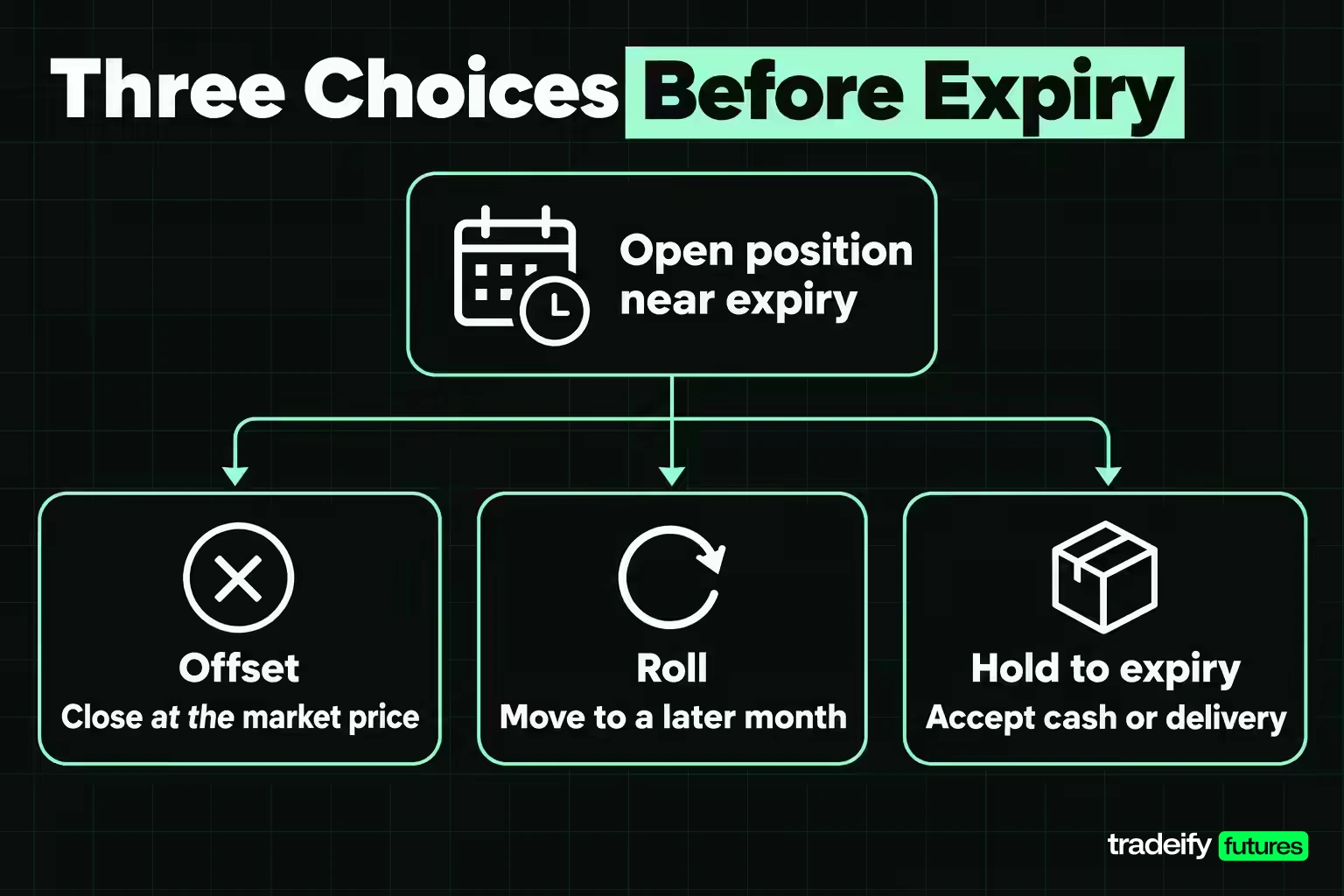
Most futures positions never reach final settlement because traders close them first. The CFTC states that most futures contracts, by volume, are liquidated by offsetting and do not result in delivery. Offsetting just means taking the opposite trade in the same contract month, which cancels the position.
The CFTC gives a good example of why even commercial users avoid delivery. A farmer near Topeka hedging with CBOT wheat would not want to deliver, because the nearest CBOT delivery point is St. Louis. So the farmer buys the futures back before the delivery date and sells the wheat locally.
Before expiry, every trader has the same three choices that CME lists for MCL:
- Offset the position and take the profit or loss at the current market price.
- Roll it to a later month with a calendar spread, which closes the expiring month and opens the next one in a single order.
- Hold to expiry and accept settlement, in cash or by delivery, depending on the contract.
How Delivery and Cash Settlement Shape Futures Prices
Even though few positions reach settlement, the settlement method still shapes the market for everyone. On a delivered contract, the delivery threat is what keeps the futures price tied to the physical market as expiry approaches.
On a cash-settled contract, the link runs through the final settlement price instead. CME points out that cash settlement lets more participants stay in late in a contract's life, because no one has to worry about notice days or delivery logistics.
That has a practical consequence for a speculative trader. Most speculators want out of a delivered contract before delivery can reach them, so the expiring month of a delivered contract is the one they leave first. Before trading any contract close to expiry, check its volume and spread against the next month, and trade the month where the activity actually is.
Related lesson: Moving a position from one contract month to the next
Managing Futures Settlement Risk Before Expiry
Managing settlement risk is mostly a calendar job, and it starts before you open the position. The costly settlement mistake is rarely a bad read on price. It is holding a contract one day longer than its rules allow for, usually because the trade was meant to be short and quietly became long.
Run this check before holding any futures position for more than a session:
- Confirm the settlement method in the contract specification. Do not assume it from the symbol or the contract size.
- Find the first date that matters for your side. For gold, that is first notice day, which comes before the last trading day. For crude oil, notices follow the last trading day, so the last trading day is the deadline.
- Compare that date to your planned holding period. If the hold crosses it, trade a later month or a cash-settled product instead.
- Read your broker's expiry policy for that product. A broker can set its own expiry and delivery rules on top of the exchange's, and those rules may close or restrict a position earlier than the exchange calendar suggests.
- Price the roll before you need it. Rolling means a calendar spread between two months, and that spread is a real cost set by the market.
Where Settlement Risk Catches Traders
Settlement risk usually catches traders through the calendar rather than the chart. Imagine a trader who buys the front gold contract late in a month and plans to hold it for a couple of weeks. If that contract's delivery month starts next month, first notice day lands on the last business day of this one, possibly before the trade is a week old. The chart gives no warning. The contract calendar does.
The failure modes repeat across products. A delivered contract is held past first notice day. A cash-settled print is treated as if it were the last chart price. A micro contract is assumed to be cash settled because it is small. One habit prevents all three: read the dates before you size the trade, and read them again if a trade outlives its plan.
On our accounts, a position cannot reach final settlement, because every position must be closed by 4:45 PM ET on regular trading days and nothing is held overnight; anything left open at that time is closed automatically. Our product list still mixes cash-settled contracts such as ES, NQ and MCL with delivered ones such as CL, GC and LE, so the calendar habit carries over: as a contract nears expiry, switch to the next month for your next session instead of trading a thinning expiring contract.
Common Futures Settlement Misconceptions
Settlement misconceptions usually come from applying one contract's rules to another. These are the ones that cause the most trouble.
- "Micro contracts are always cash settled." MCL is cash settled, but Micro Gold (MGC) is physically delivered at 10 troy ounces per contract. Size tells you nothing about settlement.
- "First notice day always comes before the last trading day." It does for COMEX gold, where first notice day is the last business day of the month before delivery. For CL, delivery notices are filed after trading has ended, so the last trading day is the real deadline.
- "The final settlement price is the last price on my chart." ES and NQ settle to a special opening quotation built from Friday's opening stock prices. It can land above or below Thursday's close.
- "Cash settlement is less real than delivery." A cash-settled contract is a binding contract with a real money obligation. It simply settles the price difference instead of moving goods.
- "Delivery happens to you at random." Delivery follows published notice and assignment rules. A position closed or rolled before the relevant date is not exposed to it.
- "Physical delivery means the full amount was risked from day one." Daily settlement has already moved every gain and loss. At delivery, the long pays the final settlement price and receives the asset, which brings the net cost back to the original entry price.
Related lesson: The expiry dates that set every settlement deadline
Cash vs Physical Settlement FAQ
What is the difference between cash settlement and physical delivery?
Cash settlement ends a contract with a money transfer based on the final settlement price. Physical delivery ends it with the actual asset moving from the short to the long, who pays the final settlement price for it. The exchange sets which method applies in each contract's rules.
What does regular way settlement mean?
Regular way settlement is the standard settlement cycle for a securities trade, the normal time between the trade date and the date cash and securities change hands. In the US, the SEC shortened it from two business days (T+2) to one (T+1), with a compliance date of May 28, 2024. Futures do not use that cycle, because they are marked to the daily settlement price every trading day.
How does a cash settlement work?
A cash settlement works by marking every open position to an exchange-calculated final settlement price and paying the difference in money. Trading stops at the contract's last trading time, and the exchange sets that price under the contract's rules. Each position is credited or debited one last time, and no asset changes hands.
How to avoid physical settlement of options?
You avoid physical settlement of options by closing or rolling an in-the-money equity option before expiration, or by trading cash-settled index options instead. Standard US equity options settle in shares, usually 100 per contract, while index options are traditionally cash settled. Check your broker's exercise cut-off time too, because each firm sets its own.
Is a micro futures contract always cash settled?
No. Micro WTI Crude Oil (MCL) is cash settled, while Micro Gold (MGC) is physically delivered like full-size gold. Always check the settlement method in the contract specification.
Futures trading involves substantial risk, and leverage means losses can exceed the money in an account. Delivery obligations on physically settled contracts can add costs well beyond the original trade. Contract rules and dates in this guide reflect exchange specifications read in November 2026; check the current specification before relying on them. Evaluation and funded prop accounts are simulated. This guide is education, not investment advice.


