



TL;DR: Clearing and settlement are the two jobs between your fill and your final cash, and clearing always comes first. Clearing guarantees and nets the trade, while settlement delivers it. Since May 28, 2024, US stocks, bonds and options settle one business day after the trade (T+1). Futures settle every day in cash through mark to market, so an open position can move money before you close it.
Clearing and settlement are the back-office steps that turn an executed order into a finished transaction. Clearing confirms the trade, puts a central counterparty between buyer and seller, and works out the net amount each firm owes. Settlement is the actual delivery: securities to the buyer, cash to the seller. Most traders never see either step, which is exactly why the steps catch them out. The usual surprises are a stock sale whose cash is not spendable yet, or a futures position that pulls money out of the account before anything was closed. Knowing which step you are waiting on tells you whether the problem is a guarantee, a delivery or a cash deadline.
What Clearing and Settlement Mean
Clearing and settlement are two separate jobs, and clearing always comes first. Clearing establishes what each side owes. Settlement discharges that obligation.
The Federal Reserve Bank of Chicago describes the start of clearing in plain terms: capture the trade data and check that the buyer's record and the seller's record match "as a mirror image of the other." Once the trade matches, the clearinghouse steps in as counterparty and nets the obligation against everything else the firm traded that day. At that point nothing has moved yet. The trade is guaranteed and sized, but no cash or shares have changed hands.
Settlement is the movement itself. The SEC's investor guidance defines it as the official transfer of securities to the buyer's account and cash to the seller's account. FINRA frames it as two dates on every ticket:
- Trade date is the day your order executes.
- Settlement date is the day the cash and the securities must actually be delivered.
The distinction matters because the two steps fail in different ways. A clearing problem is about whether the trade is recognized and guaranteed. A settlement problem is about whether the cash or the shares show up on time. If your statement shows a trade but your buying power has not moved, you are usually looking at the gap between the two, not an error.
How the Clearing Process Works
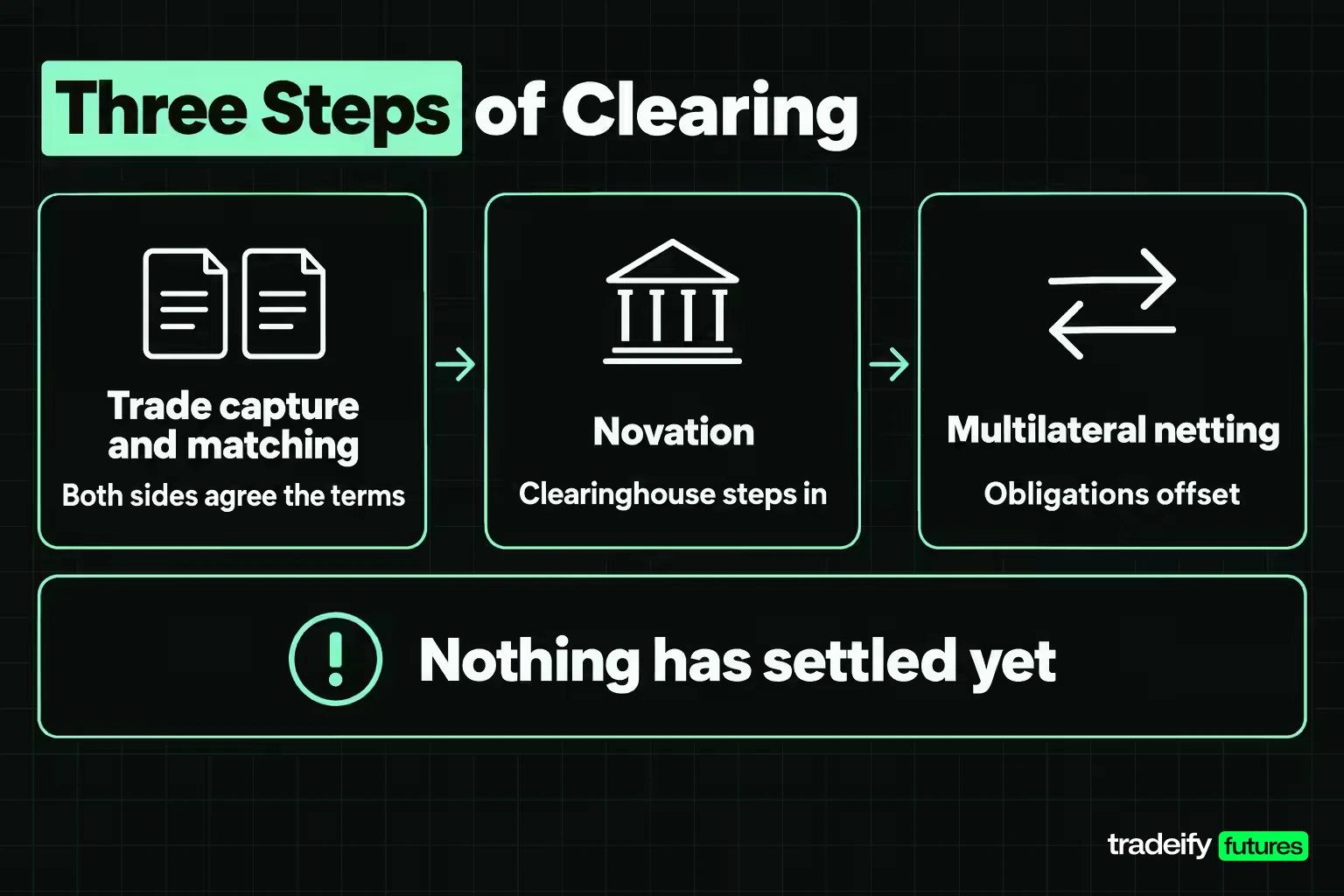
The clearing process has three core steps for most exchange-traded products: trade capture and matching, novation, and netting. Each one removes a specific risk before any money moves.
Trade capture and matching
Clearing starts when the trade details reach the clearing system and both sides agree on the terms: instrument, quantity, price and counterparties. On an exchange the match usually arrives already paired from the matching engine. In securities, the SEC's staff describes the clearing broker affirming the trade by checking those details before it moves toward settlement. A trade that does not match cannot be guaranteed, which is why matching is called the front end of a clearing system.
Novation
Novation is the step that replaces the original trade with two new ones. The clearinghouse becomes the seller to every buyer and the buyer to every seller. The CFTC describes a derivatives clearing organization as substituting its own credit for the credit of the original parties.
The practical result is that you never carry exposure to the trader who took the other side of your order. It also explains why you can close a futures position before expiry with anyone in the market: the clearinghouse keeps the number of longs equal to the number of shorts at every moment, so participants can come and go without breaking that balance. Some British-law markets use a variant called open offer, where the substitution happens on a slightly different legal basis, but the effect for a trader is similar.
Multilateral netting
Netting is how clearing shrinks the amount that has to settle. Instead of delivering each fill to the specific firm on the other side, the clearinghouse offsets each member's buys against its sells in the same security and reduces the cash side to a single payment to or from the clearinghouse. DTCC reports that its equity clearinghouse, NSCC, reduces the value of payments that need to be exchanged by an average of 98% each day.
The table below is an illustrative, constructed example of one firm's trading in a single stock over one day.
| Leg | Counterparty | Shares | Price | Cash value |
|---|---|---|---|---|
| Buy | Firm A | 2,000 | $50.00 | $100,000.00 |
| Buy | Firm B | 1,000 | $50.20 | $50,200.00 |
| Sell | Firm C | 1,500 | $50.10 | $75,150.00 |
| Sell | Firm D | 800 | $50.30 | $40,240.00 |
| Buy | Firm E | 500 | $49.90 | $24,950.00 |
Without netting, that clearing day means five deliveries, 5,800 shares moving and $290,540.00 of gross cash. With netting, the firm bought 3,500 shares and sold 2,300, so it receives one net delivery of 1,200 shares and makes one net payment of $59,760.00 ($175,150.00 of purchases minus $115,390.00 of sales). In this small example 79.4% of the gross cash never moves. Spread across thousands of firms and millions of trades, the same arithmetic produces the 98% figure DTCC reports.
Related lesson: How trade execution works
Central Counterparties and the Clearing Guarantee
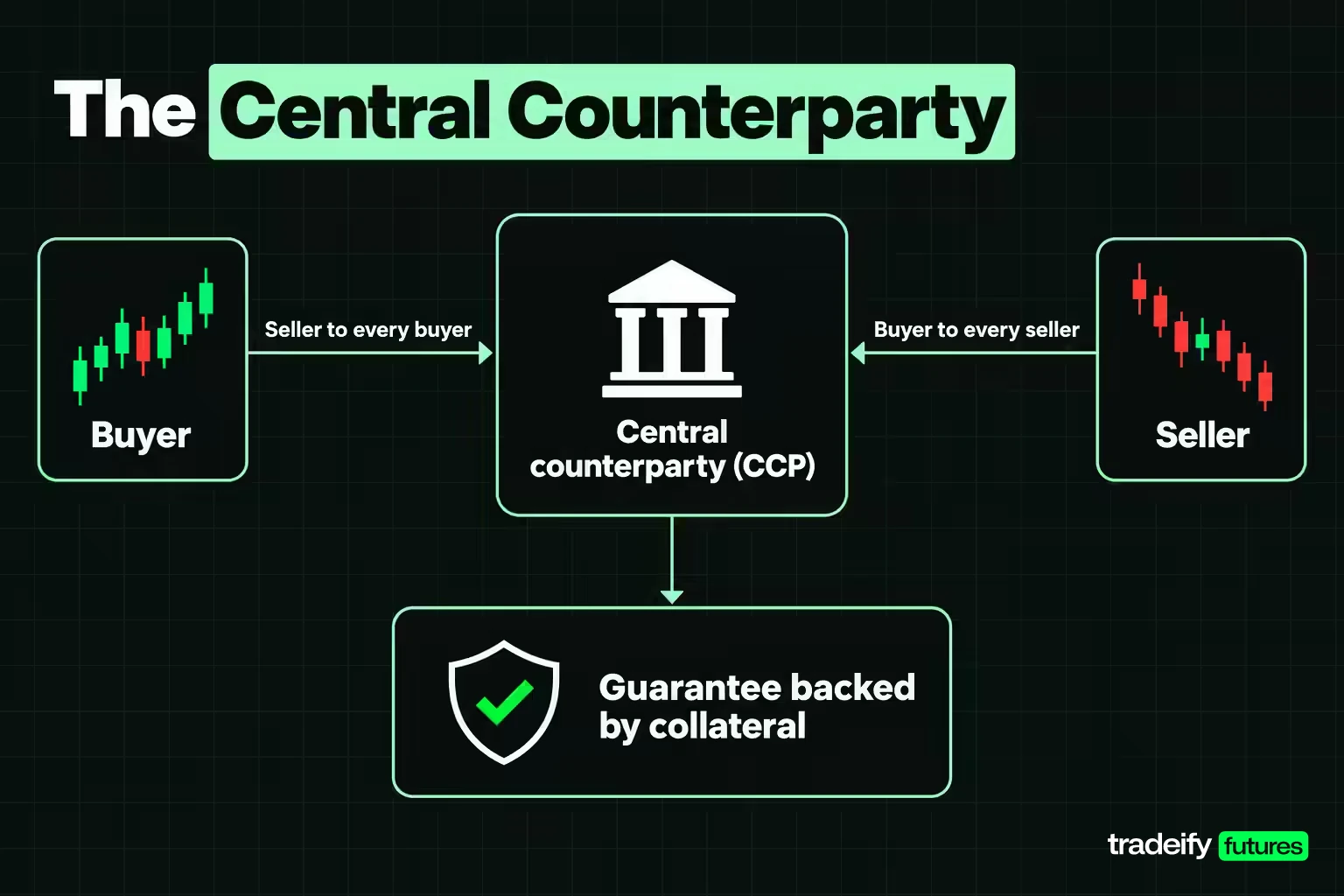
A central counterparty (CCP) is the clearinghouse that sits in the middle of every cleared trade and guarantees both sides. CME Clearing does this for CME Group futures, and NSCC does it for most US stock trades.
The SEC staff's report on the January 2021 meme-stock period gives the cleanest example of why the guarantee exists. If a buyer agrees to pay $100 per share on Monday and the price falls to $20 before settlement, the buyer may regret the deal and try to walk away. The CCP guarantees the seller that the trade still goes through.
That guarantee is backed by collateral and a layered loss structure, not by an open-ended promise. The Chicago Fed notes that CCPs typically set collateral to cover about one day's market move, more for products that would take longer to liquidate, and that many CCP guarantees are finite. CME publishes its own order of defence, usually called the default waterfall:
- The defaulting clearing member's own resources, never those of its customers.
- CME Clearing's own capital, which it says is $100 million for its futures and options clearing service.
- The guaranty fund, contributed by non-defaulting clearing members and sized to cover the default of the two largest clearing members (the "Cover 2" standard).
- Assessments, the unfunded layer that can be called from clearing members if everything above runs out.
For a trader, the takeaway is simple. The CCP removes the risk that a stranger fails to pay you. It does not remove market risk, and it does not stop your own broker from calling for more money when your position moves against you. The guarantee protects the system from your counterparty; it does not protect you from your own position size.
Related lesson: How margin works
How Settlement Works
Settlement is the final, irreversible transfer that completes a trade. How it happens depends on what is being exchanged and which system carries the cash.
Delivery versus payment
Delivery versus payment (DVP) is the rule that ownership of a security transfers only if the cash to pay for it transfers at the same moment. The Chicago Fed describes this as the international standard for securities settlement. DVP removes the worst settlement outcome: delivering your shares and never receiving the cash, or paying and never receiving the shares. Once title changes hands, settlement is finished and custody begins.
Gross settlement versus net settlement
Settlement systems either settle each payment one at a time (gross) or offset many payments and settle the difference (net).
- Real-time gross settlement (RTGS) settles every transfer individually as soon as it is processed. The Federal Reserve's Fedwire Funds Service is an RTGS system, and the Fed describes its transfers as immediate, final and irrevocable once processed. Its business day runs from 9:00 PM ET on the previous calendar day to 7:00 PM ET. The Fed's book-entry system for Treasury securities works the same way, moving the security and the cash at essentially the same instant.
- Net settlement offsets obligations first and moves only the balance. It needs far less cash but leaves participants exposed to each other until the net amount settles.
- Hybrid systems try to get both benefits. The Clearing House describes CHIPS, the only privately owned US high-value payment system, as continuously netting payments in a queue and settling net amounts as each payment is released. It moved from end-of-day deferred net settlement to intraday settlement in 2000.
The tradeoff is cash versus risk. Gross settlement is final payment by payment but ties up more liquidity. Net settlement saves liquidity but concentrates exposure until the netting cycle closes.
Cross-border settlement and correspondent banks
Cross-border settlement usually runs through correspondent banking. The Bank for International Settlements defines it as an arrangement in which one bank (the correspondent) holds deposits owned by other banks (respondents) and provides them with payment and other services. A trade in one country that is paid for in another currency often settles across several of these accounts before the cash lands. The BIS notes that the arrangement requires respondents to open accounts on the correspondent's books, so a respondent bank without direct access to a foreign payment system pays through its correspondent's account there, and the correspondent settles in the local system on its behalf. BIS research using SWIFT data found the number of active correspondent banks fell by 20% between 2011 and 2018, which is one reason cross-border settlement can be slower and costlier than a domestic transfer.
Clearing Houses vs Settlement Systems and Depositories
Clearing houses, settlement systems and depositories are different institutions, and US markets split the jobs between them. Investor.gov lists the SEC-regulated clearing agencies as clearing corporations such as NSCC and FICC and depositories such as DTC.
| Institution | Main job | Markets it serves |
|---|---|---|
| NSCC (DTCC) | Central counterparty and netting through its CNS system | Broker-to-broker trades in US stocks, corporate and municipal bonds |
| FICC (DTCC) | Matching, clearing and netting | US Treasury and agency debt, repos and mortgage-backed securities |
| The Options Clearing Corporation | Central counterparty for options, some futures and securities lending | US listed options and 22 exchanges and platforms |
| CME Clearing | Central counterparty, daily mark to market and margin | CME Group futures and options |
| DTC (DTCC) | Depository that records ownership by book entry and moves securities for NSCC's net settlements | US securities |
| Fedwire Funds Service | Real-time gross settlement of cash | Bank-to-bank dollar payments |
| CHIPS | Hybrid net settlement of cash | Large-value dollar payments between banks |
| Clearing broker or FCM | Clears and settles on behalf of its customers | Retail and institutional accounts |
The roles connect in a chain. The clearing broker or futures commission merchant (FCM) faces the clearinghouse for all of its customers combined, which the Chicago Fed calls clearing at the level of the firm's origin account. Settlement banks then move the cash, and the clearinghouse holds debit authority over the members' settlement accounts. A clearing member that fails to make settlement is treated as being in default.
That chain is why your broker matters. You never deal with NSCC or CME Clearing directly. Your clearing firm does, and it passes the obligations, the margin calls and the protections down to you.
Settlement Cycles for Stocks, Bonds and Options
Securities settlement in the US runs on the T+1 cycle: one business day after the trade date. The SEC adopted the change on February 15, 2023, with a compliance date of May 28, 2024. Before that, most securities settled T+2, which had been the standard since 2017.
The same rule package requires broker-dealers to have written agreements or procedures designed to complete allocations, confirmations and affirmations as soon as technologically practicable and no later than the end of trade date. FINRA lists the T+1 cycle as applying to stocks, bonds, options, municipal securities, exchange-traded funds, certain mutual funds, US government securities and limited partnerships that trade on an exchange.
| Instrument | Standard cycle | What changes hands |
|---|---|---|
| US stocks and ETFs | T+1 | Shares against cash |
| Corporate and municipal bonds | T+1 | Bonds against cash |
| Listed options | T+1 | Option premium against cash |
| US government securities | T+1 | Securities against cash |
| Certain mutual funds | T+1 | Fund shares against cash |
| US futures | Every business day | Cash variation, with delivery or cash settlement only at expiry |
T+1 settlement dates in practice
The T+1 clock is easiest to see on real dates, using an illustrative stock trade. A purchase on Wednesday, November 4, 2026 settles on Thursday, November 5, 2026. A purchase on Friday, November 6, 2026 settles on Monday, November 9, 2026, because weekends are not business days. Holidays push the date further.
Securities clearing vs derivatives clearing
Securities clearing and derivatives clearing differ in how long the guarantee lasts. The Chicago Fed points out that a CCP's guarantee on a stock trade lasts only a few days, until the shares and cash change hands. A derivatives contract can stay open for months or years, so the clearinghouse revalues it every day and requires both sides to settle the change in value daily until the position is closed or expires.
Daily Settlement in Futures
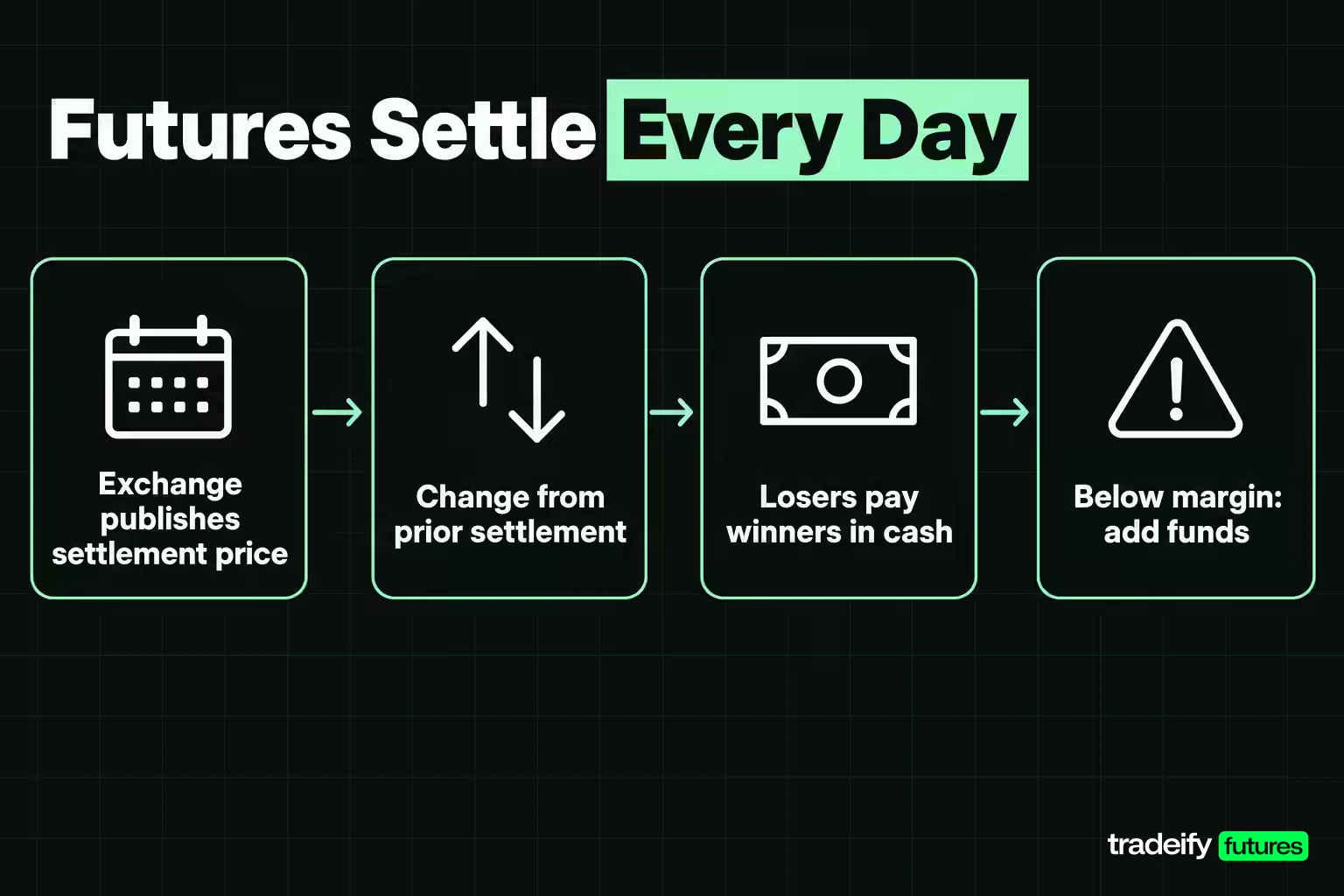
Futures settlement happens every business day, not once. The exchange publishes a daily settlement price, and the clearinghouse moves cash between every open long and short based on the change from the previous settlement price.
CME Group's education material puts it bluntly: in futures, losers pay winners every day, losses are not carried forward, and the final daily settlement price is the same for everyone. If a loss pulls account equity below the required margin, the trader has to add funds or risk having the position liquidated.
The settlement price is a calculated number, not simply the last trade. For Micro E-mini equity index futures, CME's FAQ says the daily settlement price is the 30-second volume-weighted average price of the E-mini counterpart between 3:59:30 PM and 4:00:00 PM ET. CME Clearing then runs settlement cycles at least twice a day for exchange-traded derivatives, once intraday and once at end of day, and can add extra intraday cycles in volatile markets. CME says those settlement variation payments are final, irrevocable and unconditional once the funds move.
A worked MES daily settlement ledger
The daily settlement ledger below follows an illustrative long position of 4 Micro E-mini S&P 500 (MES) contracts through three daily settlements. MES is worth $5 per index point, so four contracts move $20 per point. The settlement prices are constructed round numbers, not market data.
| Settlement day | Settlement price | Change in points | Variation on 4 MES |
|---|---|---|---|
| Start | 7,000.00 | None | None |
| Day 1 | 7,012.50 | +12.50 | +$250.00 |
| Day 2 | 7,004.25 | -8.25 | -$165.00 |
| Day 3 | 7,020.00 | +15.75 | +$315.00 |
Over three days the position gained 20.00 points, or $400.00, and nothing was ever closed. But $730.00 of variation moved through the account to get there, and on day two $165.00 left the account even though the trade was on its way to a profit. A trader who was right over three days could still have been short of cash on day two.
Two practical points follow. First, the equity that counts for margin is the post-settlement number, not the unrealized number on the chart. Second, a position that looks fine at the last trade can still be marked at a worse settlement price, because the settlement window and the last trade are different prices. The temptation is to judge a futures trade only by where it ends; daily settlement makes you pay for the path as well.
Related lesson: Mark-to-market in futures
Clearing and Settlement Risks
Clearing and settlement reduce risk, but they do not remove it. Four risks show up at different stages of the process.
- Counterparty risk is the chance the other side fails to perform. Novation moves it from the original counterparty to the clearinghouse, which then manages it with margin and the default waterfall.
- Liquidity risk is the chance someone has the money eventually but not on the settlement date. Daily futures variation and sudden margin increases are where traders meet it most often.
- Operational risk covers mismatched trade details, missed affirmations, system outages and wrong instructions. Shorter settlement cycles leave less time to fix these.
- Settlement risk is the chance that delivery or payment does not happen on the scheduled date.
Settlement fails
A settlement fail is a delivery that did not happen on time, not a cancelled trade. The Chicago Fed separates two kinds. A short fail is when the seller does not have the securities or does not deliver them properly. A long fail is when the buyer does not have enough funds. Clearinghouses have procedures and financial resources to cover both temporarily, and the obligation carries forward rather than disappearing.
Fails are not rare, but the move to T+1 did not make them worse. The T+1 After Action Report published by SIFMA, ICI and DTCC in September 2024 found an average CNS fail rate of 2.12% for July 2024 and a DTC non-CNS fail rate of 3.31%, both consistent with T+2 averages. Nearly 95% of transactions were meeting the affirmation cutoff of 9:00 PM ET on trade date, up from 73% at the end of January 2024.
For an individual account, a fail usually looks like shares or cash arriving later than expected. The trade still stands. The risk is in what you planned to do with that cash in the meantime, so a trade that depends on sale proceeds landing on time deserves a backup plan.
Related lesson: Trading halts and circuit breakers
Clearing Under Financial Stress
Clearing behaves very differently in a crisis, because the clearinghouse raises margin exactly when markets are most volatile. The clearest recent US example is January 2021, when meme-stock volatility hit the clearing system.
According to the SEC staff report on those events, NSCC made intraday margin calls on January 27, 2021 from 36 clearing members totaling $6.9 billion, bringing total required margin across members to $25.5 billion. Of that $6.9 billion, $2.1 billion was intraday mark-to-market and $4.8 billion was a special charge called the excess capital premium (ECP), which applies when a member's margin exposure exceeds its excess net capital.
On January 28, 2021 NSCC used its rules-based discretion to waive the ECP for all members. The SEC staff wrote that without the waiver, one retail broker-dealer would have faced an extra ECP charge of more than double its $1.4 billion margin requirement that day. The waiver was removed on February 2, 2021. The report also notes that the combination of volatility and settlement risk led some firms to temporarily restrict trading.
That episode is the reason the distinction between clearing and settlement stops being academic in a stress event. The trades had already cleared. The problem was the margin needed to cover the days until they settled. When the SEC adopted T+1, its chair said the rule addressed one of four staff recommendations that followed the meme-stock events. The After Action Report later found the NSCC Clearing Fund was $2.4 billion (20%) lower in the first month of T+1, falling from $12.2 billion to $9.8 billion. A shorter settlement window means less time for prices to move against an unsettled trade, and therefore less margin to hold against it.
Related lesson: Margin calls and liquidation
Customer Money Protection While Trades Settle
Customer money protection during settlement depends on whether you trade securities or futures, because two different regimes apply.
For futures, the CFTC requires futures commission merchants to keep customer funds segregated from the firm's own money. Segregated accounts must be titled for customers, and banks and clearinghouses cannot offset them against the FCM's debts. If an FCM becomes insolvent, segregated customer funds have a bankruptcy preference, but if those funds fall short, the rest of what customers are owed shares pro rata with the firm's unsecured creditors.
For securities, the Securities Investor Protection Corporation (SIPC) protects cash and securities held at a failed member brokerage up to $500,000, including a $250,000 limit for cash. SIPC does not protect against a fall in market value. It also states that it does not protect commodity futures contracts, unless they are held in a special portfolio margining account, and that cash held in connection with a commodities trade is not protected.
The practical question to ask any firm is which regime covers the specific account you fund. "Is my money protected?" has a different answer for a stock account and a futures account.
Blockchain and DLT Settlement Projects
Blockchain and other distributed ledger technology (DLT) are being tested as a way to settle trades faster by recording ownership and payment on a shared ledger. The appeal is atomic settlement, where the asset and the cash move in the same step with no reconciliation between separate systems.
The most concrete US example is DTCC's Project Ion. In August 2022 DTCC announced that the platform, built on R3's Corda, was running in a parallel production setup and processing over 100,000 bilateral equity transactions per day, with almost 160,000 on peak days. DTC's existing settlement systems remained the authoritative record throughout.
The industry is cautious about going all the way to same-day settlement. The T+1 After Action Report argued that moving to T+0 is not simply the next step and would need a comprehensive independent review, because it could introduce significant risks and complexity. Faster settlement removes the time to net trades, fix errors and arrange cash, which is part of what makes the current system work.
Settlement Checks for Active Traders
Settlement rules turn into a short checklist for anyone who trades actively. None of it needs you to know your clearing member's name; it needs you to know which clock each position runs on.
- Know which clock you are on. Stocks, ETFs and options settle T+1. Futures settle in cash every business day.
- Treat initiated cash as not yet there. FINRA says starting an ACH transfer does not meet a payment requirement; the funds have to be deposited in the brokerage firm's bank account by settlement date.
- Watch the settlement window, not just the last trade. For Micro E-mini futures the daily settlement price comes from 3:59:30 PM to 4:00:00 PM ET, and that number decides the day's variation.
- Keep a cash buffer above the worst day, not the average day. Daily variation can take money out of an account that is profitable over the week.
- Expect margin to rise when volatility does. Clearinghouses raise requirements in stress, and brokers can pass those increases on to customers.
On our accounts at Tradeify, evaluations and funded accounts are simulated, and every position has to be closed by 4:45 PM ET, with no overnight, weekend or swing holds. Our drawdown is measured on end-of-day balance but enforced in real time on net liquidation value, so the live number in your account is the one that counts during the session.
Related lesson: Initial vs. maintenance margin
Clearing and Settlement FAQ
What are the steps in the clearing and settlement process?
The trade is captured and matched, the clearinghouse novates it and becomes the counterparty to both sides, and obligations are netted. Settlement then delivers the securities against payment on the settlement date, which is T+1 for most US securities. Futures replace the single settlement date with daily mark-to-market cash payments.
What is a clearing firm in finance?
A clearing firm is the broker-dealer or futures commission merchant that faces the clearinghouse on behalf of its customers. It confirms trades, posts margin to the clearinghouse and settles with it for all of its clients combined. The SEC's staff describes the clearing broker as the firm that affirms a trade's details and then settles it.
What is the $3,000 bank rule?
The $3,000 rule is a Bank Secrecy Act recordkeeping rule, not a clearing rule. Financial institutions must keep records on funds transfers of $3,000 or more, including the sender's name, address, amount and date. That information also has to travel with the transfer to the next institution.
Is JP Morgan a clearing house?
No, JPMorgan is a bank, not a central clearing house like NSCC or CME Clearing. Its broker-dealer, J.P. Morgan Securities LLC, is a registered futures commission merchant that clears trades for its clients. In that role it is a clearing firm that deals with clearinghouses, not the clearinghouse itself.
Which comes first, clearing or settlement?
Clearing always comes first. A trade has to be matched, guaranteed and netted before anyone can know what to deliver. Settlement is the final step that moves the cash and the asset.
Trading futures and other leveraged products carries a high risk of loss, and daily settlement can take money out of an account faster than a trader expects. The worked examples here use constructed prices for illustration, not market data or a forecast. Results on simulated, evaluation and funded accounts are simulated and may differ from live trading. Nothing in this guide is investment, legal or tax advice; confirm the settlement cycle and protections for your specific account with your broker.


