



TL;DR: Futures rollover means closing a position in the expiring contract month and opening the same position in a later month. The real decision is timing, and the deadline is set by the product, not by a blog's rule of thumb. Index futures roll on a published Monday, while crude oil, gold and corn force earlier exits around their notice dates. Execute it as one calendar spread when you can, count two sides of commission, and recheck your chart levels afterward.
A futures rollover looks like admin until the day you get it wrong. A position you meant to hold is sitting in a contract that stops trading in three days, the volume has quietly moved elsewhere, and the chart you have been reading for a week is showing a different contract from the one in your account.
Every futures contract has an end date. Futures rollover is how a trader keeps the same market exposure past that date without letting the contract expire on them. This guide covers what a rollover actually does, the dates that decide when you have to act, how to read the volume shift, the three ways to execute a roll, and what it does to your charts.
Related lesson: How futures contracts are built and why they expire
What Futures Rollover Means
Futures rollover is the act of closing a position in a contract month that is about to expire and opening the same position in a later contract month. The CFTC glossary describes it as lifting a near futures position and re-establishing it in a more deferred delivery month.
CME Group's own example is simple. A trader long four September E-mini S&P 500 contracts sells those four September contracts and buys four December contracts. The trader is still long four contracts on the same index. Only the expiration date changed.
Before any futures contract expires, the holder has three choices, as CME Group lays them out:
- Offset the position with an equal and opposite trade in the same month and walk away with the profit or loss.
- Roll the position into a later month, which is an offset in the old month plus a new trade in the new month.
- Go to settlement, which means cash settlement or physical delivery depending on the contract.
So a rollover is two trades that the trader treats as one decision. That framing matters. A roll should change which contract you hold and when it expires, nothing else. If you add size, move your stop or flip direction during the roll, you placed a new trade and called it a rollover.
So why roll at all? Because the reason you entered the trade usually has nothing to do with the contract's calendar. A trader who wants six months of exposure to the S&P 500 cannot get it from a contract that expires in six weeks, so the position has to move forward at least once. A "rollover contract," in the loose way the phrase gets searched, is simply the next contract month that the position moves into.
Futures Rollover Terms and Definitions
Futures rollover vocabulary is small, but several words sound alike and mean very different things for your deadline. These are the terms that decide when and how a roll happens.
| Term | What it means | Why it matters for a roll |
|---|---|---|
| Contract month | The month a futures contract matures and can be settled | Every roll moves you from one contract month to a later one |
| Front month | The nearest traded contract month, also called the nearby or lead month | Usually where volume and tight spreads sit until the roll |
| Back month | Any contract month further out than the front month | The destination of the roll |
| Open interest | Contracts still open in a month, not yet offset or delivered | Shows where positions are actually being held |
| Offset | Closing a position with an equal and opposite trade in the same month | The first leg of every roll |
| Calendar spread | Buying one contract month and selling another of the same contract at the same time | Lets you roll in one order at one price |
| First notice day | The first day delivery notices can be issued against open positions | The practical deadline on many physically delivered contracts |
| Last trading day | The final session the contract month trades | The hard stop for any contract |
| Roll date | CME's published Monday when equity index trading customarily moves to the next quarter | A convention for index futures, not a deadline |
| Contango | Later contract months priced above the nearer month | The new month costs more in price terms, not in fees |
| Backwardation | Later contract months priced below the nearer month | The new month trades at a lower price than the old one |
First Notice Day vs Last Trading Day in a Futures Rollover
Two of these terms deserve extra attention in any futures rollover. First notice day and last trading day are not in the same order on every product. On crude oil, trading ends before delivery notices start. On gold and corn, notices start weeks before trading ends. The product's specification decides which one you plan around.
Related lesson: First notice day and last trading day in detail
Futures Contract Lifecycle From Listing to Expiration
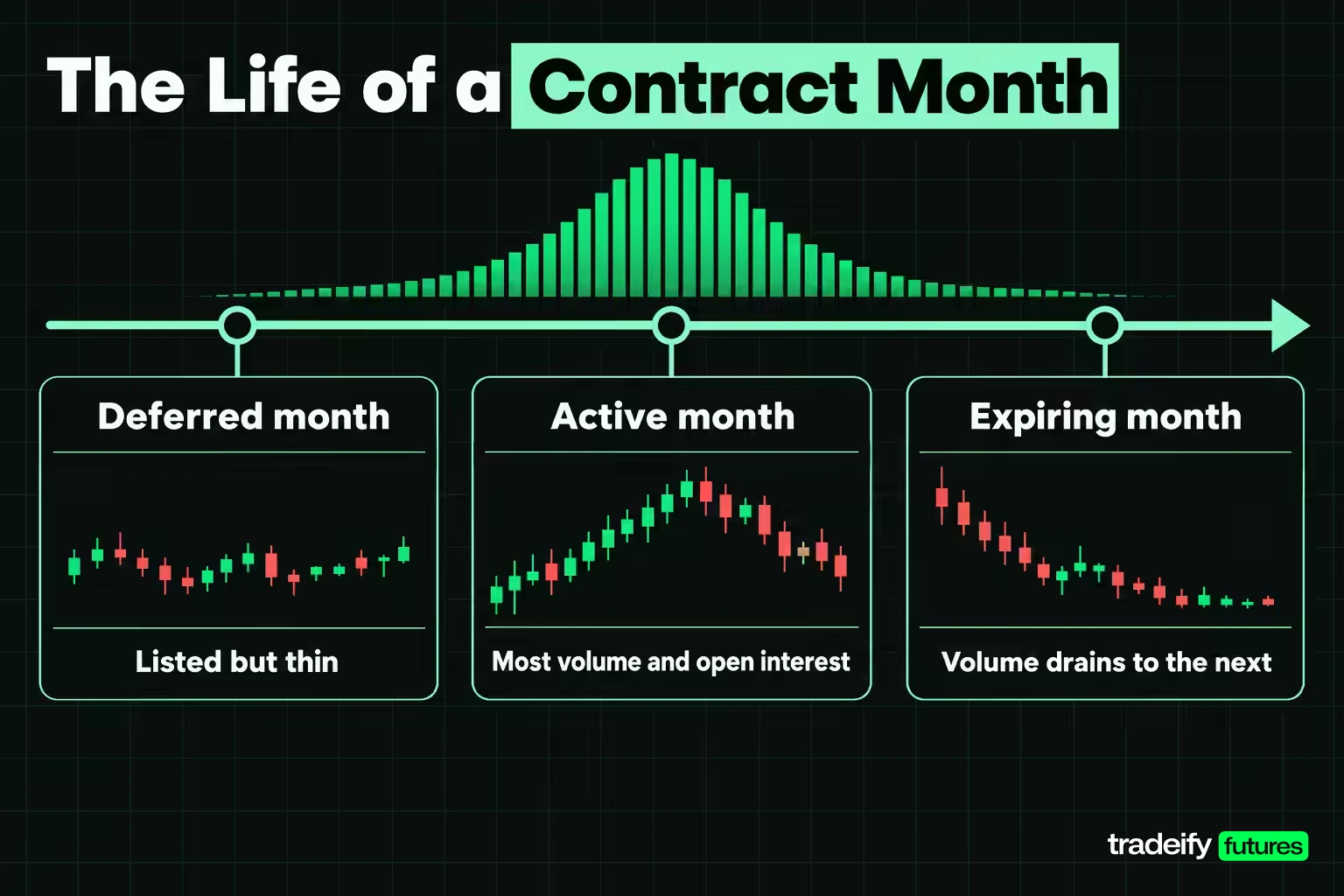
A futures contract is listed years before most traders touch it, becomes the active month for a short window, and then expires on a date written into its specification. Following one real contract makes the lifecycle concrete.
Take the December 2026 E-mini S&P 500, symbol ESZ26 (ESZ6 on many platforms). CME's product calendar shows it first traded on September 17, 2021. For most of those five years it was a deferred month with little activity. It became the front month after the September 2026 contract expired, and its last trading day is December 18, 2026, the third Friday of December.
That one example also answers a common question about how long you can hold a futures contract. You can hold it from the day it lists until its last trading day, and not one session longer. After that the contract is settled and the position ends whether you wanted it to or not.
The lifecycle has three practical phases for an active trader:
- Deferred month. Listed and tradable, but thin. Prices can be quoted with wide gaps between bid and ask.
- Active month. Most volume and open interest sit here. This is the contract most charts and most day traders use.
- Expiring month. Volume drains to the next month, spreads widen, and the settlement mechanics start to matter.
A futures rollover is the move from phase three of one contract to phase two of the next.
Daily Settlement While You Hold a Futures Contract
A futures contract is marked to market every session while you hold it. CME sets one final daily settlement price that applies to everyone, and gains and losses move between accounts each day, so no loss is carried forward unpaid.
This is why a roll does not "lock in" anything new. By the time you offset the old month, your account has already been credited or debited every day you held it. The offset simply finishes that position at its final price, and the new month starts its own daily settlement from the price you paid for it.
Related lesson: How daily settlement works on an open futures position
Cash Settlement vs Physical Delivery and Why It Changes the Roll
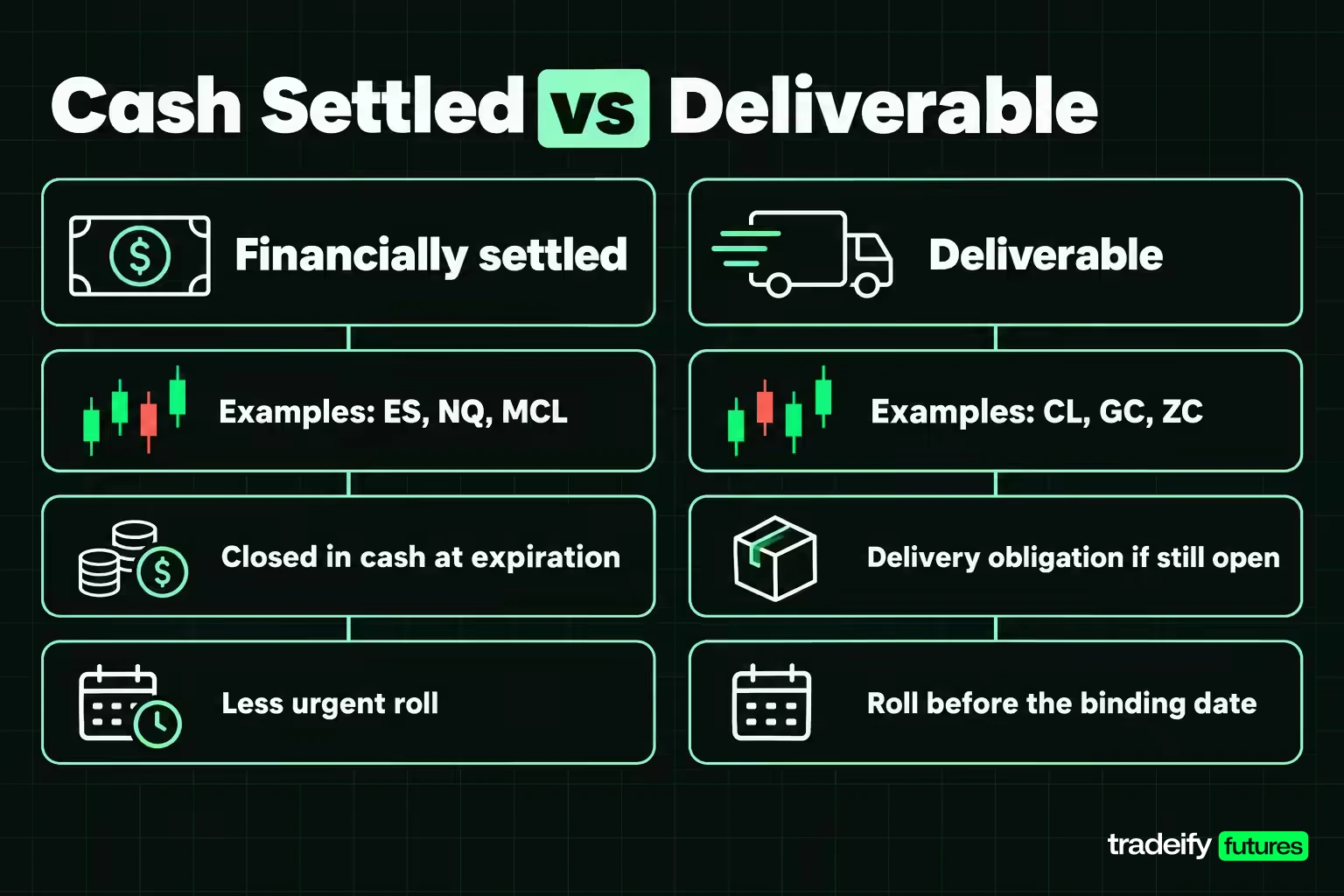
How a contract settles decides how urgent the roll is. A financially settled contract ends with a cash adjustment. A deliverable contract can end with an obligation to make or take delivery of the underlying commodity.
The E-mini S&P 500 is financially settled. Under CME Rule 35803.A its final settlement price is a special opening quotation of the S&P 500 on the third Friday of the contract month. If you hold ES into expiration, the position is closed at that price and the profit or loss is booked in cash. Nobody delivers a basket of 500 stocks.
Crude oil (CL) is deliverable. A long December 2026 contract still open after trading ends is tied to delivery of 1,000 barrels in Cushing, Oklahoma during December. Gold (GC, 100 troy ounces) and corn (ZC, 5,000 bushels) are deliverable too.
Some smaller contracts change the answer. Micro WTI Crude Oil (MCL, 100 barrels) is financially settled even though full-size CL is deliverable, and it stops trading one business day before the matching CL contract.
| Contract | Settlement method | What happens if still open at expiration |
|---|---|---|
| ES and NQ equity index | Financially settled | Closed in cash at the final settlement price |
| MCL Micro WTI crude | Financially settled | Closed in cash, one business day before CL |
| CL crude oil | Deliverable | Delivery obligation for 1,000 barrels |
| GC gold | Deliverable | Delivery obligation for 100 troy ounces |
| ZC corn | Deliverable | Delivery obligation for 5,000 bushels |
The rule that follows is simple. On a cash-settled contract you can roll late and the worst case is a cash settlement you did not plan. On a deliverable contract, a speculator rolls or offsets before the delivery window opens, because delivery is an outcome a day trader or swing trader is not equipped to handle.
Related lesson: Cash settlement and physical delivery compared
What Happens If You Don't Roll a Futures Position
If you neither roll nor offset a futures position before expiration, the contract goes to settlement. What that means depends on the product, and none of the outcomes is a trader quietly keeping the position.
On a financially settled contract such as ES or NQ, the position is closed at the final settlement price. That price is set at the open on expiration morning, so a position held into it takes whatever gap the opening print delivers.
On a deliverable contract the risk is larger. A long position open into the delivery period can be assigned a delivery notice, and a short can be required to deliver. Your broker's expiration policy decides how close to that window it lets a speculative position get, and the time to read that policy is before the notice period, not during it.
There is also a quieter cost of not rolling: liquidity. An expiring month empties out. On the November 3, 2026 session, the November 2026 gold contract traded 17 contracts while December 2026 gold traded 163,000. A November position was technically open in a market that had already left it, and any exit had to cross a thin book.
Offsetting Instead of Rolling
A futures rollover is only right when you still want the exposure. If the trade has done its job, or the reason for holding it no longer applies, offsetting is the cleaner choice.
Offsetting means one trade, not two. You sell the contracts you are long, or buy back the ones you are short, in the same contract month. The position is gone, the profit or loss is final, and you are free to decide later whether the next contract month offers a trade on its own merits. A roll should be a deliberate choice to keep the same position, never a reflex that keeps a stale trade alive.
When to Roll Futures by Market
The right time to roll futures depends on the contract, because each product writes its own deadline. Equity index futures have a published customary roll date. Physically delivered commodities have notice dates that arrive earlier than many traders expect.
For CME equity index futures, the roll date is the Monday before the third Friday of the expiration month. After that date, CME says it is customary to treat the next quarterly month as the lead month, and the roll date decides which contract month is listed for trading in the CME Globex session. CME also states plainly that participants may roll at any time they choose. It is a convention, not a deadline. Nikkei 225 and TOPIX futures are the documented exception and typically roll on the Monday before the second Friday.
Equity index futures (ES, NQ, YM, RTY and their micros) expire quarterly in March, June, September and December, so their roll comes four times a year. Crude oil lists every month and rolls monthly. Gold lists many months but trades heavily in only a few.
December 2026 Futures Roll Dates by Contract
The binding futures rollover dates for the December 2026 contracts, from CME's product calendars read on November 4, 2026, are listed in this table.
| Contract month | Settlement | First notice day | Last trading day | Practical roll deadline |
|---|---|---|---|---|
| ESZ26 E-mini S&P 500 | Cash | None | December 18, 2026 | Roll date December 14, 2026 |
| NQZ26 E-mini Nasdaq-100 | Cash | None | December 18, 2026 | Roll date December 14, 2026 |
| CLZ26 crude oil | Delivery | November 24, 2026 | November 20, 2026 | Before November 20, 2026 |
| GCZ26 gold | Delivery | November 30, 2026 | December 29, 2026 | Before November 30, 2026 |
| ZCZ26 corn | Delivery | November 30, 2026 | December 14, 2026 | Before November 30, 2026 |
| BTCZ26 Bitcoin | Cash | None | December 24, 2026 | Before December 24, 2026 |
Read the table by the column that binds you. On December crude, the last trading day of November 20, 2026 comes four days before the first notice day, so the exit has to happen before trading stops. On December gold and corn, the first notice day of November 30, 2026 comes two to four weeks before trading ends, so the real deadline is the notice date, not the last trading day. Counting from November 4, 2026, that is 16 days for crude and 26 days for gold and corn, against 40 days to the equity index roll date.
Related lesson: The full calendar of expiration dates by product
Why Crude Oil Rolls Earlier Than Its Contract Month
Crude oil confuses traders because the contract named for a month stops trading in the month before. CL trading ends three business days before the 25th calendar day of the month prior to the contract month. December 2026 crude therefore stops trading on November 20, 2026, and the delivery itself runs from December 1 to December 31, 2026.
A trader who reads "December contract" and assumes it is good through December will be out of the contract a month early. Check the termination rule on the specification, not the month in the name.
Reading Volume and Open Interest to Time a Futures Rollover
The cleanest signal that a futures rollover is under way is volume moving from the old month to the new one. CME's own course on contract rolls says traders decide when to switch by watching volume in both the expiring and the next contract month.
A simple measure is the next month's share of the two months' combined volume. Below 50% the old month still does most of the trading. Above 50% the market has moved.
Here is that measure on CME settlement data for the November 3, 2026 session.
| Product (old month to new month) | Old month volume | New month volume | New month share | Status on November 3, 2026 |
|---|---|---|---|---|
| ES Dec 26 to Mar 27 | 1,579,232 | 5,104 | 0.3% | Roll not started |
| NQ Dec 26 to Mar 27 | 643,657 | 1,571 | 0.2% | Roll not started |
| CL Dec 26 to Jan 27 | 376,081 | 201,939 | 34.9% | Roll under way |
| ZC Dec 26 to Mar 27 | 186,854 | 111,337 | 37.3% | Roll under way |
| GC Dec 26 to Feb 27 | 163,000 | 20,570 | 11.2% | Early, notice day ahead |
Crude shows a roll in motion. January's share of the two crude months rose from 29.8% on October 30 to 33.9% on November 2 and 34.9% on November 3, 2026. December open interest fell 25,539 contracts over the same sessions, from 261,778 to 236,239, as positions closed or moved forward. The index contracts, more than five weeks from expiration, show essentially no roll yet.
Open interest tells you where positions are being held, which is slower than volume but harder to fake with a day of spread trading. When both volume and open interest favour the new month, the roll is complete in practice.
What the September 2026 Equity Index Roll Looked Like
The September 2026 equity roll shows how fast the switch happens once it starts. A previous version of this guide measured it from hourly bars on the September and December 2026 E-mini S&P 500 and E-mini Nasdaq-100 contracts, grouped into CME trading sessions of 6:00 PM to 5:00 PM ET, for the sessions of September 9 to 16, 2026.
The December contract's share of E-mini S&P 500 volume was 3.4% on September 9 and 9.2% on Thursday, September 10. On Monday, September 14, CME's published roll date, it was 51.6%, and by September 16 it was 79.7%. The E-mini Nasdaq-100 followed the same path, from 3.6% on September 10 to 51.6% on September 14.
The exact percentages matter less than where the crossover landed. It came on CME's customary roll date, not on the "Thursday eight days before expiration" that some guides repeat, a session when the new month held under a tenth of the volume. A rule of thumb is worth checking against the data before you trade on it.
Related lesson: How to tell which contract month the market is using
Futures Rollover Strategies Compared
A futures rollover strategy comes down to two choices, when you roll and how you send the orders. Each one trades one risk for another, so pick the one whose downside you can live with.
Choosing When to Roll
There are three common timing approaches.
- Calendar rule. Roll on a fixed date, such as CME's equity index roll date or a set number of days before the first notice day. It is easy to plan, but it ignores what volume is actually doing.
- Volume crossover. Roll in the session the next month's volume passes the old month's. It follows the market, but it requires you to check the data every session in roll week.
- Deadline-first. Find the binding date (first notice day or last trading day, whichever comes first for a deliverable contract) and roll comfortably before it, ideally after the volume crossover. This is the safest default for commodities.
Choosing How to Execute the Roll
| Execution method | How it works | Main risk | Best fit |
|---|---|---|---|
| Two separate orders | Close the old month, then open the new month | The price gap between months can move between fills | Small positions in liquid products |
| One calendar spread order | Buy one month and sell the other in a single order at one spread price | The spread order may not fill if your price is too tight | Most rolls, especially larger positions |
| Rolling in tranches | Move part of the position each session over several sessions | More orders and more commission | Size large enough to move the spread |
A calendar spread order is the textbook roll because both legs fill together. On ES, the calendar spread trades in increments of 0.05 index points, worth $2.50 per contract, far finer than the 0.25-point tick on an outright ES order.
Roll Week Volatility and Spread Risk
Roll week can be choppy for an expiring month as volume drains away. The bigger risk for a trader rolling with two separate orders is that the price difference between the two months moves while they are flat.
In a measurement of the September 2026 E-mini S&P 500 roll (hourly bars on both contracts, CME sessions of September 10 to 16, 2026), the ES September to December spread moved between 1.25 and 2.50 points inside a single session, or $62.50 to $125.00 per contract. That was measured from hourly closes, so the true intraday range was at least that wide. It is small per contract and real at size, which is why a calendar spread order exists.
How to Roll a Futures Position Step by Step
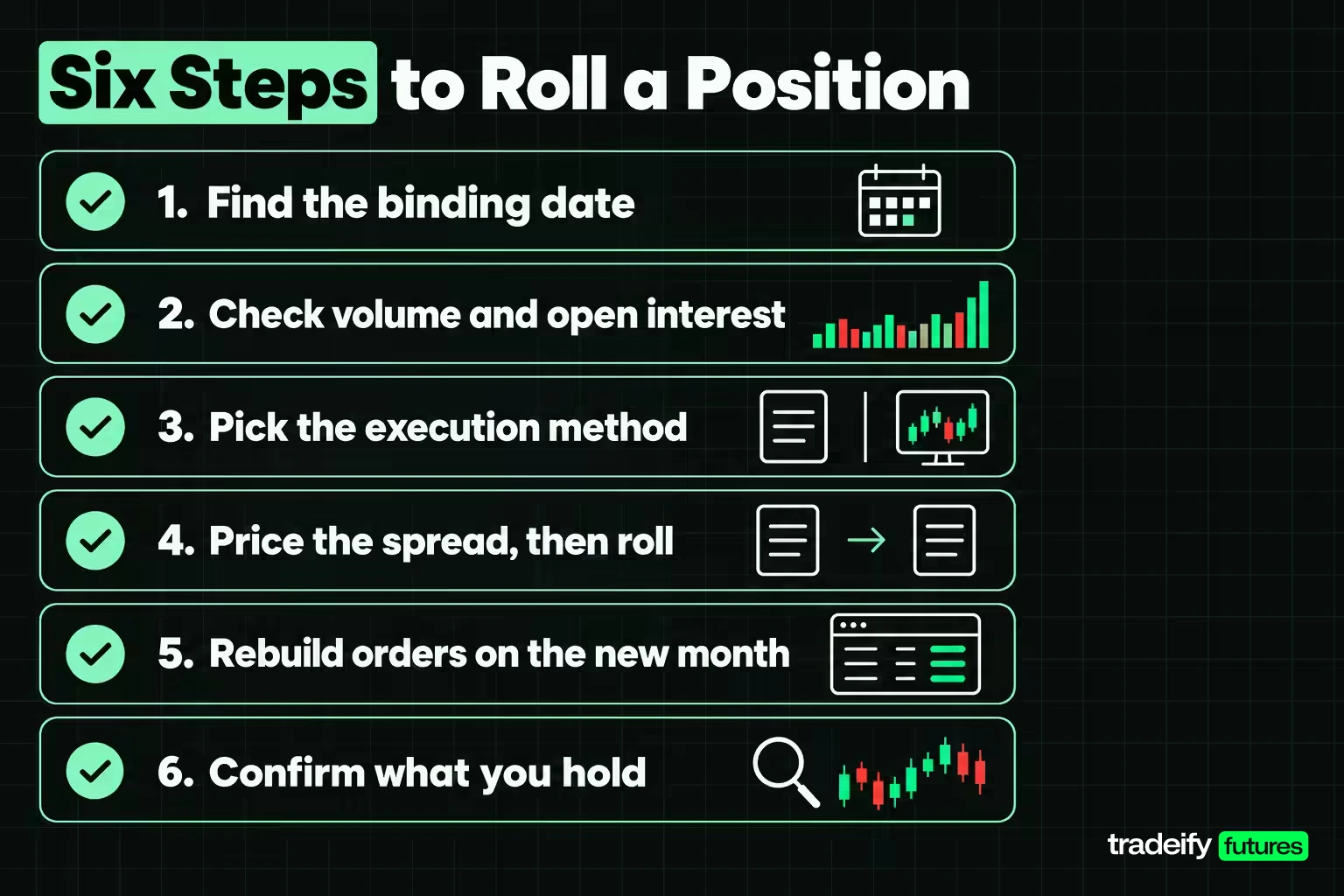
A futures rollover is a short checklist. Work through it in order and the roll becomes arithmetic instead of a scramble on the last day.
- Find the binding date. Look up the contract's specification and CME calendar for first notice day and last trading day. Use whichever comes first on a deliverable contract.
- Check volume and open interest in both months. If the next month is still thin, rolling early means a worse fill. If it already carries most of the volume, you are late.
- Pick the execution method. One calendar spread order for most rolls, two orders only when the position is small and the market is liquid.
- Price the spread, then place the roll. Use a limit price on the spread, not a market order, so you control what you pay.
- Rebuild your orders on the new month. Stops and targets attached to the old contract do not move by themselves. Recalculate them on the new contract's price.
- Confirm what you hold. Check that the old month shows zero and the new month shows the same size and direction you had.
A Worked Futures Rollover on the E-mini S&P 500
Here is a 2-contract ES roll using the November 3, 2026 settlement prices as a reference. The December 2026 contract settled at 7,596.75 and the March 2027 contract at 7,670.00.
- The trader is long 2 ESZ26 and wants to keep the exposure into March.
- The roll is one calendar spread order: sell 2 December, buy 2 March.
- The spread is 73.25 points, worth $3,662.50 per contract at $50 per point.
- With an illustrative commission of $2.50 per side, the roll costs $10.00 (2 contracts times 2 sides).
- Direction and size are unchanged: still long 2 ES.
The 73.25-point difference is a price, not a fee. March trades above December because the futures price carries financing costs and the dividends a futures holder does not receive. CME describes this as the cost of carry behind equity index basis. Paying a higher price for March is not a loss on the roll. The March contract will converge toward the index as its own expiration approaches, just as December does.
The real cost of rolling is the commission on two sides, plus whatever you give up crossing the bid and ask on each leg. Send it as two separate orders instead and a 2.00-point drift in the spread between fills would cost $200.00 on two contracts (illustrative). Over a full year, a quarterly contract held throughout needs four rolls, or 8 sides of commission per contract, just to keep the same position.
That answers the common question about the rollover cost of a futures contract. The cost is execution, not the gap between the two months' prices.
Manual Rolls vs Automatic Rolls
Many platforms advertise "automatic rollover," and it usually means less than traders assume. On most charting software, an automatic roll switches the symbol your chart and order ticket point to. It does not move an open position.
A manual roll is the trade itself: you close one month and open the next, ideally as one calendar spread. Some brokers and platforms offer roll tools that build that spread order for you, but it is still a trade you approve, with commission on both legs.
If you hold a position overnight across the roll, check both things separately. Is the chart on the new month? Is the position on the new month? They can disagree for days.
Related lesson: How a calendar spread is priced and quoted
How Rolling Contracts Changes Futures Charts
Rolling contracts changes futures charts because each contract month trades at a different price. A continuous chart that stitches one month onto the next will show a jump at the switch that no trader actually traded.
On the November 3, 2026 session, March 2027 ES settled 73.25 points above December. When a continuous ES chart switches from December to March, that gap appears as a jump of roughly that size on the chart, even if the market did not move.
There are two ways chart vendors handle this.
- Unadjusted continuous. The chart splices raw prices from each contract. The roll gap shows up as a fake jump, which can trigger false breakouts, distort indicators and confuse support and resistance levels drawn across the switch.
- Back-adjusted continuous. Earlier contracts are shifted by the price difference at the switch so the line joins smoothly. TradingView, for example, adjusts all previous contracts by the difference between the new and old contracts' closes on the daily bar nearest the switch. It is off by default and turned on with the B-ADJ button or the "Adjust for contracts changes" setting.
Back-adjusted charts are better for studying price history and indicators. The catch is that old price levels on a back-adjusted chart are not prices that actually traded. A level you marked at a round number on the old contract will sit at a different number on the new one.
That is the practical rule after any roll: re-read your key levels on the contract you will actually trade. If your stop was 20.00 points below entry on December, keep the distance, but rebuild the price on the March contract instead of copying the December number.
Related lesson: Continuous futures charts and how they are stitched
Common Futures Rollover Mistakes
Most futures rollover mistakes come from treating the roll as a chart setting instead of a trade with a deadline. These are the errors that show up most often, with the check that prevents each.
- Trusting the month in the contract name. December crude stops trading on November 20, 2026. Read the termination rule, not the label.
- Planning around the last trading day on a deliverable contract. On December 2026 gold and corn, first notice day is November 30, 2026, weeks before trading ends. The earlier date binds.
- Assuming the next listed month is the active one. Gold lists a November 2026 contract, yet it traded 17 contracts on November 3, 2026 against 163,000 in December. Check volume before you pick the month.
- Rolling the chart and forgetting the position. A chart that switched to the new month does not move your contracts. Confirm the position in your account.
- Leaving stops on the old contract. Protective orders attached to the expiring month are not transferred. Rebuild them on the new month.
- Copying price levels across the roll. The new month trades at a different price. Recalculate stops and targets from the new contract.
- Using two market orders in a fast market. The spread can move between fills. Use a calendar spread order with a limit price.
- Rolling backward. Moving from a later month to an earlier one puts you closer to expiration, not further away.
- Turning the roll into a new trade. Adding size or changing direction during the roll mixes two decisions. Roll first, then decide separately.
Related lesson: Deciding the right moment to roll a contract
Futures Rollover for Day Traders Who Finish Flat
Futures rollover looks different for a day trader who closes every position before the session ends. With no open contracts at night, there is nothing to roll in the position sense. What does have to move is the contract you trade next session: the chart, the order ticket and any saved templates.
That makes the roll a matter of picking the right symbol on the right day. When the market has moved to the new month, a day trader still clicking on the old one is trading in a thinning book with wider spreads. The same two signals still decide the switch: the session the next month's volume passes the old month's, and the contract's first notice day or last trading day. For a flat day trader they tell you when to change your symbol rather than when to move a position.
Symbol formats differ by platform, which is a frequent source of errors. CME month codes run F for January through Z for December, so the March 2027 E-mini S&P 500 is ESH27 in CME's own listing, ESH7 on platforms that use one year digit, and ESH2027 on platforms that use the full year.
On our accounts, every position must be closed by 4:45 PM ET and nothing is held overnight, so a roll for you only means switching which contract month you trade the next session. Our Help Center recommends trading the front month, avoiding contracts within one to two weeks of expiration, and always rolling forward, never backward. On Tradovate you can roll a chart or SuperDOM forward from the gear (View Settings), and Tradovate, Rithmic, WealthCharts and NinjaTrader use the one-digit year format (ESH7) while TradingView and Tradesea use the full year (ESH2027).
Futures Rollover Questions Traders Ask
What is the 80% rule in futures trading?
The 80% rule is a heuristic from Market Profile, the charting method Peter Steidlmayer developed in the 1980s, and it has nothing to do with futures rollover. It says that if price opens outside the prior session's value area, then re-enters it and holds for two consecutive 30-minute periods, there is roughly an 80% chance it travels to the other side of that value area. The 80% figure is a trader rule of thumb, not a published exchange statistic.
Do Bitcoin futures expire?
Yes. CME Bitcoin futures are financially settled monthly contracts that stop trading at 4:00 PM London time on the last Friday of the contract month. The December 2026 contract's last trading day is December 24, 2026, because Friday, December 25 is not a business day. Holding one past that date means a cash settlement, so a longer position has to roll like any other futures contract.
What is the rollover cost of a futures contract?
The cost of a futures rollover is commission on two sides per contract plus the bid and ask you cross on each leg. The price difference between the two contract months is not a fee. It reflects carry and the market's pricing of each month.
How long can I hold a futures contract?
You can hold a futures contract until its last trading day, which differs by product. Equity index futures run to the third Friday of their quarterly month. December 2026 crude oil stopped short of that and ends trading on November 20, 2026. To hold exposure longer, you roll into a later month.
Can you give me an example of a futures contract?
The December 2026 E-mini S&P 500 (ESZ26) is one example. Each contract is worth $50 times the S&P 500 index, moves in 0.25-point ticks worth $12.50, settles in cash, and stops trading on December 18, 2026.
Futures trading involves substantial risk, and leveraged positions can lose more than you expect, including during roll week when spreads and liquidity shift between contract months. Contract dates, volumes and prices in this guide were read on November 4, 2026 and will change, so confirm current specifications with the exchange and your broker before acting. Results in simulated or funded evaluation accounts are simulated and do not represent live trading. This guide is education, not individual financial advice.


