




TL;DR: Global trading sessions are the Sydney, Tokyo, London and New York windows that pass liquidity around the clock on weekdays. The London and New York overlap, 8:00 AM to 12:00 PM ET, carries the most depth and the tightest spreads. Asian hours and the seam after the New York close are thinner, wider and more prone to gaps. Session times move with daylight saving, so anchor your plan to UTC. Pick the windows that suit your market, then price what the hour costs you.
Global trading sessions are the blocks of the day when the dealing desks of one financial centre are staffed and quoting. If you trade currencies, index futures or gold, the session you pick decides how deep the book is, how wide the spread runs and how likely a stop is to fill where you put it. The clock is part of your risk plan whether you write it down or not. The usual mistake is treating every hour the chart is moving as an hour worth trading.
What Global Trading Sessions Are
A global trading session is a convention, not a rule. Spot forex has no central exchange, so "the London session" means the hours when London banks and dealers are quoting prices. Nobody rings a bell. The session starts when desks fill up and ends when they go home.
That is why the currency market can run 24 hours a day on weekdays. As one centre winds down, the next one is starting. A typical broker schedule shows how long the week is: OANDA lists forex instruments as opening Sunday at 5:05 PM and closing Friday at 4:59 PM New York time, with a six minute break each day around 5:00 PM.
Availability is not the same as depth, though. The 2025 BIS Triennial Survey put global FX trading at $9.6 trillion per day in April 2025, up 28% from 2022. Sales desks in just four places, the United Kingdom, the United States, Singapore and Hong Kong, handled 75% of it. The United Kingdom alone accounted for 38%.
A market that concentrated cannot be equally deep at every hour. When London and New York are both at their desks, most of the world's FX dealers are working. At 6:00 PM New York time, most of them are not. Everything else in this guide follows from that.
Futures and stocks use a different model. Exchanges publish fixed hours, so the session is a rule you can look up. The forex session names still matter for futures traders, because the people who move currencies, bonds and index futures are the same desks working the same hours.
Related lesson: How depth and quoted size differ across hours
The Four Major Trading Sessions and Their Hours
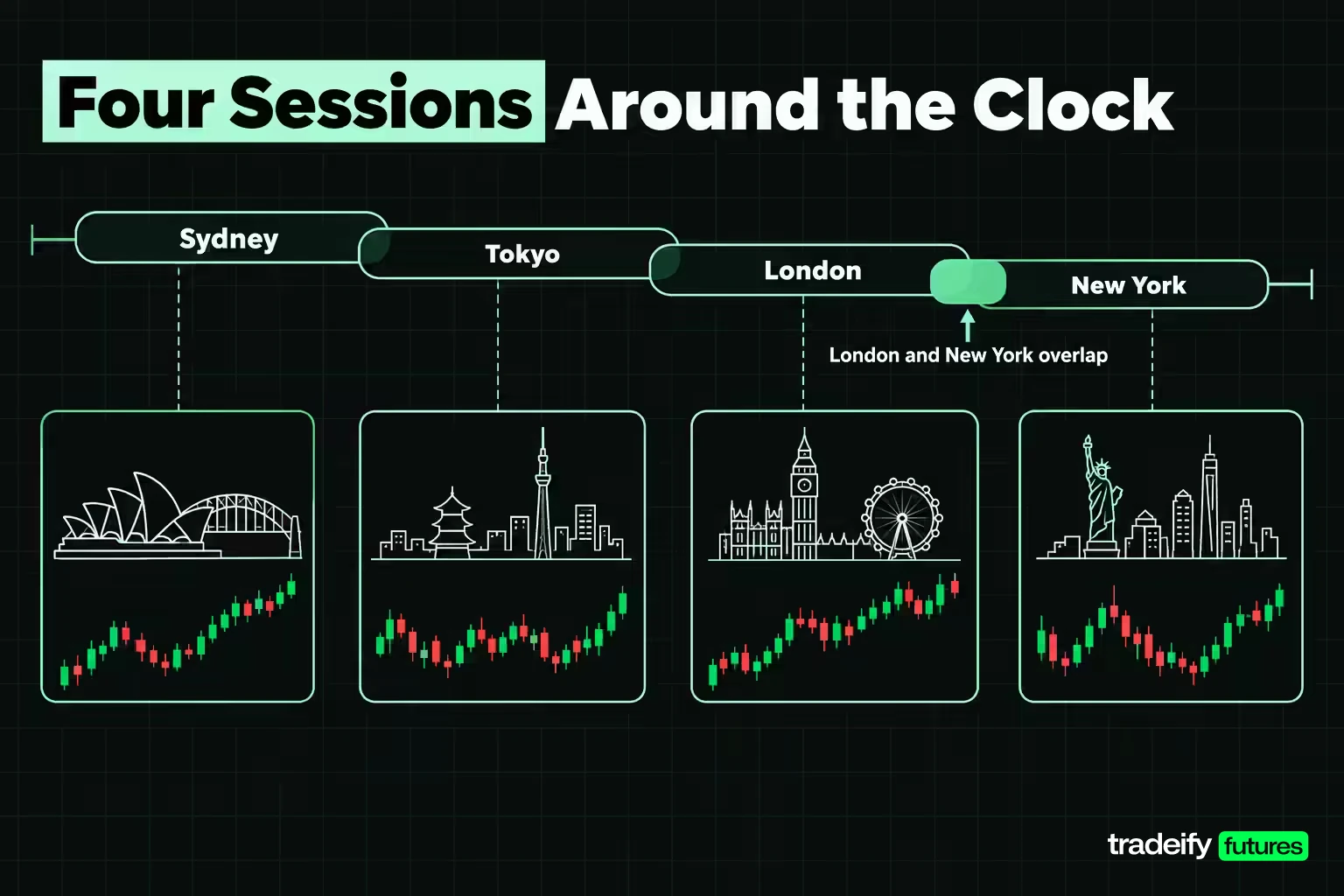
The four major trading sessions are named after the cities that dominate them: Sydney, Tokyo, London and New York. Most session tables treat each one as roughly the local working day, about 8:00 AM to 5:00 PM local time (Tokyo is usually shown as 9:00 AM to 6:00 PM). Converting those local hours to UTC and New York time gives the windows below.
| Session | UTC in northern winter | New York time in northern winter | UTC in northern summer | New York time in northern summer |
|---|---|---|---|---|
| Sydney | 21:00 to 06:00 | 4:00 PM to 1:00 AM | 22:00 to 07:00 | 6:00 PM to 3:00 AM |
| Tokyo | 00:00 to 09:00 | 7:00 PM to 4:00 AM | 00:00 to 09:00 | 8:00 PM to 5:00 AM |
| London | 08:00 to 17:00 | 3:00 AM to 12:00 PM | 07:00 to 16:00 | 3:00 AM to 12:00 PM |
| New York | 13:00 to 22:00 | 8:00 AM to 5:00 PM | 12:00 to 21:00 | 8:00 AM to 5:00 PM |
"Northern winter" here means the US and UK are on standard time and Sydney is on daylight time, which is the setup from early November to early March. "Northern summer" is the reverse, from April to early October. Sydney's seasons run opposite to London's and New York's, which is why its UTC window moves the other way.
Treat the edges as soft. Session start and end times differ by an hour or so from one source to the next, because they describe when desks are busy, not when anything opens. What stays stable is the character of each window, and that is what you trade.
The Sydney and Tokyo Sessions
The Sydney session opens the trading week and is the smallest of the four sessions on its own. The Australian and New Zealand dollars are the most active currencies in it. Because Sydney is the first centre to trade after the weekend, it is also where weekend news gets priced first, so a Monday gap shows up here before anywhere else.
The Tokyo session follows a couple of hours later and overlaps Sydney for most of its first half. Yen pairs and the yen crosses (AUD/JPY, EUR/JPY) dominate. The Tokyo Stock Exchange gives the city's rhythm away: its morning session runs 9:00 AM to 11:30 AM and its afternoon session 12:30 PM to 3:30 PM, Tokyo time, and it is closed from January 1 to January 3 and on December 31.
Asian Session Ranges and Yen Pairs
Asian hours tend to be quieter for the majors. In an illustrative study of Yahoo Finance hourly bars from August 5 to November 4, 2026, EUR/USD averaged a 7.1 pip range per hour between 7 PM and 3 AM New York time. During the London and New York overlap, the same pair averaged 14.2 pips per hour.
USD/JPY breaks the pattern. It averaged 20.4 pips per hour in that Asia block, much closer to its 27.9 pip overlap average, because Japanese exporters, importers and investors trade it in their own working day.
The practical read: a range that holds through Tokyo is often just the market waiting for London. It is tempting to treat that range as a setup in itself. Traders who chase small breaks in Asian hours on EUR/USD or GBP/USD often get chopped up. Traders who mark the Asian high and low and wait to see how London treats them have a reference to work from.
The London Session
The London session is the largest of the four global sessions. The United Kingdom handled 38% of all FX turnover in April 2025, according to the BIS, more than any other location. No other single window comes close to that share.
London is also where European economic data lands, and where European banks, funds and corporates do their currency business. In the same study of Yahoo Finance hourly bars, EUR/USD averaged 10.6 pips per hour from 3 AM to 8 AM New York time, before New York had even started. That is about 50% more than the Asia block.
How the London Session Open Trades
The first hour or two of London often decides whether the Asian range holds or breaks. A clean break of the Tokyo high or low on rising activity is information. A poke through the level that snaps straight back inside is information too, usually that the move lacked real participation.
What would change that read? A scheduled release. If euro-area or UK data prints in the first London hours, the move belongs to the data, not to the session, and the usual open behaviour does not apply.
The New York Session
The New York session runs from about 8:00 AM to 5:00 PM New York time. Its first four hours overlap London, and that is where it earns its reputation. The BIS 2025 Triennial Survey found the US dollar on one side of 89% of all FX trades, so US news moves almost everything.
The data calendar is the key. Major US releases such as the consumer price index print at 8:30 AM ET; the next CPI report, for October 2026, is due Tuesday, November 10, 2026, at 8:30 AM ET. US stocks open an hour later, with the NYSE core session running 9:30 AM to 4:00 PM ET. Index futures react to both.
The New York Afternoon
Once London closes around 12:00 PM New York time, activity fades. In the Yahoo Finance hourly-bar study, EUR/USD averaged 7.9 pips per hour from 12 PM to 5 PM ET, close to its Asian level. Index futures stay busier into the stock market close, then quieten sharply.
The late New York session hands over to the quietest stretch of the whole day. From 5 PM to 7 PM ET, EUR/USD averaged 6.0 pips per hour and AUD/USD 4.1 pips. Most desks in three of the four centres are shut, and the fourth is only just opening.
How Daylight Saving Moves Session Times
Session times move twice a year because the centres change their clocks on different dates. That is the single most common reason a trader's session map quietly goes wrong.
The 2026 and 2027 dates that matter:
- United States: daylight saving ran from March 8 to November 1, 2026, and starts again March 14, 2027.
- United Kingdom: clocks went forward 29 March 2026 and back 25 October 2026; in 2027 they go forward 28 March and back 31 October.
- Sydney (New South Wales): daylight saving started 4 October 2026 and ends 4 April 2027. Queensland, Western Australia and the Northern Territory do not change their clocks.
When the London and New York Overlap Changes Length
For most of the year, the London and New York overlap is 8:00 AM to 12:00 PM New York time, four hours. Between March 8 and March 29, 2026, and again between October 25 and November 1, 2026, the US was on daylight time while London was on GMT. London's session then ran 4:00 AM to 1:00 PM ET, so the overlap stretched to five hours, 8:00 AM to 1:00 PM ET.
If your plan says "trade the London open at 3:00 AM", it was an hour late in those weeks. The next mismatch runs from March 14 to March 28, 2027.
Converting Sessions to Your Time Zone
The simplest method is two columns. Write each session in UTC, then add a second column in your own time zone and recheck it after every clock change in the US, UK or Australia. A world-clock app or a session clock does the arithmetic for you; the habit that matters is checking it on those dates.
Session Overlaps and Why They Matter
Session overlaps are the hours when two centres are at their desks at once. There are three that traders track.
| Overlap | New York time in northern winter | UTC in northern winter | Most affected markets |
|---|---|---|---|
| Sydney and Tokyo | 7:00 PM to 1:00 AM | 00:00 to 06:00 | AUD/JPY, NZD/JPY, AUD/USD |
| Tokyo and London | 3:00 AM to 4:00 AM | 08:00 to 09:00 | EUR/JPY, GBP/JPY |
| London and New York | 8:00 AM to 12:00 PM | 13:00 to 17:00 | EUR/USD, GBP/USD, USD/JPY, index futures, gold |
The London and New York overlap is the one that matters most. The two largest FX centres are both quoting, US data lands at 8:30 AM ET, and US stocks open at 9:30 AM ET. More dealers quoting at the same moment means more size at the best prices and narrower spreads. Scheduled news inside that window adds direction.
The Tokyo and London overlap is short, one hour in northern winter and two (3:00 AM to 5:00 AM ET) in northern summer. It is when Asian flow and European flow briefly meet, which makes it relevant for yen crosses. The Sydney and Tokyo overlap mostly matters for the Australian and New Zealand dollars against the yen.
Related lesson: Why the spread widens when desks go home
Forex and Futures Liquidity by Session
Liquidity follows the working day of a handful of cities. The BIS figures explain why: when 75% of FX trading runs through four locations, depth rises and falls with their office hours.
Index futures make the pattern easy to see because they publish volume. In an illustrative study of Yahoo Finance hourly bars, the front ES contract averaged about 9,858 contracts per hour between 7 PM and 3 AM New York time. From 3 AM to 8 AM, with London trading, it averaged 19,658. During the London and New York overlap it averaged 157,038 contracts per hour, about 16 times the Asian hours. The New York afternoon stayed heavy at 131,483, because US stocks were still trading.
| Window (New York time) | ES average contracts per hour | ES average hourly range in points |
|---|---|---|
| Asia, 7 PM to 3 AM | 9,858 | 9.6 |
| London before New York, 3 AM to 8 AM | 19,658 | 12.4 |
| London and New York overlap, 8 AM to 12 PM | 157,038 | 23.4 |
| New York afternoon, 12 PM to 5 PM | 131,483 | 17.0 |
The study method: Yahoo Finance one-hour bars for ES from August 5 to November 4, 2026 (13 weeks), weekdays only, bucketed by New York clock hour and averaged. It is a short sample from one quarter, so read it as an illustration of the shape of the day, not a forecast.
24-Hour Access Is Not 24-Hour Depth
A market can accept your order at 2:00 AM and still be thin enough that your fill lands several ticks from the price you clicked. The hours that exist and the hours worth using are two different lists. Liquidity is also self-reinforcing: traders who need size come to the busy hours because others are already there, which leaves the quiet hours quieter.
Volatility and Spreads by Session
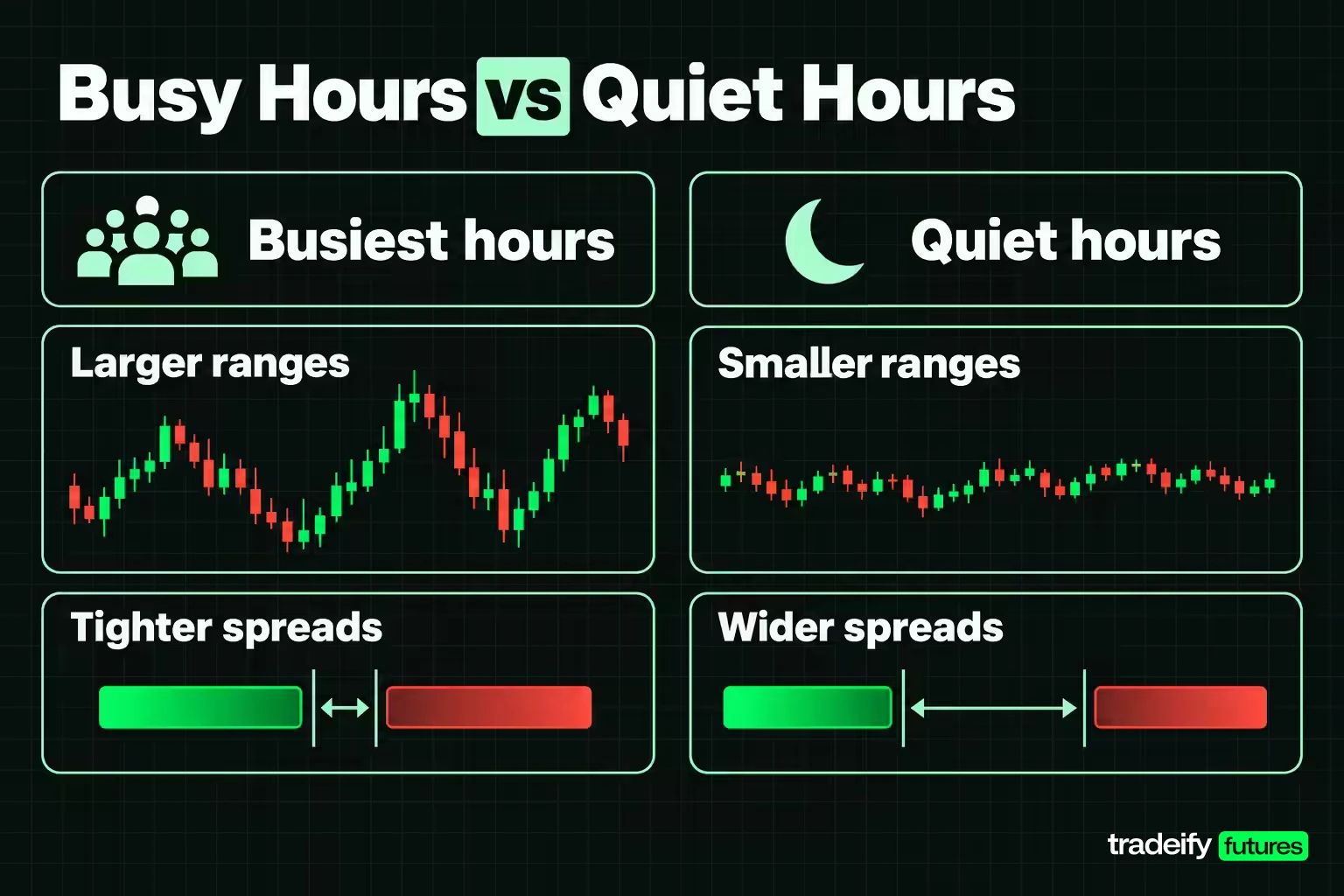
Volatility and spreads both move with the session, and not in the direction many newer traders assume. Quiet hours feel safer, but the busiest hours usually have the largest ranges and the tightest spreads. The quiet hours have smaller ranges and wider spreads, which is a poor combination for anyone crossing the spread often.
| Window (New York time) | EUR/USD average hourly range | USD/JPY average hourly range | AUD/USD average hourly range |
|---|---|---|---|
| Asia, 7 PM to 3 AM | 7.1 pips | 20.4 pips | 6.7 pips |
| London before New York, 3 AM to 8 AM | 10.6 pips | 21.4 pips | 6.9 pips |
| London and New York overlap, 8 AM to 12 PM | 14.2 pips | 27.9 pips | 9.8 pips |
| New York afternoon, 12 PM to 5 PM | 7.9 pips | 15.7 pips | 5.2 pips |
| After the New York close, 5 PM to 7 PM | 6.0 pips | 12.2 pips | 4.1 pips |
These are averages from the same 13-week sample of Yahoo Finance hourly bars (high minus low, weekdays, bucketed by New York hour). The single busiest hour for EUR/USD was 8 AM ET at 16.7 pips; the quietest was 6 PM ET at 4.7 pips.
Why Spreads Widen in Thin Sessions
A spread is what a dealer charges for taking the other side of your trade right now. With fewer dealers quoting, each one has less competition and more risk of being stuck with a position, so quotes widen. Brokers say as much: OANDA's hours page warns that spreads typically widen before markets close.
In stress, the gap can be extreme. The Reserve Bank of Australia's account of the 3 January 2019 yen flash event says bid-ask spreads widened from around 2 pips to 100 to 300 pips for a short period. That happened in the thin hours after the New York close, not in the overlap.
Related lesson: The wider cost of filling away from the price you saw
Spread Costs by Trading Session
Session choice is normally discussed as a preference for "movement." It is more useful to price it. The same trade costs different amounts at different hours, and you can put a number on that.
Take an illustrative trade of 4 Micro E-mini S&P 500 (MES) contracts. MES is $5 times the index, with a minimum tick of 0.25 points worth $1.25. If you enter and exit with market orders, you pay roughly one full spread per round turn: half on the way in and half on the way out, measured from the mid price. Assume, for illustration only, a 1 tick spread in the overlap, 2 ticks in Asian hours and 3 ticks in the seam after the close.
| Assumed spread | Spread cost per round turn on 4 MES | Net win on a 10 point target | Net loss on a 10 point stop | Break-even win rate |
|---|---|---|---|---|
| 1 tick | $5.00 | $195.00 | $205.00 | 51.25% |
| 2 ticks | $10.00 | $190.00 | $210.00 | 52.50% |
| 3 ticks | $15.00 | $185.00 | $215.00 | 53.75% |
A 10 point move on 4 MES is $200 before costs. The spread alone takes 2.5%, 5.0% or 7.5% of that target. With a 10 point stop, the break-even win rate rises from 51.25% to 53.75% with no change to the entries, exits or risk.
Session Costs Over a Month
Per trade, a few dollars is easy to shrug off. Over a month it stops looking like rounding. At 6 round turns a day for 20 days, 120 round turns, the spread costs $600.00 in a 1 tick book, $1,200.00 at 2 ticks and $1,800.00 at 3 ticks. The $1,200.00 gap between the best and worst case equals 6 gross targets of $200. Commissions and slippage on stops come on top of that, and slippage is usually worse in thin hours too.
Best Times to Trade Each Session
The best time to trade depends on what you trade and what your strategy needs. There is no single best session, but there are clear matches.
- Major dollar pairs (EUR/USD, GBP/USD) and US index futures: the London and New York overlap, 8:00 AM to 12:00 PM ET, has the most depth and the largest average ranges.
- Euro and sterling pairs: London hours, from about 3:00 AM ET, when European data and flows arrive.
- Yen pairs: Tokyo hours carry real activity in USD/JPY and the yen crosses, plus the Tokyo and London hand-off.
- Australian and New Zealand dollars: Sydney and Tokyo hours, especially around Australian data.
- Range strategies: quieter Asian hours, where price more often respects boundaries, as long as the spread cost fits the target.
- Breakout and momentum strategies: the London open and the overlap, where participation can carry a move.
Choosing Sessions You Can Actually Trade
The best session on paper is useless if you are asleep or at work during it. A trader in Los Angeles sees the overlap from 5:00 AM to 9:00 AM local time; a trader in Sydney sees it late at night. Pick the window you can watch fully, with a clear head, and match your instruments to it rather than the other way round.
Two rules keep this honest. Trade at most two or three windows and treat the rest as closed. And check the economic calendar before each session, because an overlap with a CPI release inside it behaves very differently from a quiet one.
How Futures Trading Sessions Fit the Global Day
Futures trading sessions run on an exchange clock, not on the four forex names. CME Globex equity index futures such as ES trade from Sunday 6:00 PM to Friday 5:00 PM ET, with a daily maintenance break from 5:00 PM to 6:00 PM ET. CME currency futures such as Micro EUR/USD (M6E) follow the same daily clock: 5:00 PM to 4:00 PM Central Time with a 60-minute break.
Inside that one long session, futures traders usually talk about three or four blocks that line up with the global sessions:
- Asian hours, from the 6:00 PM ET reopen through the Tokyo session.
- European hours, from the London open around 3:00 AM ET.
- The US morning, from the 8:30 AM ET data releases through the 9:30 AM ET stock market open and the overlap.
- The US afternoon, into the stock market close and the 5:00 PM ET break.
Note where the daily break sits. The quietest forex hours, between the New York close and the Tokyo morning, are exactly when CME index and currency futures pause and reopen. The ES study shows it: the 5 PM ET hour averaged 5 contracts.
Related lesson: Settlement, the daily break and the reopen in detail
Weekend Gaps and Session Breaks
The global trading week has one long break, the weekend. Spot forex usually closes Friday around 5:00 PM New York time and reopens Sunday evening, and CME futures follow a similar Sunday to Friday schedule. While the market is closed you cannot open or close positions, and news keeps arriving.
That is why Monday opens can gap. OANDA's hours page warns that prices may change significantly, or gap, when trading resumes, and that a stop may be filled at a different price from the one on the order. Sydney is first to price the weekend, so the gap shows up in its hours.
Daily Breaks and Holiday Sessions
Smaller breaks matter too:
- Daily futures break: CME index and currency futures stop from 5:00 PM to 6:00 PM ET each weekday.
- Friday afternoon: liquidity thins as desks square up for the weekend, so late-Friday fills are often worse.
- Holidays: a holiday in one centre thins its session even when others are open. The Tokyo Stock Exchange is closed January 1 to January 3, and the London Stock Exchange closes early on 24 December 2026 and 31 December 2026, with its closing process from 12:30 London time.
- Exchange holiday schedules: CME publishes holiday and early-close hours for each product; check them before trading around any public holiday.
Related lesson: How weekend and holiday gaps form and get filled
Trading Session Risks in the Thin Hours
The riskiest trading session hours are the thin ones: the seam after the New York close, holidays, and the days around clock changes. Two documented flash events show what that can look like.
The sterling flash event of 7 October 2016 happened during early Asian trading hours. The BIS Markets Committee report on it put significant weight on the time of day, together with mechanical amplifiers such as options hedging.
The yen flash event of 3 January 2019 began at 9:36 AM Sydney time, which was still the previous evening in New York. Over about 30 seconds the yen rose 3% against the US dollar. The Australian dollar then fell 3% against the dollar within about two minutes, touching a 10-year low of 0.6715. The Reserve Bank of Australia noted that FX volumes are particularly low between the US close and the Tokyo open, when Auckland and Sydney are the only centres trading, and that Japanese banks were closed for a holiday that day.
Practical Rules for Thin Session Hours
- Size by the session, not only by the stop. A stop that is sensible in the overlap can fill far beyond its level in the seam.
- Avoid starting new positions in the hour or two after the New York close unless your strategy is built for it.
- Mark holidays in every centre you depend on, not just your own.
- Recheck your session times on clock-change dates.
- Do not assume a stop is a price guarantee. In a gap or a thin book it becomes a market order at the next available price.
The thread running through all of these: the instrument does not change when the clock does, but the market behind it does. A rule calibrated in one hour can quietly fail in another.
Building a Trading Session Plan
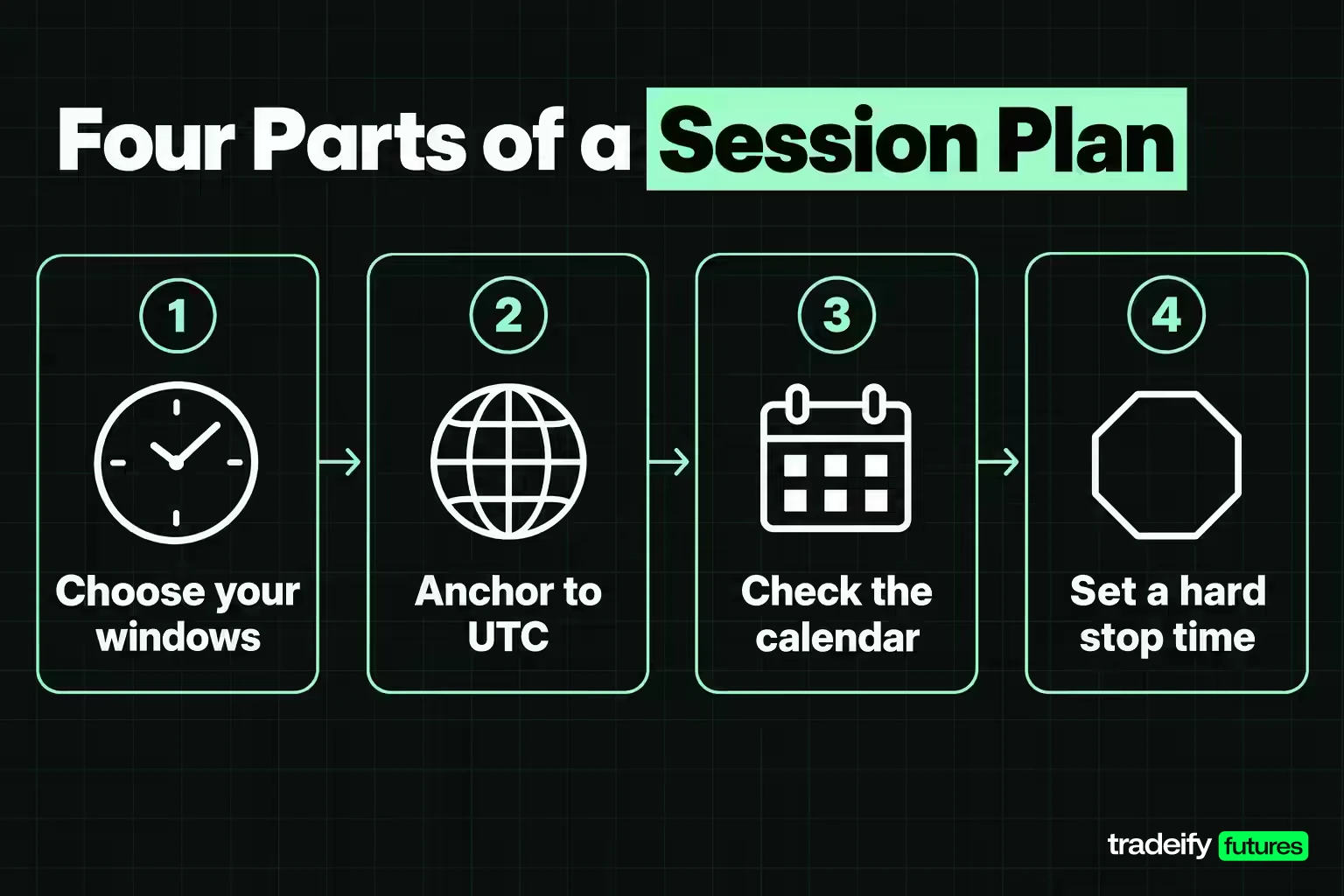
A session plan turns all of this into rules you set before you trade, not after. Four parts cover most of it:
- Choose your windows. Write down which sessions you trade and treat everything else as closed.
- Anchor to UTC. Keep a UTC column and a local column, and recheck both after every clock change in the US, UK or Australia.
- Check the calendar. Note scheduled releases inside your window and decide in advance whether you trade through them or stand aside.
- Set a hard stop time. Decide when you are flat each day, before the thin hours and before any exchange break.
None of this replaces a strategy. It makes the strategy's results comparable from one day to the next, because you are trading the same kind of market each time. If your journal shows most of your losers came from one window, that is the window to drop first.
On our accounts, the trading day follows the CME clock: it opens at 6:00 PM ET and runs until 5:00 PM ET, and every position must be closed by 4:45 PM ET (12:59 PM ET on holiday early closes). Asian and London hours belong to the same trading day as the New York morning, so a position opened at 8 PM Monday can be closed at 2 PM Tuesday, but nothing is held overnight past that flat time or over the weekend. For currency exposure we list CME currency futures such as 6E and M6E rather than spot forex, and our funded accounts are simulated.
Global Trading Sessions FAQ
What are the four trading sessions in futures?
Futures do not have four official sessions; CME Globex runs one session from 6:00 PM to 5:00 PM ET with a daily break. Traders still split that day into Asian hours, European hours, the US morning and the US afternoon. Those blocks line up with the Sydney and Tokyo, London and New York forex sessions.
What is XAUUSD trading?
XAU/USD is the price of one troy ounce of gold in US dollars, traded over the counter much like a currency pair. Brokers usually quote it nearly around the clock on weekdays, for example Sunday 6:05 PM to Friday 4:59 PM New York time. On futures, gold trades through exchange contracts such as Micro Gold (MGC), which covers 10 troy ounces.
Can you make $100 a day on forex?
There is no reliable daily income from trading, and any target like $100 a day depends on account size, risk per trade and costs. Losing days are normal, and forcing a daily number pushes traders into poor setups and thin hours. A better goal is a process with positive expectancy after costs, measured over many trades.
Is forex a skill or luck?
Over a few trades, outcomes are mostly noise, so luck dominates the short run. Over hundreds of trades, a repeatable process with an edge after costs can show up, and that is where skill lives. Session choice is one of the parts you control, because it sets your costs and the kind of market you face.
What time does the London session open in New York time?
The London session opens around 3:00 AM New York time for most of the year. In the few weeks when US and UK clock changes are out of step, it opens around 4:00 AM ET instead.
Which trading session is the most volatile?
The London and New York overlap usually has the largest price ranges for major pairs and US index futures. In a 13-week sample of Yahoo Finance hourly bars, EUR/USD moved about twice as much per hour in the overlap as in Asian hours.
Trading futures, forex and gold involves substantial risk, and leveraged products can lose more than you expect, quickly, especially in thin hours and gaps. The session figures in this guide are illustrative averages from a short sample and constructed examples, not forecasts or live quotes. Funded and evaluation accounts are simulated. Nothing here is investment advice or a recommendation to trade any product; confirm current hours and contract details with the exchange or your provider before relying on them.


