



TL;DR: The bid-ask spread is the gap between the best price buyers will pay and the best price sellers will accept. You pay it whenever you cross it with a market order. On one Micro E-mini S&P 500 contract, a one-tick spread costs $1.25 per round trip. On a 4-tick target and 4-tick stop, that tick lifts the break-even win rate from 50% to 62.50%.
You buy, the market ticks your way, you get out, and the trade still closes red. Most of the time that is not a bad read. It is the bid-ask spread, the gap between the highest bid and the lowest ask, and it was never in the plan.
This guide covers what the spread is, who earns it, how to calculate it in ticks and dollars, and how it quietly changes the win rate a strategy needs.
What Is the Bid-Ask Spread
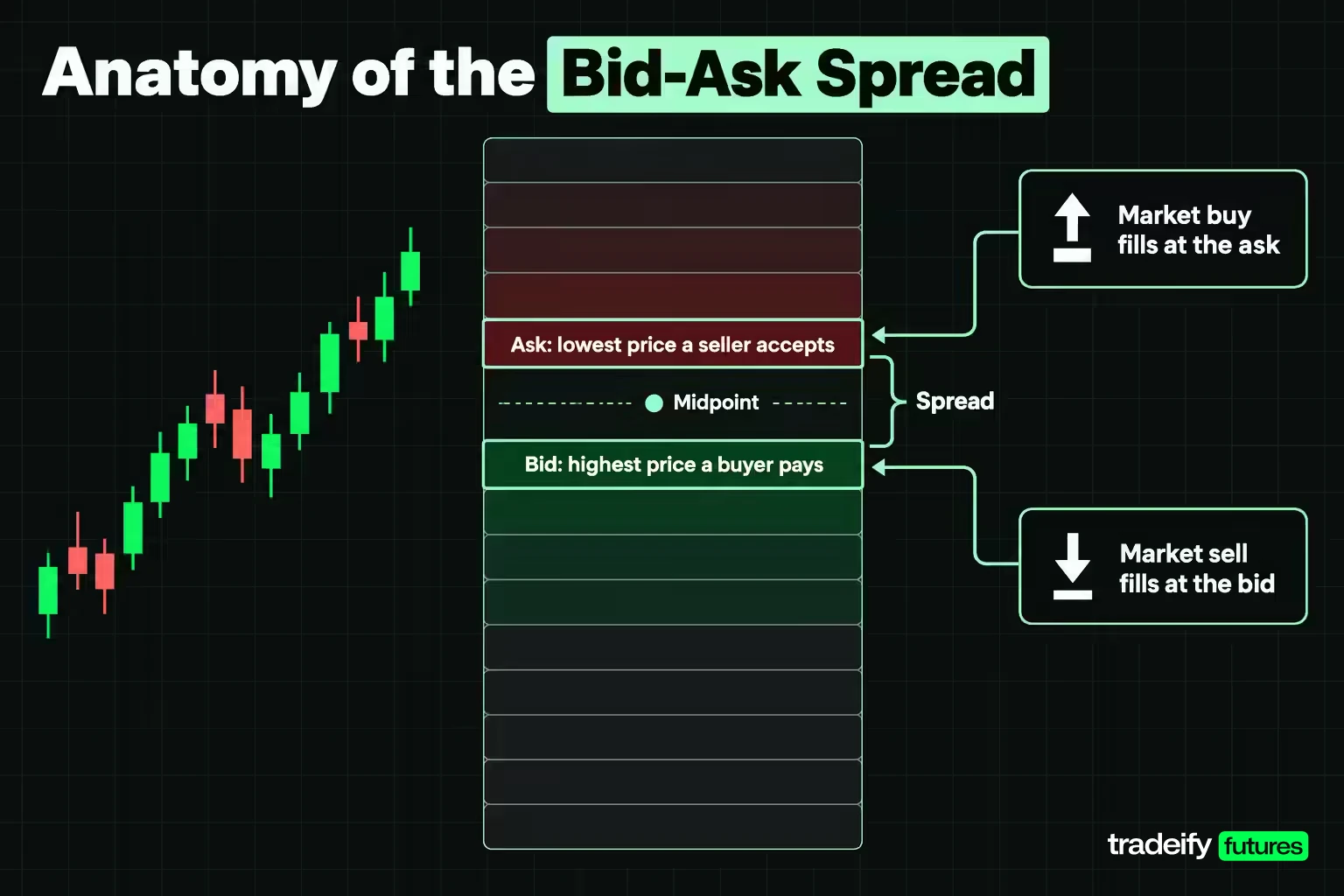
The bid is the highest price a buyer is willing to pay right now. The ask, also called the offer, is the lowest price a seller is willing to accept. The spread is the gap between the two.
Investor.gov, the SEC's investor education site, defines it the same way: the bid is the highest price a buyer will pay for a specified number of shares, the ask is the lowest price at which a seller will sell, and the bid will almost always be lower than the ask. Optiver, a market-making firm, adds the detail that matters for futures: on many exchanges a central limit order book lists every resting limit order and quote, and the best bid and best ask are simply the top of that book.
Two rules follow from the definition.
- You buy at the ask and sell at the bid when you trade immediately. A market order takes whatever price is resting on the other side.
- The midpoint is the average of the bid and the ask. It is a reference price, not a price anyone is quoting to you.
Related lesson: Bid price vs. ask price
Who Sets the Spread and Who Earns It
The spread is not a fee an exchange charges. It is the price of trading right now, paid to whoever was already waiting on the other side.
Every quote in the order book is a resting limit order or a market maker's quote. Optiver notes that market makers are generally contractually required to quote both a bid and an offer continuously, and that market-making contracts often set a maximum spread they are allowed to quote. CME Group consolidates the terms of its market maker and incentive programs under its Rule 195.
That splits every trade into two roles.
- The taker sends an order that can be matched now, such as a market order. The taker pays the spread.
- The maker has an order resting in the book. When a taker hits it, the maker trades at the better side of the quote.
The maker is not collecting free money. A market maker who buys at the bid has to hold that position until someone else buys it back, and the price can move against them in the meantime. Optiver describes the spread widening when uncertainty rises because market makers are exposed to more risk. The spread is what they charge for carrying that risk.
Related lesson: Market makers explained
Bid-Ask Spread Formula and How to Calculate It
The bid-ask spread formula is short.
- Spread = ask price minus bid price.
- Spread percentage = (ask price minus bid price) divided by the ask price, times 100. Wall Street Prep uses the ask as the denominator; some sources divide by the midpoint instead, and the difference is tiny on liquid markets.
- Midpoint = (bid price plus ask price) divided by 2.
Optiver's worked example uses Apple shares quoted at $112.48 bid and $112.56 ask. A buyer pays $112.56, a seller receives $112.48, and the spread is $0.08, or 0.07% of the price.
Futures need one more step, because the useful unit is the tick. Divide the spread in price by the contract's minimum tick, then multiply by the tick value.
- Spread in ticks = (ask minus bid) divided by the minimum tick.
- Spread in dollars per contract = spread in ticks times the tick value.
Take an illustrative Micro E-mini S&P 500 (MES) quote of 7,000.00 bid and 7,000.25 ask. CME Group lists MES at $5 times the S&P 500 Index with a minimum tick of 0.25 index points, worth $1.25. The spread is 0.25 points, which is one tick, which is $1.25 per contract. As a percentage of a 7,000 index level, that is about 0.0036%, which is why percentage spreads are a poor way to judge futures. The dollar figure per tick is what reaches your account.
The spread is paid once per round trip, not on each leg. Measured from the midpoint, you give up half the spread when you buy at the ask and the other half when you sell at the bid. Enter long at 7,000.25 and exit at 7,000.00 with no price change, and you are down 0.25 points, or $1.25 on one MES.
Related lesson: Tick size and tick value
Spread Examples in Stocks and Futures
The raw spread tells you little until you convert it to dollars. A 0.01 spread in crude oil and a 0.25 spread in the S&P 500 sound very different, and on the micro contracts they cost almost the same.
Here is what a one-tick spread costs on six common futures contracts, using the contract units and minimum ticks CME Group publishes. The quotes are illustrative round prices, not market data.
| Contract | Contract unit | Minimum tick | Illustrative bid and ask | One-tick spread in dollars |
|---|---|---|---|---|
| Micro E-mini S&P 500 (MES) | $5 x S&P 500 Index | 0.25 index points | 7,000.00 and 7,000.25 | $1.25 |
| E-mini S&P 500 (ES) | $50 x S&P 500 Index | 0.25 index points | 7,000.00 and 7,000.25 | $12.50 |
| Micro E-mini Nasdaq-100 (MNQ) | $2 x Nasdaq-100 Index | 0.25 index points | 28,000.00 and 28,000.25 | $0.50 |
| Micro E-mini Russell 2000 (M2K) | $5 x Russell 2000 Index | 0.10 index points | 2,800.00 and 2,800.10 | $0.50 |
| Micro WTI Crude Oil (MCL) | 100 barrels | $0.01 per barrel | $70.00 and $70.01 | $1.00 |
| Micro Gold (MGC) | 10 troy ounces | $0.10 per troy ounce | $4,000.00 and $4,000.10 | $1.00 |
Read the right-hand column as the floor cost of a round trip in that market when it is quoting one tick wide. A futures market cannot quote tighter than one tick, so a one-tick spread is as cheap as crossing gets.
Stocks work the same way with shares instead of ticks. An illustrative stock quoted at $50.00 bid and $50.02 ask has a $0.02 spread. On 100 shares, buying at the ask and selling straight back at the bid costs $2.00, about 0.04% of the price.
The comparison that matters is the dollar cost against the move you are trying to catch. One MES tick is $1.25 against a contract that moves $5 per index point. One MNQ tick is $0.50 against a contract that moves $2 per index point. Same tick count, different dollar cost, so compare markets in dollars, not in quoted points.
What the Spread Costs Active Traders Over a Year
The spread is a small number paid often. That is exactly why it matters most to people who trade often.
It also never shows up as its own line on a statement. It hides inside a slightly worse entry and a slightly worse exit, so a trader can feel the market went their way and still close the trade red.
Here is a one-tick spread on a single contract counted over an illustrative year of 250 trading sessions.
| Round trips per day | Round trips per year | One-tick spread paid on MES | One-tick spread paid on ES |
|---|---|---|---|
| 2 | 500 | $625.00 | $6,250.00 |
| 5 | 1,250 | $1,562.50 | $15,625.00 |
| 10 | 2,500 | $3,125.00 | $31,250.00 |
| 20 | 5,000 | $6,250.00 | $62,500.00 |
Nothing in that table requires a bad trade. Five round trips a day on one micro contract is an ordinary intraday schedule, and the bill arrives whether the trades win or lose. Commissions and exchange fees sit on top of it.
The fix is not to stop trading. It is to know the number before you pick a target, a market and a trade frequency, because the spread doesn't care whether the trade was a good one.
How the Spread Raises Your Break-Even Win Rate
The dollar total is not the part that hurts. The spread does its real damage to the win rate a strategy needs, and a 1-to-1 target and stop that sounds like a coin flip stops being one.
Measure the target and stop from the midpoint. If you enter and exit with market orders, you pay one full spread on every round trip. That spread comes off every winner and adds to every loser. The break-even win rate is the net loss divided by the sum of the net win and the net loss.
| Target and stop in ticks | Gross risk on one MES | No spread | 1-tick spread | 2-tick spread | 3-tick spread |
|---|---|---|---|---|---|
| 4 | $5.00 | 50.00% | 62.50% | 75.00% | 87.50% |
| 6 | $7.50 | 50.00% | 58.33% | 66.67% | 75.00% |
| 8 | $10.00 | 50.00% | 56.25% | 62.50% | 68.75% |
| 12 | $15.00 | 50.00% | 54.17% | 58.33% | 62.50% |
Work the top row by hand so you do not have to trust the table. A 4-tick target and a 4-tick stop on MES are each $5.00 gross. Take one tick of spread off the winner and add it to the loser, and you net $3.75 on a win and lose $6.25 on a loss. The break-even win rate is $6.25 divided by $10.00, which is 62.50%. A strategy that looked like a coin flip now has to win five trades in eight just to stand still.
Why small targets suffer most
The spread is a fixed cost, so it eats a bigger share of a smaller move. One tick is 25% of a 4-tick target and 12.50% of an 8-tick target. Against a 2-tick stop, one tick is 50% of the risk.
That is why scalpers feel spreads more than anyone. Their read on direction can be fine while the target is simply too small for the cost of getting in and out. Being right about direction and having a trade that pays are two different things.
When limit exits lower the spread cost
Break-even win rates like these assume you cross the bid-ask spread on both legs, entering and exiting with market orders. If your profit target is a resting limit order, the winning exit fills at your price and you do not pay the spread on that leg. Stops are usually market orders once triggered, so the losing side still pays in full, sometimes more. Treat those break-even figures as the cost when you take liquidity both ways, and check your own fills to see where you actually sit.
Related lesson: Commission-adjusted futures breakeven
Liquidity, Market Depth and the Spread
Liquidity is how much you can trade near the current price without moving it. The spread is the most visible sign of liquidity, and it is not the whole story.
Optiver calls the spread a proxy for liquidity: typically, the more liquid the market, the smaller the spread. A one-tick spread tells you the best bid and best ask are adjacent. It does not tell you how many contracts sit at those prices or behind them.
Bid size vs ask size
Each side of the quote carries a size. The bid size is how many contracts or shares buyers are showing at the best bid. The ask size is how many sellers are showing at the best ask.
Size decides what happens to a larger order. If the best ask shows 3 contracts and you buy 10 at market, the first 3 fill at the ask and the rest fill at the next prices up. The spread looked like one tick, and your average fill was worse.
Size imbalances are tempting to read as direction. A big bid under a thin ask can look like support, but resting orders can be cancelled before price reaches them, so treat displayed size as information to confirm with traded volume, not as a promise.
Level 1 and Level 2 market data
Level 1 data shows the best bid, the best ask and the last traded price, usually with the size at each. That is enough to see the spread.
Level 2 data, often called market depth, shows resting orders at several price levels on each side of the book. It answers the question Level 1 cannot: how far would an order of a given size move the price.
Depth can vanish when you need it most. CME Group's study of E-mini S&P 500 futures during the April 2025 tariff volatility found that on April 7, 2025, volume in the June contract was over 99% higher than its first-quarter 2025 average while order book depth was down 68%. Plenty of trading, far less size resting at each price. A spread can stay one tick wide while the book behind it thins out.
Related lesson: Market depth and Level II data
What Makes a Bid-Ask Spread Wider or Tighter
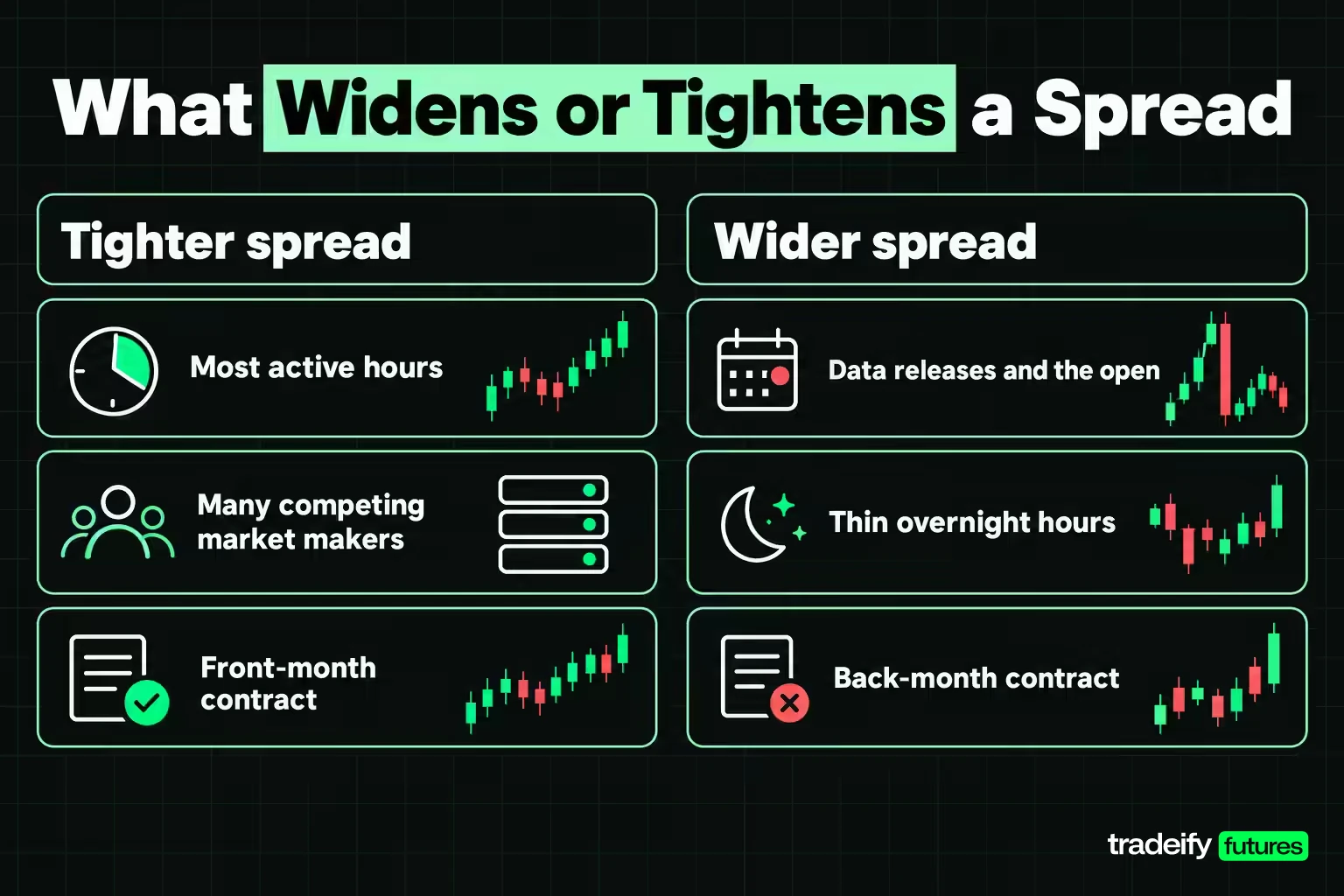
The spread belongs to the market at a moment, not to the instrument. The same contract can quote one tick wide in a quiet mid-morning stretch and several ticks wide a minute after a data release.
Optiver names four forces.
- Activity. High trading volume lets market makers quote tighter because the risk of not finding an opposite trade is low.
- Uncertainty. When risk rises, market makers widen their quotes.
- Competition. More market makers competing for the same flow generally narrows spreads.
- Contracts. Market-making agreements often cap the spread a market maker may quote.
For an intraday futures trader, those forces show up as a rhythm you can plan around.
- Around scheduled data releases and the first minutes of a session, uncertainty is high and the book is still filling in, so spreads tend to widen.
- In the most active hours of the day, volume concentrates and the main index contracts often quote one tick wide.
- In thin overnight hours, near holidays and in the minutes before a market closes, there are fewer participants and spreads can open up.
- Back-month contracts usually quote wider than the front month, which carries most of the volume.
How spreads vary after hours, across brokers and in a halt
Stock and ETF spreads vary in a few ways of their own.
- Extended hours. Pre-market and after-hours sessions usually have far fewer participants than regular hours, so spreads are often wider and displayed size is thinner.
- Thin and low-priced stocks. Thinly traded names tend to quote wider than heavily traded ones, sometimes by a wide margin relative to the share price.
- Brokers and venues. A stock order can be routed to different exchanges or market makers, so two brokers can give you different fills against the same quote.
- Halts and reopenings. When trading in a security is halted, there is no tradable spread at all, and the first quotes after it reopens are often wide until the book refills.
Can you negotiate the spread? Not on a screen quote. The only levers a retail trader has are order type, timing and the choice of market: post a limit order instead of crossing, trade when the book is busy, or pick the more active contract or share class.
What a wider spread does to a year of trades
Spread width changes the yearly bill directly. At a one-tick spread, 1,250 MES round trips cost $1,562.50 in spread. If those same trades are clustered at moments when the market is three ticks wide, the same schedule costs $4,687.50. That is $3,125.00 more for identical decisions.
Tight Spreads vs Wide Spreads
A tight spread means buyers and sellers are close together and crossing is cheap. A wide spread means they are far apart, crossing is expensive, and something is usually keeping participants away.
| Spread condition | What it usually signals | Market order cost | Practical response |
|---|---|---|---|
| One tick, deep book | Heavy participation and competition | Lowest possible | Market orders are a reasonable price for certainty |
| One tick, thin book | Adjacent quotes with little size behind them | Low on small orders, higher on large ones | Size down or split the order |
| Several ticks, calm market | Low participation, such as a back month or overnight | High | Use limit orders or trade the more active contract |
| Several ticks, fast market | Uncertainty around news or a sharp move | High and unpredictable | Wait for quotes to settle or stand aside |
Is a narrower spread always better? For the trader paying it, yes, but only if size is there too. A one-tick market with almost nothing resting at the best prices can cost more on a ten-contract order than a two-tick market with deep size. Judge the spread and the depth together.
A wide spread is not automatically a bad trade either. It is a higher entry fee. The question is whether your target is large enough to pay it and still leave something worth the risk.
Related lesson: What is liquidity
Placing Orders Around the Spread
Order type decides whether you pay the spread, earn it or wait. Investor.gov describes the basic tradeoff: a market order guarantees execution but not the price, while a limit order executes only at your limit price or better.
- Market order. You pay the spread and get filled now. On a one-tick, liquid market, that is a fair price for certainty.
- Limit order at the bid when buying, or at the ask when selling. You join the queue as a maker. If the market trades to you, you avoid paying the spread on that leg. If it does not, you have no trade.
- Limit order inside a wide spread. When a market is several ticks wide, a limit between the bid and ask can improve your price, but it may not fill.
- Stop order. When the stop price is reached, it becomes a market order, so it pays the spread at whatever width the market has at that moment.
Limit orders carry their own cost. The trades that fill easily at your price are often the ones moving against you, and the ones that run away never fill. A missed winner never shows up as a loss, but it still shows up in the results.
The temptation after a missed fill is to chase with a market order at a worse price. That is a different trade from the one you planned, with a worse entry and the same stop.
A simple written rule keeps these choices out of the heat of the moment.
- Check the spread in ticks before you enter.
- If it is one tick on a liquid front-month contract, a market order is a defensible cost.
- If it has widened to several ticks, use a limit order or trade a more active contract.
- If you work a limit, decide in advance how long you will wait before you cross or cancel.
Reading the bid and ask at support and resistance
Some traders watch the bid and ask at chart levels they already marked. If price reaches an old high and the ask keeps refilling while buyers lift it without progress, that is an observation, not a signal. It becomes useful only when price confirms it, for example by failing to hold above the level. If price then breaks through cleanly, the read was wrong and the level no longer matters.
Related lesson: Limit orders
Spread, Slippage and Price Improvement
The spread, slippage and price improvement are three different gaps, and they are easy to blur together.
- The quoted spread is the gap between the bid and ask you see before you trade.
- Slippage is the gap between the price you expected and the price you got. It comes from price moving between your decision and your fill, or from your order being larger than the size at the best price.
- Price improvement is a fill better than the quote, which some stock venues can provide.
US stock market rules measure the real cost with the effective spread. SEC Rule 605 defines it, for a buy order, as double the difference between the execution price and the midpoint of the national best bid and offer at the time the order was received. Take a quote of $50.00 bid and $50.02 ask, a midpoint of $50.01. Buy at $50.02 and the effective spread is $0.02, the full quoted spread. Buy at $50.01 and the effective spread is $0.00, because you were filled at the midpoint.
In futures there is one central order book per contract, so price improvement in that sense is rare. What you see is what you can trade, size permitting. The bigger risk is slippage when the book thins out, which is why a stop in a fast market can fill several ticks beyond its trigger.
Related lesson: Slippage explained
Bid-Ask Spreads in Options Trading
Options are where spreads bite hardest in percentage terms. Many strikes and expirations trade only lightly, so quotes sit further apart relative to the premium.
Investor.gov notes that one stock option contract generally represents 100 shares, so every $0.01 of spread costs $1 per contract. Take an illustrative option quoted at $1.90 bid and $2.10 ask. The spread is $0.20, which is $20 per contract and 10% of the $2.00 midpoint. Buy at $2.10 and sell straight back at $1.90, and you have lost $20, about 9.52% of the $210 you paid, without the option's value changing at all.
Compare an actively traded option quoted at $2.00 bid and $2.02 ask. The spread is $0.02, or $2 per contract, about 1% of the price. Same strategy, a fraction of the cost.
That is why many options traders work limit orders at or near the midpoint rather than paying the ask. A limit at $2.00 on the wide quote may fill, may fill only after the market moves, or may not fill at all. The practical habits are the same as in futures: check the spread as a share of the premium before you trade, prefer actively traded strikes and expirations, and decide in advance how far you will move your limit before giving up.
Related lesson: Liquidity and bid-ask spreads in options
A Pre-Trade Bid-Ask Spread Check in Five Steps
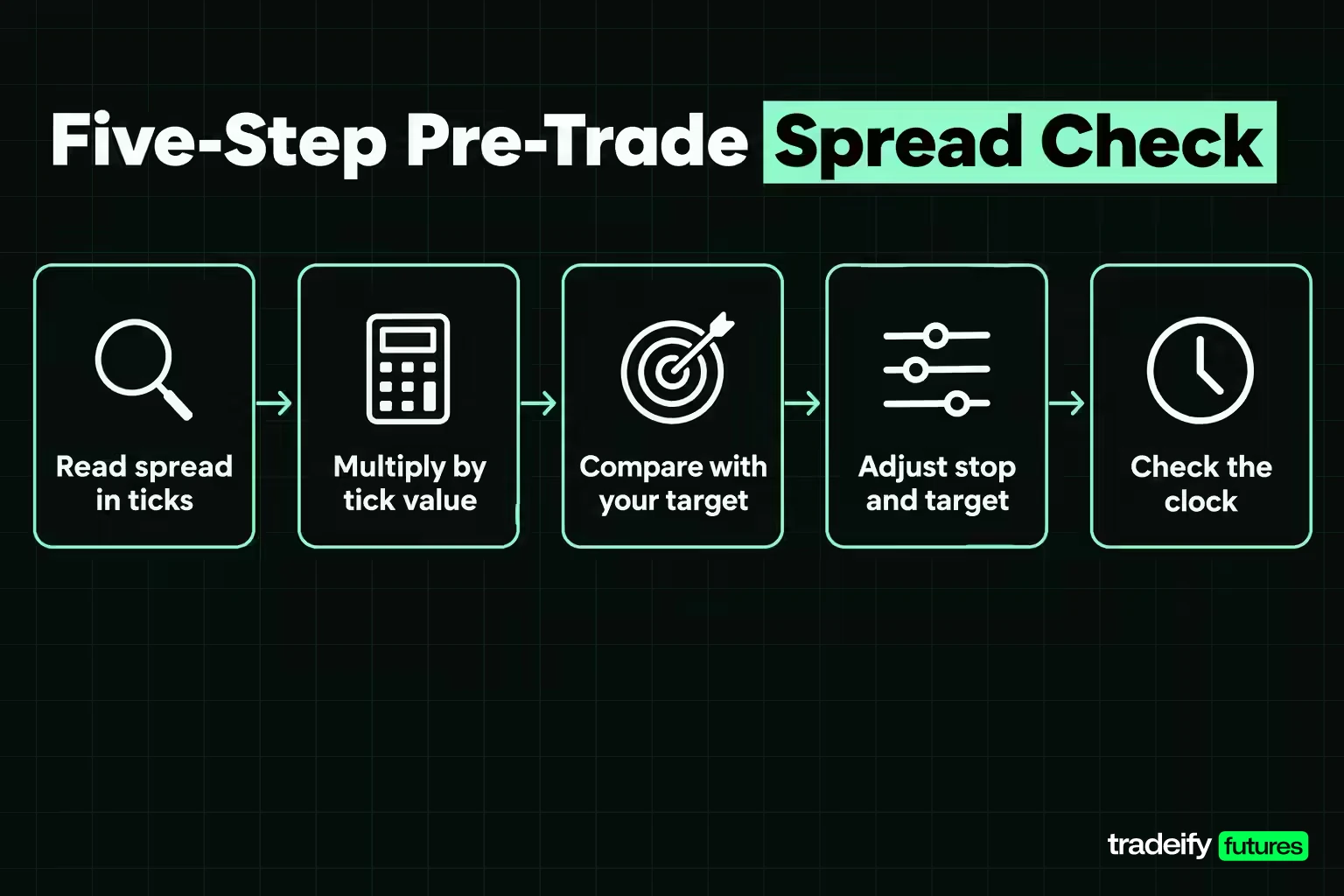
A spread check takes seconds, and it changes which trades are worth taking. Run it before the entry, not after the fill.
- Read the current bid and ask for the exact contract you plan to trade, and write the spread in ticks.
- Multiply by the tick value. That is your spread cost per contract per round trip.
- Divide it by your target in dollars. If the spread is a large share of the target, the target is too small for this market right now.
- Add the spread to your stop and take it off your target. That is the reward-to-risk you are really trading.
- Check the clock. If you are entering at the open or into a data release and the spread is several times its usual width, you are choosing a more expensive version of the same trade.
Two situations should stop the trade outright. The first is a market so thin that the round-trip cost eats most of your target, because no edge survives that. The second is a market order into an event when the book has thinned, because the quoted spread is the best case and the fill can be worse.
On our accounts, every account includes Level 1 CME data, which shows the best bid, best ask and last price, so the spread is always on your screen. Level 2 depth is a paid add-on bought from Tradovate on Tradovate accounts and is not yet available on Rithmic or WealthCharts accounts. Our round-trip commission is $1.82 on MES and $5.76 on ES, so ten MES cost $18.20 in commission against $5.76 for one ES, even though one tick of spread costs the same $12.50 either way.
Bid-Ask Spread FAQ
What is the formula for spread?
The bid-ask spread formula is the ask price minus the bid price. To express it as a percentage, divide the spread by the ask price and multiply by 100. For futures, divide the spread by the minimum tick and multiply by the tick value to get dollars per contract.
Do you buy at the bid or ask?
You buy at the ask and sell at the bid when you trade immediately with a market order. A buy limit order resting at the bid can fill at the bid, but only if a seller comes to you.
What is a good bid-ask spread?
In futures, a good spread is one tick, the minimum the market can quote. Whether that is cheap depends on your target. One tick against an 8-tick target is 12.50% of the move, while one tick against a 2-tick target is 50%.
What does 0.3 spread mean?
It means the ask sits 0.3 price units above the bid, in whatever unit that market quotes. On a stock quoted in dollars that is $0.30 per share, or $30 on 100 shares. In currency markets the unit is usually the pip, so a 0.3 spread is three tenths of a pip.
What is the difference between bid volume and ask volume?
Bid size is the number of contracts or shares waiting to buy at the best bid, and ask size is the number waiting to sell at the best ask. Traded volume counts what actually changed hands. Many platforms also split traded volume into trades that hit the bid and trades that lifted the ask, which shows who was crossing the spread.
What is the 7% rule in stocks?
It is a stop-loss guideline from Investor's Business Daily that says to cut a stock loss at 7% to 8% below your purchase price. On a $10,000 position that is a $700 to $800 loss limit. The spread matters here too, because a wide spread on a thin stock uses up part of that cushion the moment you buy.
Is the bid-ask spread the same as a commission?
No. A commission is a separate charge from your broker. The spread is paid through the price you get, to whoever was on the other side of the trade. Both come out of your net result, but only the commission appears as its own line.
Why is the bid-ask spread so high?
Usually because liquidity is thin or uncertainty is high. Low volume, few market makers, a pending news release, an off-hours session or a back-month contract can all widen it. Waiting for activity to return or switching to a more active contract often brings it back down.
This guide is educational and is not financial advice or a recommendation to trade any instrument. Futures, options and other leveraged products can lose money quickly, and losses can exceed what you expect. All quotes, spreads and dollar figures here are illustrative examples, not market data; check current contract specifications with the exchange and your own fee schedule. Funded and evaluation accounts at prop firms are simulated, and simulated fills can differ from live market fills.


