



TL;DR: A GTC order keeps an order working past the close until it fills, you cancel it, or another clock ends it. Published broker caps include 90 days, a quarter and 180 days, and a futures GTC order also ends when its contract expires. A day order expires at the session's end, which is tidier but can leave a position unprotected overnight.
A GTC order is the instruction you attach to an order when you want it to keep working after today's session ends. GTC stands for good til canceled (also spelled good till cancelled), and the name promises more than it delivers. The order does carry over, but it rarely lasts until you cancel it, and the clock that actually ends it is usually one you never looked at.
Here is where traders get caught. A stop you thought was protecting a position quietly expired. A buy limit you forgot about filled six weeks later on news that broke your reason for wanting the trade. Neither failure is exotic. Both come from treating time in force as a box you tick once instead of a date you manage. This guide covers what a GTC order is, how long it really lasts, how it differs from a day order, and the routine that keeps resting orders from surprising you.
What Is a GTC Order
A GTC order is an order with a time in force of good til canceled. Time in force is a separate setting from the order type. The order type decides how the order behaves on price: a limit order rests at a price or better, a stop order waits for a trigger. The time in force decides how long that order is allowed to exist.
Interactive Brokers describes time in force exactly that way, as the length of time an order continues working before it is canceled, and lists GTC beside Day, GTD, IOC and FOK on the same field. FINRA makes the same split for stock investors: market, limit and stop orders "can include time mandates", and good 'til canceled orders remain in effect until they are executed or canceled.
So a GTC order is not a sixth order type next to market, limit and stop. It is a lifespan you attach to one of them. Get that straight and most of the confusion around the term goes away.
Related lesson: Order types overview
Which order types can be GTC orders
Limit orders are the most common GTC orders, because a resting price is the thing you most often want to leave in place. Stop orders, stop limit orders and the legs of a bracket can usually carry GTC as well, depending on the platform. Interactive Brokers states plainly that not every time in force is available for every order, since the valid choices depend on the order type, the exchange and the product.
Market orders are the exception in practice. A market order is meant to fill immediately, so there is nothing to keep alive overnight.
How a GTC order persists at the exchange
On CME Globex, the futures exchange platform, the default is the opposite of GTC. CME states that Globex "assumes that all orders are day orders unless otherwise specified", and that day orders expire at the end of the trading day and do not carry over to the next trade date.
A GTC order is defined by CME as remaining active in the order book "until they are completely executed, canceled or when the instrument expires".
The persistence is also real in queue terms. Under CME's first-in, first-out matching, a GTC order keeps its original timestamp over subsequent trading sessions, as long as you do not modify it in a way that costs priority. A GTC buy limit entered on Monday is still ahead of a buy limit at the same price entered on Wednesday.
How Long Does a GTC Order Last
A GTC order lasts until the first of several clocks runs out, and "until you cancel it" is only one of them. The SEC's investor education site says it directly: brokerage firms typically limit how long a GTC order can stay open, the time frame varies by firm, and investors should ask their broker which limit applies.
The published limits really do vary. Here is what three brokers state in their own help documentation for stock orders:
- TradeStation resubmits GTC orders each day and gives them "a maximum life span of 90 calendar days". After that, the order drops out of the daily resubmission.
- Interactive Brokers cancels GTC orders at the end of the calendar quarter following the current one, so an order placed in the fourth quarter is canceled at the end of the first quarter of the next year.
- Schwab says GTC orders are "good for up to 180 calendar days".
Three firms, three answers. That is why the honest answer to "how long does a GTC order last" is a date you look up for your own account, not a number you assume.
Account and contract expiration clocks
Published broker caps are only one way a GTC order ends. Two other clocks are easy to miss.
The account clock is one. Interactive Brokers lists a failure to log into the account for 90 days as an automatic cancellation condition for GTC orders. That 90 days is tied to your logins, not to the order's age, so it restarts every time you sign in.
The instrument clock is the other, and for futures it is usually the one that binds. A futures contract has a fixed expiration date, and CME's definition ends a GTC order when the instrument expires. No broker setting extends it. The December 2026 Micro E-mini S&P 500 contract (MESZ6), for example, expires on December 18, 2026, the third Friday of the contract month.
A GTC order timeline for one placement date
Put the clocks that end a GTC order on one calendar and the problem gets concrete. Take an order placed on Wednesday, November 4, 2026. The broker caps below are the ones each firm publishes for stock orders, and the last row is a futures order on the December MES contract.
| Clock | Rule as published | Order placed November 4, 2026 ends around |
|---|---|---|
| Futures contract expiration | GTC ends when the instrument expires | December 18, 2026 for MESZ6 (44 days) |
| TradeStation cap | 90 calendar days | February 2, 2027 |
| Interactive Brokers quarter rule | End of the quarter after the current one | March 31, 2027 |
| Schwab cap | Up to 180 calendar days | May 3, 2027 |
| Interactive Brokers login rule | 90 days without logging in | Rolling, resets at each login |
The futures order dies first, 44 days in, while the stock-account caps run out between February and May 2027. If you hold a futures position behind a GTC stop, the contract month on the ticket is the date to write down. The phrase "good til canceled" is not.
GTC Order vs Day Order
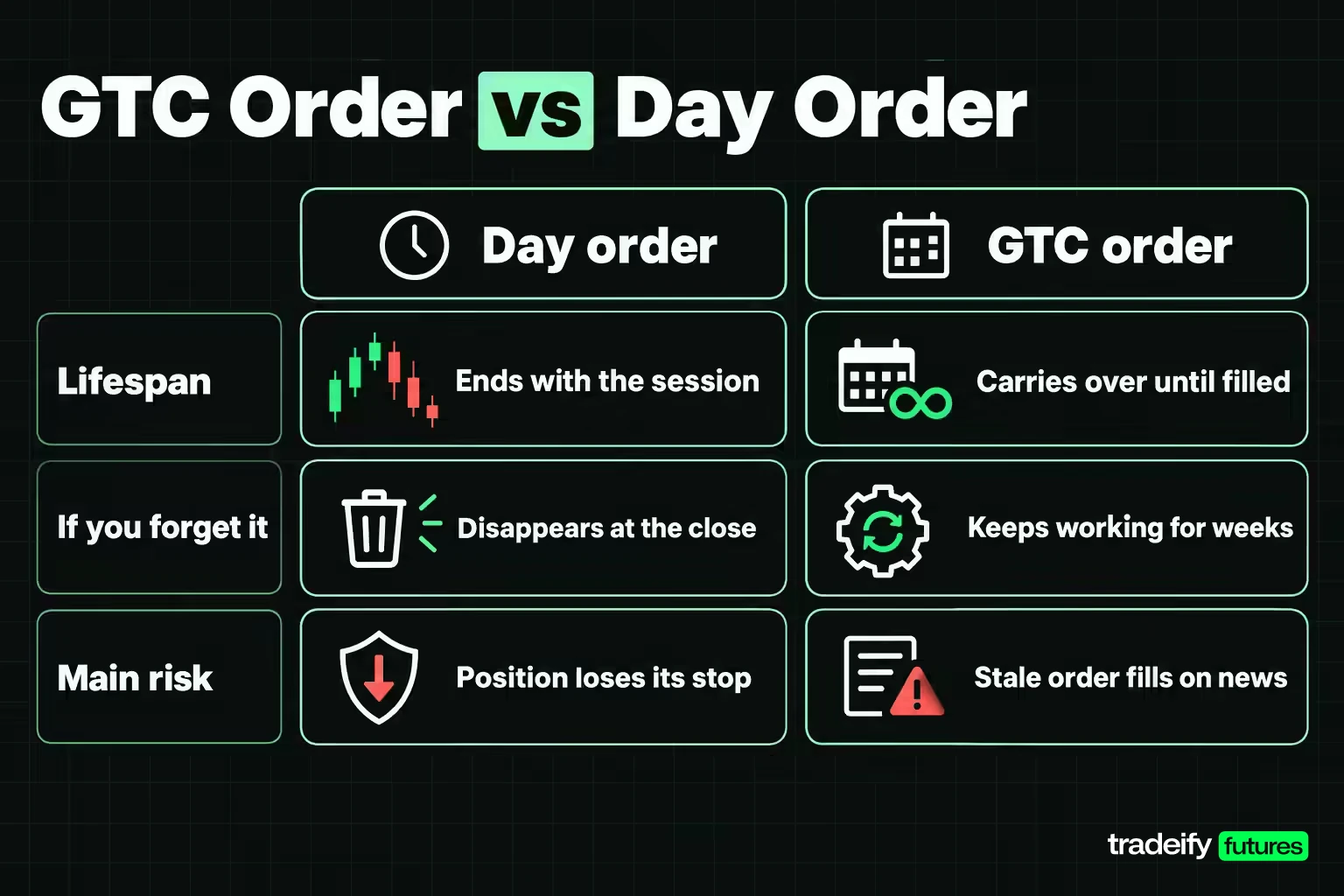
A GTC order and a day order answer one question differently: does the order survive the end of the session. A day order that does not fill is canceled when the trading day ends. A GTC order carries over into the next session and keeps going until it fills, you cancel it, or a broker cap or the contract's expiration ends it.
The day order is the default almost everywhere. CME Globex treats every order as a day order unless told otherwise, Interactive Brokers says every order is a day order unless otherwise specified, and Tradovate's help center says its web app uses Day order flags by default. That default exists for a reason: an order you forget about disappears at the bell instead of lingering for weeks.
| Feature | Day order | GTC order |
|---|---|---|
| Lifespan | Ends with the current trading session | Carries over until filled, canceled or a cap or expiry ends it |
| Default setting | Yes on most platforms | Must be selected |
| If you forget it | It disappears at the session end | It keeps working, possibly for weeks |
| Overnight or weekend protection | None, the order is gone | A resting stop or target stays in place |
| Queue position at the exchange | Starts over each session you re-enter it | Keeps its timestamp at CME if unmodified |
| Main risk | A position loses its stop or target at the close | A stale order fills on news you did not plan for |
Choosing between a day order and a GTC order
Three questions usually settle it.
First, is there an open position behind the order? If a stop or target protects a position you will still hold after the session ends, a day order leaves that position naked once the bell rings. That is a risk gap, not a style preference.
Second, will you honestly look at the order again before it matters? A GTC order is a promise to review it. Traders who check working orders every session can run GTC comfortably. Traders who check them "when they remember" tend to hear about the order from a fill or an expiry notice.
Third, will the reason for the order still be true next week? An entry at a level you picked from today's chart can be stale by Friday. If the idea only holds for today, a day order matches the idea. Leaving it working longer does not make it a better trade, just an older one.
GTC Orders in Extended Hours and Futures Sessions
What "the session" means changes by market, and a GTC order inherits whatever definition your broker applies.
In US stocks, the standard session runs 9:30 AM to 4:00 PM ET. Schwab says its GTC orders, like its day orders, apply only to that standard session. To work outside it you choose a different duration, GTC plus extended, which is available for limit orders only and is active from 7:00 AM to 8:00 PM ET across Schwab's extended sessions. So a plain GTC limit order on a stock does nothing in the premarket or after hours at that firm, even though it is still "alive".
TradeStation shows the same split in how it resubmits orders. Its GTC server re-enters plain GTC orders as day orders at the start of each core session at 9:30am ET, and GTC+ orders at the start of the extended premarket session at 8:00am ET. Interactive Brokers uses a separate "fill/trigger outside RTH" checkbox for orders that should work outside regular trading hours.
What a trading day means for a futures GTC order
Futures run on a different clock. CME Globex equity index futures trade from Sunday 6:00 PM to Friday 5:00 PM ET, with a daily maintenance break from 5:00 PM to 6:00 PM ET. The trading day starts in the evening and ends the next afternoon, so a day order entered at 8:00 PM ET on a Monday belongs to the session that ends at 5:00 PM ET on Tuesday.
That has two practical effects. A day-flagged stop on a futures position expires at 5:00 PM ET, which means it is gone before the evening session reopens and before the weekend. A GTC stop stays on the book through the break and is working again when trading resumes at 6:00 PM ET, which is the moment overnight news tends to hit the price.
Related lesson: Futures trading sessions and the daily maintenance window
GTC Order vs GTD, IOC, FOK and Other Time in Force Settings
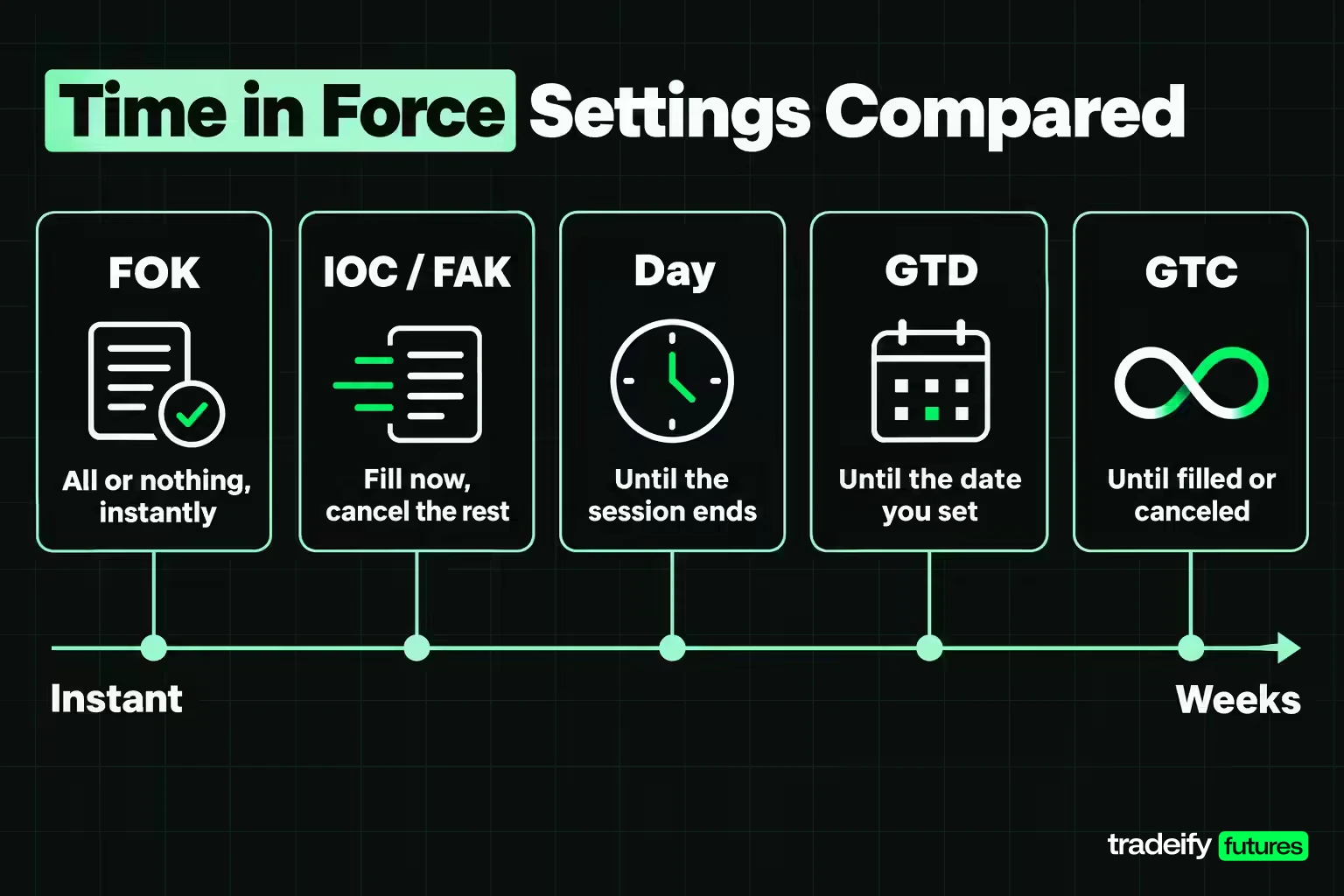
GTC is one choice on a menu of time in force settings, and the neighbours are worth knowing because they solve problems GTC creates.
- GTD (good til date). CME's definition keeps the order working until it executes, reaches the date you set, is canceled, or the instrument expires. In plain terms, a GTD order is a GTC order that already knows its own end date.
- IOC (immediate or cancel), called FAK (fill and kill) on CME. Whatever can fill immediately fills, and the rest is canceled. CME accepts FAK orders only while the market is open.
- FOK (fill or kill). The entire order fills immediately or none of it does. CME builds an FOK as a FAK with the minimum quantity set to the full order size.
- DTC (day til canceled), an Interactive Brokers setting. The order is canceled at the exchange at the end of the day but stays on your trading screen, ready to re-transmit.
- OPG. Used at Interactive Brokers for market-on-open and limit-on-open orders that only work at the open.
| Time in force | How long it can work | Typical use |
|---|---|---|
| Day | Until the current session ends | Anything you are actively watching |
| GTC | Until filled, canceled, capped or the instrument expires | Resting stops, targets and patient entries |
| GTD | Until the date you set, or an earlier GTC-style ending | Orders that must not outlive an event or a contract month |
| IOC or FAK | An instant, unfilled balance canceled | Taking available size without leaving a resting order |
| FOK | An instant, all or nothing | Size that is only worth having in full |
The useful contrast is between GTC and GTD. If you want an order to stop working before a known event (a data release, an earnings date, the roll of a futures contract), say so with a GTD date rather than hoping a broker cap lands where you wanted it.
Related lesson: Fill or kill orders
When a GTC Order Makes Sense
A GTC order earns its place when the order should outlive the session and you have a plan to supervise it. The common cases:
- A resting stop on a position you will hold past the close. In a market that reopens after a break or a weekend, a stop that expired at the bell protects nothing when trading resumes.
- A profit target at a level that may take days to reach. Re-entering the same target every morning is tedious and easy to forget. TradeStation describes its GTC service in exactly those terms, as a convenience that saves resubmitting orders every morning.
- A patient entry at a planned level. If your plan is "buy if price comes back to this level this week", a GTC or GTD limit holds the plan without you watching every tick.
- Keeping your place in the queue. On a FIFO futures market, a GTC limit that is not modified keeps its original timestamp across sessions, so it can fill ahead of identical orders entered later.
When a GTC order is the wrong choice
The features that make a GTC order useful become liabilities in other cases. If the order only makes sense in today's context, a GTC order turns a same-day idea into a multi-week commitment. If you cannot check your working orders at least once a session, the order is effectively unsupervised. And if the order is an entry rather than protection, ask whether you would still place it after a surprise headline. If the answer is "it depends", the order should not be sitting in the market while you are away.
GTC Order Risks and Drawbacks
A GTC order does exactly what it was told, for as long as it lives. Most of its risks come from that obedience meeting a market or a trader that changed.
Gap fills on a GTC stop
A stop order becomes a market order once triggered, so it fills at the next available price, not at the stop. When a market reopens after a break, the next price can be far away.
Here is an illustrative case on Micro E-mini S&P 500 futures, which are worth $5 per index point. A trader is long 2 MES at 6,050 with a GTC sell stop at 6,000. Friday's session closes at 6,020. Over the weekend the news turns, and Sunday's 6:00 PM ET reopen prints 5,970. The stop is triggered at the open and, assuming it fills at 5,970, the exit is 30 points worse than planned.
- Planned risk: 50 points x $5 x 2 contracts = $500
- Actual loss: 80 points x $5 x 2 contracts = $800
- Extra cost of the gap: $300
The GTC stop still did its job. A day-flagged stop in the same position would have expired at Friday's 5:00 PM ET close, leaving no exit at all when the market reopened. The lesson is not "avoid GTC stops". It is that a stop limits the loss to the next tradable price, which after a gap can be well past your level.
Related lesson: Stop orders
Stale limit orders that fill on old ideas
A buy limit fills at your price or better, and that "or better" can be the problem. Imagine a GTC buy limit for 100 shares at $50 placed while the stock trades at $55. Weeks later the company misses earnings and the stock opens at $44. The limit fills at $44 or better, so the trader now owns a roughly $4,400 position bought into the exact news that undermined the idea.
The order behaved correctly. The thesis behind it expired, and nobody told the order. That is the trade-off of any resting order: it remembers your price, not your reasoning.
Silent expiry and forgotten orders
Expiry is quiet. Nothing beeps when a broker cap, a quarter rule or a contract expiration removes your order. If that order was the profit target on a position, the position simply has no exit anymore.
Put a number on it with an illustrative case: long 4 MES at 6,020 with a GTC sell limit target at 6,092. That target is worth 72 points x $5 x 4 = $1,440 gross if it fills. If the target lapses unnoticed and price later trades through 6,092 and back down, the $1,440 was never booked, and the position is now managed by whatever you remember to do next.
The reverse failure is just as common: an order you meant to cancel stays alive. A forgotten GTC entry can open a position on a day you were not even planning to trade.
Open GTC buy orders and buying power
A stock buy order that is still open may be counted against your available cash or margin, depending on how your broker handles open orders. Ask your broker how it treats open GTC buy orders, especially if you keep several working at once, so a forgotten order does not block a trade you actually want.
How to Manage, Modify and Cancel a GTC Order
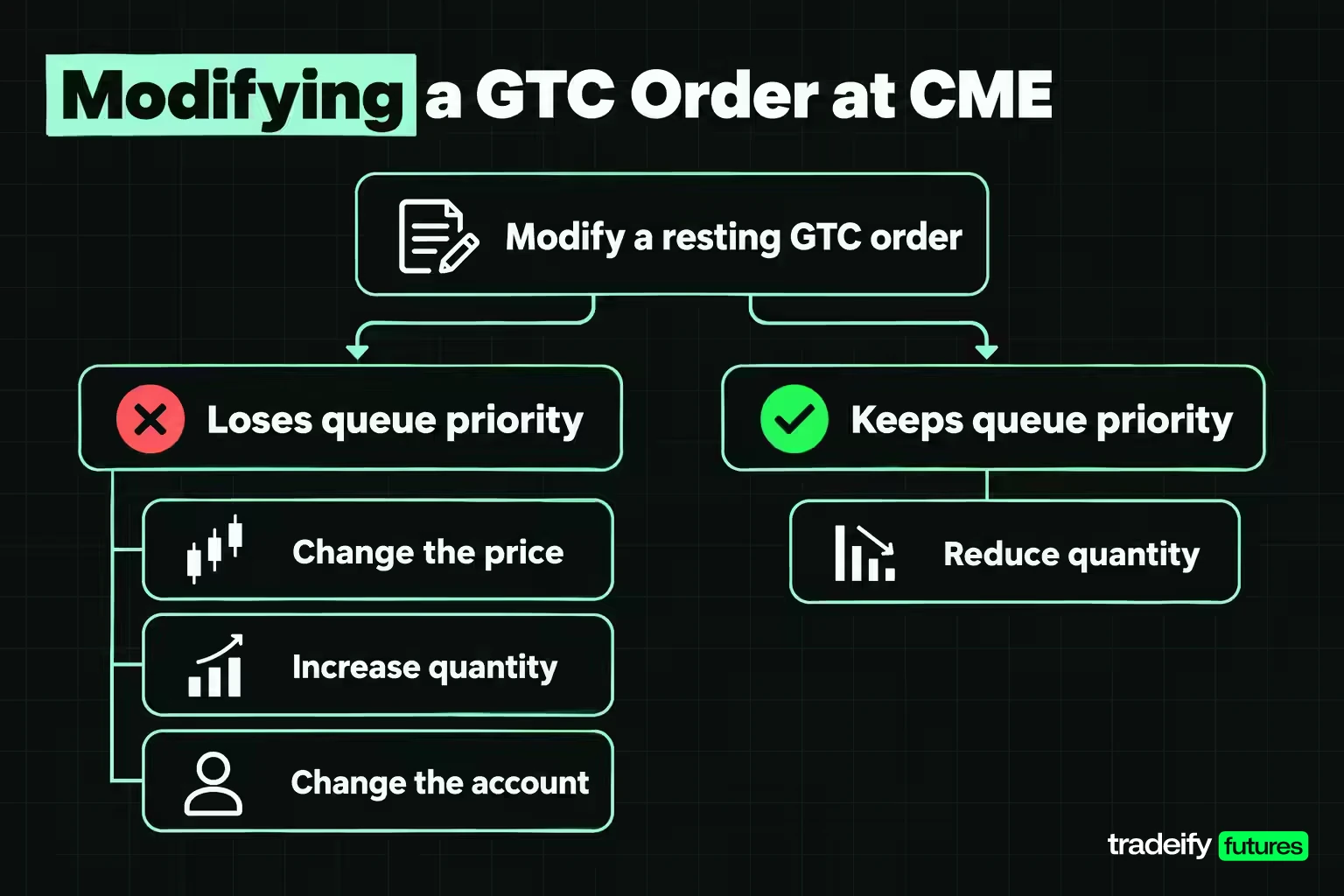
Managing a GTC order is mostly about knowing what each action does to the order's place in line and to its expiry date.
Changing a day order to GTC
On most platforms the time in force is chosen before you submit. Tradovate's help center describes Day/GTC buttons on the chart and in the Trading menu that set the flag for upcoming orders, with a separate cancel toggle for a GTD date. If an order is already working as a day order, check whether your platform lets you change its duration in place or whether you need to cancel and re-enter it. A cancel and re-enter is a brand new order with a brand new timestamp.
Modifying a GTC order without losing priority
At CME, a modified order loses its timestamp priority when you increase the working quantity, change the price, or change the account number. Reducing quantity is not on that list.
So nudging a GTC buy limit from 5,990.00 to 5,990.25 (one tick, $1.25 on MES) sends it to the back of the queue at the new price. Cutting its size from 4 contracts to 2 does not. If queue position matters to you, decide on the price before you place the order rather than adjusting it tick by tick.
Modification can also reset the expiry. Interactive Brokers says modified GTC orders get a new "Auto Expire" date at the end of the calendar quarter following the current one. That can quietly extend an order you meant to wind down.
Resting orders during a connection drop
A GTC order that is resting at the exchange or on your broker's servers does not depend on your laptop staying online. TradeStation states that its GTC orders are not canceled because you log off or lose connectivity.
At the exchange level, CME's Cancel on Disconnect service cancels resting orders when a firm's iLink connection to Globex drops unexpectedly, but it explicitly excludes GTC and GTD orders. Day orders on that connection can disappear in an outage while GTC orders keep working.
Platform-held orders are different. Some order types are held by your platform or broker until a trigger and only then sent to the exchange, so ask where your stops actually live before you rely on them during an outage.
GTC Orders After Stock Splits and Dividends
Corporate actions are a stock-market issue, and they can change or cancel a GTC order you placed weeks earlier. Futures contracts do not have dividends or splits in the same way, so this section applies to stock accounts.
FINRA Rule 5330 sets the baseline for open orders held by a member firm:
- Cash dividends. Unless the order is marked "Do Not Reduce", the open order's price is reduced by the dividend amount on the ex-dividend date (dividends under one cent, $0.01, are not adjusted).
- Stock splits and stock dividends. The price is reduced and, unless marked "Do Not Increase", the share quantity is increased by the split ratio. In a 2-for-1 split, a buy limit for 100 shares at $50 becomes 200 shares at $25.
- Reverse splits. The pending order is canceled.
- Scope. The rule covers buy orders and open sell stops, including GTC, limit and stop limit orders. It does not apply to open sell orders, open buy stops, or orders governed by exchange rules.
Schwab gives a dividend example: a GTC buy limit at $193 would normally be reduced to $192.50 on the ex-dividend date of a $0.50 dividend, unless it carries a Do Not Reduce instruction.
Broker policy can go further than the rule. Interactive Brokers cancels GTC orders when a corporate action results in a forward or reverse split, an exchange for shares or a distribution of shares, and says its multi-day orders are not reduced for dividends. TradeStation drops orders admin-canceled for a corporate action from its daily resubmission. The safe habit is simple: when a stock you have a GTC order on announces a split or a large distribution, check the order after the ex-date and re-enter it if it is gone.
Risk Management Rules for GTC Orders
A GTC order is only as safe as the routine around it. If you know the rule before the order goes in, the expiry or the fill does not surprise you later. These rules turn "I think it's still working" into something you checked.
- Write down the real end date. Take the earliest of your broker's cap, any quarter or inactivity rule, and the contract's expiration. For a December MES order that is December 18, 2026, no matter what the ticket says.
- Reconcile orders against positions every session. Every open position should have the stop and target you intended, and every working order should still match an idea you hold today.
- Use GTD around known events. If an order should not survive a data release, an earnings date or a contract roll, give it a date instead of an open end.
- Size stops for the gap, not just the level. In an illustrative weekend gap, a reopen 30 points past the stop cost $300 more than planned on 2 MES contracts. If a gap of that size would break your risk limit, the position is too large to hold through the break.
- Re-check after any modification. A price change costs queue priority, and at some brokers any change resets the expiry date.
- Clean up when you flatten. Closing a position does not always cancel its orders. Cancel leftover working orders in the instrument so nothing fires later on its own.
Time in force on an intraday-only futures account
On our accounts every position must be closed by 4:45 PM ET on regular days, with no overnight or weekend holds, so a GTC order's job is narrower. Tradovate's chart has a DAY/GTC button and WealthCharts offers both Day and GTC, so check which flag is active before you send an order. If you flatten for the day and leave a GTC entry working, it can fill in a later session and open a new position you then have to manage and close by 4:45 PM ET.
GTC Order FAQ
What does GTC mean in trading
GTC means good til canceled. It is a time in force setting that keeps an order working past the end of the trading session until it fills or is canceled. In practice brokers also cap how long a GTC order can stay open, and futures GTC orders end when the contract expires.
Can limit orders be GTC
Yes. Limit orders are the most common GTC orders, because a resting price is what traders usually want to leave in place. Stop and stop limit orders can usually carry GTC too, though the choices depend on the platform, exchange and product.
How long does a GTC order remain active
A GTC order remains active until it fills, you cancel it, or your broker's cap or the contract's expiration ends it. Published stock-account caps include 90 calendar days at TradeStation, the end of the following calendar quarter at Interactive Brokers and up to 180 calendar days at Schwab. A futures GTC order also ends when the contract expires.
Does a GTC order work in premarket and after hours
Not always. Schwab's plain GTC orders work only in the 9:30 AM to 4:00 PM ET session, and a separate GTC plus extended duration, limit orders only, covers 7:00 AM to 8:00 PM ET. Check your platform's extended hours setting rather than assuming GTC covers every session.
Is a GTC order riskier than a day order
It carries a different risk rather than a larger one. A forgotten day order vanishes at the close, which can leave a position without protection. A forgotten GTC order keeps working, which can fill on news you never planned for, so match the setting to how closely you watch your account.
This article is educational and not investment advice. Futures and other leveraged products can produce losses larger than expected, including more than your initial deposit, and stop orders can fill well beyond their trigger price when markets gap. Funded and evaluation accounts at prop firms are simulated. Order handling, time in force options and GTC limits differ by broker and change over time, so confirm them with your own broker or platform before relying on a resting order.


