



TL;DR: A fill or kill order must fill its whole quantity immediately or it is cancelled, with no partial fill and nothing left resting. IOC keeps whatever fills and cancels the rest, while FOK keeps all of it or none. On CME Globex, FOK is a fill and kill order with a minimum quantity equal to the full size. Use it when exact size matters more than getting into the trade.
A fill or kill order is the strictest instruction you can attach to an order. It says: give me the whole quantity right now, or give me nothing. Most traders meet it on an order ticket next to Day, GTC and IOC and assume it behaves like one of them. It doesn't. The difference shows up at the exact moment you care about: you click for 20 contracts and the book only has 15 at your price.
This guide covers what a fill or kill order is, how long it lasts, how it compares with immediate or cancel, all or none and a plain limit order, how futures exchanges build it, and what a killed order or a partial fill actually costs, worked through on one illustrative order book.
What Is a Fill or Kill Order
A fill or kill (FOK) order carries two requirements at once, and both are absolute.
The first is size. The order must execute in its entirety. The SEC's investor education site, Investor.gov, defines it as an order that must be executed immediately in its entirety, otherwise the entire order is cancelled, with no partial execution allowed.
The second is speed. The whole quantity has to trade on arrival, not over the next few minutes. CME Group's order qualifier documentation says FOK orders must be fully filled immediately or the entire order is canceled.
Brokers usually present FOK as a time in force setting rather than a separate order type. Interactive Brokers' glossary describes a fill or kill order as an order with the FOK time in force applied. That framing matters, because it tells you what FOK does and doesn't control:
- It controls whether you accept a partial fill (you don't).
- It controls whether you are willing to wait (you aren't).
- It does not set your price. You attach FOK to a market order or a limit order, and the price rules of that order still apply.
So a fill or kill order is a quantity and timing instruction. If you want price protection, that comes from the limit price, not the FOK label. Mixing those two up is where most FOK surprises start.
How a Fill or Kill Order Works on the Order Book

A fill or kill order never sits on the order book. It resolves the moment it arrives, which answers the most common question traders ask about FOK, how long it lasts. Effectively, no time at all.
When an FOK buy order reaches the exchange, the matching engine checks whether the full quantity can trade against resting sell orders at the order's price or better. If yes, every contract fills and you hold the full position. If no, the whole order is cancelled and you hold nothing.
A Cboe rule change notice published in the Federal Register spells out the mechanism: market or limit orders, and their unexecuted portions, with times in force of immediate or cancel or fill or kill are cancelled rather than entered into the book. Limit orders marked day, GTC or GTD may enter the book. Cboe's own rule text describes FOK as an order to be executed in its entirety as soon as the system receives it and, if not, cancelled.
That one property drives most of the practical differences:
- You cannot cancel or modify a fill or kill order after you send it, because there is nothing left to cancel.
- You cannot watch it work in your working orders list. If a "fill or kill" order is still sitting there, the instruction that reached the market was something else.
- You cannot use it as a resting stop or target, because resting is the one thing it can't do.
Some broker help pages describe FOK as "good only for the current day". Fidelity's order conditions page does, while also saying the order is either immediately completed in its entirety or canceled. Read that as the order being valid for submission during the session, not as a day-long wait.
Related lesson: How resting orders queue at each price
Day, GTC, IOC and FOK Time in Force Compared
Time in force is the part of an order that says how long it stays alive and what happens to any quantity that doesn't fill. FOK is one setting among several, and it sits at the extreme short end.
CME Group's order qualifier page lists the futures versions. A Day order is active only during that trading day and expires at the end of it, and CME Globex assumes every order is a day order unless told otherwise. A good till cancel (GTC) order stays on the book until it is completely executed, cancelled or the contract expires. A good till date (GTD) order lasts until a date you choose. A fill and kill (FAK) order, CME's name for immediate or cancel, trades whatever it can at once and cancels the balance.
All or none (AON) is a condition you'll meet at stock and options brokers. The SEC's investor bulletin on order types describes it as an order that must execute in its entirety or not at all, and unlike FOK, an AON order that doesn't execute immediately remains active until it is executed or cancelled.
| Setting | How long it lives | Can it rest on the book | Partial fill allowed |
|---|---|---|---|
| Day | Until the end of the trading day | Yes | Yes |
| GTC | Until filled, cancelled or the contract expires | Yes | Yes |
| GTD | Until filled, cancelled or the chosen date | Yes | Yes |
| IOC or FAK | Only at submission | No | Yes, the rest is cancelled |
| AON | Until filled or cancelled | Yes, where offered | No |
| FOK | Only at submission | No | No |
Broker limits on these settings vary. Fidelity, for example, says its GTC orders are generally good for 120 days, while CME's GTC lasts until the contract expires. Read the time in force definitions on the platform you actually use.
Related lesson: Where each order type sits
Fill or Kill vs Immediate or Cancel and GTC
Fill or kill and immediate or cancel share the same clock and disagree on size. Both live only at submission. The difference is what happens when the market can't fill everything.
The SEC's bulletin puts it plainly. An IOC order must execute immediately, and any portion that can't be filled immediately is cancelled. An FOK order must execute immediately in its entirety, or the whole order is cancelled.
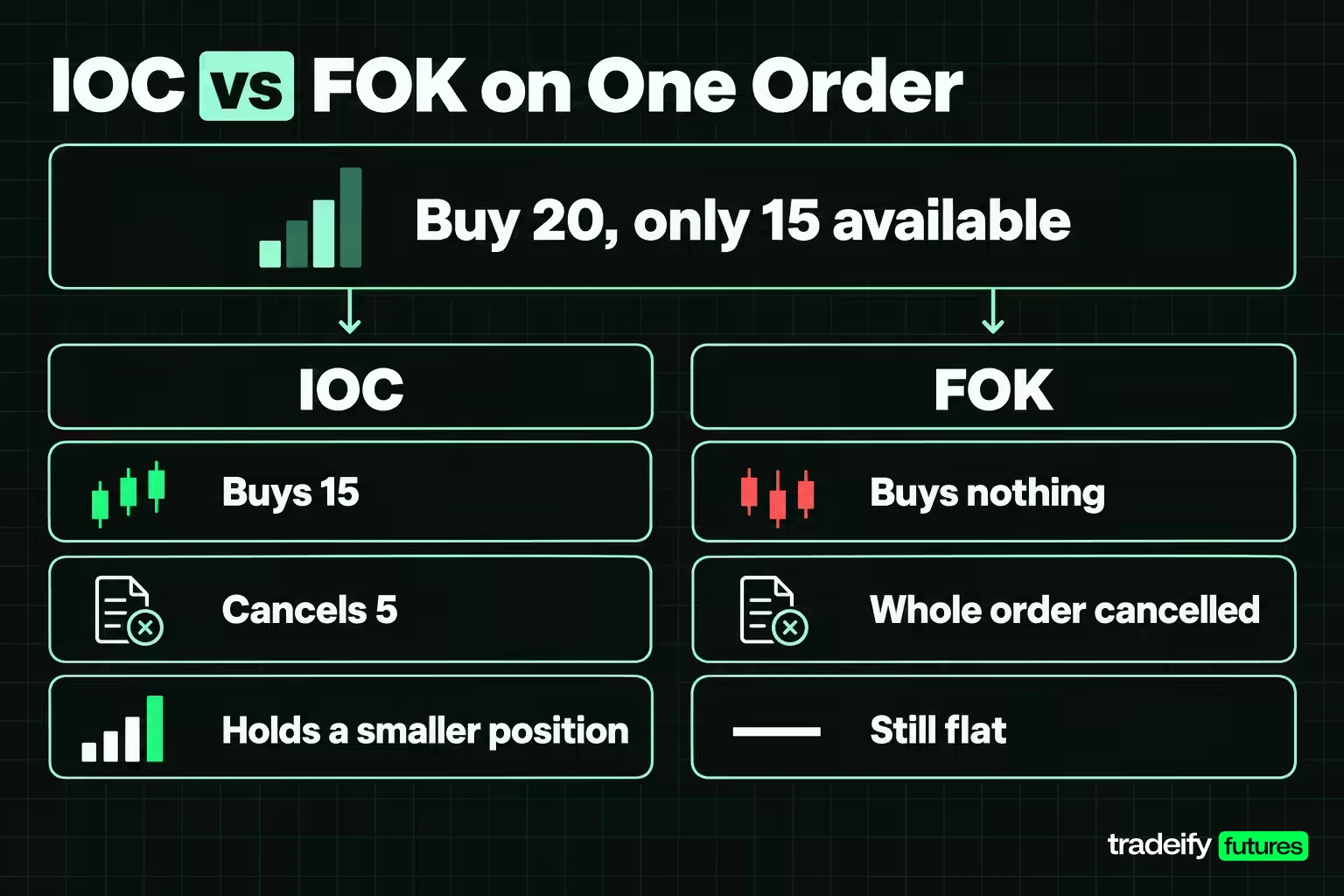
Run a 20-contract buy against 15 contracts available at your price:
- IOC buys 15 and cancels 5. You now hold a position three quarters the size you planned.
- FOK buys nothing. The whole order is cancelled and you are still flat.
Neither outcome is wrong. IOC is for when some exposure beats none. FOK is for when a partial position would be a problem in itself, because your stop, target and dollar risk were all built for 20 contracts, not 15.
GTC belongs in the comparison because it sits at the opposite end of the time scale. A GTC limit order for 20 contracts would buy the 15 available, then rest the remaining 5 on the book, potentially for days, until the price comes back, you cancel it, or the contract expires. FOK refuses to wait even a second. GTC is willing to wait almost indefinitely.
The American Association of Individual Investors sums up the relationship neatly: a fill or kill order is in essence a combination of an all or none order and an immediate or cancel order. It takes the speed from IOC and the size rule from AON.
Related lesson: What happens to the unfilled remainder of an IOC order
FOK vs All or None Orders
FOK and all or none (AON) share the size rule and differ on patience.
Both refuse a partial fill. Cboe's options rules make the overlap explicit: the system considers an FOK order to be an AON order. But an AON order can wait. Per AAII, an AON order remains active until cancelled, while an FOK order is cancelled immediately if the full quantity isn't available.
In practice:
- AON says "all of it, whenever it becomes available".
- FOK says "all of it, right now, or forget it".
There's a futures wrinkle worth knowing. CME Globex's order qualifier list includes Day, GTC, GTD, FAK, FOK, minimum quantity and display quantity, with no all or none qualifier. If you trade CME futures, the full-size-only choice you have is FOK, and the waiting version simply isn't on the menu. AON is mostly a stock and options broker feature.
Related lesson: The size-first instruction without the time limit
FOK vs a Plain Limit Order
A plain limit order sets the worst price you'll accept. It does not care about size or speed. A buy limit at a given price can fill some contracts, rest the remainder on the book, and keep filling over time as sellers arrive.
Adding FOK to that limit order changes two things. The order can no longer rest, and it can no longer fill partially. The price limit stays exactly where it was.
One misunderstanding is worth clearing up. A fill or kill limit order doesn't mean every contract fills at one price. It means every contract fills at your limit or better, which can include several price levels. If the best offer has 6 contracts and the next level has 9, a 15-contract FOK at the higher price takes both levels. Your average lands between them, and the worst contracts fill at your limit.
A related question comes up often: what is the difference between a stop price and a limit price? A stop price is a trigger. When the market trades there, the order activates. A limit price is a boundary on what you'll pay or accept once the order is live. A stop-limit order uses both, and neither is the same thing as FOK, which controls quantity and timing rather than price.
Related lesson: How limit orders fill or miss
A Fill or Kill Example on 20 MES Contracts
Definitions only go so far. Here's one order intent priced against an illustrative order book.
You want to buy 20 Micro E-mini S&P 500 (MES) contracts. Per CME Group's contract specifications, MES is $5 times the S&P 500 index, so one index point is $5 per contract, and the minimum tick is 0.25 points, or $1.25.
The ask side of the book holds three levels. These are round illustrative prices, not a quote:
| Ask price | Contracts offered |
|---|---|
| 6,039.75 | 6 |
| 6,040.00 | 9 |
| 6,040.25 | 12 |
That's 27 contracts offered, but only 15 at 6,040.00 or better and only 6 at the best price. Now run four instructions against it.
FOK limit at 6,040.00 gets killed
A fill or kill buy for 20 at 6,040.00 can reach only 15 contracts at that price or better. Fifteen isn't 20, so the order is killed with nothing filled. You are as flat as before you clicked, and the only cost is time, because the book may move while you decide what to do next.
FOK limit at 6,040.25 fills across three levels
The same fill or kill order at 6,040.25 can reach all 20 contracts: 6 at 6,039.75, 9 at 6,040.00 and 5 at 6,040.25. The average fill is 6,039.9875, which is 0.2375 points above the best ask. On 20 MES contracts that's $23.75 of slippage against the best offer. On the same ladder in E-mini S&P 500 (ES), which is ten times the size of MES, it would be $237.50.
One tick on the limit took the order from a 0% fill to a 100% fill. That's the real lever in an FOK order: the limit you set defines how deep into the book you're willing to go to get all of your size.
A market FOK for 20 would fill the same way here, sweeping the ladder up to 6,040.25. With no limit, though, nothing stops it going deeper if the book is thinner than it looks.
IOC at 6,040.00 leaves a partial
An immediate or cancel buy for 20 at 6,040.00 fills 15 contracts at an average of 6,039.90 and cancels the remaining 5. This is the outcome a fill or kill order exists to prevent. Fifteen contracts against a plan built for 20 is a different trade, and finishing it usually means paying more than you planned.
Related lesson: What it costs to take liquidity in a hurry
What the Unfilled Remainder Costs on a Risk Plan
A partial fill rarely hurts on its own. The damage usually comes from what you do with the remainder, so it's worth pricing on the risk plan rather than on the fill. The numbers here use an illustrative Micro E-mini S&P 500 (MES) order book, at $5 per index point: 20 contracts wanted, 15 filled at an average of 6,039.90 by an IOC order at 6,040.00.
Say the plan was 20 MES contracts entered at 6,040.00 with a stop 12 points lower at 6,028.00. At $5 a point, that's $1,200 of planned risk.
The IOC gives you 15 contracts at 6,039.90. With the stop at 6,028.00, those 15 carry $892.50 of risk, which is 75% of the planned size and about 74% of the planned risk. That's not a disaster. It's an unfinished trade.
Finishing a partial fill at a worse price
Now suppose you buy the missing 5. Your own order took two levels out of a thin book, so the best ask has moved to 6,044.00. Buying 5 there gives a blended average of 6,040.925 on all 20 contracts.
Recompute the risk on the full position: 12.925 points times 20 contracts times $5 is $1,292.50. The plan was $1,200. You're $92.50 over, or 7.7% over the risk you wrote down, before commission.
| Path | Filled | Average entry | Full-position risk | Against the $1,200 plan |
|---|---|---|---|---|
| FOK at 6,040.00 | 0 of 20 | No position | None | Setup missed |
| FOK at 6,040.25 | 20 of 20 | 6,039.9875 | $1,198.75 | $1.25 under |
| IOC at 6,040.00 then 5 more at 6,044.00 | 15 then 5 | 6,040.925 | $1,292.50 | $92.50 over |
FOK didn't win this comparison by being cheaper. It won by being final. Either you were in at a known size and a known average, or you were out.
The maximum re-entry price
If you hold the 15-contract partial and still want 20 contracts inside the same $1,200, the full position's average entry can't exceed 6,040.00. That puts the maximum price for the last 5 contracts at 6,040.30. That's 0.40 points above the 6,039.90 you already paid and only $1.50 per contract more than the 6,040.00 you originally wanted.
In plain terms, the trade stays inside the plan only if the market comes back almost exactly to where you started. If it doesn't, the disciplined answer is to keep the 15, leave the stop where it is, and accept a smaller position. That's harder than it sounds when price is running without your last 5 contracts, which is why the number belongs in your plan before the entry, not after the partial.
Chasing the whole 20-lot 6 points higher would have added $600 of risk. A chase on the full size is far more expensive than a chase on the leftover, which is why the leftover is the failure mode to plan for.
Related lesson: What a partial fill does to your average
How Fill or Kill Works in Futures on CME Globex
On CME Globex, fill or kill isn't a standalone order type. It's assembled from two parts. CME's documentation says an FOK order is created by using the fill and kill (FAK) qualifier and setting the minimum quantity to the total order quantity.
Minimum quantity is the real setting
CME's minimum quantity rules work like this. At least the minimum must fill immediately on entry, or the entire order is cancelled. If the minimum or more fills, the remaining quantity is handled by the order's time in force.
That gives a futures trader three distinct outcomes from one setting. Take an illustrative book with only 15 contracts offered at 6,040.00 or better and a 20-contract buy at 6,040.00:
- FAK for 20 with a minimum quantity of 10 at 6,040.00: 15 is at least 10, so 15 fill and 5 are cancelled.
- A Day limit order for 20 with a minimum quantity of 10 at 6,040.00: 15 fill and the remaining 5 rest on the book at 6,040.00.
- FAK for 20 with a minimum quantity of 20, which is FOK: nothing fills and the order is cancelled.
If your platform shows a minimum quantity field, that field is what the exchange actually sees.
Market state decides between cancelled and rejected
CME says FAK and FOK orders are accepted during the Open market state only and are rejected during any other market state. Open is the continuous trading phase, when order matching runs.
CME's market state documentation lists the others. In Pre-Open, orders can be entered but nothing matches. In Pause, only cancellations are allowed. Velocity Logic can briefly move an instrument into a reserved state after a fast move. Post-Close accepts only GTC and GTD orders. An FOK sent in any of these states is rejected, not killed.
A rejection and a kill are different events. A kill means the market looked at your order and couldn't fill it. A rejection means the order was never eligible to trade. If an FOK order didn't fill, read the message before you conclude the liquidity wasn't there.
What a Kill Order Means in Trading
In trading, "kill" is shorthand for cancel. The word shows up in three different places, and it helps to keep them apart.
The first is the kill inside a fill or kill order. It's automatic. The exchange cancels the entire order the instant it can't fill in full, with no action from you.
The second is a manual cancel. Traders often say they "killed" a working limit or stop order when they pulled it from the book. That only applies to orders that rest, so it never applies to a fill or kill order, which has already finished by the time you could click.
The third is a firm-level kill switch. CME Globex offers clearing firms a Kill Switch that shuts down a firm's activity in one step. When it is activated, all order entry is blocked and all working orders are cancelled for the selected IDs. That's a risk tool for firms, not something a retail trader triggers from an order ticket, but it's where the phrase "kill all orders" comes from in exchange language.
How to Place an FOK Order
Placing a fill or kill order is simple on platforms that offer it. The work is in the checks before you send it.
- Confirm your platform offers FOK, and find out what it sends. Some show FOK as a time in force choice. Some show FAK or IOC with a minimum quantity field. Some don't offer it at all.
- Check the depth at your limit price, not just the best bid or offer. Add up the size at every level you're willing to reach.
- Enter the side, quantity and order type, usually a limit order. Set the limit at the worst price you'll accept on any contract in the order.
- Choose FOK as the time in force, or set the minimum quantity equal to the order quantity.
- Confirm the market is open for continuous trading. On CME Globex, FOK sent outside the Open state is rejected.
- Read the result: a full fill, a kill, or a rejection. Each one means something different for your next decision.
Stock brokers can add their own conditions. Fidelity, for example, accepts fill or kill orders only during market hours on orders of 101 shares or more, and not on stop orders or short sales.
Fill or Kill Orders in Stocks and Options
Fill or kill started as a stock and options instruction, and that's still where most traders see it.
In US equities, the SEC's definition applies, and individual brokers add their own rules. Fidelity's are typical: FOK only during market hours, only on orders of 101 shares or more, and not on stop orders or short sales.
In listed options, exchange rules treat FOK as a form of all or none. Cboe's rules say its system considers an FOK order to be an AON order, and older Cboe rule text deemed fill or kill orders all or none for its trading rules. Interactive Brokers' glossary notes that FOK is typically used for options orders, where a trader may need the full number of contracts at one moment.
In futures, the CME Globex version applies: a fill and kill order with a minimum quantity equal to the full size, accepted only in the Open market state.
When to Use a Fill or Kill Order
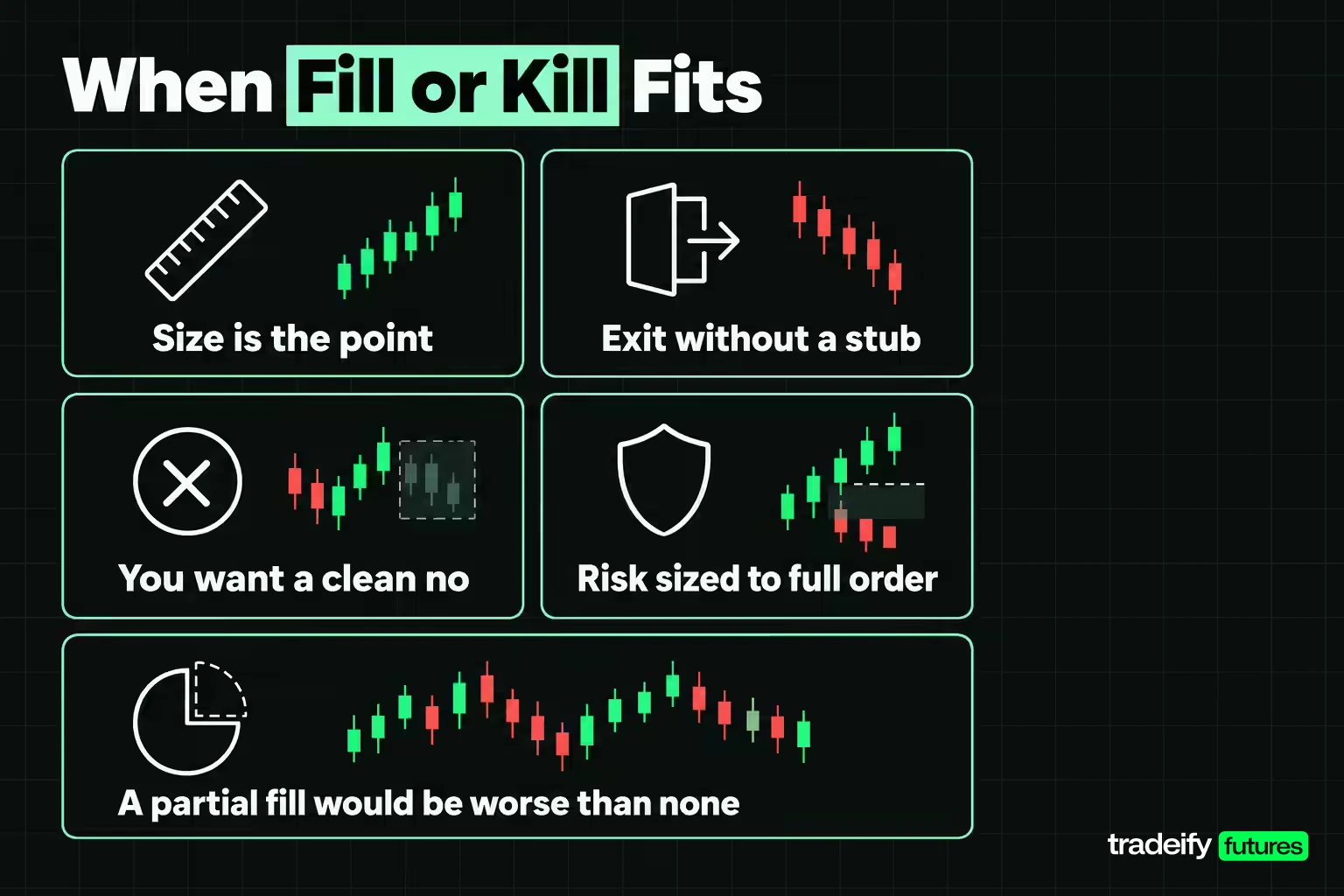
A fill or kill order fits a narrow set of situations, and the common thread is that a partial fill would be worse than no fill.
- The size is the point. If a position only makes sense at full size, a partial leaves you holding something you didn't plan. AAII notes that FOK orders are usually large orders placed by institutional investors, often paired with a market or limit order.
- Exiting without leaving a stub. A partial exit can leave a small leftover position with a stop and target sized for something else. FOK makes the exit all or nothing.
- You want a clean no. In a thin market, a kill tells you immediately that the size isn't there at your price, instead of leaving you managing a fragment.
- Your risk plan is sized to the full order. If the stop, the target and the dollar risk were all computed for 20 contracts, FOK keeps the trade you get matched to the trade you planned.
It works against you when the setup matters more than the exact size. In a fast market, an FOK order can be killed again and again while the move you identified goes without you. AAII's blunt note fits here too: the average individual investor probably won't trade in the quantities that require an FOK.
Fill or Kill Risks and Failure Modes
The main risk of a fill or kill order is the one built into its name: non-execution. A kill doesn't cost money directly. It costs the trade, and sometimes the trade was the good part.
That creates its own pressure. Traders rarely revenge trade a killed order the way they do a loss, but the urge after a kill is familiar: loosen the limit, resend immediately, take the next price that appears. The order did its job. The decision after the kill is where a rule helps, such as one resend at most, at a limit you chose before the first attempt.
| Failure mode | What it looks like | What it costs |
|---|---|---|
| Killed for being short of size | 15 contracts available against a 20-lot order | The setup passes and you stay flat |
| FOK treated as price protection | Assuming every contract fills at one price | You can pay your limit price on part of the order |
| Sent in the wrong market state | Order rejected rather than killed | A missed entry and a message easy to misread |
| Used on a thin contract | Repeated kills and resubmissions | Attention, time and a habit of loosening the limit |
| Partial assumed then chased | Finishing an IOC remainder at a worse price | Full-position risk above the plan |
| Used when exposure was the goal | No position on a valid idea | A missed move, often the costliest outcome |
AAII also warns that setting unrealistic limits can delay fulfilment. For FOK the effect is sharper: an unrealistic limit doesn't delay the order, it ends it.
A Pre-Trade Checklist for Time in Force Choices
Before you attach FOK or IOC to an order, run through the basics. Most of these take seconds, and each one maps to a way traders get caught:
- Decide what matters more on this trade, the exact size or simply getting a position.
- Check the depth of the book at your limit price, not only the best bid or offer.
- Confirm the full size is available at or better than your limit before you send.
- On futures, confirm the market is in continuous trading so the order isn't rejected.
- Read your platform's definition of fill or kill rather than assuming it matches the exchange rule.
- If you accept a partial fill, decide the remainder rule in advance: a maximum re-entry price, or no re-entry.
- Keep the stop sized to the position you actually hold, and adjust the size, not the plan.
On our accounts, the order-entry guides in our Help Center document Day and GTC time in force on Tradovate, through the order flags on the chart, and on WealthCharts. They don't describe a fill or kill setting, so check the order ticket on your platform before planning around one. Whatever instruction you use, positions on our accounts must be closed by 4:45 PM ET, so an FOK entry is still an intraday trade.
Related lesson: Reading the size sitting at each price
Fill or Kill Order FAQ
How long does a fill or kill order last?
It lasts only as long as it takes to check the book on arrival. The order fills in full immediately or is cancelled. It never rests on the order book, so there's nothing left to cancel afterward.
Can a fill or kill order partially fill?
No. Partial execution isn't allowed, which is the reason the instruction exists. If you received fewer contracts than you ordered, the instruction that reached the market was IOC, FAK or a plain limit order.
Is a fill or kill order the same as immediate or cancel?
No. Both act only at submission, but IOC keeps whatever fills and cancels the rest. A 20-contract IOC against 15 available contracts leaves you with 15. The same FOK order leaves you with none.
Is a fill or kill order the same as all or none?
They share the size rule but differ on timing. An all or none order can stay active until it fills or is cancelled. A fill or kill order is cancelled immediately if the full size isn't available.
Why was my fill or kill order rejected?
On CME Globex, FOK orders are accepted only during the Open market state, when continuous trading runs. Sent during Pre-Open, a pause or after the close, they are rejected. Some platforms also reject FOK if they don't support it.
What is the difference between a stop price and a limit price?
A stop price is a trigger that activates an order when the market trades there. A limit price caps what you'll pay or sets the minimum you'll accept. A stop-limit order uses both, and FOK can be added to a limit order to require a full, immediate fill.
Trading futures involves substantial risk of loss and isn't suitable for everyone. Futures are leveraged, so losses can exceed what you expect and can build quickly, and order instructions such as fill or kill don't remove market, liquidity or slippage risk. Funded and evaluation accounts at prop firms are simulated, and simulated results don't reflect live market execution. This article is educational and isn't investment advice.


