



TL;DR: The best order type for day trading depends on whether this trade needs a guaranteed fill or a guaranteed price. Market orders buy speed, limits protect price but may not fill, and stops are triggers, not exit prices. On one MES setup, five order types gave fills 5 ticks apart, or $6.25 per contract. A planned $80.00 stop lost $110.00 after slippage and $150.00 when a stop-limit skipped. Choose the entry and exit orders separately, and size for the worse fill.
There is no single best order type for day trading. Every order you send makes one trade-off: you can be sure of getting filled, or you can be sure of the price, but not both at once. Which one you need changes from trade to trade, and sometimes from the entry to the exit of the same trade.
This guide explains what each order type actually does, follows an order from click to fill, and prices one futures setup five different ways so you can see the cost of each choice in ticks and dollars before you pick one.
Why No Single Order Type Is Best for Day Trading
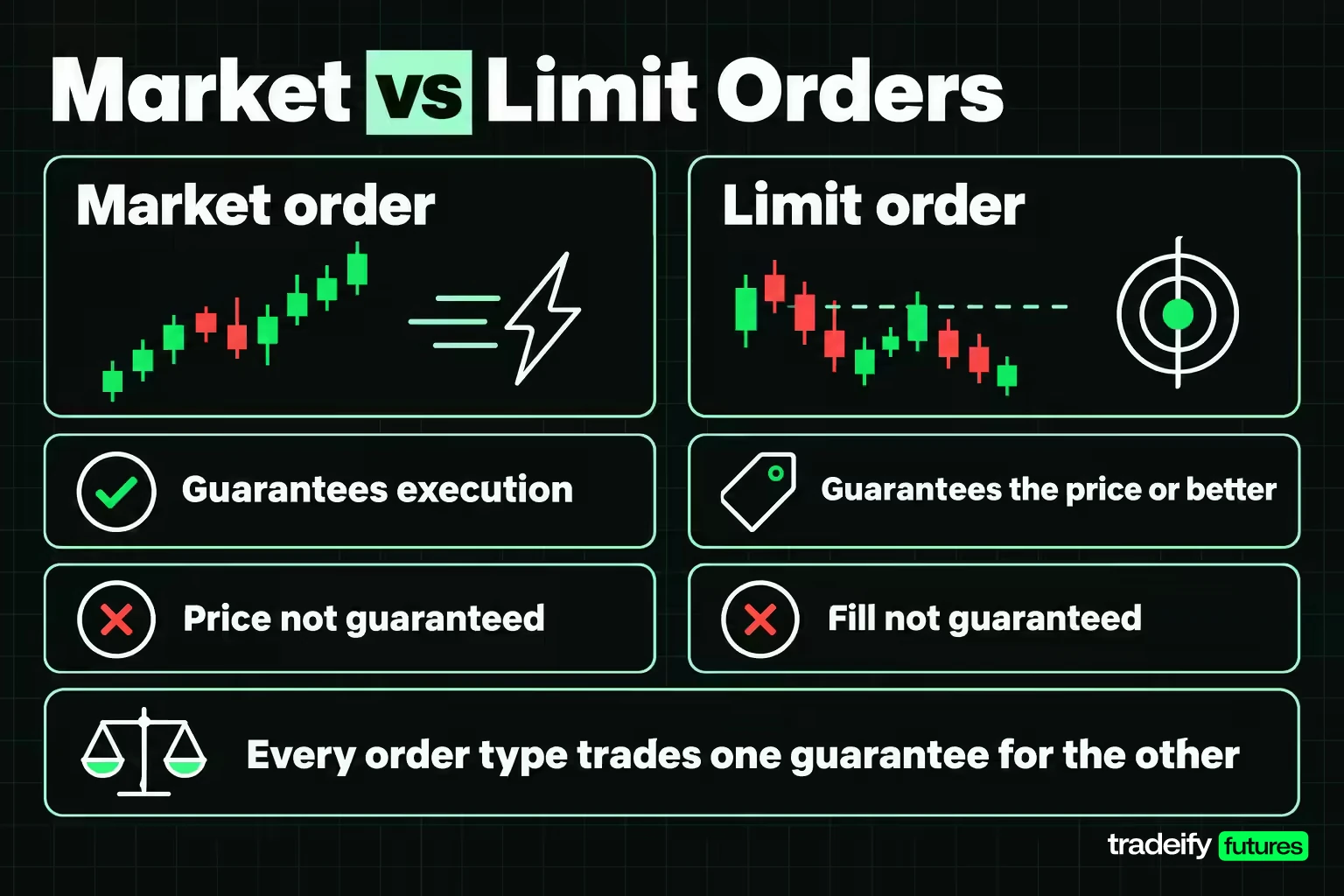
Choosing an order type is really choosing which guarantee you want. A market order guarantees execution but not the execution price, according to the SEC's investor education site. A limit order guarantees the price, or better, but the SEC's bulletin on order types is just as direct that a limit order is not guaranteed to execute.
Every other order type is a variation on those two positions:
- A stop order waits for a trigger price, then behaves like a market order.
- A stop-limit order waits for a trigger, then behaves like a limit order.
- A trailing stop is a stop whose trigger moves with the market in your favor.
- Time-in-force settings, such as Day or good-til-canceled, decide how long any of those orders keeps working.
- Bracket and OCO orders link several orders so that one filling cancels or activates another.
That is why "which order type is best" has no universal answer. The useful version of the question is narrower: for this trade, right now, do I need to be in (or out), or do I need a specific price?
When the answer is "I need to be out," an order that might not fill is the wrong tool, however good its price. When the answer is "this trade only works at 6000.00," an order that fills anywhere is the wrong tool, however fast it is.
Related lesson: Order Book
Market Orders and When Speed Beats Price
A market order tells the market to fill you now at the best price available. The Investor.gov definition says a market order generally executes at or near the current ask for a buy and the bid for a sell, and warns that the last traded price is not necessarily the price you get.
That gap between the last price and your fill is the first thing to understand. If the last trade printed at 6000.00 but the best offer is 6000.25, a market buy pays 6000.25. If the offer moves before your order arrives, you pay whatever is offered next.
Size adds a second layer. The SEC bulletin notes that parts of a large market order may execute at different prices because there is not enough liquidity at one price. A market order does not stop at the first level of the book. It keeps working through the levels until your quantity is filled.
Market Orders on Futures Exchanges
On CME Globex, a market order is a market order with protection. CME's client documentation explains that the exchange adds protection points to the best offer for a buy (or subtracts them from the best bid for a sell) and only fills within that protected range. Any quantity that cannot fill inside the range rests in the book as a limit order at the edge of the range.
So a futures market order is not unlimited. It can, however, still fill several ticks away from the price on your screen, and part of it can end up resting rather than filled. Check the order status after a fast-market fill instead of assuming you got the full size.
When a Market Order Makes Sense
Market orders earn their place when being filled matters more than the price:
- Exiting a position that is going against you and your stop has not been placed or has failed.
- Joining a move where the plan is valid at any nearby price and the spread is one tick.
- Flattening before a deadline you cannot miss, such as a session close.
They are expensive when the spread is wide, the book is thin, or your size is large relative to the visible depth. On a contract quoted one tick wide, a small market order usually costs one tick. In a thin market the same click can cross several levels.
Related lesson: Market Orders
Limit Orders and When Price Beats the Fill
A limit order sets the worst price you will accept. Investor.gov defines it simply: a buy limit can only execute at the limit price or lower, and a sell limit only at the limit price or higher.
That control comes with a cost. A limit order fills only if the market reaches your price and enough opposite orders trade against yours. If price stops one tick short, you have no trade, however right the idea was.
Queue Position and Partial Fills on Limit Orders
A resting limit order joins a queue. On CME Globex, the default matching rule for many products is first in, first out: orders at the same price fill in the order they arrived. If other traders' bids were already resting at 6000.00 before your two contracts, their orders trade first.
Two practical results follow:
- A market can trade at your limit price without filling you, because the volume at that price went to orders ahead of you.
- You can be partly filled. CME's documentation says any portion of a limit order that can be matched executes immediately, and the rest stays on the book until it is executed, cancelled or expires.
A limit order is only certain to fill when price trades through it, to a better price than your limit.
When a Limit Order Makes Sense
Limit orders suit trades where the level is the whole point:
- Pullback entries into a level you planned in advance.
- Profit targets, where the exit price is the reason the order exists.
- Scalps, where one tick of spread is a large share of the target.
- Any market where the spread is wider than usual.
A useful test before you send one: if this limit does not fill and price runs away, will you chase it? If the honest answer is yes, the limit was never your real order, and you should decide in advance whether a missed fill means "no trade" or "re-enter at market."
Related lesson: Limit Orders
Stop Orders and Buy Stops vs Sell Stops
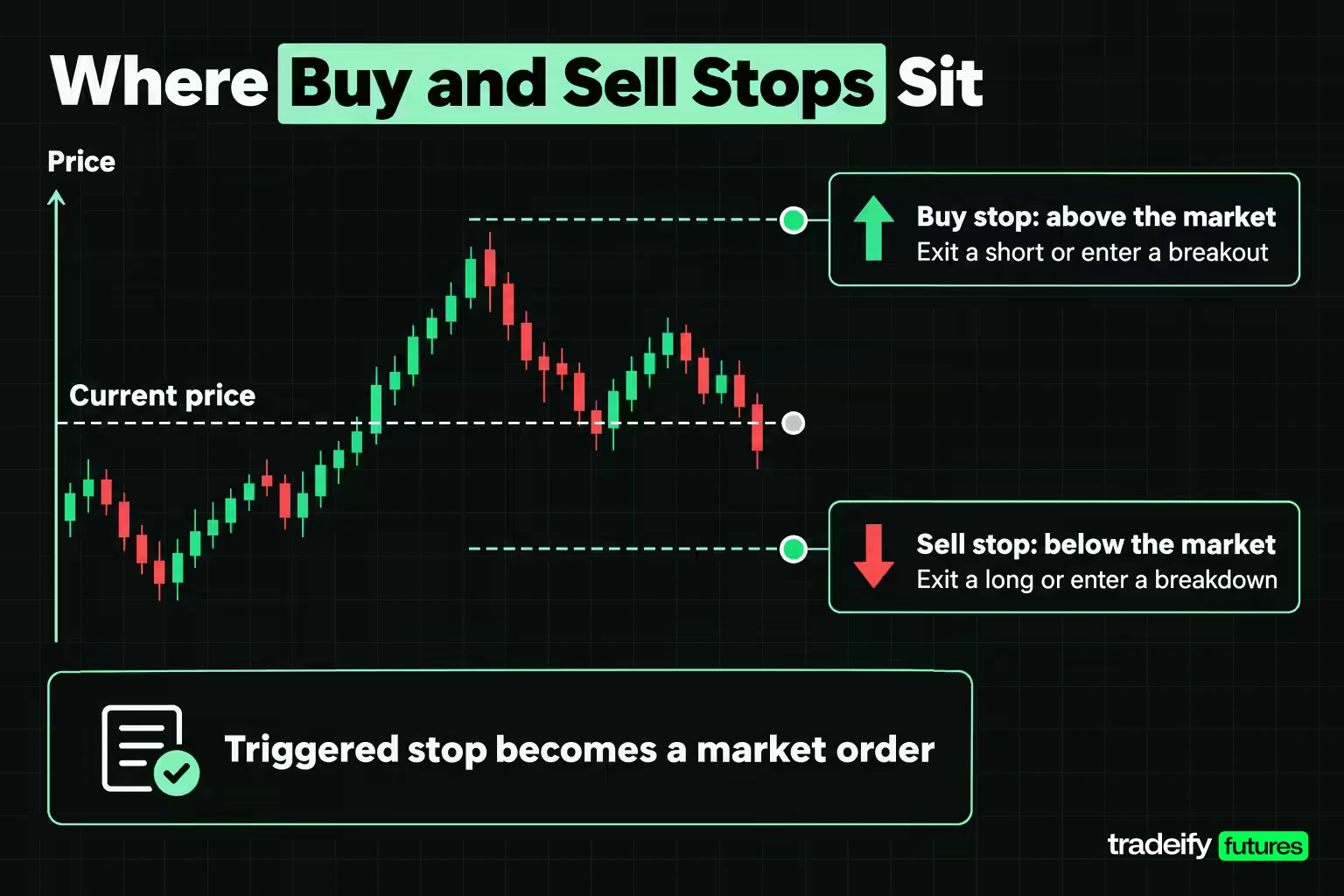
A stop order sits dormant until price reaches a level you choose, called the stop price. Once that price is reached, the stop becomes a live order. Investor.gov says that when the stop price is reached, a stop order becomes a market order.
Stop orders come in two directions:
- A buy stop is placed above the current market price. You use it to exit a short position if price rises, or to enter long on a breakout above a level.
- A sell stop is placed below the current market price. You use it to exit a long position if price falls, or to enter short on a break below a level.
The direction rule is enforced. CME's documentation says a buy stop's trigger must be above the last traded price and a sell stop's trigger below it during the continuous session. A buy stop placed below the market is rejected, which is usually the first sign that the order was set up on the wrong side.
Why a Stop Price Is Not an Exit Price
The single most expensive misunderstanding about stop orders is treating the stop price as the price you will get. The SEC bulletin is explicit: the stop price is a trigger, not a guaranteed execution price, and the fill can deviate significantly from the stop price.
Once triggered, the order competes for whatever liquidity is left. In an orderly market that might be one tick past your level. In a fast market, after a data release or through a thin patch of the book, it can be several points.
Venues also differ on what counts as reaching the stop. The SEC bulletin notes that some use last-sale prices and others use quotes, which is why a stop can trigger on a quote you never saw trade.
Stop Orders on CME Globex
On CME Globex, a stop is a stop with protection. CME describes it as activating when the market trades at or through the trigger, then entering the book as a market order with a protection limit set at the trigger plus or minus a set number of protection points (usually half the product's non-reviewable range). It fills at prices between the trigger and that limit, and any remainder rests at the protection limit.
In practice, a futures stop can partly fill and leave some contracts working at a price the market has already moved past. If a stop looks ignored in a fast move, check whether part of the order is still resting before you send another exit.
Related lesson: Stop Orders
Stop-Limit Orders and Trailing Stop Orders
Stop-limit and trailing stop orders are the two most common variations on a plain stop. Each solves one problem and creates another.
How a Stop-Limit Order Works
A stop-limit order has two prices: a trigger and a limit. CME's documentation describes it this way: once the trigger trades, the order enters the book as a limit order at your limit price, it can fill at any level between the trigger and the limit, and any unfilled quantity stays on the book as a limit order.
The stop and limit do not have to match. The SEC's example is a sell stop-limit with a $3.00 stop and a $2.50 limit, which becomes active at $3.00 but can only sell at $2.50 or better.
The appeal is obvious: no fill worse than your limit. The risk is just as clear. If price gaps or runs past your limit, nothing fills, and you still hold the position you wanted out of. A stop-limit protects your price, not your account.
That is why many traders use stop-limits for entries (missing a breakout costs nothing) and plain stops for exits (missing the exit can cost a great deal).
Related lesson: Stop-Limit Orders
What a Trailing Stop Loss Is
A trailing stop is a stop whose trigger moves with the market. The SEC defines it as a stop or stop-limit order set a fixed percentage or dollar amount away from the market price. When price moves in your favor, the trigger follows. When price moves against you, the trigger stays where it is.
An illustrative futures example on Micro E-mini S&P 500 (MES) futures, which CME specifies at $5 per index point with a 0.25-point tick worth $1.25:
- You buy one MES at 6000.00 with a 4.00-point trailing stop, so the first trigger is 5996.00.
- Price rallies to 6010.00. The trigger trails up to 6006.00.
- Price then falls. The trigger stays at 6006.00 and, if it triggers, the trade exits around +6.00 points, or $30.00 per contract before slippage.
Trailing stops suit trend days, where you want to stay in while the move continues. On choppy days, a tight trail tends to get hit by normal noise, so the trail distance should come from how far the market usually pulls back, not from how much profit you want to keep.
Related lesson: Trailing Stop Orders
What Happens to an Order After You Click
The path an order takes from your platform to the exchange explains most of the fill surprises day traders run into.
- You build the order in your platform: instrument, side, quantity, order type, price and time-in-force.
- Your broker or clearing firm runs pre-trade checks, such as position limits and available funds. An order that fails these checks is rejected before it reaches the exchange.
- The exchange's matching engine receives it. A marketable order (a buy at or above the best offer, or a sell at or below the best bid) trades against resting orders at once. Anything else rests in the order book.
- The exchange sends execution reports back: an acknowledgement, then one report per fill. A single order can produce several partial fills at different prices.
- Whatever is not filled keeps working until it fills, you cancel it, or its time-in-force expires.
Partial Fills and Resting Order Remainders
An order that is only partly filled keeps working, and CME's documentation shows how often that happens. A market-limit order that only partly fills turns into a limit order for the remainder. A stop with protection that runs out of room rests its remainder at the protection limit. A limit order stays on the book until it is executed, cancelled or expires.
Each of these leaves an order working after you think you are done. Before sending a second exit or a new entry, read the order status, not just the position size.
Related lesson: How Trade Execution Works
One Day Trading Setup Submitted as Five Order Types
Definitions only go so far until you put numbers on them. Here is one illustrative day trading setup, priced five ways, on MES futures ($5 per point, 0.25-point tick, $1.25 per tick per contract).
The market is quoted 6000.00 bid and 6000.25 ask. The written plan says: buy two contracts if 6001.00 breaks. Now submit that same plan as five different orders and replay it down two paths, a follow-through to 6006.00 and a rejection to 5995.00.
| Order submitted | Fill | Versus the 6001.00 plan level | Follow-through to 6006.00, 2 lots | Rejection to 5995.00, 2 lots |
|---|---|---|---|---|
| Market order | 6000.25 | 3 ticks below | +5.75 points, +$57.50 | -5.25 points, -$52.50 |
| Buy limit at 6000.00 | 6000.00, if a seller hits it first | 4 ticks below | +6.00 points, +$60.00 | -5.00 points, -$50.00 |
| Buy stop at 6001.00 | 6001.25 | 1 tick above | +4.75 points, +$47.50 | -6.25 points, -$62.50 |
| Buy stop-limit 6001.00, limit 6001.25 | 6001.25 | 1 tick above | +4.75 points, +$47.50 | -6.25 points, -$62.50 |
| Buy limit at 5998.50 | No fill, low was 5999.00 | No position | No trade | No trade |
The filled entries span 1.25 points, five ticks, or $6.25 per contract ($12.50 on two contracts) from the same idea, purely because of the mechanism used.
What the Five Entry Orders Reveal About Order Choice
Read the two outcome columns together, because the order type looks good or bad depending on a path you cannot know in advance.
- The resting limit at 6000.00 got the best price on both paths, but it also ignored the plan. It only fills if a seller hits the bid before the breakout, and on a clean breakout it may never fill at all.
- The market order paid one tick ($1.25 per contract) more than the bid before the trade started, and still bought before the plan level had broken.
- The stop entry paid 1.00 point, four ticks, or $5.00 per contract more than the market order. It was the worst filled entry if the breakout failed and the only entry that waited for the plan's condition.
- The deep limit at 5998.50 took no trade. On the rejection path, that was the best result on the board.
The lesson is not "always use X." It is that the entry order should match the condition in your plan. A breakout plan needs an order that waits for the break (a stop or stop-limit). A pullback plan needs an order that waits for the level (a limit).
Slippage, Liquidity and Fill Quality by Order Type
Entry choice moves a result by a few ticks. Exit choice can move it by the size of the whole risk plan, which is why the stop deserves more thought than the entry.
How the Exit Order Type Changes Your Real Loss
Take an illustrative long of two MES at 6000.00 with a written stop at 5992.00. The plan risks 8.00 points, 32 ticks, or $80.00 on two contracts. Here is what four exit mechanisms could produce.
| Exit order for long 2 MES at 6000.00 | What happened | Fill | Loss on 2 lots | Versus $80.00 planned |
|---|---|---|---|---|
| Sell stop at 5992.00, orderly market | Triggered, filled at the next price | 5991.75 | 8.25 points, $82.50 | $2.50 worse |
| Sell stop at 5992.00, fast market | Triggered, price already through the level | 5989.00 | 11.00 points, $110.00 | $30.00 worse |
| Sell stop-limit 5992.00, limit 5990.00 | Triggered, never filled, exited by hand later | 5985.00 | 15.00 points, $150.00 | $70.00 worse |
| Sell stop-limit 5992.00, limit 5988.00 | Triggered, filled inside the limit | 5989.00 | 11.00 points, $110.00 | $30.00 worse |
The orderly row is what most traders imagine, and it is already $2.50 worse than the plan. The fast-market row turns $80.00 of intended risk into $110.00 of real risk. The stop-limit that skipped is the worst case on the board, worse than the plain stop it was meant to improve on.
Only the last row makes the stop-limit look sensible, and it needed a limit four points below the trigger. A limit tight enough to feel safe is a limit likely to be skipped.
How Position Size Changes Slippage
Order type is decided by the chart, your size and the depth on the side you need. The same stop behaves differently at one contract and at ten. Using an illustrative book with 13 contracts bid across four levels below the 5992.00 stop:
| Exit size | Depth used after the trigger | Average fill | Slippage past 5992.00 | Per contract | Total slippage |
|---|---|---|---|---|---|
| 1 contract | 5991.75 x1 | 5991.75 | 0.25 points, 1 tick | $1.25 | $1.25 |
| 2 contracts | adds 5991.25 x1 | 5991.50 | 0.50 points, 2 ticks | $2.50 | $5.00 |
| 5 contracts | adds 5991.25 x1 and 5990.75 x2 | 5991.15 | 0.85 points, 3.4 ticks | $4.25 | $21.25 |
| 10 contracts | adds 5990.75 x2 and 5990.25 x3 | 5990.80 | 1.20 points, 4.8 ticks | $6.00 | $60.00 |
At one contract, the stop costs a tick. At ten, the same stop slips 4.8 ticks on average and adds $60.00 to the planned loss, because the exit had to work through most of the visible book.
Liquidity Conditions That Hurt Fill Quality
Slippage is worst when liquidity is thinnest. Optiver's explainer on spreads notes that market makers widen spreads when uncertainty rises and that more liquid markets usually have tighter spreads. In day-trading terms, watch for:
- Scheduled data releases and the minutes around them.
- The open, when the book is still filling in.
- Thin overnight sessions and holiday trading.
- Less active contracts and back months.
In those conditions, market and stop orders pay more, and limit and stop-limit orders miss more. Neither choice is free. If your size is a meaningful share of the depth at your exit level, treat the stop as a price range when you size the trade, not a single price.
Related lesson: Slippage Explained
Time-in-Force Settings for Day Trading Orders
Time-in-force decides how long an order keeps working. It matters as much as the order type, because an order that outlives your plan can open a position you no longer want.
| Time-in-force | What it does | Day trading use |
|---|---|---|
| Day | Works for the current trading day, then expires | The default for intraday plans |
| Good-til-canceled (GTC) | Works until filled or cancelled; on CME, until the contract expires | Rarely needed intraday, easy to forget |
| Good-til-date (GTD) | Works until a date you set | Levels you plan to revisit on a set date |
| Immediate-or-cancel (IOC) or fill-and-kill (FAK) | Fills what it can at once, cancels the rest | Taking available size without leaving a resting order |
| Fill-or-kill (FOK) | Fills the full size at once or cancels completely | Trades that only work at full size |
| All-or-none (AON) | Fills the full size or not at all, but can keep resting | Mostly a stock-market instruction |
CME's order qualifier documentation says Globex treats every order as a Day order unless told otherwise, and that Day orders expire at the end of the day without carrying over. It also notes that FAK and FOK orders are accepted only while the market is open, and that an FOK is built as a fill-and-kill whose minimum quantity equals the whole order.
Why Stale Orders Are a Day Trading Risk
The classic day-trading accident is a GTC order left from an earlier idea. It sits quietly below the market, the market drifts down a day later, and you are suddenly long a position you never meant to hold.
Two habits prevent it. Use Day orders unless you have a written reason not to, and clear your working orders when you stop trading for the session. Many traders check the working-orders panel as the last step of their routine, the same way they check that the position is flat.
Related lesson: Good-Til-Canceled Orders
Bracket and OCO Orders for Managing the Exit
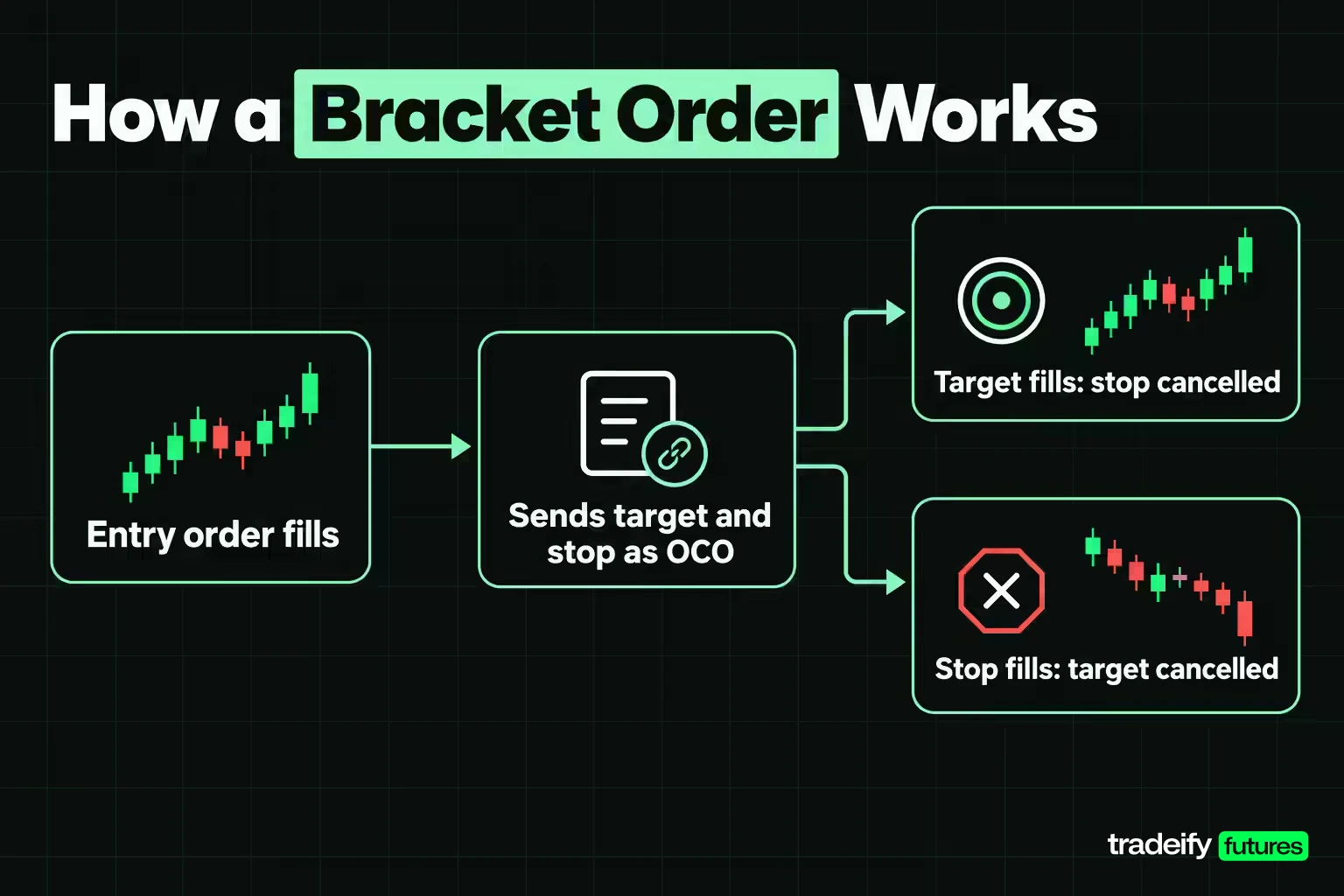
Bracket and OCO orders are conditional orders: they link orders together so that one fill changes another order automatically.
- OCO (one cancels the other) links two orders, usually a profit target and a stop. When one fills, the other is cancelled.
- OSO or OTO (one sends or triggers the other) holds child orders until a parent fills, then sends them.
- A bracket combines both: an entry that, once filled, sends a target and a stop linked as OCO.
An illustrative bracket on two MES: buy at 6000.00, target a sell limit at 6010.00, stop a sell stop at 5992.00. If the target fills, you make 10.00 points, $50.00 per contract or $100.00 on two, and the stop is cancelled. If the stop fills, you lose 8.00 points, $40.00 per contract or $80.00 on two before slippage, and the target is cancelled.
Why Bracket Orders Help Day Traders
The main value of a bracket is that both exits exist the moment the entry fills. You make the exit decision before the trade, when you are calm, rather than during it. That removes the most common failure mode in fast markets: getting filled and then scrambling to place a stop.
Two cautions apply. A bracket is only as good as the stop type inside it, and a stop-limit leg can take you out of the plan rather than out of the position. And the legs need to match the position size: a target for two contracts with a stop for one leaves a contract unprotected after the target fills.
Related lesson: Bracket Orders
Choosing the Best Order Type for Each Day Trading Situation
The order type should come from the situation, not from habit. Here is how the trade-off usually plays out across common day-trading situations.
| Situation | Usual order type | Why | What you give up |
|---|---|---|---|
| Breakout entry | Buy stop or sell stop, or a stop-limit with a small offset | Waits for the break you planned | Pays up for the fill; stop-limit can miss |
| Pullback entry at a level | Limit | The level is the reason for the trade | May not fill if price turns early |
| Scalp entry and target | Limit for both | One tick of spread is a large share of the target | Missed fills when the market moves |
| Protective stop | Stop (stop market) | Getting out matters more than price | Slippage in fast markets |
| Profit target | Limit, linked to the stop as OCO | You choose the exit price | Price can turn just short of it |
| Trend ride | Trailing stop | Follows the move without a fixed exit | Noise can hit a tight trail |
| Urgent exit or flatten | Market | Certainty of getting out | Whatever the book offers |
The scalp row deserves a number. On MES, one tick is $1.25. On a 4-tick target, crossing a one-tick spread with a market order gives up 25% of the target before the trade starts. On a 40-tick trend trade, the same tick barely matters. The shorter your target, the more limit orders pay off.
A Five-Step Order Type Routine Before Each Trade
Run this before each entry. It takes seconds once it is a habit.
- Write down whether this trade needs the fill or the price. If you cannot choose, the trade is not ready.
- Match the entry order to the plan's condition: a stop for a break, a limit for a level, a market order only when any nearby price is fine.
- Price the entry in ticks and dollars against the plan level, so you know what the order type costs.
- Choose the exit order separately, and size the trade against the worse fill. If your stop-limit could skip, your real risk sits beyond its limit, not at it.
- Log the order type, the fill you expected and the fill you got in your journal. After a few weeks, that log shows what your default order type is really costing you.
Related lesson: How to Keep a Trading Journal
Common Order Type Mistakes
Most order type mistakes come from one assumption, that an order is an instruction the market must obey. It is a request with published rules, and the market follows the rules, not your intention.
| Mistake | Why it happens | What to do instead |
|---|---|---|
| Treating the stop price as the exit price | The word "stop" sounds final | Size the trade for a fill one or more ticks past the stop |
| Using a tight stop-limit as a protective stop | It feels like slippage control | Use a plain stop for exits, or set a limit wide enough to fill |
| Buy limit above the market or buy stop below it | The order ticket looks the same for both | Buy limits rest below the market, buy stops trigger above it |
| Sending a second exit while the first still works | A partial fill looks like no fill | Check order status before re-sending |
| Leaving GTC orders working after the session | Old ideas are forgotten | Use Day orders and clear working orders at the end of the session |
| Chasing an unfilled limit with a market order | Fear of missing the move | Decide before the trade whether a missed fill means no trade |
Order Types Under Prop Firm Loss Limits
Prop firm evaluations do not change how order types work, but they change what a bad fill costs. A typical firm's daily loss limit or trailing drawdown is measured on your actual fills, not on the stop you planned. If two MES contracts with an 8.00-point stop ($80.00 of planned risk) slip to an $110.00 loss, or a skipped stop-limit turns it into $150.00, the fixed loss allowance shrinks faster than your plan said it would. That is why the exit order type and position size matter more in an evaluation than the entry order type.
The practical rule is to size each trade against the worse fill your exit order could get, then check that a few of those worse fills in a row still leave room under the loss limit. Order type reduces the variance of a fill. Only size and a written stop keep the total inside the rules.
On our accounts, the Order Types Explained guide in our Help Center covers market, limit, stop, stop-limit, trailing stop, OCO and OSO orders. On Tradovate, ATM strategies place your stop loss and profit target as a linked OCO bracket as soon as your entry fills, though brackets are not supported while Group Trading. R Trader Pro keeps stops, brackets, OCO and trailing orders on Rithmic's servers if your internet drops. Our funded accounts are simulated, and all positions are closed by 4:45 PM ET on regular trading days.
Related lesson: Daily and Weekly Loss Limits
Frequently Asked Questions About Day Trading Order Types
What is the best order type for day trading?
The best order type for day trading is the one that matches what the trade needs, because no single order type wins every time. Use a market order when getting filled matters more than price, a limit order when the trade only works at a specific level, and a stop order to exit when a level breaks. Choose the entry and the exit order separately.
What is the difference between a buy stop and a sell stop order?
A buy stop is placed above the current price and triggers when price rises to it, either to exit a short or to enter long on a breakout. A sell stop is placed below the current price and triggers when price falls to it, either to exit a long or to enter short on a breakdown.
What is a trailing stop loss?
A trailing stop loss is a stop order whose trigger follows the market by a fixed distance as price moves in your favor and stays put when price moves against you. It helps you stay in a trend while protecting part of an open profit, but the exit can still slip once it triggers.
Is a market order bad for day trading?
No, but it can be expensive. On a liquid contract quoted one tick wide, a small market order usually costs about one tick. In thin markets, around data releases or at larger size, the same order can fill several ticks away.
Can I use a limit order as a stop loss?
Not in the usual sense. A sell limit rests above the market, so it works as a profit target, not a stop. To cap a loss with price control you need a stop-limit order, which can fail to fill if price moves past its limit.
Is day trading illegal?
No, day trading is legal. In US stock margin accounts, the pattern day trader rule and its $25,000 minimum equity are being replaced under FINRA Regulatory Notice 26-10, with a phase-in that ends October 20, 2027. Futures were never subject to the pattern day trader rule.
Putting Your Order Type Choice Into Practice
The fastest way to improve your order type choices is to measure them. For the next few weeks, write the order type, the price you expected and the price you got next to each entry and exit. Then replay those trades as if you had used a different order type and see whether the result changes.
Often it will not, which tells you your default order type is fine for how you trade. When it does change, you have found a cost you were paying without noticing, and you know which situation to handle differently.
This article is educational and is not financial advice or a recommendation to trade any instrument. Futures are leveraged, and losses can exceed what you expect, especially when fast markets cause slippage or a stop-limit fails to fill. No order type guarantees an exit at a chosen price. The prices in this guide are illustrative examples, not quotes. Funded and evaluation accounts are simulated, and results in simulation do not predict live results.


