



TL;DR: How to sell stocks comes down to two decisions: why you are selling and which order type protects what matters most. Open the position, enter the shares, pick market or limit, set the time in force, then review, submit and confirm the fill. A market sell fills near the bid, a limit sets your floor, and a stop can gap past its trigger. Shares held over one year get long-term rates, and a rebuy within 30 days of a loss is a wash sale. Proceeds settle T+1, one business day after the trade.
Selling a stock takes a few clicks. Selling it well takes a decision you made before the order ticket opened, because once the quote starts moving, every choice gets harder.
The Sell button is the easy part. The hard parts are knowing how many shares to sell, what price you will accept, which shares count as sold for tax purposes, and what would make you cancel the order. A rushed click can turn a sound plan into the wrong quantity, the wrong account or a fill well away from the price you saw.
This guide covers the mechanics of a stock sale in a typical online broker, the sell order types and how each one can fail, the reasons to sell (and the bad ones), the tax rules that change what you keep, and what happens to the money after the trade.
How a Stock Sell Order Gets Filled
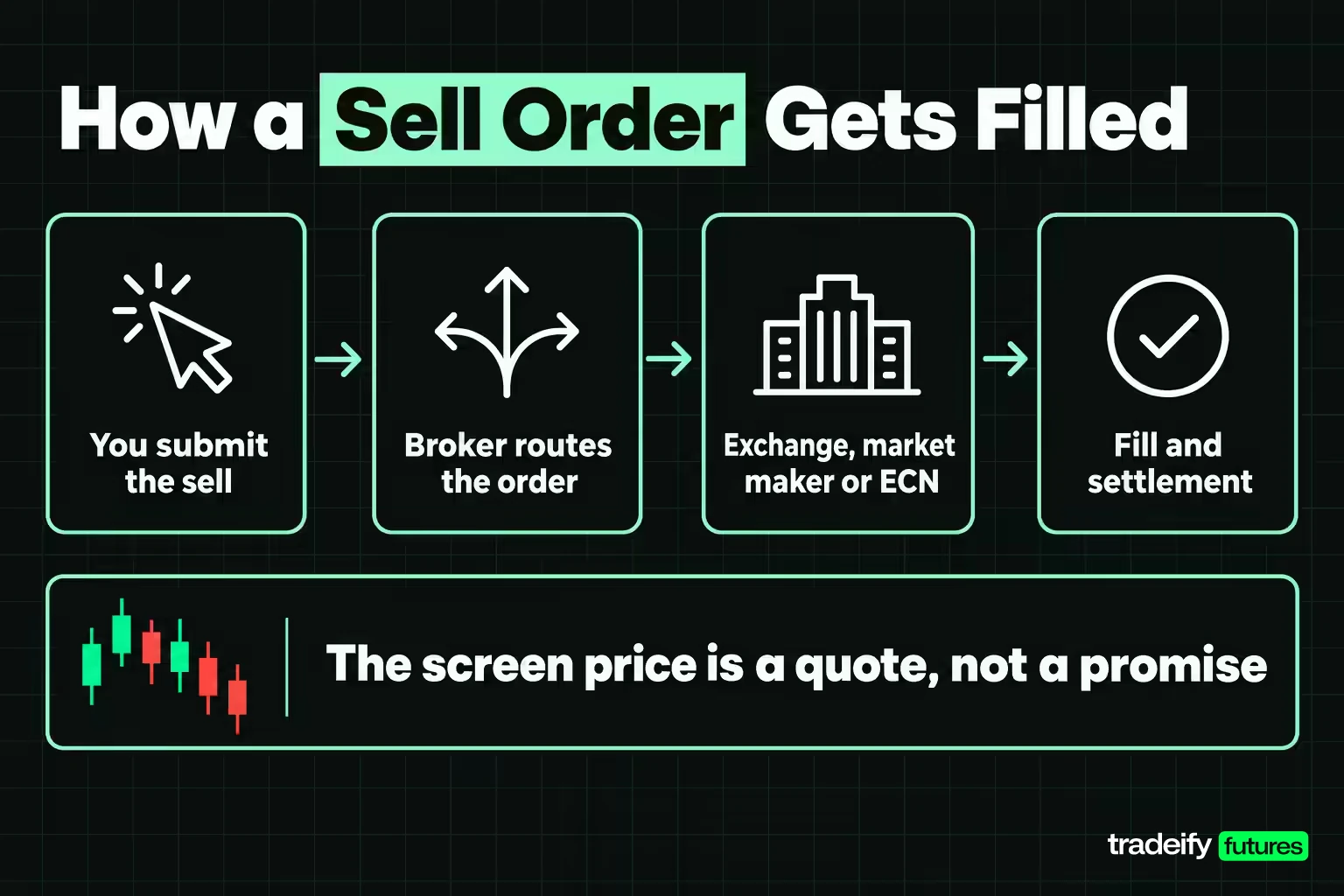
Selling a stock means your broker sends your sell order to a market where someone else buys the shares. Your position shrinks by the number of shares filled, and your account is credited with the proceeds once the trade settles.
Most investors assume they have a direct line to the exchange. According to the SEC's Investor.gov guide on executing an order, they don't. Your order travels to your broker, and the broker decides where to send it: to an exchange, to a market maker that stands ready to buy and sell at quoted prices, to an electronic communications network (ECN) that matches buy and sell orders, or to another part of the broker's own firm (internalization).
That routing takes time. It is usually fast, but prices can change while it happens, and the quote on your screen applies only to a certain number of shares. Investor.gov notes that SEC rules do not require a trade to be executed within a set period, and that by the time your order reaches the market, the price could be slightly or very different.
Your broker does owe you something. It has a duty to seek best execution, which includes considering the chance of price improvement, meaning a fill better than the current quote. Price improvement is an opportunity, not a guarantee.
Three practical consequences follow:
- The screen price is a quote, not a promise. It describes where the market was a moment ago.
- A sell order can fill in pieces. If you send 200 shares and only 75 trade at an acceptable price, you hold a 75-share partial fill while 125 shares stay open, expire or cancel, depending on your instructions.
- The default is usually a market order. FINRA notes that brokerage firms typically enter your order as a market order unless you specify otherwise, so leaving the order type untouched is itself a choice.
How to Sell Stocks in a Brokerage Account Step by Step
To sell stocks in a brokerage account, you follow the same six steps at nearly every broker, even though screen labels differ. Investor.gov notes that brokers charge a commission for buying and selling shares, and some investors also hold shares through a direct stock plan or a dividend reinvestment plan, which have their own sell process and fees.
Confirm the stock position and account
Start with the position, not the ticket. Open Positions, Holdings or Portfolio, find the stock and confirm three things: the ticker, the account and the number of shares you own.
Do not start from a watchlist symbol. A company can have more than one share class, and you may hold the same ticker in a taxable account and a retirement account. Selling from the wrong one changes the tax result completely.
Write down the reason for the sale while you are here. "It feels weak" is hard to test. "The position is now too large for my plan" or "the reason I bought it no longer holds" is something you can check later.
Enter the share quantity to sell
Enter the exact number of shares. Check the unit label on the field, because some tickets switch between shares, dollars and percent of position. One field can change the whole instruction.
A full exit closes the position. A partial sale trims it. Those are different decisions. Some brokers support fractional shares or dollar-based orders, and those can come with fewer order types or shorter trading windows than whole-share orders.
Choose the stock sell order type
The central choice for most sellers is market or limit. A market order prioritizes getting out. A limit order sets the lowest price you will accept and may never fill. Stop and stop-limit orders are conditional: they wait for a trigger price, so they suit a planned exit you set in advance, not a sale you want done now.
Ask yourself one question here. If the stock dropped a dollar while your order was in flight, would you still want out? If yes, a market order in a liquid stock fits. If no, set a limit.
Set the time in force and the session
Time in force tells the broker how long the order should stay active. FINRA describes the common ones: a day order expires at the end of the trading day if it isn't executed, and a good 'til canceled (GTC) order stays in effect until it executes or you cancel it. Market-on-open and market-on-close orders aim for the start or end of regular hours.
Check whether the ticket includes extended-hours trading. Pre-market and after-hours sessions run on different rules, and many brokers accept only limit orders there.
Review the stock sell ticket
Pause before you press submit. Confirm:
- The account and ticker
- Sell, not Buy
- The share quantity and unit
- The order type, plus the limit or stop price if you used one
- The time in force and session
- The estimated proceeds and any commission or fee shown
- Any other open order that could sell the same shares
Ten seconds of review costs less than unwinding a wrong order after it reaches the market.
Submit the order and confirm the fill
Submit once, then open the Orders or Activity screen. Do not assume the order filled because the ticket closed. Check the status (open, working, partially filled, filled, canceled, rejected or expired), the filled quantity, the average price and any shares still working.
To change an open order, use the broker's cancel or cancel-replace function and wait for confirmation. Sending a second sell while the first is still working can sell more shares than you own in that position, or more than you meant to.
Worked example (illustrative): you own 120 shares and decide the position is a third too large. One-third of 120 is 40 shares, leaving 80. You will wait for a better price rather than sell at any price, so you enter a 40-share day limit order at $48.00. If it fills, the gross proceeds are $1,920.00. If the stock never trades at $48.00 that day, the order expires unfilled. That is not an error. It is the condition you chose.
Stock Sell Order Types Compared

Stock sell order types decide which risk you accept: the risk of a worse price or the risk of no fill. Investor.gov and FINRA define them consistently, and the table sums up how each one behaves on the sell side.
| Sell order type | What triggers it | Price control | Main way it goes wrong |
|---|---|---|---|
| Market | Sent immediately | None, fills at or near the bid | Fill well below the last price in a fast or thin market |
| Limit | Sent immediately | Fills only at the limit or higher | Never fills if price does not reach the limit |
| Stop (stop-loss) | Price reaches the stop price | None once triggered, becomes a market order | Gaps through the stop and fills far lower |
| Stop-limit | Price reaches the stop price | Becomes a limit order at the limit price | Triggers, then does not fill while the stock keeps falling |
| Trailing stop | Price falls a set percent or dollar amount from its high | None once triggered | Normal swings trigger it early, or a gap fills it lower |
Market and limit sell orders
A market sell order, per Investor.gov, guarantees execution but not price, and generally executes at or near the current bid. The last traded price is not necessarily the price you get.
Worked example (illustrative): the bid is $49.98, the ask is $50.02 (a $0.04 spread) and the last trade printed $50.10. A 200-share market sell will generally fill near the $49.98 bid. Against the last price on the screen, that is $24.00 less than the headline number suggests. In a liquid stock during regular hours the gap is small. In a thin stock, or just after news, it can be much larger.
A sell limit order can execute only at the limit price or higher. If you enter a $51 limit on a stock bid at $50, you are stating a condition, not a forecast. FINRA adds that limit orders are for when getting the right price matters more than speed, and that there is a chance the order never executes. Moving the limit down again and again because you want it filled erases the boundary you set.
Stop and stop-limit orders on a gap
A sell stop sits below the current price and becomes a market order when the stop price is reached. Investor.gov describes it as a way to limit a loss or protect a profit on stock you own. The stop price is a trigger, not a promised sale price.
Worked example (illustrative): you bought 100 shares at $50 and placed a sell stop at $45, planning a $500 maximum loss. The company reports bad news after the close and the stock opens at $41. The stop triggers, becomes a market order and fills near $41. The loss is $900, $400 more than planned.
A stop-limit would have handled that differently, and not necessarily better. With a $45 stop and a $44.50 limit, the order triggers at the open but cannot fill at $41, because a limit only fills at the limit or better. You still own all 100 shares, and the stock is still falling. A stop gives you certainty of exit with price risk. A stop-limit gives you price control with exit risk. Pick the risk you can live with.
A trailing stop moves the trigger up as the stock rises, set as a percentage or dollar amount below the market price. FINRA describes it as a stop order whose stop price is set differently, following the stock instead of staying fixed. It has the same gap risk once triggered, and a trail set too tight can be hit by ordinary daily swings.
FINRA also flags a cost people forget: orders with automatic triggers can have tax consequences you did not plan, including a higher rate on the gain. A stop that fires a few days before a holding passes one year is one way that happens.
Selling stocks in extended hours
Regular trading hours for exchange-listed stocks run from 9:30 AM to 4:00 PM Eastern Time. The SEC's extended-hours bulletin lists the risks of selling outside that window: less liquidity, more volatility, prices that may not match the regular session, wider spreads, unlinked trading systems that can show different prices for the same stock, and news that hits while few buyers are around. Many brokers accept only limit orders in extended hours, and you need to check whether an unfilled order carries into the next regular session or is canceled.
Related lesson: Order types overview
When to Sell a Stock
Knowing when to sell stocks starts with the reason you bought them. A sale is easiest to judge when it answers a question you wrote down at the start: what would make this position no longer worth holding?
The sound reasons usually fall into four groups.
- The thesis worked. The stock reached the value you estimated, and holding on now requires a new reason, not the old one stretched further.
- The thesis broke. Something you relied on, such as growth, margins or a product, stopped being true. Price falling alone does not count. The business changing does.
- Your goal or time horizon arrived. Investor.gov defines the time horizon as the months, years or decades you plan to invest to reach a goal. Money you need for a house deposit next year is short-horizon money, whatever the stock is doing.
- The position no longer fits your risk tolerance. Investor.gov defines risk tolerance as your ability and willingness to lose some or all of an investment for a chance at higher returns. A stock that grew from 5% of your account to 30% carries a different risk than the one you signed up for.
Time horizon and selling a stock
Time horizon matters because stocks are volatile in the short run. Investor.gov notes that large company stocks as a group have lost money on average about one year in three, and that if you have to sell when the price is below what you paid, you lose money on the sale.
That is the case for selling some stock before you need the cash, not on the day you need it. Imagine tuition is due in 18 months. A sale plan that moves the money into cash over the coming year removes the risk of being forced to sell in a bad month. The opposite also holds. If the money is for retirement 20 years away, a 15% drop is not by itself a reason to sell.
Risk tolerance and stock position size
Risk tolerance shows up in position size more than in stock selection. A practical test: if this stock fell by half tomorrow, would the loss change your plans or your sleep? If yes, the position is bigger than your tolerance, and trimming it is a legitimate reason to sell even when you still like the company.
Trimming is not a verdict on the stock. It is a decision about how much of your account one company should be allowed to move.
Fundamental Reasons to Sell a Stock
Fundamental reasons to sell a stock come from the business, not the chart. They are the strongest sell signals for a long-term investor because they change what the shares are worth, not just what they traded for this week.
Business changes that commonly justify a fresh look:
- Results that keep missing the reason you bought. One weak quarter is noise. Several quarters of slowing revenue, shrinking margins or rising debt, against a thesis built on growth, is evidence.
- A dividend cut or suspension. For an income holding, a cut removes the reason the stock was in the portfolio. Ask whether the cut is a short-term repair or a sign the payout was never covered by earnings.
- A lost competitive edge. A key patent expiring, a major customer leaving or a new competitor taking share can change the long-run value even when the current numbers still look fine.
- Management or accounting red flags. Late filings, restatements, auditor changes or a pattern of guidance cuts deserve attention because they weaken your ability to trust the numbers.
- A merger or acquisition. In an all-cash takeover, holders typically receive a fixed cash price per share when the deal closes, so the stock tends to trade near that price until then and the remaining upside is small. In a stock-for-stock deal, you end up owning the buyer, a different company with its own risks. Either way, the announcement is a decision point: hold to closing, or sell now and redeploy.
Telling a business change from noise
The useful question is whether the information changes your estimate of the company's long-run earnings, or only its price. A sector selloff, an analyst downgrade or a market-wide drop can move the price without touching the business. A broken product line or lost contract touches the business even if the price has not reacted yet.
Write the thesis in one or two sentences when you buy. When news arrives, test the news against the sentences. If the sentences still hold, the news is probably noise. If one of them is now false, you have a fundamental reason to sell, whatever the price is doing.
Technical Signals for Selling Stocks
Technical signals for selling stocks use price and volume to decide when to exit, often regardless of why the stock is moving. Traders and shorter-term investors lean on them most, and they work best as a precommitted rule rather than a judgment made while watching the price.
Common technical sell signals:
- A break below support. A level where buyers have repeatedly stepped in gives way, often on heavier volume.
- A break below a moving average you already track. A close under a widely watched average can mark a change in trend for a trend-following holder.
- Heavy volume on down days. Large selling volume suggests institutions are leaving, not just a quiet drift.
- A failed breakout. The stock pushes to a new high, then falls back into its old range.
None of these are guarantees. Each one also fires falsely, and a stock can break support and recover the next week. The value of a chart signal is that it is defined before the trade, so the exit does not depend on how you feel that day.
The 7% to 8% stock sell rule
The 7% sell rule comes from Investor's Business Daily. IBD says to sell all your shares if a stock falls 7% or 8% below the price you paid, and suggests a tighter cut, around 4%, when the overall market is weak. IBD's reasoning is that leading stocks bought at a proper buy point rarely fall more than 8% from that entry. The rule applies to your purchase price, not to a pullback from a later high.
Worked example (illustrative): you buy at $50.00. A 7% cut sits at $46.50 and an 8% cut at $46.00. You can place a sell stop near that level, accepting that an overnight gap can fill it lower, or set an alert and decide at the close.
The arithmetic behind the rule is what makes it stick. A loss needs a bigger percentage gain to recover, because the gain is measured from a smaller base:
| Loss on the stock | Gain needed to break even |
|---|---|
| 7% | 7.53% |
| 8% | 8.70% |
| 25% | 33.33% |
| 50% | 100.00% |
The limitation is just as real. A fixed percentage ignores how volatile a stock normally is. A stock that routinely swings 5% in a day will hit a 7% cut on ordinary noise. The rule fits momentum-style buying better than long-term value investing, where a falling price on an unchanged business may be the opposite of a sell signal.
Related lesson: Support and resistance
Taxes When You Sell Stocks
Taxes when you sell stocks depend on three things: how long you held the shares, which shares you sold, and whether you bought the same stock back soon after a loss. These are US federal rules from the IRS. Other countries differ, and state tax may apply on top.
The rules here apply to taxable brokerage accounts. Retirement accounts follow their own tax rules, so check those separately.
Short-term vs long-term gains on a stock sale
IRS Topic 409 sets the line at one year. Shares held more than one year produce a long-term gain or loss. Shares held one year or less produce a short-term gain or loss. You count from the day after you bought through the day you sold.
The difference in rate can be large. Long-term net capital gains are taxed at 0%, 15% or 20% depending on taxable income, and the IRS says most individuals pay no more than 15%. Net short-term gains are taxed as ordinary income.
Worked example (illustrative): a $1,000 long-term gain taxed at 15% costs $150, so you keep $850. The same gain as short-term, for someone in a hypothetical 24% ordinary bracket, costs $240, leaving $760. Higher earners may also owe the net investment income tax, which the IRS lists as a separate charge.
The holding period ends on the trade date, not the settlement date. IRS Publication 550 gives the example of a sale on December 31 that settles in January: it belongs to the year of the trade.
Choosing which shares count as sold
If you bought the same stock at different times, each purchase is a separate lot with its own cost and date. The IRS says that if you identify the specific shares you sold with your broker, your basis is what you paid for those shares plus purchase costs. If you can't adequately identify them, the shares you bought first are treated as sold first (FIFO).
Worked example (illustrative): you own Lot A, 50 shares bought more than a year ago at $40, and Lot B, 50 shares bought four months ago at $70. You sell 50 shares at $60.
| Lot method | Shares treated as sold | Result |
|---|---|---|
| FIFO default | Lot A at $40 | $1,000 long-term gain |
| Specific identification | Lot B at $70 | $500 short-term loss |
Same sale, same price, opposite tax results. Most brokers let you choose the lot on the ticket or set a default method in account settings, but the choice generally has to be made by the time of the trade, not at tax time. For stock acquired after 2010, the broker reports cost basis, holding period and any wash-sale adjustment on Form 1099-B.
The wash sale rule
A wash sale happens, per Investor.gov, when you sell at a loss and within 30 days before or after the sale you buy substantially identical securities, or a contract or option to buy them. IRS rules then disallow the loss.
The loss is not gone forever. IRS Publication 550 shows the mechanics: you buy 100 shares for $1,000, sell them for $750, and buy 100 shares back within 30 days for $800. You can't deduct the $250 loss now. It is added to the new shares' cost, giving a basis of $1,050, and the new shares' holding period includes the old ones.
Selling losing stocks to offset gains
Capital losses offset capital gains. If losses exceed gains, the IRS lets you deduct up to $3,000 a year against other income ($1,500 if married filing separately) and carry the rest forward. Selling a loser before year end to use that loss is often called tax-loss harvesting. It only works if you avoid the wash sale window, and it should not be the only reason you sell a stock you otherwise want to own.
Tax rules depend on your situation. Treat this as background and check the details with a tax professional before a large sale.
Holding vs Selling Stocks for the Long Term
Holding versus selling stocks is a choice between two kinds of risk. Holding risks riding a broken business down. Selling risks missing the gains that a long-held stock delivers, while paying tax and trading costs along the way.
The case for holding is mostly cost and behavior. Each sale can create a taxable gain, costs a commission or spread, and forces a second decision about where the money goes next. Investor.gov notes that investors who stuck with stocks over long periods, such as 15 years, have generally been rewarded with positive returns, while also warning that there is no guarantee and you can lose money.
The case for selling is that "hold forever" is not a plan for a stock whose business has changed. Holding works for a portfolio you rebalance and review. It fails when it becomes a reason to never look.
A middle path suits many investors:
- Hold by default while the thesis is intact.
- Review on a schedule, such as each quarter's results, rather than on every price move.
- Sell when a written condition is met: thesis broken, goal reached, position too large.
- Trim rather than sell outright when the only problem is size.
Making money on stocks without selling
You can earn from a stock without selling it in two ways. Investor.gov lists dividends, when a company distributes some of its earnings to stockholders, and capital appreciation, when the price rises. Appreciation stays unrealized until you sell. It shows in your account value and can be borrowed against in a margin account, but it is not cash, and it can shrink again. Dividends arrive as cash (or reinvested shares) while you keep the position.
The Psychology of Selling Stocks
The psychology of selling stocks is where most selling mistakes start. Buying feels like opportunity. Selling feels like a verdict: sell a winner and you fear it keeps running, sell a loser and you admit the trade was wrong.
Research shows how strong that pull is. Terrance Odean's 1998 study in the Journal of Finance examined trading records for 10,000 accounts at a discount brokerage from 1987 through 1993. Investors realized gains far more readily than losses: on a given day, a stock that was up was more than 50% more likely to be sold than a stock that was down. This is the disposition effect, a name Shefrin and Statman gave it in 1985. Odean also found the winners investors sold went on to outperform the losers they kept.
The feelings behind it are familiar:
- Anchoring on the purchase price. "I'll sell when it gets back to what I paid" treats your cost as if the market knows it. It doesn't.
- Panic in a fast drop. A red screen pushes you toward a market order at the worst moment, often in a gap.
- Fear of missing more upside. You hold a winner past every exit you planned because selling would feel like giving money back.
- Regret after selling. The stock rises after you sell and you buy it back higher, turning one decision into two.
Precommitted rules for selling stocks
The fix is to make the selling decision before the emotion shows up. A few rules that do that:
- Write the sell condition when you buy: the thesis, the price or event that breaks it, and the size limit.
- Use a limit or stop order for price exits, entered while you are calm.
- Separate "the price fell" from "the business changed" by testing the news against the written thesis.
- Trim instead of deciding all or nothing when you are torn.
- Wait a set time, such as a day, before re-buying a stock you just sold.
Missing the top is not a mistake. Nobody sells the exact high on purpose. Selling without a reason you can state is the mistake.
Related lesson: Loss aversion
Common Mistakes When Selling Stocks
Common mistakes when selling stocks fall into two groups: errors on the ticket and errors in the decision. Both are avoidable if you sell stocks with a slower, written process.
Order ticket mistakes when selling a stock
- Wrong quantity. Typing 100 when you meant 10 closes far more of the position. Check the remaining shares on the review screen.
- Wrong account. Selling a holding in a taxable account when you meant the retirement account creates a tax bill you did not need.
- Using the last price as the expected fill. A seller trades against the bid. In a wide spread, the difference between the last print and the bid is real money.
- Treating a stop as a guaranteed price. A stop controls when the order activates, not the final fill, and a gap can jump past it.
- Duplicate open orders. An old GTC sell and a new sell can both be working on the same shares. Review open orders first.
- Selling in extended hours with a market mindset. Thin liquidity and wide spreads punish urgency outside regular hours.
Decision mistakes that cost money when you sell stocks
- Deciding inside the ticket. A moving quote adds pressure. Decide the reason, the size and the price limit first.
- Ignoring the tax lot and the date. Selling a few days before a holding passes one year, or using FIFO by default when another lot fits your plan, can cost more than the price move you were reacting to.
- Re-buying inside the wash sale window. Selling at a loss and buying the same stock back within 30 days defers the loss.
- Freeriding in a cash account. Buying a new stock with unsettled sale proceeds and selling it before the first sale settles is freeriding under Regulation T. Investor.gov says it can lead the broker to freeze the cash account for 90 days, during which purchases must be paid in full on the trade date.
- Leaving the cash idle with no plan. The sale is half the decision. Where the proceeds go is the other half.
What Happens After You Sell Stocks
What happens after you sell stocks runs in three stages: the fill, settlement, and the cash becoming usable. Your broker shows the fill right away. Settlement takes longer.
Settlement, as the SEC's investor bulletin defines it, is the official transfer of the shares to the buyer's account and the cash to the seller's account. Since May 28, 2024, most US broker-dealer transactions in stocks, bonds, ETFs and similar securities settle T+1, one business day after the trade date. Sell on Monday, and the trade settles on Tuesday.
Where the money goes after a stock sale
The buyer's cash goes to you. In practice, it moves through the brokers and the clearing system and lands as a cash balance in your brokerage account, not in your bank. Your balance may show the proceeds as soon as the trade fills, but the broker may label them as unsettled until settlement day. Moving the money to a bank is a separate withdrawal, and when you can do it depends on the broker's rules.
Reusing proceeds in a cash account
Unsettled proceeds can usually buy another stock the same day, with one catch. The SEC's cash account bulletin, updated August 7, 2026, walks through it with an investor who holds $10,000 of fully paid stock ABC.
- Sell ABC on Monday, buy $10,000 of XYZ the same day, and sell XYZ on Friday: permitted, because the ABC sale settled on Tuesday and paid for XYZ before XYZ was sold.
- Sell ABC on Monday, buy XYZ the same day, and sell XYZ on Monday afternoon without adding cash: freeriding, because XYZ was sold before it was paid for.
Margin accounts work differently and follow FINRA's margin rules. Those rules are changing: FINRA Regulatory Notice 26-10 replaces the pattern-day-trader day-trade count and its $25,000 minimum equity with new intraday margin standards, effective June 4, 2026, with a phase-in that ends October 20, 2027. Some brokers may still apply the old rules during the phase-in, so check yours.
Records to keep after you sell stocks
Keep the trade confirmation and check that the remaining position matches your plan, with no part of the order still working. At tax time, your broker reports the sale on Form 1099-B, including cost basis for stock acquired after 2010.
Related lesson: Clearing and settlement
Rebalancing After You Sell Stocks
Rebalancing after you sell stocks means putting the proceeds where your target allocation says they belong, rather than wherever the last headline points. Investor.gov describes rebalancing as bringing a portfolio back to its original mix after some investments grow faster than others.
Investor.gov's own example: you start with 60% in stocks and market gains push that to 80%. To restore the mix, you may need to sell some stock, add new money to other asset classes, or both.
Worked example (illustrative): a $100,000 portfolio at 80% stocks holds $80,000 of stock. At a 60% target, the stock portion should be $60,000, so the rebalancing sale is $20,000 of stock, with the proceeds going to bonds or cash. In a taxable account, sell from the lots that create the smallest tax bill, or rebalance with new contributions instead of sales.
Investor.gov notes two common schedules: rebalancing at regular intervals, such as every six or 12 months, or when an asset class drifts more than a preset percentage from target. It adds that rebalancing tends to work best when done relatively infrequently. Selling winners to buy laggards feels wrong, which is exactly why a written schedule helps.
Not every sale needs reinvesting. If the sale funded a goal, the cash already has its job. The mistake is leaving proceeds in cash by default for months, without having decided to.
A Pre-Sale Stock Checklist

A pre-sale stock checklist separates the decision to sell from the mechanics of the ticket. Run these five questions before you open the order screen.
- What changed? State in one sentence why you are selling: thesis met, thesis broken, goal reached or position too large.
- How much? Closing the position or trimming it? Write the exact share count and the lot you want treated as sold.
- What matters more, the fill or the price? Getting out now points to a market order in a liquid stock during regular hours. A minimum acceptable price points to a limit.
- What would make you cancel? Name the news or price level that would change the decision before the order fills.
- What happens next? Where you will confirm the fill, when the trade settles, what the tax result is, and where the proceeds go.
If you can't answer the first question, you are not ready to sell. You may still be right to sell. You just don't know it yet.
Selling Stocks vs Exiting a Futures Position
When you sell stocks and when you exit a futures position, you are "selling" in both cases, but the mechanics differ. When you sell a stock you own, you deliver shares to a buyer and receive cash at settlement. To sell a stock you don't own, you have to borrow the shares first: the SEC explains that in a short sale your broker lends you the stock, charges interest and applies margin rules.
A futures contract has no shares to own or borrow. The CFTC defines closing a futures trade as an offset: you exit a long position by selling the same number of contracts in the same delivery month, and a short by buying them back. Selling a futures contract to open a position works the same way as buying one, without a borrowing step.
That is the main reason traders who want exposure to the stock market as a whole often use equity index futures rather than individual stocks. We don't offer cash stocks on our accounts. Traders on our accounts use equity index futures such as ES, MES, NQ and MNQ, and every position is closed by 4:45 PM ET, with no overnight holds. Our funded accounts are simulated.
Frequently Asked Questions About Selling Stocks
Where does money go when you sell stocks?
The buyer's cash goes to you, through the brokers and the clearing system. It lands as a cash balance in your brokerage account once the trade settles, which for most US stocks is one business day after the trade date. Moving it to your bank is a separate withdrawal under your broker's rules.
How do I cash in my shares?
Sell them through your broker by opening the position, choosing Sell, entering the share count and order type, and submitting. After the sale settles on T+1, request a withdrawal to your linked bank account. Shares held in a direct stock plan or dividend reinvestment plan are sold through that plan's administrator instead.
What is the 7% sell rule?
It is a loss-cutting rule from Investor's Business Daily. It says to sell a stock if it falls 7% or 8% below your purchase price, and to cut sooner in a weak market. It is a discipline tool for growth-stock buyers, not a law, and it can trigger on normal swings in a volatile stock.
What is a short squeeze?
The SEC describes a short squeeze as pressure on short sellers to buy back shares after a sharp price rise or when the shares become hard to borrow. Their buying pushes the price higher still, which can force more short sellers to cover. Squeezes can happen naturally, but manipulating a stock to cause one is illegal.
How do you make money on stocks if you don't sell?
Through dividends and price appreciation. Dividends are paid in cash or reinvested shares while you hold the stock. Appreciation raises your account value, but it stays unrealized and can disappear until you sell.
Can I make $1000 a month in the stock market?
It is possible, but it takes a large amount of capital, and no return is guaranteed. Illustrative arithmetic: $1,000 a month is $12,000 a year, which from dividends alone at a 3% yield needs about $400,000 invested, or $600,000 at 2%. Trading for that income adds the risk of losing money instead.
Can I cancel a stock sell order?
You can request a cancellation while the order is still open. The order may fill before the cancellation takes effect, so wait for the broker to confirm it before you send a new order for the same shares.
Can I sell stocks at any time?
You can enter an order whenever your broker accepts one, but it only executes when the market is open and a buyer is available at your terms. Regular hours run from 9:30 AM to 4:00 PM Eastern Time. Extended-hours sessions have thinner trading, wider spreads and often allow only limit orders.
This guide is general education, not individual investment, tax or legal advice. Stock prices can move fast, orders can fill at unexpected prices or not at all, and you can lose money investing in stocks. Futures and other leveraged products can lose more than expected, and funded trading accounts are simulated. Check your broker's current rules and talk to a qualified professional about your situation.


