



TL;DR: Initial vs maintenance margin is a question of timing: initial margin is checked before you open, maintenance while you hold. Falling short of initial only blocks new trades; falling below maintenance triggers a margin call. In stocks the floors are 50% at entry and 25% afterward, while futures set both in dollars per contract. The gap between the two is your cushion, and it can be small or even zero.
Two numbers sit on almost every margin statement, and most traders only look at the first one. Initial margin decides whether you can open a position. Maintenance margin decides whether you get to keep it. Confuse the two and you can size a trade that is perfectly legal at entry but sits one ordinary bad session away from a margin call.
The fix is knowing where each number bites. Below, both numbers are worked through in stock, futures and forex accounts, with the math for the exact price that triggers a call and what happens when a call goes unmet.
What Initial Margin Is
Initial margin is the collateral that has to be in your account before a leveraged position can be opened. It is an entry check. If the account doesn't hold enough eligible collateral when you send the order, the order is rejected. Nothing is liquidated and nothing is charged. You just can't open that position at that size.
Who sets the number depends on the market:
- US stocks bought on margin. The Federal Reserve's Regulation T sets the floor at 50% of the current market value for a margin equity security. Buy $20,000 of stock and at least $10,000 has to be your own equity. The rest is a loan from the broker.
- Futures. CME Clearing sets initial margin as a dollar amount per contract, and your broker may be required to collect more than that. There is no loan. The CFTC glossary is blunt on this point: futures margin is not partial payment on a purchase. It is a performance bond, a good-faith deposit held against the daily gains and losses of the contract.
- Forex and CFDs at a retail broker. The broker sets initial margin as a percentage of the position's notional value and checks it on order placement. Saxo's help center, for example, describes initial margin as a pre-trade check run when you place the order.
So when someone asks what "margin requirement" means, the honest answer is that there are two of them. The initial requirement is the price of admission, and clearing it says nothing about whether the trade is sized well.
Related lesson: What margin is and why it is required
What Maintenance Margin Is
Maintenance margin is the minimum equity that has to stay in the account while a position is open. It is a continuous check. Once you are in the trade, every price move changes your equity, and maintenance margin is the floor that equity has to stay above.
Maintenance margin sits below initial margin on purpose. If the two were the same, a position funded at exactly the initial requirement would produce a demand for cash the first time price ticked against it. The gap gives an account room to absorb ordinary movement before anyone asks for money.
Here is how the floor works in each market:
- US stocks. FINRA Rule 4210 sets maintenance at 25% of current market value for margin securities held long. Brokers can, and often do, set a higher house requirement.
- Futures. CME Clearing sets maintenance per contract as the minimum that must be kept in the account at any given time.
- Forex and CFDs. The broker sets a maintenance percentage of notional. In Saxo's documented example, maintenance is 1.00% of notional against a 1.50% initial requirement.
Only a breach of maintenance margin produces a margin call. An account can sit below its initial requirement and above its maintenance requirement for days with no call at all. It just can't open anything new.
Initial vs Maintenance Margin Side by Side
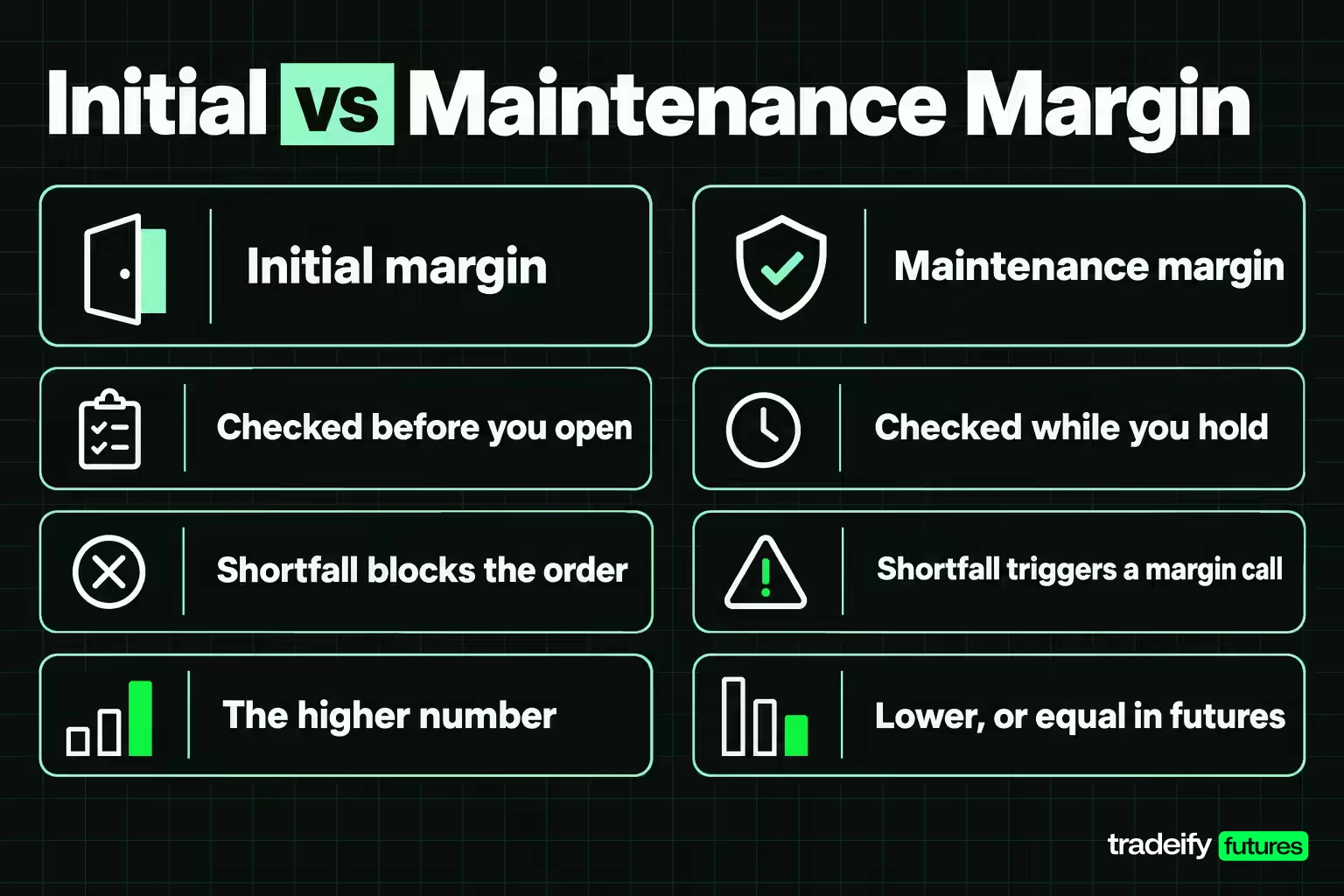
Initial vs maintenance margin is easiest to see in one table. Both numbers answer the same question (how much of your own money supports this position?) at different moments.
| Feature | Initial margin | Maintenance margin |
|---|---|---|
| When it is checked | Before the order is accepted | Continuously while the position is open |
| What a shortfall does | Blocks the new order or added size | Triggers a margin call or forced close-out |
| US stocks held long | 50% of market value under Regulation T | 25% of current market value under FINRA Rule 4210, often higher at the broker |
| Futures | Dollars per contract set by the clearing house, broker may add more | Dollars per contract, at or below the initial figure |
| Forex example (Saxo) | 1.50% of notional | 1.00% of notional |
| Size relative to the other | The higher of the two | The lower of the two, or equal in some futures |
| What a call restores | Not applicable | Stocks: an amount set by the broker. Futures: the full initial level |
The last row matters more than it looks. In futures, a margin call does not ask you to top up to the maintenance line you just crossed. It asks you to restore the full initial level, which is a bigger number.
Initial and Maintenance Margin in Stock Accounts
Initial and maintenance margin in a US stock account come from two different rulebooks, and they measure against two different bases.
At entry, Regulation T requires 50% of the purchase value for a long margin equity security. After entry, FINRA Rule 4210 requires equity of at least 25% of the current market value. FINRA also requires at least $2,000 of equity in a margin account, and it lets firms set their own higher requirements. A house requirement above 25% is common on volatile or concentrated positions, and the broker can raise it whenever it wants.
Long and short margin requirements in stocks
Short positions run on a different schedule. Regulation T requires 150% of the current market value of the stock when you sell short: the 100% of sale proceeds plus a 50% deposit. FINRA Rule 4210 then sets maintenance on a short stock trading at $5.00 or above at the greater of $5.00 per share or 30% of current market value. For a short stock trading below $5.00, it is the greater of $2.50 per share or 100%.
Here is an illustrative short. You short 100 shares at $50. The $5,000 of proceeds plus a $2,500 deposit puts $7,500 in the account, so your equity at entry is $2,500. Equity on a short is $7,500 minus the current value of the shares. Under a 30% maintenance requirement, the call arrives when the share price rises above $57.69 (7,500 divided by 1.3 is $5,769.23 of market value), a rise of about 15%. At that price the 30% requirement works out to $17.31 per share, comfortably above the $5.00 per share minimum.
That asymmetry is worth a second look before you short on margin. A long margin position at 50% initial and 25% maintenance can absorb roughly a one-third fall before a call. The short in this example draws a call after a rise of about 15%, and a short has no ceiling on how far price can go.
Related lesson: Why a required deposit is not borrowed money
Initial and Maintenance Margin in Futures
Initial and maintenance margin in futures work differently from stocks, and the difference isn't cosmetic. You don't buy anything, so there is no loan and no interest. Both numbers are flat dollar amounts per contract, set by the clearing house to cover a day's worth of potential losses. CME Group says its margins are set to cover 99% of potential price moves, usually over one trading day, and its introductory course puts futures margin at roughly 3-12% of a contract's notional value, compared with up to 50% for stocks bought on margin.
How CME sets the ratio between initial and maintenance
CME publishes the relationship directly. For a Heightened Risk Profile (HRP) account, initial margin is 110% of the maintenance requirement. For a Non-HRP account, initial margin is 100% of maintenance. In other words, for some accounts there is no gap at all.
CME's own illustration uses Canadian Heavy Crude (Net Energy) futures, months 3 to 6:
| Rate type | Initial margin | Maintenance margin | Gap between them |
|---|---|---|---|
| HRP | $1,540 | $1,400 | $140 |
| Non-HRP | $1,400 | $1,400 | $0 |
CME labels those figures for illustration only, so read them as the shape of the rule, not as today's requirement. The point holds: the same product, the same months, and one account type has a $140 cushion while the other has none. A position funded at exactly the Non-HRP initial requirement is already sitting on its maintenance line.
Brokers then layer their own requirements on top. The CFTC glossary notes that futures commission merchants may require customers to post margin above exchange levels, so the number on your platform can differ from the clearing house figure.
Mark to market and variation margin in futures
Futures positions are marked to market. CME Clearing marks positions twice a day, and gains and losses move as cash between accounts each session. The payment that flows when price moves against a position is variation margin. The CFTC defines it as a payment made on a daily or intraday basis by a clearing member to the clearing organization based on adverse price movement.
This is why a futures position can produce a cash demand without anyone deciding to close it. Your equity falls as losses settle, and if it drops below maintenance, the call follows. A stock position has no daily cash settlement, so it can drift below its maintenance level and only produce a written demand.
How to Calculate Margin Requirements and the Margin Call Price
The margin call price is worth calculating yourself, because brokers publish percentages and dollar amounts, not the price where your position gets into trouble.
Margin call price for a long stock position
For a long stock position, the market value at which you hit the maintenance requirement is:
Trigger market value = loan ÷ (1 − maintenance percentage)
Divide that by the number of shares for a per-share trigger price.
Take an illustrative position: 400 shares at $50, a $20,000 position, bought with $10,000 of your own money and a $10,000 margin loan (the Regulation T 50% case). Here is where the call lands at three maintenance levels:
| Maintenance requirement | Trigger market value | Trigger price per share | Decline from $50 | Equity left at the trigger |
|---|---|---|---|---|
| 25%, the FINRA floor | $13,333.33 | $33.33 | 33.33% | $3,333.33 |
| 30%, a common house level | $14,285.71 | $35.71 | 28.57% | $4,285.71 |
| 40%, a stricter house level | $16,666.67 | $41.67 | 16.67% | $6,666.67 |
Nothing about the position changed between those rows. Only the house requirement did. At 40%, a 16.67% decline is enough, and in a volatile stock that's an ordinary bad week, not a crash.
Margin cushion for a futures position
Futures cushions are easier to read in price terms. Subtract maintenance from initial, then divide by the contract's dollar value per point.
CME published real figures for Gold futures in 2020. At the close on Friday, January 10, 2020, initial margin was $5,500 and maintenance was $5,000 per contract. By the close on Tuesday, March 24, 2020, they were $7,700 and $7,000. A gold contract covers 100 troy ounces with a $0.10 tick worth $10.00, so it moves $100 for every $1 change in the gold price.
- January 2020. The $500 gap equals $5.00 per ounce, or 50 ticks.
- March 2020. The $700 gap equals $7.00 per ounce, or 70 ticks.
That's the honest size of the cushion on a position funded at exactly initial margin. A $5 move in gold is not a rare event. If your stop sits further away than the cushion, the margin call can arrive before your stop does.
Margin utilization and the 100% close-out in forex accounts
Many forex and CFD brokers express the same idea as a utilization percentage. Saxo's help center walks through it: deposit EUR 10,000 and buy 100,000 EURUSD. Initial margin at 1.50% is EUR 1,500 and maintenance at 1.00% is EUR 1,000, so utilization starts at 10.0% (EUR 1,000 against EUR 10,000 of equity). After an unrealized loss of EUR 9,000, equity is EUR 1,000 and utilization hits 100.0%. At that point Saxo closes out positions automatically.
So if your maintenance margin rate reaches 100% at a broker that reports it this way, your equity has fallen to the maintenance requirement and liquidation starts. Saxo describes that close-out as automatic, so don't count on a phone call first.
Related lesson: Reading a contract's tick value before sizing it
What Triggers a Maintenance Margin Call
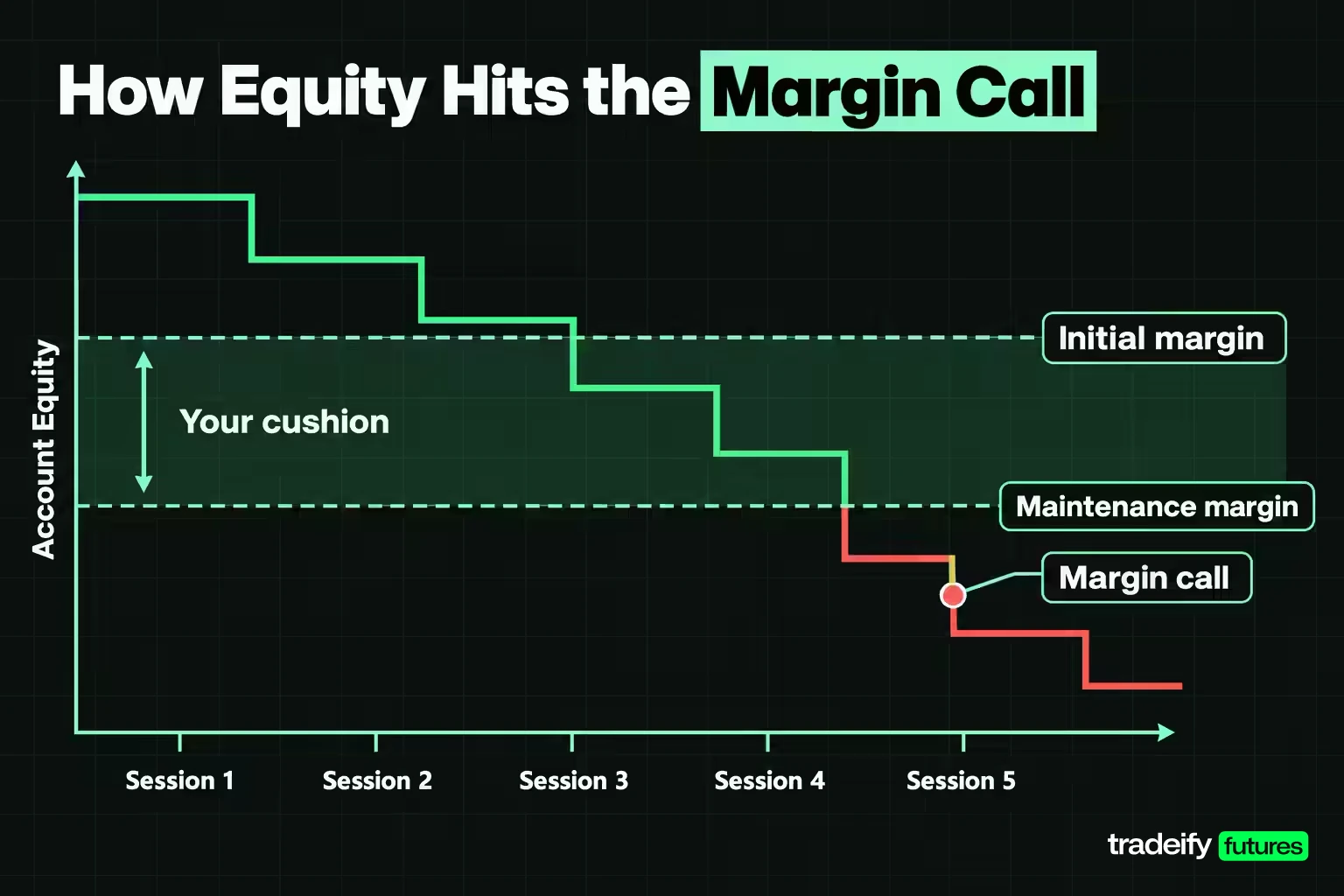
A maintenance margin call is triggered when account equity falls below the maintenance requirement. That can happen in more ways than most traders expect.
- Price moves against you. The obvious one. Losses reduce equity until it crosses the floor.
- The requirement goes up while price stands still. CME raises margins when volatility rises and lowers them when it falls, and it gives at least 24 hours' notice. Gold's requirements rose 40% between January 10 and March 24, 2020. A position that just cleared the old level can be in a call the day the new one takes effect, with no adverse move at all.
- Your broker changes the threshold. Investor.gov warns that a brokerage firm may change the threshold at which customers get a margin call at any time.
- Daily settlement in futures. Losses settle in cash every session, so equity falls in steps, and a run of small losing days can cross the line without any single dramatic move.
- Adding positions. New positions add to the total requirement. In portfolio-margined futures accounts, the CFTC notes that SPAN looks at all positions together, so a new trade can change the requirement on the whole book.
The requirement change is the one that feels unfair, because you did nothing wrong on the chart. But a margin requirement you checked last month is not a fact about today.
Related lesson: How daily settlement moves cash in a futures account
What Happens When a Call Goes Unmet
When a margin call goes unmet, the broker closes positions to bring the account back into line, and it doesn't need your permission.
Investor.gov spells out the stock account version. If the value of securities bought on margin falls, the brokerage firm can require you to deposit cash or securities immediately, or sell any of the securities in your account to cover the shortfall, without telling you in advance. The firm decides which securities to sell. Even if it gives you a set number of days to cover, it can still sell before then.
Futures work along the same lines. CME's course material says a position may be liquidated automatically once it drops below the maintenance level, and that a trader who can't meet the call may be able to reduce the position instead. In fast markets, a forced sale can fill well below the price you were watching. Brokers' own risk disclosures warn that losses on margin products can exceed what you deposited, and a negative balance left after liquidation is still a debt.
So if you ignore a margin call, you don't avoid the loss. You hand the timing and the choice of what gets sold to someone else.
How to meet a margin call with cash or a sale
A margin call can be resolved three ways: deposit cash, deposit eligible securities, or reduce the position. Each one costs a different amount, and this is where traders get the math wrong.
Stock example (illustrative). Take 400 shares bought at $50 with $10,000 of your own money and a $10,000 margin loan. The stock falls to $35.00, a market value of $14,000, so equity is $4,000. A 30% requirement on $14,000 is $4,200, so you need a $200 deposit. If you sell stock instead, the proceeds pay down the loan, which leaves equity unchanged and only lowers the requirement by 30% of what you sell. To clear a $200 shortfall by selling, you need to sell $666.67 of stock ($200 divided by 0.30).
Futures example (illustrative, using CME's January 2020 gold figures). A gold account funded at $5,500 falls to $4,900, below the $5,000 maintenance level. The call is $600, not $100, because a futures call restores the account to the initial level. CME's own course quiz makes the same point: with $8,000 initial, $6,500 maintenance and an account at $4,200, the call brings the account back to $8,000, a $3,800 deposit.
Two things follow. The required amount changes every time price moves, because the requirement is measured against current value. And meeting a call restores compliance, nothing more. It doesn't bring back the cushion you had at entry.
Related lesson: What happens when a call is not met
Intraday Margin Rules for Day Traders
Intraday margin is the third number many active traders run into, and it works differently in stocks and futures.
In US stocks, FINRA Regulatory Notice 26-10 (published April 20, 2026) adopted new intraday margin standards that replace the old day-trading margin requirements in their entirety, including the pattern day trader day-trade count and the $25,000 pattern day trader minimum equity. The amendments to Rule 4210 took effect June 4, 2026, with a phase-in period that ends October 20, 2027. During the phase-in, your broker may still be running the old rules, so check which regime applies to your account. Futures were never subject to the pattern day trader rule.
In futures, many brokers publish their own day-trading margins alongside the exchange initial margin. Tradovate's margin page, for example, lists separate "Day" and "Initial" columns per symbol, plus a section on margin changes around economic news announcements. Day margins are broker terms, not exchange figures. Anything still open when the broker's day-margin window closes is held to the full exchange requirement, and a broker can raise day margins around major data releases.
A low day margin is permission, not a sizing plan. It tells you how large a position the broker will accept. It says nothing about how far price can move before your account takes a loss you can't afford.
Related lesson: Intraday vs overnight futures margin
How to Avoid a Margin Call
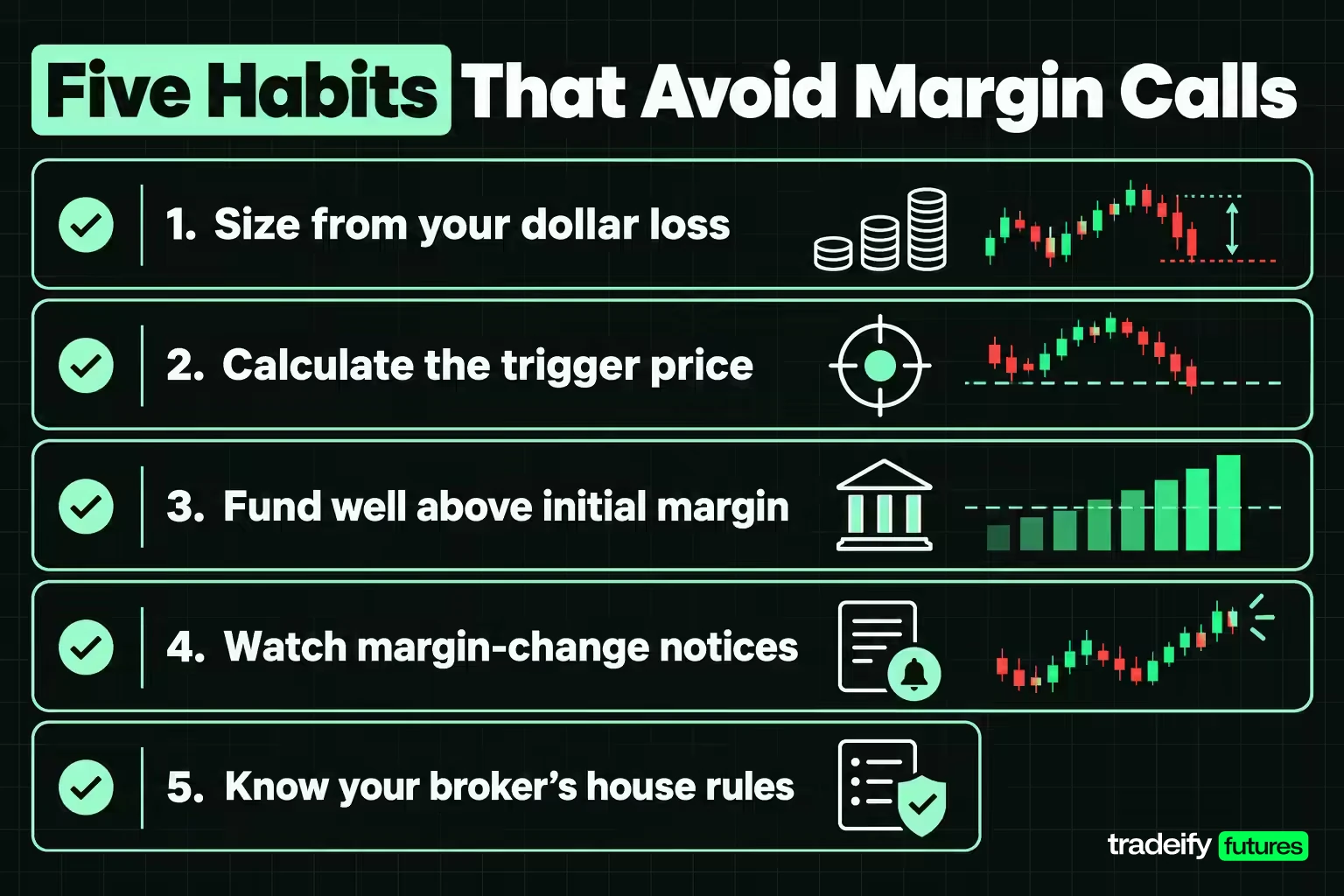
The cleanest way to avoid a margin call is to make the maintenance level irrelevant: size every position so your stop would close it long before equity gets near the floor.
A few habits do most of the work:
- Calculate the trigger price when you set the stop. Write both on the same line of your journal. If the trigger sits closer than the stop, the size is wrong, not the entry.
- Fund well above initial margin. A futures position funded at exactly initial margin has only the gap as a cushion, and on a Non-HRP account that gap can be zero.
- Watch margin-change notices. CME gives at least 24 hours' notice before changing requirements. Read them, especially in volatile weeks.
- Know your broker's house rules. A 40% house requirement roughly halves the decline a long stock position can absorb compared with the 25% FINRA floor.
- Don't treat day margin as a size limit. Size from the dollar loss you are willing to take, then check that the margin fits, not the other way round.
Margin vs loss limits on prop firm evaluation accounts
Prop-firm evaluation and simulated funded accounts run on a different constraint. There is no clearing house holding your collateral, so there is no exchange margin call. What replaces it is a rule about how much the account may lose, and breaching that rule usually ends the account rather than producing a call. A trader who learns that a platform permits a large position has learned about margin, not about risk. On these accounts, the loss limit is the number that matters, and it is usually far smaller than any margin figure.
On our accounts, we don't set a margin figure for you to track. Position size is capped by contract limits instead (a 50K account can hold up to 4 minis or 40 micros), losses are measured against an end-of-day trailing drawdown enforced in real time on net liquidation value, and every position has to be closed by 4:45 PM ET. Evaluation and funded accounts are simulated.
Related lesson: How a position is sized against a loss limit rather than a margin figure
Initial and Maintenance Margin FAQ
What is a margin call?
A margin call is a demand to bring your account back up after equity falls below the maintenance requirement. In stocks you meet it with cash, securities or a sale. In futures, the CFTC defines it as a request to bring margin deposits back up to initial levels.
What happens if your maintenance margin rate reaches 100%?
At brokers that report margin as a utilization rate, 100% means your equity has fallen to the maintenance requirement. Saxo, for example, closes out positions automatically at that level. You can usually only close positions, not open new ones.
What does "margin requirement" mean?
A margin requirement is the amount of your own money that must support a leveraged position. There are two: the initial requirement to open the position and the lower maintenance requirement to keep it open. Brokers can set both above the regulatory or exchange minimum.
What happens if you ignore a margin call?
The broker can sell your positions without asking, and it chooses what to sell. Investor.gov notes this can happen even before a stated deadline. If the forced sale fills badly, you can lose more than you deposited and owe the difference.
What is variation margin and what is its purpose?
Variation margin is the cash that moves when a futures position is marked to market. The CFTC defines it as a daily or intraday payment based on adverse price movement. Its purpose is to stop losses from piling up unpaid between the two sides of a trade.
Why is maintenance margin lower than initial margin?
Maintenance margin is set lower so ordinary price movement doesn't trigger a call the moment a trade goes slightly against you. Initial margin is the stricter entry filter. In futures, CME sets initial at 100% or 110% of maintenance depending on the account's risk profile.
Margin trading in stocks, futures and forex carries a substantial risk of loss, and leveraged positions can lose more than you deposit; a margin call can lead to positions being closed without notice. Margin requirements change with volatility and broker policy, so confirm current figures with your broker or exchange before relying on any number here. The worked examples are illustrations, not trade records. Evaluation and funded prop accounts are simulated. Nothing here is investment advice.


