




TL;DR: How margin works depends on the account: in a securities account it is a loan, and in a futures account it is a deposit. Stock margin lets you borrow up to 50% of a purchase and requires equity of at least 25% of market value, often more. Futures margin is a performance bond that gets topped back up to the initial level when it falls below maintenance. Either way, a forced sale can come without warning and losses can exceed what you put in.
How margin works is one of those topics where a single word hides two different arrangements. If you open a stock brokerage account with margin turned on, margin means borrowing: the broker lends you cash, your securities are the collateral, and you pay interest. If you open a futures account, margin means a good-faith deposit that sits behind an open contract, and nobody lends you anything.
If you're about to tick the margin box on a brokerage application, or you're moving from stocks to futures, the question that matters is simple: what can force your position closed, and when? The answer differs by account, and so does what you pay and how fast a call arrives. This guide walks through both, with worked numbers you can check on paper.
What Margin Means in Securities and Futures Accounts
Margin in a securities account is a loan. The SEC's investor bulletin on margin accounts describes a margin account as one where your broker-dealer lends you cash, using the account as collateral, to buy securities. The securities you buy, and the others you hold there, secure the loan. The amount you owe is called the debit balance, and it accrues interest until you repay it.
Margin in a futures account is collateral, not borrowing. The CFTC's glossary is direct about it: futures margin "is not partial payment on a purchase," and the same entry says it is also called a performance bond. CME Group describes performance bond as a good-faith deposit that guarantees you can cover potential losses on open positions. You are not buying anything when you go long a futures contract. You are agreeing to settle price changes, and the deposit proves you can.
So when someone asks what "trade margin" means, the honest answer is "it depends which account you're in":
- Securities margin is a debt problem. The question is whether your equity still covers the loan.
- Futures margin is a collateral problem. The question is whether your deposit still covers the next adverse move.
Get that split right and most margin confusion clears up. A stock trader and a futures trader can both say "I got a margin call" and be describing completely different events.
Related lesson: What borrowing does to position size
Margin Requirements Set by Reg T, FINRA and Your Broker
Securities margin requirements come from three layers: the Federal Reserve's Regulation T, FINRA Rule 4210, and your own broker's house rules. The broker's number is the one that usually bites, because it can only be stricter than the regulatory floor, never looser.
These are the numbers that govern a typical US stock margin account:
| Margin requirement | Who sets it | What it says |
|---|---|---|
| Minimum equity | FINRA Rule 4210 | At least $2,000 of equity before margin trading, or 100% of the purchase price if that is less |
| Initial margin, long stock | Federal Reserve Regulation T | You put up at least 50% of the purchase price, so you may borrow up to half |
| Initial margin, short sale | Federal Reserve Regulation T | 150% of current market value (the sale proceeds plus 50%) |
| Maintenance margin, long stock | FINRA Rule 4210 | Equity of at least 25% of the current market value of the securities |
| Maintenance margin, short stock at $5 or more | FINRA Rule 4210 | The greater of $5.00 per share or 30% of current market value |
| House requirement | Your broker | Often 30 to 40 percent per the SEC, and some firms range from 30% to 100% depending on the security |
Initial margin applies only when you open a new position. Once you own the stock, only the maintenance requirement matters, and it is measured against today's market value, not your entry price.
Which Securities Can Be Bought on Margin
Not every security can be bought on margin. FINRA notes that firms may restrict stocks that don't trade on a national exchange and stocks prone to large daily swings. The SEC adds that brokers generally don't let you use margin to buy options at all, even though they often require a margin account to trade them. A security the broker won't lend against carries, in effect, a 100% requirement: you pay for it in full.
Your margin agreement is where the house numbers live. Read it before the first trade, because a firm can raise house requirements at any time without advance written notice.
Related lesson: Maintenance margin floor
How Much You Can Borrow and What Buying Power Means
The borrowing limit on a new stock purchase is set by Regulation T's 50% initial requirement. With $10,000 of cash in a margin account, you can buy up to $20,000 of fully marginable stock: $10,000 of your money and $10,000 of the broker's. That 2-to-1 ratio is the ceiling on a fresh purchase, and a broker can set it lower.
Brokers show this as buying power, and the label matters because several numbers sit side by side:
- Margin buying power is the most you can spend on marginable securities using cash plus available borrowing, without adding money. Fidelity's balance definitions describe it this way.
- Non-margin buying power is what you can spend on securities that cannot be borrowed against, such as options or penny stocks. It counts your cash plus the loan value of marginable stock you already hold, so using it can still create a margin loan.
- Cash available to trade without borrowing is the number to watch if you never want a debit balance at all.
Several things shrink buying power below the 2-to-1 headline. A higher house requirement on a volatile stock lowers its loan value. Non-marginable holdings add nothing. And open orders and same-day trades consume buying power before they settle.
Timing matters too. FINRA explains that under Reg T you have one payment period, currently three business days from the trade date, to meet the initial requirement on a new margin purchase, and a firm may shorten that window. Miss it and the result is a Reg T call, whatever the stock did in the meantime.
How Margin Works on a Stock Purchase, Step by Step
A worked example shows how margin works on a stock position better than any definition. Imagine a trader who buys 400 shares at $50 (an illustrative price). The position is worth $20,000. The trader puts in $10,000 and borrows $10,000, the maximum Regulation T allows, so equity starts at 50% of market value.
Hold the $10,000 debit constant and walk the price down. Equity is market value minus the debit, and each requirement is a percentage of market value:
| Share price | Market value | Equity | Equity as % of value | 25% FINRA floor | 30% house rule | 40% house rule |
|---|---|---|---|---|---|---|
| $50 | $20,000 | $10,000 | 50.00% | $5,000 | $6,000 | $8,000 |
| $45 | $18,000 | $8,000 | 44.44% | $4,500 | $5,400 | $7,200 |
| $40 | $16,000 | $6,000 | 37.50% | $4,000 | $4,800 | $6,400 |
| $35 | $14,000 | $4,000 | 28.57% | $3,500 | $4,200 | $5,600 |
| $30 | $12,000 | $2,000 | 16.67% | $3,000 | $3,600 | $4,800 |
Read across the $40 row. Equity of $6,000 clears the 25% floor and the 30% rule, but a broker using 40% wants $6,400, so the account is $400 short. At $35, the 30% account is $200 short and the 40% account is $1,600 short. At $30, even the regulatory floor is breached.
The thing that catches people is the asymmetry. The share price fell 20% from $50 to $40, but the trader's equity fell 40%, from $10,000 to $6,000. The debit doesn't shrink when the stock does, so every dollar of loss comes out of your side of the account.
The Margin Call Price Formula
The margin call price for a long stock position is the price at which equity exactly equals the maintenance requirement. For a fixed debit, solve it directly:
Call price = debit ÷ shares ÷ (1 − maintenance %)
For the 400-share example with a $10,000 debit:
- At a 25% requirement: $10,000 ÷ 400 ÷ 0.75 = $33.33, a drop of 33.33% from $50 that wipes out 66.67% of the trader's equity.
- At a 30% requirement: $10,000 ÷ 400 ÷ 0.70 = $35.71, a drop of 28.57% and an equity loss of 57.14%.
- At a 40% requirement: $10,000 ÷ 400 ÷ 0.60 = $41.67, a drop of only 16.67% and an equity loss of 33.33%.
That last line is worth sitting with. On a 40% house requirement, a one-sixth decline in the stock is enough for a call. Run this formula before you buy, write the call price into your plan, and compare it to how far the stock normally moves in a bad week. If an ordinary pullback reaches it, the position is sized for the good outcome only.
How Margin Magnifies Gains and Losses
Margin magnifies percentage results in both directions, because the gain or loss lands on your equity while the debit stays fixed. In the 400-share example:
- If the position rises 20%, from $20,000 to $24,000, the $4,000 gain is 40% of the trader's $10,000 equity.
- If it falls 20%, to $16,000, the $4,000 loss is 40% of the equity.
The SEC's own example makes the downside sharper. Buy a stock at $50 using $25 of your money and $25 borrowed. If it falls to $15, a cash buyer has lost 70%. The margin buyer has lost more than 100%: the full $25 stake, plus $10 still owed to the broker, plus interest. Losing more than you deposited is not a remote edge case with margin. It is simply what happens when the decline is bigger than your equity cushion.
What Triggers a Margin Call
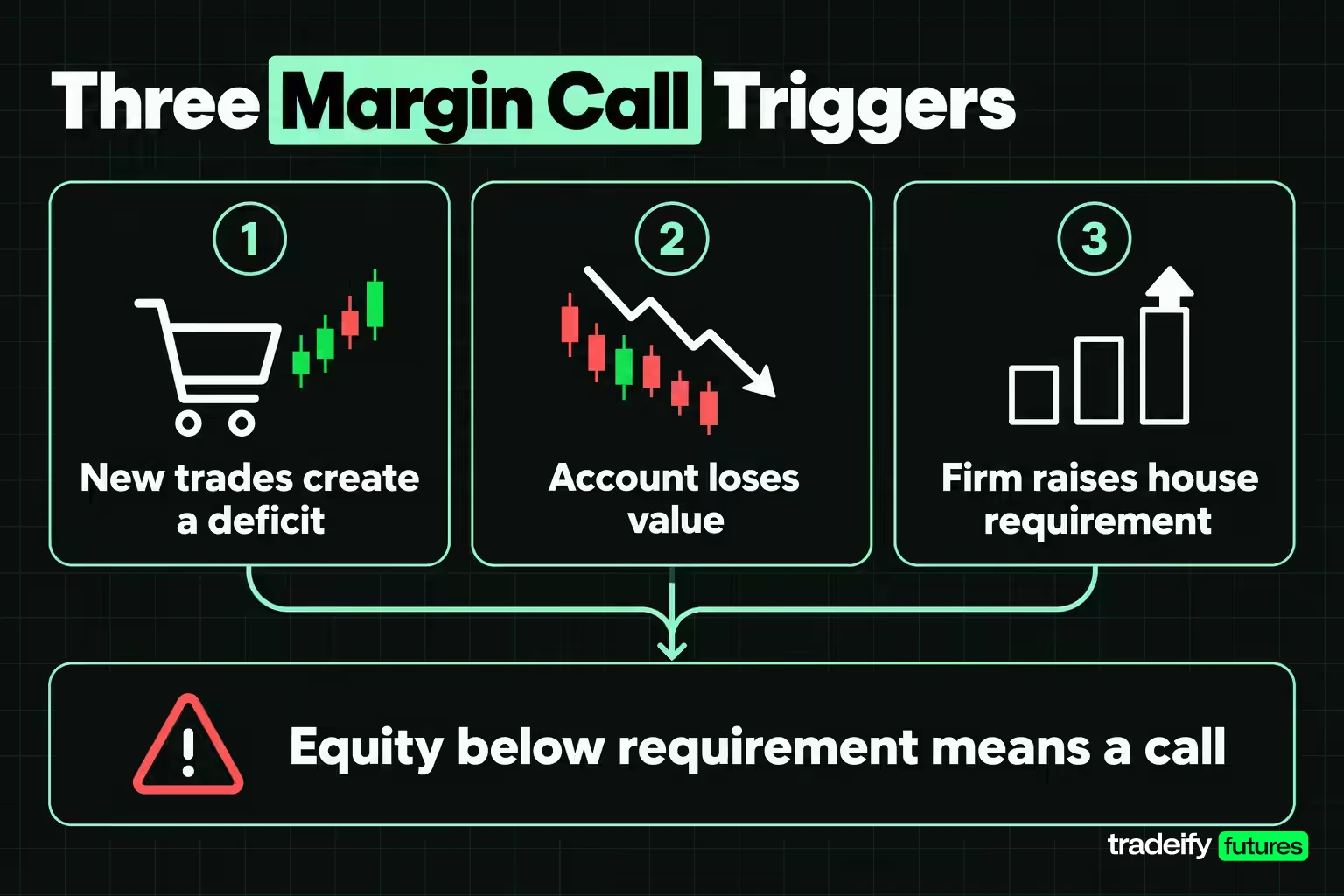
A margin call is a demand from your broker to bring the account back up to its requirement, and FINRA lists three ways it can start:
- New trades create a deficit. Buy on margin without enough equity to meet Regulation T's 50% initial requirement and you owe the difference within the payment period. Reg T says a margin call must be satisfied within one payment period. A firm can apply to its regulator for an extension, but you can't count on one.
- The account loses value. When equity falls below the maintenance requirement, whether FINRA's 25% or the firm's higher house number, you get a maintenance call. This is the call the step-by-step price ladder produces.
- The firm raises its house requirement. You can get a call without trading and without losing money. FINRA notes firms may raise requirements on a stock that is volatile, bankrupt or delisted, or on a whole sector.
There is now a fourth timing issue for stock day traders. FINRA Regulatory Notice 26-10 replaces the old day-trading margin rules in their entirety, including the pattern day trader day-trade count and its $25,000 minimum equity, with new intraday margin standards. The new rules took effect June 4, 2026, with a phase-in that runs to October 20, 2027, so your broker may still be on the old regime for now. Under the new standards, FINRA says you must keep adequate equity throughout the day, not just at the close.
The key word in every case is "may." FINRA is explicit that a firm isn't required to notify you when equity drops below maintenance, and doesn't have to issue a margin call before selling.
Related lesson: What happens when the firm closes a position
How to Meet a Margin Call
A margin call can be met in three ways, and FINRA gives a formula for each. Take the 30% house account from the 400-share example at $35: equity is $4,000, the requirement is $4,200, and the call is $200.
| Way to meet the call | FINRA formula | Amount for a $200 call at 30% |
|---|---|---|
| Deposit cash | Call amount | $200 |
| Deposit marginable securities | Call ÷ (100% − requirement) | $285.71 |
| Sell securities in the account | Call ÷ requirement | $666.67 |
Cash is the cheapest fix because every dollar goes straight to equity. Deposited securities count only at their loan value, so you need more of them. Selling is the most expensive, because each sale reduces the requirement by just 30 cents per dollar sold. FINRA's own example uses a $6,000 house call: $10,000 of stock deposited at a 40% requirement, or $15,000 of stock sold.
If you don't act, the firm will. The SEC bulletin warns that you aren't entitled to an extension, you can't choose which securities are sold, and under most agreements the firm can sell without waiting for you. FINRA adds that it may sell enough to repay the whole loan, not just cover the call. The sale happens at whatever price the market offers, which usually means during the move that caused the problem.
How to Avoid Margin Calls
Avoiding margin calls starts before the trade. FINRA's guidance boils down to three habits:
- Read your margin agreement. It says how interest is charged, how your securities serve as collateral and what notice, if any, you get before a sale.
- Know how your firm monitors margin. Some firms check in real time and block trades that would create an intraday deficit. Others compute at the close.
- Know your cushion. Maintenance margin excess is how far the account can fall before a call. Turn it into a call price with the formula for each position.
Add one rule of your own, and set it before the trade rather than during the drawdown: borrow less than the maximum. A trader using half the allowable loan has a call price far lower than a trader at the 2-to-1 limit. Calls that keep arriving are usually telling you the position is too big for the equity behind it.
Related lesson: Sizing from the equity you own
Margin Interest and How It Is Calculated
Margin interest is charged on the debit balance, not on the position size. In the 400-share example the interest runs on $10,000 from the moment the loan exists until it is repaid.
Charles Schwab's explainer shows how one large broker computes it: interest compounds daily on a 360-day year, starts accruing at settlement of the trade that creates the loan (T+1), and is posted monthly. Rates are tiered by balance. As of November 4, 2026, Schwab published a base rate of 10.25%, with standard margin rates from 12.075% on debits of $100 to $24,999.99 down to 10.325% on $250,000 to $499,999.99. Rates differ by broker and change, so check your own firm's schedule before borrowing.
Here is what that 12.075% tier costs on a $10,000 debit, compounded daily on a 360-day year:
| Holding period | Interest owed | As % of the $20,000 position |
|---|---|---|
| One day | About $3.35 | About 0.02% |
| 30 days | About $101 | About 0.5% |
| 90 days | About $306 | 1.53% |
| One year | About $1,283 | About 6.4% |
That last column is the hurdle, and it's the one people skip when a losing trade "just needs a few more weeks." Held for a year, this position has to rise about 6.4% just to pay for the money it borrowed, before commissions or any profit. A trade that goes sideways still loses, because the interest meter doesn't stop. The SEC bulletin notes that firms must generally give at least 30 days' written notice before changing how interest is computed, but the rate itself can float with the base rate.
Why Traders Use Margin Accounts
Traders use margin accounts for more than buying extra stock, and each use comes with its own cost. These are the common reasons, with the catch that comes with each:
- Larger exposure. Borrowing up to 50% of a purchase doubles the position your cash can control, which is what "leverage trading" means in a stock account. The benefit is a bigger gain on a winner. The cost is a bigger loss, interest, and a call price closer to your entry.
- Short selling. FINRA notes a margin account is required to sell short, because the firm lends you the shares. Shorting carries a 150% Regulation T initial requirement and a 30% FINRA maintenance minimum, and a short loses money as the price rises with no ceiling.
- Options strategies. Many options strategies need a margin account, even though options themselves generally can't be bought on margin.
- Liquidity without selling. Some brokers let you borrow against a portfolio for other needs, such as bridging a short cash gap. The SEC warns that a margin loan used for non-securities purposes is still secured by your securities and carries the same call risk.
- Settlement flexibility. Freeriding rules, which can freeze a cash account for 90 days, apply when you buy and sell before paying. In a margin account the broker's credit covers that gap, with interest if a loan results.
The benefits are real, but notice the pattern. Every advantage of a margin account trades flexibility for a counterparty that can sell your holdings on its own schedule. The question isn't whether margin is useful. It's whether the specific use is worth the interest and the call risk at the size you're planning.
The Main Risks of Trading on Margin
Margin trading risks go beyond "losses get bigger." The SEC bulletin lists the risks every margin user accepts:
- You can lose more money than you deposited.
- You may have to add cash or securities on short notice.
- The firm can sell some or all of your securities without consulting you.
- You don't get to choose which securities are sold.
- The firm can raise its requirements at any time without notice.
- You aren't entitled to an extension on a call.
Most margin accidents come from a handful of misreadings, and each has a number that would have caught it:
| Margin failure mode | What it looks like | The number that would have caught it |
|---|---|---|
| Treating the 25% floor as the trigger | The account is watched against 25% while the firm uses 40% | The house call price, $41.67 in the 400-share example |
| Reading maintenance as a deposit | "25% margin" assumed to mean 25% down | Maintenance is a share of current market value, which falls with the stock |
| Ignoring the interest clock | The trade is planned on price alone | About $3.35 a day on $10,000 at 12.075% |
| Waiting for the call | Planning to deal with it when the broker phones | Firms may sell without any call at all |
| Borrowing the maximum | Every purchase at the full 2-to-1 | A 20% drop costs 40% of equity |
The emotional risk deserves a line too. A forced sale locks in a loss at the worst point of a move, which is exactly when traders are most tempted to deposit more just to keep a losing position alive. Decide in advance which positions you'd cut first, so the choice isn't made under pressure.
Margin Account vs Cash Account
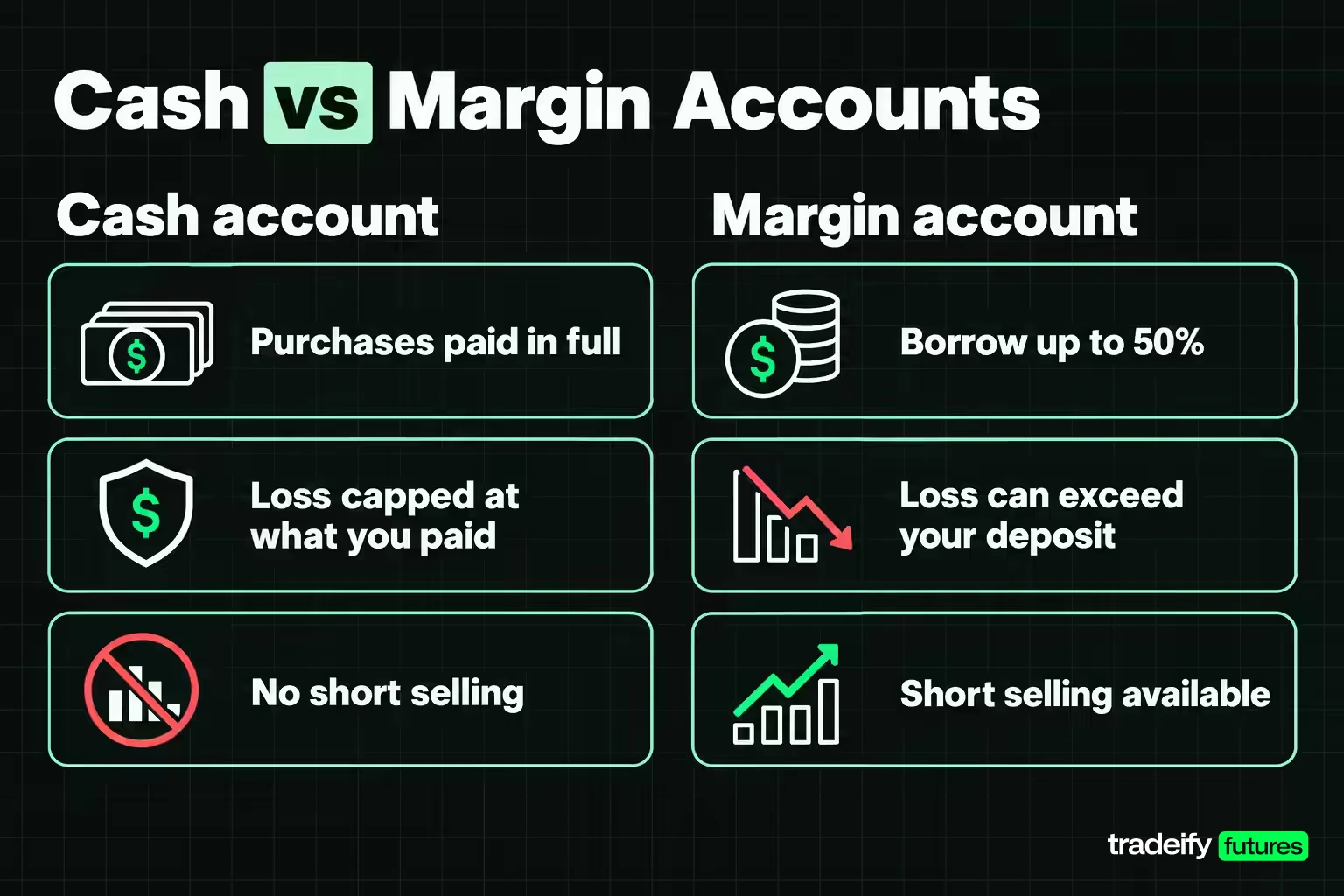
A margin account and a cash account differ in one basic way: in a cash account you pay for everything in full, and in a margin account you can borrow. The SEC notes that brokers may let you hold both at the same time.
| Feature | Cash account | Margin account |
|---|---|---|
| Borrowing | None, purchases paid in full | Up to 50% of a marginable purchase under Reg T |
| Minimum equity | No margin minimum | At least $2,000 under FINRA Rule 4210 |
| Short selling | Not available | Available, with margin requirements |
| Interest | None on purchases | Charged on the debit balance |
| Maximum loss | What you paid | Can exceed what you deposited |
| Main restriction | Pay before you sell; freeriding can bring a 90-day freeze | Margin calls and forced sales |
| Day trading rules | Trade with settled cash to avoid freeriding | FINRA intraday margin standards replacing the old pattern day trader rule |
A cash account suits anyone who wants losses capped at the money put in and no counterparty able to sell holdings. A margin account suits a trader who needs shorting, certain options strategies or settlement flexibility, and who will actively manage call prices and interest.
Opening a Margin Account
Opening a margin account usually means ticking a box on the brokerage application and signing a margin agreement, which may be part of the main account agreement or a separate document. The SEC warns that some applications make margin the default account type, so confirm which one you're opening before you sign. You'll need at least $2,000 of equity before margin trading under FINRA rules, and many firms ask more. The agreement binds you to Federal Reserve, FINRA, exchange and house requirements, and it spells out how interest is calculated and what notice you get before a sale.
How Futures Margin Works
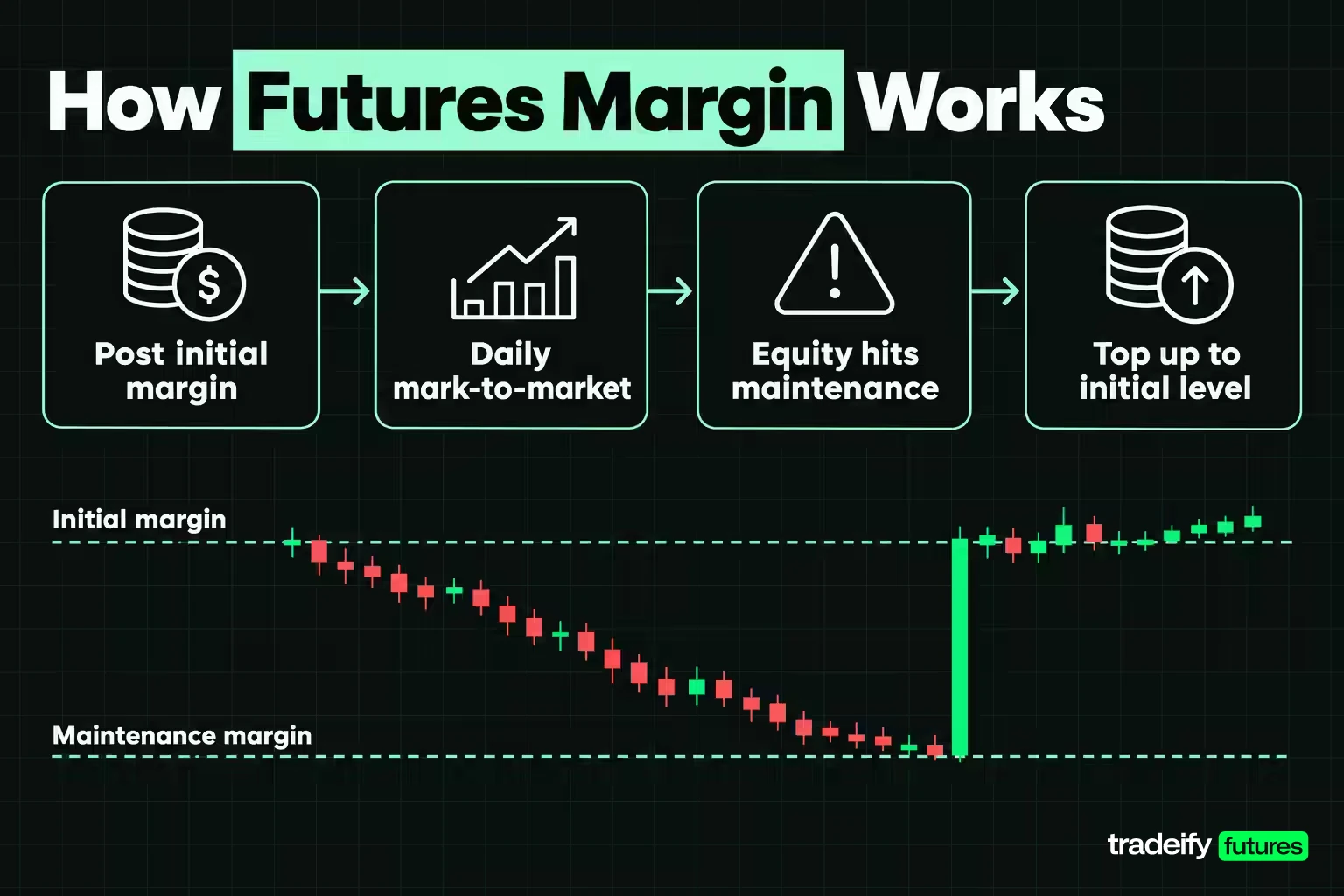
Futures margin works on a different model from stock margin. Nothing is borrowed, so there's no interest on a debit. Instead you post a performance bond, and the account is settled in cash as prices move. If you come from stocks, the trap is reading a small futures deposit as a small risk.
The mechanics run in four steps:
- Initial margin is the deposit required to open the position. Exchanges set minimums, and the CFTC notes brokers may require more than the exchange level.
- Mark-to-market happens at least daily. The CFTC glossary describes it as calculating each position's gain or loss at the end of the session and adding it to or subtracting it from the account balance. Losses come out of your cash while you hold the position, not only when you close.
- Maintenance margin is the floor. If equity falls to or below it, the broker must issue a call.
- The call restores the initial level, not the maintenance level. Both the CFTC and CME say the call brings the account back up to initial margin. That's a bigger top-up than stock traders expect.
CME's FAQ uses a historical E-mini S&P 500 example: initial margin of $4,000 and maintenance of $3,200 on a contract worth $52,500 at an index level of 1050.00, so the deposit was about 7.6% of contract value. A 10-point fall debited $500; a 6-point rise credited $300. Those were the figures of the time, not current requirements. CME Clearing recalculates requirements at least once a day and twice daily in most cases, and changes them as volatility shifts. Its methodology is designed to cover 99% of price moves over at least one day for futures, which is why a performance bond reflects expected volatility, not the size of a loan.
A Worked Futures Margin Example
A worked futures margin example makes the call mechanics concrete. This one uses an illustrative Micro E-mini S&P 500 (MES) position. MES is $5 times the S&P 500 index, so at an illustrative index level of 7,000 one contract controls $35,000. Assume a $2,000 initial and $1,600 maintenance requirement (round assumptions, not CME or broker figures):
- The deposit controls 17.5 times its own value in exposure.
- A 90-point fall costs $450, leaving $1,550, below the $1,600 maintenance level. The call is $450, to restore $2,000.
- A 2% move is 140 points, or $700, which is 35% of the deposit.
That last line is why a futures margin figure is not a risk measure. It tells you what the clearing house wants posted to keep the position open. Your actual risk is the contract multiplier times how far price can move against you.
Futures Margin Calls Compared With Securities Margin Calls
Futures and securities margin calls look similar on a statement and work differently underneath:
| Feature | Securities margin call | Futures margin call |
|---|---|---|
| What margin is | A loan secured by your securities | A performance bond, not a loan |
| Interest | Charged on the debit balance | None on the deposit itself |
| Trigger | Equity below the maintenance or house requirement | Equity at or below maintenance margin |
| Amount owed | Back to the maintenance or house requirement | Back to the initial margin level |
| How losses hit | Unrealized until you sell | Settled in cash at least daily |
| Who sets the number | Federal Reserve, FINRA and your broker | The exchange or clearing house, plus your broker |
How Margin Compares With Prop Firm Account Rules
Margin rules from a brokerage account don't map neatly onto a prop firm evaluation or funded account. Prop firms typically set their own limits on how big a position can be and how much the account can lose, often as contract caps and a drawdown floor. Read the firm's own rules instead of assuming stock-account margin logic carries over.
On our accounts, we size positions by contract limits rather than a margin number: a 50K account can hold up to 4 minis or 40 micros, with 10 micros counting as one mini. The line that ends an account is the end-of-day trailing drawdown, enforced in real time on net liquidation value, and every position is closed by 4:45 PM ET, so nothing is held overnight. Our evaluations and funded accounts are simulated.
Related lesson: Contract multipliers used in the futures example
Frequently Asked Questions About Margin
What does trade margin mean?
Trade margin is the money or collateral that must sit in an account to support a position. In a stock account it is your equity alongside a broker loan. In a futures account it is a performance bond deposit, and no loan is involved.
What is the 7% rule in stocks?
The 7% rule usually refers to Investor's Business Daily's guidance to sell a stock if it falls 7% to 8% below what you paid. It is a loss-cutting rule of thumb, not a regulation. On 50% margin, a 7% drop in the stock costs about 14% of your equity, so the cut hurts twice as much.
What is leverage trading?
Leverage trading means controlling a position larger than the cash you put up. In a stock account the leverage comes from a margin loan, capped at 2-to-1 on a new purchase under Reg T. In futures it comes from a small performance bond backing a large contract value.
What does a margin call mean?
A margin call means your broker wants more cash or securities because equity has fallen below the requirement. You can deposit cash, deposit marginable securities or sell positions. The firm may also sell for you without notice.
What does 30% margin mean?
A 30% margin requirement means equity must stay at or above 30% of the position's current market value. On a $14,000 position that is $4,200. Because the percentage applies to market value, the dollar requirement falls as the stock falls, but your equity falls faster.
How do you pay back a margin loan?
You repay a margin loan by selling the securities or by depositing cash, and proceeds go to the debit first. Many brokers set no fixed repayment schedule while you keep the required equity. Interest keeps accruing until the balance is cleared.
Margin, futures and other leveraged products carry a substantial risk of loss, and you can lose more than you deposit. Forced sales can happen without notice. The prices, requirements and rates in this guide are illustrations or dated snapshots, not live quotes; confirm the numbers for your own account with your broker. Evaluation and funded prop accounts are simulated. This article is education, not individual advice.


