



TL;DR: Negative balance protection caps your loss at the money in your account, so a gap past zero is written off, not billed to you. It is mandatory for retail CFD clients in the EU, UK and Australia, but US futures and forex customers can still owe a deficit. It protects you from debt, not from losing your whole deposit, so size positions for the gap.
Negative balance protection matters at exactly one moment. The market moves so far, so fast, that your loss runs past the money in the account before anything can close the position. Without it, the shortfall is a debt you owe the firm. With it, the shortfall is written off and the balance goes back to zero.
That sounds like full protection. It isn't. Your entire deposit is still at risk, the rule only exists in certain countries and for certain products, and it disappears if you accept professional status. This guide covers how the zero floor works, the arithmetic of when a gap creates a deficit, where the rule applies, and how to check whether your own account carries it.
What Negative Balance Protection Is
Negative balance protection is a limit on liability. It caps what a client can owe on a leveraged account at the funds in that account, so the balance can fall to zero but no further.
The UK rule states it in one sentence. FCA rule COBS 22.5.17R says the liability of a retail client for all restricted speculative investments connected to the account "is limited to the funds in that account." The FCA's guidance adds that funds means the cash in the account plus unrealised net profits from open positions, and that money held in the same account for other purposes does not count.
The mechanics follow from that:
- Losses reduce your account equity as usual.
- Normally a margin call or an automatic close-out acts before equity reaches zero.
- If the market moves too fast for those to work, equity can cross below zero.
- Without protection, that negative figure is a debt the firm can pursue. With protection, the firm absorbs it and resets the balance to zero.
So does a negative balance mean you owe money? Without a protection rule, usually yes, and that is the part most traders only learn after a gap. A negative balance is an unpaid loss, and the account agreement typically makes you liable for it. With protection, the negative figure is the firm's problem, not yours.
What the protection does not do matters just as much. It does not reduce a loss below your balance, refund anything, or stop you losing every dollar you deposited. "You cannot lose more than you deposit" and "you can lose your whole deposit" are both true. Only the second describes the risk you still carry.
Related lesson: What leverage does to the size of a loss
Margin Close-Outs Come Before Balance Protection

Negative balance protection is the second line of defence. The first is the margin system, which is designed to close positions while there is still money left in the account.
In the EU and UK the close-out level for retail CFD accounts is standardised. ESMA's 2018 measures set it at 50% of the minimum required margin, and the FCA's COBS 22.5.13R requires a firm to keep a retail client's net equity from falling below 50% of the margin needed to hold the open positions. Below that, the firm must close positions as soon as market conditions allow.
Here is how that plays out on an illustrative account:
- You deposit $1,000 and open a currency CFD at the 30:1 retail maximum, a $30,000 position.
- The required margin is the whole $1,000 (3.33% of $30,000).
- The 50% close-out triggers when equity falls below $500, which is a $500 loss, or a 1.67% move against you.
- In a normal market the position is closed with roughly $500 still in the account.
The weak spot is the phrase "as soon as market conditions allow." A close-out is a market order, and a market order fills at the next available price. If the price jumps from a 1% loss straight to a 5% loss, there is no fill at 1.67%. A 3.33% gap uses the whole $1,000. A 5% gap is a $1,500 loss, which leaves equity at minus $500.
That minus $500 is the exact number negative balance protection exists to erase. Close-outs and stop orders work in orderly markets. They fail in the conditions where losses are largest: weekend and overnight opens, central bank surprises, limit moves and moments when liquidity vanishes.
Related lesson: Margin calls and forced liquidation
How Leverage Turns a Gap Into a Negative Balance

Leverage decides how big a gap has to be before it eats your deposit and starts creating a deficit. The more notional exposure each dollar carries, the smaller the move that takes the balance below zero.
A Micro E-mini worked example of a negative balance
Take one Micro E-mini S&P 500 (MES) futures contract with the index at an illustrative 7,000. The contract pays $5 per index point, so the position controls $35,000 of index exposure. Put $1,500 behind it, which is 4.29% of the position's value, or about 23 times leverage on the money committed.
| Gap against the position | Share of the 7,000 index | Loss on 1 MES | Equity after the gap | Deficit owed |
|---|---|---|---|---|
| 100 points | 1.43% | $500 | $1,000 | $0 |
| 300 points | 4.29% | $1,500 | $0 | $0 |
| 340 points | 4.86% | $1,700 | -$200 | $200 |
| 400 points | 5.71% | $2,000 | -$500 | $500 |
| 500 points | 7.14% | $2,500 | -$1,000 | $1,000 |
The 300 point row is where the account hits zero. A 4.29% move in a broad index is a rough stretch, not a once-in-a-century event, and most traders holding one contract on $1,500 never run that number before they enter. Everything below that row is where protection and no protection stop being the same thing. At 500 points the trader has lost the $1,500 and owes another $1,000 on top.
Notice what protection changes in that table: nothing in the first two rows. It only matters once the account is already gone.
The same gap at different leverage ratios
A fixed percentage gap does very different damage depending on the leverage. If you post the full margin and use it, the move that wipes out the deposit is simply 100 divided by the leverage ratio.
| Leverage | Margin as share of position | Move that consumes the deposit | Deficit after a 5% gap | Deficit after a 30% gap |
|---|---|---|---|---|
| 2:1 | 50% | 50% | None | None |
| 10:1 | 10% | 10% | None | 2x the deposit |
| 20:1 | 5% | 5% | None (exactly zero) | 5x the deposit |
| 30:1 | 3.33% | 3.33% | 0.5x the deposit | 8x the deposit |
| 500:1 | 0.2% | 0.2% | 24x the deposit | 149x the deposit |
The 500:1 row is the one to sit with if you have seen offshore accounts advertise extreme leverage. At 0.2% margin, a move most traders would call noise wipes the account, and any real gap produces a deficit many times the deposit. On an account like that, a zero floor is not a bonus feature. It is the only thing standing between a bad open and a debt.
The 30:1 row is the EU and UK retail cap for major currency pairs. Regulators paired that cap with mandatory protection for a reason: one limits how large the position can be, and the other limits the damage when it goes wrong anyway.
Related lesson: Tick value and point value for sizing
Negative Balances in the 2015 Swiss Franc Shock
The clearest real-world case of a gap creating deficits is the Swiss franc on January 15, 2015. That morning the Swiss National Bank announced it was discontinuing its minimum exchange rate of 1.20 francs per euro, a floor traders had treated as fixed.
The franc jumped so far that ordinary stops and close-outs had nothing to fill against. FXCM, then a large US-listed retail forex broker, later described it in its 2015 annual report as "the most dramatic one day shift in a currency since the end of the Bretton Woods era."
The 10-K gives the numbers:
- Over 3,000 FXCM clients held slightly over $1 billion of open EUR/CHF positions when the announcement hit.
- Those clients had approximately $80.0 million of collateral in their accounts.
- The move wiped out that collateral and left debit balances owed to FXCM of approximately $275.1 million.
Put those together and the losses were about $355 million against $80 million posted. The deficit was about 3.4 times the money clients had in their accounts. That is the 30% gap row from a leverage table, played out live.
How the Swiss franc negative balances were handled
What happened to those 2015 negative balances shows the difference between a rule and a choice. FXCM was not required to forgive anything. On January 28, 2015, it announced it would forgive approximately 90% of clients with debit balances in certain jurisdictions. In the second quarter it raised that to approximately 97% of clients. The remaining approximately 3% of clients, drawn from the group FXCM described as institutional, high net worth and experienced traders, were still asked to pay. They held approximately 10% of the total debit balances. By year end FXCM had recovered $9.8 million and said it could provide no assurance of recovering more.
Most clients were let off. Some were not. Both outcomes came from the same firm, on the same day, under the same agreement, because forgiveness was discretionary. Negative balance protection rules exist to take that discretion away.
Related lesson: Why price gaps skip over stop orders
Where Negative Balance Protection Is Required
Negative balance protection is a legal requirement in some places and nothing more than a marketing promise in others. Where it is required, it covers retail clients trading specific products, usually contracts for difference (CFDs) and similar over-the-counter leveraged products.
| Jurisdiction | Required for retail clients | Rule and start date | Products covered |
|---|---|---|---|
| European Union | Yes | ESMA product intervention, applied to CFDs from 1 August 2018 | Retail CFDs |
| United Kingdom | Yes | FCA COBS 22.5.17R, in force from 1 August 2019 for CFDs | Retail CFDs, spread bets and rolling spot forex |
| Australia | Yes | ASIC product intervention order from 29 March 2021 | Retail CFDs |
| United States | No | No equivalent rule; CFTC disclosure says you are liable for any deficit | Futures and retail forex customers can owe a deficit |
The EU, UK and Australian negative balance rules
ESMA agreed its CFD package in March 2018 and applied it from 1 August 2018. It combined leverage limits from 30:1 down to 2:1 by asset class, the 50% margin close-out, negative balance protection per account, a ban on trading incentives and a standard risk warning. When it announced the package, ESMA cited national regulators' findings that 74-89% of retail CFD accounts typically lose money.
The UK made the same measures permanent in FCA policy statement PS19/18, in force from 1 August 2019 for CFDs and 1 September 2019 for CFD-like options. The FCA also looked at whether to extend the rules to futures and other leveraged products. It decided not to, and said it would reconsider if it saw evidence of harm. That leaves futures outside the UK rule.
Australia's order took effect on 29 March 2021 with the same four pillars. ASIC reported an 88% reduction in negative balance occurrences for retail clients per quarter on average in the first six months, then extended the order to 23 May 2027. As of November 4, 2026, ASIC is consulting on keeping it for a further 10 years, subject to ministerial approval.
The US position on futures and forex deficits
There is no US rule that writes off a negative balance. The CFTC requires every futures commission merchant to hand new customers a risk disclosure under 17 CFR 1.55. It says you "may sustain a total loss of the funds that you deposit" and "may incur losses beyond these amounts." If you do not meet a margin call, your position may be liquidated at a loss, "and you will be liable for any resulting deficit in your account."
Retail forex follows the same logic. Under 17 CFR 5.1, the "retail forex obligation" a dealer must count excludes customer accounts with negative net liquidating balances. In plain terms, those negative balances are not the dealer's obligation. They stay with the customer.
Some US brokers may choose to forgive deficits, as FXCM partly did in 2015. That is a business decision, not a protection you can rely on.
Retail vs Professional Status and Balance Protection
Negative balance protection follows your client classification, not the broker's brand. In the EU, UK and Australia it is written for retail clients. Professional clients in Europe and wholesale clients in Australia sit outside it.
That creates a trade that brokers sometimes put in front of active traders. Opt up to professional or wholesale status and you get higher leverage. The cost is the retail protections, which usually include the leverage caps, the standard close-out and the negative balance floor. ASIC's order explicitly does not apply to CFDs issued to wholesale clients. The FCA named "inappropriately opting up clients to become elective professional clients" as a practice its supervisors would watch for.
Before accepting a reclassification, find the clause in the agreement that says what protection you are giving up. If it is negative balance protection, the higher leverage now comes with uncapped liability.
Advantages and Limits of Balance Protection
Negative balance protection is a real improvement over what came before it. It also has gaps, and some of them are not obvious from a broker's marketing page.
The advantages:
- Your worst case has a ceiling. Losses stop at the account balance, so one gap cannot turn into a debt that follows you.
- It removes the firm's discretion. Where it is a rule, the firm cannot decide case by case which deficits to chase.
- It applies per account. Under the EU and UK rules, the cap covers all covered positions in the account together.
The limits:
- Your deposit is still fully at risk. The protection starts only after the balance is gone.
- The cost may come back to you. Absorbing client deficits is a cost for the firm. Some firms may recover it through wider spreads, stricter margin or tighter close-out levels.
- It depends on the firm staying solvent. In an extreme event, a firm can take losses from many clients at once. A protection promise is only as strong as the firm's capital. US futures customers are told in writing that their funds are not insured if the futures commission merchant fails and may be pooled with other customers' money.
- Abuse terms can apply. Some traders have tried to exploit the floor by loading extreme leverage before a scheduled announcement and counting on the write-off if the trade fails. Brokers watch for this, and some account terms address it directly, so read what yours says before assuming the floor applies to every trade.
Balance protection vs a guaranteed stop-loss
A guaranteed stop-loss and negative balance protection are often confused, but they act at different points.
A guaranteed stop-loss fixes the exact price at which a position closes, even if the market gaps through it. It is a product feature, usually charged as a premium or wider spread, and it limits the loss on one trade to a known amount.
Negative balance protection does nothing to your exit price. It only caps the total damage at zero after the account has already been emptied. A guaranteed stop protects your capital. Balance protection protects you from debt.
How to Check a Broker's Negative Balance Terms
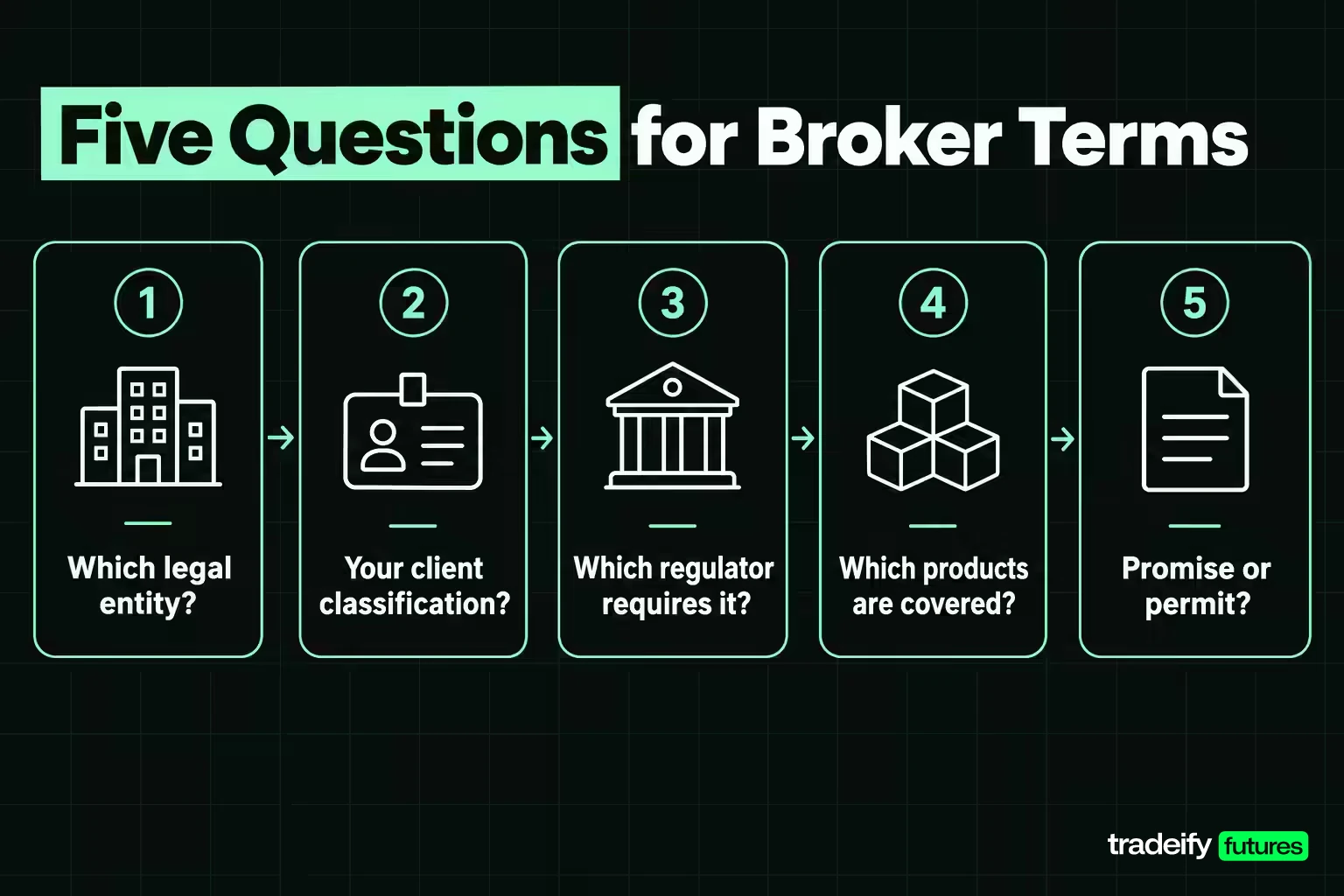
A website banner saying "negative balance protection" is not a contract. Work through these five questions and keep the documents that answer them. If a question cannot be answered from a document you can save, that is the answer.
- Which legal entity are you contracting with? Many brokerage groups run several entities under one brand, each with a different regulator. Protection attaches to the entity named in your agreement, not the logo on the website.
- What is your client classification? Retail, professional, wholesale and eligible counterparty are separate legal categories. If you were reclassified, find the clause and the date.
- Which regulator supervises that entity, and does it require the protection? Check the regulator's public register rather than the broker's site, and confirm the entity on the register matches your agreement.
- Which products are covered? Rules usually name CFDs, spread bets and rolling spot forex. Exchange-traded futures and options are typically outside them.
- Does the wording promise or permit? "We will not pursue any negative balance" is a commitment. "We may, at our discretion, write off negative balances" is not protection. It is the same discretion FXCM exercised in 2015.
Negative Balance Risk on Futures and Funded Accounts
Futures traders should assume there is no regulatory zero floor. Futures are exchange-traded, the UK left them out of its CFD rules, and the US disclosure says plainly that a deficit is your liability. The CFTC's own futures basics page warns that individuals can lose all their money and can be required to pay more than they invested.
Futures also have their own gap risks. Overnight sessions, weekend opens and exchange price limits can all move a contract past a stop. The CFTC disclosure notes it may be difficult or impossible to exit when a market hits a daily price limit.
Funded and evaluation accounts sit in a different category again. Those programmes typically run on simulated accounts under a contract with the trader rather than as a regulated brokerage holding client money, so the regulatory rules above do not apply to them. What matters is the programme's own terms: the maximum loss, how it is measured and what happens if a position gaps past it.
On our accounts, evaluations and funded accounts are simulated. The trailing drawdown updates at the end of each day but is enforced in real time against net liquidation value, so touching it fails the account. All positions close by 4:45 PM ET, with no overnight or weekend holds.
Whatever account you trade, size for the gap rather than the floor. Before the entry, work out how far the market would have to jump to take the whole account. If that distance is a move the product has made before, the position is too big, however tight the stop looks. A zero floor only matters after that check was skipped.
Related lesson: How to size positions so a gap is survivable
Negative Balance FAQ
Does a negative balance mean I owe money?
Usually, unless a negative balance protection rule applies to your account. A negative balance is an unpaid trading loss, and most account agreements make you liable for it. In the US, the futures risk disclosure says you will be liable for any resulting deficit.
Why is my fund balance negative?
A trading account usually shows a negative balance when a loss filled beyond the remaining equity, often after a gap at the open or during a fast news move. Fees, financing charges or a failed deposit can also push a small balance below zero. Ask the firm for the statement line that created it before adding money.
Can a trading account go below zero with a stop-loss in place?
Yes. A standard stop becomes a market order once price reaches it, and if price gaps past your level the fill comes at the next available price. That fill can produce a loss larger than the account balance.
Is negative balance protection free?
Usually there is no separate fee for it. Absorbing client deficits still costs the firm money, though, and some firms may recover that through spreads, margin levels or close-out settings. Compare total trading costs, not just the headline promise.
Does negative balance protection apply to futures?
Generally no. The EU, UK and Australian rules cover CFDs and similar over-the-counter products. US futures customers are told in writing that they can lose more than their deposit.
Trading futures, CFDs, forex and other leveraged products carries a substantial risk of loss, and an adverse gap can take an account below zero before a stop or close-out can act. In many jurisdictions and products you can lose more than you deposit. Funded and evaluation accounts are simulated, and simulated results do not reflect live trading. Rules differ by country, entity and product and change over time. This article is general education, not investment, legal or tax advice.


