



TL;DR: Market participants are everyone who buys, sells, quotes, routes, clears or regulates trades, and each wants something different. Retail traders, institutions, hedge funds, market makers, HFT firms and hedgers meet in one order book. Brokers, exchanges, clearing houses and regulators sit behind every fill. One tick of spread costs $1.25 on a Micro E-mini S&P 500 and $12.50 on an E-mini. Who is trading at a given hour decides how wide that spread gets.
Every filled order has someone on the other side, and that someone had a reason to trade that probably has nothing to do with your chart. A pension fund rebalancing, a farmer locking in a harvest price, a market maker earning a tick and a high-frequency firm flattening its book can all take the opposite side of a retail order in the same minute.
Market participants are the cast that makes a market work, and the cast changes by market and by hour. Knowing who they are, what each one is paid to do and when each one shows up explains a lot of what new traders file under "the market is random": the fill that came back worse than the quote, the limit order that sat untouched, the spread that doubled at the open. This guide maps the participants in stock and futures markets, shows the dollar cost of dealing with them, and ends with a checklist you can use before your next session.
What Market Participants Are
Market participants are the people and firms that take part in a financial market, either by trading in it or by making trading possible. A useful way to sort them is by job:
- Investors and traders put capital at risk. This group includes retail traders, institutional investors such as mutual funds and pension funds, hedge funds, proprietary trading firms and commercial hedgers.
- Intermediaries stand between those traders and the market. Brokers, futures commission merchants, investment advisers and market makers all sit here, each paid in a different way.
- Infrastructure and oversight keep the market running. Exchanges match orders, clearing houses guarantee trades, depositories keep ownership records, and regulators such as the SEC and CFTC set and enforce the rules.
The SEC's investor education site lists the securities market participants it regulates: broker-dealers, clearing agencies, credit rating agencies, alternative trading systems, investment advisers, securities exchanges, self-regulatory organizations and transfer agents. That is a regulator's list, so it leaves out the people doing most of the buying and selling, including you.
Legal and accounting meanings of market participants
The phrase "market participant" also has two meanings outside trading, and both show up in search results. In US constitutional law, the market participant exception shields a state from Commerce Clause challenges when it acts as a buyer or seller in a market rather than as a regulator. In accounting, IFRS 13 defines fair value as the price agreed in an orderly sale between market participants, using the assumptions those hypothetical buyers and sellers would make. This guide covers the trading meaning only.
Related lesson: How financial markets work
Types of Market Participants at a Glance
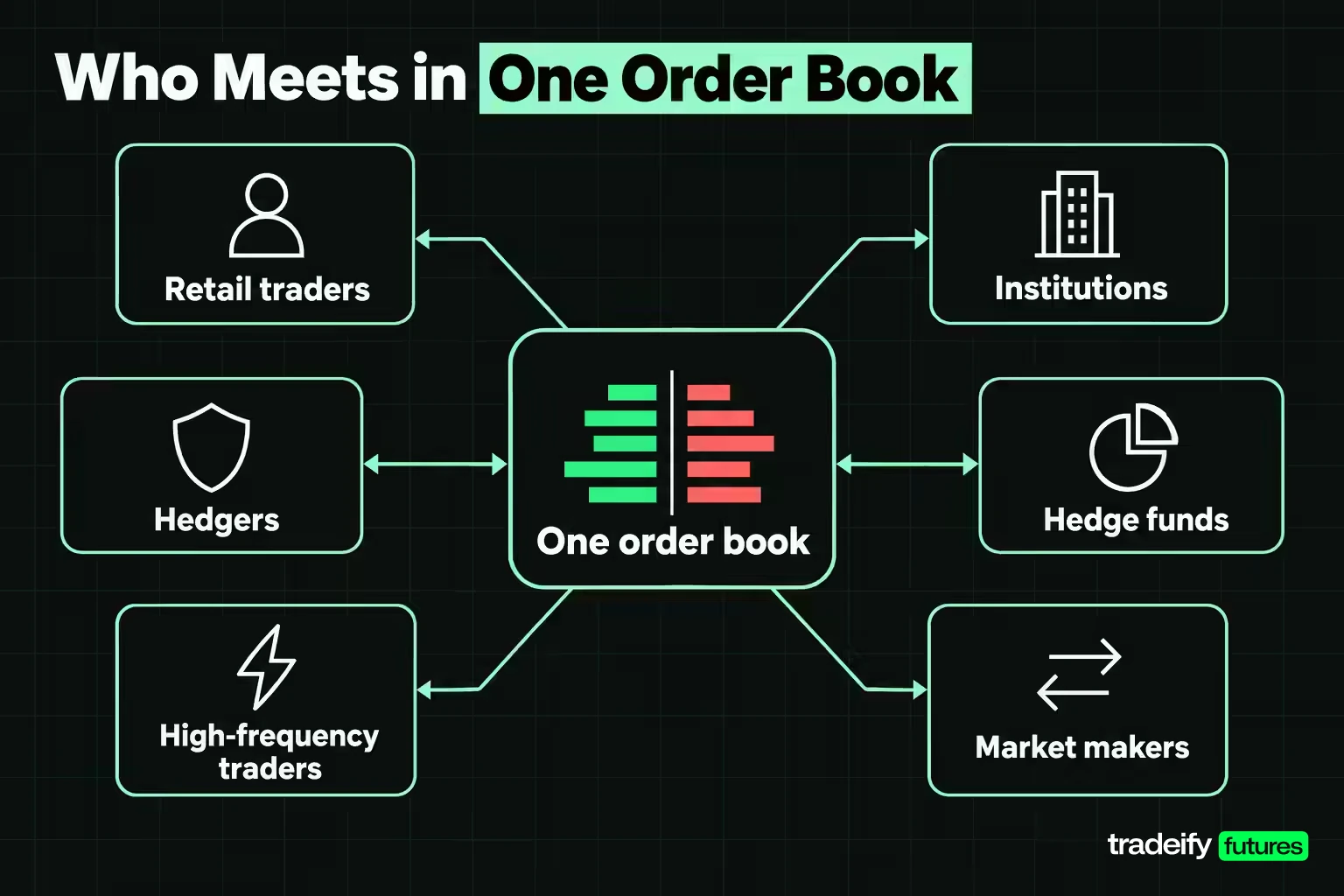
The main types of market participants differ less in what they trade than in why they trade. That motive decides how they behave in the order book, and that behavior is what reaches your fill.
| Participant | What they want | How they usually trade | What it changes for you |
|---|---|---|---|
| Retail trader or investor | Profit from price moves or long-term growth | Small orders routed through a broker | You usually pay the spread and any slippage |
| Institutional investor | Meet a mandate or track a benchmark | Large orders worked slowly in slices | Steady pressure in one direction that can last for hours |
| Hedge fund | Absolute returns with flexible strategies | Long, short, leveraged, often across markets | Fast repositioning when a crowded trade unwinds |
| Market maker | Earn the bid-ask spread many times a day | Two-sided quotes, quick inventory turnover | Supplies the immediacy you pay for, and wider quotes when risk rises |
| High-frequency trader | Small edges repeated at very high volume | Automated orders, many cancelled within moments | Often tighter quotes in calm markets, thinner books in fast ones |
| Hedger | Remove a price risk the business already has | Orders driven by business needs, not chart levels | Size that can arrive regardless of support or resistance |
| Broker or futures commission merchant | Fees, commissions and order flow | Routes and clears client orders | Decides where your order goes and what it costs to send |
| Exchange and clearing house | A fair, functioning venue | Matches orders and guarantees settlement | Sets tick size, trading hours and contract rules |
| Regulator or self-regulatory organization | Fair dealing and market integrity | Registration, rules, surveillance | Decides who may hold your money, not whether you profit |
The four types of market participants in beginner guides
Many beginner guides list four types of market participants: retail traders, institutional traders, market makers and hedgers or speculators. That short list is a fair start, but it leaves out the broker that routes your order and the clearing house that makes the trade final.
Retail Participants and Individual Investors
Retail participants are individuals trading or investing their own money through a brokerage account, and they are the most numerous market participants by headcount even though each one trades small. In futures language, most retail traders are speculators: they take on price risk in the hope of profiting from it, rather than to offset a risk their business already carries.
Retail traders do not reach the market directly. The SEC's investor site is blunt about it: when you press enter, the order goes to your broker, and the broker decides where to send it. For a stock, that can be the listing exchange, another exchange, a market maker, an electronic communications network, or the broker's own inventory. Some market makers pay brokers for that order flow, "a penny or more per share" in the SEC's description, which is why commission-free stock trading still has a business model behind it. Your broker still owes you best execution, a duty to seek the best price reasonably available.
Here is where retail traders usually get caught. Each order is small, so it is easy to assume it cannot matter, and on its own it rarely moves anything. The cost sits elsewhere: you are usually the participant asking for immediacy, and immediacy is exactly what other participants charge for.
How much of the stock market individuals own
Retail ownership is far more concentrated than the word "retail" suggests. According to the Federal Reserve's Distributional Financial Accounts, the wealthiest 10% of US households held 88.1% of the corporate equities and mutual fund shares that households own directly, as of the second quarter of 2026. The top 1% alone held 50.9%, and the bottom half of households held 0.6%. That share has climbed from 81.6% for the top 10% when the series begins in 1989.
Two cautions keep that figure honest. The measure excludes stocks held through defined contribution retirement plans, so it understates how many ordinary people own stocks indirectly. And household ownership is not the same as trading activity: a large share of those holdings are managed, voted and traded by institutions acting for the households.
Institutional Investors as Market Participants
Institutional participants are organizations that invest large pools of money, either their own or on behalf of clients. Banks, insurance companies, pension funds, mutual funds, endowments and investment advisers managing client assets all count. In the US, the SEC requires any institutional investment manager with investment discretion over $100 million or more in qualifying securities to report its holdings on Form 13F, due within 45 days after each quarter ends. That threshold is a reasonable working line between institutional size and everyone else.
Size changes how institutions trade. Imagine an asset manager that needs to buy 2,000 E-mini S&P 500 contracts, around $700,000,000 of exposure at an illustrative index level of 7,000. If the best offer shows an illustrative 150 contracts, sending the whole order at once would sweep through many price levels and push the price up against itself. So the manager works it, perhaps as 20 child orders of 100 contracts spread across a session, often through an algorithm that hides the full size.
That is why institutional flow tends to show up as steady, persistent pressure rather than one spike. Price grinds in one direction, pullbacks get bought, and traders fading the move keep getting run over without ever seeing a single large print. The wrong read is "someone is manipulating the market." The better read is "a large participant has an order to finish and does not care much about the next tick," and the practical response is to stop fading it until the pressure visibly stops.
Mutual funds as market participants
A mutual fund is an SEC-registered open-end investment company that pools money from many investors and is run by a registered investment adviser. Investors buy and redeem shares at the fund's net asset value, calculated each business day. That daily redemption promise shapes behavior: when investors pull money, the fund may have to sell holdings, and when money flows in, it has to buy. Large, steady fund flows are one reason broad index markets have such deep, consistent participation.
Pension funds and insurance companies
Pension funds and insurance companies are long-horizon institutions. Their liabilities, retirement payments and insurance claims, stretch years or decades into the future, so they buy bonds and stocks to match those obligations and rebalance on a schedule rather than react to every headline. In futures, the CFTC notes that pension funds appear among "index traders" in some commodity markets, holding long positions to gain broad commodity exposure and rolling them forward from contract to contract. Their trades are slow, large and predictable in timing, such as rebalancing around month-end or quarter-end, but rarely about short-term direction.
Hedge Funds, Private Equity and Alternative Funds
Hedge funds are private investment funds, and as market participants they have far more flexibility than mutual funds. They pool money from wealthy individuals and institutions. The SEC's investor site notes they can use leverage, short-selling and other speculative strategies, are not marketed to retail investors and are generally limited to accredited investors or qualified purchasers. Typical fees are a management fee of 1-2% of net asset value plus a performance fee of 15-20% of profits.
As market participants, hedge funds matter most when many of them hold the same trade. Leverage lets them build large positions, and when a crowded position goes wrong, forced selling or short covering can drive moves that look unrelated to any news.
Venture capital and private equity firms work mostly in private markets. Venture capital funds back early-stage companies before they list, while private equity funds buy stakes in established private companies or take public companies private. They touch public markets at the edges, for example when a portfolio company goes public or a buyout removes a stock from the exchange.
Alternative investment funds is the broader regulatory label for these vehicles in some countries. India's SEBI (Alternative Investment Funds) Regulations, 2012 sort them into three categories: Category I covers venture capital, SME, social venture and infrastructure funds; Category II covers private equity and debt funds that do not borrow beyond day-to-day needs; and Category III covers funds with complex trading strategies that may use leverage, such as hedge funds.
Brokers, FCMs and Other Intermediary Participants
Brokers are the intermediary participants every retail order passes through. In securities, a broker-dealer handles trades between buyers and sellers for a fee and may also trade from its own inventory. FINRA, the largest self-regulatory organization in the US securities industry, is the frontline regulator of broker-dealers.
Futures intermediaries come in registered categories set by the Commodity Exchange Act, and the custody difference between them matters:
- Futures commission merchant (FCM): accepts futures orders and accepts customer money to support them. Your margin sits with the FCM, which the CFTC requires to keep customer funds separate from its own.
- Introducing broker (IB): solicits or accepts orders but does not hold customer money; it passes accounts through to an FCM.
- Commodity trading advisor (CTA): advises others on trading futures for compensation.
- Commodity pool operator (CPO): runs a pool that combines money from several people to trade futures.
The CFTC states that companies and individuals who handle customer funds or give trading advice must register with the National Futures Association. That registration is worth checking before you send money anywhere.
Investment advisers
An investment adviser is a firm or person paid to advise others on investing in securities, or to publish reports and analysis about securities, as a regular business. Advisers who manage client money also trade on their clients' behalf, which makes them institutional participants in practice even when each client is an individual.
Market participant identifier (MPID)
In US equity markets, broker-dealers and market makers are identified on orders and trade reports by a market participant identifier, or MPID, a four-character code. FINRA publishes the list of MPIDs, and the codes are what you see attached to quotes on a Level 2 stock screen. Futures exchanges do not show participant codes in their public order books, which is why futures depth looks anonymous.
Market Makers and Liquidity Providers
Market makers are participants who stand ready to buy and sell at publicly quoted prices, posting a bid and an offer at the same time. Their revenue is the spread: buy at the bid, sell at the offer, repeat thousands of times. On futures exchanges, many liquidity providers also sign up for exchange programs that give them fee incentives in return for quoting obligations.
Market makers are not betting on direction the way other market participants are. Every trade they take leaves them holding inventory, and inventory is risk. When they get long from absorbing sell orders, they shade their quotes lower to attract buyers and shed the position. When volatility jumps or news is due, they widen their quotes or pull size altogether, because getting caught with inventory in a fast move can wipe out a day of spread income. That is the mechanical reason spreads widen and slippage grows at exactly the moments traders most want to get in.
What one tick of spread costs in dollars
Spread feels abstract until it is in dollars. On the Micro E-mini S&P 500 (MES), the contract is $5 times the index and one tick of 0.25 points is worth $1.25. On the E-mini S&P 500 (ES), the contract is $50 times the index and the same tick is worth $12.50.
Say the market is quoted at an illustrative 7,000.00 bid and 7,000.25 offer. You buy at the offer and later sell at the bid with the price unchanged. You paid one tick: $1.25 on one MES, or $12.50 on one ES. The participant whose resting order you traded against earned it.
How spread cost scales with trading frequency
Spread cost for any market participant who takes liquidity grows with every round turn. Scale the one-tick example on MES and ES:
- A trader doing 4 round turns a day for 20 sessions completes 80 round turns.
- On one MES that is 80 x $1.25 = $100 in spread alone, before commissions.
- On one ES it is 80 x $12.50 = $1,000.
The cost also scales against your target. On MES, a 10-point target is worth $50, so one tick is 2.5% of it. Cut the target to 5 points, worth $25, and the same tick is 5% of it. Nothing about the market makers changed. A smaller target simply makes their fee a bigger share of every win.
From the other side, a liquidity provider earning one tick on 200 MES round turns grosses $250 before fees. The business only works on volume, which is why market makers care far more about the flow of orders than about any single trader's position.
Related lesson: Market makers explained
High-Frequency Traders and Algorithmic Participants
High-frequency traders are algorithmic participants that trade their own capital at very high speed and very high volume. The SEC's 2010 review of equity market structure noted that estimates put HFT above 50% of total volume in US-listed equities at the time, while admitting the term had no clear definition. It listed five traits often attributed to HFT:
- Extremely fast, sophisticated programs to generate, route and execute orders.
- Co-location and direct data feeds from exchanges to cut delays.
- Very short holding periods.
- Large numbers of orders cancelled shortly after they are placed.
- Ending the day as close to flat as possible.
Many HFT firms act as electronic market makers, and their competition is a big reason quotes in liquid futures such as ES are often a single tick wide in normal hours. The catch is that this liquidity is conditional. The same programs that quote tightly in calm conditions are built to cancel orders the instant conditions change, so the depth you saw a second before a data release may not be there when your order arrives.
Algorithmic trading is broader than HFT. Institutions use execution algorithms to slice large orders, systematic funds run rule-based strategies on longer horizons, and some retail platforms let individuals automate entries. A chart that "respects" a moving average or a round number often reflects many automated participants watching the same simple signal.
Related lesson: High-frequency trading
Hedgers and Speculators in the Futures Market
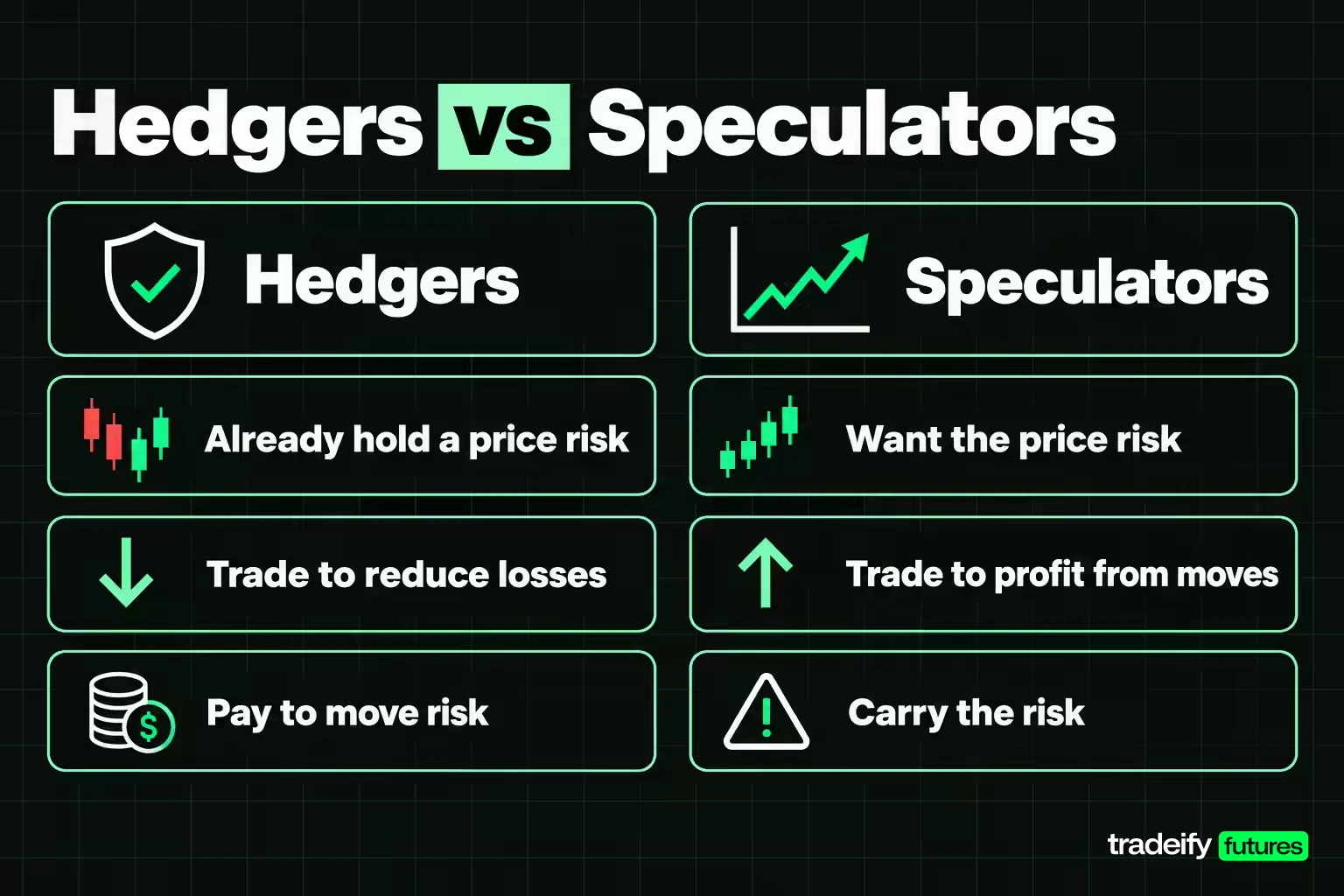
Hedgers and speculators are the two founding participant types of the futures market. The CFTC describes most futures participants as commercial or institutional producers and consumers, and most as "hedgers" who trade futures to reduce the risk of losses from price changes. Others are "speculators" who try to profit from those price changes.
A hedger already has a price exposure from running a business. A grain farmer worried about falling prices sells futures before harvest. An airline worried about rising fuel costs buys energy futures. An asset manager about to receive a large inflow buys equity index futures to get market exposure right away. In each case the futures position offsets a risk the participant already holds.
Speculators take the other side because they want the risk and the potential reward attached to it. That swap is the whole point of the market. Hedgers pay, through the spread and the price they accept, to move risk onto someone willing to carry it.
For a short-term trader, the practical lesson is about timing. A hedger's order arrives when a business decision is made, not when price reaches your level. Large hedging flow can blow through support that "should" hold, or sit at a price for an hour soaking up every buyer, with no technical reason visible on the chart.
Related lesson: Futures market participants
Exchanges, Clearing Houses and Regulators Behind Every Market
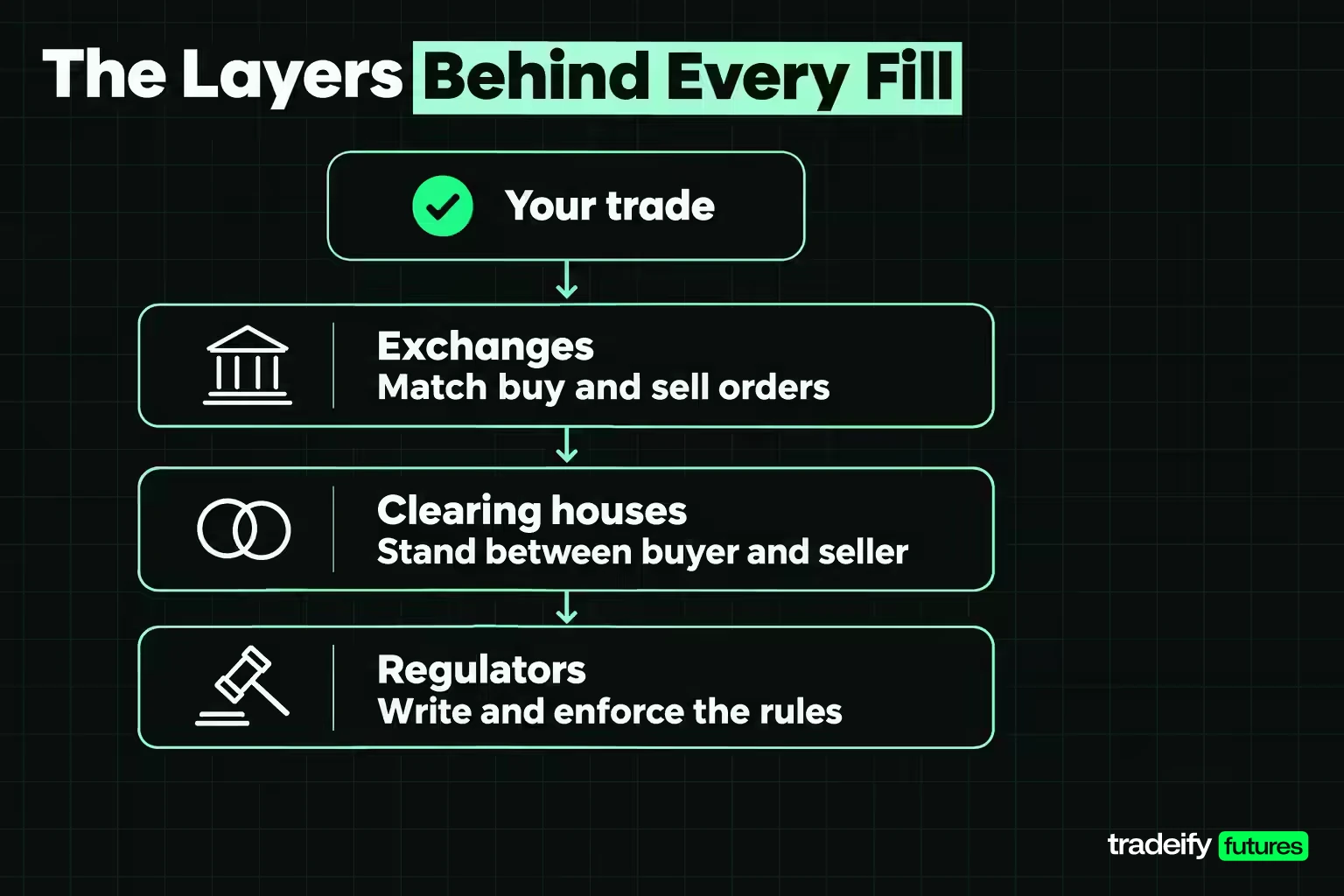
Exchanges, clearing houses and regulators are the infrastructure market participants. They do not take market views, but every trade depends on them.
- Exchanges list products, publish contract specifications such as tick size and trading hours, and run the matching engine that pairs buy and sell orders. Alternative trading systems match stock orders outside the national exchanges under their own SEC rules.
- Clearing houses stand between buyer and seller once a trade is matched. In futures, a derivatives clearing organization substitutes its own credit for that of each side, so you never need to trust the trader who took the other side of your order. In US stocks, clearing corporations such as the NSCC clear trades, and the Depository Trust Company holds securities and keeps ownership records.
- Regulators and self-regulatory organizations write and enforce the rules. The SEC oversees securities, the CFTC oversees futures and other derivatives, FINRA polices broker-dealers, and the NFA handles registration and conduct for futures firms.
Beginners often expect regulation to protect them from losses. It does not. Registration and supervision require disclosure, fair dealing, the separation of customer funds and sound settlement. The CFTC itself warns that speculating in futures is rarely suitable for retail customers and that many individuals lose all their money and can owe more than they put in.
Related lesson: Clearing and settlement
How the Mix of Market Participants Shapes Price and Liquidity
The mix of market participants at any moment explains much of how a market behaves. The same contract can feel deep and smooth at one hour and thin and jumpy at another, and the difference is who is trading.
- Lots of market makers and HFT, few large directional orders: tight spreads, plenty of displayed size, small choppy moves. Your market orders fill near the quote.
- Large institutional or hedging flow in one direction: persistent trends, pullbacks that get absorbed, and liquidity providers leaning their quotes the same way.
- Liquidity providers stepping back before or after news: wider spreads, thin depth and slippage on stop orders.
- Crowded leveraged positions unwinding: sharp moves that overshoot, then often partly reverse once forced trading is done.
Reading the participant mix in the Commitments of Traders report
For futures, the CFTC publishes a weekly breakdown of which market participants hold open positions. The Commitments of Traders (COT) report uses each Tuesday's data and is generally released Friday at 3:30 PM Eastern, for markets where 20 or more large traders hold positions above CFTC reporting levels. Those reportable positions usually make up 70% to 90% of open interest. The rest is "nonreportable," the smaller traders whose categories are unknown.
The Traders in Financial Futures version sorts large traders into four groups: Dealer/Intermediary, Asset Manager/Institutional, Leveraged Funds and Other Reportables. As of the report for October 27, 2026, E-mini S&P 500 futures had open interest of 1,955,711 contracts, split like this:
| COT category | Long share of open interest | Short share of open interest |
|---|---|---|
| Asset Manager/Institutional | 56.8% | 9.6% |
| Dealer/Intermediary | 9.9% | 42.6% |
| Leveraged Funds | 5.2% | 25.7% |
| Other Reportables | 3.1% | 3.2% |
| Nonreportable | 13.0% | 7.0% |
The pattern is typical of an equity index future. Asset managers hold heavy long exposure, which fits funds using futures to stay invested. Dealers, who often sit on the other side of client swaps and other hedging business, and leveraged funds, some of which run relative-value trades against the cash market, hold most of the short side. The CFTC is clear that its staff do not know the specific reasons for any trader's positions, so treat these readings as structure, not as a timing signal. A week-to-week change in one group's position tells you more than a single snapshot.
How the participant mix changes through the day
The cast also rotates with the clock. ES trades on CME Globex from Sunday 6:00 PM to Friday 5:00 PM ET, with a daily maintenance break from 5:00 PM to 6:00 PM ET, but participation is far from even across those hours.
- US cash session hours bring institutions, the cash stock market and the most active liquidity providers together. Depth is greatest and spreads are tightest.
- Overnight hours run on thinner books. A smaller order moves price further, and displayed size can disappear quickly.
- Scheduled data releases pack hedgers, algorithms and short-term speculators into the same seconds while market makers pull back, so spreads widen right when moves are largest.
- The open and the close concentrate institutional orders, including index-tracking funds trading near the close.
That is why two identical setups can cost different amounts at 10:00 AM and at 3:00 AM.
Related lesson: The bid-ask spread explained
Market Participants in the Indian Stock Market and Abroad
Market participants abroad fill the same roles under different rules, and the Indian stock market is a good example because its regulator defines foreign access in detail.
In India, SEBI (the Securities and Exchange Board of India) regulates the market. The main participants are the stock exchanges, such as NSE and BSE, the depositories NSDL and CDSL that hold shares electronically, SEBI-registered stockbrokers, domestic institutions such as mutual funds and insurers, retail investors, and foreign portfolio investors.
Foreign portfolio investors and participatory notes
Foreign portfolio investors (FPIs) are overseas institutions and funds that buy listed Indian shares, bonds and exchange-traded derivatives as portfolio investments rather than strategic stakes. They must register with SEBI before investing. SEBI sorts them into Category I, which covers governments, central banks, sovereign wealth funds, pension funds and regulated banks, insurers and asset managers, and Category II, which covers less regulated entities treated as higher risk.
FPI rules also cap how much of one company a foreign portfolio investor can own. A single FPI, together with its investor group, must stay below 10% of a listed company; a breach has to be sold down within five trading days, or the whole holding is treated as foreign direct investment instead.
Participatory notes, or P-Notes, are an offshore route into the same market. A registered Category I FPI issues a derivative overseas whose value tracks Indian securities it holds, so the end investor gains exposure without registering in India. SEBI's FPI Regulations of 2014 formally defined these as Offshore Derivative Instruments, and issuers must report holder details to SEBI.
Reading Your Fills to Identify Other Market Participants
A retail futures trader is usually a small speculator in the nonreportable slice of the COT report, trading against a book shaped by market makers, algorithms, hedgers and institutions. You can learn a lot about that mix from how your own orders fill. This diagnostic works backward from what you saw to the participant most likely on the other side.
| What you observe | Likely counterparty or cause | What it means for you |
|---|---|---|
| Filled at the quote, spread one tick | Market maker or HFT quoting both sides | Normal. You paid the spread and nothing unusual happened |
| Filled several ticks worse in a quiet hour | Thin book with little resting size | Your order was large for the depth. Trade smaller or at a busier hour |
| Filled several ticks worse right after a release | Algorithms and hedgers active, liquidity providers stepped back | Expected in fast markets. Use limit orders or wait for the book to refill |
| Partial fill on a limit order price touched | Orders ahead of you in the queue | You were in line, not skipped. Being touched is not being filled |
| Limit order untouched while price trades at your level | Queue at that price never cleared | Price had to trade through your level for a guaranteed fill |
| Price grinds against you with no big prints | Institutional order worked in slices | Fading persistent flow is a low-odds trade until the pressure stops |
Most fills that feel personal turn out to be structural. That does not make them free, but it does make them predictable enough to plan around.
Simulated funded accounts and live order books
Many funded futures programs run evaluations and funded accounts on simulated accounts that use live market data. In that setup your fills are modeled on what the market was doing, not matched with another participant's order, so simulated fills can be kinder or harsher than live ones. Treat them as a model of participation rather than proof of it.
On our accounts at Tradeify, evaluations and funded accounts run in a simulated setting, so your orders are modeled against market data rather than taken by another participant in the exchange's book. Profits can still lead to real payouts, and traders may later be moved to a live account. Position size is set by each account's contract limit, and all positions close by 4:45 PM ET, so you are never one of the overnight participants holding risk through the thin hours.
Common Misreads About Market Participants
Misreads about market participants usually come from assuming everyone on the other side wants the same thing you do.
| Misread | What traders assume | What is actually true |
|---|---|---|
| Someone has to lose for me to win | The other side is another trader betting against me | The other side is often a market maker earning the spread, a hedger removing risk, or a fund meeting a mandate, none of whom formed a view on your trade |
| Market makers hunt my stop | Quoting firms target individual positions | Market makers earn the spread and manage inventory. Stops get hit when larger flow absorbs the resting orders near them |
| Big players always know more | Institutions trade on secret information | Many institutional trades are rebalancing, hedging or fund flows with no short-term view at all |
| Regulated means safe from losses | Registration protects against losing money | Regulation covers disclosure, fair dealing and settlement. It does not stop trading losses |
| The market behaves the same all day | Participation is constant | The cast rotates by hour, so cost and fill quality change too |
| Simulated fills are live fills | A simulated account trades in the live book | Simulated accounts model fills from market data and do not take another participant's order |
Market Participants FAQ
Who owns 90% of the stock market today?
In the US, the wealthiest 10% of households held 88.1% of the stocks and mutual fund shares that households own directly, as of the second quarter of 2026, according to the Federal Reserve. That measure leaves out stocks held in workplace retirement plans. Much of the trading in those shares is done by institutions managing money for households.
What are the 7 types of financial markets?
A common list is the stock market, bond market, money market, derivatives market, foreign exchange market, commodity market and crypto asset market. There is no official count, so some lists merge commodities into derivatives or leave crypto out. Each market has its own mix of participants, from central banks and money market funds in the money market to commercial hedgers in commodities and dealer banks in foreign exchange.
What are people in the stock market called?
People who buy stocks to hold them are usually called investors or shareholders, and people who buy and sell more often are called traders. The firms that handle their orders are brokers or broker-dealers. Traders who expect prices to rise are often called bulls, and those who expect falls are called bears.
Who are the market participants in the Indian stock market?
The Indian stock market includes SEBI as regulator, exchanges such as NSE and BSE, depositories, SEBI-registered stockbrokers, domestic institutions such as mutual funds and insurers, retail investors and registered foreign portfolio investors. Foreign investors can also gain exposure indirectly through participatory notes issued by Category I FPIs.
What is the market participant identifier (MPID)?
An MPID is a four-character code that identifies a broker-dealer or market maker in US equity trading and FINRA reporting. It is the label you see next to quotes on a Level 2 stock screen. Futures order books do not display participant identities.
Who are the four types of market participants?
Simple lists name retail traders, institutional investors, market makers and hedgers or speculators. A fuller list adds brokers, high-frequency traders, exchanges, clearing houses and regulators, because no trade happens without them.
A Market Participants Checklist for Your Next Session
A market participants checklist turns this map into decisions. Answer these for the instrument and hour you actually trade:
- What is one tick worth on this contract, and what does a round turn cost in spread before commissions? On MES it is $1.25 a tick.
- Is the hour I trade inside the busiest part of the session, or am I trading a thin book?
- Is a scheduled release due during my session, and will liquidity providers step back around it?
- Is there persistent one-way pressure today that looks like an institution working an order?
- Which of my last ten fills came back worse than the quote, and what was the market doing at that moment?
- If I trade a simulated account, which parts of my fill quality are modeled and which reflect real liquidity?
If you cannot answer at least four of these, the missing answers are your next piece of research, not your next trade.
This guide is educational only and is not financial advice or a recommendation to trade any product. Futures and other leveraged products can lose more than you expect, and in some accounts more than you deposit. Simulated and funded evaluation accounts are simulated, and their results do not reproduce live execution. Past or simulated results do not predict future results.


