



TL;DR: Market makers are dealers that quote a bid and an ask at once and trade at both, earning the spread for carrying inventory risk. A one-tick MES spread is $1.25 per contract, so 3 contracts start $3.75 behind before price moves. Registered market makers must keep quoting, yet on May 6, 2010 many widened spreads or withdrew. In DeFi, Uniswap v2 replaces the quote with an x * y = k pool and a 0.30% fee.
Every time you click buy at the ask, someone is selling to you at that price. Very often it is one of the market makers: firms that quote a price to buy and a price to sell in the same instrument at the same moment, and stand ready to trade at either one. They are the reason you can usually get in or out of a liquid contract instantly instead of waiting for someone who wants the exact opposite trade.
Knowing how they work changes how you read a quote. It explains why the spread exists, why it widens before news, and why the size you see on the screen is not a promise. This guide covers what market makers do, how they make money, the risks they manage, how they behave when markets turn violent, and what all of it costs you per trade.
What Are Market Makers
Market makers are dealers that continuously publish two prices. The bid is the price at which they will buy. The ask, also called the offer, is the price at which they will sell. A trader who wants in can buy at the ask immediately, and a trader who wants out can sell at the bid immediately.
The SEC's investor site defines a market maker as a firm that stands ready to buy or sell a stock at publicly quoted prices. US securities law is more specific. Section 3(a)(38) of the Securities Exchange Act of 1934 covers any dealer that holds itself out as willing to buy and sell a security for its own account on a regular or continuous basis, including by entering quotations in an inter-dealer system.
Two parts of that definition matter.
- Own account. A market maker trades as a principal. When you sell to one, it buys the position and owns the risk.
- Regular or continuous. A firm that fills you once is not a market maker. The continuous quote is the job.
Optiver, a market making firm, describes the role as continuously providing bids and offers as a primary trading strategy, usually under contractual or legal obligations to quote for a set part of the day, in a minimum size, within a maximum spread.
The cleanest way to understand what market makers sell is to look at a market without them. Optiver uses buying a house. You cannot do it instantly. You wait, sometimes for weeks, until a seller with the right property appears. Market makers replace that wait with a standing price. What they sell is immediacy, and the spread is what you pay for it.
Related lesson: Market participants
How Market Makers Operate Day to Day
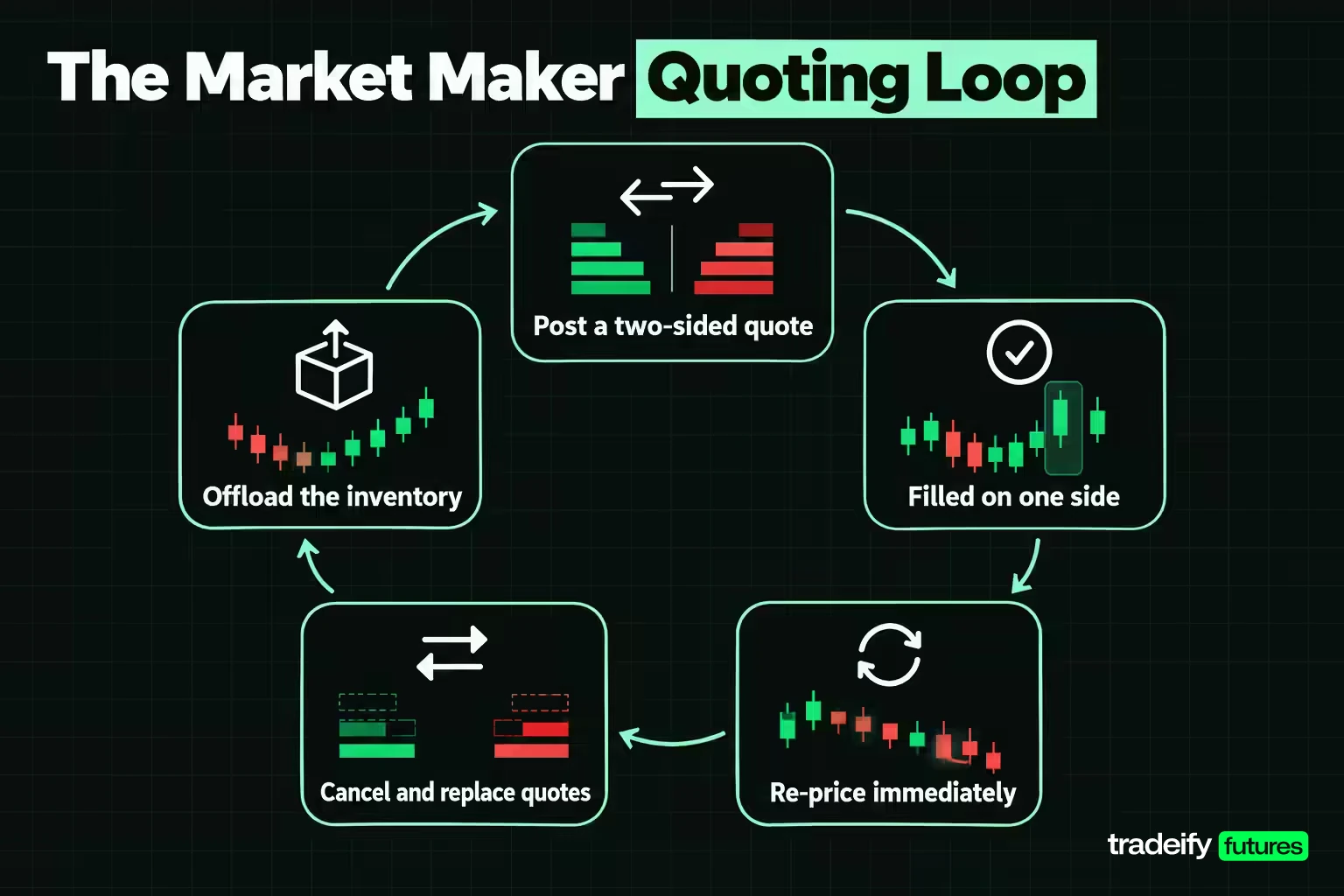
Market makers start every quote with a theoretical price, their estimate of fair value from inputs such as related contracts, recent trades and the order book. They then decide how much margin they need to cover the risk of trading at that price and set a bid below it and an ask above it.
From there the work is a loop that runs all session, in this order.
- Post a two-sided quote in a stated size.
- Get filled on one side when someone trades against the quote.
- Re-price immediately, because the fill has changed the firm's inventory.
- Cancel and replace quotes as the theoretical price moves.
- Offload the inventory, either by getting filled on the other side or by hedging elsewhere.
Inventory skew on an illustrative MES quote
Quote skew is how market makers steer their own inventory. Take Micro E-mini S&P 500 (MES) futures, where one tick is 0.25 index points and worth $1.25 per contract. Suppose an illustrative market maker quotes 7,000.00 bid and 7,000.25 ask.
A wave of sellers hits the bid and the firm ends up long 100 contracts. It does not want that position. So it may lower both prices by a tick, to 6,999.75 bid and 7,000.00 ask. The lower bid makes it less likely to buy more. The lower ask makes it more attractive to buyers, which is how it sells the 100 contracts back out.
When you see the inside quote tick down without a trade, a skew like this is one possible reason. Treat it as an observation, not a signal. The theoretical price may simply have moved, and you cannot see the firm's inventory from your DOM.
Speed and queue position
Speed matters because most electronic order books use price-time priority. At the same price, the order that arrived first fills first. IMC notes that when competing market makers offer the same price, the one that posted first typically gets the trade. On some CME products the matching algorithm also includes a lead market maker allocation, which rewards a designated firm for its quoting commitment.
Related lesson: The order book
How Market Makers Make Money
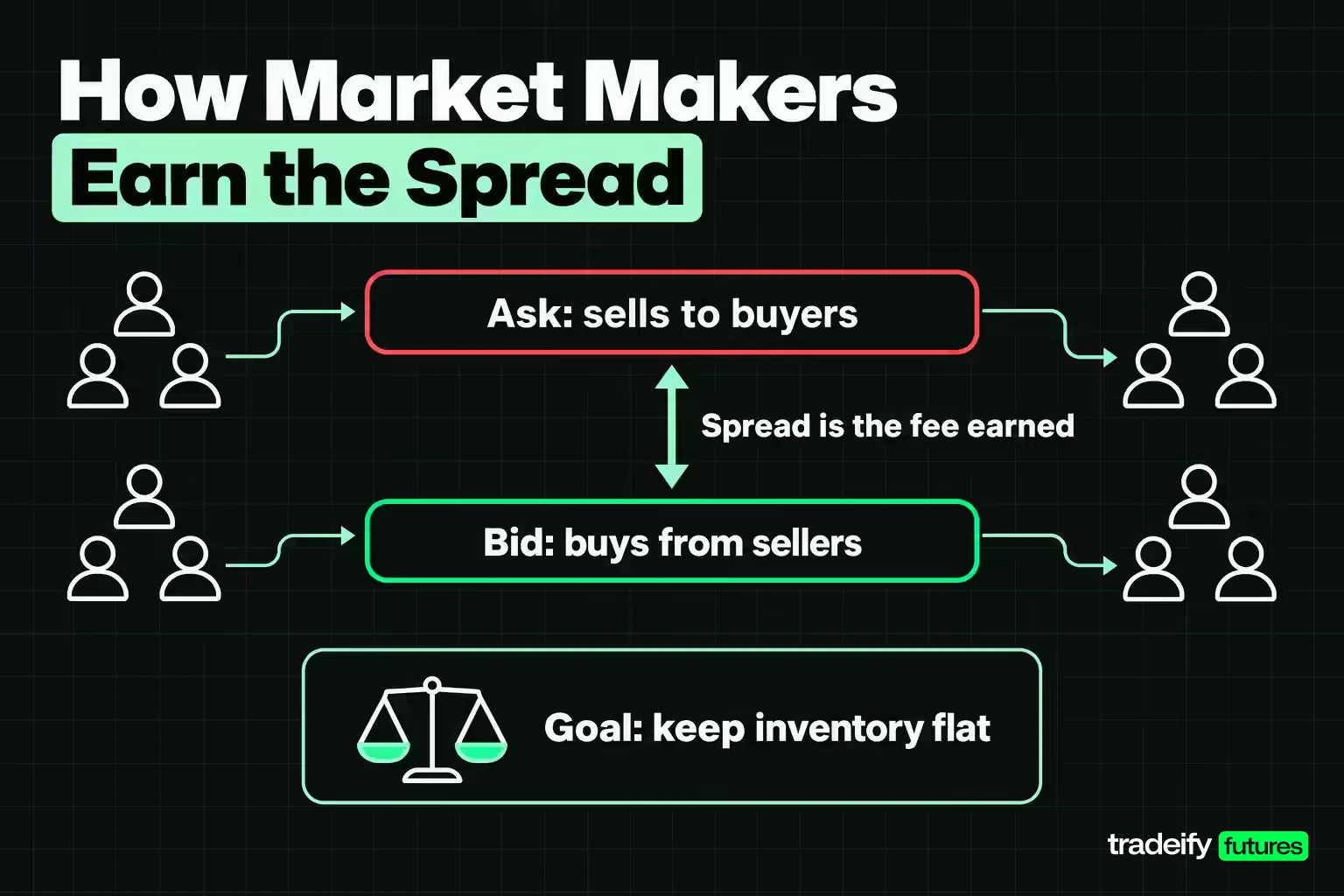
Market makers make money mainly from the bid-ask spread, earned across a very large number of trades. Optiver's example: fair value $100, a bid for 1,000 shares at $99.95 and an offer at $100.05. If one person sells to the firm and another buys from it, the firm earns $0.10 per share, which is $100 on 1,000 shares.
The same logic on a futures contract, using illustrative MES prices:
- The firm buys 100 contracts at 7,000.00 and sells 100 at 7,000.25.
- One tick captured on 100 contracts is 100 x $1.25 = $125.
- If price had moved 1 point against those 100 contracts before it sold, the loss would be 100 x $5 = $500, four times the $125 captured.
That ratio explains why the ideal state is a flat inventory. The spread is a small, steady fee. The inventory is a large, unpredictable risk. Market makers earn by turning inventory over quickly, not by holding it and hoping. A market maker that starts forecasting direction with its inventory has stopped making markets and started speculating.
Rebates and order flow payments to market makers
- Exchange incentives. Exchanges pay for committed quoting. A 2009 CME market making program for 3-Year Treasury Note futures waived clearing and Globex fees for up to 5 market makers and paid a $0.11 credit per contract, capped at $15,000 a month. CME Rule 195 now consolidates the terms of its market maker and incentive programs.
- Payment for order flow. In US stocks, some market makers pay retail brokers a penny or more per share to receive customer orders, according to the SEC's investor site. Brokers still owe customers best execution.
Why pay for any of this? Because the alternative is waiting. The spread is the price of trading now, and competition between market makers is what keeps that price small.
Related lesson: Payment for order flow
Market Maker Risk Management
Market maker risk management is the actual business. A firm that quotes both sides all day is constantly handed positions it did not choose, and its survival depends on how fast it can neutralize them.
The main risks:
- Inventory risk. After a fill, the firm owns a position and price can move against it before it gets flat.
- Adverse selection. Some orders come from traders who know something the firm does not. If a quote is stale for even a moment around a data release, informed flow picks it off.
- Event and gap risk. A sudden move can jump straight through the quote.
- Technology risk. A pricing or connectivity error can repeat across thousands of quotes in seconds.
How market makers control risk
- Spread width. CME's education material says the market maker's view of how risky a trade is primarily sets the width of the bid and offer. Riskier conditions mean wider quotes.
- Skew. Shifting both quotes to attract the trade that reduces inventory.
- Hedging. IMC's airport currency counter example shows the idea. A desk holding unwanted euros can sell them to a traveler going the other way, or swap them for British pounds, a currency that tends to move closely with the euro against the dollar.
- Size limits. Smaller displayed size when uncertainty rises.
- Automated pauses. The SEC and CFTC's report on May 6, 2010 found that many liquidity providers' systems paused automatically when prices moved past pre-defined thresholds.
Each control protects the firm. Several of them (wider quotes, smaller size and pauses) also mean less liquidity for everyone else exactly when it is scarce. That is the tradeoff to keep in mind: the same risk discipline that keeps market makers in business is what thins the book in a fast market.
Why Market Makers Make Markets More Efficient
Market makers matter because liquidity attracts more liquidity. A market with a tight, reliable quote draws traders, which lowers the market maker's risk of holding inventory, which lets it quote tighter still. CME's education material puts it simply: liquid and illiquid markets tend to be self-perpetuating.
Three effects follow.
- Lower trading costs. Optiver notes that more competing market makers typically narrow the spread further. IMC makes the same point with currency counters: when a second desk offers a better rate, the first loses the business and customers benefit.
- Continuous price discovery. Market makers update quotes every time new information arrives, so the market price reflects new information quickly.
- Linked prices across venues. When the same exposure trades in two places, for example an index future and an ETF on the same index, market makers trading both tend to close small price gaps between them. That arbitrage is one way they find edge, and it keeps related prices consistent.
Without market makers, a seller waits for a natural buyer. In an active futures contract, that wait would show up as wider spreads and bigger jumps between trades, which is roughly what you already see in a quiet overnight session or an illiquid back-month contract.
Related lesson: What is liquidity
How Market Makers Behave During Volatility
Market makers are expected to keep quoting when markets move, and registered ones carry obligations to do so. The limits of that support became clear on May 6, 2010, the Flash Crash.
What happened to market makers on May 6, 2010
The SEC and CFTC staff report describes the sequence.
- At 2:32 PM a large fundamental seller, a mutual fund complex, started selling 75,000 E-Mini S&P 500 contracts, about $4.1 billion, as a hedge.
- Between 2:45:13 and 2:45:27, the report found, high-frequency traders traded over 27,000 contracts, about 49% of volume, while adding only about 200 contracts net. They were passing the same positions back and forth.
- Buy-side depth in the E-Mini fell to about $58 million, less than 1% of that morning's level, according to the same report.
- At 2:45:28 PM CME's Stop Logic paused E-Mini trading for five seconds. When trading resumed at 2:45:33 PM, prices stabilized.
In stocks, the SEC and CFTC staff found, some market makers widened spreads, others cut size, and a significant number withdrew completely. To meet their two-sided quoting obligations after withdrawing, some left stub quotes, prices so far from the market they were never meant to trade. Market orders hit them anyway. Per the same report, over 20,000 trades in more than 300 securities printed more than 60% away from prices moments earlier, some at a penny or less and some as high as $100,000. Accenture's bid fell from about $30 to $0.01 in seven seconds. Those trades were later broken.
Market maker quoting rules after the Flash Crash
After the Flash Crash, in November 2010, the SEC approved new market maker quoting standards that effectively prohibited stub quotes. Market makers in exchange-listed stocks had to keep continuous two-sided quotes within 8% of the national best bid and offer for stocks in the circuit breaker pilot, 20% near the open and close, and 30% for other listed stocks, effective December 6, 2010.
The lesson for a trader is narrow and practical. Market makers do support prices in normal volatility, by absorbing imbalances and widening rather than vanishing. In extreme stress their obligations limit how far away they can quote, not whether they will absorb your size.
Related lesson: Slippage explained
Market Makers vs Brokers, Dealers and Exchanges
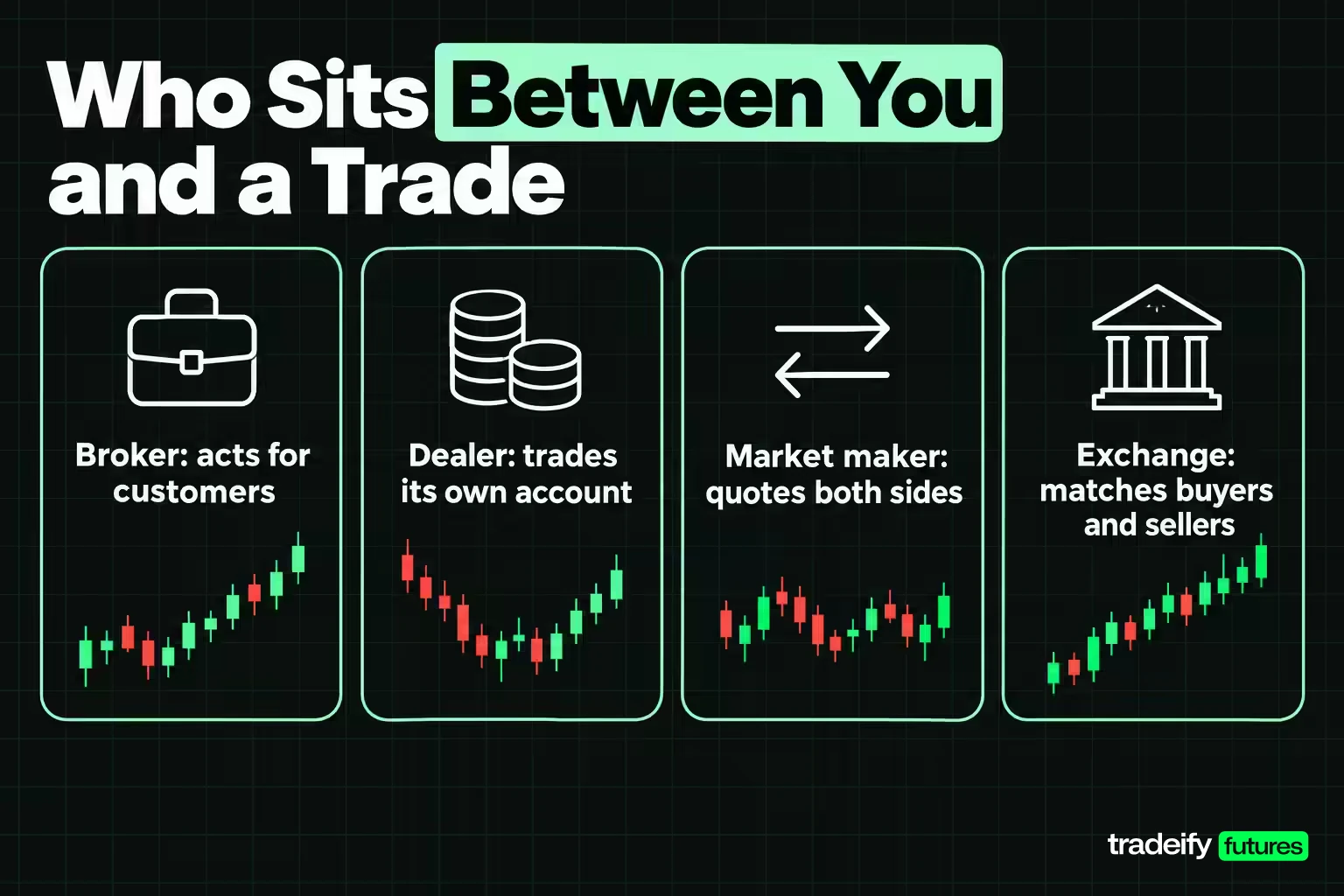
Market makers are often confused with the other firms between you and a trade. The legal definitions in the Securities Exchange Act separate them cleanly.
| Role | Acts for | Main job | Takes the other side of your trade |
|---|---|---|---|
| Broker | Customers | Effects trades for the account of others | No |
| Dealer | Itself | Buys and sells for its own account | Sometimes |
| Market maker | Itself | A dealer that quotes both sides on a regular or continuous basis | Yes, when you trade against its quote |
| Exchange | The marketplace | Brings buyers and sellers together | No |
| Unregistered liquidity provider | Itself | Posts limit orders without quoting obligations | Yes, but it can cancel at any moment |
Two distinctions matter most.
- Registered versus unregistered. A registered market maker has signed up for quoting obligations. A firm or trader posting limit orders provides liquidity too, but can cancel the moment conditions turn. Displayed size from either is a snapshot, not a promise.
- Broker versus wholesaler. When you buy a stock through a retail app, the broker decides where to send the order. It can go to an exchange or to a wholesale market maker that fills it from its own inventory, sometimes after paying the broker for that order flow.
Is JP Morgan a market maker
Large banks often act as market makers through their broker-dealer arms. J.P. Morgan Securities LLC is on the New York Fed's list of primary dealers as of November 4, 2026. Primary dealers are expected to make markets for the New York Fed on behalf of its official accountholders and to bid in every Treasury auction.
Related lesson: Dark pools and off-exchange trading
Where Market Makers Trade
Market makers work almost everywhere that has a quote.
- Listed stocks and ETFs. Exchange market makers, the primary-listing designated market maker on some venues, and wholesalers that fill retail orders. On Nasdaq Level II, each market maker shows a four-character ID, such as CDRG for Citadel Securities.
- Options. Thousands of strikes and expirations would have no quote at all without firms pricing them continuously.
- Futures. CME runs market maker and incentive programs. The 2009 program for 3-Year Treasury Note futures shows what the obligations look like: quote bids and offers 75% of the time in normal conditions between 7:00 AM and 4:00 PM, no wider than half of 1/32, in a minimum size of 50 contracts, with CME able to revoke market maker status for non-compliance.
- Government bonds. Primary dealers make markets in Treasuries and bid in auctions.
- Currencies and crypto. Bank and non-bank dealers quote currency pairs, and crypto market makers quote on exchanges that never close.
The biggest market making firms and how they hire
The large firms are mostly proprietary trading firms trading their own capital. Jane Street describes itself as one of the world's largest market makers, trading on more than 200 electronic exchanges and venues. Optiver, IMC, Virtu and Citadel Securities are other well-known names.
The job has changed. IMC writes that the old must-haves were fast mental math and communication, and that quantitative skills from engineering, mathematics or computer science now come first, because pricing and hedging run on algorithms. Firms hire traders, researchers and engineers, and they pay for speed because, at equal prices, the first quote gets the fill.
Related lesson: Futures market participants
Market Makers in Crypto Markets and DeFi
Market makers in crypto do the same job on a different structure. Centralized crypto exchanges run order books around the clock, so quoting never pauses for a close. Token projects also hire market makers directly to keep a new token tradable, which creates a conflict: a firm paid by the issuer has a reason to make trading look busier than it is.
That conflict has been prosecuted. In October 2024 the SEC charged three companies presenting themselves as market makers, ZM Quant, Gotbit and CLS Global, with providing "market-manipulation-as-a-service." The SEC alleged wash trading that at times generated billions of dollars of artificial volume a day. High reported volume on a small token is not proof of real liquidity.
Automated market makers
Decentralized exchanges such as Uniswap replace the human market maker with a smart contract. Liquidity providers deposit two tokens into a pool, and the pool prices trades with the constant product formula x * y = k. In Uniswap v2 every pool charges a flat 0.30% fee, which goes to the liquidity providers.
Here is the math on an illustrative pool of 1,000 token A and 1,000,000 token B, a spot price of 1,000 B per A.
- To buy 10 A, the pool must keep x * y constant. Your cost is 10,101.01 B before the fee, an average of 1,010.10 per A, about 1.01% above spot.
- With the 0.30% fee, you pay 10,131.40 B, about 1.31% above spot.
- The pool's new spot price is about 1,020.30.
There is no spread in the order book sense. The cost shows up as price impact, and it grows with trade size relative to the pool. A deeper pool works like a tighter market.
Benefits and Drawbacks of Market Makers
The case for market makers is cheaper, faster trading in normal conditions. The case against centers on conflicts of interest and on liquidity that can disappear under stress, as it did on May 6, 2010.
| Benefit | Drawback |
|---|---|
| Instant execution at a quoted price | You pay the spread on every round turn |
| Competition narrows spreads | Liquidity can vanish in extreme stress |
| Continuous quotes in thinly traded products | Obligations can be met with wide quotes |
| Fast price discovery across related markets | Speed advantages favor the fastest firms |
| Retail stock orders can be filled from inventory without waiting | Payment for order flow creates a conflict of interest |
| Liquidity in new crypto tokens | Some crypto market makers have been charged with manipulation |
Do market makers hunt stops
The claim you will read is that market makers push price into clusters of stop orders to fill their own books. The honest answer is narrower. Stops resting at obvious levels are known in aggregate to many participants, aggressive flow moves price, and a liquidity provider is on the other side of that flow.
What is not established is that a market maker with quoting obligations can reliably move a deep market like index futures to a chosen price and hold it there without taking on large risk itself. Blaming a stop-out on a hunt is tempting because it takes the decision out of your hands.
The useful part is mechanical. A stop-market order becomes a market order once its price trades. In a thin moment it fills at whatever is available. That is a fill-quality problem you can plan for: put the stop where being filled is acceptable, size so a few ticks of slippage do not matter, and assume your stop level is not a secret.
Related lesson: Liquidity sweeps and stop runs
What Market Makers Cost You as a Futures Trader
Market makers set the spread, and the spread is a toll you pay every time you cross it. On MES one tick is $1.25 per contract. Suppose the illustrative book shows 7,000.00 bid and 7,000.25 ask, and you buy 3 contracts at the ask.
You are immediately $3.75 behind (3 x $1.25) if you mark the position at the bid. Price has not moved. The market has to travel one tick in your favor to get you back to even.
| Spread width | Spread in index points | Cost per contract | Cost on 3 contracts |
|---|---|---|---|
| 1 tick | 0.25 | $1.25 | $3.75 |
| 2 ticks | 0.50 | $2.50 | $7.50 |
| 3 ticks | 0.75 | $3.75 | $11.25 |
| 4 ticks | 1.00 | $5.00 | $15.00 |
Spread as a share of your target and stop
The same toll weighs very differently depending on the size of the move you are trading.
| Target move | Gross move on 1 contract | Share at 1 tick | Share at 2 ticks | Share at 4 ticks |
|---|---|---|---|---|
| 2 points | $10 | 12.5% | 25% | 50% |
| 5 points | $25 | 5% | 10% | 20% |
| 10 points | $50 | 2.5% | 5% | 10% |
| 20 points | $100 | 1.25% | 2.5% | 5% |
| 40 points | $200 | 0.625% | 1.25% | 2.5% |
Stops work the same way. With a 4-point stop on MES, a one-tick spread is 6.25% of your risk. With a 1-point stop it is 25%. And frequency compounds it: 20 round turns a session for 20 sessions is 400 round turns, and on 3 contracts at one tick that is $1,500 of spread in a month, paid on winners and losers alike, before commissions.
On ES the same one-tick spread is $12.50 per contract, ten times the MES toll.
Five questions when a fill surprises you
- What were the bid and ask when you sent the order?
- Is your contract's tick value what you think it is?
- Did you cross the spread or rest inside it?
- Was the spread wider than usual because of news, a thin session or a fast move?
- Is the spread a small share of your stop, or a large one?
If you cannot answer the question about the bid and ask, start there. A lot of spread cost is paid by traders who never looked at both prices before clicking. The fix is boring: check the quote, know the tick value, and decide in advance whether this setup needs immediacy or can wait for a limit fill.
Checking the market maker spread on your platform
Any futures platform shows the inside bid and ask, which is the spread market makers and other liquidity providers are setting. On our accounts, which run in a simulated setting, Tradovate connections include Level 1 CME data, so the best bid and ask are on your screen; Level 2 depth is a paid Tradovate add-on and is not yet available on Rithmic. Our Order Types guide says to always check the bid-ask spread before using a market order and to avoid market orders during major announcements. News trading is allowed on all of our accounts, at your own risk.
Related lesson: Tick size and tick value
Market Makers FAQ
Who are market makers in the stock market
They are exchange-registered dealers, designated market makers on some listing venues, and wholesalers that fill retail orders from their own inventory. Firms such as Citadel Securities, Virtu and Jane Street are among the best known.
Is JP Morgan a market maker
Yes, in several markets. J.P. Morgan Securities LLC is a New York Fed primary dealer, a role that includes making markets for the New York Fed and bidding in Treasury auctions.
How do market makers make money
Mostly from the bid-ask spread across a very large number of trades, plus exchange rebates and fee waivers on some products. In US stocks, some also pay brokers for order flow they expect to be profitable to fill.
Are market makers on the other side of every trade
No. Buyers and sellers are matched against each other whenever possible, and market makers fill the gaps. In a liquid contract they are involved in a large share of volume, but never all of it.
Are there market makers in futures
Yes. CME runs market maker and incentive programs in which firms commit to quoting both sides for a set share of the session, within a maximum spread and minimum size, in exchange for fee waivers and rebates.
Are market makers the same as liquidity providers
Every market maker provides liquidity, but not every liquidity provider is a registered market maker. Registration brings quoting obligations; an unregistered provider can cancel its orders whenever it wants.
What is the 3-5-7 rule in trading
It is an informal risk heuristic, not a regulation: risk at most 3% per trade and 5% across all open positions, and aim for winners at least 7% larger than losers, per DayTrading.com. It is unrelated to market makers, but spread costs eat into every one of those percentages.
This article is educational, not investment advice, and every price in it is illustrative. Futures and other leveraged products can lose more than you expect, and evaluation and funded accounts at prop firms are simulated, so their fills can differ from live market fills.


