



TL;DR: High frequency trading is automated trading where speed is the edge, so the real question is whether the volume pays for the speed. One CME co-location link lists at $12,000 a month as of November 2026, about $571 a session. At a $1.00 net edge that is 572 round turns a session before rack, data or staff. That arithmetic is why HFT is run by firms, while retail traders mostly feel its effects in spreads and fills.
If you have ever watched price touch your limit order and leave without filling it, you have met queue position. High frequency firms compete hard, and pay heavily, to stand at the front of that queue.
High frequency trading is a business where speed is the product. Firms run automated systems that hold positions for seconds or less, quote and cancel thousands of orders, and aim to finish the day close to flat. The edge on each trade is tiny, often a fraction of one tick, so the strategy only works at very high volume and very low latency.
This guide covers how high frequency trading works, the strategies firms run, where the legal line sits, and why the economics keep it out of reach for an individual account. The breakeven ladder turns one published infrastructure fee into the trade count it demands, which is the part most explanations skip.
What Is High Frequency Trading
High frequency trading (HFT) is a subset of algorithmic trading. Every HFT system is an algorithm, but most algorithms are not HFT. An execution algorithm that slices a pension fund's order across an afternoon is algorithmic, but it is not trying to win a race measured in microseconds.
The simple test is this: does the strategy still work if its signal arrives a few milliseconds late? If the answer is no, you are looking at HFT.
Related lesson: Algorithmic trading
The five HFT traits in the SEC concept release
The U.S. Securities and Exchange Commission has never adopted a formal definition. Its January 2010 Concept Release on Equity Market Structure said the term "is not yet clearly defined" and listed five characteristics often attributed to firms engaged in HFT.
- Extraordinarily high-speed and sophisticated computer programs for generating, routing and executing orders.
- Co-location services and individual data feeds to minimise network and other latencies.
- Very short time frames for establishing and liquidating positions.
- Numerous orders that are cancelled shortly after submission.
- Ending the trading day as close to flat as possible, with no significant unhedged overnight positions.
The same release noted that estimates of HFT volume in U.S. equities "typically are 50% of total volume or higher" at the time. The list is a description, not a checklist. A firm does not need all five traits to be called a high frequency trader.
The EU's measurable definition of high frequency trading
Europe did write a test. Under MiFID II, a high-frequency algorithmic trading technique has three features: infrastructure built to minimise latency (co-location, proximity hosting or high-speed direct electronic access), systems that decide order initiation, routing or execution without human intervention on individual orders, and high message intraday rates.
The supporting regulation sets the message threshold. A firm crosses it by sending, on average, at least 2 messages per second in any single instrument on a trading venue, or at least 4 messages per second across all instruments on that venue. Orders, quotes and cancellations all count as messages.
That number matters because it turns the HFT definition into arithmetic. Any automated strategy's average message rate can be checked against 2 and 4 messages per second, so a firm knows which side of the line it sits on.
How High Frequency Trading Works From Data to Fill
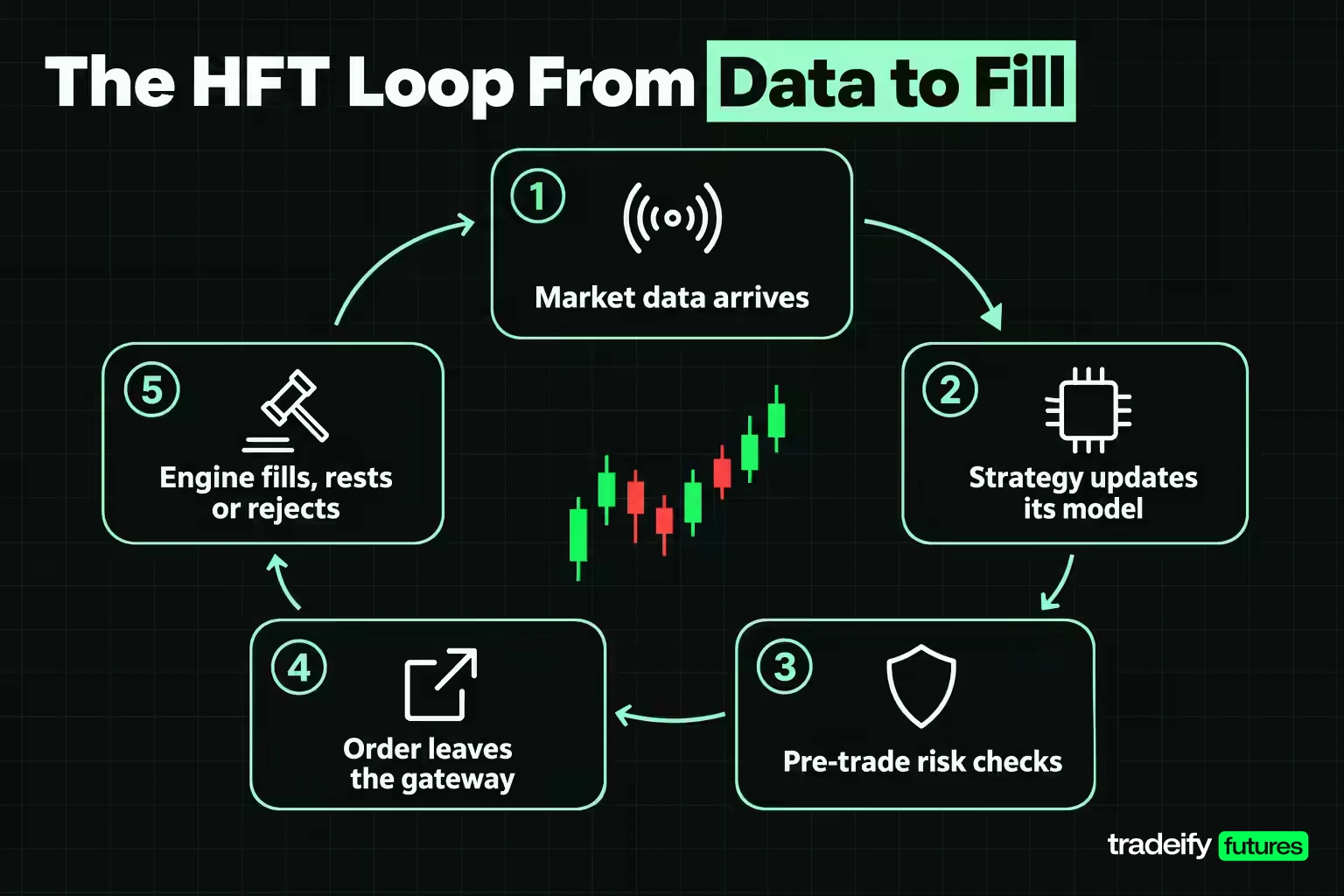
High frequency trading runs as a loop that repeats thousands of times a second. Each pass has five steps, and every one of them costs time.
- Market data arrives from the exchange's direct feed, as individual order book updates rather than a summarised quote.
- The strategy updates its model of the book and decides whether its quotes are still safe or a trade is worth taking.
- Pre-trade risk checks confirm the order fits position, credit and price limits.
- The order leaves through the exchange gateway with an order type chosen for the job.
- The matching engine fills, rests or rejects it, and the confirmation feeds back into step 2.
Order types high frequency systems rely on
High frequency systems use the same order types every trader can, but they use them differently. Resting limit orders do most of the work in market making, and queue position decides who gets filled. Most order books use price-time priority: the best price fills first, and at the same price the earliest order is first in line. On CME, many futures match first-in, first-out (FIFO) at each price, though some products use pro-rata allocation instead. Immediate orders such as CME's Fill and Kill (FAK) fill whatever is available at once and cancel the balance, while Fill or Kill (FOK) must fill in full immediately or be cancelled. Those are the tools for taking a stale price without leaving a resting order behind.
Cancel and replace is the other core action. Every time the market moves, a market maker pulls its quotes and sends new ones, which is why HFT message counts dwarf trade counts. In his September 2010 speech, SEC Chairman Mary Schapiro said many HFT firms "generate 90 or more orders for each executed trade."
Two more order behaviours matter in HFT. Display quantity (an iceberg) shows only part of a large resting order, so a 100-lot can sit in the book showing 10 at a time. In U.S. equities, the SEC's 2010 market structure work also covered intermarket sweep orders and proposed to effectively prohibit marketable flash orders, which let some participants see an order before the wider market.
Execution benchmarks such as VWAP and TWAP belong to the slower world of institutional order execution. HFT systems often trade against those algorithms rather than running them.
Why high frequency tick data behaves differently
Tick data is the raw material of HFT, and it does not look like a chart. Updates arrive at irregular intervals, bunch up around news and the open, and go quiet in lunchtime trade. Prices bounce between bid and ask, so a series of trade prints shows noise that is not real price movement.
That is why HFT research models the order book, queue position and trade direction rather than candles. A one-minute bar throws away almost everything an HFT model needs.
The Main Strategies High Frequency Firms Run
High frequency firms do not run one strategy. They run families of strategies that share infrastructure but carry very different risks.
| Strategy family | Where the edge comes from | Main risk |
|---|---|---|
| Market making | Earning the bid-ask spread many times a day | Being picked off when quotes go stale |
| Arbitrage | Closing small price gaps between related instruments or venues | Losing the race, so only one leg fills |
| Order anticipation | Reading public order flow to predict short-term direction | Misreading the flow; legal risk if non-public customer data is used |
| Event and news trading | Reacting to machine-readable releases faster than others | Slippage and a crowded first move |
| Rebate capture | Collecting exchange payments for adding liquidity | Fees and adverse fills wiping out the rebate |
Crypto venues host the same families. Exchanges run continuous order books around the clock, market makers quote on many venues at once, and price gaps between exchanges invite arbitrage. The difference is mostly structural: fragmented venues, varied fee schedules and less uniform market oversight than U.S. futures exchanges.
One strategy name needs a warning. "Momentum ignition" describes entering orders to trigger a fast move and then trading against it. When the orders are not genuine, that is manipulation, and it sits in the enforcement section of this guide rather than in the list of legitimate strategies.
Related lesson: Order flow analysis
Market Making by High Frequency Firms
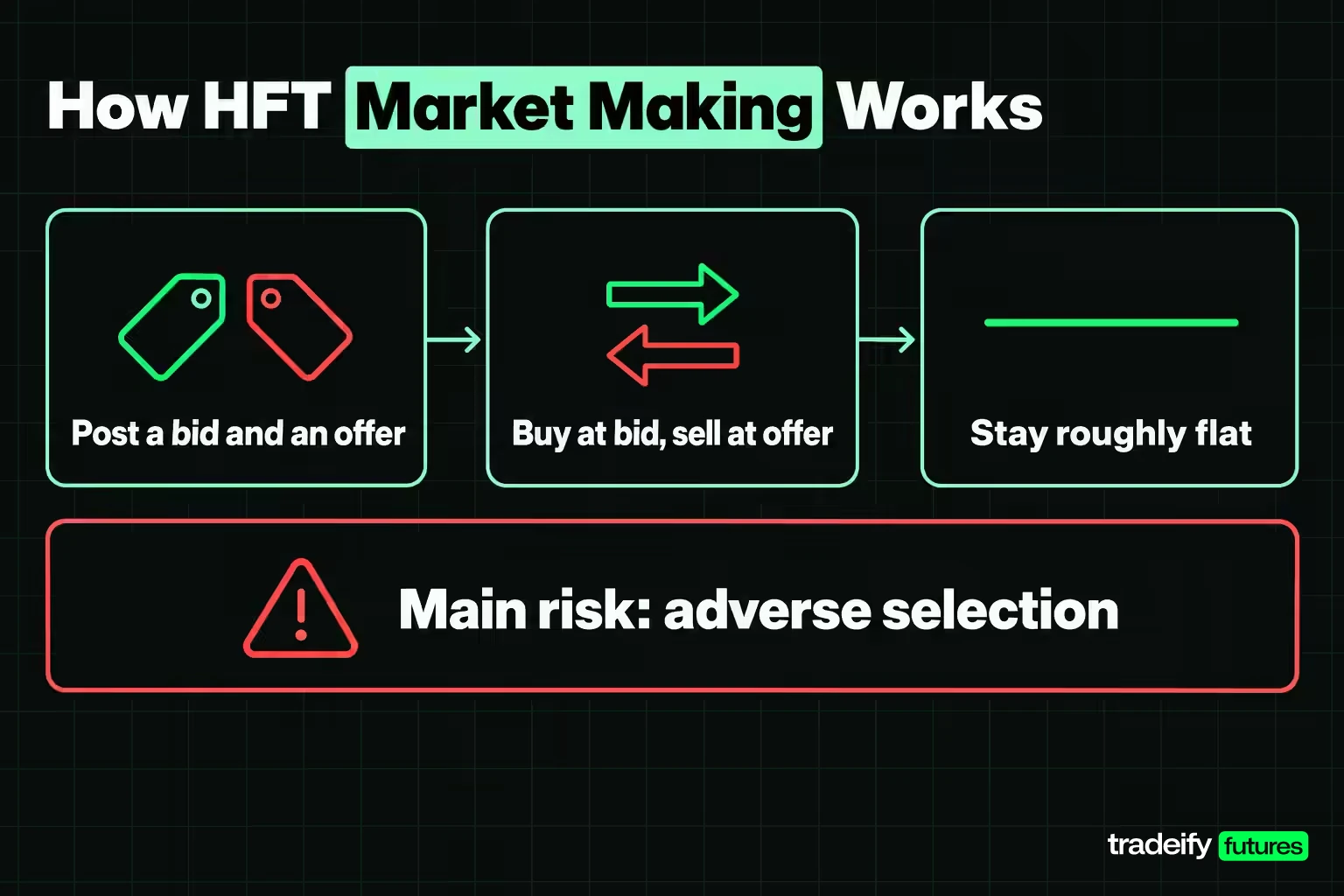
Market making is the largest HFT activity and the easiest to misunderstand. A market maker posts a bid and an offer at the same time and tries to buy at the bid, sell at the offer, and stay roughly flat.
Virtu Financial, an electronic market maker, described the business in its 2014 S-1 filing as quoting in more than 10,000 securities and other instruments on more than 210 venues in 30 countries. It called its market making "market neutral", meaning it was not built on predicting direction.
Spread capture versus being picked off in HFT market making
For an HFT market maker, the risk is not direction in the usual sense. It is adverse selection, which means your quote gets hit at exactly the moment it is wrong.
Here is an illustrative example on the E-mini S&P 500 (ES), where one tick is worth $12.50. Assume a market maker completes 10 round turns. On 8 of them it captures one full tick of spread, and on 2 it is picked off and loses two ticks ($25) each.
- 8 x $12.50 = $100 earned.
- 2 x $25 = $50 lost.
- Net $50, or $5.00 per round turn, before exchange and clearing fees.
Now shift only the pick-off rate. If 4 of 10 round turns get picked off, the same arithmetic gives $75 earned and $100 lost, a $25 loss. Nothing about the strategy changed except how often faster traders reached the stale quote first.
That is why market makers spend so heavily on speed. For them, speed is defence. It exists to pull a quote before someone faster trades against it.
Related lesson: Market makers explained
Arbitrage Strategies in HFT
Arbitrage in HFT means buying one instrument and selling a related one when their prices drift apart for a moment. The gaps are small and short-lived, so the trade is a race.
- Index arbitrage. An index future and the basket or ETF that tracks the same index should move together. When the future moves first, fast firms buy the cheap side and sell the rich one. The SEC and CFTC report on May 6, 2010 described cross-market arbitrageurs buying E-mini futures while selling SPY or stock baskets.
- Latency arbitrage. The same stock or future can trade on several venues, and quotes on a slower venue can lag the move elsewhere. A faster firm trades against the stale quote before it updates.
- Cross-venue and cross-product arbitrage. Related contracts, such as different months of the same future, should hold a steady relationship. Short-lived breaks get traded back into line.
- Statistical arbitrage. This version relies on relationships that usually hold rather than ones that must hold. At HFT speed it runs on very short horizons and many small positions.
Every one of these carries "leg risk". If the second leg does not fill at the expected price, a hedged trade becomes a naked position, and the profit on many small trades can vanish in one bad fill.
Related lesson: Statistical arbitrage
Speed, Latency and Co-Location in HFT
Speed in HFT is bought in layers, and each layer removes a different delay.
- Co-location puts the firm's servers in the same data centre as the exchange's matching engine. CME Group's Aurora, Illinois data centre houses the matching engines for all CME Globex products alongside customer equipment, rented as half or full cabinets.
- Direct connections and feeds replace slower shared routes. CME's GLink, its lowest-latency connection, is only available inside that co-location facility.
- Specialised hardware such as FPGAs (chips programmed for one task) cuts the time spent processing each message.
- Microwave and laser links carry signals between cities faster than fibre, because light in glass travels at only about two thirds of its speed in air.
A worked latency example from Chicago to New Jersey
Distance sets a hard floor on latency. Chicago, home to major futures infrastructure, is about 1,129 km from Carteret, New Jersey, where Nasdaq runs its primary data centre.
- At the speed of light in a vacuum (about 299,792 km per second), a one-way signal needs about 3.8 milliseconds.
- In standard fibre (about 204 km per millisecond), a perfectly straight cable would need about 5.5 milliseconds.
- Nasdaq publishes the one-way circuit latency between Carteret and its Chicago access point as 7.25 milliseconds, which implies a fibre route of about 1,480 km, about 31% longer than the straight line.
So the published fibre route is about 3.5 milliseconds slower than the physical limit, one way. That gap is what microwave networks were built to close. You would never notice 3.5 milliseconds. An arbitrage strategy reacting to a futures move notices nothing else, because it decides who gets the fill.
How exchanges slow the high frequency speed race
Some venues push back on pure HFT speed. IEX, approved by the SEC as a national securities exchange in June 2016, built a 350 microsecond speed bump into its design. At fibre speed that is roughly 71 km of cable, a delay meant to stop faster traders from picking off orders resting on its book.
Related lesson: Market depth and level II data
The Breakeven Ladder for High Frequency Trading Costs
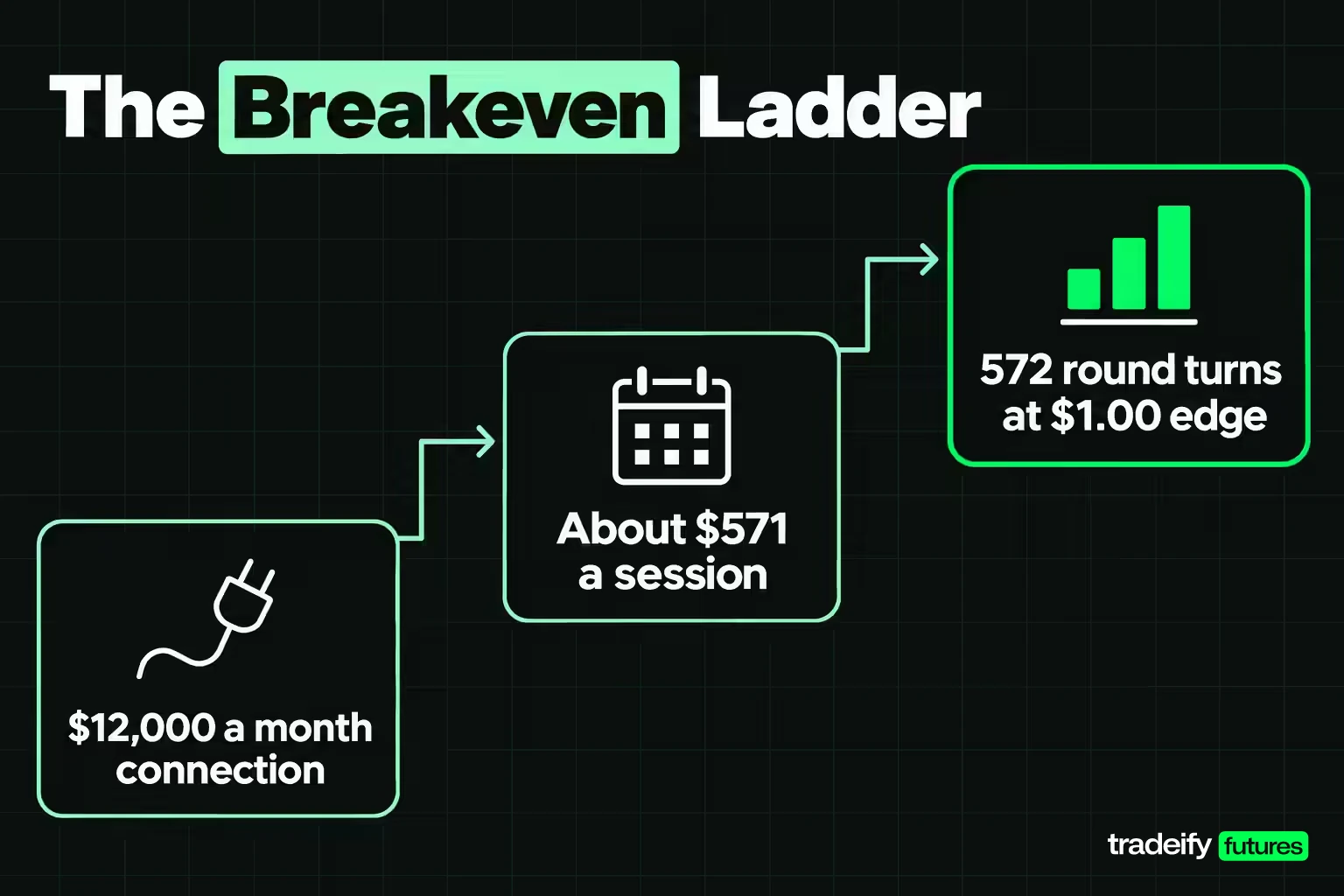
Every HFT strategy has to pay for its own speed before it makes a cent. The breakeven ladder makes that visible using one published price and a few stated assumptions.
The published price is CME's GLink connection, listed at $12,000 a month as of November 2026, with a $2,000 install and a 12-month minimum. That is $144,000 a year for a single connection, before cabinet space, power, servers, market data, software, staff or clearing.
The assumptions are illustrative:
- 21 trading sessions a month, so the connection costs about $571 a session.
- Trading concentrated in a 6.5-hour window (9:30 AM to 4:00 PM ET), or 23,400 seconds.
- Two message intensities: a lean 20 messages per round turn, and Schapiro's 2010 figure of 90 orders per executed trade, which is 180 messages per round turn.
- Net edge means profit per contract round turn after exchange and clearing fees.
| Net edge per round turn | Round turns per session to cover $571 | Messages per second at 20 per round turn | Messages per second at 180 per round turn |
|---|---|---|---|
| $0.50 | 1,143 | 0.98 | 8.79 |
| $1.00 | 572 | 0.49 | 4.40 |
| $2.50 | 229 | 0.20 | 1.76 |
| $6.25 (half an ES tick) | 92 | 0.08 | 0.71 |
What the high frequency breakeven ladder shows
The breakeven ladder divides one $12,000-a-month CME connection (about $571 a session over 21 sessions) by the net edge per round turn. Start with the $1.00 row. A market maker earning a dollar per round turn has to complete 572 round turns every session just to pay for that one connection. If it cancels and replaces the way Schapiro described, it is sending 4.40 messages per second all day, which would already clear the EU's 4-per-second venue threshold (an EU yardstick here, since CME is a U.S. venue).
Now look at the $6.25 row, half of one ES tick. A wider edge needs only 92 round turns, and that is the tempting row. But wide edges do not survive in a contested market. If $6.25 a round turn were reliably there, other firms would quote inside it until it shrank. Competition pushes real strategies toward the $0.50 and $1.00 rows, where volume and message rates climb.
The ladder also leaves costs out on purpose. Nothing in it covers the cabinet, hardware, data or salaries, so the true round-turn count is a multiple of these figures. That is the economic reason HFT is run by firms with large balance sheets, not by individual accounts.
The one part that transfers is the method. Any automated strategy has a monthly running cost and a net edge per trade. Divide the first by the second and compare the result with the trade count your rules actually produce.
Pros and Cons of High Frequency Trading
The case for and against high frequency trading depends on which market conditions you look at. In calm markets the benefits are easy to see. In stressed markets the costs show up.
| Pros of HFT | Cons of HFT |
|---|---|
| Continuous two-sided quotes in many instruments | Liquidity can disappear when it is needed most |
| Competition among liquidity providers narrows spreads | An arms race spends heavily on speed rather than research |
| Fast arbitrage keeps related prices in line | Faster firms can pick off slower participants' orders |
| Lower trading costs for ordinary orders in normal conditions | Huge message traffic and complexity raise systemic risk |
Evidence for and against high frequency trading
On the benefit side of the HFT debate, Schapiro's 2010 speech noted that commenters credited the electronic market structure with fostering competition among liquidity providers that "lowered spreads". Tighter spreads mean a smaller cost every time an ordinary trader crosses them.
On the cost side, the joint SEC and CFTC staff report on May 6, 2010 found that HFTs kept trading as prices collapsed but mostly passed contracts among themselves, which added volume without adding real buying. The same report found that nearly half of intermediaries withdrew from the market during the rebound. Liquidity that is cheap in normal times is not guaranteed in a crisis.
The fairness debate sits between liquidity and fragility. HFT speed advantages are legal and widely available to anyone who pays for them, but the price of entry is high enough that very few participants do.
HFT Failures From the 2010 Flash Crash to Knight Capital
Two events dominate HFT risk discussion: the flash crash of May 6, 2010 and the Knight Capital router failure of August 1, 2012. Neither was caused by speed itself. In both, nothing stood between an algorithm and the market to ask whether its orders still made sense.
The flash crash of May 6, 2010
At 2:32 PM, a large mutual fund complex started an automated sell program for 75,000 E-mini S&P 500 contracts, valued at about $4.1 billion, as a hedge. The algorithm targeted a share of volume and ignored price and time. It finished in about 20 minutes, compared with more than 5 hours for a previous sell program of the same size.
HFTs absorbed the early selling and then passed it around. Between 2:45:13 and 2:45:27, HFTs traded over 27,000 contracts, about 49 percent of volume, while buying only about 200 contracts net. Buy-side depth in the E-mini fell to about $58 million, less than 1% of the morning level, and the contract dropped another 1.7% in those 15 seconds.
At 2:45:28 PM, CME's Stop Logic paused E-mini trading for five seconds. When trading resumed at 2:45:33 PM, prices stabilised and began to recover. Schapiro later described broad indexes falling more than 5 percent in five minutes and rebounding almost entirely within 90 seconds.
Related lesson: Trading halts and circuit breakers
The Knight Capital failure of August 1, 2012
Knight Capital was a major U.S. equities market maker, and its August 2012 failure came from a software deployment mistake. Old, unused code in its equity order router was triggered by a new release. In the first 45 minutes of trading, the router sent more than 4 million orders while trying to fill 212 customer orders. Knight traded more than 397 million shares and lost more than $460 million.
The SEC found that Knight lacked adequate controls immediately before orders left for the market. It noted that 97 automated emails had flagged an error before the open. Knight paid a $12 million penalty in the first enforcement action under the SEC's market access rule. The lesson of the Knight Capital failure is that a fast router without a final check on what it sends can turn 45 minutes of trading into a loss of more than $460 million.
Spoofing, Layering and Other HFT Manipulation
A high cancellation rate is not manipulation by itself. A market maker cancels constantly because the market keeps moving. The legal question is intent: did the trader want the order to fill?
- Spoofing. U.S. futures law, amended by section 747 of the Dodd-Frank Act, prohibits "bidding or offering with the intent to cancel the bid or offer before execution."
- Layering. A form of spoofing that stacks orders at several price levels to fake depth on one side of the book, then trades on the other side.
- Quote stuffing. Flooding a venue with messages to slow other participants' systems or bury useful information in noise.
- Momentum ignition. Using non-genuine orders to trigger a fast move, then trading against the traders who chase it.
The first criminal spoofing case
According to the U.S. Department of Justice, Michael Coscia, a high-frequency trader, was the first person prosecuted under the Dodd-Frank anti-spoofing provision. His algorithms placed large orders he intended to cancel on CME and ICE Futures Europe, earning about $1.4 million in illegal profits in less than three months in 2011. A jury convicted him on six counts of commodities fraud and six counts of spoofing, and in 2016 he was sentenced to three years in prison.
The case settled the point most traders care about. Code is not a defence. If your rules place orders you never mean to fill, it does not matter that a computer sent them.
High Frequency Trading Regulation in the US and EU
High frequency trading is legal in the United States and the European Union. Regulation targets the controls firms must run and the conduct they must avoid, rather than speed itself.
HFT rules in the United States
- Market access rule. The SEC adopted Rule 15c3-5 on November 3, 2010. It bans "unfiltered" or "naked" market access and requires broker-dealers to apply automated pre-trade controls, including credit and capital thresholds and checks for erroneous orders.
- Circuit breakers. After May 6, 2010, the SEC approved a pilot that paused trading in individual stocks that moved 10 percent or more within five minutes. Futures exchanges run their own protections, such as CME's Stop Logic pauses.
- Anti-spoofing law. The Commodity Exchange Act, amended by Dodd-Frank, prohibits spoofing in futures markets, and the CFTC and Department of Justice enforce it.
HFT rules in the European Union
- Authorisation. Firms that deal on their own account usually fall outside MiFID II licensing, but not if they use a high-frequency algorithmic trading technique. Those firms must be authorised.
- System controls. Article 17 requires resilient systems, trading thresholds and limits, controls against erroneous orders, testing, monitoring and notice to regulators.
- Record keeping. HFT firms must keep accurate, time-sequenced records of every order, cancellation, quote and execution.
- Venue limits. Regulated markets must cap the ratio of unexecuted orders to trades and be able to slow order flow when systems near capacity.
- Market making obligations. Algorithmic market makers must quote continuously for a set share of trading hours under a written agreement with the venue.
Related lesson: Rule-based vs. discretionary trading
High Frequency Trading Careers and Firms
High frequency trading firms look more like technology companies than trading floors. The typical roles are:
- Quantitative researchers, who build and test models of order books, spreads and short-term price behaviour.
- Software and hardware engineers, who write low-latency code, build feed handlers and program FPGAs.
- Traders, who supervise live strategies, adjust parameters and decide when to widen quotes or step back.
- Risk and compliance staff, who watch exposure, message rates and compliance with anti-spoofing and market access rules.
Most of these firms are private, so few publish detailed results. Virtu Financial is the best-known exception. Its 2014 S-1 filing with the SEC said it had "only one losing trading day" across 1,238 trading days from January 1, 2009 through December 31, 2013.
That record belongs to a diversified firm trading thousands of instruments, not to a person. Firm revenue has to cover research, technology, infrastructure and staff, so it says little about what any one employee earns in a day. Treat any headline "HFT traders make X a day" figure with suspicion unless it names its source.
What Retail Traders Can Learn From High Frequency Firms
You cannot run high frequency trading from a home connection, but four HFT lessons transfer directly to ordinary trading.
- Latency is a cost. If your order reaches the market a fraction of a second after the price that triggered it, your fill will often be worse than your chart shows. Your backtest should assume the same.
- Frequency multiplies cost. A rule that trades 20 times a day pays spread and commission 20 times. The more often you trade, the more your results depend on execution quality rather than signal quality.
- Infrastructure has a floor. Divide your monthly platform, data and server costs by your net edge per trade. If your strategy does not produce that many trades, it is losing money before the market moves.
- Controls come first. Flash crashes and broken algorithms share one lesson. Daily loss limits and position caps are the retail version of a pre-trade risk check.
The same logic answers a common question: how hard is it to make $100 a day? On one E-mini S&P 500 contract, $100 is 8 ticks, or 2 index points, before costs. On one Micro E-mini, it is 20 index points. Some days that comes easily. Doing it every day does not, and no amount of speed changes that.
On our accounts, personal trading bots are allowed only if you own the strategy, it is not shared with other traders or firms, and it is not high-frequency trading. On funded accounts, a payout request also requires more than 50% of your trades to be held longer than 10 seconds, with more than 50% of profit coming from those trades.
Related lesson: Slippage explained
High Frequency Trading FAQ
Is high-frequency trading profitable?
It can be for firms with the capital, technology and scale to run it. Virtu Financial reported only one losing day in 1,238 trading days in its 2014 S-1 filing. For an individual, one $12,000-a-month CME connection alone needs 572 round turns a session at a $1.00 net edge.
Is HFT trading illegal?
No. High frequency trading is legal in the United States and the European Union. Specific conduct such as spoofing, layering and trading on non-public customer orders is illegal whether a person or a computer does it.
How much do HFT traders make per day?
No reliable public per-day figure exists for individual HFT traders, because most HFT firms are private. Firm-level results have to cover research, technology and staff costs, so they do not translate into a per-person daily number.
Can I make $100 a day day trading?
On some days, yes. On one E-mini S&P 500 contract, $100 is 8 ticks before costs. Doing it consistently is much harder, and it depends on edge and risk control, not on speed.
How fast is a high-frequency trade?
The fastest high-frequency trades complete in under a millisecond. Schapiro said in 2010 that the fastest venues could accept, execute and respond to an order in less than one thousandth of a second. IEX's 350 microsecond speed bump shows how small the gaps being fought over have become.
This guide is educational and is not investment advice. Futures trading involves substantial risk, leverage can magnify losses, and fast markets can fill orders far from the expected price. Funded and evaluation accounts are simulated, and simulated fills do not capture real queue position, market impact or slippage. The costs and examples in this guide are illustrative and based on the assumptions stated with them.


