




TL;DR: The pattern day trader rule flagged margin accounts with four or more day trades in five business days and required $25,000. FINRA replaced it with intraday margin standards effective June 4, 2026. Brokers may phase the change in until October 20, 2027, so check which rules your firm runs. The new test measures your worst intraday margin shortfall, not how many trades you place. Futures and prop firm evaluation accounts were never covered by the old rule.
If a broker page just told you that you need $25,000 before you can day trade, it may be describing a rule that is on its way out. The pattern day trader rule ran for nearly a quarter of a century inside FINRA Rule 4210, and in 2026 FINRA replaced it with a margin check that looks at what your account is holding during the day instead of how often you trade.
Which part of that matters depends on what you trade. If you trade stocks or options in a US margin account, the old trade count and the $25,000 floor are being retired, but a new deficit clock and a 90 day freeze now sit in their place. If you trade futures or a prop firm evaluation, the PDT framework never applied to you at all, and knowing why saves you from planning around a rule that was never in your way.
What a Pattern Day Trader Was Under FINRA Rules
A pattern day trader, under the retired version of FINRA Rule 4210, was any customer who executed four or more day trades within five business days in a margin account. That was the count. The rule then added a second condition that most summaries skip: if those day trades were 6 percent or less of the customer's total trades in the same five business days, the customer was not a pattern day trader.
So the designation needed both pieces at once.
- Four or more day trades inside a rolling five business day window.
- Day trades making up more than 6% of all trades in that same window.
There was also a third route that had nothing to do with counting. If a firm knew, or had a reasonable basis to believe, that a customer would pattern day trade, it could apply the special requirements from day one. FINRA's own example was a firm that had given a customer day trading training before opening the account.
The pattern day trader 6% condition worked out
The 6% condition sounds like an escape hatch. For a small account it almost never was, because a small account rarely placed enough trades to dilute four day trades. The table shows the smallest number of total trades in the five-day window that kept a given day trade count at 6% or less. The arithmetic is simple division, but seeing the numbers explains why almost every active retail trader who hit four day trades also got flagged.
| Day trades in five business days | Total trades needed to stay at 6% or less | Share at that count | One fewer total trade |
|---|---|---|---|
| 4 | 67 | 5.97% | 6.06% |
| 5 | 84 | 5.95% | 6.02% |
| 6 | 100 | 6.00% | 6.06% |
| 8 | 134 | 5.97% | 6.02% |
| 10 | 167 | 5.99% | 6.02% |
Four day trades inside 67 total trades escaped the designation. Four day trades inside 13 total trades did not. In practice the 6% condition protected high-volume accounts that also made a handful of same-day round trips, not the part-time trader who bought and sold a few names in a week.
Why the pattern day trader flag stuck
A pattern day trader designation did not expire when the four-in-five count dropped. FINRA's investor guidance said that once an account had been coded as a pattern day trader account, a firm would generally keep treating it that way even after a five-day pause, because the trading history itself gave the firm a reasonable belief. The way out was to change strategy and ask the firm to recode the account, which was the firm's call, not an automatic reset.
Related lesson: Day trading
What Counts as a Day Trade
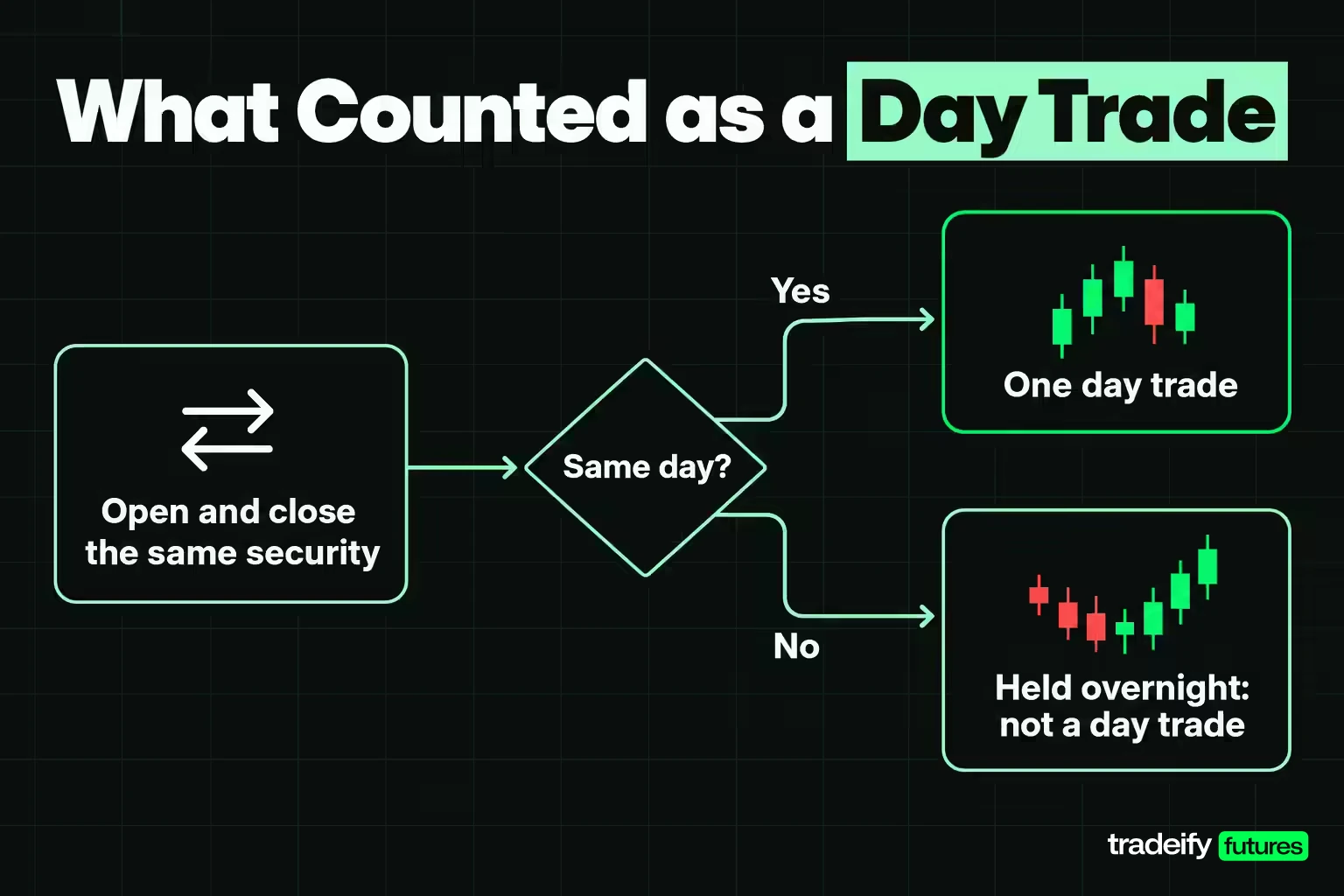
A day trade, under the retired rule, was buying and selling (or selling short and buying back) the same security on the same day in a margin account. It applied to any security, including options. Two situations were carved out: a long position held overnight and sold the next day before any new purchase of that security, and a short position held overnight and covered the next day before any new sale.
Four everyday cases show where the line fell.
- Buy 100 shares at 10:00 AM, sell them at 2:00 PM the same day: one day trade.
- Buy shares Monday, sell them Tuesday morning before buying any more: not a day trade, because of the overnight carve-out.
- Sell shares you held overnight on Tuesday morning, buy the same stock back Tuesday afternoon and sell it again before the close: the afternoon round trip is a day trade.
- Buy a call option at the open and sell it at noon: a day trade, because options counted.
In a cash account, day trading as the margin rule defined it was not permitted. FINRA's guidance was that buying a security, paying for it in full as Regulation T requires and then selling it was not counted as a day trade, which is why a cash account sat outside the PDT count while still being bound by settlement rules such as the ban on free-riding.
How brokers counted day trades for the PDT rule
Under the old PDT rule, FINRA noted there were two methods of counting day trades and told customers to ask their firm which one it used. The difference showed up with scaled entries and partial exits: buying in two pieces and selling in one, or the reverse, could count as one day trade at one firm and two at another. If you traded close to the limit, the firm's method mattered more than the rule's wording.
The rolling five-day counter replayed
The window rolled every business day. It did not reset on Monday, and that is where most accidental flags came from. Here is a hypothetical log for a trader who believed each week started fresh.
| Session | Day trades that session | Rolling five-session count | Status under the old rule |
|---|---|---|---|
| Week 1 Monday | 0 | 0 | Clear |
| Week 1 Tuesday | 0 | 0 | Clear |
| Week 1 Wednesday | 0 | 0 | Clear |
| Week 1 Thursday | 2 | 2 | Clear |
| Week 1 Friday | 1 | 3 | One trade from the limit |
| Week 2 Monday | 1 | 4 | Flagged |
| Week 2 Tuesday | 0 | 4 | Still flagged |
| Week 2 Wednesday | 0 | 4 | Still flagged |
| Week 2 Thursday | 0 | 2 | Count drops, coding usually stays |
The Monday trade felt like the first trade of a new week. To the counter it was the fourth trade in five sessions. And because firms generally kept a coded account coded, the drop back to two on Thursday did not undo it.
Under the intraday margin standard none of this is counted. A firm that has moved to the new rule does not cap how many trades you place per day; it checks whether each position leaves you short of margin.
The $25,000 Pattern Day Trader Minimum
The best-known part of the PDT rule was the floor. A pattern day trader had to hold minimum equity of $25,000 in the margin account, in cash, eligible securities or a mix of both. The money had to be in the account before any day trading, and it had to stay there at all times.
Three details made the $25,000 minimum stricter than it sounds.
- Falling short stopped day trading. If equity slipped under $25,000, even by a few dollars after a losing trade, the account could not day trade until it was restored.
- Another account could not cover it. Cross-guarantees from a second account were prohibited for meeting day trading requirements.
- Deposits were locked. Money deposited to meet the minimum or a day trading call could not be withdrawn for two business days after the close of business on the day of deposit.
Firms could also set a higher house minimum, and some did.
The new intraday standard removes the $25,000 figure entirely. FINRA's investor guidance states it directly: there is no $25,000 minimum equity requirement for day trading. What survives is the general margin floor of $2,000, which is the minimum equity to trade on margin at all. Under $2,000 you can still trade in a margin account, but only with cash you have, not borrowed money.
Pattern Day Trader Buying Power and Margin Calls
Besides the $25,000 minimum, the PDT rule capped how much a flagged account could trade. Pattern day traders could not exceed their day-trading buying power, which for equity securities was the prior day's closing equity, minus the maintenance margin requirement, multiplied by four. That gap between equity and the requirement is called maintenance margin excess.
Here are four illustrative accounts at the standard 25% maintenance requirement on long margin-eligible stock. The numbers are round on purpose.
| Account (illustrative) | Long stock held at prior close | Maintenance requirement at 25% | Maintenance margin excess | Day-trading buying power at 4x | Restricted buying power at 2x |
|---|---|---|---|---|---|
| $30,000 equity | $0 | $0 | $30,000 | $120,000 | $60,000 |
| $25,000 equity | $40,000 | $10,000 | $15,000 | $60,000 | $30,000 |
| $26,000 equity | $100,000 | $25,000 | $1,000 | $4,000 | $2,000 |
| $50,000 equity | $60,000 | $15,000 | $35,000 | $140,000 | $70,000 |
The third row is the one that caught people. That account cleared the $25,000 floor, yet a nearly fully committed position left it only $4,000 of day trading room. Holding more than $25,000 was never the same as having room to trade.
How a pattern day trader margin call played out
Under the retired PDT rule, a pattern day trader who exceeded their day-trading buying power (four times maintenance margin excess at the prior close) received a day-trading margin call. The sequence was fixed by the rule.
- The day's trades were margined on the cost of all day trades made that day.
- While the call was open, buying power dropped to two times maintenance margin excess, and the firm could no longer use the highest open position ("time and tick") method that sometimes gave a smaller requirement.
- The customer had at most five business days to deposit funds and meet the call.
- If the call went unmet, the account could trade only on a cash available basis for 90 days or until the call was met.
That 90 day restriction is the ancestor of the 90 day freeze in FINRA's 2026 intraday margin standard, but the trigger changed. The old restriction followed a single unmet day-trading call. The new freeze needs both an intraday margin deficit left unpaid past the fifth business day and a practice of not paying deficits promptly.
Related lesson: Margin calls and liquidation
What Happened When an Account Was Flagged as a Pattern Day Trader
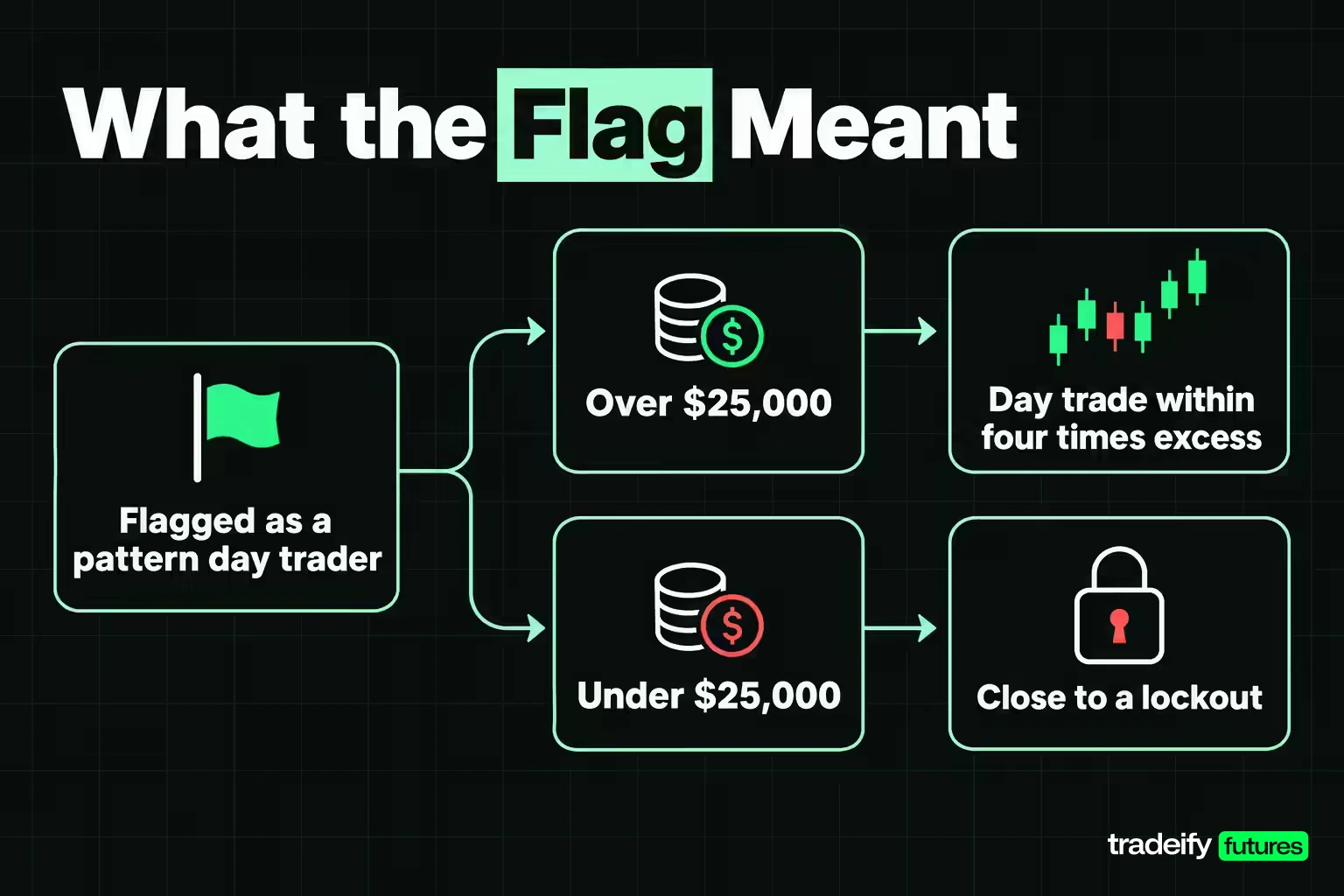
Being flagged as a pattern day trader was not a fine or a violation. It was a classification that switched on the special requirements. What it meant in practice depended almost entirely on account size.
For an account with well over $25,000 and spare maintenance margin excess, the flag mostly changed the math. Day trading continued, measured against four times excess, and the trader's job was to stay inside that number.
For an account under $25,000, the flag was close to a lockout. A trader with $8,000 who placed a fourth day trade in five sessions could not day trade again until equity reached $25,000. The realistic choices were to deposit the difference, switch to holding positions overnight, or ask the firm to recode the account after committing to stop day trading. Recoding was the firm's decision, not something the trader could demand.
The behavioural cost was real too. With three round trips on the counter, a trader could talk themselves out of a fourth valid setup just to protect the count, or hold a position overnight they would rather have closed. The rule started shaping decisions that had nothing to do with whether the trade was any good.
What happens to old PDT flags now
Under FINRA's intraday margin standard there is no pattern day trader designation based on counting trades. Once a firm has moved to the new rule, an old PDT flag stops mattering, because nothing in the new rule reads it. During the phase-in, though, a firm still running the old requirements can still apply them, so the honest answer for a flagged account is to ask the firm whether it has migrated yet.
Is the Pattern Day Trader Rule Gone in 2026
Yes for the rule itself, with a transition caveat. The SEC approved FINRA's amendments to Rule 4210, FINRA published the change, and it took effect on June 4, 2026. Firms that need more time can keep running the old requirements until the phase-in ends. Here is the sequence from the primary documents.
| Date | What happened |
|---|---|
| October 2024 | FINRA Regulatory Notice 24-13 asks for comment on the day trading requirements |
| April 14, 2026 | SEC grants accelerated approval in Securities Exchange Act Release No. 105226, File No. SR-FINRA-2025-017 |
| April 20, 2026 | FINRA publishes Regulatory Notice 26-10 announcing the intraday margin standards |
| June 4, 2026 | Amendments take effect, 45 days after publication |
| October 20, 2027 | End of the 18-month phase-in for firms that need more time |
FINRA's notice says the new standards replace the old day trading margin requirements "in their entirety", including the day trade count that designated a pattern day trader and the $25,000 minimum equity. It also notes customers and firms had for some time called the old requirements restrictive, onerous and unnecessary in today's markets.
The phase-in is why searches for the pattern day trader rule keep turning up conflicting answers. Until October 20, 2027, your firm might still be operating under the old requirements or might have migrated already. Some public pages still describe the four-in-five test in the present tense next to a note about the new rule. Your firm's margin agreement and help pages are the only reliable source for which framework applies to your account today.
How Intraday Margin Replaced the Day Trader Rules
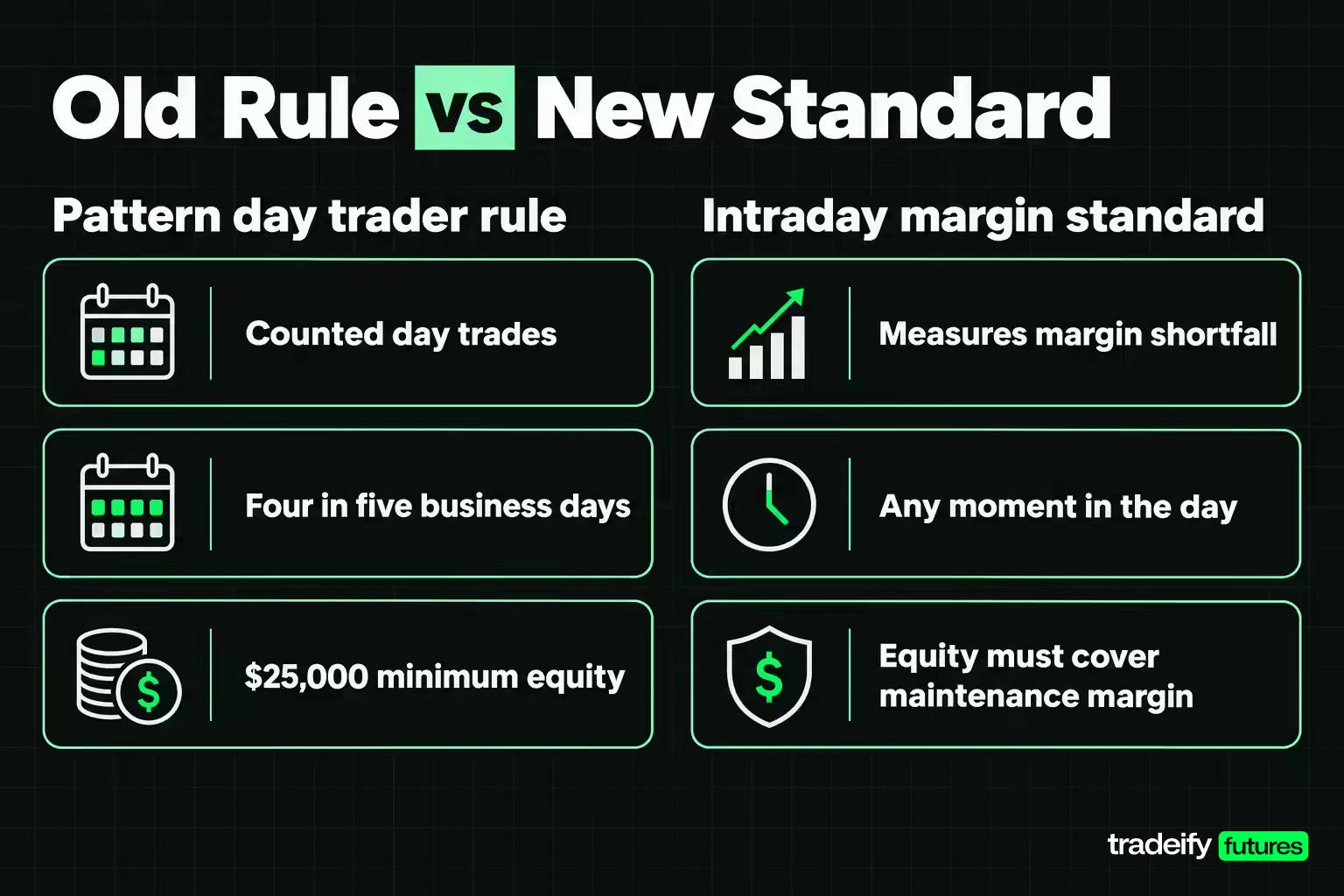
The replacement is an intraday margin standard in new paragraph (d)(2) of Rule 4210. It stops asking how often you trade and starts asking whether your positions, at any moment in the day, need more maintenance margin than your equity covers. It applies to customer margin accounts other than good faith and portfolio margin accounts, on any day with at least one transaction that reduces the account's margin cushion.
Three defined terms do the work.
- Intraday margin level (IML). The cash you could withdraw while still meeting maintenance margin. If you are short of maintenance margin, the IML is negative, equal to what you would need to deposit.
- IML-reducing transaction. Any purchase or sale that lowers the IML, including option exercise or assignment, a long option expiring, and any withdrawal of cash or securities.
- Intraday margin deficit. The largest negative IML after any IML-reducing transaction that day. It is measured at the account's worst point, not at the close.
Two procedural details push the deficit higher rather than lower. If a firm cannot show which of two activities happened first, the IML is computed in whichever order gives the highest deficit. And while firms may treat deposits, withdrawals and the closing of positions held from the previous day as happening at the start of the day, a new position opened and closed the same day still counts at its peak.
An intraday margin deficit worked through
Take an illustrative margin account with $10,000 of equity in cash, a 25% maintenance requirement, and prices that do not move, so only position size changes.
| Time (illustrative) | Long stock held | Maintenance requirement at 25% | Intraday margin level |
|---|---|---|---|
| 10:00 AM buy | $30,000 | $7,500 | $2,500 |
| 10:30 AM add | $45,000 | $11,250 | -$1,250 |
| 11:30 AM sell all | $0 | $0 | $10,000 |
The account finished the day flat with the same $10,000 it started with. It still has an intraday margin deficit of $1,250, because for an hour it carried more stock than its equity could margin. An end-of-day maintenance check alone would never have seen it.
The same arithmetic gives you a ceiling to plan around. At 25% maintenance, $10,000 of equity supports up to $40,000 of long stock before a deficit appears. If your firm's house requirement is 30%, the ceiling is $33,333; at 40%, it is $25,000. Firms can set those higher requirements, so the number on your firm's margin page is the one that counts.
How to satisfy an intraday margin deficit
An intraday margin deficit under FINRA Rule 4210 must be satisfied as promptly as possible. It counts as satisfied when, from the end of that day to the end of a later day, you make net deposits or otherwise raise the account's IML by at least the deficit amount. FINRA's investor guidance describes the practical routes as depositing funds or liquidating positions. One deposit can clear several outstanding deficits on the same account.
A broker may also simply stop you before an intraday margin deficit happens. The rule allows real-time monitoring that blocks a trade which would create or increase a deficit, or a single end-of-day calculation followed by a call, or a mix of both. Which one your firm chose decides whether you see a rejected order at 10:30 AM or a margin call that evening.
The deficit clock and the 90 day freeze
A deficit stays outstanding until it is satisfied or until immediately after the close of business on the 15th business day after it occurred. The 90 day freeze needs two conditions at once:
- You fail to satisfy a deficit by the close of business on the fifth business day after it occurred.
- You make a practice of failing to satisfy deficits as promptly as possible.
When both are true, the firm must stop you from creating or increasing a short position or debit balance (other than closing a short) for 90 calendar days after that fifth business day, or until the deficit is satisfied. In plain terms, no new margin borrowing for about three months.
Business days make the deadlines shorter than they feel. Using dates with no market holidays in the window:
| Deficit date | Fifth business day | Fifteenth business day |
|---|---|---|
| Monday, September 14, 2026 | Monday, September 21 | Monday, October 5 |
| Thursday, September 17, 2026 | Thursday, September 24 | Thursday, October 8 |
A freeze triggered after the September 21 deadline would run 90 calendar days, to December 20, 2026, unless the deficit was satisfied first. A weekend inside the five-day window does not add time. It takes two calendar days out of it.
The de minimis carve-out by account size
Under the intraday margin standard's 90 day freeze test, small deficits do not count toward "making a practice" of non-payment. The carve-out is the lesser of 5% of the account's equity or $1,000, plus deficits the firm reasonably decides came from extraordinary circumstances.
| Account equity | 5% of equity | Carve-out (lesser of 5% or $1,000) |
|---|---|---|
| $2,000 | $100 | $100 |
| $5,000 | $250 | $250 |
| $10,000 | $500 | $500 |
| $20,000 | $1,000 | $1,000 |
| $25,000 | $1,250 | $1,000 |
| $50,000 | $2,500 | $1,000 |
| $100,000 | $5,000 | $1,000 |
The two legs cross at $20,000 of equity. Under that, the carve-out grows with the account. Past it, the cap stays at $1,000 however large the account gets. A $1,250 deficit on a $10,000 account is over that account's $500 carve-out, so it would count if it went unpaid. The carve-out only affects the freeze test; the deficit itself still has to be satisfied.
Related lesson: How margin works
Margin and Cash Accounts Under the Day Trader Rules
The pattern day trader rule only ever reached margin accounts. That made account type the first question to answer, and it still is, because each type now answers to a different set of rules. The intraday deficit test itself covers customer margin accounts other than good faith and portfolio margin accounts.
| Account type | Under the old PDT rule | Under the intraday margin standard |
|---|---|---|
| Securities margin account | Four-in-five count, $25,000 minimum, 4x buying power | Intraday margin deficit, 15th business day expiry, 90 day freeze for a practice of non-payment, $2,000 minimum to borrow |
| Cash account | Not counted as day trading as defined; settlement rules apply | Not covered; settlement rules still apply |
| Portfolio margin account | Had its own day trading provisions, now deleted | Intraday risk monitoring; accounts under $5 million in equity must hold intraday margin similar to end-of-day margin |
Day trading in a cash account
A cash account has no borrowing, so it has no PDT count, but it has its own traps. You must pay for securities in full before you sell them. Buying and selling before paying is free-riding, a Regulation T violation that can lead your broker to freeze the cash account for 90 days, during which every purchase has to be fully paid on the trade date. A good faith violation is buying with proceeds that have not settled yet and then selling before those proceeds settle.
Most equity trades now settle T+1, the next business day. That makes a cash account workable for a few same-day trades if you only ever use settled cash. A trader with $5,000 of settled cash can buy and sell $5,000 of stock today, but the sale proceeds cannot fund another round trip until they settle. It is a capital rotation limit, not a trade count, and it was never part of the pattern day trader rule.
Margin accounts after the change
A margin account now has no trade count and no $25,000 floor, but it carries three constraints: $2,000 of equity to borrow at all, 25% maintenance on long margin-eligible stock held through the whole session (more if your firm says so), and the deficit clock if you overreach intraday. Regulation T's 50% initial margin still applies to positions you carry, and every margin account can lose more than you deposited.
Pattern Day Trader Workarounds and Whether They Still Matter
Under the old rule, traders who wanted to day trade with less than $25,000 used a short list of workarounds. Each one traded the PDT limit for a different cost, and that cost is worth naming before deciding whether any of it still applies to you.
- Three day trades per rolling five sessions. Staying at three kept the count under four. The cost was skipping valid setups to protect the counter, and a scaled exit or a miscount could still produce the fourth trade.
- Cash account trading. No count applied, but settled cash rotated slowly and free-riding or good faith violations could freeze the account.
- Accounts at more than one broker. Each firm counted its own account, so two accounts meant two counters. It also meant split capital, two sets of fees and smaller positions in each.
- Holding overnight instead. Turning a day trade into a swing trade avoided the count but added overnight gap risk, a different strategy with different stops.
- Trading products outside the rule. Futures never sat inside FINRA's securities margin rule, so some traders moved there. That swapped a stock rule for futures leverage, which can move an account faster than stock margin.
Which PDT workarounds still matter in 2026
For a stock trader at a firm that has migrated to intraday margin, the old PDT workarounds (the three-trade cap, the second broker, the forced overnight hold) are no longer needed, because there is no day trade count to manage. The question becomes margin, not frequency. For a trader at a firm still in its phase-in, the old workarounds still apply until the firm moves or October 20, 2027, whichever comes first.
Trading habits that fit intraday margin
Under FINRA's intraday margin standard, the habits that protect a stock margin account are about size, not frequency.
- Know your maximum intraday position in dollars before the open: equity divided by your firm's maintenance percentage.
- Treat adding to a winner the same as a new entry, because it raises the requirement at that moment, not at the close.
- Keep a cushion. A position that sits exactly at your margin ceiling becomes a deficit on the first tick against you.
- If you do create a deficit, satisfy it the same week rather than counting on the 15th business day expiry, so it never becomes a practice.
- Ask your firm whether it blocks trades in real time or calculates at the end of the day, so you know when you would find out.
Related lesson: Day trading vs swing trading
Day Trading Risks the Rule Change Did Not Remove
Removing the $25,000 floor did not make day trading any safer. It removed a barrier that, whatever its faults, kept smaller accounts out of heavy intraday margin use. FINRA's own investor guidance on the change says frequent trading with margin remains a high-risk activity and that you should only use money you can afford to lose.
The Day-Trading Risk Disclosure Statement in FINRA Rule 2270 is still in force, and brokers that promote day trading must give it to customers before opening an account. Its main points are blunt.
- Day trading can be extremely risky, and you should be prepared to lose all of the funds you use for it.
- It is generally not appropriate for someone with limited resources, limited trading experience and low risk tolerance.
- Do not fund it with retirement savings, student loans, second mortgages, emergency funds or money needed for living expenses.
- It states that certain evidence indicates an investment of less than $50,000 will significantly impair a day trader's ability to make a profit, and that $50,000 or more in no way guarantees success.
That last line sits awkwardly next to a rule change that removes the $25,000 minimum. Both are true at once: the regulator no longer requires a large balance to day trade, and its own disclosure still warns that small accounts face long odds.
Under FINRA Rule 2130, a broker promoting a day trading strategy must also approve your account for it or get your written agreement that you will not day trade. That rule was not part of the 2026 amendments.
Where small day trading accounts usually get hurt
The end of the $25,000 PDT minimum makes a few failure modes more likely for new stock day traders. A $3,000 margin account can now place unlimited round trips, so costs, slippage and fatigue add up faster than under the old count. A trader who sizes to the full intraday ceiling has no room for a bad fill. And a trader who repeatedly lets deficits sit can end up with a 90 day freeze at exactly the moment they want to trade most. The useful question before any session is how much you can lose today without breaking your plan, not how many trades the rule lets you take.
Do Day Trading Limits Apply to Futures and Prop Accounts
The pattern day trader rule never applied to futures. It lived in FINRA Rule 4210, which governs securities margin accounts at FINRA member broker-dealers. Commodity futures such as E-mini S&P 500 or crude oil are not securities. They sit under the Commodity Exchange Act, overseen by the CFTC, and firms that handle futures customer funds register with the National Futures Association.
What limits a futures day trader is margin per contract (a performance bond set by the exchange, with brokers free to require more), not a trade count. The CFTC's own guidance warns that speculating in futures is rarely suitable for individual investors and that many lose all their money and can be required to pay more than they invested. The trade count never applied, but the leverage risk is real.
Prop firm evaluation and funded accounts sit outside Rule 4210 in a different way. They are not customer margin accounts at a broker-dealer; the firm's own rulebook sets the limits. That means two separate questions: whether a securities rule reaches the account at all (it does not), and what the firm's rules let you do (that is what actually binds you).
On our accounts there is no day trade count. What limits you is the contract limit for the account size (4 minis or 40 micros on a 50K, for example), the end-of-day trailing drawdown, a daily loss limit on Growth evaluations, and the requirement to be flat by 4:45 PM ET each trading day. Our funded accounts are simulated, and we do not offer stocks or options, so the securities margin rules in this guide do not reach them.
Pattern Day Trader Rule FAQ
Is the pattern day trader rule removed?
Yes. FINRA Regulatory Notice 26-10 replaced the day trading margin requirements, including the four-in-five count and the $25,000 minimum, with intraday margin standards effective June 4, 2026. Brokers may phase in the change until October 20, 2027, so ask your firm whether it has migrated.
Can I day trade if I don't use margin?
Yes, in a cash account, as long as every purchase is paid for with settled funds. Selling before paying is free-riding and can freeze the account for 90 days. Most stock trades settle T+1, so settled cash sets how many round trips you can make.
How many stock trades per day can you make?
Under FINRA's intraday margin standard, no rule caps the number of stock trades per day. The limit is margin: your positions at any moment must not need more maintenance margin than your equity covers. A firm still on the old rules during the phase-in may still apply the four-in-five count.
How do you become a day trader?
Start by choosing the market and account type, because stocks, options and futures follow different rules. Then learn your firm's margin rules, size positions by what you can afford to lose, and practise in a simulator before using real money. Read the day trading risk disclosure your broker provides before you open the account.
How much money do day traders with $100,000 accounts make per day on average?
There is no reliable published average, and any figure quoted without a stated sample and method is marketing, not data. FINRA's day trading risk disclosure says traders should be prepared to lose all of the funds they use, and a larger account changes position size, not the odds of a given trade.
Day trading stocks, options and futures involves substantial risk of loss, and margin or futures leverage can produce losses larger than your deposit. Simulated and funded evaluation accounts are simulated, rule summaries here are simplified (your firm's requirements govern your account), and this article is educational, not investment, legal or tax advice.


