



TL;DR: Day trading vs swing trading comes down to one decision, whether the position is still open when the session closes. On the same ES entries, holding four more sessions nearly tripled the spread of results. The overnight gap averaged 27.89 points, close to half a normal session's range. Swing trades need stops and size built for that gap; day trades pay more in costs per point captured.
You can read ten comparisons of day trading and swing trading and come away with two lists of pros and cons that look almost identical. Both styles use technical analysis, both can fit around a job or fill a full day, and both can lose money quickly. None of that helps you choose.
The one difference that is not cosmetic is the clock. A day trade is closed before the session ends. A swing trade stays open while the market moves and you are asleep, at dinner or at work. This guide puts a number on that difference instead of describing it: one fixed entry rule, run on two exit clocks over the same windows of E-mini S&P 500 (ES) futures, so any gap between the results comes from the holding period and nothing else.
What separates day trading from swing trading
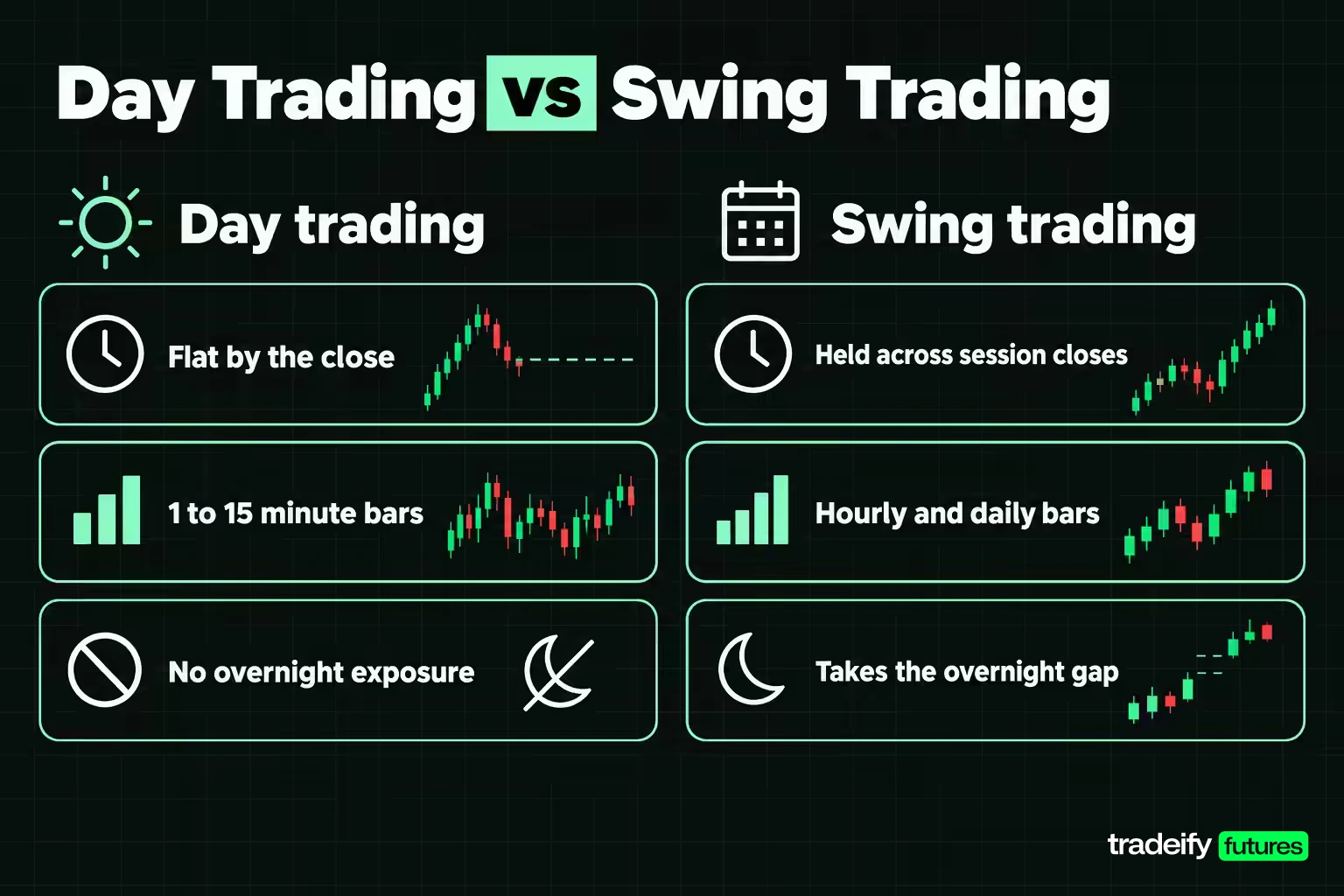
Day trading means opening and closing a position inside one session, so nothing is carried through the close. Investor.gov describes day traders as buying and selling rapidly throughout the day and warns that day trading "is extremely risky and can result in substantial financial losses in a very short period of time."
Swing trading means holding a position across at least one session close, usually for several sessions, to capture a move that takes longer than a day to play out. The swing trader accepts whatever happens between the close and the next open in exchange for not needing to be right inside a single session.
The two styles share more than they differ. Both can trade the same markets, read the same charts and use the same entry signals. What changes is the exposure that comes with the holding period.
| Feature | Day trading | Swing trading |
|---|---|---|
| Holding period | Minutes to hours, flat by the close | Across one or more session closes |
| Chart timeframes | 1-minute to 15-minute bars, often with a higher timeframe for context | Hourly and daily bars, sometimes weekly for context |
| Trades per week | Often several per session | Often a handful per week or fewer |
| Stop distance | Sized to the noise inside one session | Sized to multi-session swings plus overnight gaps |
| Overnight exposure | None | Every night and weekend the trade is open |
| Cost per point captured | Higher, because the target is smaller and trades are more frequent | Lower, because one round turn covers a larger move |
| Decision pressure | Fast, in real time, during market hours | Slower, often made after the close |
Why ES futures suit a day vs swing comparison
ES futures make the comparison between day trading and swing trading clean because they trade almost around the clock. CME Globex hours for ES run from Sunday 6:00 PM to Friday 5:00 PM ET, with a daily maintenance break from 5:00 PM to 6:00 PM ET. A swing trader in ES is therefore exposed to real trading through the night, not just a frozen price that reopens in the morning.
Related lesson: Trading styles explained
How the day and swing trading clocks were measured
A comparison of day trading and swing trading built on two different strategies proves nothing, because the result could come from the strategies rather than the holding period. So one entry rule was fixed and only the exit clock changed.
- Instrument: ES futures, the front continuous contract, 5-minute bars including overnight trading.
- Session: the regular stock-market session, 9:30 AM to 4:00 PM ET.
- Entry: the close of the 9:55 AM bar, known at 10:00 AM. Long if that price is above the 9:30 AM open, short if it is below.
- Day clock exit: the close of the same session at 4:00 PM ET.
- Swing clock exit: the 4:00 PM ET close four sessions later, so the position crosses four nights (or a weekend).
- Adverse excursion: the worst price against the position after entry, using bar highs and lows. On the swing clock this includes every overnight bar.
- Cost: an illustrative $5.00 round-turn commission plus one tick of slippage ($12.50), so $17.50 per contract, or 0.35 points.
The sample covers 35 complete regular sessions from September 17 to November 4, 2026, after the September contract roll. That gives 31 windows where both clocks can be measured from the same entry. One corrupted 3:00 PM bar on October 30 (a spike to 7754.25 when the day's high was 7713.00) was cleaned before any figure was calculated.
What the day and swing trading measurement does not show
ES is worth $50 per index point, with a minimum tick of 0.25 points ($12.50). The Micro E-mini S&P 500 (MES) is worth $5 per point. Those two multipliers turn every point figure in this guide into dollars.
This measurement of day and swing holding periods is not a backtest of a strategy anyone should trade. There are no stops, no partial exits and no position sizing in the clock results, and seven weeks of one market is a small sample. It measures what the market did to the same entry over two different holding windows.
Day trading vs swing trading results on the same entry
On the same 31 entries, with the same direction and cost, the day clock finished with a total of -57.35 points and the swing clock finished with +328.40 points. It is tempting to read that as "swing trading wins." Look at the spread first.
| Measure (31 windows, Sept 17 to Nov 4, 2026) | Day clock | Swing clock |
|---|---|---|
| Total result, points net of cost | -57.35 | +328.40 |
| Mean per window, points | -1.85 | +10.59 |
| Median per window, points | -5.85 | +15.65 |
| Standard deviation, points | 30.83 | 82.69 |
| Rough 95% range for the mean, points | -12.92 to +9.22 | -19.11 to +40.30 |
| Winning windows | 13 of 31 | 17 of 31 |
Both ranges for the mean include zero. Neither clock showed an edge that the sample can separate from luck. What the sample does show clearly is the spread: holding four extra sessions made the result per window 2.7 times as variable, 82.69 points against 30.83.
An earlier day vs swing trading sample
The same 10:00 AM ES entry rule, with the same day and swing exits, was measured on an earlier sample in the September version of this guide: 49 complete regular ES sessions from July 8 to September 15, 2026, with 45 windows and a cost of $15.08 per round turn. There the result ran the other way.
| Measure | Earlier sample (45 windows, July 8 to Sept 15, 2026) | Newer sample (31 windows, Sept 17 to Nov 4, 2026) |
|---|---|---|
| Day clock total, points | +68.40 | -57.35 |
| Swing clock total, points | -543.10 | +328.40 |
| Day clock standard deviation, points | 30.31 | 30.83 |
| Swing clock standard deviation, points | 110.05 | 82.69 |
| Spread multiple, swing over day | 3.6 | 2.7 |
| Windows where both clocks had the same sign | 31 of 45 | 15 of 31 |
That reversal is the most useful thing in this comparison. The sign of the result flipped between two consecutive samples, so "which style makes more" depended on the weeks measured. The spread did not flip. In both samples the swing clock was roughly three times as variable as the day clock, from the same entries.
In the newer sample, the two clocks finished on the same side of zero in only 15 of 31 windows. In 6 windows only the day clock finished positive, and in 10 only the swing clock did. Changing nothing but the exit day changed whether the trade made or lost money about half the time.
The overnight gap a swing trade accepts
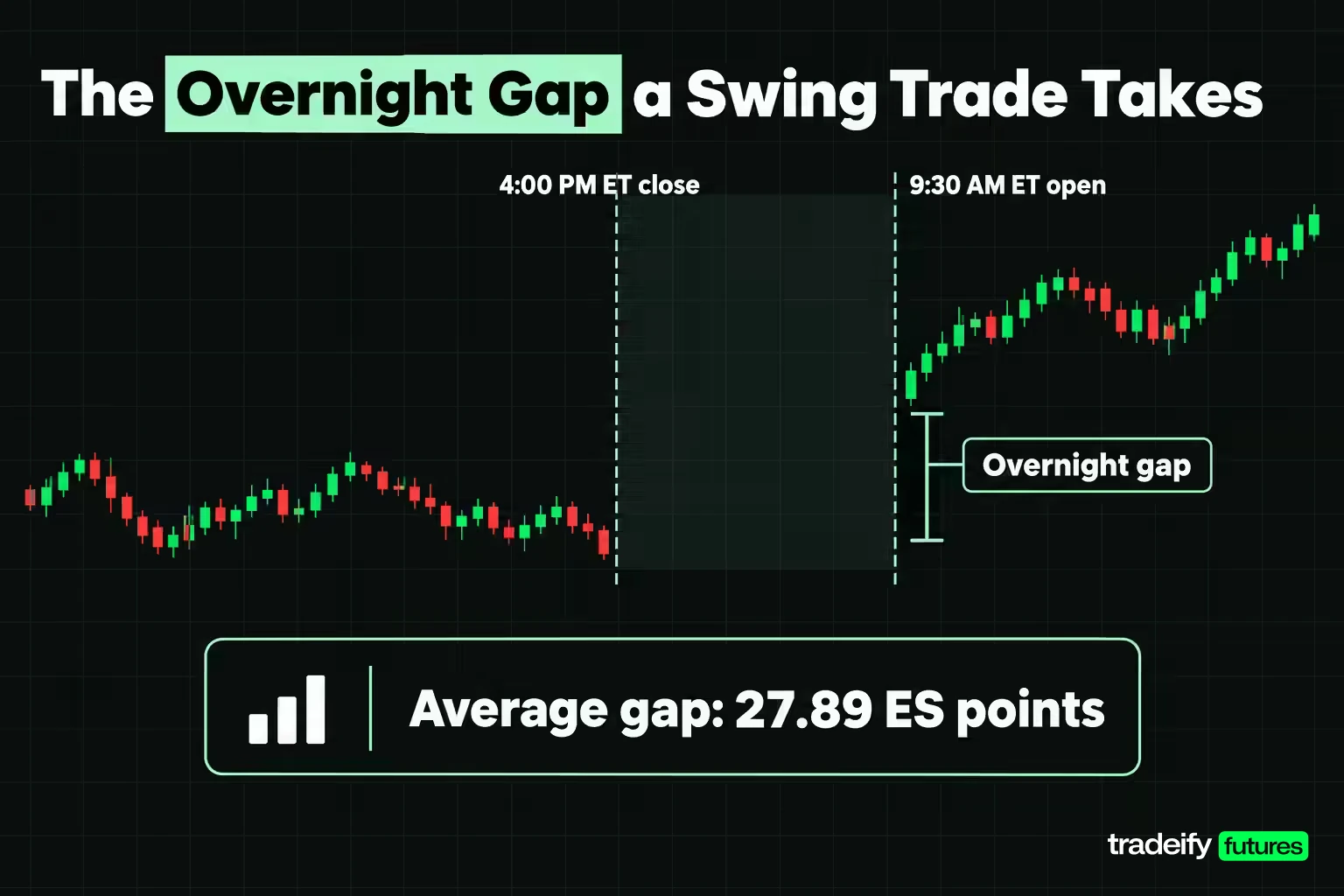
The overnight gap is the price of the swing clock. Here it is measured as the move from the 4:00 PM ET close of one regular session to the 9:30 AM ET open of the next, which covers the evening and overnight trading a swing position sits through.
| Overnight gap measure (34 gaps, Sept 17 to Nov 4, 2026) | ES points |
|---|---|
| Average session range, 9:30 AM to 4:00 PM ET | 61.91 |
| Mean absolute gap | 27.89 |
| Median absolute gap | 21.75 |
| 90th percentile gap | 58.67 |
| Largest gap | 86.50 |
| Gaps wider than 8 points | 26 of 34 |
| Gaps wider than half an average session range | 15 of 34 |
| Gaps wider than a full average session range | 4 of 34 |
The average gap was 45.1% of an average session's full range. Twenty gaps opened higher and 14 opened lower. In the earlier July to September sample the average gap was 26.84 points, 46% of that sample's average range of 58.96 points, and 5 of 48 gaps were wider than a full session. Two separate samples gave almost the same answer.
The practical reading is blunt. In this ES gap measurement, a gap wider than an 8-point stop happened in 76.5% of nights, so a swing position cannot use a day trader's stop distance. Holding overnight is not a small extra risk you can trim. You either take the whole gap or you are flat before it.
A stop order does not cap a gap loss either. A stop becomes a market order once its price is reached, and in a fast or gapping market the fill can land well past the level you chose.
Related lesson: Gaps and gap analysis
Stop width and risk management for each trading style
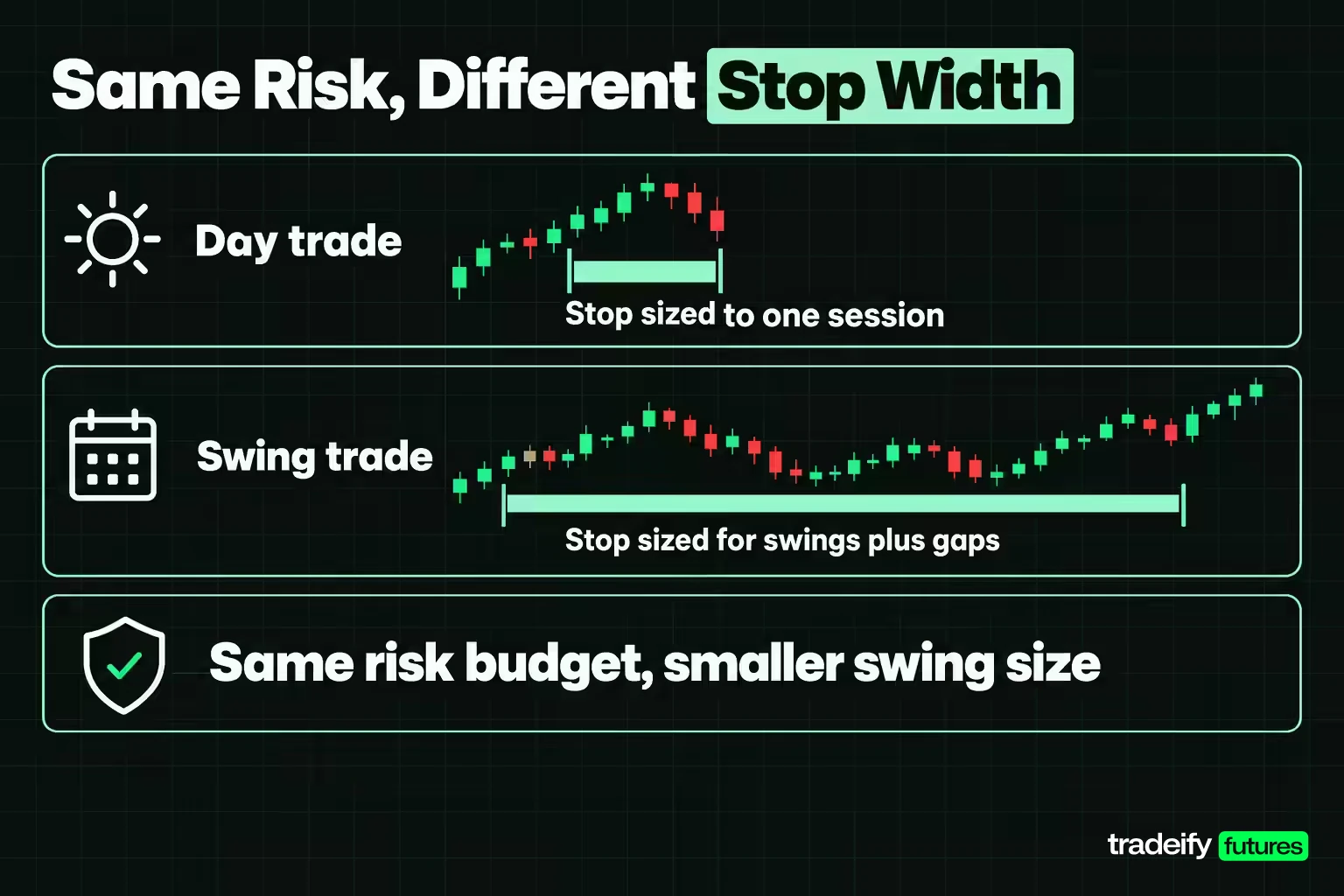
Adverse excursion is how far a position went against you before it closed. It is the number a stop has to be wider than for the trade to survive, so it is the most practical risk measure in this comparison.
From the same 10:00 AM entries, the mean adverse excursion inside the first session was 26.19 points, with a 90th percentile of 49.75 and a worst case of 74.00. Across the five sessions of the swing clock, including every overnight bar, the mean was 77.58 points, with a 90th percentile of 154.75 and a worst case of 186.25. The swing clock's typical worst point was about three times deeper.
Stop-breach ladder for day and swing trades
This table shows how often a stop of each width would have been touched on each clock, out of 31 windows. The dollar columns are per contract.
| Stop width, points | ES risk | MES risk | Day clock touched | Swing clock touched |
|---|---|---|---|---|
| 8 | $400 | $40 | 77.4% | 93.5% |
| 15 | $750 | $75 | 64.5% | 87.1% |
| 30 | $1,500 | $150 | 38.7% | 74.2% |
| 45 | $2,250 | $225 | 19.4% | 67.7% |
| 60 | $3,000 | $300 | 6.5% | 58.1% |
| 90 | $4,500 | $450 | 0.0% | 45.2% |
| 120 | $6,000 | $600 | 0.0% | 16.1% |
The two clocks separate fast in this ES study. A 60-point stop, about one average session range, was touched in only 6.5% of day-clock windows but in 58.1% of swing-clock windows. To survive every swing window in this sample, a stop would have needed to sit beyond 186.25 points, about three average session ranges and $9,312.50 of risk on one ES contract.
No sensible swing plan carries that. So every realistic swing plan accepts one of three costs: a wider stop, a smaller position, or more trades stopped out by noise rather than by the trade idea being wrong.
Sizing each trading style to the same risk
Sizing is where the stop width turns into a contract count. Take an illustrative $50,000 account risking 1% per trade, which is $500.
- Day trade with a 15-point stop: one MES contract risks $75, so $500 allows 6 MES contracts ($450 of risk).
- Swing trade with a 60-point stop: one MES contract risks $300, so $500 allows 1 MES contract ($300 of risk).
- One ES contract on the 60-point swing stop risks $3,000, six times the $500 budget.
Same account, same percentage risk, and the swing trade carries a sixth of the day trade's size. That is not a flaw in swing trading. It is what holding through the gap costs, and it needs to be decided before the entry, not after the position is offside.
Related lesson: Position sizing
Trading costs and fees for day and swing trades
Day trading is the more expensive style per point captured, and the size of the difference comes from how many round turns you pay for, not from the style's name.
At the illustrative $17.50 per round turn (0.35 points on ES), one round turn is:
- 0.57% of an average session range of 61.91 points.
- 4.38% of an 8-point day-trading stop.
- 0.58% of a 60-point swing stop.
- 0.5% of the mean five-session move of 70.57 points.
A cost that is more than 4% of what you are risking is a real part of the trade. On a swing stop it is a rounding item.
Frequency is what makes day trading expensive. The table counts round turns over the same five sessions a single swing trade covers.
| Round turns per session (five sessions) | Cost per ES contract | Cost in points | Share of the mean five-session move |
|---|---|---|---|
| 1 | $87.50 | 1.75 | 2.5% |
| 10 | $875 | 17.50 | 24.8% |
| 20 | $1,750 | 35.00 | 49.6% |
One swing round turn across the same five sessions costs $17.50. Twenty day-trading round turns a session spend almost half of the average five-session move before a single trade is right or wrong. Commission rates vary by broker and contract, so plug in your own, but the shape of the arithmetic does not change.
Slippage is the second half of the friction. Day traders pay it on every entry and exit. Swing traders pay it less often but can pay a lot of it at once when a stop is hit through a gap.
Related lesson: Slippage explained
A five-session ES swing trade traced leg by leg
Totals hide where a swing trading result comes from. This ES window, October 15 to October 21, 2026, moved 71.25 points from entry to the swing exit, close to the 70.57-point average across the 31 measured windows from September 17 to November 4, 2026, so it is a typical case rather than a chosen one.
The entry rule goes long or short at 10:00 AM depending on whether the 9:55 AM bar closes above or below the 9:30 AM open. On October 15 that bar closed at 7727.75, below the open of 7735.75, so the rule went short. The day clock exits at the same day's 4:00 PM ET close, and the swing clock exits at the 4:00 PM ET close four sessions later.
| Leg | From | To | Points for the short |
|---|---|---|---|
| Session 1 after entry, Oct 15 | 7727.75 | 7791.00 | -63.25 |
| Night, Oct 15 to Oct 16 | 7791.00 | 7802.75 | -11.75 |
| Session 2, Oct 16 | 7802.75 | 7703.00 | +99.75 |
| Weekend, Oct 16 to Oct 19 | 7703.00 | 7741.50 | -38.50 |
| Session 3, Oct 19 | 7741.50 | 7734.75 | +6.75 |
| Night, Oct 19 to Oct 20 | 7734.75 | 7727.00 | +7.75 |
| Session 4, Oct 20 | 7727.00 | 7759.00 | -32.00 |
| Night, Oct 20 to Oct 21 | 7759.00 | 7779.50 | -20.50 |
| Session 5, Oct 21 | 7779.50 | 7799.00 | -19.50 |
The day clock closed the short at 7791.00 for a loss of 63.25 points, or 63.60 net of cost, which is $3,180 on one ES contract. The swing clock closed at 7799.00 for a loss of 71.25 points, or 71.60 net, which is $3,580.
The path matters more than the totals. At the close of session 2 the swing position was 24.75 points in profit. The weekend gap took 38.50 points back before anyone could act, turning that profit into a loss. The position crept back to about breakeven by the October 20 open, then sessions 4 and 5 and the night between them carried it to the final loss. Four overnight legs together moved 63.00 points against the short.
The window also shows something about the day clock. With no stop, the day trade lost 63.25 points in one afternoon, with a worst point of 74.00 points against it. The day clock limits exposure to one session, but one session can still be expensive without a stop.
Is day trading or swing trading more profitable
Neither day trading nor swing trading is more profitable by design. When one fixed ES entry rule was run on a same-day exit and a four-sessions-later exit, over two separate 2026 samples, the day exit came out ahead in one sample and the swing exit in the other. Profit depends on whether the entry rule has an edge after costs, and on whether the trader follows it. The holding period mostly changes how widely results scatter.
The published research on day traders is sobering. Chague, De-Losso and Giovannetti studied everyone who began day trading Brazilian equity index futures between 2013 and 2015. Of the 1,551 who persisted for more than 300 days, 97% lost money net of fees, and only 1.1% earned more than the Brazilian minimum wage. A separate line of research on Taiwan Stock Exchange data from 1992 to 2006, by Barber, Lee, Liu, Odean and Zhang, reports that less than 1% of the day-trading population predictably earn profits.
Comparable large studies of swing traders are scarce, so there is no matching number to set beside those. That is not evidence that swing traders do better. Swing trading has fewer trades, so it takes longer to learn whether a rule works at all.
Income targets and the spread of results
A daily day-trading income target such as $100 a day is easy to convert into points: 2 points on one ES contract, or 20 points on one MES contract. The problem is the spread. In 31 measured ES day trades from September 17 to November 4, 2026 (one 10:00 AM entry per session, closed at 4:00 PM ET), one trade's result had a standard deviation of 30.83 points, which is about $154 on one MES contract. A $100 target is smaller than the normal noise of a single trade, so any single day says very little about skill.
A better way to judge either style is a sample of at least 30 trades on a written rule, with costs included, before drawing a conclusion.
Related lesson: Backtesting a trading strategy
Time commitment for day trading and swing trading
Day trading asks for fixed, focused screen time. Even a simple day-trading rule that enters at 10:00 AM and exits at the 4:00 PM ET close needs someone present to take the entry and in charge of the position until the close, unless every order is placed in advance. Many day traders choose a narrower window, such as the first two hours of the 9:30 AM to 4:00 PM ET stock-market session, and stop trading when it ends.
Swing trading asks for less screen time but more exposure time. Analysis can happen after the close, orders can be placed in advance, and a check once or twice a day is often enough. But the position is live through every night and weekend it is open, and ES trades from Sunday 6:00 PM to Friday 5:00 PM ET, so news can move it while you are unavailable.
That trade-off is easy to misread. Day trading consumes your attention during market hours and gives you your evenings back. Swing trading frees your market hours and keeps a small claim on your attention at all times.
Learning time differs too. A day trader who takes three trades a session can log 30 trades in about two weeks. A swing trader taking two trades a week needs about 15 weeks to reach the same sample, which slows the feedback loop.
Day trading and swing trading strategies
Most setups work on either clock. The difference is the timeframe they are read on and the move they are expected to deliver.
Common day-trading approaches:
- Opening range breakouts, trading a move out of the range set in the first part of the session.
- Pullbacks to an intraday reference such as VWAP or the prior day's high or low.
- Mean reversion back into a session range after a failed breakout.
- Reaction trades around scheduled releases, for traders willing to accept fast price changes and slippage.
Common swing-trading approaches:
- Pullbacks within a trend on the daily chart, entered as price returns toward a moving average or prior breakout level.
- Breakouts from multi-day ranges or consolidation patterns.
- Reversals from major daily or weekly support and resistance.
Whatever the setup, the clock should be decided at the entry. When one fixed 10:00 AM ES entry was exited at the same day's close and again four sessions later, across 31 windows from September 17 to November 4, 2026, the two exits finished on opposite sides of zero about half the time. The holding period changes the outcome, so it belongs in the plan.
Related lesson: Trade setups and confirmation
How market conditions change each trading style
Session ranges in the sample swung from 23.75 points on the quietest day to 127.25 points on the busiest, so conditions change a lot even within seven weeks.
Day trading tends to suffer most in narrow, choppy sessions, where a small range leaves little room between the stop and the target and costs eat a larger share. Swing trading tends to suffer most when the market chops back and forth across several days, or when a scheduled event such as a CPI release or a Fed decision lands while a position is open. High volatility widens both, so stop distances that worked last month may be too tight this month.
Platforms and tools each trading style needs
Day trading needs real-time data and fast order handling. Delayed or snapshot data is not good enough when decisions are made bar by bar. Useful tools include a depth-of-market or order-entry ladder, bracket orders that place a stop and target the moment the entry fills, hotkeys and a stable internet connection. Server-side stops, which stay on the broker's or data provider's servers if your connection drops, are worth checking for.
Swing trading needs good daily and hourly charts, price alerts, and orders that stay working across sessions (good-till-cancelled rather than day orders). Mobile access matters more, because the position is open while you are away from your desk. End-of-day review tools and a calendar of scheduled economic releases help you see what the position will sit through.
Both styles need a trading journal that records the planned clock, the entry, the stop, the result and whether the plan was followed.
Related lesson: How to keep a trading journal
Capital and rules for day and swing trading
In stock accounts, the old pattern day trader rule shaped this choice for years. FINRA Regulatory Notice 26-10, published April 20, 2026 and effective June 4, 2026, replaces the day-trading margin requirements in their entirety, including the pattern day trader designation and the $25,000 minimum equity, with new intraday margin standards. The phase-in runs until October 20, 2027, so some brokers may still apply the old rules during that period.
Futures were never subject to the pattern day trader rule. What limits a futures trader is margin and contract size. The CFTC describes futures margin as a performance bond rather than a partial payment: initial margin is required to open a position and maintenance margin must be kept on deposit. A swing trader carries positions through the close, so the account has to meet the margin required for a position held overnight, which can be higher than any intraday margin a broker offers.
Capital needs follow from the stop, not from the style's label. Risking an illustrative 1% per trade:
- A 15-point MES day-trading stop risks $75, so one contract fits a $7,500 account.
- A 60-point MES swing stop risks $300, so one contract needs a $30,000 account.
- One ES contract with a 60-point swing stop risks $3,000, which at 1% implies a $300,000 account.
Swing trading at this risk level needs four times the capital of the day trade for the same single MES contract.
Related lesson: Intraday vs overnight futures margin
Which trading style fits your personality and schedule
The best style is the one you can follow every day without breaking your own rules. A few honest questions narrow it down.
- Can you be at the screen for the same window every trading day? If not, day trading will get squeezed into whatever time is left, which is how unplanned trades start.
- How do you react to being offside when you cannot act? In one October 2026 ES window measured for this guide, a weekend gap opened 38.50 points against a swing position on a Monday morning. If that would keep you awake, the swing clock will push you into early exits.
- Do you make good decisions quickly? Day trading rewards fast, rule-based execution. Swing trading rewards patience and the ability to leave a position alone.
- How much feedback do you need? Day trading gives many small samples quickly. Swing trading gives fewer, slower answers.
- What does your account allow? If a swing stop sized for the gap does not fit your risk budget even on one micro contract, the account is deciding for you.
Common day trading and swing trading mistakes
Several mistakes show up on both clocks. A few belong to one style.
Day-trading mistakes:
- Overtrading. More round turns raise costs and usually lower the quality of each trade.
- Trading outside the planned window, when the setup that was tested is no longer the setup being traded.
- Using the day's loss limit as the stop instead of a planned stop on each trade.
- Revenge trading after a loss to "get it back" before the close.
Swing-trading mistakes:
- Using a day-trading stop distance on a multi-session hold. In the ES sample measured for this guide, an 8-point stop was touched in 93.5% of five-session swing windows.
- Sizing as if the gap does not exist, then being forced out by a single open.
- Holding through a scheduled event without checking the economic calendar first.
- Checking the position constantly and turning a swing trade into a nervous day trade.
The mistake that crosses both styles is changing clocks mid-trade. A day trade that is losing at the close becomes a "swing trade" so the loss does not have to be taken. That trade now has a day-trading stop, a day-trading size and a swing trade's overnight exposure. If the plan changes, treat it as a new trade with its own reason, stop and size.
Day trading vs swing trading for beginners
For most beginners, the honest answer is that the clock matters less than the rule and the sizing. A practical way to start:
- Pick one market and one contract size small enough that a full stop is a small share of the account. Micro contracts such as MES make that possible on either clock.
- Write the clock into the plan before the first trade: flat by a set time, or held for a set number of sessions.
- Size the stop from measured behaviour. For a day clock, look at how far price usually moves against an entry inside one session. For a swing clock, include the overnight gap.
- Log at least 30 trades with costs before deciding whether the rule works, and review them against the plan.
- Practise on a simulator first, so mistakes cost time instead of money.
Day trading gives faster feedback and caps exposure at one session, which makes it easier to review. Swing trading suits people who cannot watch the market during the day, as long as the account can carry a stop built for the gap.
On our accounts the choice is already made: positions are intraday only. Every position must be closed by 4:45 PM ET (12:59 PM ET on holiday early closes), with no overnight, weekend or swing holds on any account, Live included. A position can stay open for a whole trading day, which runs from 6:00 PM to 5:00 PM ET, so a trade opened at 8:00 PM Monday can be closed at 2:00 PM Tuesday. Funded accounts are simulated.
Day trading vs swing trading FAQ
What are the key differences between swing trading and intraday trading?
Intraday trading (day trading) closes every position before the session ends, while swing trading holds across one or more closes. That one choice drives the rest: stop width, position size, cost per point captured and exposure to overnight gaps. When the same ES entries were held five sessions instead of closed the same day, from September 17 to November 4, 2026, results were 2.7 times as variable.
Is it true that 97% of day traders lose money?
It is true for one well-studied group. Chague, De-Losso and Giovannetti found that of the 1,551 Brazilian equity index futures day traders who persisted for more than 300 days, 97% lost money net of fees. Research on Taiwan Stock Exchange data by Barber, Lee, Liu, Odean and Zhang also reports that less than 1% of day traders predictably earn profits.
Can I make $100 a day day trading?
Some days can end $100 up, but no trading style can make that a reliable daily income. In points, $100 is 2 points on one ES contract or 20 points on one MES contract. In 31 measured ES day trades from fall 2026, a single result had a standard deviation of about $154 on one MES contract, larger than the target itself.
Can I use swing trading on Groww?
It depends on your account, because swing trading is a holding period rather than a platform feature. Whether you can swing trade on any broker app, Groww included, depends on whether your account type lets you hold positions overnight and on that broker's margin and product rules. Check the broker's own documentation for carried positions before planning a swing trade.
What is the 3-5-7 rule in forex?
The 3-5-7 rule is an informal risk heuristic, not a regulation. A common version says risk no more than 3% on one trade, keep total open risk at or under 5%, and aim for winners at least 7% larger than losers. Versions differ, so treat it as a starting point for your own written limits.
Is day trading riskier than swing trading?
Per trade, day trading is usually the smaller and more predictable exposure. On the same ES entries from September 17 to November 4, 2026, the mean adverse excursion was 26.19 points when closed the same day and 77.58 points when held five sessions. Day trading's main risks are frequency and costs, while swing trading's main risk is the overnight gap. Either style can lose money quickly without a stop and sensible size.
How long does a swing trade last?
A swing trade lasts at least one night and often several sessions, sometimes longer. A five-session hold, for example, crosses four nights or a weekend plus three nights. Even one overnight hold adds the gap exposure that a day trade avoids.
Trading futures involves substantial risk of loss and is not suitable for everyone. Futures are leveraged, so a small price move can produce a loss larger than expected, and a gap can carry price past a stop. All figures in this guide come from historical ES data over two short samples and illustrative costs; they are not a backtest, a forecast or a realised trading result. Funded and evaluation accounts are simulated. This guide is educational and is not investment advice.


