




TL;DR: Position sizing in forex means setting your cash risk first, then letting the stop and pip value decide the lot size. Units equal cash risk divided by stop pips times pip value per unit, rounded down. Example: $100 of risk on a 25-pip EUR/USD stop is 0.40 lots. Convert pip value into your account currency, reserve costs, then check margin.
Position sizing in forex is the step where an idea on a chart becomes a number on an order ticket. It is also the step most traders rush, because the setup is right there and the lot size feels like a formality. Get it wrong and a perfectly reasonable trade can do outsized damage. Get it right and a losing trade costs roughly what you agreed to lose before you clicked.
This guide covers the formula, pip value, account-currency conversions, how pairs differ, the main sizing methods and the mistakes that quietly break the math. Every example ends with a reverse check, because a size you cannot reconstruct is a size you should not send.
What Is Position Sizing in Forex
Position sizing in forex is choosing how many currency units (or lots) to trade so that the loss at your planned stop stays inside a cash limit you set in advance. The size is an output. The inputs are your account figure, your risk percentage, the distance to your stop in pips and the value of each pip.
Forex sizes are usually quoted in lots. A standard lot is 100,000 units of the base currency, a mini lot is 10,000, a micro lot is 1,000 and a nano lot is 100. Platforms often write these as 1.00, 0.10 and 0.01 lots.
A pip is the standard unit of price change. On most pairs it is 0.0001 (the fourth decimal place). On Japanese yen pairs it is 0.01. Many platforms quote one extra digit, called a pipette or fractional pip, which is a tenth of a pip.
The trap position sizing exists to stop is simple to describe. A trader gets comfortable with "one lot" or "0.5 lots" and uses it on every setup. That number feels safe because it is familiar, but it says nothing about risk. A 0.5-lot EUR/USD trade with a 15-pip stop risks $75. The same 0.5 lots with a 60-pip stop risks $300. Same lot size, four times the loss.
So the order is fixed: cash risk first, stop second, size last.
Why Position Size Matters More Than Direction
Position size decides whether a normal losing streak is an annoyance or an account-ending event. Even a solid strategy loses several trades in a row at some point, and the size of each loss determines what is left when the streak ends.
The math compounds against large risk. If each loss is a fixed fraction of current equity, ten straight losses do this:
| Risk per trade | Drawdown after 10 straight losses | Gain needed to recover | Losses in a row to reach a 20% drawdown |
|---|---|---|---|
| 0.5% | 4.89% | 5.14% | 45 |
| 1% | 9.56% | 10.57% | 23 |
| 2% | 18.29% | 22.39% | 12 |
| 5% | 40.13% | 67.02% | 5 |
At 1% per trade, ten losers cost under a tenth of the account and need about a 10.57% gain to repair. At 5%, the same streak takes 40.13% of the account and needs a 67.02% gain to get back to even. The win rate did not change. Only the size did.
This is why sizing matters more than being right about direction on any single trade. You can be right on direction and still lose when the stop is too tight for the volatility. You can be wrong and barely notice when size was sensible. Over hundreds of trades, the sizing rule is what keeps you in the game long enough for an edge, if you have one, to show up.
The stakes are real in retail forex. The CFTC reports that over the period it measured, about one-third of customers at registered off-exchange forex dealers made a profit and two-thirds lost money. Sizing cannot fix a weak strategy, but oversizing can wreck a decent one.
The Core Inputs Behind Every Position Size
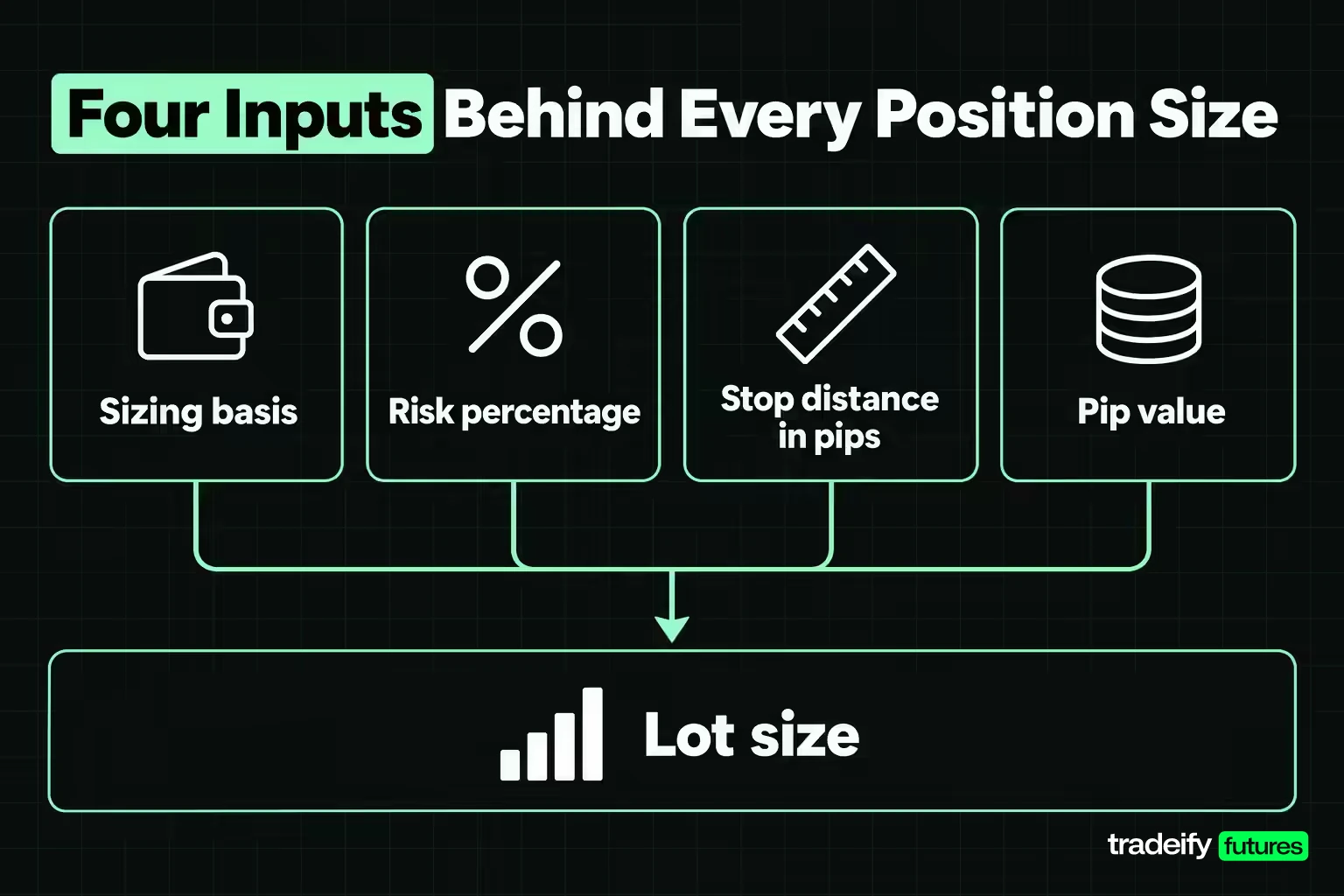
Every forex position size calculation runs on four inputs. If any one is vague, the final lot size is just a guess with decimal places. Decide all four before you open the order ticket, because once price is moving, the temptation is to work backwards from the size you want.
Sizing Basis
The sizing basis is the account figure you apply your risk percentage to. Common choices are the account balance, current equity (balance plus or minus open profit and loss), or the room left before a hard loss limit. On an account with a maximum drawdown rule, the room left before that rule matters more than the headline balance.
Pick one basis and keep it. Switching between balance and equity from trade to trade, usually whichever gives the bigger number that day, makes your percentage meaningless.
Risk Percentage or Cash Risk
This is how much of the basis you will lose if the stop is hit. On a $10,000 basis, 0.5% is $50, 1% is $100 and 2% is $200. Converting the percentage to cash before you size is the step that makes the consequence visible.
Stop Distance in Pips
The stop belongs where the trade idea is proven wrong, measured from entry in pips. A stop placed at whatever distance produces a comfortable lot size is backwards. A wider logical stop means a smaller position; a tighter one means a larger position, with the cash risk unchanged.
Pip Value
Pip value is how much one pip is worth for each unit you trade, expressed in your account currency. It depends on the pair and on whether your account currency matches the pair's quote currency. Without it, a stop distance in pips cannot be turned into money.
How the Four Inputs Combine
The four inputs combine into one size. With a $10,000 basis, 1% risk gives $100. A 25-pip EUR/USD stop at $10 per pip per standard lot costs $250 per lot, so the position is 0.40 lots, or 40,000 units.
Change any single input and the size moves with it:
| Input changed | New value | New position size |
|---|---|---|
| Sizing basis | $5,000 instead of $10,000 | 0.20 lots |
| Risk percentage | 0.5% instead of 1% | 0.20 lots |
| Stop distance | 50 pips instead of 25 | 0.20 lots |
| Pip value | USD/JPY at 150.00, $6.67 per lot | 0.60 lots on a 25-pip stop |
Halving the account, halving the risk percentage or doubling the stop all halve the position. A lower pip value does the opposite and allows more units for the same cash risk, which is why a USD/JPY position can look larger than a EUR/USD position with identical risk.
How Much to Risk per Trade
The risk percentage per trade is the one input you choose purely on judgment, so it deserves the most thought.
The common convention is 1% to 2% of the account per trade. Investopedia describes 2% as the ceiling most retail traders use, and CME Group's education material on "the 2% rule" makes the same point while calling the threshold itself "completely arbitrary". That honesty is useful. There is nothing special about 2%. It is a level where a long losing streak hurts without ending the account.
A practical way to choose is to work backwards from the losing streak you need to survive. At 0.5% per trade it takes 45 straight losses to reach a 20% drawdown. At 1% it takes 23. At 2% it takes 12. At 5% it takes only 5. If your strategy's journal shows losing runs of eight or nine trades, a 5% risk per trade is not a strategy, it is a countdown.
Other things that should pull your percentage down:
- A short or untested track record. You do not yet know how long your losing streaks run.
- A hard loss limit on the account, such as a daily loss limit or a trailing drawdown on an evaluation account, which leaves less room than the balance suggests.
- Several open trades at once, because each 1% adds to the total.
- Wider spreads or thin liquidity, which make the real loss larger than the planned one.
Risk tolerance matters too. If a 2% loss makes you anxious enough to move your stop, your real risk per trade is not 2%. It is whatever you end up losing after the panic. Choose a level you can sit through without touching the trade.
Related lesson: Setting a maximum risk per trade
How Pip Value Feeds the Position Size
Pip value converts a stop distance into money, so the position size formula cannot work without it.
The base calculation is pip value = units x pip size, and the result comes out in the pair's quote currency (the second currency in the pair). For EUR/USD, the quote currency is the US dollar, so 100,000 units x 0.0001 = $10 per pip. A mini lot of 10,000 units is $1 per pip and a micro lot of 1,000 units is $0.10 per pip.
That $10 figure is so common that many traders assume it applies everywhere. It does not. When the quote currency is not your account currency, the pip value has to be converted, and the result changes with the exchange rate.
Pip value per standard lot for a US dollar account, at round illustrative rates:
| Pair | Pip size | Pip value in quote currency | Illustrative rate used | Pip value in USD |
|---|---|---|---|---|
| EUR/USD | 0.0001 | $10 | None needed | $10 |
| USD/JPY | 0.01 | ¥1,000 | USD/JPY 150.00 | $6.67 |
| USD/CHF | 0.0001 | 10 francs | USD/CHF 0.8000 | $12.50 |
| EUR/GBP | 0.0001 | £10 | GBP/USD 1.3000 | $13.00 |
The yen row shows why this matters. A trader who assumes $10 per pip on USD/JPY would think a 40-pip stop on one lot risks $400, when at 150.00 it risks about $267. The error runs the other way on EUR/GBP, where the assumed $10 is really $13.00 and every stop costs 30% more than planned.
The Forex Position Size Formula Step by Step
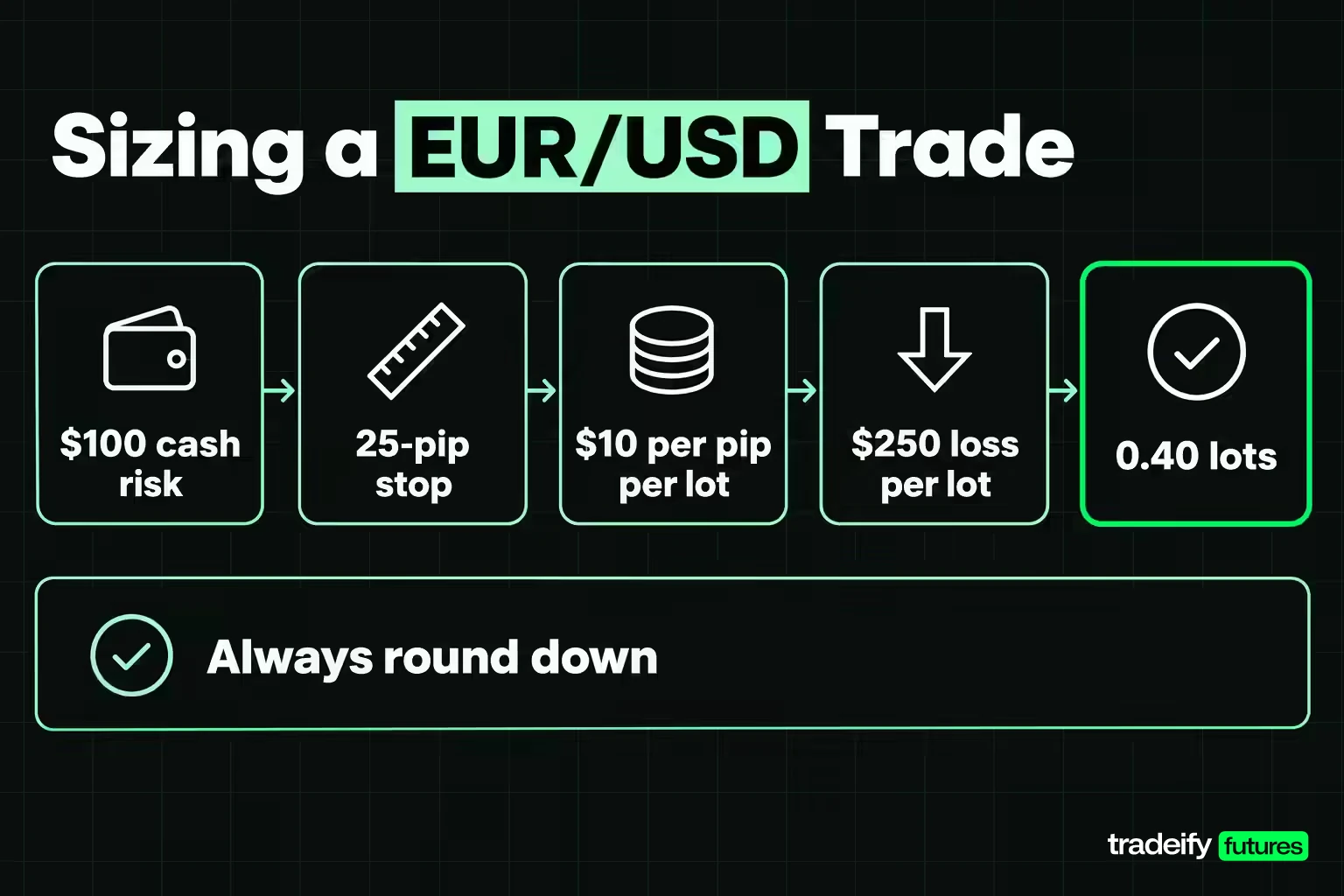
The forex position size formula is:
Position size in units = cash risk ÷ (stop distance in pips x pip value per unit)
Cash risk = sizing basis x risk percentage
Here is the walkthrough with a $10,000 US dollar account, 1% risk and a EUR/USD trade with a 25-pip stop.
- Set the cash risk. $10,000 x 1% = $100.
- Measure the stop in pips. Entry to stop is 25 pips, placed where the setup is invalid.
- Find the pip value. EUR/USD in a USD account is $10 per pip per standard lot.
- Find the loss per lot at the stop. 25 pips x $10 = $250 per standard lot.
- Divide cash risk by loss per lot. $100 ÷ $250 = 0.40 lots, or 40,000 units.
- Round down to what the platform accepts. 0.40 lots fits a 0.01-lot increment exactly.
- Reverse-check. 40,000 units x 0.0001 x 25 pips = $100.
Step 7 is the one most traders skip, and it is the cheapest error check you have. If size x stop x pip value does not reproduce your cash risk, something in the inputs is wrong.
Always round down, never up. If the raw answer is 0.437 lots and the platform takes 0.01-lot steps, 0.43 lots keeps you under the cap and 0.44 lots puts you over it.
Worked Forex Position Sizing Examples
These forex position sizing examples use round, illustrative prices, not live quotes. Each one ends with a reverse check.
EUR/USD With Trading Costs Reserved
Account: $10,000 in US dollars. Risk: 0.75%, so $75. Entry 1.0840, stop 1.0810, a 30-pip stop. Estimated spread, commission and slippage: $3.
- Reserve costs first. $75 - $3 = $72 left for the price move.
- Pip value per unit is $0.0001, because the quote currency is the account currency.
- Size: $72 ÷ (30 x $0.0001) = 24,000 units, or 0.24 lots.
- Check: 24,000 x $0.0001 = $2.40 per pip, and 30 x $2.40 = $72. Add the $3 of costs and the total planned loss is $75.
If the raw answer had been 24,600 units and the platform only accepted 1,000-unit steps, 24,000 would keep the cap and 25,000 would break it.
Reserving costs matters most on tight stops. A $3 cost allowance on a 30-pip stop is small. The same cost on a 6-pip stop is a much bigger share of the planned loss.
USD/JPY in a US Dollar Account
Account: $10,000. Risk: 1%, so $100. Entry 150.00, stop 149.60, a 40-pip stop (yen pip = 0.01).
- Pip value per unit in yen is 0.01. Converted to dollars at 150.00, it is 0.01 ÷ 150.
- Size: $100 ÷ (40 x 0.01 ÷ 150) = 37,500 units.
- Round down to 37,000 units (0.37 lots) if the platform uses 1,000-unit steps.
- Check: the loss at the stop is 37,000 x 0.40 = ¥14,800. At 150.00 that is $98.67.
There is a detail here most calculators skip. The loss is realized in yen and converted at the rate when you exit, which is the stop price of 149.60. ¥14,800 at 149.60 is $98.93, slightly more than the estimate. The gap is small on a 40-pip stop, but on wider stops or bigger sizes the conversion rate at the exit is the one that counts.
How Stop Distance Changes the Same Position
Hold the market-loss budget at $72 on EUR/USD in a USD account and change only the stop:
| Stop distance | Units | Standard lots | Cash at risk |
|---|---|---|---|
| 20 pips | 36,000 | 0.36 | $72 |
| 30 pips | 24,000 | 0.24 | $72 |
| 45 pips | 16,000 | 0.16 | $72 |
The stop gets 2.25 times wider from 20 to 45 pips, and the position gets 2.25 times smaller. The cash at risk does not move. That is the whole point: the chart picks the stop, the budget picks the loss, and the size is what makes them agree.
Account Currency and Pip Value Conversions
Account currency changes the pip value step of every forex position size calculation. There are three cases.
Account Currency Is the Quote Currency
This is the easy case. A US dollar account trading EUR/USD, GBP/USD or AUD/USD earns and loses dollars directly. Pip value per unit is the pip size, and no conversion is needed.
Account Currency Is the Base Currency
Here the pip value comes out in the quote currency and has to be divided by the pair's rate. Take a euro account trading EUR/USD at an illustrative 1.1000. One pip on a standard lot is $10, which is €10 ÷ 1.1000 = €9.09.
With a €10,000 account at 1% (€100) and a 25-pip stop, one lot risks 25 x €9.09 = €227.27. The size is €100 ÷ €227.27 = 0.44 lots, or 44,000 units. Check: 44,000 x 0.0001 x 25 = $110, which is €100 at 1.1000.
Account Currency Is a Third Currency
When the account currency is in neither half of the pair, you need a cross rate. Take a pound sterling account trading USD/JPY. With illustrative rates of USD/JPY 150.00 and GBP/USD 1.3000, GBP/JPY is 195.00. One pip on a standard lot is ¥1,000, which is £5.13.
A £10,000 account at 1% (£100) with a 40-pip stop risks £205.13 per lot. The raw size is 0.4875 lots, rounded down to 48,000 units. Check: 48,000 x 0.40 = ¥19,200, which is £98.46 at 195.00.
Conversion direction is where people slip. If the pair's quote currency is your account currency, multiply nothing. If it is not, convert the quote-currency pip value into your account currency using the live rate between those two currencies, and confirm whether you need to multiply or divide by checking that the result makes sense.
How the Currency Pair Changes Position Size
The currency pair changes position size in three ways: pip value, typical volatility and trading cost.
Majors such as EUR/USD, GBP/USD and USD/JPY have the tightest spreads, so the gap between planned and actual loss tends to be smallest. Crosses such as EUR/GBP or GBP/JPY carry their own pip values that need conversion, and often wider spreads. Exotic pairs, such as the US dollar against the Mexican peso or South African rand, usually have much wider spreads and can gap harder, so the same cash risk buys a smaller, less predictable position. In the US, dealers must collect at least a 2% deposit on major pairs and 5% on all other pairs, which reflects the same difference in risk.
Volatility is the bigger lever. In an illustrative study of Yahoo Finance daily bars from November 2016 to October 2026, using a 20-day average true range (ATR), EUR/USD's median 20-day average true range was 81.6 pips, while USD/JPY's was 95.4 pips and reached 283.5 pips at its highest. A stop that respects normal movement on one pair can be too tight on another, and wider stops mean smaller positions.
Position Sizing for Gold (XAU/USD)
Gold quoted as XAU/USD is the classic trap for forex traders. One lot is commonly 100 troy ounces, not 100,000 units, so a $1 move in the gold price is worth $100 per lot. Brokers set their own contract sizes (some offer 10-ounce or 1-ounce lots) and even disagree on whether a gold "pip" is a $0.10 or a $0.01 move.
The safe approach is to skip pips entirely and size gold in dollars of price distance. With a $100 budget and a stop $12 away, one lot risks $1,200, so the raw size is 0.083 lots, rounded down to 0.08 lots (8 ounces), for a planned loss of $96. Always read the contract size and tick value in your platform's symbol specification first.
Position Sizing Methods Compared
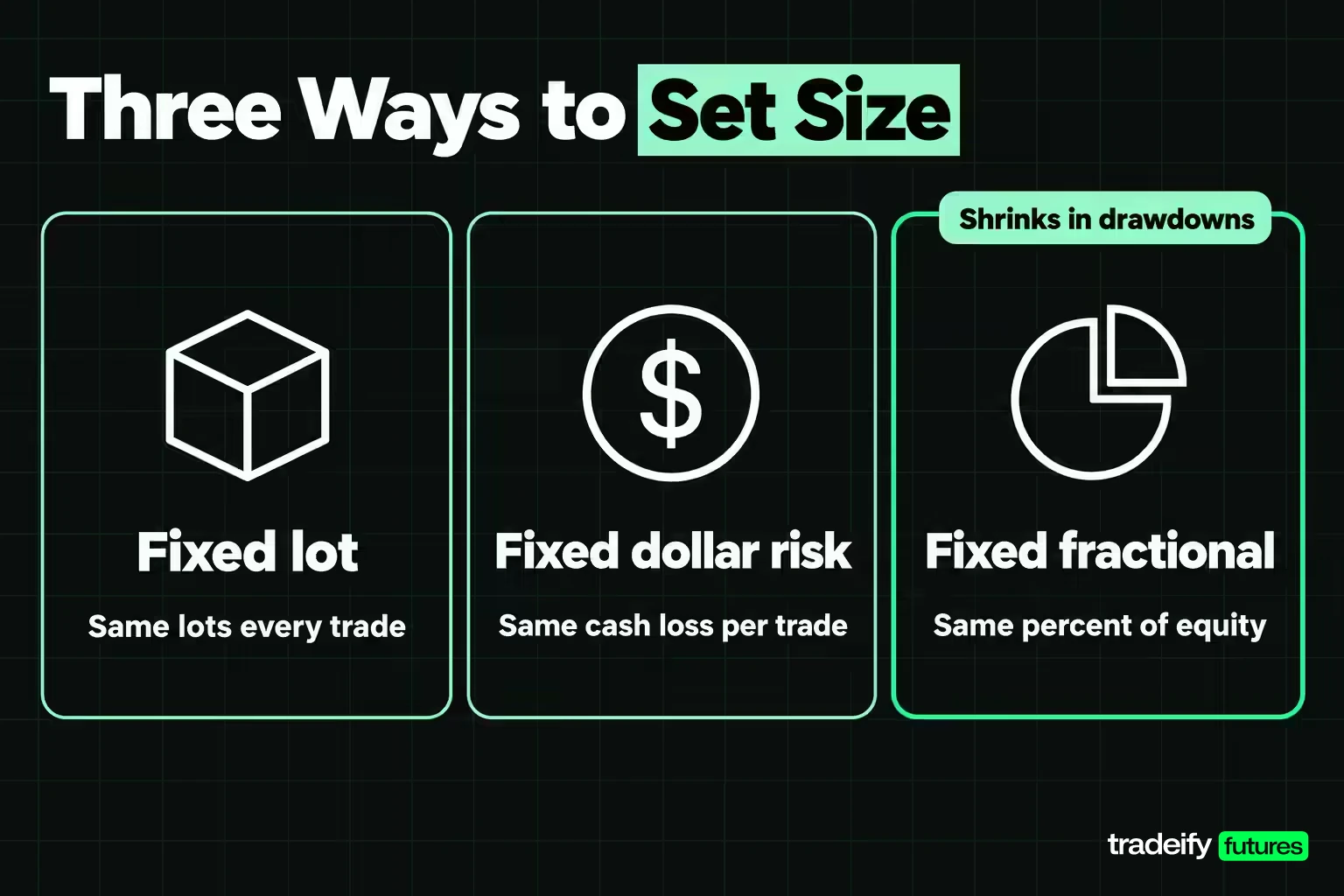
There is more than one way to decide position size. Each method answers the question "how much?" with a different input, and the right one depends on how much you actually know about your own results.
| Method | How size is set | Strength | Weakness |
|---|---|---|---|
| Fixed lot | Same lots on every trade | Simple | Risk changes with every stop distance and pair |
| Fixed dollar risk | Same cash loss per trade | Easy to read in a journal | Does not shrink after losses |
| Fixed fractional | Same percentage of current equity | Shrinks size during drawdowns | Recovery is slower after losses |
| Volatility-based | Stop scaled to ATR, size scaled to stop | Adapts to quiet and wild markets | Needs a consistent volatility measure |
| Kelly criterion | Formula from win rate and payoff | Maximizes long-run growth in theory | Very sensitive to estimation errors |
| Scaling in or out | Size added or reduced in pieces | Can fit trade management plans | Easy to exceed total risk by accident |
Fixed fractional is the default in most forex education because it is self-correcting. Ten losses at 1% of current equity cost 9.56% of the account, versus 10% with a fixed $100 risk on a $10,000 account, and every loss makes the next trade a little smaller.
Kelly Criterion and Fractional Kelly Sizing
The Kelly criterion, published by John L. Kelly Jr. in 1956, sets size as Kelly % = W - (1 - W) / R, where W is the win rate and R is the average win divided by the average loss. A strategy that wins 40% of the time at 2 to 1 gives 0.40 - 0.60 / 2 = 10% of capital at risk per trade, far above the 1% to 2% most traders use. That is why traders who use Kelly at all use a fraction of it. Half Kelly keeps about 75% of the theoretical growth rate with much smaller swings, and the inputs are usually estimated from only the last 50 or 60 trades, which is a small and noisy sample.
If you are still building a track record, fixed fractional with a volatility-aware stop is the practical default. Kelly only becomes meaningful once you have a long, honest sample of your own trades.
Scaling In and Out of Forex Positions
Scaling in or out is a trade management choice layered on top of a sizing method. The rule that keeps it safe: total risk across all pieces, measured from each entry to the current stop, never exceeds the original cash risk.
Related lesson: Kelly criterion and why full Kelly is risky
Volatility-Based Sizing on EUR/USD
Volatility-based sizing uses the average true range (ATR), an indicator J. Welles Wilder introduced in 1978. True range is the largest of the day's high minus low, the high minus the previous close, or the low minus the previous close, so it captures gaps. ATR measures how far price moves, not which way.
To show what this does to position size, an illustrative study ran on Yahoo Finance daily EUR/USD bars from November 2, 2016 to October 30, 2026 (2,580 readings of a 20-day simple ATR). The stop was set at 1.5 x ATR, rounded to whole pips, with $100 at risk and size rounded down to 1,000 units. Yahoo's FX bars are indicative composite quotes, not a dealer's feed, so treat the figures as a guide.
| EUR/USD volatility level | 20-day ATR | Stop at 1.5 x ATR | Position size | Planned loss |
|---|---|---|---|---|
| Quiet (5th percentile) | 52.8 pips | 79 pips | 12,000 units | $94.80 |
| Calm (25th percentile) | 67.0 pips | 101 pips | 9,000 units | $90.90 |
| Typical (median) | 81.6 pips | 122 pips | 8,000 units | $97.60 |
| Active (75th percentile) | 95.9 pips | 144 pips | 6,000 units | $86.40 |
| Wild (95th percentile) | 122.9 pips | 184 pips | 5,000 units | $92.00 |
From the quiet end to the wild end, the position shrinks 2.4 times while the planned loss stays under $100. The highest reading in the sample was 200.0 pips on April 1, 2020. A trader using a fixed lot size through that period would have carried roughly double the usual risk per trade without changing a single setting.
Leverage, Margin and Forex Position Size
Leverage and margin decide how large a position you are allowed to open. They do not decide how large a position you should open. Mixing the two up is the most expensive confusion in forex sizing, and high available leverage makes it very easy to do.
In the US, federal rules require dealers to collect a security deposit of at least 2% of notional value on major currency pairs and 5% on all other pairs, which works out to maximum leverage of 50 to 1 and 20 to 1. If deposits fall short, the dealer must collect more or liquidate positions.
Consider a 24,000-unit EUR/USD position at 1.0840 in a $10,000 account. Its notional value is $26,016, the 2% deposit is $520.32, and effective leverage is about 2.6 times. The risk at a 30-pip stop is $72. Margin barely enters the decision.
Now the overleveraged version. At 50 to 1, that same $10,000 can control $500,000 of notional, about 4.6 standard lots of EUR/USD at 1.0840. A 30-pip stop on 4.6 lots costs $1,380, or 13.8% of the account on one ordinary stop-out. Nothing about the setup changed. The only difference is that the trader sized to what margin allowed instead of what the risk budget allowed.
So run the order the right way round: calculate the risk-based size first, then confirm there is enough free margin to open it. If margin or an account rule caps you below the risk-based answer, take the smaller size. Never the larger.
Risk-Reward Ratio and Stop Placement
The risk-reward ratio compares the distance to your target with the distance to your stop. It interacts with position size in a specific way: the stop sets the size, and the target sets the reward. Moving the target does not change how much you can lose.
What the ratio does change is the win rate you need to break even before costs:
| Reward to risk | Break-even win rate |
|---|---|
| 1 to 1 | 50% |
| 1.5 to 1 | 40% |
| 2 to 1 | 33.33% |
| 3 to 1 | 25% |
The trap is tightening the stop to make the ratio look better. A 20-pip stop and a 60-pip target looks like 3 to 1, and the tighter stop allows a bigger position. But if 20 pips sits inside normal noise for the pair, the stop gets hit far more often and the 25% break-even rate is no longer realistic. The ratio only means something when the stop is placed where the idea is wrong, not where the math looks pretty.
Related lesson: Risk-reward ratio explained
Sizing Several Open Trades at Once
Sizing several open trades at once needs a second limit on top of risk per trade: total open risk.
Three trades at 1% each are 3% of open risk. That is fine on its own, but in forex several trades can be the same bet. Long EUR/USD, long GBP/USD and short USD/CHF are three tickets and essentially one position against the US dollar. If the dollar rallies on one data release, all three can hit their stops together.
Two practical rules handle this:
- Cap total open risk across all trades, for example at a multiple of your per-trade risk that you could lose in one bad session.
- Group trades by currency. If two or more positions share the same currency exposure in the same direction, treat them as one risk and split the budget between them instead of giving each a full share.
Using a Position Size Calculator
A position size calculator does the arithmetic, but it cannot check your inputs. Most bad results from a calculator come from what was typed in, not from the formula behind it.
The common types each have a weak point:
- Web calculators are quick but may use a delayed conversion rate and a default contract size.
- Platform scripts and expert advisors read the live symbol specification, but only if they read the right fields, such as tick value and contract size, instead of assuming forex defaults.
- Spreadsheets are transparent and easy to audit, but every rate and contract size is only as current as the last time you updated it.
Before trusting any calculator, confirm the account currency, the pair, the stop in pips, the risk amount, the contract size per lot and the minimum lot step. Gold is where most calculators fail, because some assume 100,000 units or treat a $0.01 move as a pip.
Then verify the output by hand once: size x stop distance x pip value should reproduce your cash risk. If it does not, find out why before the order goes in.
Common Position Sizing Mistakes
Most position sizing mistakes come from skipping one of the inputs, usually under time pressure. The usual ones:
- Using the same lot size on every trade. Risk then changes with every stop distance and pair. Recalculate from the inputs each time.
- Picking the lot size first. Choosing size, then moving the stop to fit it, lets the account decide where the trade is wrong instead of the chart.
- Trading without a stop. With no stop there is no stop distance, so there is no position size, only an open-ended loss.
- Assuming $10 per pip everywhere. Yen pairs, crosses, base-currency accounts and gold all break that assumption.
- Rounding up. It puts every trade slightly over the cap, and over many trades the drift adds up.
- Ignoring costs and slippage. A stop is an instruction, not a guaranteed price. Spreads widen and fast markets gap, so the real loss can exceed the plan.
- Sizing from a stale balance. After a drawdown or a withdrawal, yesterday's figure overstates what you can risk today.
- Treating correlated trades as separate. Three dollar trades at 1% each are closer to one 3% trade.
Position Size and Trading Psychology
Position size is where trading psychology shows up in the account. An oversized position changes how you behave inside the trade long before it changes your balance, and most traders only notice afterwards.
When the loss at the stop is bigger than you are comfortable with, the usual reactions are predictable: watching every tick, closing a good trade early to stop the discomfort, or moving the stop further away to avoid taking the loss. Each one breaks the plan the size was based on. A trade sized so that the stop-out is boring is a trade you can actually manage by your rules.
The opposite problem is real too. After a run of losses, some traders hesitate on the next valid setup, or cut size to almost nothing. Others raise size to win it back quickly, which is how a normal drawdown becomes a deep one.
A fixed sizing rule removes most of these decisions from the moment of stress. If risk per trade, the basis and the rounding rule are decided before the session, there is nothing to negotiate when a trade is open. If you notice you are routinely overriding the size the formula gives you, treat that as a signal to lower your risk percentage, not to stop calculating.
Building Position Sizing Into a Trading Plan
Position sizing works best as a written part of the trading plan, not a calculation you remember to do. A sizing section in the plan can cover:
- The sizing basis (balance, equity or room before a loss limit) and when it is refreshed.
- Risk per trade, and any lower level used after a set number of losses or a drawdown threshold.
- The maximum total open risk and how correlated trades are grouped.
- The rounding rule (always down) and the minimum lot step.
- A cost allowance for spread, commission and slippage.
- Which setups, if any, get a reduced size, such as trades into a scheduled data release.
Adjusting size by setup is reasonable when the plan defines it in advance, for example half size on a lower-conviction setup or around a news event. Adjusting size because a trade "feels good" is not a plan. It is the same impulse that doubles size after three winners, right before the market reminds you it has not read your journal.
Recalculate whenever the entry, stop, basis, conversion rate or account rule changes. A pending order that sat for hours may need a fresh size if price has moved the entry-to-stop distance.
Finally, measure it. Record intended cash risk, units, the actual fill, the actual exit and costs, then express each result in R, where 1R is your planned risk. Over a meaningful sample, that record shows whether your real losses match your planned ones or keep running over.
Sizing Currency Futures Contracts
Currency futures use the same sizing logic with fixed contract sizes instead of flexible lots. The Euro FX futures contract (6E) is 125,000 euros, with a minimum tick of 0.00005, worth $6.25, so one full pip of 0.0001 is $12.50. The Micro EUR/USD contract (M6E) is 12,500 euros, where one pip is $1.25.
Because you cannot trade a fraction of a contract, the rounding step bites harder. With a $100 budget and a 30-pip stop, one 6E risks 30 x $12.50 = $375, which is far too big, so the honest answer is zero 6E contracts. One M6E risks 30 x $1.25 = $37.50, so the raw size is 2.67 contracts, rounded down to 2, for $75 of planned risk. The temptation is to squeeze the stop until a full-size contract fits. That is the "lot size first" mistake in a different form.
On our accounts, spot forex and CFDs aren't offered; the currency exposure we list is CME currency futures (6E, 6B, 6J, 6A, 6C, 6S, M6E and M6A). Size on our accounts is capped by contract limits, for example 4 minis or 40 micros on a 50K account, with 10 micros counting as one mini, and all positions close by 4:45 PM ET. Sim Funded accounts are simulated.
Related lesson: How currency futures work
Position Sizing in Forex FAQs
How do you calculate forex position size?
Divide your cash risk by the stop distance in pips multiplied by the pip value per unit, in your account currency. For example, $100 of risk on a 25-pip EUR/USD stop in a USD account is $100 ÷ $250 per lot, or 0.40 lots. Round down to the platform's lot step and reverse-check the loss.
What is the 5-3-1 rule in forex?
The 5-3-1 rule is an informal routine framework, not a sizing method. It suggests watching up to five currency pairs, using three defined strategies and focusing on one main trading session. It says nothing about position size, leverage or total exposure, so it needs a separate sizing rule alongside it.
How much is 1 pip in 1 lot?
On a standard lot of 100,000 units, one pip is $10 on pairs quoted in US dollars, such as EUR/USD, for a USD account. On other pairs it varies with the exchange rate, for example about $6.67 on USD/JPY at 150.00. Check the pip value for your pair and account currency rather than assuming $10.
What are the best position sizing strategies?
Fixed fractional sizing, risking a set percentage of current equity per trade, is the most widely used because it shrinks size during drawdowns. Volatility-based sizing adds an ATR-based stop so size adapts to market conditions. Full Kelly sizing is usually too aggressive for real trading.
Forex and currency futures are leveraged, and losses can exceed what you planned, especially when spreads widen or prices gap past a stop. Prop-firm evaluation and funded accounts are typically simulated, and results there can differ from live trading. This article is educational and is not financial or trading advice.


