




TL;DR: Currency futures are exchange-traded contracts on an exchange rate, so the first decision is which contract size fits your risk. A standard Euro FX contract (6E) covers 125,000 euros and moves $6.25 per tick. Micro EUR/USD (M6E) covers 12,500 euros at $1.25 per tick. Know the quote direction, tick value and last trading day before you place an order.
Currency futures are standardized contracts that let you buy or sell one currency against another on a regulated exchange, at a price agreed today, for a set date in the future. Most traders never take delivery. They use currency futures to speculate on the euro, yen, pound and other majors against the U.S. dollar, or to hedge a known foreign-currency payment.
The common way to get hurt here is not a bad read on the euro. It is a good read placed in the wrong contract size, the wrong month or, with the yen, the wrong direction. A move of 0.0050 in EUR/USD sounds tiny until you know it is $625 on one standard contract.
This guide works through the mechanics in the order you need them: how the contracts work and are quoted, the main CME specifications, micros, margin and costs, how they compare with spot forex, and what to check before your first order.
What Are Currency Futures
A currency futures contract is an agreement, traded on an exchange, to exchange a fixed amount of one currency for another at a price set when the trade is made, on a set future date. The exchange writes every term except the price. For the CME Euro FX contract, that means one contract always covers 125,000 euros, the price is quoted in U.S. dollars per euro, and the contract has a fixed tick, listed months and a last trading day.
That standardization is what separates currency futures from two close relatives:
- A currency forward is a private agreement between two parties, usually a bank and a client, with a custom amount and date.
- Spot forex is the over-the-counter market for near-immediate exchange, where retail traders usually deal with a broker or dealer rather than a central exchange.
Because every Euro FX contract is identical, buyers and sellers trade them on one central order book, and you close a position by doing the opposite trade. Nobody negotiates terms. Your decisions are the contract, the month, the direction and the quantity, and each one can be wrong independently of your market view.
How Currency Futures Work
A currency futures position has two sides. The buyer (long) gains when the futures price rises. The seller (short) gains when it falls. Since most CME currency futures are quoted in dollars per unit of foreign currency, a long 6E position is a bet that the euro strengthens against the dollar.
Related lesson: How futures contracts are built and traded
A worked currency futures example
Take illustrative prices. A trader buys one 6E contract at 1.1200. The contract covers 125,000 euros, so its notional value is 125,000 × 1.1200 = $140,000.
Price rises to 1.1250. That is a move of 0.0050. The 6E tick is 0.00005, so the move is 100 ticks. At $6.25 per tick, the gain is $625 before costs. A drop of the same size would be a $625 loss.
The same move on one Micro EUR/USD (M6E) contract is 50 of its 0.0001 ticks at $1.25 each, or $62.50. Same price path, same opinion, one tenth of the dollar exposure. Which of those two numbers your account can absorb at your stop is the real sizing question, not which one would make a better screenshot.
Daily mark-to-market
Futures gains and losses do not wait until you close. The CFTC describes mark-to-market as a daily cash flow system that works out each position's gain or loss at the end of each session and adds it to or subtracts it from account balances. If the euro falls for three days while you hold a long 6E, your account is debited three times, and the broker may ask for more margin before you ever decide to exit. The trade can still be "right" by Friday and you can still be forced out on Wednesday.
Exchange clearing and counterparty risk
Currency futures trade on exchanges that the CFTC oversees as designated contract markets under the Commodity Exchange Act. Every trade is centrally cleared. CME's education material says the clearing house becomes the buyer to every seller and the seller to every buyer, so you are not exposed to whether the trader on the other side of your fill pays.
That does not remove market risk, and it does not protect you from your own broker's failure in every case. It does mean prices, volume and open interest are published, every participant sees the same order book, and settlement prices are set by the exchange rather than by a dealer quoting you.
Currency Pairs and Quote Conventions in Currency Futures
Every exchange rate is a pair. The first currency is the base and the second is the quote. EUR/USD at 1.1200 means one euro costs 1.12 dollars.
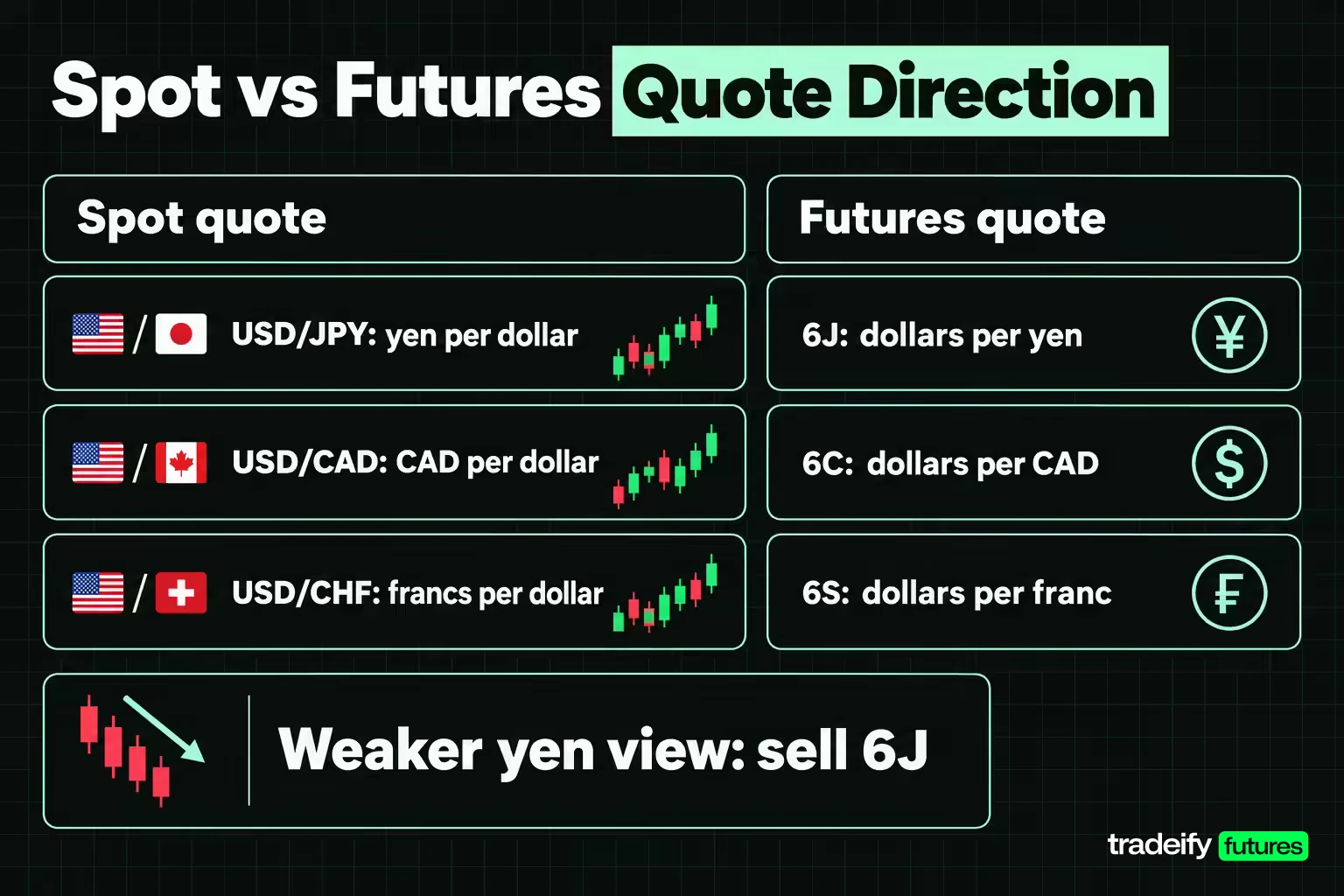
CME's major currency futures are mostly quoted in what is often called American terms: U.S. dollars per one unit of the foreign currency. That matches the spot quote for EUR/USD, GBP/USD and AUD/USD. It does not match how the spot market quotes three of the majors:
- Spot USD/JPY quotes yen per dollar. The 6J contract quotes dollars per yen.
- Spot USD/CAD quotes Canadian dollars per U.S. dollar. The 6C contract quotes dollars per Canadian dollar.
- Spot USD/CHF quotes francs per dollar. The 6S contract quotes dollars per franc.
The direction matters more than it looks. If you expect the yen to weaken, a spot trader buys USD/JPY. The futures trader sells 6J, because a weaker yen means fewer dollars per yen. Traders who come from spot charts get this backwards more often than they like to admit, usually in a hurry around a Bank of Japan headline.
Converting a yen futures quote
On illustrative prices, 6J at 0.006300 means $0.0063 per yen. Divide 1 by 0.0063 and you get about 158.73 yen per dollar, the number a spot chart would show. If 6J rises to 0.006350, spot would read about 157.48. The futures price went up, the spot USD/JPY number went down, and both describe the same thing: the yen got stronger.
A 6J tick is 0.0000005, worth $6.25 on a 12,500,000-yen contract. The 0.000050 move in that example is 100 ticks, or $625 per contract. Writing out the decimal places before the trade is the simplest way to avoid a misplaced zero.
Currency Futures Contract Specifications and Symbols
Before trading any currency futures contract, read its specification. These are the core CME terms for the six most traded majors, from CME's contract specifications as of November 2026.
| Contract | Symbol | Contract size | Minimum tick | Tick value | Last trading day |
|---|---|---|---|---|---|
| Euro FX | 6E | 125,000 euros | 0.00005 | $6.25 | 2 business days before 3rd Wednesday |
| Japanese yen | 6J | 12,500,000 yen | 0.0000005 | $6.25 | 2 business days before 3rd Wednesday |
| British pound | 6B | 62,500 pounds | 0.0001 | $6.25 | 2 business days before 3rd Wednesday |
| Australian dollar | 6A | 100,000 Australian dollars | 0.00005 | $5.00 | 2 business days before 3rd Wednesday |
| Canadian dollar | 6C | 100,000 Canadian dollars | 0.00005 | $5.00 | 1 business day before 3rd Wednesday |
| Swiss franc | 6S | 125,000 Swiss francs | 0.00005 | $6.25 | 2 business days before 3rd Wednesday |
All six trade on CME Globex Sunday to Friday, 5:00 PM to 4:00 PM CT (6:00 PM to 5:00 PM ET), with a 60-minute break each day starting at 4:00 PM CT. Trading on the last day ends at 9:16 AM CT. All six are physically delivered at expiration.
Reading a currency futures symbol
A futures symbol is the root plus a month code plus the year. The quarterly months use H (March), M (June), U (September) and Z (December). So 6EZ6 is December 2026 Euro FX, and 6JH7 is March 2027 Japanese yen. Some platforms print the full year instead, as in 6EZ2026.
Most volume sits in the nearest quarterly month. 6E also lists serial (non-quarterly) months, but they trade far less. A November contract can appear on your screen with a believable price and very little volume behind it.
Related lesson: How month codes and symbols are built
Major Currency Futures Contracts and Their Liquidity
Liquidity in currency futures is not spread evenly. CME's preliminary figures for the November 4, 2026 session show how far apart the majors are.
| Contract | Volume, Nov 4 2026 | Open interest, Nov 4 2026 |
|---|---|---|
| Euro FX (6E) | 261,866 | 869,785 |
| Japanese yen (6J) | 226,194 | 376,651 |
| Australian dollar (6A) | 86,686 | 332,804 |
| Canadian dollar (6C) | 80,995 | 347,115 |
| British pound (6B) | 80,430 | 240,947 |
| Swiss franc (6S) | 40,810 | 131,252 |
| Micro EUR/USD (M6E) | 31,937 | 19,775 |
| Micro AUD/USD (M6A) | 5,229 | 3,276 |
| Micro GBP/USD (M6B) | 4,506 | 3,182 |
One day is a snapshot, not a permanent ranking, so check current volume yourself before you commit to a thinner contract. What each currency tends to reflect is a better guide to what you are actually trading:
- Euro (6E). The deepest currency futures market. Driven by the gap between U.S. and euro-area rates and growth.
- Japanese yen (6J). Very sensitive to U.S. Treasury yields and to sudden risk-off moves, when it can strengthen quickly.
- British pound (6B). Reacts to UK inflation, Bank of England decisions and UK political news.
- Australian dollar (6A). Often moves with commodity prices and Chinese demand, and with general risk appetite.
- Canadian dollar (6C). Often linked to oil prices and to U.S. economic news.
- Swiss franc (6S). Tends to attract demand in stress, much like the yen.
The practical point: on that snapshot, 6E and 6J carried far more volume than the rest, which usually means tighter markets and more size at each price. Thinner contracts can be traded, but your stop fills during a fast move will be less predictable, and that is exactly when it matters.
Micro Currency Futures
Micro currency futures are one tenth the size of their standard contracts. CME lists Micro EUR/USD (M6E) at 12,500 euros, Micro AUD/USD (M6A) at 10,000 Australian dollars and Micro GBP/USD (M6B) at 6,250 pounds.
| Micro contract | Symbol | Size | Tick | Tick value |
|---|---|---|---|---|
| Micro EUR/USD | M6E | 12,500 euros | 0.0001 | $1.25 |
| Micro AUD/USD | M6A | 10,000 Australian dollars | 0.0001 | $1.00 |
| Micro GBP/USD | M6B | 6,250 pounds | 0.0001 | $0.625 |
The micro tick is wider in price than the standard tick (0.0001 versus 0.00005 for the euro), so one micro tick is not one tenth of a standard tick. The dollar value of the same price move is exactly one tenth, though. A 0.0030 stop is 30 ticks and $37.50 on M6E, and 60 ticks and $375 on 6E.
When micro currency futures make sense
Micros help when a standard contract's tick value would push you into a stop that is too tight. If your setup needs 30 pips of room and your risk budget is $50, one 6E is out of the question and one M6E fits. The temptation is to keep the 6E and shrink the stop to 4 pips instead. That turns a reasoned invalidation level into a coin flip on noise.
The tradeoff is liquidity. CME's preliminary November 4, 2026 figures show 31,937 M6E contracts traded against 261,866 in 6E. M6E lists only two quarterly months at a time, and its book is thinner. Micros also often cost more in commission per dollar of exposure, because ten micro commissions usually add up to more than one standard contract's.
Related lesson: Standard versus micro contracts
Currency Futures Margin and Trading Costs
Margin in currency futures is a good-faith deposit, not a down payment, and confusing the two is the most expensive misunderstanding in this market. One 6E contract at an illustrative 1.1200 controls $140,000 of euros. The margin the broker holds is a small fraction of that, set by the exchange as a minimum and often raised by the broker. Exchange margins change with volatility, so check the current figure on CME's margin page and with your broker before trading. Day-trading margins offered by some brokers can be lower than exchange margins, which increases leverage.
The ratio of notional value to margin is your leverage. Higher leverage means a small percentage move in the exchange rate becomes a large percentage change in your account. Margin is also not a loss limit. A fast move can take an account below zero.
Every cost in a currency futures round trip
A completed trade (entry and exit) usually pays:
- Broker commission, per contract per side.
- Exchange and clearing fees, charged by CME.
- Regulatory fees, such as the NFA fee in the U.S.
- The bid-ask spread. Crossing a one-tick spread on 6E costs $6.25 per contract. On M6E it costs $1.25.
- Slippage, when a stop fills worse than its price in a fast market.
Spread and slippage hurt most on small stops, which is the hidden cost of trading very short-term. A one-tick spread on M6E is $1.25, which is 10% of a 10-tick stop ($12.50). Widen the stop to a level that actually invalidates your idea and the spread matters less in percentage terms, but the dollar risk per contract grows, which may mean trading fewer contracts.
There is no overnight swap or rollover credit in futures. The interest-rate difference between the two currencies is already built into the futures price, which is why deferred months trade at a different price from the front month.
Currency Futures vs Spot Forex
Currency futures and spot forex give exposure to the same exchange rates, but the plumbing is different.
| Feature | Currency futures | Retail spot forex |
|---|---|---|
| Venue | Regulated exchange with one central order book | Over the counter, quoted by a dealer or broker |
| Size | Fixed contracts, 125,000 euros for 6E, 12,500 for M6E | Flexible lots, standard lot 100,000 units |
| Price visibility | Exchange-published prices, volume and open interest | Dealer quotes; no central volume figure |
| Holding cost | Interest gap built into the futures price | Daily swap or rollover charge or credit |
| U.S. leverage cap | Set by exchange and broker margin | At least 2% deposit on majors, 5% on others |
| Expiration | Quarterly, physically delivered | No expiry; positions roll daily |
| Quote direction | Dollars per foreign unit, including yen, CAD and franc | Market convention, such as USD/JPY in yen per dollar |
In the U.S., federal rules (17 CFR 5.9) require a retail forex security deposit of at least 2% of notional value for major pairs and 5% for others, a 50:1 and 20:1 leverage ceiling. At the 2% minimum, $140,000 of EUR/USD needs $2,800.
Why forex traders switch from spot to currency futures
One 6E contract is 1.25 standard forex lots, and one M6E is 0.125 lots. A pip (0.0001) is worth $12.50 on 6E and $1.25 on M6E, against $10 on a standard EUR/USD lot.
Traders who move to futures usually want three things: a central order book where every trader sees the same price, published volume, and no dealer setting both the quote and the spread. What they give up is size flexibility, since futures come only in whole contracts, and some pairs. Plenty of crosses that are common in spot have thin or no futures market.
Benefits and Drawbacks of Currency Futures
The case for currency futures rests on market structure and sizing, and every benefit below has a matching cost in the second list.
Benefits:
- Transparent pricing. Every trader sees the same central order book and exchange-set settlement prices.
- Central clearing. The clearing house stands between buyer and seller, which removes the risk that the other trader fails to pay.
- Exact hedges. A business with a known euro, yen or pound payment can match it closely with standard contracts.
- Nearly 24-hour access. CME FX futures trade from Sunday evening to Friday afternoon U.S. time with one daily break.
- Short selling is routine. Selling a contract is as simple as buying one.
- Size choices. Micro contracts make small positions possible.
Drawbacks:
- Leverage cuts both ways. A move that looks small in the exchange rate can be a large loss on the account.
- Fixed sizes. You cannot buy 1.3 contracts, so position size moves in steps.
- Expiration. Contracts expire and must be rolled, and the major CME contracts are physically delivered.
- Inverse quotes. 6J, 6C and 6S quote the opposite way from spot, a common source of wrong-direction trades.
- Fewer pairs. The futures list is narrower than a spot forex menu.
Hedging Currency Risk With Futures

Hedging means taking a futures position that gains when your real-world currency exposure loses. A U.S. importer that must pay a European supplier in euros in March loses if the euro strengthens before then, because the payment will cost more dollars. Buying euro futures offsets that.
A currency futures hedge, step by step
Take illustrative figures. An importer owes €1,000,000 in March and the March 6E contract trades at 1.1300.
- Divide the exposure by the contract size: 1,000,000 ÷ 125,000 = 8 contracts.
- Buy 8 March 6E contracts at 1.1300.
- Hold the hedge until the payment date, then close it.
If the euro rises and the futures are at 1.1800 when the importer pays, the futures gain is 0.0500 × 1,000,000 = $50,000. That roughly offsets the extra $50,000 the euros now cost.
If the euro falls to 1.0800, the futures lose $50,000, but the euros are $50,000 cheaper to buy. The importer gave up the windfall in exchange for a known cost. That is the hedge working, not failing.
Odd amounts and basis risk
Real exposures are rarely round. A payment of €1,060,000 is 8.48 standard contracts. Eight 6E plus four M6E covers €1,050,000 and leaves €10,000 unhedged. Micros exist partly for this.
The hedge is also not perfect to the dollar. The futures price and the spot rate the importer actually pays can differ on the payment day, especially if the payment date falls between contract months. That gap is basis risk. Daily mark-to-market also means a hedge that loses money on paper needs cash for margin before the offsetting gain arrives in the business.
Related lesson: Hedging concepts in more depth
Speculating on Exchange Rates With Currency Futures
A speculator has no currency exposure to protect. The futures position is the whole trade, so the risk must be planned from the price chart and the account, not from a business need.
Take an illustrative plan. A trader expects the euro to firm after a data release and buys 2 M6E at 1.1200, with a stop at 1.1170 where the idea is wrong and a target at 1.1260.
- Stop distance: 0.0030 = 30 ticks = $37.50 per contract, $75 for two.
- Target distance: 0.0060 = 60 ticks = $75 per contract, $150 for two.
- The same stop on one 6E would be 60 ticks, or $375.
The order of decisions is what matters. Stop placement comes from where the setup fails. Size comes from dividing the risk budget by the dollar cost of that stop. If the release lands and price never reaches 1.1260, the plan still did its job as long as the loss stayed at $75. Choosing 6E instead of M6E because the profit would look bigger is how small accounts get hurt.
Common currency futures speculation mistakes
- One dollar bet in three symbols. Long 6E, long 6B and long 6A at the same time can all be the same weaker-dollar idea. If the dollar rallies, all three lose together.
- Trading the release itself. The minute after a major data release can show wide spreads and stops that fill well past their price.
- Reversed direction on inverse quotes. Selling 6J when you meant to bet on a weaker dollar is an expensive typo.
What Moves Currency Futures Prices
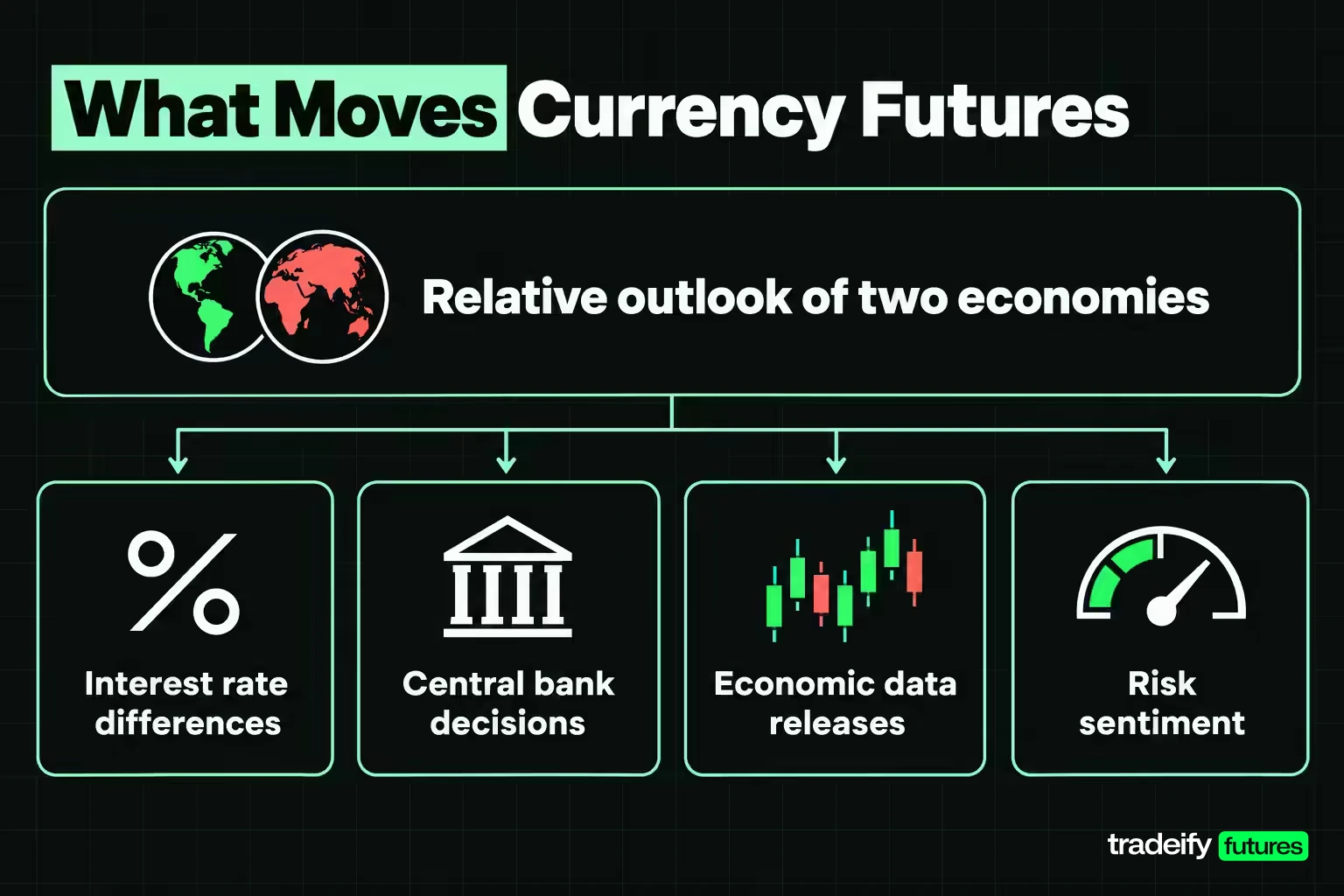
Exchange rates move on the relative outlook for two economies. Strong U.S. data does not lift the dollar if the market expected even stronger numbers, or if Europe's outlook improves faster. That is why reading the headline alone often leaves traders confused about why price went the "wrong" way.
Interest rates and central banks
Interest-rate differences are the main long-run driver. When one country's rates are expected to rise relative to another's, its currency tends to attract demand. As of November 4, 2026, the Federal Reserve's target range is 3.75%-4.00% after it held rates on October 28, 2026, and the ECB's deposit facility rate is 2.50%. The next FOMC meeting is December 8-9, 2026. Decisions and statements from the Fed, ECB, Bank of Japan, Bank of England and others can move their currencies in seconds.
Economic data and risk sentiment
Inflation, employment and growth releases change rate expectations. The next U.S. CPI report (October 2026 data) is due Tuesday, November 10, 2026, at 8:30 AM ET. Traders compare the actual figure with the forecast and the prior reading, so the same number can lift or sink a currency depending on what was expected.
Risk sentiment matters too. In stress, demand often shifts toward the dollar, yen and franc, while commodity-linked currencies such as the Australian and Canadian dollars tend to weaken.
Why currency futures trade away from spot
A currency futures price is not a forecast of the future spot rate. It is the spot rate adjusted for the interest-rate gap between the two currencies until delivery. When U.S. rates are above euro rates, euro futures for later months trade above nearer months.
The CME settlements for November 4, 2026 show it: December 2026 6E settled at 1.124150 and March 2027 at 1.128500. The 0.004350 gap is 87 ticks, or $543.75 per contract. Spread over the 91 days between the two last trading days, that is about 1.55% a year, roughly in line with the gap between the Fed range and the ECB deposit rate. As a contract approaches expiration, this gap (the basis) shrinks and the futures price converges on spot.
Arbitrage keeps the gap honest
If a futures price drifted far from spot plus the interest gap, large banks could buy currency in the spot market, sell the futures and lock in the difference, or do the reverse. That trade, called covered interest arbitrage, is why the basis stays close to the rate differential. It needs bank-level funding and tiny costs, so it is not a realistic retail strategy, but it explains why currency futures track spot so closely.
Currency Futures Settlement and Expiration
Currency futures settle in one of two ways in general: cash settlement, where the final gain or loss is paid in cash, or physical delivery, where the currencies actually change hands. The major CME currency futures, including 6E, 6J, 6B, 6A, 6C, 6S and the micros M6E, M6A and M6B, are listed by CME as deliverable. A position still open after the last trading day leads to actual currency delivery through the clearing system. Speculators almost never want that, and brokers commonly close or restrict positions before the last day.
What physical delivery means for a currency futures position
Delivery means the long side pays U.S. dollars at the final settlement price and receives the foreign currency, while the short side delivers the foreign currency and receives dollars. It runs through clearing firms and requires bank accounts able to send and receive both currencies, which is why it suits banks and businesses with real currency needs. A retail account that drifts into delivery can face fees, forced liquidation or a delivery obligation it cannot meet.
Last trading days for currency futures
Trading stops at 9:16 AM CT two business days before the third Wednesday of the contract month for most of the majors, and one business day before for 6C. For December 2026, CME's calendar shows the 6E and M6E contracts last trading on Monday, December 14, 2026, with delivery on Wednesday, December 16, 2026. The March 2027 M6E contract last trades March 15, 2027.
Rolling a currency futures position
To keep exposure past expiration, traders roll: close the expiring month and open the next quarterly month. Volume moves to the next contract in the days before the last trading day, so check which month carries most of the volume rather than following the calendar alone.
The roll costs or earns the basis between the two months. On the November 4, 2026 settlements, rolling a long 6E from December to March meant buying at a price $543.75 higher per contract, which reflects the interest-rate gap between the dollar and the euro over those three months. For a day trader who is flat every session, rolling simply means switching which month you trade.
Related lesson: How expiration dates work
How to Start Trading Currency Futures
A first currency futures trade goes better with a fixed routine, because the first trade is where excitement tends to replace arithmetic.
- Pick one contract. 6E or M6E is the usual starting point because it is the deepest market and quoted the same way as spot EUR/USD.
- Write down the specification. Contract size, tick, tick value, active month, last trading day and settlement.
- Watch it for a few sessions. Note when volume is high, when spreads widen, and how it behaves around scheduled data.
- Plan a trade on paper. Entry, invalidation and target, each converted into ticks and dollars, plus costs.
- Size from the stop. Divide your maximum loss by the dollar risk per contract and round down.
- Enter with a bracket. Place the stop and target with the entry so the exit plan exists before you need it.
- Review every trade. Record whether the fill, the stop and the reason for the trade matched the plan.
Choosing a broker or platform for currency futures
Check these before opening an account:
- Access to the CME currency futures you want, including micros.
- All-in round-trip cost per contract, including exchange and regulatory fees.
- Margin policy, both day-trading and overnight, and how it changes in volatile periods.
- Expiration policy: when the broker closes or blocks positions before delivery.
- Real-time CME data and its monthly cost.
- Order types you need, especially brackets and server-side stops.
- Regulatory status, such as registration with the CFTC and NFA membership in the U.S.
Are currency futures suitable for beginners
Currency futures can suit a beginner who is willing to do the arithmetic, because the contracts are standardized and the rules are published. Micros make small, defined risk possible.
They are a poor fit for anyone who treats margin as the amount at risk, trades through major data releases without a plan, or wants to hold through expiration without understanding delivery. Practice on a simulator first, keep each trade's risk small relative to the account, and judge yourself on whether you followed the plan over a few dozen trades, not on the first week's result.
Currency futures on a funded trading account
On our accounts, the supported currency futures are 6E, 6B, 6J, 6A, 6C and 6S, plus the micros M6E and M6A (Micro GBP/USD is not on our list, and we do not offer spot forex). Round-trip commissions are $6.20 per full-size contract ($10.20 for 6S) and $1.60 for M6E or M6A. All eight sit in our Currencies product group, so holding opposing positions such as long 6E and short 6B at the same time counts as hedging and is not allowed. Every position must be closed by 4:45 PM ET, which means delivery never comes into play: "rolling" just means choosing next quarter's contract for your next session. Our funded accounts are simulated.
Currency Futures FAQ
What is meant by currency futures?
Currency futures are standardized contracts, traded on an exchange, to buy or sell a fixed amount of one currency for another at a set date. The exchange fixes size, tick, months and settlement, and traders agree only the price.
What is the most traded currency future?
Euro FX (6E) is the most active CME currency futures contract. CME's preliminary figures for November 4, 2026 show 261,866 contracts traded, ahead of the Japanese yen contract.
Do currency futures expire?
Yes. CME currency futures expire quarterly, in March, June, September and December, with some serial months for certain contracts. Most stop trading two business days before the third Wednesday of the contract month and are physically delivered.
Are currency futures the same as forex?
No, they track the same exchange rates but trade in different markets. Currency futures trade in fixed contracts on a regulated exchange and expire. Retail spot forex is quoted by dealers in flexible lot sizes and rolls daily with a swap charge or credit.
Are micro currency futures safer than standard contracts?
No, micros carry one tenth of the dollar exposure but are not safer by design. Risk still depends on stop placement, position size and execution. Micros also have thinner order books than the standard contracts.
Your Next Step With Currency Futures
Pick one currency futures contract, most likely 6E or M6E, and write its contract size, tick value, active month and last trading day on one line. Then plan three hypothetical trades on today's chart, converting each stop into ticks and dollars before you look at the target. If the dollar risk on the smallest contract is still more than your loss limit, the answer is to wait, not to tighten the stop.
Related lesson: Sizing currency futures by risk
Futures and currency futures are leveraged products, and losses can exceed the amount deposited or expected. Funded and evaluation accounts at prop firms are simulated. Prices and figures in this guide are illustrative or dated where marked. This material is for education only and is not financial advice.


