



TL;DR: Protective puts pair 100 shares you own with one put, so the strike caps your loss until the put expires. With shares at $100, a $95 put bought for $3 sets an $800 maximum loss and a $103 breakeven. Rolling 90-day puts all year can cost about 13% of the share price in a model, so hedge a defined window. Pick the strike from your loss budget and the expiration from the dates the risk can hit.
A protective put is a long put option held against shares you already own. The shares keep their upside. The put gives you the right to sell those shares at the strike price until expiration, so the strike works like a floor under the position for as long as the contract lasts.
Protective puts answer a specific worry. You still like the stock, but you cannot afford a large drop over the next few weeks or months.
They also get misused. The usual pattern is buying a put because the market feels shaky, without deciding what loss you are protecting against, how long the risk lasts, or how much premium you are willing to lose if nothing happens. That is not a hedge yet. It is just another position.
This guide covers the mechanics, the payoff math, what the hedge really costs, how to pick a strike and an expiration, how to manage the put once you own it, and how protective puts compare with collars, put spreads, stop-loss orders and index puts.
Related lesson: Put options basics
What a Protective Put Is
A protective put is a stock-plus-option position: long shares and a long put on the same stock. The Options Industry Council (OIC) describes it as a long put added to long stock that "insures the stock's value." The strike you choose decides where that insurance starts.
Buying a put means paying a premium for the right, but not the obligation, to sell the underlying at the strike price on or before expiration. On its own, a long put is a bearish bet. Held against shares you own, it becomes protection: if the stock falls below the strike, the put gains value as the shares lose it.
The insurance comparison is useful because it sets the right expectation. A homeowner pays a premium every year and hopes never to file a claim. A protective put holder pays a premium and, in most cases, would rather the stock rise and the put expire worthless.
Protective put vs married put
The two names describe the same position with different timing. A protective put is bought to hedge stock already in the portfolio. A married put is bought at the same time as the shares. OIC also notes that "synthetic call" is a generic term for the combination, because long stock plus a long put has the same payoff shape as a long call: limited downside, open upside.
Who protective puts fit
The position fits an investor who is bullish over the long run but worried about a sharp, temporary decline. OIC lists the common situations:
- An earnings release or other news event that could knock the stock down.
- Money in the stock that is needed on a known date, such as a house down payment or tuition five months away.
- One stock that has become a large percentage of the portfolio.
- A period when the shares cannot be sold.
- A large unrealized gain the owner wants to protect.
If the long-term view has turned bearish too, a protective put is usually the wrong tool. Ask a plain question first: would you buy these shares today at this price? If the answer is no, paying a premium to keep them makes less sense than selling.
How Protective Puts Work
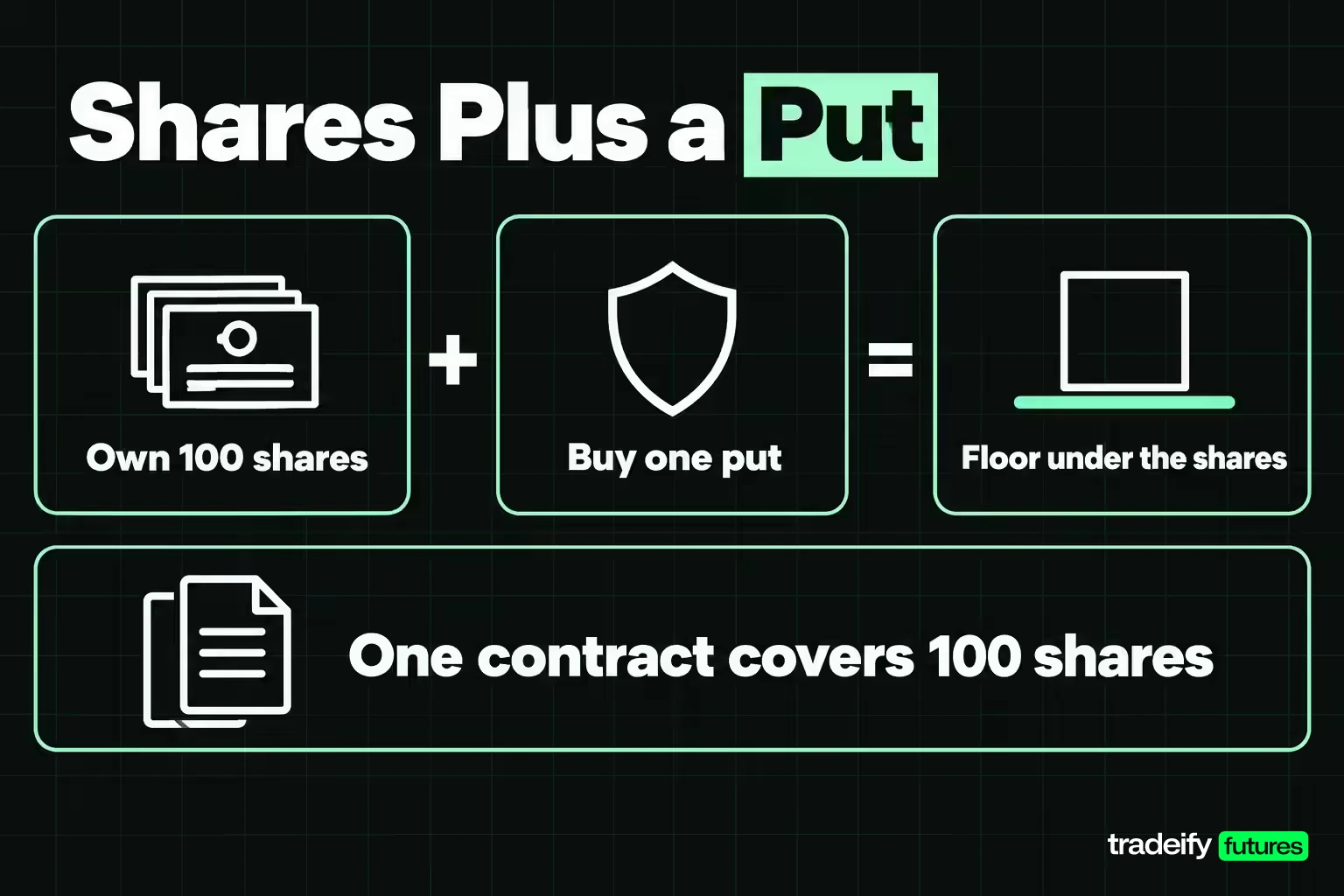
Protective puts work through three pieces: the share count, the contract size and the expiration date.
A standard U.S. equity option covers 100 shares, and Cboe quotes the premium in points where one point equals $100. So one put contract hedges 100 shares, and a put quoted at $3.00 costs $300. If you own 300 shares and buy one put, only 100 shares are protected, which is 33% of the position. The other 200 shares carry their full downside.
U.S. equity options are generally American style, which means the holder can exercise on any business day up to and including expiration. Standard monthly equity options expire on the third Friday of the expiration month.
How a protective put hedge ends
A protective put ends in one of three ways:
- You sell the put. If the stock rallies or the risk passes, you can sell the put back and recover whatever time value is left. If the stock has fallen, the put is worth more and selling it books the gain while you keep the shares.
- You exercise the put. Exercise sells your shares at the strike price. Per OIC, the net price you receive per share is the strike minus the premium you paid.
- The put expires. An out-of-the-money put expires worthless. An in-the-money put is normally exercised automatically: the Options Clearing Corporation (OCC) exercises options that are $0.01 in the money at expiration unless you instruct otherwise, and brokers can set their own thresholds.
The expiration case catches people. If you want to keep the shares, an in-the-money put left open into expiration can sell them for you.
How to place a protective put
Before you can buy any option, your broker has to approve the account for options trading. The SEC's investor bulletin on opening an options account explains that you fill out an options agreement covering your objectives, experience and finances, and the broker decides which kinds of options trading your account can do.
Once approved, the order itself is short:
- Confirm how many shares you want to protect and divide by 100 to get the number of contracts.
- Pick the expiration that covers your full risk window.
- Pick the strike that matches the loss you can accept.
- Enter a "buy to open" order for the put, ideally as a limit order near the middle of the bid-ask spread rather than a market order.
- Write down what will make you sell, exercise, roll or let the put expire.
Cboe's spec page notes that purchases of puts with 9 months or less until expiration must be paid for in full, so the premium comes out of cash, not margin.
Protective Put Payoff and Maximum Loss
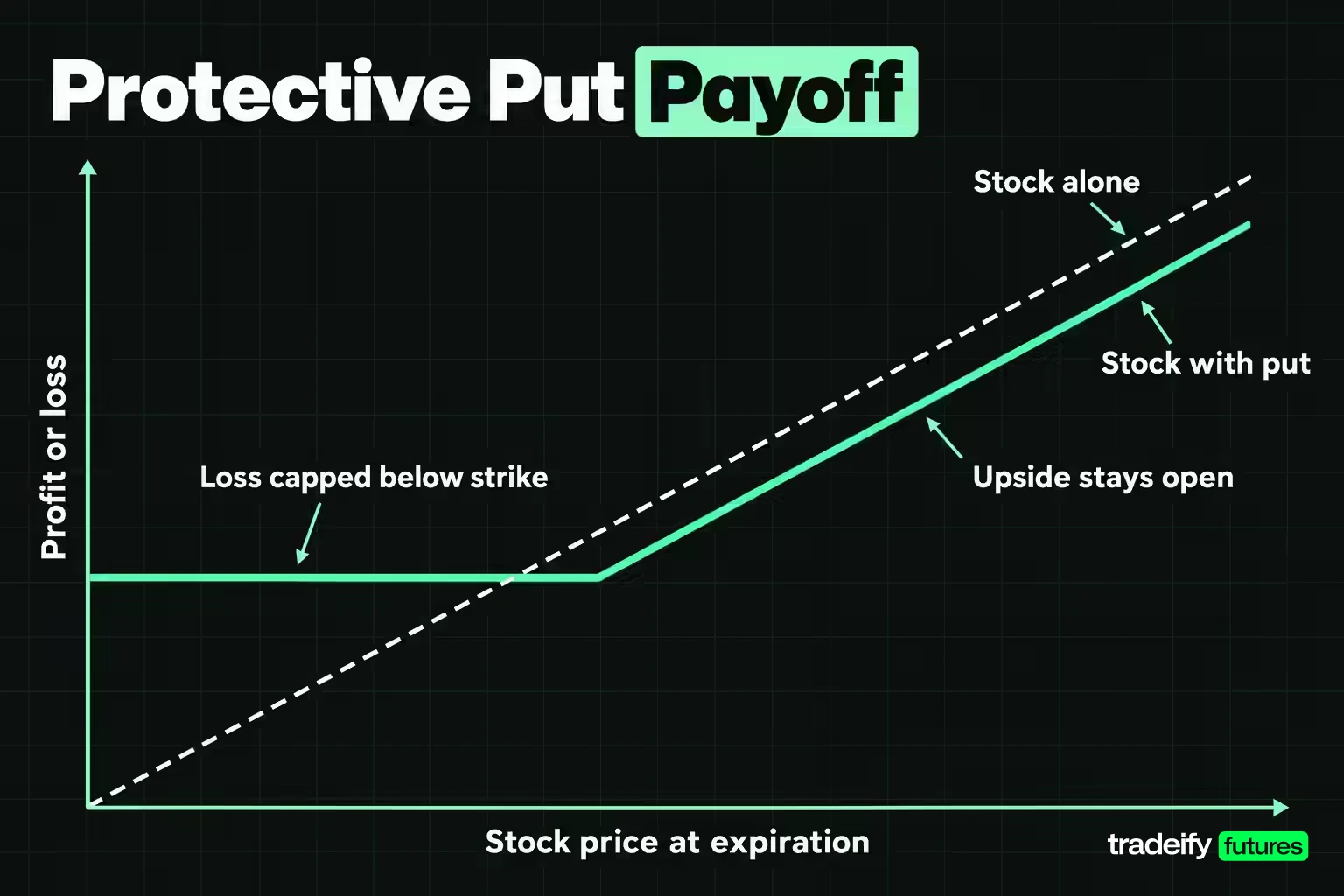
The payoff of a protective put at expiration comes down to three formulas, all from OIC's strategy page:
- Breakeven = stock purchase price + put premium.
- Maximum loss = stock purchase price - strike price + premium paid.
- Maximum gain = unlimited in theory, because the shares can keep rising.
These assume one put for every 100 shares and ignore commissions and spreads.
A protective put example with 100 shares
Here is an illustrative trade. You buy 100 shares at $100 ($10,000) and one $95 put for $3 per share ($300). Your total outlay is $10,300.
- Breakeven at expiration is $103.
- Maximum loss is $100 - $95 + $3 = $8 per share, or $800.
- Above $103, you profit, always $300 less than you would have without the put.
| Stock price at expiration | Put value | Stock alone P&L | Stock with put P&L |
|---|---|---|---|
| $60 | $3,500 | -$4,000 | -$800 |
| $80 | $1,500 | -$2,000 | -$800 |
| $95 | $0 | -$500 | -$800 |
| $100 | $0 | $0 | -$300 |
| $103 | $0 | +$300 | $0 |
| $120 | $0 | +$2,000 | +$1,700 |
| $140 | $0 | +$4,000 | +$3,700 |
Read the table from both ends. At $60, the put saves $3,200 compared with holding the stock alone. At $140, it costs you $300 of profit. In between, at $95 to $100, the hedged position actually does worse than plain stock, because the stock has not fallen far enough for the put to pay and you have still spent the premium.
That middle band is where a hedge feels most like wasted money, and it is tempting to skip the next one because of it. Judge the put by the job you bought it for, not by whether the stock happened to fall. Insurance you did not use is not a mistake. Insurance bought without a reason is.
Protecting an unrealized gain with a protective put
Protective puts change character when the shares were bought lower. Imagine an investor who bought 100 shares at $60 and now sees $100. Buying a $95 put at $3 locks in a worst case of $95 - $60 - $3 = $32 per share, or $3,200, until expiration, against a current paper gain of $4,000. OIC makes the same point: the loss or gain on exercise depends on what you originally paid for the stock, not on today's price.
What Protective Puts Cost
The premium is the obvious cost of protective puts. It is not the only one.
A full cost review includes:
- The premium, multiplied by 100 per contract.
- The bid-ask spread and commissions on the way in and out.
- The higher breakeven, since every gain is reduced by the premium.
- Time decay, which shrinks the put's value if the stock goes nowhere.
- The cost of renewing the hedge if the risk lasts longer than the put.
OIC lists six factors that set an option's premium: the underlying price, the strike, time until expiration, implied volatility, dividends and interest rates, with the last two having a smaller effect. For protective puts, strike, time and volatility do most of the work.
The annual cost of rolling protective puts
The cost of protective puts that catches investors is repetition. A single put is a one-time expense. A habit of always holding puts is a running drag on returns.
To make that concrete, a Black-Scholes model with illustrative inputs (stock $100, 90 days, 30% implied volatility, 4% interest rate, no dividends) prices a 90-day $95 put at $3.27. Buying four of those back to back, one per quarter, costs about $13.09 a year if price and volatility stay where they are. That is about 13% of a $100 share price every year, paid whether or not the stock ever falls.
That is why protective puts usually work best for a defined window, not as a permanent overlay. If the risk is ongoing, a collar, a smaller position or simply selling some shares may cost less.
How Implied Volatility Changes Protective Put Prices
Implied volatility is the market's estimate of how much the stock may move, and it is a big part of what protective puts cost. OIC notes that higher volatility generally raises premiums for puts and calls alike, and the effect is strongest at the money.
Using an illustrative Black-Scholes model (stock $100, $95 strike, 90 days, 4% rate, no dividends), here is how the price of the same protection changes as implied volatility rises:
| Implied volatility | Model $95 put price | Cost for 100 shares |
|---|---|---|
| 15% | $0.84 | $84 |
| 20% | $1.58 | $158 |
| 30% | $3.27 | $327 |
| 45% | $5.99 | $599 |
| 60% | $8.76 | $876 |
The strike, the stock price and the expiration are identical in every row. Only the market's fear level changed, and the price of the hedge rose more than tenfold from the first row to the last.
Here is the uncomfortable part. Protection is cheapest when nobody wants it and most expensive right after a selloff or ahead of a well-known event. Buying puts after the stock has already dropped and volatility has jumped often means paying the highest price for the least remaining risk.
There is a flip side. If you already own the put, a rise in implied volatility helps it. OIC rates the effect of rising implied volatility on a protective put as neutral to slightly positive, because the put you hold becomes worth more if you decide to sell it.
Choosing a Protective Put Strike Price
The protective put strike answers one question: how much of the decline are you willing to absorb yourself before the put takes over?
Using an illustrative Black-Scholes model (stock $100, 90 days, 30% implied volatility, 4% rate, no dividends), here is how four strikes compare for 100 shares bought at $100:
| Put strike | Moneyness | Model premium | Floor price | Maximum loss | Breakeven |
|---|---|---|---|---|---|
| $90 | Out of the money | $1.77 ($177) | $90 | $11.77 ($1,177) | $101.77 |
| $95 | Out of the money | $3.27 ($327) | $95 | $8.27 ($827) | $103.27 |
| $100 | At the money | $5.43 ($543) | $100 | $5.43 ($543) | $105.43 |
| $105 | In the money | $8.25 ($825) | $105 | $3.25 ($325) | $108.25 |
The pattern holds across protective puts generally. A higher strike buys a higher floor and a smaller maximum loss, but it costs more and pushes the breakeven further up. A lower strike is cheap, but you carry more of the drop yourself before the protection starts.
Neither end is automatically better. The $90 put is not "cheap protection" if a $1,177 loss would break your plan. The $105 put is not "safe" if you need the stock to climb past $108.25 just to make money.
A loss-budget method for picking the strike
Work backward from the loss you can live with, not forward from the premium that looks affordable:
- Write down the maximum dollar loss you accept on the position.
- Divide by the number of shares to get a loss per share.
- For each candidate strike, add the premium to the gap between your cost basis and the strike.
- Keep only the strikes where that total stays inside your loss per share.
- Among those, pick the one with the lowest premium that still covers your time window.
If no strike fits your budget at an acceptable premium, the hedge is telling you something useful. The position may simply be too large for the risk you are willing to carry, and trimming it could do more than any put.
Related lesson: Strike prices
When to Buy a Protective Put and How Long to Hedge
Timing a protective put has two parts: when you buy it and when it expires.
The expiration should cover the whole period in which the risk can happen. A put that expires two days before an earnings release, a court ruling or the date you need the cash does not protect against that event at all. OIC is clear that the protection ends at expiration.
Longer protection costs more in total but less per day. Using an illustrative Black-Scholes model ($100 stock, $95 strike, 30% implied volatility, 4% rate, no dividends):
| Days to expiration | Model $95 put price | Cost per day |
|---|---|---|
| 30 | $1.33 | 4.4 cents |
| 60 | $2.42 | 4.0 cents |
| 90 | $3.27 | 3.6 cents |
| 180 | $5.13 | 2.9 cents |
| 365 | $7.56 | 2.1 cents |
Short-dated protective puts look cheap on the order ticket but cost the most for each day of protection, and they force another buying decision sooner. Time value also erodes fastest in the final weeks, which OIC notes is most noticeable at the money.
Buying protective puts before the risk, not after
The best time to buy a protective put is before the risk is obvious to everyone. Once a stock has already gapped down and implied volatility has jumped, the same put costs much more and protects a smaller remaining move.
That is the hedging version of chasing a missed entry. The protection you wanted last week is gone, and what is left is a different, pricier trade. The fix is not buying puts constantly. It is deciding before each known event whether you want a hedge, and writing that decision down.
LEAPS for long-term protection
For protection measured in years rather than months, long-dated equity options called LEAPS are an option. Cboe's spec page says equity LEAPS expire roughly two to three years from initial listing, can be listed up to 39 months out, and use January expirations only. The premium is larger in dollars, but the cost per day is usually lower, and there are fewer renewal decisions.
Managing a Protective Put Before Expiration
Protective puts are not set-and-forget. Once the put is on, the decision is not over. The stock will move, and each outcome calls for a choice.
If the stock falls well below the strike and you still want to own it, you can sell the put instead of exercising it. OIC notes that selling recovers premium, may even produce a profit on the put, and effectively lowers your cost basis on the shares you keep. If your outlook has turned bearish, exercising the put sells the shares at the strike, which OIC calls the minimum exit price.
If the stock rises well above your purchase price, the original put is now far out of the money and protects a level that no longer matters much. A common adjustment is to roll up: sell the old put for whatever it still fetches and buy a higher-strike put to lock in part of the new gain. That costs fresh premium, so treat it as a new hedge decision, not a reflex.
If the risk window gets longer, you can roll out: sell the current put and buy one with a later expiration. Budget for that second premium before the first put is bought, not after.
If the risk has passed, sell the put to recover any remaining time value rather than letting it decay to zero.
Automatic exercise of protective puts at expiration
An in-the-money protective put left open at expiration is normally exercised automatically. OCC exercises options that are $0.01 in the money unless told otherwise, and brokers may use their own thresholds. OIC points out that holders who intend to keep their stock may need to sell an in-the-money put before expiration. Check your broker's exercise cut-off time well before the last trading day.
Related lesson: Managing and rolling options
Protective Put Alternatives That Cut the Cost
The main complaint about protective puts is the cost. Three common variations reduce it, and each gives up something in return. The figures in this section come from an illustrative Black-Scholes model (stock $100, 90 days, 30% implied volatility, 4% rate, no dividends).
Collar strategy
A collar adds a short call to the protective put. OIC describes the put strike as the floor and the call strike as the ceiling, with both options on the same expiration. The call premium helps pay for the put, but you give up gains above the call strike, and the shares may be called away.
In the model, buying the $95 put for $3.27 and selling a $108 call for $3.28 produces a net credit of $0.01, which is close to a zero-cost collar. Using OIC's collar formulas for 100 shares bought at $100:
- Maximum gain is $108 - $100 + $0.01 = $8.01 per share ($801).
- Maximum loss is $100 - $95 - $0.01 = $4.99 per share ($499).
OIC sums the trade-off this way: the collar offers more protection than a covered call at a lower up-front cost than a protective put. The catch is that early assignment of the short call is possible, generally just before the stock goes ex-dividend.
Put spread
A put spread buys the protective put and sells a lower-strike put against it. Buying the $95 put for $3.27 and selling an $85 put for $0.84 costs about $2.44 net in the model. Protection runs only from $95 down to $85. At $85 the loss is $15 - $10 + $2.44 = $7.44 per share, but below $85 the losses start again. This works for a moderate drop and does little in a crash.
Partial hedge
A partial hedge covers only part of the position, such as one put on 300 shares. It cuts the premium by two thirds but leaves the uncovered shares fully exposed. It suits investors who want to soften a decline rather than set a hard floor.
| Approach | Upfront cost (model) | Downside protection | What you give up |
|---|---|---|---|
| Protective put ($95) | $3.27 per share | Full floor at $95 | Premium; higher breakeven |
| Collar ($95 put, $108 call) | About zero | Full floor at $95 | Gains above $108; possible early assignment |
| Put spread ($95 over $85) | $2.44 per share | Only from $95 to $85 | Protection below $85 |
| Partial hedge (1 put on 300 shares) | $3.27 on 100 shares | Floor on 33% of shares | Two thirds of shares unhedged |
Protective Puts vs Stop-Loss Orders
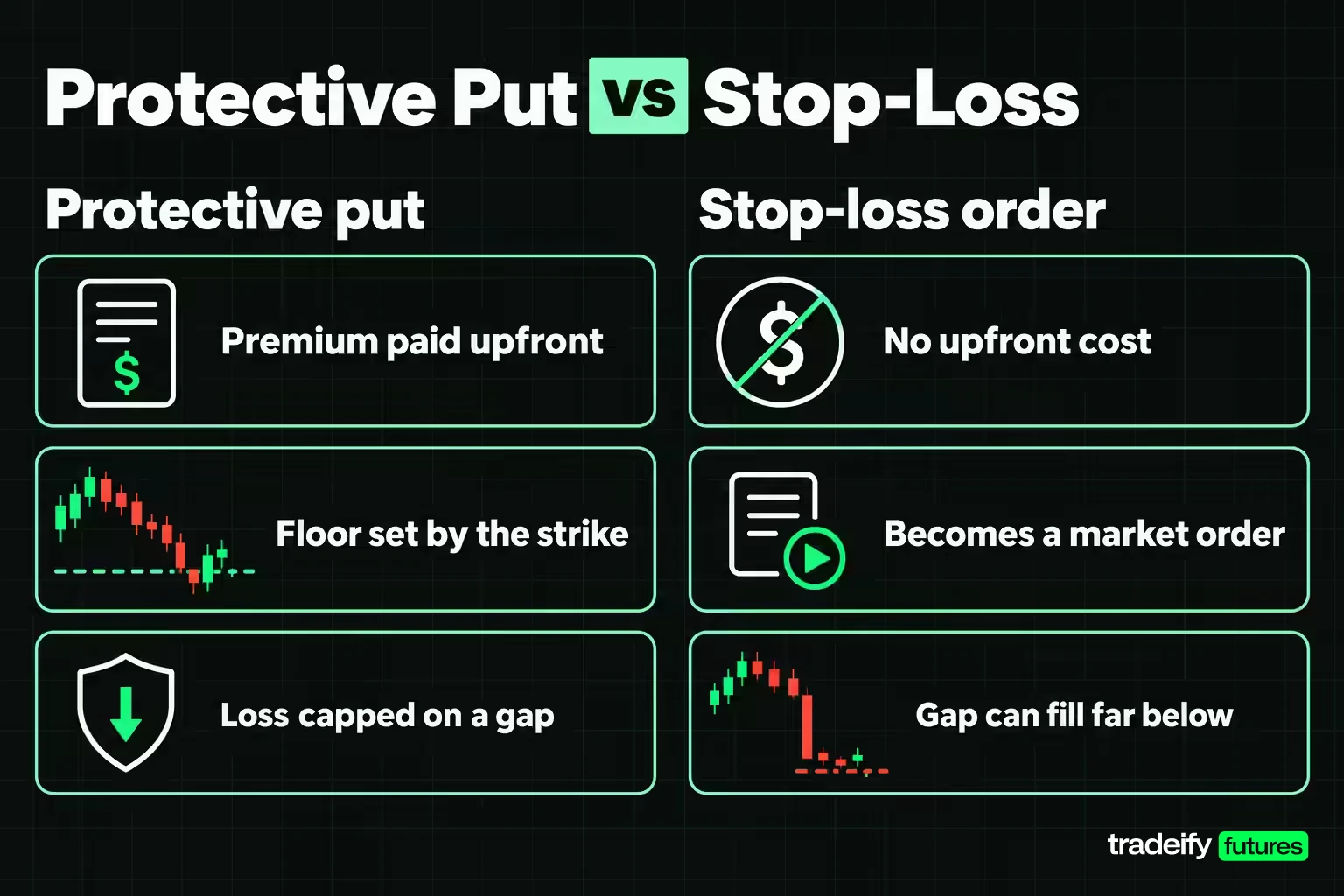
Protective puts and stop-loss orders both try to limit a loss on shares you own, but they fail in different ways.
A stop order becomes a market order once the stop price is reached. The SEC's investor bulletin on stop orders is blunt about the limits: the stop price is not a guaranteed execution price, the fill "can deviate significantly" from it, and short-term swings can trigger a stop you did not want triggered. A stop-limit order controls the price but may not fill at all.
An illustrative gap shows the difference. A stock trades at $100, you hold a sell stop at $95, and bad news hits after the close. The stock opens at $85. The stop triggers and fills near $85, so the loss is about $15 per share, or $1,500 on 100 shares. With a $95 put bought for $3 instead, the loss is capped at $800, because the put's strike does not care where the stock opens.
| Feature | Protective put | Stop-loss order |
|---|---|---|
| Upfront cost | Premium paid | None |
| Gap through the level | Floor still holds at the strike | Fills at the next available price |
| Shares sold automatically | No, you choose to sell, exercise or hold | Yes, once triggered |
| Whipsaw risk | None, a dip does not close the position | A brief dip can trigger it |
| Time limit | Ends at expiration | Can stay working as long as the broker allows |
Neither tool wins every time. A stop is free and simple for liquid stocks in calm markets. A protective put costs money but holds its floor through gaps, and it lets you decide what to do with the shares after a drop instead of having the market decide at the open.
Related lesson: Stop-loss orders
Protective Puts on a Portfolio With S&P 500 Index Options
Protective puts are not limited to single stocks. Investors with a diversified portfolio often hedge with puts on the S&P 500 Index instead of buying a put on every holding.
Yes, you can buy put options on the S&P 500. The two Cboe-listed index products most used for this are SPX and XSP (Mini-SPX):
- SPX has a $100 multiplier, European-style exercise (only on the expiration date) and cash settlement on the business day after expiration.
- XSP uses one-tenth of the S&P 500 Index value, also with a $100 multiplier, European exercise and cash settlement.
Contract size matters for sizing the hedge. With the S&P 500 at an illustrative 6,000, one SPX contract covers 6,000 x $100 = $600,000 of index value. One XSP contract covers 600 x $100 = $60,000. An investor with an illustrative $120,000 portfolio that tracks the index closely would need about 2 XSP puts, while a single SPX put would cover five times the portfolio.
Sizing protective puts inside a portfolio
Portfolio protective puts are sized to the market exposure, not just the dollar value. A common adjustment uses beta, the portfolio's typical sensitivity to index moves. If an illustrative $120,000 portfolio has a beta of 1.2, it behaves roughly like $144,000 of index exposure ($120,000 x 1.2). With the S&P 500 at an illustrative 6,000, that is 2.4 XSP contracts, so the choice is 2 contracts (slightly under-hedged) or 3 (slightly over-hedged). Beta is an estimate from past prices, so treat the result as a range, not a precise answer.
Decide the hedge budget at the portfolio level too. Write down the most you will spend on protection in a year as a percentage of the portfolio, then choose strikes and expirations that fit inside it. Without that cap, a run of nervous markets can turn occasional insurance into a standing cost that quietly eats a large share of returns.
Concentrated positions are the exception. If one stock is a large share of the account, a put on that stock does a job no index put can, because the index will not fall with that company's own bad news.
Limits of index protective puts
Index protective puts guard against a broad market decline, not against one company's bad news. If your portfolio leans toward a few stocks or one sector, it may fall further than the index, and the hedge will cover only part of the loss. Cash settlement also means the put pays cash rather than selling your holdings, so the shares stay in the account.
Tax and employment checks before hedging
OIC adds two warnings worth checking before any protective put. If employment rules restrict selling a stock, a protective put may be treated as just as unacceptable as a sale. And depending on several factors, the IRS might treat a particular protective put as equivalent to selling the stock, which can trigger tax you did not plan for. Check both with the relevant adviser before placing the hedge.
Why Protective Puts Rarely Fit Intraday Futures Trading
A protective put is a tool for someone who owns shares and plans to keep holding them through a risky period. The risk it insures is time-based: an earnings release next month, a gap overnight, a crash while you are holding for the long run.
Intraday futures traders face a different version of the problem. Their risk sits inside a single session, and it is usually handled with position size, a stop order placed before entry and a daily loss limit, rather than with an option on top of the position.
We don't offer options on our accounts; only the futures products on our supported list can be traded, and our funded accounts are simulated. Every position is closed by 4:45 PM ET on regular trading days, with no overnight or weekend holds, so the multi-week holding risk a protective put is built for does not carry from one session to the next on our accounts.
Protective Puts FAQ
What does buying a put option mean?
Buying a put means paying a premium for the right to sell 100 shares of the underlying at the strike price until expiration. On its own it profits if the price falls below the strike by more than the premium. Held against shares you own, it works as a protective put.
What is Warren Buffett's favorite option strategy?
Berkshire Hathaway's shareholder letters show Buffett selling puts rather than buying protective puts. The 2008 letter describes Berkshire selling long-dated "equity put" contracts on stock indexes, due in 15 or 20 years, that pay out only if the index is below its starting level at maturity. That makes Berkshire the seller of the insurance that protective put buyers pay for.
How do you place a protective put?
Get options approval from your broker, then buy to open one put contract for every 100 shares you want to protect. Choose an expiration that covers your full risk window and a strike that matches the loss you accept. Use a limit order near the middle of the bid-ask spread.
Can you buy put options on the S&P 500?
Yes. Cboe lists SPX options with a $100 multiplier and XSP options based on one-tenth of the index value. Both are European style and cash settled, so they hedge a portfolio's market exposure without selling any shares.
Do protective puts limit your upside?
No. The shares keep their full upside, but every gain is reduced by the premium paid. A collar is the version that caps gains, because it adds a short call.
Is a protective put the same as a married put?
They are the same position with different timing. A married put is bought together with the shares, while a protective put is added to shares you already hold.
Options involve risk and are not suitable for every investor, and the prices in this guide are illustrative or model values, not quotes. A protective put cannot remove the premium cost, execution risk or all loss, futures and other leveraged products can lose more than expected, simulated and funded accounts are simulated, and nothing here is investment advice.


