



TL;DR: Trader burnout is chronic, unmanaged trading stress; first decide if it is burnout, a losing streak or something bigger. It shows in your log before your mood: reviews lapse, setups loosen, size creeps. On 20 years of E-mini data, setups after the heaviest months averaged -0.43R; after light months, +0.41R. A one-week break skipped nothing on 79% of start dates, so fix workload first and price any rest.
Trader burnout rarely arrives as one dramatic blowup. More often it is a month where the reviews stopped, the setups you used to skip started looking fine, and a good winner barely registered. By the time it feels like burnout, the process has usually been breaking for weeks.
This guide covers what trader burnout is and is not, why trading produces it so reliably, how to tell it apart from a losing streak, and what recovery looks like. It also measures one thing most writing on the subject skips: how the workload in the weeks before a trade related to the result of that trade, on 20 years of E-mini S&P 500 futures data.
What Trader Burnout Is
Trader burnout is a state of exhaustion, detachment and falling effectiveness that builds from trading stress you have not been able to manage over a long stretch. It is a slow process, not a single bad day.
The clearest working definition comes from the World Health Organization. The 11th Revision of the International Classification of Diseases (ICD-11) describes burn-out as a syndrome resulting from chronic workplace stress that has not been successfully managed. WHO lists it as an occupational phenomenon, not as a medical condition, with three dimensions:
- Feelings of energy depletion or exhaustion.
- Increased mental distance from the job, or negativism and cynicism about it.
- Reduced professional efficacy.
Each dimension has a trading version you can actually spot.
| WHO dimension | What it looks like in trading |
|---|---|
| Exhaustion | You are tired after a session even when you slept well, and the pre-market prep feels like a chore you skip |
| Mental distance or cynicism | You stop caring whether a trade followed the plan, or you start calling the market rigged and your rules pointless |
| Reduced efficacy | Setups you used to execute cleanly now come with late entries, moved stops and missed exits |
The definition matters for one practical reason. Burnout comes from how the work is set up and how long it has run, so the fix sits mostly in the work itself (hours, workload, rules, review) rather than in willpower. Treat it as a character flaw and the usual response is to grind harder, which is the one move that feeds it.
What Burnout Is Not
Trader burnout gets used as a label for almost any bad stretch, and the wrong label leads to the wrong fix. Four things are commonly mistaken for it.
Ordinary fatigue. A long session around a big data release can leave you drained for an evening. If a normal night of sleep and a quiet weekend bring your focus back, that was fatigue. Burnout does not clear with one rest day.
A bad week. Five losing sessions in a row feel awful, but a strategy with a 40% win rate produces runs like that as a matter of course. Pain from losses is not the same as exhaustion from the work.
Boredom in a slow market. A grinding, low-range week can make trading feel pointless. If the feeling lifts the moment volatility returns, the problem was the market, not you.
Depression or another health condition. WHO says the burn-out concept applies specifically to the occupational context and should not be used to describe experiences in other areas of life. If low mood, poor sleep or loss of interest reach well beyond trading (family, hobbies, food, friends), the issue is not trading burnout, and a trading article is not the right help. A doctor or licensed therapist is.
A quick test helps separate trader burnout from these. Ask whether the problem is tied to trading specifically, whether it has lasted weeks rather than days, and whether ordinary rest has stopped fixing it. Burnout usually answers yes to all three.
Why Trading Causes Burnout
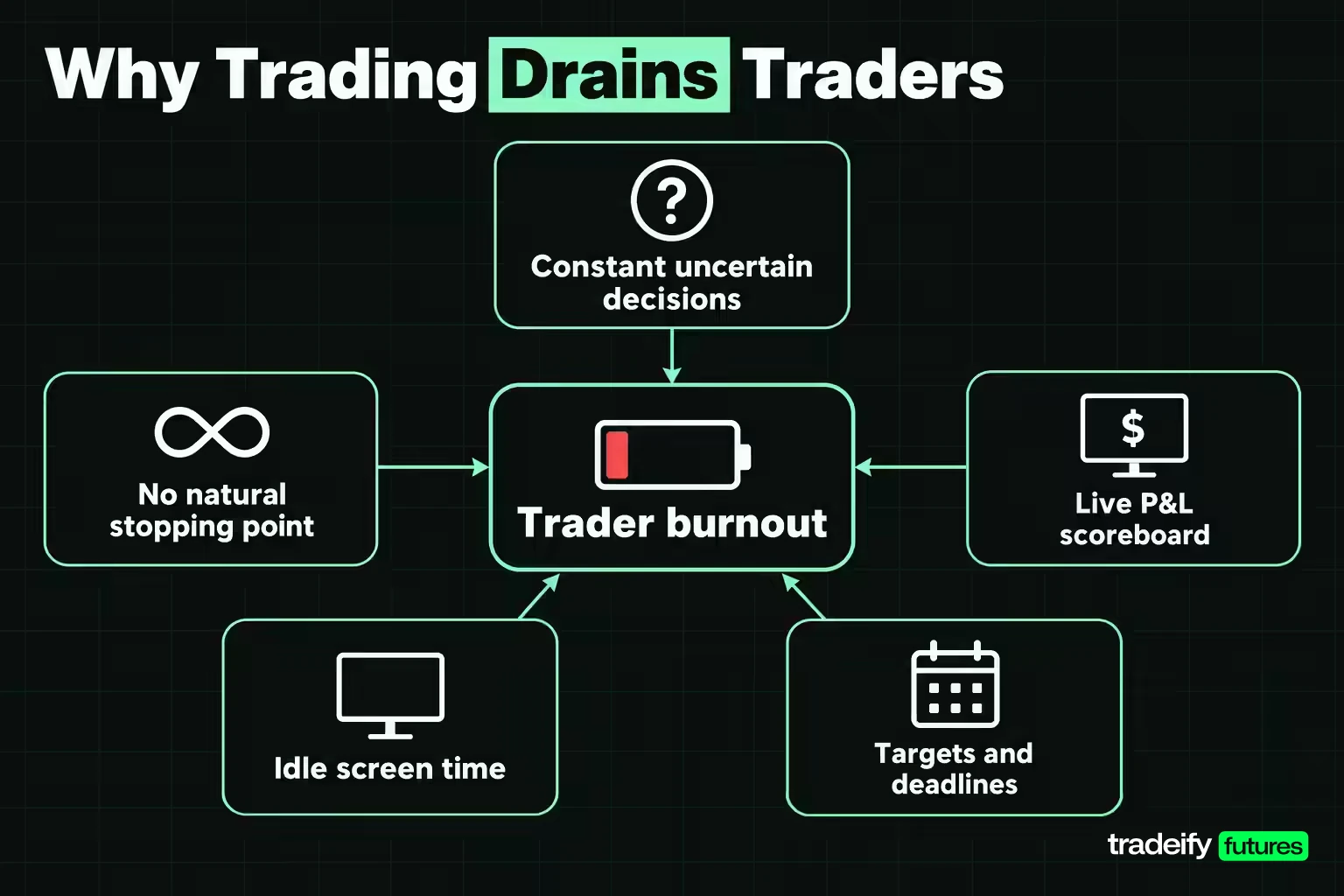
Trading causes burnout because it builds several known drivers of trader burnout into one job, and most traders run them with no limits at all.
Constant decisions with uncertain rewards
A discretionary trader makes dozens of small calls an hour: is this a setup, is it confirmed, where is the stop, do I add, do I exit. Each one carries money and uncertainty. Unlike most jobs, doing the work well can still produce a loss, so effort and reward stop lining up. Over months that disconnect wears down the sense that your work matters, which is the efficacy dimension of burnout in plain terms.
No natural stopping point
Futures trade nearly around the clock on weekdays, and there is always another session, another market and another setup. Without a written session window, the only thing that ends your trading day is exhaustion or a loss. That turns every day into a test of willpower, and willpower is the thing burnout drains first.
Money as a live burnout scoreboard
Your result is printed in dollars, live, all day. Watching open profit and loss tick creates a stress response with no physical outlet. Traders who check balances between trades, or keep the account tab open on their phone, extend that stress into evenings and weekends.
Idle screen time that drains traders
Long hours watching charts with no valid setup feel like effort but produce nothing. They also tempt you to invent activity, which leads to the forced trades that cause the next round of stress.
Pressure from targets and deadlines
Self-imposed monthly income targets, evaluation rules and the urge to recover a drawdown fast all push a trader to keep going past the point of clear thinking. The pressure is often internal, which is why it rarely gets switched off.
Isolation
Many traders work alone, so nobody notices the slow slide. A colleague in an office might say you look worn out. A trader at home has only the log, and only if they are still keeping it.
Signs of Trader Burnout
Signs of trader burnout fall into four groups: emotional, physical, behavioral and performance. The behavioral and performance signs matter most, because they show up in your records before you admit how you feel.
| Sign group | What you notice | What your trade log shows |
|---|---|---|
| Emotional | Dread before the open, numbness after a win, irritability at small losses | Journal notes get shorter or stop, emotion tags read "flat" or "annoyed" |
| Physical | Tired after adequate sleep, tension headaches, eye strain, poor sleep before sessions | Late starts, skipped pre-market prep, sessions cut short or dragged long |
| Behavioral | Trading outside your window, checking positions from bed, avoiding the review | Trades outside listed setups, entries outside the session plan, no weekly review |
| Performance | Rules that used to hold stop working while rule breaks rise | Larger average loss, moved stops, size above plan, more trades per day |
Which burnout signs come first
The order is often the most useful clue. A common sequence is that the review habit lapses first, then size starts to creep, then the setup standard loosens, and only after that do results fall. By the time the account shows the damage, the process has been eroding for weeks.
That gives you a practical early warning. Skip two weekly reviews in a row and treat it as a burnout signal, not a scheduling problem. The review is the checkpoint that would have caught everything else, and it is usually the first thing a tired trader drops.
A trader burnout self-check for this week
Answer each question from your records, not from memory:
- How many of the last 20 sessions did you trade, and how many did you plan to trade?
- How many trades in the last 20 sessions were outside your written setup list?
- When was your last complete weekly review?
- Has your average position size risen without a written decision to raise it?
- Do you feel relief, rather than satisfaction, when a session ends?
Two or more answers pointing the wrong way is enough reason to act on the burnout recovery steps before results force you to.
Burnout, a Losing Streak, or a Broken Method
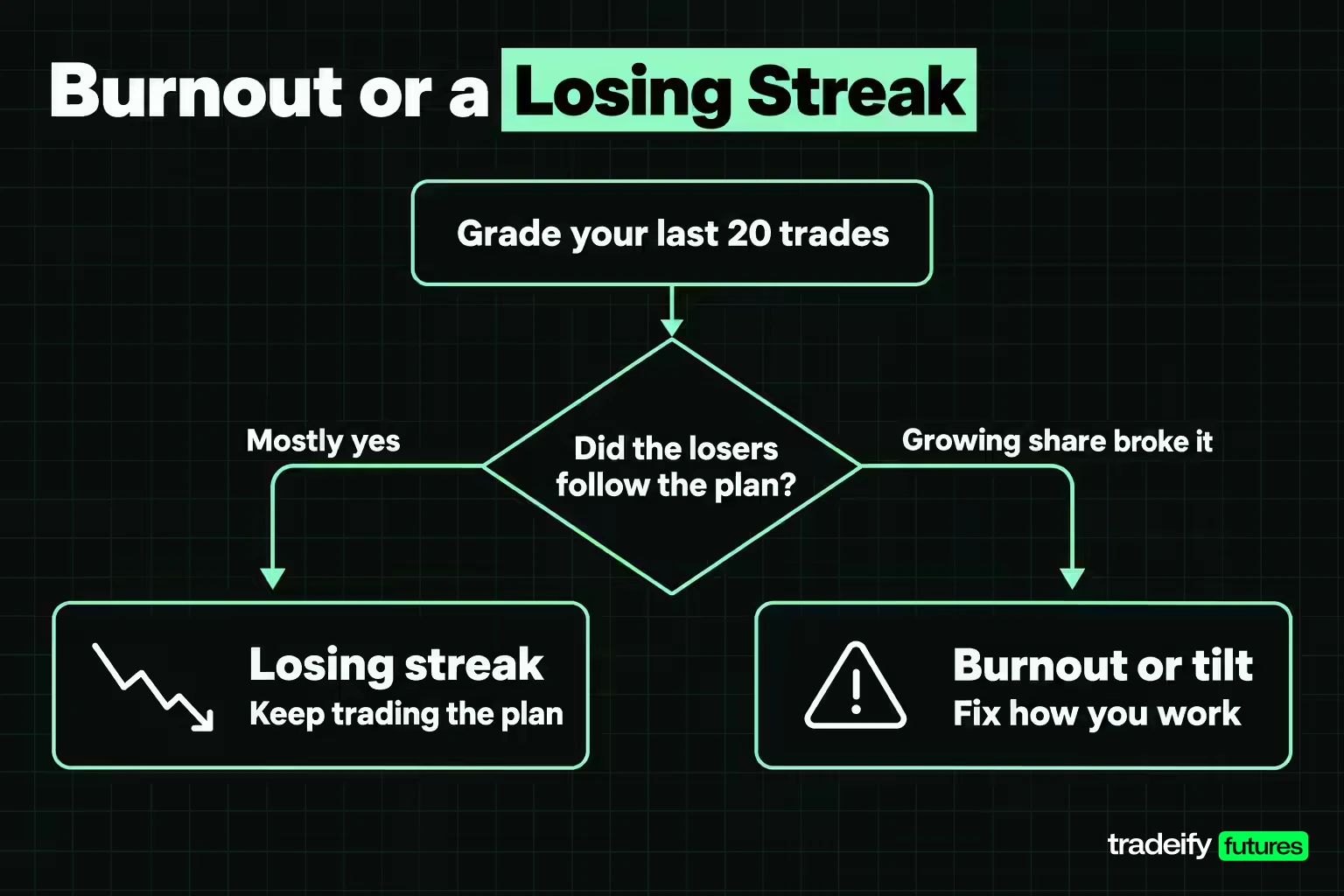
When results go bad and you feel worn down, three explanations compete: burnout, an ordinary losing streak, or a method that has stopped working. They need different responses, so it pays to test before you act.
Burnout versus a losing streak
A losing streak is a run of losses on trades you took correctly. Trader burnout is a decline in how you take the trades. The test is execution quality, not profit and loss.
Pull your last 20 trades and grade each one on whether it matched your plan (setup, entry, stop, size, exit). If most of the losers were clean trades, you are in a losing streak. Keep trading the plan at your normal or slightly reduced size. If a growing share of trades broke the plan, the problem is how you are working, and that points toward burnout or tilt.
The feelings differ too. A losing streak tends to bring frustration and an itch to trade more. Burnout tends to bring flatness, and either an urge to trade less or to trade without caring. Those are rough guides, not proof, which is why the execution grade comes first.
When burnout makes you lose faith in your method
Burnout often turns into distrust of a strategy that was working. The tired trader sees five losses, decides the edge is gone, and starts jumping to a new system, which resets their sample and adds fresh stress.
It is an understandable reaction. When you are drained, a new system feels like a fresh start. Before you abandon a method, though, separate the two questions. Did the clean trades, taken exactly as written, perform within the range your backtest or past record suggested? If yes, the method is fine and the execution is the problem. If clean trades are failing well outside their historical range over a meaningful sample (at least several dozen trades), then review the method, but do it on a weekend with the data in front of you, not mid-session while exhausted.
Compulsive Trading and Burnout
Trader burnout usually makes people pull away from the screen. Sometimes it does the opposite. A worn-down trader can keep trading because stopping feels worse than losing, and that pattern needs a different response than rest.
How compulsive trading differs from overtrading
Overtrading is taking more trades than your plan calls for. Compulsive trading is when you cannot stop even though you want to and have decided to. The ICD-11 entry for gambling disorder, which lists "compulsive gambling" as an inclusion term, describes three markers that translate directly into trading behavior:
- Impaired control over when trading starts, how often, how large and when it stops.
- Increasing priority given to trading over other life interests and daily activities.
- Continuation or escalation despite negative consequences.
For a clinical diagnosis WHO says the pattern is normally evident over at least 12 months, so a bad quarter does not make anyone a gambler. The markers are still a useful mirror. If you trade through planned days off, hide losses from people close to you, raise size to win back money, or feel restless and irritable when you cannot trade, the issue is control, not workload.
Why rest fails with compulsive trading
Rest helps burnout because the work itself is the drain. Rest often fails with compulsive trading, because the urge follows you into the break and pulls you back early. The fixes are external and hard to override: platform lockouts, removing trading apps from your phone, a hard daily loss limit set at the platform level, and telling someone you trust what your limits are.
If the pattern feels out of your control, talk to a professional. In the US the National Problem Gambling Helpline, 1-800-MY-RESET, connects callers with local support, and many therapists treat compulsive trading the same way they treat gambling problems.
Related lesson: What a heavy stretch does to the size of the next position
Burnout and Workload in 20 Years of E-mini Data
Most advice on trader burnout says to trade less, but it rarely shows what "too much" looks like in results. One way to test it is to measure how busy an account was before each trade and compare that with how the trade turned out.
How the workload study works
This illustrative study was computed for this guide from Yahoo Finance daily bars for the continuous front-month E-mini S&P 500 futures contract (ES), 5,067 completed sessions from 18 September 2006 to 4 November 2026. The rule is simple enough to rebuild:
- Signal: a session closes above the highest high of the prior 20 sessions.
- Entry: the next session's open, long, one contract.
- Exit: a stop at 1.0 times the 14-session average true range (ATR, Wilder's method), a target at 2.0 times ATR, or the close of the 20th session held, whichever comes first.
- Cost: 0.5 index points per round turn. Results are in R, where 1R is the ATR at the signal.
In this guide's calculation, taking every signal produced 592 signals at 0.13R per trade with a 40% win rate (bootstrap 95% interval 0.02R to 0.25R). A trader who could hold only one position at a time would have taken 211 of them at 0.11R per trade and been in a position on 35% of sessions.
Workload is the count of the 20 sessions before each signal on which that one-position trader was holding a trade. Zero means a month of being flat. Twenty means the whole month was spent in a position.
What heavy months did to the next trade
| Workload in prior 20 sessions | Signals | Average result | One-position trades | One-position average |
|---|---|---|---|---|
| 0 to 4 sessions held | 173 | +0.33R | 82 | +0.27R |
| 5 to 9 sessions held | 167 | +0.50R | 54 | +0.28R |
| 10 to 14 sessions held | 166 | -0.15R | 47 | -0.15R |
| 15 to 20 sessions held | 86 | -0.43R | 28 | -0.28R |
The ordering in this guide's ES calculation is not subtle. Signals arriving after a light month (0 to 9 sessions held, 340 signals) averaged +0.41R. Signals after the heaviest months averaged -0.43R. The difference is -0.84R, with an interval of -1.12R to -0.55R, so it does not cross zero.
On the one-position trades in the same ES calculation the difference shrinks to -0.56R on an interval of -1.05R to -0.04R. It still excludes zero, but only just, on a smaller sample. Splitting the 20 years in half at July 2016 gives -0.87R and -0.83R on all signals, so the pattern is not one era's quirk.
Limits of the burnout workload study
The E-mini workload study (a 20-session breakout rule on ES daily bars, 2006 to 2026, computed for this guide) sees market exposure and results. It does not see sleep, mood, screen hours or stress, so it is not proof that tired traders decide worse. A stretched trending market can produce weaker breakout setups on its own. Counting how many separate positions were opened in the prior 20 sessions also showed no clean ordering, so the effect tracks time in a position, not the number of trades.
The practical point survives either explanation. On this rule, the setups that came after a heavy month were the ones worth skipping, and a heavy month is something you can see on a calendar before you feel anything. Add a workload column to your own journal and check whether your results follow the same shape. If they do not, that is useful too: it tells you workload is not your problem.
How Trading Structure Prevents Burnout
Structure prevents trader burnout by moving decisions out of the session, where you are tired and emotional, and into the plan, where you are calm. Every rule you write in advance is one less decision your willpower has to carry at 2 PM, four hours into a choppy day.
The five rules that do the most work
- A session window. Write the hours you trade and the hour you stop. A window ends the day for you, so exhaustion or a loss does not have to.
- A setup list. Name the setups you take, with an example chart for each. Anything off the list is not a trade. This removes the most draining question in trading: "is this good enough?"
- Stop conditions. Decide in advance what ends a session early: for example, two losses, one rule break, or your daily loss limit, whichever comes first. Write it as a count, because you cannot judge it honestly while tilted.
- A workload cap. Set a limit on trades per day or on sessions per week. If you trade positions that last several days in your own account, cap how many sessions in a row you hold risk.
- A review cadence. A short daily note and a fuller weekly review. The review is the checkpoint that catches burnout early, so it is the last rule to drop, not the first.
Why unstructured trading drains you
A trader without a session window, setup list, stop conditions or review routine turns every session into an open-ended negotiation with themselves. You decide when to start, when to stop, which setups count and how much to risk, all while under pressure. That load adds up even on profitable days, which is why traders can burn out while making money.
How much screen time is enough
No hour count fits everyone, and nobody has a reliable study that sets one. A better measure is output per hour. If most of your valid setups come in the first two hours of the US session, hours three to six are mostly watching, and watching is where forced trades start. Track when your valid setups actually happen, then cut the screen time that produces nothing.
Related lesson: The routines that make a rest a rest
Managing Emotions Before They Become Burnout
Emotional management in trading is not about feeling nothing, and it is one of the cheapest defenses against trader burnout. Fear after a stop and frustration after a missed move are normal. Trying to suppress them is extra effort on top of the work, and that extra effort is part of what burns traders out. The goal is to notice the feeling, name it, and have a response ready that does not involve the order button.
Emotion methods that work without suppression
- Name the state out loud or in the journal. "I am frustrated after that stop" is enough. Labeling the emotion puts a small gap between the feeling and the next click.
- Reset the body first. Stand up, walk away from the screen for five minutes, drink water, breathe slowly. Stress has a physical component, and a physical reset is often faster than arguing with yourself.
- Use precommitted responses. Decide now what you do after a big loss, a big win or a missed trade. For example: after any loss larger than planned, the platform goes flat for 30 minutes. You make the decision once, calmly, instead of in the moment.
- Grade execution, not outcome. Score every trade on whether you followed the plan. A clean loss scores well, and a sloppy win scores badly. Over time this cuts the emotional link between money and self-worth that drives so much trading stress.
- Separate the day from the account. A daily result is one sample. Reviewing performance weekly or monthly rather than tick by tick lowers the emotional swing.
Big wins can feed burnout too
Burnout is not only fed by losses. A big win can push a trader to trade longer, raise size and chase the feeling again. Treat an unusually good day as a signal to stick to the window, not to extend it.
Related lesson: The bias that makes a tired trader take the setup anyway
Time Off for Trader Burnout and What a Break Costs
Taking time off is the most common advice for trader burnout, and it helps when the cause is accumulated workload. It does less when the cause is how you trade, because the same habits are waiting when you come back. A break is worth taking, but it works best paired with a structural change.
Making a break from trading actually work
A break from trading resolves burnout only when something changes before you come back. Use the time off to rest first, then to fix the cause. Three rules help a break do its job:
- Go fully flat. Close every position before the break starts. Rest with open risk running is not rest; it just moves the stress out of sight.
- Set the length in advance. A fixed return date stops the break from ending early on a good-looking chart, or dragging on until coming back feels impossible.
- Change one structural rule before returning. Shorten the session window, cut the setup list or add a workload cap. If nothing changes, the same workload rebuilds the same burnout.
If the urge to trade keeps pulling you back during the break, that is useful information too. A trader who cannot stay away for a planned week may be dealing with a control problem rather than simple exhaustion.
What a break costs on the E-mini study
A break has a price: any valid setups you skip. You can estimate it. In a calculation run for this guide on Yahoo Finance ES daily bars with a one-position E-mini breakout rule (2006 to 2026, 20-session breakout, 1.0 ATR stop, 2.0 ATR target), every session was treated as a possible start date for a break, and the results of the trades that would have been skipped were added up.
| Break length in sessions | Average cost | Break skipped nothing | Free or better | Worst start date cost |
|---|---|---|---|---|
| 5 | 0.02R | 79% | 92% | 3.98R |
| 10 | 0.04R | 62% | 84% | 3.99R |
| 20 | 0.09R | 37% | 72% | 5.92R |
| 40 | 0.19R | 14% | 58% | 5.99R |
| 60 | 0.30R | 5% | 52% | 6.95R |
"Free or better" means the break skipped nothing at all, or skipped trades that would have lost. In this guide's ES calculation the median cost was 0R at every length. A one-week break skipped nothing on 79% of start dates. A four-week break (20 sessions) cost 0.09R on the average start date and was free or better 72% of the time.
The worst case is the real risk. On the unluckiest start date, a 20-session break skipped 5.92R of winners. That is not a reason to keep trading while burned out, because a burned-out trader probably would not have taken those winners cleanly anyway. It is a reason to plan the break, check your own signal history first, and accept the cost knowingly.
Rest alone did little for burnout in the study
If rest repaired decision quality, trades taken after a long gap should do much better. In this guide's ES breakout calculation (one position at a time, 2006 to 2026) they did only slightly better: 0.07R after a gap of 9 sessions or fewer versus 0.16R after 10 or more, a difference of 0.10R with an interval of -0.28R to 0.48R that spans zero. In this study the time spent in a position before a trade mattered far more than the time spent resting.
How long burnout lasts
There is no reliable standard timeline. Mild workload burnout can ease within one to two weeks of reduced trading and real rest. Burnout that has run for months, or that comes with sleep problems and low mood outside trading, can take much longer and may need professional help. Judge recovery by function (sleep, focus, interest in the review) rather than the calendar.
Do You Have to Stop Trading to Recover From Burnout
You do not always have to stop trading completely to recover from trader burnout. There are three options, and the right one depends on how severe the signs are.
| Option | When it fits | How it works |
|---|---|---|
| Full stop | Exhaustion outside trading, sleep loss, compulsive patterns, repeated rule breaks you cannot stop | No live or funded trading for a set period; platform apps removed; review only on a set day |
| Reduced trading | Rules mostly intact, but workload and screen time have crept up | Shorter session window, best setups only, half size, fewer sessions per week |
| Simulated only | You want to keep skills sharp without money pressure | Practice or replay on a simulator; grade execution only |
Choosing a burnout recovery option
A full stop makes sense when the problem has spread beyond the screen or when you cannot keep your own rules. Continuing to trade in that state usually adds losses and guilt, which deepens the burnout.
Reduced trading suits the more common case, where the trader is worn down by too many hours and too many trades but can still follow a plan. Cutting the window to your highest-value hours keeps your skills and routine intact while removing the excess.
Simulated trading is a useful bridge for some traders, but it is not automatically restful. If you treat a simulator with the same intensity and screen time, you have changed the stakes, not the workload.
Returning to trading after a full stop
Set the return date in advance, not by feel. Start with a shorter window, your one or two best setups and reduced size, then build back over a set number of sessions only if your execution grades stay high. A return built on a schedule is far less likely to slide back into the same workload.
Trader Burnout Recovery Steps
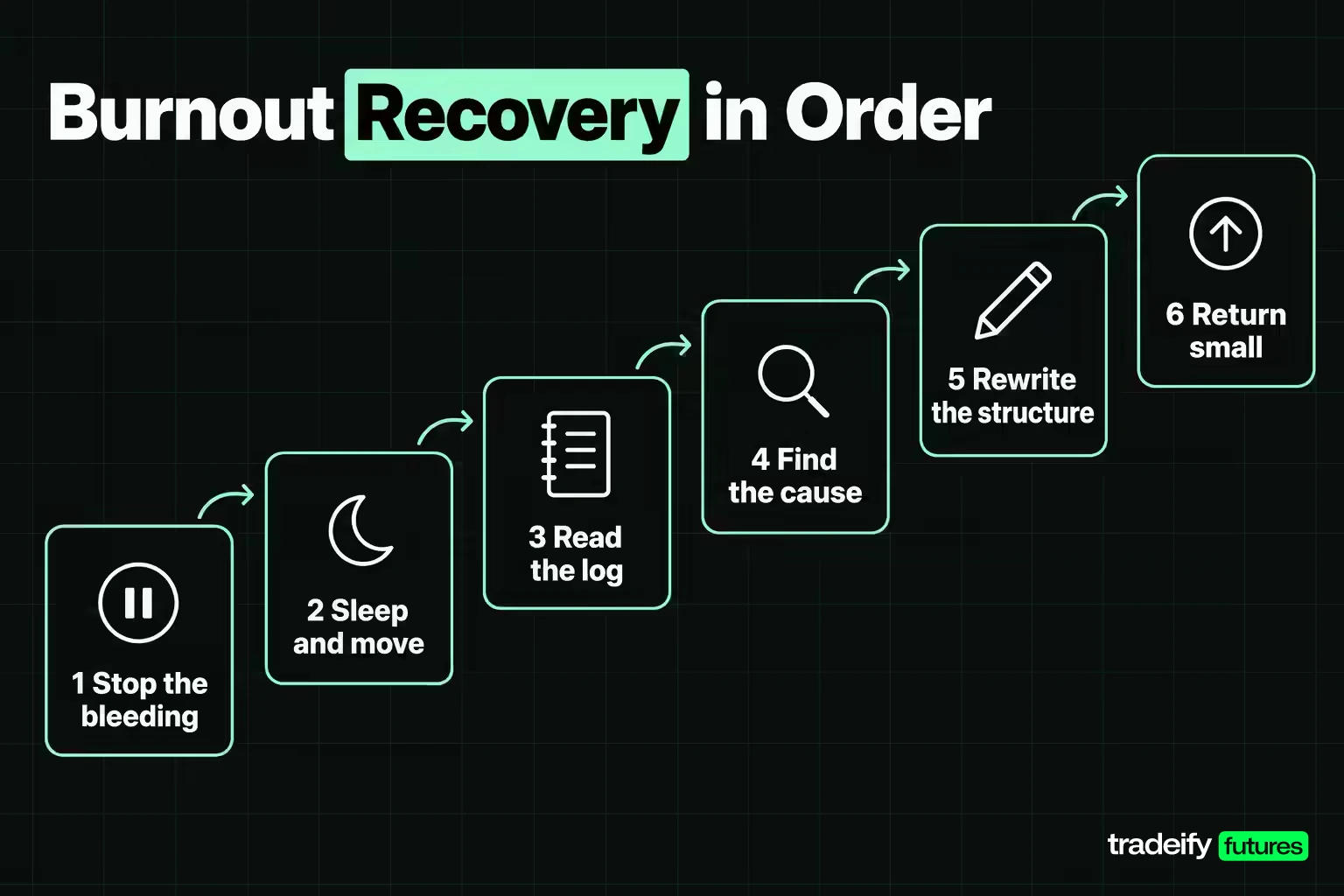
Recovery from trader burnout works best as a sequence. Each step makes the next one possible, so the order matters.
- Stop the bleeding. Cut size and session length right away, or pause entirely if the signs are severe. The first goal is to stop adding stress and losses.
- Sleep and move. Restore regular sleep, daylight and exercise for at least a week before judging anything. Fatigue distorts every decision that follows.
- Read the log, not your memory. Grade your last 20 trades on execution and mark which signs appeared and in what order. This tells you whether you face burnout, a losing streak or a method problem.
- Find the cause. Was it hours, workload, money pressure, a target, isolation or something outside trading? Write one sentence naming it.
- Rewrite the structure. Set a session window, setup list, stop conditions and workload cap that directly address the cause you named.
- Return small. Come back with your best setups only and reduced size for a set number of sessions, for example 10 sessions at half size.
- Scale on process, not profit. Move back to full size only when execution grades stay high across that return period, regardless of whether it made money.
- Keep the review. A short daily note and a weekly review are the early warning system. If the review starts slipping again, go back to step 1.
Session limits that support burnout recovery
Hard limits set outside the session make recovery easier, because they end the day without asking for willpower. On our accounts, every position has to be closed by 4:45 PM ET and nothing can be held overnight or over a weekend, so the trading day has a built-in end. Our Growth evaluation daily loss limit is a soft breach that puts the account in liquidation-only until the next trading day, which works as a hard stop condition. Traders who want tighter limits can also set personal daily or weekly loss limits in Tradovate's Risk Settings or use the lockout timer in Tradesea; these are your own limits and do not replace our rules. Funded accounts are simulated.
Related lesson: The habit that lapses first when workload rises
When Trader Burnout Is Something Else
Sometimes what feels like trader burnout is a different problem using trading as its outlet. Workload fixes will not help much if the real issue sits elsewhere, so it is worth checking honestly.
Signs the problem is bigger than trader burnout
- Low mood, hopelessness or loss of interest that shows up in areas with no link to trading.
- Sleep or appetite changes that continue on days you do not trade.
- Anxiety that stays high on weekends and holidays.
- Financial pressure where trading income has to cover rent or debt, which turns every trade into a survival decision.
- Major life stress (health, relationships, grief) that you are trying to trade through.
Getting help beyond trading burnout
If low mood, sleep problems, constant anxiety or life stress reach beyond trading, talk to a doctor or licensed mental health professional. That is not an overreaction. Burnout, depression and anxiety can overlap, and a professional can tell them apart in a way no checklist can.
Financial pressure deserves its own fix. If trading has to pay this month's bills, the stakes of every decision rise sharply, and the stress will return no matter how good your structure is. Reducing that dependence, through other income or a larger cash buffer, can do more for burnout than any trading rule.
If you are having thoughts of harming yourself, contact a crisis line now. In the US you can call or text 988 to reach the 988 Suicide & Crisis Lifeline, which is free, confidential and open around the clock.
Related lesson: When the heavy stretch has already become a drawdown
Trader Burnout FAQ
What are the signs of trader burnout?
The main signs are exhaustion that rest does not fix, detachment from your rules and results, and falling execution quality. In practice that shows as skipped reviews, trades outside your setup list, creeping size and dread before the open.
How long does trader burnout last?
There is no fixed timeline. Mild workload burnout can ease within one to two weeks of reduced trading and real rest. Longer or deeper burnout can take months, and needs professional help if it reaches beyond trading.
Is trader burnout the same as depression?
No. WHO classifies burn-out as an occupational phenomenon tied to work, not a medical condition. Depression affects life well beyond trading and does not clear because you stop looking at charts, so see a professional if symptoms reach other areas of your life.
How much screen time is too much for trading?
Screen time is too much when extra hours stop producing valid setups, and no single number fits everyone. A better test is how many valid setups each hour produces. Hours spent watching with no setups add stress and invite forced trades, so cut those first.
Does burnout mean my strategy stopped working?
Not necessarily. Grade your recent trades on execution first. If clean trades still perform within their normal range, the method is fine and the problem is how you are working.
Should I stop trading completely to recover?
Not always. Stop fully if the signs reach outside trading or you cannot keep your rules. Otherwise, a shorter window, fewer setups and reduced size often allow recovery while keeping your routine.
Trading futures involves substantial risk, and leverage means losses can exceed what you expect. The E-mini study in this guide is a historical illustration of one rule on one data series, not a prediction or a performance record. Funded and evaluation accounts at prop firms are simulated. This article is educational content, not medical, financial or investment advice; if what you are experiencing goes beyond trading, please speak with a qualified professional.


