




TL;DR: Trailing stops move your exit up behind a winning trade and freeze when price turns, so the real decision is the trail distance. On 25 recent E-mini S&P 500 sessions, 8 and 16 tick trails exited every trade within six bars. Looser trails stayed in longer but handed back more open profit. Over 20 years of daily bars, 1 and 2 ATR trails beat a fixed stop on most of the same entries yet capped the best winners. A trailing stop changes how a trade ends, not whether the entry has an edge.
A trailing stop sounds like the obvious upgrade to a fixed stop. Your risk stays capped, and if the trade works, the stop follows it up and locks in some of the gain without you touching anything.
The catch is the distance. Set it tight and the order closes good trades in the first few minutes of ordinary noise. Set it loose and it hands back most of a move before it fires. Most traders feel both in the same week, then keep adjusting the setting after each trade, which is the one way to make sure no setting ever gets a fair test. This guide explains how trailing stops work, then measures that tradeoff on real E-mini bars so you can see what each distance actually did.
What Trailing Stops Are and How They Differ From a Fixed Stop
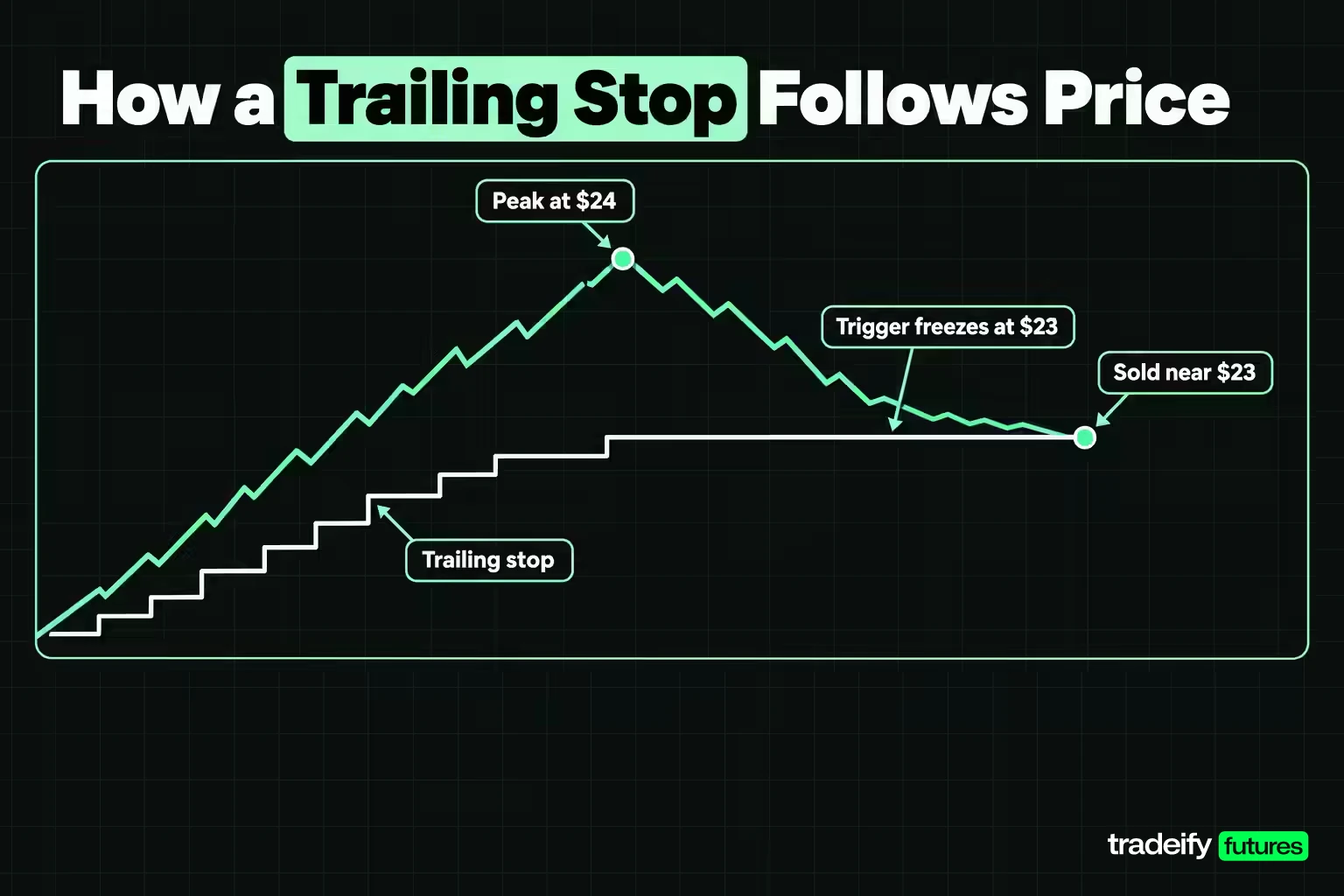
A trailing stop is a stop order whose trigger price is not a fixed number. You choose a side and a trail distance, and the trigger is calculated from the best price the market has reached since the order went live.
The SEC's Office of Investor Education and Advocacy defines it this way in its investor bulletin on stop, stop-limit and trailing stop orders: the stop price is a set percentage or dollar amount above or below the market price, it adjusts or "trails" the market as price moves in your favor, and it stays fixed when price moves against you.
The bulletin's own example is worth following step by step:
- You buy XYZ at $20 and it rises to $22.
- You place a sell trailing stop $1 below the market price.
- While price rises, the trigger stays $1 behind it.
- XYZ peaks at $24 and starts to fall, so the trigger stays at $23.
- The shares are sold when XYZ reaches $23, though the execution price may differ from $23.
A fixed stop protects only the original risk. Trailing stops protect the original risk and then starts protecting open profit once price moves your way. That is the whole appeal of trailing stops, and it is also where the problems start, because every rise in the trigger brings the exit closer to normal market noise.
Interactive Brokers describes the design goal in one line: a trailing stop is meant to limit the maximum possible loss without limiting the maximum possible gain. The second half of that sentence is true only if the trail survives the pullbacks along the way.
Related lesson: Stop loss orders and placement
How a Trailing Stop Moves on One E-mini Session
The clearest way to see a trailing stop work is one trade, bar by bar. The session below is the E-mini S&P 500 front-month contract on 15 October 2026, using 5-minute bars from Yahoo Finance's ES=F series, regular session only.
The rule is simple. Buy one contract at the close of the 9:55 AM ET bar (the 10:00 AM close), at 7727.75. Use a 16 tick trail, which is 4.00 index points because one E-mini tick is 0.25 points. The first trigger is the entry minus the trail, 7723.75.
| Bar start (ET) | Open | High | Low | Close | Trigger in force | What the trailing stop did |
|---|---|---|---|---|---|---|
| 9:55 AM | 7719.25 | 7728.50 | 7717.25 | 7727.75 | None | Long entry at the close, 7727.75, trigger set at 7723.75 |
| 10:00 AM | 7727.75 | 7744.50 | 7726.25 | 7742.50 | 7723.75 | Low stayed above the trigger, new high of 7744.50 lifted it to 7740.50 |
| 10:05 AM | 7741.75 | 7747.25 | 7741.00 | 7746.25 | 7740.50 | Low held by 2 ticks, new high of 7747.25 lifted the trigger to 7743.25 |
| 10:10 AM | 7746.25 | 7753.25 | 7742.50 | 7745.50 | 7743.25 | Low of 7742.50 traded through 7743.25, exit at 7743.00 after one tick of slippage |
The trigger only moved up, and only when a bar made a new high. When the 10:10 AM bar dipped to 7742.50, the trailing stop fired and the trade closed 15.25 points above the entry. That is 61 ticks, or $762.50 on one E-mini contract at $12.50 a tick, and $76.25 on one Micro E-mini at $1.25 a tick.
What the trailing stop missed on 15 October 2026
After the 16 tick trailing stop closed the 15 October trade at 7743.00, the market kept going. The session made its high of 7801.75 in the 3:20 PM bar and closed at 7791.00. A fixed stop at the opening range low of 7717.25 (10.50 points of risk, $525 on one E-mini) was never touched, so the same entry held to the close made 63.25 points, or $3,162.50 per E-mini.
Neither exit was "right", and that is worth sitting with before you change any setting. The trailing stop banked a quarter of what the fixed stop made, but on a different day the fixed stop would have taken the full 10.50 point loss while the trail scratched out. The point of the example is the mechanism: a 4 point trail on a market whose first half hour covered 30.50 points is very close to the noise.
One honest limit on bar data: the 10:10 AM bar also traded up to 7753.25, and a 5-minute bar cannot show whether the high or the low came first. The study treats the low as coming first, which is the conservative reading.
Trailing Stop Distances Measured on 25 E-mini Sessions
A single trade cannot tell you which trailing stop distance works, so this guide ran one fixed entry rule through nine exit policies on the 25 most recent complete E-mini S&P 500 sessions, 30 September to 4 November 2026. The data is Yahoo Finance's ES=F series of 5-minute bars from the regular session (9:30 AM to 4:00 PM ET). The 30 October session was left out because one of its bars was missing.
How the 25-session trailing stop study was run
- Entry: one long and one short at the 10:00 AM close each session, so a market that drifted up or down does not flatter either side. That gives 50 trades per exit policy.
- Opening range: the high and low of the first 30 minutes. The fixed policy places its stop at the opening range low for longs and the high for shorts and holds to the close.
- Trailing policies: trails of 8, 16, 24, 32 and 48 ticks, plus trails of 0.5, 1.0 and 2.0 times that session's opening range width.
- Fills: a touched trigger fills one tick worse. A bar that opens through the trigger fills at its open. A bar that closes through a trigger it just raised exits inside that bar, because the close prints after the high. Anything still open exits at the 4:00 PM close.
The results below are this guide's own calculations on those Yahoo Finance ES=F bars, with results in index points per trade.
| Exit policy | Mean result (points) | Win rate | Average peak open profit (points) | Average profit handed back (points) | Exited within 6 bars | Later ran 20+ points your way after exit |
|---|---|---|---|---|---|---|
| Fixed opening range stop | -1.19 | 20.0% | 16.45 | 17.64 | 52.0% | 14 of 50 |
| 8 tick trail | 0.01 | 22.0% | 2.27 | 2.25 | 100.0% | 30 of 50 |
| 16 tick trail | 0.18 | 44.0% | 4.43 | 4.25 | 100.0% | 30 of 50 |
| 24 tick trail | -1.13 | 34.0% | 5.12 | 6.25 | 98.0% | 30 of 50 |
| 32 tick trail | 1.67 | 38.0% | 9.92 | 8.25 | 84.0% | 28 of 50 |
| 48 tick trail | 1.60 | 34.0% | 13.85 | 12.24 | 56.0% | 26 of 50 |
| 0.5x opening range trail | 2.56 | 44.0% | 14.66 | 12.10 | 62.0% | 26 of 50 |
| 1.0x opening range trail | -1.28 | 36.0% | 20.86 | 22.14 | 22.0% | 16 of 50 |
| 2.0x opening range trail | -1.64 | 44.0% | 26.52 | 28.16 | 6.0% | 3 of 50 |
"Profit handed back" is the best open profit the trade reached minus its final result. The last column counts trades where, after the exit, price went on to at least 20 points beyond the entry in the trade's direction later that session.
What 25 sessions of trailing stop results show
In this guide's 25-session ES study, the tight trailing stops behaved like a coin flip with a short fuse. The 8 and 16 tick trails exited every one of the 50 trades within six bars, on average in one or two 5-minute bars, and on 30 of those trades price later ran at least 20 points the way the trade had pointed. If you have ever been stopped out near the low tick and watched the move leave without you, that row is the feeling in numbers.
The loose trailing stops in the same ES study lived much longer and gave back much more. The 2.0x opening range trail held 30 of its 50 trades to the close and handed back an average of 28.16 points from the best open profit. Only 3 of its trades left before a 20 point continuation.
Now the uncomfortable part. In the same 25-session study, every mean result sits between -1.64 and +2.56 points, and the standard error of the fixed-stop mean on these 50 trades is 2.93 points. None of the exit policies produced a result you could tell apart from zero. The entry here is a fixed time with no directional edge, and no trailing stop distance turned it into a winning method.
That is the most useful thing the 25-session study teaches: trailing stops change the shape of your results (how long trades live, how often they win, how much they give back) far more reliably than they change the average. If your entry has no edge, the trail just rearranges the losses.
Trailing Stops vs a Fixed Stop on the Same Entries Over 20 Years
A longer test asks the question every trader really has: if I keep my entries exactly the same, does trailing the stop beat leaving it where it started? To answer it, a breakout rule was run on Yahoo Finance's continuous front-month daily bars for E-mini S&P 500 (ES=F) and E-mini Nasdaq-100 (NQ=F), 3 January 2006 to 4 November 2026.
How the 20-year trailing stop study was run
- Entry: a close above the highest high of the prior 55 sessions (long) or below the lowest low (short), first day of each breakout only. ES produced 366 signals and NQ 363.
- Initial stop: 2.0 times the 20-session average true range (ATR) from the entry, measured on the signal day.
- Every signal is simulated on its own, so each exit policy sees the identical list of entries.
- Fixed policy: the 2.0 ATR stop never moves. Trailing policies: the trigger is the higher of the initial stop and the best high since entry minus 1.0, 2.0 or 3.0 ATR (mirrored for shorts).
- Every policy closes at the 40th session if nothing else has, and results are in R, where 1R is the initial 2.0 ATR risk.
- The continuous series is not adjusted for contract rolls, so roll days carry small artificial jumps.
The results below are this guide's own calculations on those Yahoo Finance daily bars.
| Market and exit | Mean R per trade | Median R | Win rate | Average sessions held | Best trade (R) | Exits filled at a gap open | Beat the fixed stop on the same entry |
|---|---|---|---|---|---|---|---|
| ES fixed 2.0 ATR stop | 0.062 | -1.002 | 34.2% | 22.9 | 7.58 | 5 | Not applicable |
| ES 1.0 ATR trail | -0.031 | -0.180 | 35.5% | 4.4 | 3.32 | 20 | 64.5% |
| ES 2.0 ATR trail | -0.054 | -0.296 | 36.6% | 11.3 | 4.09 | 8 | 63.4% |
| ES 3.0 ATR trail | -0.032 | -0.555 | 35.5% | 17.6 | 3.63 | 7 | 36.9% |
| NQ fixed 2.0 ATR stop | 0.203 | -1.000 | 37.5% | 23.5 | 6.30 | 3 | Not applicable |
| NQ 1.0 ATR trail | 0.061 | -0.108 | 42.1% | 4.6 | 2.30 | 7 | 62.5% |
| NQ 2.0 ATR trail | -0.016 | -0.239 | 39.1% | 10.9 | 3.74 | 6 | 61.7% |
| NQ 3.0 ATR trail | 0.058 | -0.530 | 34.7% | 17.3 | 5.75 | 3 | 34.4% |
Why trailing stops won more often but not on average
In this guide's 20-year breakout study on ES and NQ daily bars, every exit policy saw the identical 366 ES entries and 363 NQ entries. On ES, the 1.0 ATR trail finished ahead of the fixed stop on 64.5% of the identical entries. That is the experience traders remember: most of the time, trailing felt better, because it cut losers short and kept a small piece of trades that later failed.
The best single trade tells the other half. In the same study, the fixed stop's best ES trade made 7.58R. The 1.0 ATR trail's best made 3.32R. Breakout methods tend to depend on a few large trends, and a tight trail closes those trades early. Winning more often by small amounts while giving up the largest winners left every ES trail with a slightly lower mean than the fixed stop.
The differences in that 20-year study are small, though. The standard error of the ES fixed-stop mean is 0.086R, so neither policy is clearly better over 366 trades. The fair conclusion is narrower than "trail" or "don't trail": the trail moved the median result up sharply (from -1.002R to -0.180R on ES) and cut the best trades roughly in half, and whether that trade is worth making depends on your method and on how you handle a run of small exits.
Related lesson: Trading expectancy
How to Choose a Trailing Stop Distance
The trail distance should come from the market you are trading, measured the same way you measured your initial stop. Three methods cover most traders:
- Fixed ticks or points. Simple and easy to set on any platform. The weakness is that a tick count means nothing on its own. It has to be compared with how far the market is moving that day.
- ATR multiple. A multiple of average true range scales the trail with volatility, so the same setting widens on busy days and tightens on quiet ones.
- Opening range or structure. A fraction of the session's opening range, or a level just beyond the latest swing, ties the trail to what the market has actually done today.
This guide's 25-session study on Yahoo Finance ES=F and NQ=F 5-minute bars shows why the first method needs a reality check. The median 30-minute opening range on ES over those sessions was 21.5 points. On E-mini Nasdaq-100 (NQ) over the same 25 sessions it was 169.0 points, almost eight times wider, while both contracts use the same 0.25 point tick.
So a tick count that partly survives on one market can be meaningless on the other. In that same study on NQ, all five tick trails from 8 to 48 ticks exited 100% of their 50 trades within six bars, and the 8 tick trail won only 2.0% of the time. The trails scaled to NQ's own opening range behaved like their ES counterparts instead, holding trades for 11.6 to 59.9 bars on average.
A practical way to set the trailing stop distance
- Start from the measure that set your initial stop. If the stop came from ATR, trail in ATR. If it came from the opening range, trail in a fraction of that range.
- Convert the trail into ticks and dollars per contract before the trade, so you know what one exit costs.
- Compare it with the ordinary pullback on this instrument recently. A trail smaller than the usual pullback is a short-term exit, not a trend-following tool.
- Decide what the trail is for. A tight trail suits a trade you want to scratch quickly if it stalls. A loose one suits a trade you want to give room to trend.
- Keep the setting for a stated number of trades before you judge it, because 25 sessions of results sit well inside normal noise.
Dollar, Point and Percentage Trailing Stops
Most platforms let you set the trail as a fixed amount (dollars per share, or points and ticks on futures) or as a percentage of price. The two behave differently as price moves.
A fixed amount stays the same size in price terms. On an illustrative stock bought at $50, a $2 trail is 4% of the price. If the stock reaches $80, the same $2 trail is only 2.5%, so the stop has quietly become tighter relative to the stock's normal swings.
A percentage trail stays the same size relative to price. A 4% trail on that stock is $2.00 at $50 and $3.20 at $80, so it widens as the position grows. That suits positions held for weeks, where price can change a lot.
On futures, percentage trails rarely fit day trading. With the E-mini S&P 500 at an illustrative 7,700.00, a 1% trail is 77.00 points, or 308 ticks. That is $3,850 per E-mini and $385 per Micro E-mini, and about 3.6 times the 21.5 point median opening range in the 25-session study. Futures day traders usually think in ticks, points or ATR for that reason.
Brokers also limit how a percentage trail can be entered. Fidelity's trailing stop overview says percentage trails must be whole percentages between 1% and 30% away from the current price, and that trailing stops on single-leg options must use a dollar trail.
| Trail type | Example setting | How it changes as price moves | Typical fit |
|---|---|---|---|
| Dollar or point trail | $2 per share, or 16 ticks on ES | Same price distance, so tighter in percentage terms as price rises | Intraday futures and short holds |
| Percentage trail | 4% of price | Grows with price in dollar terms | Stock and ETF positions held for weeks |
| ATR multiple trail | 2.0 times 20-day ATR | Follows recent volatility, not price level | Swing and trend methods on any market |
Trailing Stops on Short Positions
On a short, the trailing stop is a buy stop placed above the market. As price falls, the trigger moves down behind it. When price rises, the trigger stays put, and if the bounce reaches it, the order buys back the position. Fidelity notes that a buy trailing stop is commonly used to buy to cover a short.
An illustrative example on ES: you short at 7,700.00 with a 16 tick (4.00 point) buy trailing stop, so the first trigger is 7,704.00. Price falls to 7,690.00, which pulls the trigger down to 7,694.00. A bounce to 7,694.00 triggers the order, and a fill one tick worse at 7,694.25 closes the trade 5.75 points in profit, or $287.50 on one E-mini.
The most common mistake on shorts is the order side. A sell trailing stop placed on a short position does not protect it, and depending on the platform it can add to the position or trigger right away. Check the side on the ticket before you transmit, every time.
How to Set a Trailing Stop Step by Step
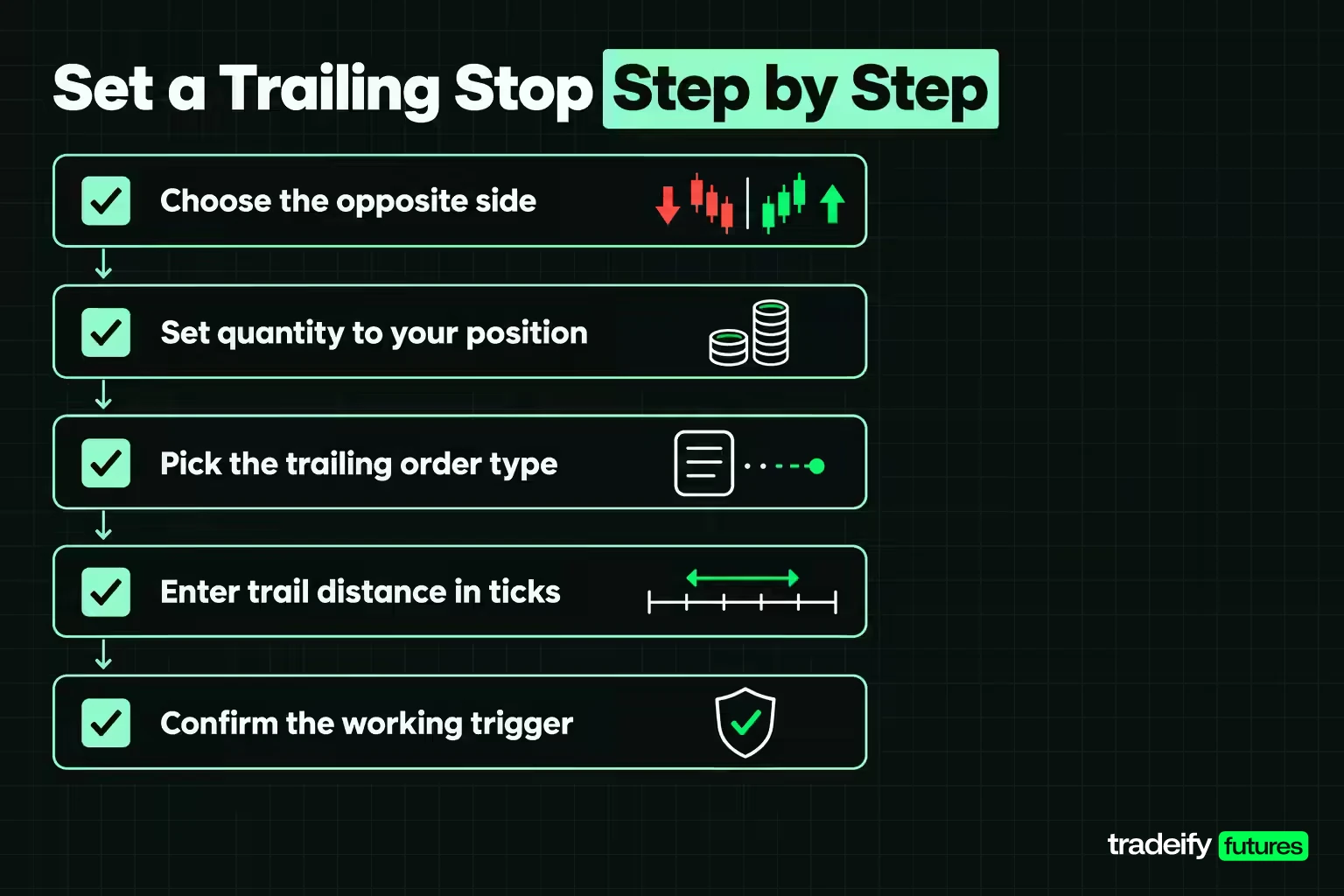
The fields differ by platform, but the process for placing a trailing stop is the same everywhere:
- Open the order ticket for the instrument you hold, and choose the opposite side (sell for a long, buy for a short).
- Set the quantity to the size of the position you want to protect, not more.
- Choose the trailing order type, either a trailing stop (market on trigger) or a trailing stop limit (limit on trigger).
- Enter the trail distance in the platform's units, and check what that distance is in ticks and dollars.
- Set or confirm the starting trigger. On Interactive Brokers, if you leave the stop price blank, the trigger is set to the last traded price minus the trail amount.
- Check which price drives the trail. Interactive Brokers tracks the last traded price, while Fidelity lets equity and option traders base it on the last trade, bid or ask.
- Set the time in force, then transmit and confirm the working order shows the trigger you expected.
Many futures traders never place a trailing stop by hand. They attach it to the entry as part of a bracket. Tradovate's ATM strategy settings, for example, offer a Trail.Stop type where the stop loss field sets the starting distance from the entry price, and each new high on a long (or new low on a short) moves the stop by the same amount. Its Trail.Stop Limit type works the same way, then places a limit order when the stop is hit.
Related lesson: Bracket orders
Trailing Stop vs Trailing Stop Limit and Stop Limit Orders
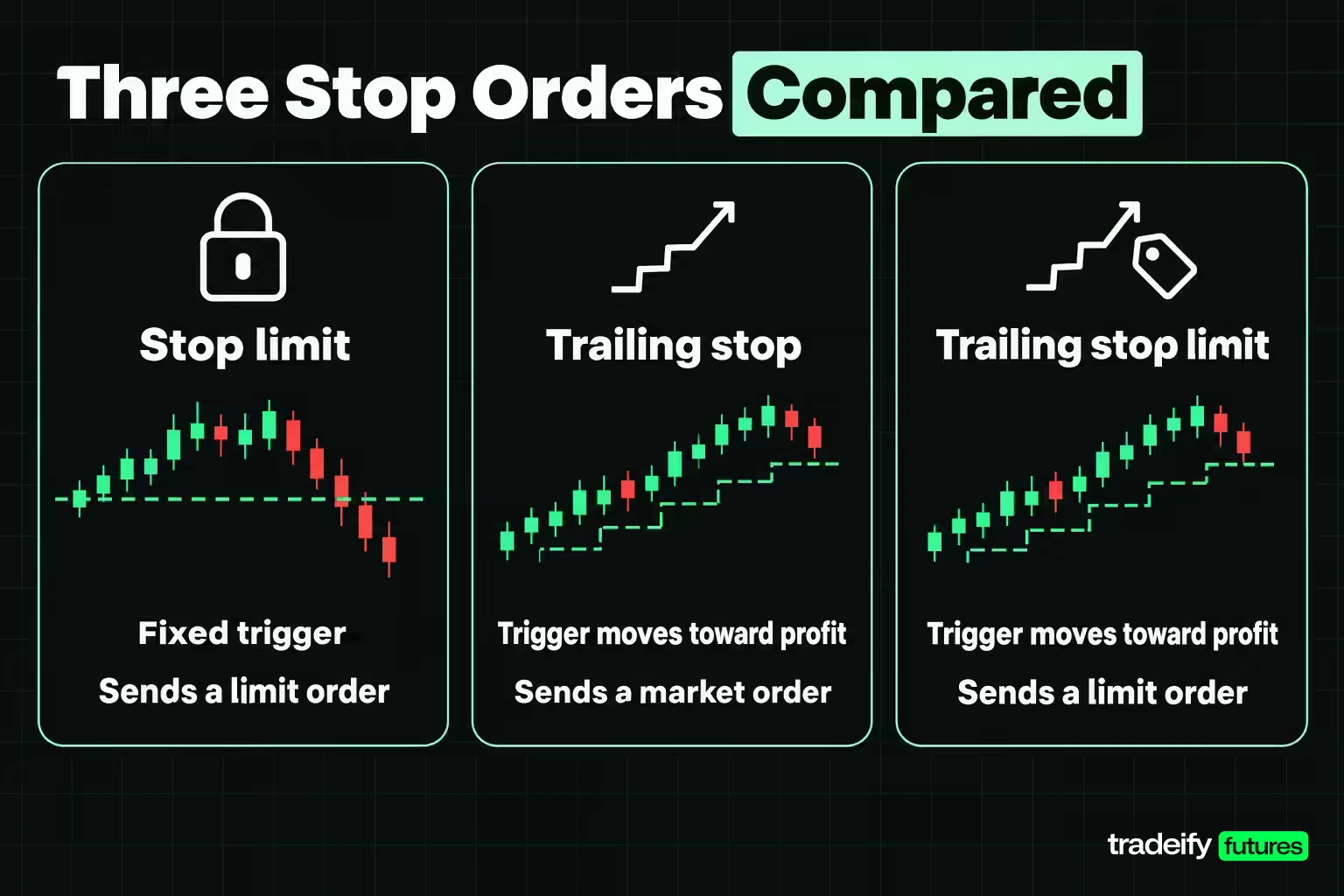
Three order types get confused here, and they protect you in different ways.
A trailing stop sends a market order once its moving trigger is hit. You are very likely to get out, but the fill price can be worse than the trigger.
A trailing stop limit has the same moving trigger, but it sends a limit order instead. Interactive Brokers describes it as recalculating both the stop price and the limit price as the market moves, then submitting a limit order at the last calculated limit price when the stop is hit. You control the worst price you accept, but if the market jumps past your limit, the order can trigger and not fill, which leaves you in the trade.
A stop limit (with no trailing) has a fixed trigger and a fixed limit. It never moves with price.
Fidelity offers four versions of the trailing stop: trailing stop loss in dollars, trailing stop loss in percentages, trailing stop limit in dollars and trailing stop limit in percentages.
| Order type | Does the trigger move | What it sends when triggered | Main risk |
|---|---|---|---|
| Stop limit | No | A limit order at your set limit | Not filled if price jumps past the limit |
| Trailing stop | Yes, toward profit only | A market order | Fill worse than the trigger in a fast market |
| Trailing stop limit | Yes, toward profit only | A limit order at the trailing limit | Triggered but not filled, position still open |
Do Trailing Stops Guarantee Your Exit Price
No. A trailing stop guarantees only that an order is sent when the trigger is hit. The Investor.gov bulletin says it plainly for stops in general: the stop price is a trigger, not a guaranteed execution price, and the fill can differ significantly from it because of demand and available liquidity. Its trailing stop example ends the same way: the shares are sold when price reaches the trigger, though the execution price may differ.
In practice, two things widen the gap between trigger and fill. Slippage in a fast market means the next available price is a few ticks past your trigger. Gaps mean the market opens past your trigger with no trading in between.
Trailing stops in gaps and fast markets
Trailing stops are more exposed to gaps than a fixed stop, because they sit closer to price for more of the trade. This guide's 20-year study on Yahoo Finance ES=F and NQ=F daily bars, 2006 to 2026, shows it clearly. On ES, the fixed 2.0 ATR stop filled at a gap open on 5 of 366 exits, while the 1.0 ATR trail did so on 20 of 366. On NQ the counts were 3 for the fixed stop and 7 for the 1.0 ATR trail.
A trailing stop limit removes that slippage but swaps it for a different risk: in a gap or a fast drop, the price can skip past the limit and leave the order unfilled. Choose between them based on which failure you can live with, a worse fill or no fill.
Related lesson: Slippage explained
Where Trailing Stops Run and Which Markets Accept Them
A trailing stop is often not an exchange order at all. CME Group's client systems documentation lists the order types CME Globex supports for futures and options: Limit, Market Order with Protection, Market-Limit, Stop-Limit and Stop Order with Protection. A trailing stop is not on that list.
That means the trailing calculation runs on your broker's or platform's servers, which watch the price and send or modify an exchange order as the trigger moves. Whether it keeps working when your computer is off depends on where it is held. Some platforms keep the trail on a server, others run it on your machine and stop trailing if the software closes. Check this before you rely on one, and if in doubt keep a plain resting stop at the current trigger level as a backstop.
Fidelity's conditional order documentation is a good example of server-held trailing stops on equities. Its trailing stop orders are monitored between 9:30 AM and 4:00 PM Eastern and held on a separate order file until triggered, then sent to the market.
Which markets accept trailing stops
Availability is set by the broker too. Fidelity offers trailing stops on listed equities, over-the-counter securities and single-leg options. Interactive Brokers says its trailing stop works with U.S. equities, options, futures, futures options, warrants, forex and certain non-U.S. products. If your broker does not list the product, assume the order type is not there.
Trailing Stops in Pre-Market and After-Hours Trading
On stocks, trailing stops usually do not work outside the regular session. Fidelity's trailing stop overview says trailing stop orders are not available during pre-market or after-hours trading, and its trading FAQ says it accepts only limit orders in the extended-hours sessions, with all other order types ineligible. Its pre-market orders can be placed from 7:00 AM to 9:28 AM ET and after-hours orders from 4:00 PM to 8:00 PM ET.
That has a practical consequence for stock traders. A trailing stop that sits idle overnight cannot react to news released after the close, so if a stock opens well below the trigger, the order fires at the regular open and fills near that opening price, not at the trigger. Some traders cover that window with a separate extended-hours limit order, which has to be entered for each session.
Trailing stops after hours on futures
Futures trade far longer hours. The E-mini S&P 500 trades on CME Globex from Sunday 6:00 PM to Friday 5:00 PM ET, with a daily maintenance break from 5:00 PM to 6:00 PM ET. Whether trailing stops follow price through the overnight session depends on the broker or platform holding them, not on the exchange, so check two things before you leave one working: whether the trail stays live outside regular hours, and whether it runs on a server or on your own computer.
Risk Management With Trailing Stops
Trailing stops manage open profit. They do not change the risk you took at the entry. Until price moves your way, a trailing stop is just a fixed stop at its starting distance, and Interactive Brokers notes that the stop price never adjusts in a way that causes more than the maximum loss you defined at the start. In this guide's 20-year study on ES and NQ daily bars, no trailing trade lost more than about 1R except when a gap opened beyond the trigger.
That makes position size the first line of defense, as it is with any stop. Size the trade so the starting trail distance costs an amount you accept, then let the trailing stop decide how much of a winning move you keep.
A "SL trailing strategy" (trailing your stop loss) is the same idea done as a rule: you move the stop behind price by a set method, such as a fixed distance, an ATR multiple or the latest swing low, rather than by feel. Three rules help it work:
- Never move a trailing stop away from price. Widening it after the trade goes against you is the same decision as removing the stop.
- Do not tighten the trail just because a trade is in profit and you feel nervous. In this guide's 25-session ES study, 8 and 16 tick trails ended every trade within six bars.
- Decide in advance what happens after an early exit. If a stopped trade can be re-entered, write down the rule now, because chasing the move later is a separate decision.
A trailing stop is not a trailing drawdown
The names are similar, but a trailing drawdown is an account rule, not an order. It is a loss floor that rises with your account balance or equity, set by the firm or the account type, and it applies to the whole account. A trailing stop on an open trade can protect that trade's profit while the account floor has already moved up on earlier profits, so a loss that the trade's stop allows can still breach an account rule. Know both numbers before you size the trade.
Trailing Stop Advantages and Disadvantages
Trailing stops are useful and they have real costs. The figures below come from this guide's own studies on Yahoo Finance E-mini bars: 25 ES sessions of 5-minute bars and 20 years of ES daily breakouts.
| Advantage | What it looks like in practice |
|---|---|
| Profit protection without watching the screen | The trigger rises automatically with every new high on a long |
| Losses stay capped at the starting risk | No trailing trade in the daily study lost much more than 1R outside gap opens |
| Higher median result | On ES daily breakouts the median moved from -1.002R (fixed) to -0.180R (1.0 ATR trail) |
| A rule replaces a decision under pressure | The exit is set before the trade, not while it is moving |
| Disadvantage | What it looks like in practice |
|---|---|
| Early exits in ordinary noise | 8 and 16 tick ES trails closed 100% of trades within six bars |
| Capped big winners | The best ES daily trade fell from 7.58R (fixed) to 3.32R (1.0 ATR trail) |
| More gap fills | 20 gap-open exits for the 1.0 ATR trail vs 5 for the fixed stop on ES |
| Platform dependence | CME Globex lists no trailing order type, so the trail lives on a broker or platform server |
| No edge of its own | No trailing distance in the 25-session study produced a mean result distinguishable from zero |
A Trailing Stop Checklist Before You Arm One
Six questions to answer about a trailing stop while you are still flat, because each one is much harder to answer honestly once the trade is open and moving:
- What sets the trail distance, and is it the same measure that set the initial stop?
- In ticks and dollars, how does that distance compare with the ordinary pullback on this instrument today?
- Which price drives the trigger (last trade, bid or ask), and does it match the chart you are reading?
- Is the trail held on a server or on your own machine, and is there a resting stop as a backstop?
- If it fills a tick or two worse than the trigger, or at a gap open, what does the trade lose?
- If it exits early and the move continues, what is your rule for re-entry, if there is one?
On our accounts, the trailing drawdown is an end-of-day trailing drawdown enforced in real time on net liquidation value, and every position has to be closed by 4:45 PM ET on regular trading days, so a trailing stop is an intraday exit tool here rather than an overnight one. Tradovate's ATM settings include Trail.Stop, Trail.Stop Limit and AutoTrail stop types, and R Trader Pro keeps trailing stops on Rithmic's servers if your connection drops.
Trailing Stops FAQ
How do I use a trailing stop?
Place it on the opposite side of your position, set the trail distance from the same measure you used for the initial stop, and confirm the starting trigger on the order ticket. Then leave it alone unless your written rule says otherwise. Most futures platforms let you attach it to the entry as part of a bracket.
What is a trailing stop limit order at Fidelity?
It is a trailing stop that sends a limit order instead of a market order when the trigger is hit. Fidelity offers it with a dollar or a percentage trail, and its percentage trails must be whole numbers from 1% to 30%. Because it is a limit order, it can trigger and still not fill.
What is an SL trailing strategy?
It means trailing your stop loss by a fixed rule, such as a set number of ticks, an ATR multiple or the most recent swing, instead of moving it by feel. The rule only ever moves the stop toward profit. The distance you pick decides how often you are shaken out and how much of a move you keep.
What is the difference between a stop limit and a trailing stop?
A stop limit has a fixed trigger and sends a limit order, so it caps your fill price but may not fill. A trailing stop has a trigger that follows price in your favor and usually sends a market order, so it is very likely to fill but at an uncertain price.
What does a 25% trailing stop mean?
The trigger sits 25% below the highest price since the order went live and never moves down. From an entry at $100, the first trigger is $75, and price has to rise to about $133.33 before the trigger reaches your entry. A setting that wide suits long-term stock positions, not intraday futures.
Are trailing stops a good idea?
They are a sound exit rule and a poor substitute for an entry edge. In this guide's E-mini studies, trails improved the median result and the win rate on many settings but did not reliably improve the average, because they cut the biggest winners short. Use one when you have a reason for its distance.
Trading futures involves substantial risk of loss and is not suitable for everyone, and leverage means losses can exceed what you expected to risk. Stops and trailing stops do not guarantee an exit price, and gaps or fast markets can fill them well beyond the trigger. The studies in this guide are historical arithmetic on stated rules, not predictions, and evaluation and funded prop accounts are simulated. Nothing here is investment advice.


