



TL;DR: Tradovate margins are $500 for ES and $50 for MES intraday, but that is an entry ticket, not a risk budget. As of November 2, 2026, NinjaTrader and Optimus match Tradovate's index rates, and AMP posts $400 for ES. TradeStation charges 5% of initial and Interactive Brokers 70% of overnight margin on index futures. Before the close each broker switches back to full overnight margin, $28,558.25 per ES at Tradovate. Size each trade from your stop, because a 10-point ES move costs the whole $500.
A $500 day trading margin (Tradovate's posted ES rate as of November 2, 2026, and subject to change without notice) on a contract that controls more than $350,000 of the S&P 500 is the reason so many traders search for broker margin tables. It is also the reason so many small accounts get liquidated on an ordinary morning.
This guide compares the posted intraday margins at six popular futures brokers, shows when each one switches you back to full exchange margin, and works through the math the margin table leaves out. The question underneath all of it is simple: how much can one bad minute cost you? Every broker figure below was read from that broker's own margin page as of November 2, 2026. Margins change without notice, so treat the numbers as a dated snapshot and check the live page before you trade.
How Futures Margin Works as a Performance Bond
Futures margin is a performance bond, not a loan. CME Group describes it as the money you deposit and keep with your broker when you open a futures position. It is not a down payment, and you do not own the underlying commodity or index.
Stock margin works the other way. When you buy shares on margin, the broker lends you part of the purchase price and charges interest on the loan. Under Regulation T, the initial requirement for a stock bought on margin is 50% of its value. CME notes that futures margin typically runs 3% to 12% of a contract's notional value, and nobody lends you the rest or charges interest on it.
That gap is what makes futures margin feel cheap, and it is also where most of the trouble starts. One E-mini S&P 500 contract (ES) moves $50 for every index point. At an illustrative ES price of 7,500, one contract carries $375,000 of notional exposure. Your profit and loss are calculated on that $375,000, not on the deposit the broker asked you to post.
| Margin comparison | Futures margin | Stock margin |
|---|---|---|
| What it is | Good-faith deposit held by the broker | Loan for part of the purchase price |
| Typical size | 3% to 12% of notional at the exchange level | 50% initial under Regulation T |
| Interest charged | None on the deposit | Yes, on the borrowed amount |
| Ownership | You do not own the underlying | You own the shares |
| Daily settlement | Gains and losses settle in cash every day | Paper gains and losses until you sell |
Gains and losses on a futures position are settled to your account in cash as they happen. If the trade moves against you, the loss comes straight out of your balance, and the broker compares what is left against the margin the position requires. Once your balance falls below that number, the broker can close the trade.
Types of Futures Margin From Initial to Variation
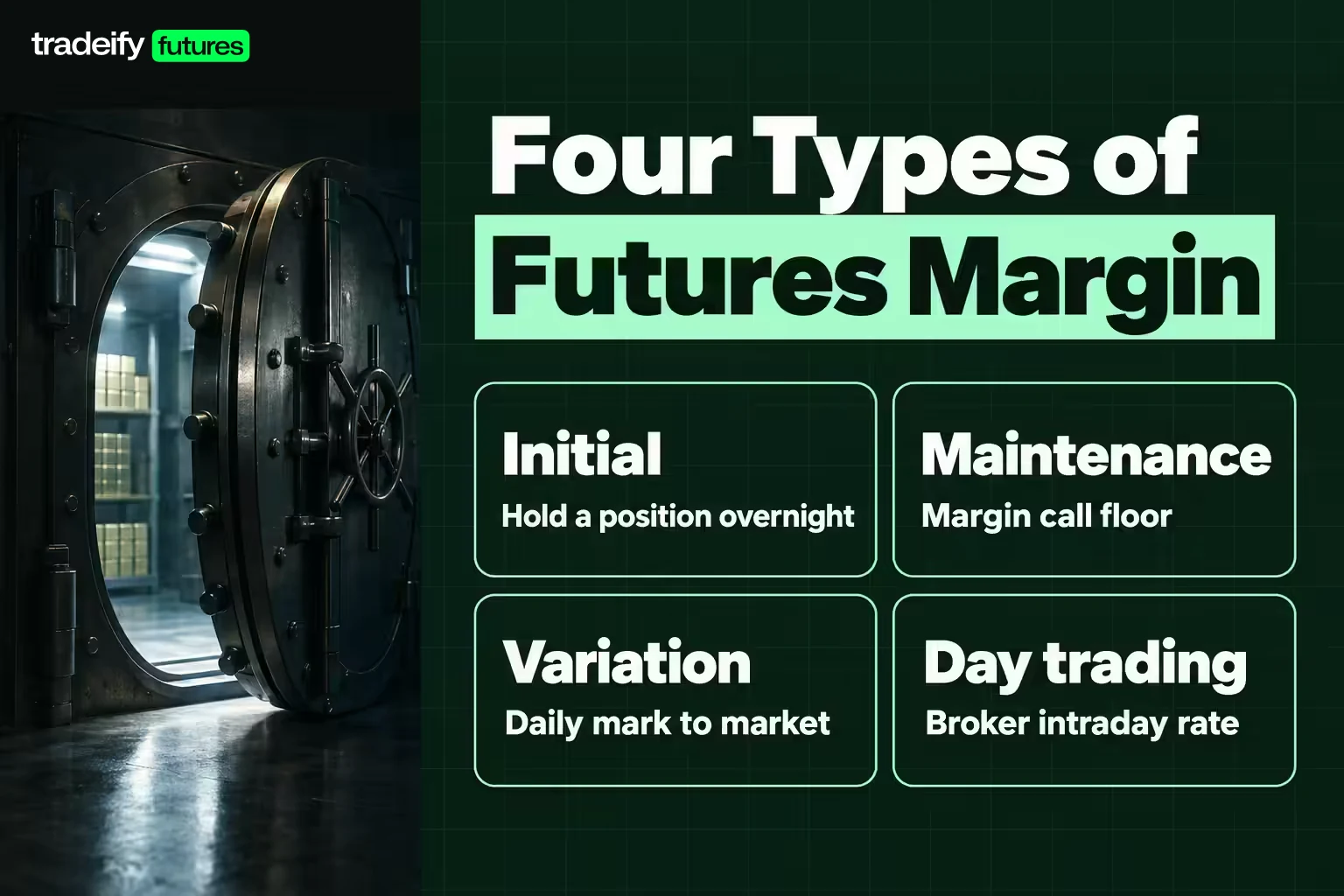
Four different margin terms show up on broker and exchange pages, and they are easy to mix up.
| Margin type | Who sets it | When it applies | What it means for you |
|---|---|---|---|
| Initial margin | Exchange clearing house (broker may add more) | Opening or carrying a position past the session close | The deposit needed to hold a position overnight |
| Maintenance margin | Exchange clearing house | While a carried position stays open | The floor that triggers a margin call |
| Variation margin | Clearing house, through daily settlement | Every trading day | The cash that moves in or out as the contract is marked to market |
| Day trading margin | Broker | During the broker's intraday window | The reduced deposit to open and hold a trade during the session |
Initial margin is set by CME Clearing, and CME says your broker may be required to collect more. Maintenance margin is the minimum you must keep in the account while a position stays open. Tradovate's help center describes maintenance as generally slightly lower than initial, and it does not list maintenance figures on its own margin page.
Day trading margin is the one most retail traders see first, and it is not an exchange number at all. It is a broker's house policy, the broker can raise it at any moment, and it tells you nothing about how much you can afford to lose.
Mark-to-Market Settlement and Variation Margin
Futures margin balances change every day because of mark-to-market settlement. CME puts it bluntly: in the futures markets, losers pay winners every day. Each contract gets one official daily settlement price, and the change from yesterday's settlement to today's becomes your profit or loss in cash. For ES, CME sets that settlement from trading between 3:14:30 and 3:15:00 PM CT.
No loss is carried forward. If a daily loss pushes your equity below the exchange's margin level, you add funds or risk liquidation. For a day trader who is flat by the close, settlement matters less, but the same principle runs in real time at the broker: every tick changes your available margin.
How Exchange Margin Requirements Are Calculated
Exchange margin is calculated from risk, not from a fixed percentage of price. CME uses its SPAN methodology, which estimates the worst loss a position or portfolio could reasonably suffer over a set period, typically one trading day. It does that by running a set of risk scenarios that combine price moves, volatility changes and time to expiration. The clearing house chooses the price scan range for each product, which is the largest move it considers reasonably likely.
That is why margin rises when markets get rough. A wider expected daily range means a larger scan range and a larger deposit. CME notes that margin requirements can also be reduced when conditions calm down.
Exchange Margin vs Broker Margin and the 10% Retail Markup
Futures brokers build their margin numbers on top of the exchange's figure. AMP's margin page says the CFTC, CME and NFA classify all retail traders as a heightened risk profile, which means a 10% higher requirement than the rates CME publishes. Optimus gives the same rule as a formula: multiply the exchange maintenance margin by 1.10 to estimate initial margin.
You can see that markup in NinjaTrader's margin table as of November 2, 2026, which lists ES maintenance at $25,962.04 and initial at $28,558.25, a ratio of 1.10. Both figures move whenever the exchange resets margin, so the ratio is the durable part.
| Exchange contract | CME maintenance margin as of November 2, 2026 | Contract month |
|---|---|---|
| ES | $25,962 (long) | December 2026 |
| MES | $2,596 (long) | December 2026 |
| GC | $19,495 | December 2026 |
| MGC | $1,950 | December 2026 |
Day trading margin sits on a different track. The exchange has no intraday rate; each broker decides how far below exchange margin it is willing to go during the session, and for which contracts.
Intraday Margin Windows and the Overnight Margin Switch
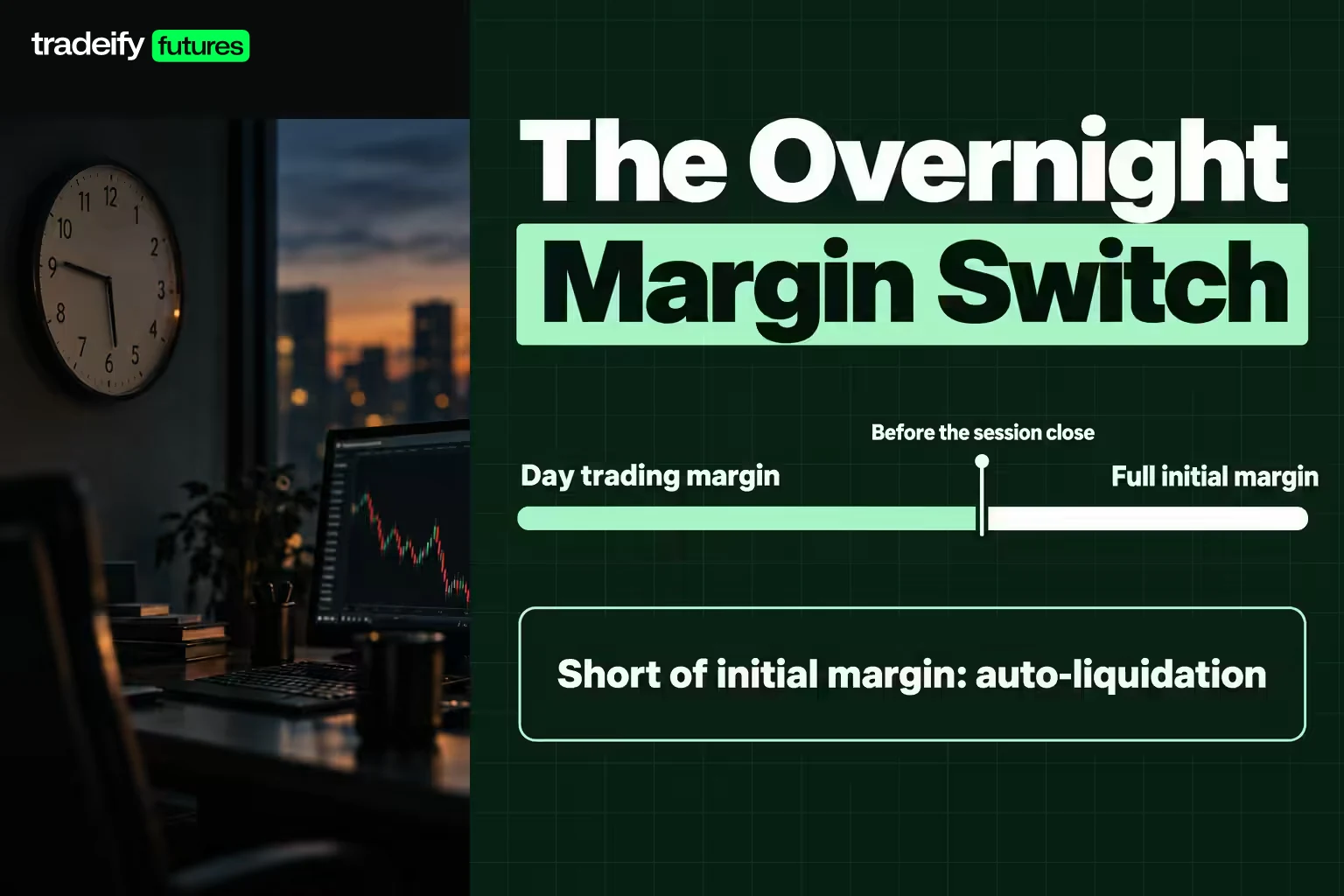
Every broker in this comparison offers a reduced rate during part of the day and returns to full exchange margin before the session closes. What differs is the window.
| Broker | When day trading margin applies | Switch back to initial margin |
|---|---|---|
| Tradovate | From product open until 15 minutes before the session close | 3:45 PM CT (4:45 PM ET) for ES, CL and GC |
| NinjaTrader | From product open until 15 minutes before the session close | 3:45 PM CT (4:45 PM ET) for ES, MES, CL and GC |
| AMP Futures | Day and overnight sessions, except the last 15 minutes of each session | Flatten or meet maintenance 5 minutes before the daily close |
| TradeStation | 9:00 AM to 4:00 PM ET, Monday to Friday, for US equity index futures and select other contracts | Above initial overnight margin or flat before the rate ends |
| Interactive Brokers | 8:30 AM to 3:15 PM CT for ES, MES, NQ and MNQ | Full overnight margin from 3:15 PM CT |
| Optimus Futures | 6:00 PM ET until 4:45 PM ET the next day | 4:45 PM ET |
Read that table as two groups. Tradovate, NinjaTrader, AMP and Optimus apply day margins through the overnight Globex session as well as the regular session. TradeStation and Interactive Brokers limit the reduced rate to US daytime hours, so a 2:00 AM ET trade on ES at those brokers needs full margin.
If your account does not meet initial margin when the window closes, the position is not carried at the cheaper rate. Tradovate's help center says plainly that open positions are auto-liquidated by the broker's order desk 15 minutes before the session close if initial margin is not met. Tradovate also defines "overnight" narrowly for margin purposes: the stretch from that cutoff until the next session opens, when the position drops back to the intraday requirement.
Day Trading Margins Compared Across Brokers
Here are the posted day trading margins for the most common index, crude oil and gold contracts, plus their micro versions, as of November 2, 2026.
| Contract | Tradovate | NinjaTrader | AMP Futures | TradeStation | Interactive Brokers | Optimus Futures |
|---|---|---|---|---|---|---|
| ES (E-mini S&P 500) | $500 | $500 | $400 | $1,427.90 | $23,984.10 | $500 |
| MES (Micro E-mini S&P 500) | $50 | $50 | $40 | $142.80 | $2,398.41 | $50 |
| NQ (E-mini Nasdaq-100) | $1,000 | $1,000 | $1,000 | $2,287.20 | $43,942.36 | $1,000 |
| MNQ (Micro E-mini Nasdaq-100) | $100 | $100 | $100 | $228.75 | $4,394.24 | $100 |
| CL (Crude Oil) | $1,000 | $1,000 | $2,852.50 | $5,704.50 | No intraday reduction | $2,000 |
| MCL (Micro Crude Oil) | $100 | $100 | $285.75 | $571.50 | No intraday reduction | $200 |
| GC (Gold) | $2,000 | $2,000 | $5,797.50 | $5,493.25 | No intraday reduction | $1,250 |
| MGC (Micro Gold) | $200 | $200 | $580 | $562.75 | No intraday reduction | $125 |
Tradovate and NinjaTrader post identical numbers because both belong to NinjaTrader Group, and both sites list the same registered futures commission merchant behind the accounts. One margin schedule covers both. Interactive Brokers' intraday index rate works out to 70% of its overnight initial margin, and TradeStation's index rate is 5% of initial, so those two scale with exchange margin rather than sitting at a flat dollar figure.
Overnight Margin by Broker
The overnight side looks very different. These are the initial or overnight figures each broker posted for a carried long position as of November 2, 2026.
| Overnight contract | Tradovate and NinjaTrader initial | AMP Futures maintenance column | TradeStation long overnight | Interactive Brokers overnight initial |
|---|---|---|---|---|
| ES | $28,558.25 | $28,813 | $28,558 | $34,263 |
| MES | $2,855.82 | $2,881 | $2,856 | $3,426.30 |
| NQ | $45,743.64 | $46,372 | $45,744 | $62,774.80 |
| MNQ | $4,574.37 | $4,638 | $4,575 | $6,277.48 |
| CL | $10,505.37 | $11,410 | $10,505 | $20,383.55 |
| MCL | $1,052.74 | $1,143 | $1,053 | $2,025.46 |
| GC | $21,371.90 | $23,190 | $21,973 | $38,918.18 |
| MGC | $2,145.00 | $2,320 | $2,251 | $3,891.82 |
AMP's column already includes the 10% retail markup. Interactive Brokers posts higher overnight numbers than the others because it applies its own risk-based house requirement on top of exchange margin. TradeStation also lists a lower short overnight margin than long on equity index contracts ($25,392 short against $28,558 long for ES), so the direction of a carried trade can change the deposit.
These are exchange-driven figures and they move with volatility. A number that is current today can be wrong next week.
Conditions Behind Each Broker's Day Trading Margin
A headline day trading margin is only half the policy. The fine print on each broker's page decides who qualifies and for how many contracts.
- Tradovate and NinjaTrader: Standard intraday margin covers positions up to 25 mini or 50 micro contracts. Above that, the excess contracts need 50% of initial margin. Intraday margins can be set to 4X the standard rate starting 15 minutes before key economic releases.
- AMP Futures: As of November 2, 2026, AMP's page says day trading margins double for account balances above $100,000. AMP also says it sets US equity index margins to 25% during the US overnight session around listed economic releases until shortly after the release. Its page does not spell out the base for that 25%, so confirm it with AMP before you rely on it.
- TradeStation: The 5% index rate took effect October 1, 2026 and covers the first 25 ES or NQ and the first 250 MES or MNQ contracts. Above those limits, at least 10% of initial applies to the whole position. A valid stop order risking no more than 50% of the intraday margin is required at all times, and repeat stop-policy violations can cost the account its reduced rate.
- Interactive Brokers: Intraday rates apply only to the listed index products during the regular session. Cash accounts and IRA accounts get no intraday rate, and an account holding futures options on the same underlying loses the intraday reduction.
- Optimus Futures: The posted rates apply to Rithmic data feed users cleared at Ironbeam. Optimus requires a $100 balance for micros and $500 for standard contracts, and blocks day margins above 20 mini or 200 micro contracts.
Leverage Math With Tradovate Margins and Notional Value
Leverage is notional value divided by the margin you post. The table below uses round, illustrative prices (not live quotes) and Tradovate's day margins as of November 2, 2026 to show what each margin controls.
| Leverage contract | Illustrative price | Multiplier | Notional value | Tradovate day margin | Notional per $1 of margin |
|---|---|---|---|---|---|
| ES | 7,500 | $50 per point | $375,000 | $500 | $750 |
| MES | 7,500 | $5 per point | $37,500 | $50 | $750 |
| NQ | 28,000 | $20 per point | $560,000 | $1,000 | $560 |
| MNQ | 28,000 | $2 per point | $56,000 | $100 | $560 |
| CL | $70 | 1,000 barrels | $70,000 | $1,000 | $70 |
| GC | $4,000 | 100 ounces | $400,000 | $2,000 | $200 |
Compare that with the overnight requirement. With ES at an illustrative 7,500 and initial margin of $28,558.25, the deposit is about 7.6% of notional, and a carried ES position controls about $13 of notional for every $1 posted. At the day rate the deposit is about 0.13% of notional, and the same contract controls $750 per $1. Nothing about the contract's risk changed between 3:44 PM and 3:46 PM CT. Only the broker's deposit did.
Leverage cuts both ways. A 1% move in ES at 7,500 is 75 points, or $3,750 per contract, which is more than seven times the $500 day margin. Gains scale the same way, and that symmetry is the whole appeal and the whole danger.
Adverse Move That Uses Up the Day Margin
Margin feels smaller once you translate it into price movement. This table shows how far each contract has to move against you to consume the full Tradovate day margin, using CME contract specifications.
| Price-move contract | Value per point | Tick size and value | Tradovate day margin | Adverse move equal to the margin |
|---|---|---|---|---|
| ES | $50 | 0.25 = $12.50 | $500 | 10 points |
| MES | $5 | 0.25 = $1.25 | $50 | 10 points |
| NQ | $20 | 0.25 = $5.00 | $1,000 | 50 points |
| MNQ | $2 | 0.25 = $0.50 | $100 | 50 points |
| CL | $1,000 per $1.00 | 0.01 = $10 | $1,000 | $1.00 per barrel |
| MCL | $100 per $1.00 | 0.01 = $1 | $100 | $1.00 per barrel |
| GC | $100 per $1.00 | 0.10 = $10 | $2,000 | $20 per ounce |
| MGC | $10 per $1.00 | 0.10 = $1 | $200 | $20 per ounce |
Ten ES points can happen in the first minute after a data release. Fifty NQ points can happen on a single headline. If your account balance equals the margin and nothing more, one ordinary swing leaves you under the requirement, and the broker, not you, decides where the trade ends.
Micros keep the same ratio of margin to movement as their full-size versions. What they change is the dollar size of each step, which gives a small account finer control over position size.
Risks of Trading on a Low Day Margin
The practical takeaway is simple: size from the stop, not from the margin. If your plan has a 12-point stop on ES, the trade risks $600 per contract before slippage and commissions, more than the $500 margin itself.
NinjaTrader's own FAQ calls trading with no excess margin "full leverage" and warns that one tick against you can trigger forced liquidation. Optimus adds that low day margins can let you hold more contracts than your risk tolerance allows and lose more than your deposit. Stops do not cap that loss either. In a fast market a stop can fill well past its price.
Margin Calls, Violations and Liquidation Policy
Margin calls work differently for day traders than for position traders.
On an overnight position, a drop below maintenance margin produces a margin call. CME's guidance is that you add funds to bring the account back to the initial margin level, reduce the position, or face liquidation. TradeStation says margin calls must be met on the same day the account incurs them.
Here is an illustrative example using NinjaTrader's ES figures as of November 2, 2026, which will change as exchange margins move. A trader with $30,000 holds one ES overnight, where initial margin is $28,558.25 and maintenance is $25,962.04. A 90-point drop costs $4,500 and leaves $25,500, which is below maintenance. The call is to restore initial margin, so the deposit needed is $28,558.25 minus $25,500, or $3,058.25, not just the $462.04 gap to maintenance.
On an intraday position there is rarely time for a call. Tradovate's orders desk monitors positions in real time, and if the account fails the margin requirement at any point during the trade, the entire position may be liquidated with an email notice afterwards. The first violation carries a $25 execution fee and later ones $50. NinjaTrader uses the same schedule, with a $10 fee on CME e-nano and US perpetual-style futures.
Day Margin Is Not a Loss Limit
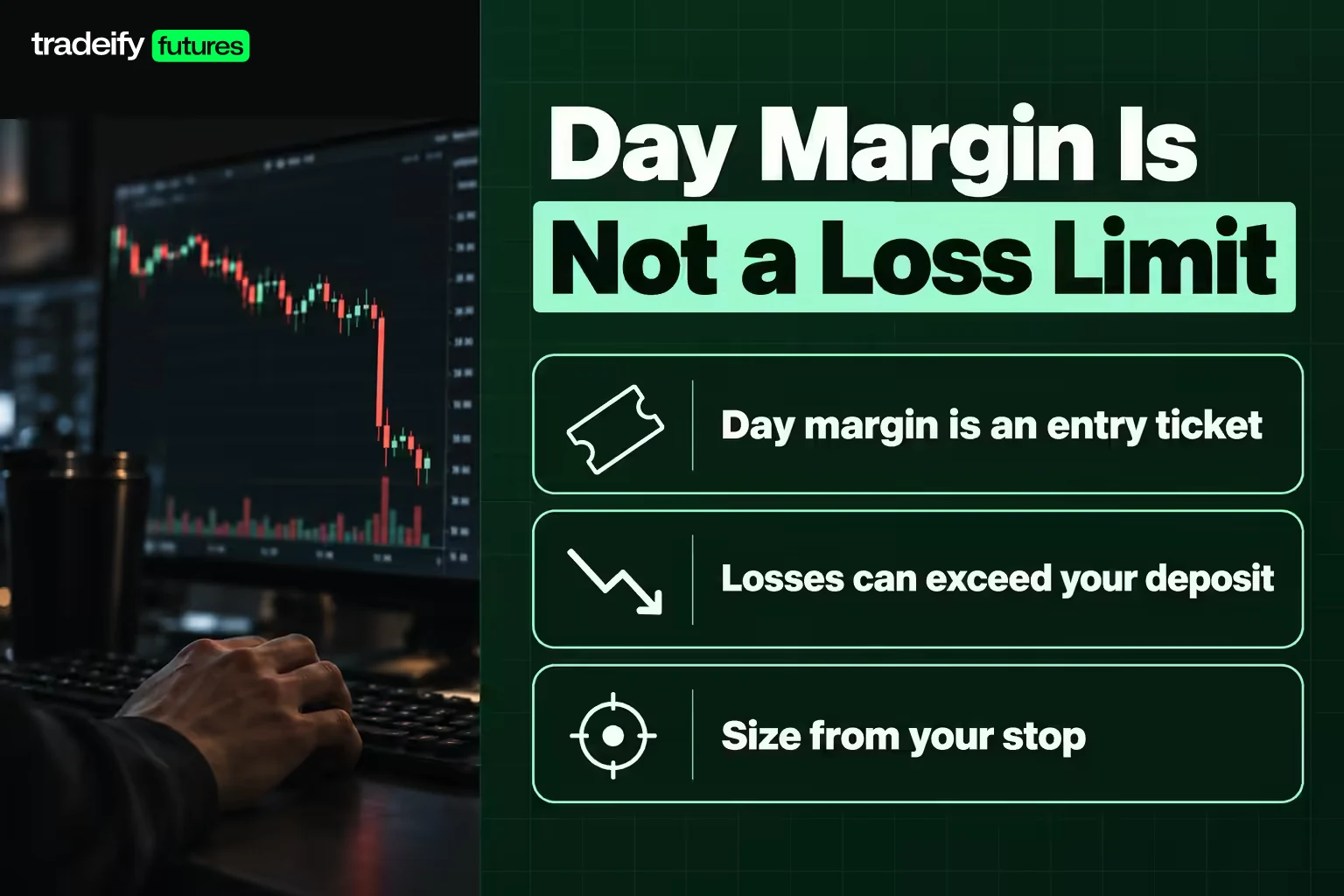
AMP adds an important clarification on its page. Its day trading margin is the amount required to enter a position. It is not the liquidation trigger, and it is not the maximum your account can lose. Futures losses can exceed your deposit. A fast market can gap past the liquidation point, and you remain responsible for any deficit, which Optimus states in its own disclosures.
A few habits keep you out of the liquidation queue:
- Keep excess margin, meaning equity well above the requirement, so one adverse swing does not trip the risk desk.
- Place a hard stop with the entry rather than relying on the broker's liquidation as your exit.
- Close or reduce before the intraday window ends instead of hoping the desk ignores a small shortfall.
- Leave room for commissions and fees, because Tradovate notes that a balance which only covers margin can get orders rejected.
Why Margin Requirements Change
Margin requirements rise for four main reasons, and day traders feel all of them.
The first is scheduled news. Tradovate and NinjaTrader can set intraday margin to 4X their standard rates starting 15 minutes before key releases. At 4X, the ES day margin goes from $500 to $2,000 for anyone opening a new position. Tradovate says the elevated rate stays in place for approximately five minutes after the announcement. The next CPI release, covering October 2026 data, is scheduled for Tuesday, November 10, 2026 at 8:30 AM ET, and the next FOMC meeting is December 8-9, 2026.
The second is volatility. Exchanges raise initial and maintenance margin when price swings widen, because SPAN's scan ranges widen with them, and brokers pass those increases straight through. Brokers can also raise their own intraday rates without notice, and Tradovate's desk can pause trading in a market around major news.
The third is position size, and it tends to surprise traders who are having a good day. Tradovate and NinjaTrader step up to 50% of initial margin on contracts beyond 25 minis or 50 micros, and TradeStation moves to at least 10% of initial on the whole position above its limits. A trader scaling into size can find the day rate disappearing partway through the trade.
The fourth is holidays and early closes. NinjaTrader states that intraday margin is not extended through holiday trading halts, so positions must meet initial margin 15 minutes before an early close.
Delivery and First Notice Margin Rules
Crude oil and gold are physically deliverable contracts, and futures brokers do not want retail day traders anywhere near delivery. Tradovate and NinjaTrader prohibit trading physically deliverable contracts from the business day before the earlier of the last trade date or the first notice date. Any position or order after that roll date is subject to liquidation and fees, whatever your margin looks like.
Equity index futures such as ES and NQ are cash settled, so this rule mainly affects CL, GC and their micros. Trade the front contract your platform lists as current, and roll before the cutoff rather than on it.
Pros and Cons of Low Tradovate Margins
Tradovate's margin schedule sits at the low end of this comparison, and that cuts both ways.
The advantages are real. At the November 2, 2026 rates, a $50 MES margin and a $100 MNQ margin let a small account trade one micro contract with room to spare. The intraday rate runs through the overnight session rather than only US hours, which matters if you trade the London open. The rules are published in one place, including the large-position step-up and the news-release multiplier.
The drawbacks come from the same low numbers. Day margin lets you open far more contracts than your account can survive. Margin can be raised to 4X for new entries 15 minutes before major data releases, which is exactly when many traders want to get in. Liquidation is automatic, and every violation costs an execution fee. Tradovate's liquidation policy reserves the right to close positions with or without notice depending on market conditions.
The trap is treating $500 as the cost of trading ES. It is the minimum the broker will accept before it starts closing your trade.
Checking Current Margin Rates Before You Trade
Margin tables go stale quickly, so build a short check into your routine.
- Open the broker's own margin page and search for the exact contract symbol, because micro and full-size contracts sit on separate rows.
- Read both the day margin and the initial margin, then note the time the intraday window ends for that product.
- Check the policy page for news multipliers, position-size step-ups and balance minimums.
- Confirm the requirement inside your trading platform before you size the trade, since the platform reflects your account's actual settings.
- Recheck before scheduled releases, holidays and roll dates, when requirements change most often.
Inside the platform, look for an excess margin or available margin figure. NinjaTrader defines excess margin as the equity in the account above the minimum margin requirement. That number tells you how close you are to liquidation in real time, which is far more useful than the posted table.
Position Sizing and a Safe Account Balance for Margin Trading
There is no single safe balance for margin trading, but there is a safe way to think about it. Start with the loss you will accept on one trade, then work back to contract count. Margin only tells you whether the broker will let you place the order.
Imagine a trader with a $5,000 account who wants to risk 1% per trade, or $50. On MES, an 8-point stop costs $40 per contract, so one MES fits the plan. On ES, the same 8-point stop costs $400 per contract, which is 8% of the account on a single trade. At $500 each, the broker's day margin would technically cover ten ES contracts with that $5,000. The risk plan says zero.
A few rules separate durable traders from short-lived accounts:
- Keep the margin in use to a small fraction of equity so normal volatility never brings the risk desk into the trade.
- Set a daily loss limit for yourself and stop trading when you hit it.
- Avoid adding contracts to a losing position simply because the margin is available.
- Be flat or fully margined before the intraday window ends, every day, without exception.
- Trade lighter, or not at all, in the minutes around scheduled news.
Prop Firm Contract Limits Versus Broker Margin
Prop evaluation accounts approach position size from a different angle than broker margin. At Tradeify, our Help Center sizes positions by contract limits per account size rather than by a margin figure: a 50K account allows up to 4 minis or 40 micros, and full-size contracts such as GC or CL count the same as one ES against that limit. Every position must be closed by 4:45 PM ET, so carrying a position into overnight initial margin is not part of how our accounts work. Funded accounts are simulated, and the limits that govern risk are the trailing drawdown and, where it applies, the daily loss limit, not a broker's margin table.
Futures Day Trading Margin FAQ
How does margin on futures work?
Futures margin is a good-faith deposit that covers potential daily losses on a contract, not a loan. Gains and losses are credited or debited to your account as prices move and are settled daily. If your balance falls below the required margin, the broker can liquidate the position or issue a margin call.
What are the commissions charged by Tradovate?
As of November 2, 2026, Tradovate's free plan charges $0.39 per side for micros and $1.29 per side for standard contracts. The $99 monthly plan cuts that to $0.29 and $0.99, and the $1,499 lifetime plan to $0.09 and $0.59. Exchange, clearing and NFA fees are charged on top of every plan.
Can you trade micro futures with $100?
Technically yes at some brokers, since Tradovate, NinjaTrader and Optimus listed a $100 MNQ day margin as of November 2, 2026, but you would be trading with zero excess margin. A one-tick move against you can put the account below the requirement and trigger liquidation. Optimus also requires a $100 minimum balance for micros, so $100 leaves no buffer anywhere.
Is $5000 enough to trade futures?
It can be, if you trade micros with a small, fixed risk per trade. At 1% risk, $5,000 allows about $50 of risk per trade, which fits one MES with an 8-point stop. With full-size ES or NQ, a normal stop can risk 8% or more of the account on one trade.
Do intraday margins apply in the overnight session?
At some brokers they do. Tradovate, NinjaTrader, AMP and Optimus apply day margins through the overnight session, with AMP changing index margins around major news. TradeStation and Interactive Brokers offer their reduced index rates only during US daytime hours.
Does the pattern day trader rule apply to futures margins?
No. Futures accounts were never subject to the pattern day trader rule. FINRA replaced that rule for stock accounts with intraday margin standards effective June 4, 2026, and futures margins remain set by exchanges and futures brokers.