



TL;DR: How trade execution works comes down to six stages: entry, pre-trade checks, routing, matching, the fill, then clearing and settlement. Your price is set at matching, and a quote only covers limited size. Buying 60 MES through a thin illustrative book cost $76.25 more than the best offer. Stocks settle T+1; futures settle cash at least twice daily. Best execution is a broker's duty to run a sound process, not a price promise.
You click buy, a fill appears, and the price is a tick or two worse than the one you were looking at. The usual reaction is to blame the platform. Usually the platform did exactly what it was told, and the answer sits somewhere in the trade execution chain you never see.
This guide follows one order from the moment you send it to the moment the trade is settled: who handles it at each stage, where it can go, how the matching engine sets your price, which rules apply, and how to work out why a fill looks wrong.
How Trade Execution Works Step by Step
Trade execution is the completion of a buy or sell order. The key word is completion. Sending an order is only an instruction. Execution is the moment that instruction meets a counterparty and becomes a trade, and until then your position has not changed.
Regulators are blunt about the gap between the two. The SEC points out that online investors do not have a direct connection to the markets. When you press enter, the order goes to your broker, and the broker decides where to send it. Execution is usually quick, but it does take time, and because a price quote is only good for a specific quantity, the price on your screen is not a promise of the price you receive.
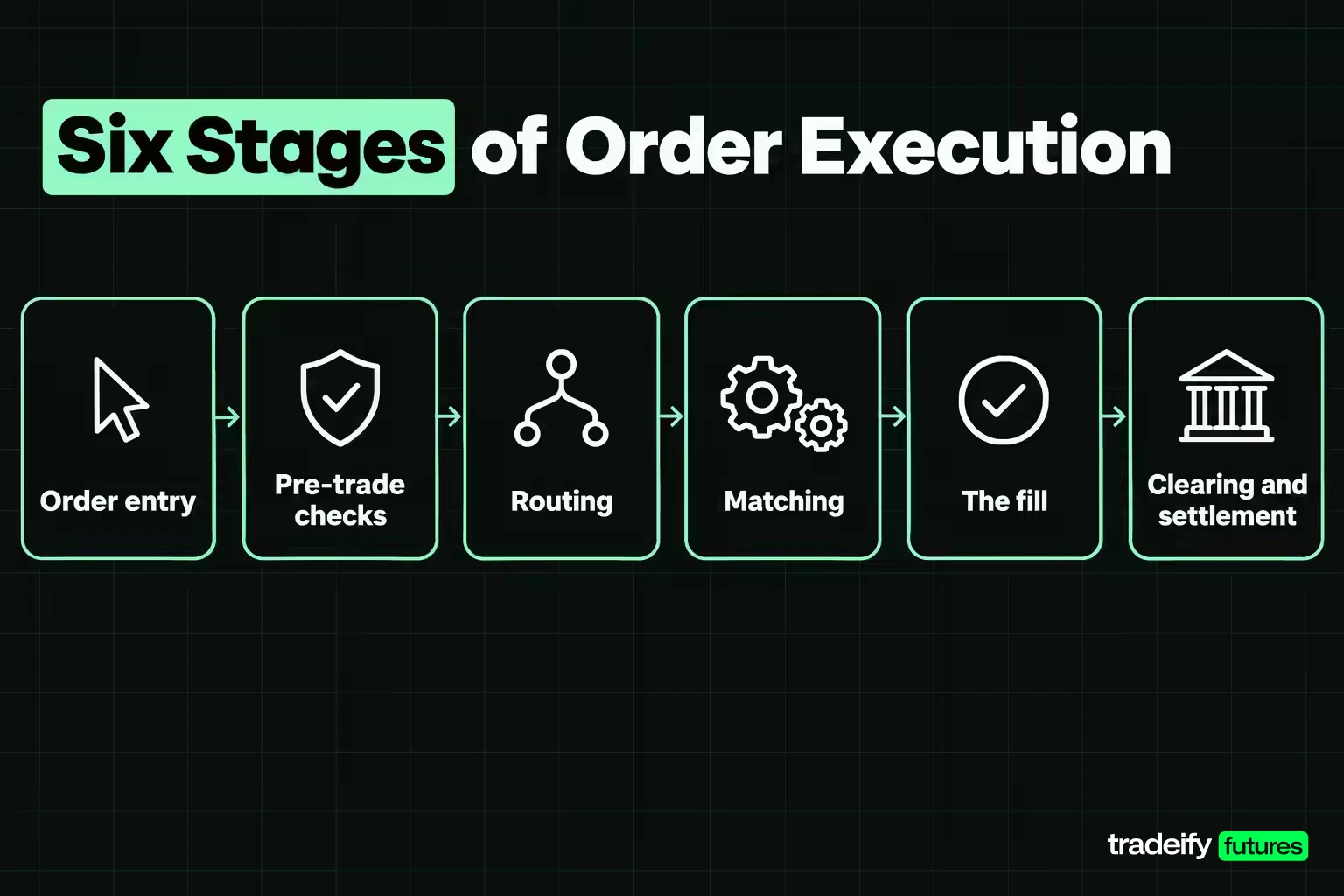
The six stages of order execution
- Order entry. Your platform validates the basics: the instrument, the side, the quantity, the order type and any price you attached.
- Pre-trade checks. Your broker screens the order against its limits and obligations. FINRA describes stock brokers reviewing each order against legal, regulatory and compliance obligations and firm policy. In futures, CFTC Rule 1.73 requires a clearing futures commission merchant (FCM) to set risk-based limits on position size, order size and margin, and to screen electronic orders against them automatically.
- Routing. The order is sent somewhere that can fill it. For stocks that can be an exchange, an alternative trading system (ATS), a wholesale broker-dealer or the broker's own inventory. For exchange-traded futures, the destination is the exchange's own order book.
- Matching. The venue pairs your order with resting orders on the other side. This is the stage that sets your price.
- Fill, partial fill or no fill. The venue reports back. FINRA notes that an order can be filled partially or not at all, which is more likely with stop or limit orders, large orders or thinly traded stocks.
- Clearing and settlement. The trade details go to a clearing firm, which checks that both sides agree on price and quantity. U.S. stock trades settle on T+1, one business day after the trade. Futures positions are marked through the clearing house's settlement cycles instead.
Who controls each stage of execution
| Stage | Who runs it | What you still control | The assumption that breaks |
|---|---|---|---|
| Order entry | Your trading platform | Order type, price, size, timing | That a submitted order is already working |
| Pre-trade checks | Your broker or FCM | Size, exposure, order frequency | That a rejection is a platform fault |
| Routing | Your broker | Directed routing, where offered | That your order goes where you are looking |
| Matching | The venue's matching engine | Nothing after arrival, only what you sent | That the displayed price covers your full size |
| Fill report | The venue, via your broker | What you do with any unfilled remainder | That a partial fill is an error |
| Clearing and settlement | Clearing firm or clearing house | Which broker and account you use | That the fill is the end of the process |
Where a Broker Can Send Your Order
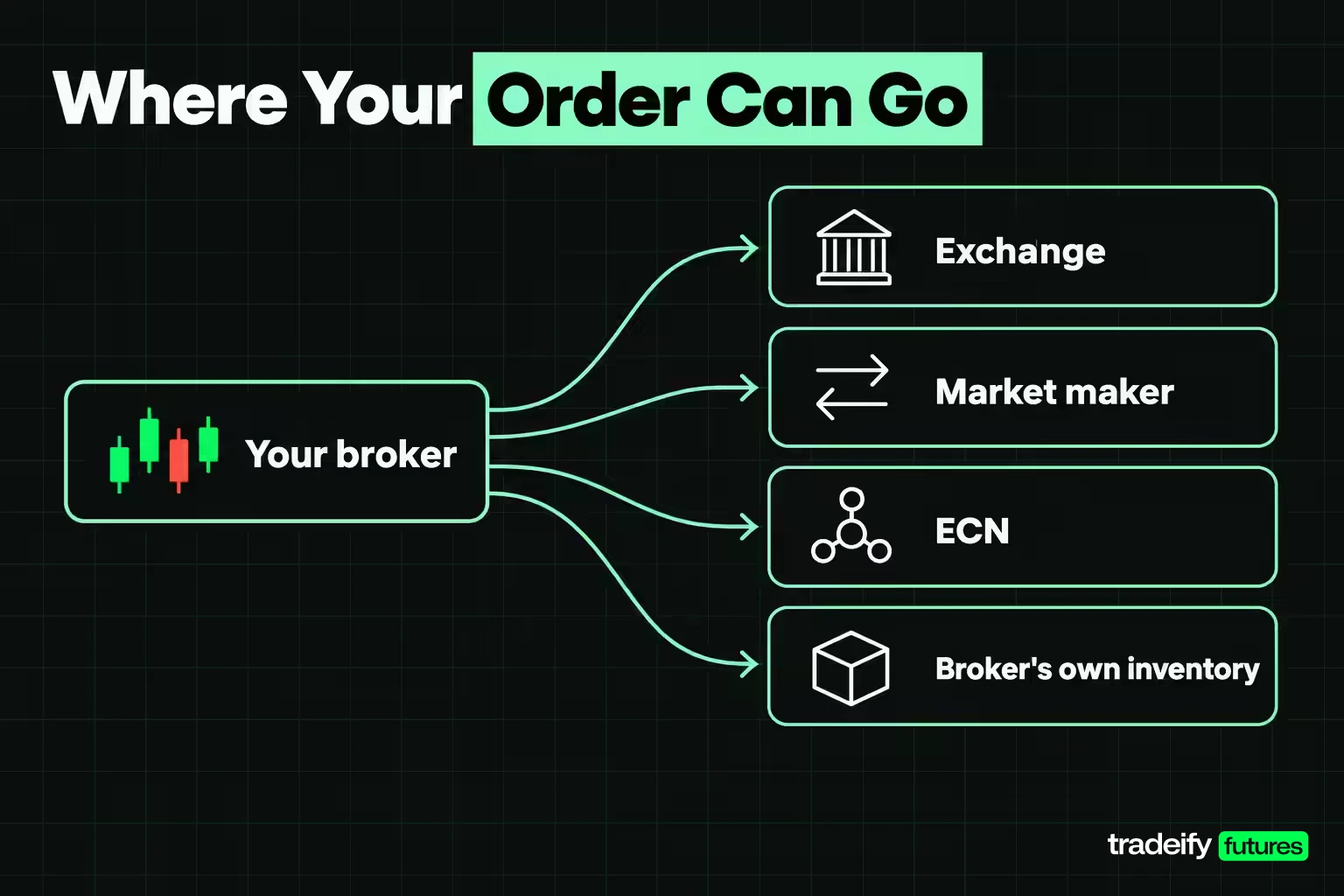
For a stock order, your broker usually has several choices of where to execute it, and the SEC and Investor.gov lay them out plainly.
- The listing exchange or another exchange. The order joins the exchange's book and trades against posted bids and offers.
- A market maker. This is a firm that stands ready to buy or sell at publicly quoted prices. Some market makers pay brokers for sending them orders, perhaps a penny or more per share. That practice is called payment for order flow.
- An OTC market maker, for stocks that trade over the counter.
- An electronic communications network (ECN). ECNs automatically match buy and sell orders at specified prices, and brokers often send limit orders there.
- The broker's own inventory. Filling your order from the firm's own book is called internalization, and the firm may earn the spread between what it paid and what it charges you.
FINRA groups the same choices a little differently: the firm executes the order itself or sends it to an exchange, an ATS or a wholesale broker-dealer, which may fill it from its own inventory or route it onward.
Related lesson: Payment for order flow
The choice matters because each destination offers a different mix of price, speed and fill certainty. A wholesaler may offer a small improvement on the quote. An exchange book offers transparency and queue position. Neither wins for every order, which is why the rules judge how the broker decides rather than naming one correct venue. Payment for order flow is the part worth watching: when the venue pays the broker, the broker has a reason to send orders there that has nothing to do with your fill.
Execution Venues and How They Match Orders
Every venue needs a rule for pairing buyers and sellers. The CFTC glossary calls this a matching algorithm: a set of rules, encoded in software on electronic markets, that decides when and if bids and offers are matched.
Exchange order books and matching algorithms
On an exchange, incoming orders that cross the spread (the aggressor) trade against resting orders. CME Group documents a three-step process: find the best opposite price, find the quantity available there, then allocate that quantity among the resting orders using the product's algorithm.
The algorithm decides who gets filled when several orders rest at the same price.
- FIFO (first in, first out) uses price and time only. The earliest order at a price fills first. On CME, an order loses its place in line if you increase its quantity or change its price.
- Pro rata ignores time and splits the incoming quantity in proportion to the size resting at that price. CME states that its pro rata allocation algorithm is applied only to SOFR futures.
- CME also lists variants such as FIFO with a lead market maker, threshold pro rata and allocation with a top-order priority.
For a trader resting a limit order, this has a direct cost. Under FIFO, joining the queue early matters, and nudging your price a tick to feel safer sends you to the back of the new line. Under pro rata, the size you show matters more than when you arrived. If your limit order sat at the price, saw trades print there and never filled, the queue is usually why.
Related lesson: The order book
Comparing execution venues
| Venue type | How your order is filled | Main execution trade-off |
|---|---|---|
| Exchange order book | Matched against resting orders by price, then the product's algorithm | Transparent price, but you take the depth that is there |
| ECN or ATS | Matched automatically against other participants' orders | Can suit limit orders, but liquidity varies by venue |
| Market maker or wholesaler | A dealer takes the other side at or near the quote | Possible price improvement, with a conflict to manage |
| Internalization | Your own broker's firm takes the other side | Fast, but the firm may earn the spread |
| Retail forex dealer | The dealer is your counterparty and sets the price | No central book to check the price against |
How Brokers Route and Aggregate Orders
Most brokers route orders with automated systems rather than one decision per ticket. That is why regulators judge routing across the whole order flow, not one fill at a time.
The SEC says a broker must evaluate the orders it receives from all customers in the aggregate and periodically assess which markets, market makers or ECNs offer the most favourable terms. FINRA Rule 5310 turns that into a process. A firm that routes on an automated, non-discretionary basis, or that internalizes orders, must run regular and rigorous reviews of execution quality, security by security and by order type, at least quarterly. If another market is giving materially better executions, the firm must change its routing or justify why it is not changing it.
The factors FINRA lists for that review show what routing is meant to balance: price improvement, price disimprovement, the likelihood that limit orders fill, speed, size of execution, transaction costs, customer needs, and any internalization or payment for order flow arrangements.
Order routing reports you can read
The routing decision leaves a paper trail. Under SEC Rule 606, brokers publish quarterly reports naming the venues that receive a significant share of their customer orders, and those reports must describe any payment for order flow or profit-sharing terms. You can also ask a broker where your own orders were routed during the previous six months.
If you trade stocks, those reports answer a question most traders never think to ask: when I press buy, who is actually on the other side of my execution, and does my broker get paid to send it there?
Best Execution and FINRA Rule 5310
Best execution is the broker's duty to seek the most favourable terms reasonably available for a customer's order. FINRA Rule 5310 requires reasonable diligence to find the best market for the security and to trade there so the price is as favourable as possible under prevailing market conditions.
The rule names five factors used to judge that diligence:
- The character of the market, including price, volatility, relative liquidity and pressure on communications.
- The size and type of the transaction.
- The number of markets checked.
- How accessible the quotation is.
- The terms and conditions of the order as the customer communicated them.
Two details are easy to miss. The duty applies whether the firm acts as your agent or trades against you as principal. And FINRA adds that a firm must make every effort to execute a marketable customer order fully and promptly.
Price improvement and its limits
Price improvement is the chance, not the guarantee, of a fill better than the current quote. The SEC's example: you send a market order to sell 500 shares quoted at $20. If it executes at $20.05, you receive $10,025.00, which is $25.00 more than at the quote.
The same SEC guidance adds the catch. The extra time some markets take to seek a better price can also produce a worse one in a fast market, so a broker has to weigh possible improvement against delay. Best execution is a standard for the process. A broker can follow it perfectly and you can still get a poor fill, because a large market order sent into a thin market is expensive no matter who handles it.
Execution Speed, Latency and Delays
Execution takes time, and the market keeps moving while it happens. Latency is the delay between your decision and the moment your order reaches the matching engine, plus the trip back for the confirmation.
Time is spent at every stage: your connection, the platform, the broker's pre-trade checks, the route to the venue, and any queue at the venue itself. Each step is usually short. Together they mean the price you saw is already history by the time your order arrives.
The SEC is direct about what this means for execution timing:
- No SEC regulation requires a trade to be executed within a set period.
- By the time your order reaches the market, the price can be slightly or very different from the quote.
- Firms that advertise their speed of execution must not exaggerate it or fail to mention the possibility of significant delays.
When the venue itself delays execution
Sometimes the delay is a deliberate market state rather than slow plumbing. On CME Globex, an instrument in Pre-Open accepts, modifies and cancels orders but does not match them. During a Pause, only cancellations are allowed. Velocity Logic can put an instrument into a brief Reserved state. An order that seems stuck in one of these states is not lost; it is waiting for matching to resume.
The practical lesson is to treat speed as a risk to plan around, not a feature to buy. A fast connection shortens the gap between quote and fill. It does not remove it, and in a fast market that gap is where most of the surprise comes from. If your strategy only works when you get the exact price you clicked, latency will find that weakness quickly.
What Determines Execution Quality
Execution quality is a mix of outcomes, not one number. FINRA's review list and the SEC's guidance point to the same core factors.
- Price. Whether the fill was at, better than or worse than the quote when your order arrived.
- Speed. How long the order took to execute, which matters most when prices are moving.
- Likelihood of execution. Whether the order fills at all. A limit order protects price and gives up certainty.
- Size of execution. How much of your order filled at the quoted price. The quote only covers a limited quantity.
- Costs. Commissions, exchange and clearing fees, and the spread you cross.
How the execution factors trade off
These factors pull against each other. A market order buys speed and near-certain execution and accepts whatever prices the book offers for your size. A limit order fixes your worst price and may leave you with nothing. A large order improves nothing about the depth available, so the bigger it is relative to the resting size, the further it walks through the book.
Market conditions change the balance too. Fast markets are where slippage risk is highest, and they are also when it is most tempting to hit a market order so you don't miss the move. A good execution decision starts with naming which factor you care about most for this trade: the price, or being in.
Related lesson: Order types overview
Execution Costs on a Worked Futures Order
Execution costs are easiest to see with numbers. This example uses the Micro E-mini S&P 500 (MES), which pays $5 per index point. Its minimum tick is 0.25 points, so one tick is $1.25 per contract. Every price below is a constructed illustration, not a quote.
The illustrative order book
The best bid is 7,000.00. The offer side shows:
- 12 contracts at 7,000.25
- 35 contracts at 7,000.50
- 90 contracts at 7,000.75
- 250 contracts at 7,001.00
The quoted spread is 1 tick. Your plan is to buy 60 contracts.
Related lesson: Tick size and tick value
Two ways to execute the same 60-lot order
| Order sent | Filled | Average fill | Gap vs best offer | Cost of the gap |
|---|---|---|---|---|
| Buy limit at 7,000.75 | 60 of 60 | 7,000.5042 | 0.2542 points, 1.02 ticks | $76.25 |
| Buy limit at 7,000.50 | 47 of 60, 13 unfilled | 7,000.4362 | 0.1862 points, 0.74 ticks | $43.75 on the 47 filled |
The first order is fully marketable. It takes 12 contracts at 7,000.25, 35 at 7,000.50 and the last 13 at 7,000.75, for an average of 7,000.5042. That is 1.02 ticks, or $1.27 per contract, above the best offer, and $76.25 across the position. Nothing malfunctioned. You asked for more size than the best price held.
The second order caps the price at 7,000.50 and fills only 47. The average is better, but 13 contracts are still unfilled. The position you planned your stop and target around does not exist yet, and the temptation now is to chase the last 13 at a worse price than the order you decided against.
Break-even exit price after a costly fill
The first order's 7,000.5042 average is your break-even before fees. The best bid is 7,000.00, so the bid has to rise by about 2 ticks, to above 7,000.50, before selling at the bid gets you back to flat. If you changed your mind and sold all 60 at the 7,000.00 bid straight after the fill, you would lose $151.25 before commissions. Selling at a 7,000.50 bid leaves you $1.25 short of flat; at 7,000.75 you are $73.75 ahead.
The SEC's Rule 605 reports measure this with the effective spread: twice the distance between the fill and the midpoint of the bid and offer when the order arrived. Here the midpoint is 7,000.125, so the effective spread on the 60-lot fill is 0.7583 points, about 3 ticks, against a quoted spread of 1 tick.
Scale matters. The same 0.2542-point gap on 60 full-size E-mini S&P 500 (ES) contracts, at $50 per point, is $762.50. None of this means size is bad. It means the cost of size is known before you send the order, so it belongs in the plan rather than in the post-trade complaint.
Hidden execution costs beyond commission
- The spread you cross on entry and again on exit.
- Market impact: the distance your own size pushes the average fill.
- Slippage between the price you saw and the price when your order arrived.
- The opportunity cost of an unfilled limit order when the market leaves without you.
- Exchange, clearing and platform fees on top of commission.
Related lesson: Slippage explained
How Market Structure Affects Execution
Market structure is the layout of venues, rules and order sizes your order passes through. It changes execution even when your order is identical.
Fragmented stock venues vs a central futures book
A U.S. stock can trade on many exchanges, ATSs and wholesalers at once, which is why stock brokers make routing decisions at all. Exchange-traded futures work differently. CME Rule 520 requires all trading in CME products to occur on or through exchange facilities, and Rule 539 prohibits prearranged or noncompetitive trades, with exceptions for block trades and exchange for related positions. For a futures trader, that means one central order book per contract, and the routing question mostly disappears.
Round lots and odd lots
Stocks trade in round lots, and quantities below a round lot are odd lots. Since the first business day of November 2025, Regulation NMS sets the round lot by a stock's average closing price:
| Average closing price | Round lot size |
|---|---|
| $250.00 or less | 100 shares |
| $250.01 to $1,000.00 | 40 shares |
| $1,000.01 to $10,000.00 | 10 shares |
| $10,000.01 or more | 1 share |
So 300 shares of a $50 stock is three round lots, and 30 shares is an odd lot. For a $400 stock, the round lot is 40 shares, so 30 shares is an odd lot and 80 shares is two round lots. Lot size can change how an order is handled: some brokers, for example, require more than one round lot before they accept an immediate-or-cancel instruction.
Futures session states and price bands
Futures exchanges also have states and limits that affect execution. CME's price banding validates orders and rejects ones priced outside the band, to stop obviously erroneous prices from trading. Pre-Open, Pause and Velocity Logic states change whether orders match at all. An order sent into one of those states behaves differently from the same order sent during continuous trading.
Trade Execution Rules and Investor Disclosures
Trade execution is regulated on both sides of the market, with different rulebooks for securities and futures.
Execution rules for stocks and other securities
- Best execution. FINRA Rule 5310 sets the reasonable-diligence duty and the quarterly review of execution quality.
- Execution quality reports. SEC Rule 605 requires market centers to publish monthly statistics on execution quality, including effective spreads and how orders of various sizes execute relative to the public quotes.
- Routing reports. SEC Rule 606 requires brokers to publish quarterly routing reports and to tell customers, on request, where their orders were routed over the previous six months.
- Settlement. The standard settlement cycle for most U.S. securities trades has been T+1 since May 28, 2024. A stock bought on Wednesday, November 4, 2026 settles on Thursday, November 5, 2026.
- Speed claims. Firms that advertise execution speed must not exaggerate it or hide the possibility of significant delays.
Execution rules for futures
- Pre-trade risk controls. CFTC Rule 1.73 requires clearing FCMs to set risk-based limits and to screen electronic orders against them automatically.
- Competitive execution. CME rules confine trading to exchange facilities and prohibit prearranged or noncompetitive trades outside the listed exceptions.
- Confirmations. CFTC Rule 1.33 requires an FCM to send a written confirmation no later than the next business day after a futures trade.
- Clearing. A derivatives clearing organization substitutes its own credit for that of the two traders, through novation or otherwise, and arranges settlement of their obligations.
Related lesson: Clearing and settlement
How Execution Differs Across Stocks, Options, Futures and Forex
The steps are the same everywhere, but who sits on the other side, and how many places your order can go, changes by market.
| Market | Where orders execute | Who is on the other side | Settlement after execution |
|---|---|---|---|
| U.S. stocks | Exchanges, ATSs, wholesalers or the broker's own inventory | Another investor, a market maker or your broker's firm | T+1 for most trades |
| Listed options | Several exchanges, since many options are multiply listed | Other traders or market makers, after routing | Through a clearing process after the trade |
| Exchange-traded futures | The exchange's central order book | Another trader, then the clearing house after novation | Marked to market at each clearing settlement cycle |
| Retail spot forex | The dealer's own platform | The dealer, which also sets the price and spread | Set by the dealer's terms |
A few notes on the table. Options exchanges began listing many of the same options in August 1999, which gave brokers routing choices, and the SEC has studied payment for order flow and internalization in options too. In retail forex, FINRA notes that the dealer acts as the customer's counterparty and sets the execution price and spread, which creates a conflict of interest and leaves the customer with no central book to check the price against.
Futures Execution From Order to Settlement
Futures execution has the same stages as a stock trade, but each one looks different.
- Your platform sends the order to your FCM or its clearing firm.
- The FCM screens it automatically against risk-based limits on position size, order size and margin, as Rule 1.73 requires.
- The order goes to the exchange's matching engine. CME Rule 548 also requires non-discretionary customer orders received by a Globex terminal operator to be entered in the sequence they were received.
- The engine matches it by price and the product's matching algorithm.
- The fill comes back, and a written confirmation follows by the next business day.
- The clearing house becomes the counterparty to both sides and runs settlement.
Daily settlement instead of T+1
A futures trade does not settle once like a stock purchase. CME Clearing runs settlement cycles at least twice daily for exchange-traded derivatives, once intraday and once at end of day. At each cycle it snapshots prices and positions and pays or collects settlement variation from each clearing member. Gains and losses on an open futures position move as cash at each cycle, rather than waiting until you close it.
Retail vs Institutional Execution
Retail and institutional execution differ mainly in how much discretion the order gives the broker.
A typical retail order is what the SEC calls a held order: the broker must try to execute it immediately. An institutional order is often not held, which gives the broker discretion over price and time. Brokers working not-held orders commonly choose among algorithms such as volume-weighted average price (VWAP), percentage of volume or implementation shortfall, at a chosen level of urgency. Institutional customers can request a report, under Rule 606(b)(3), on how their not-held orders were routed and executed over the prior six months.
The reason for the split is size. A retail order is usually small next to the resting depth, so speed is cheap. An institutional order can be many times the visible depth, so sending it all at once would take every price level in turn and drag the average fill well away from the quote. Working it slowly reduces that market impact and adds the risk that the price drifts while it is being worked. In futures, block trades are a separate route for large size: privately negotiated trades executed apart from the public market, open only to eligible contract participants and subject to product-specific minimum sizes.
Diagnosing a Disappointing Fill Stage by Stage
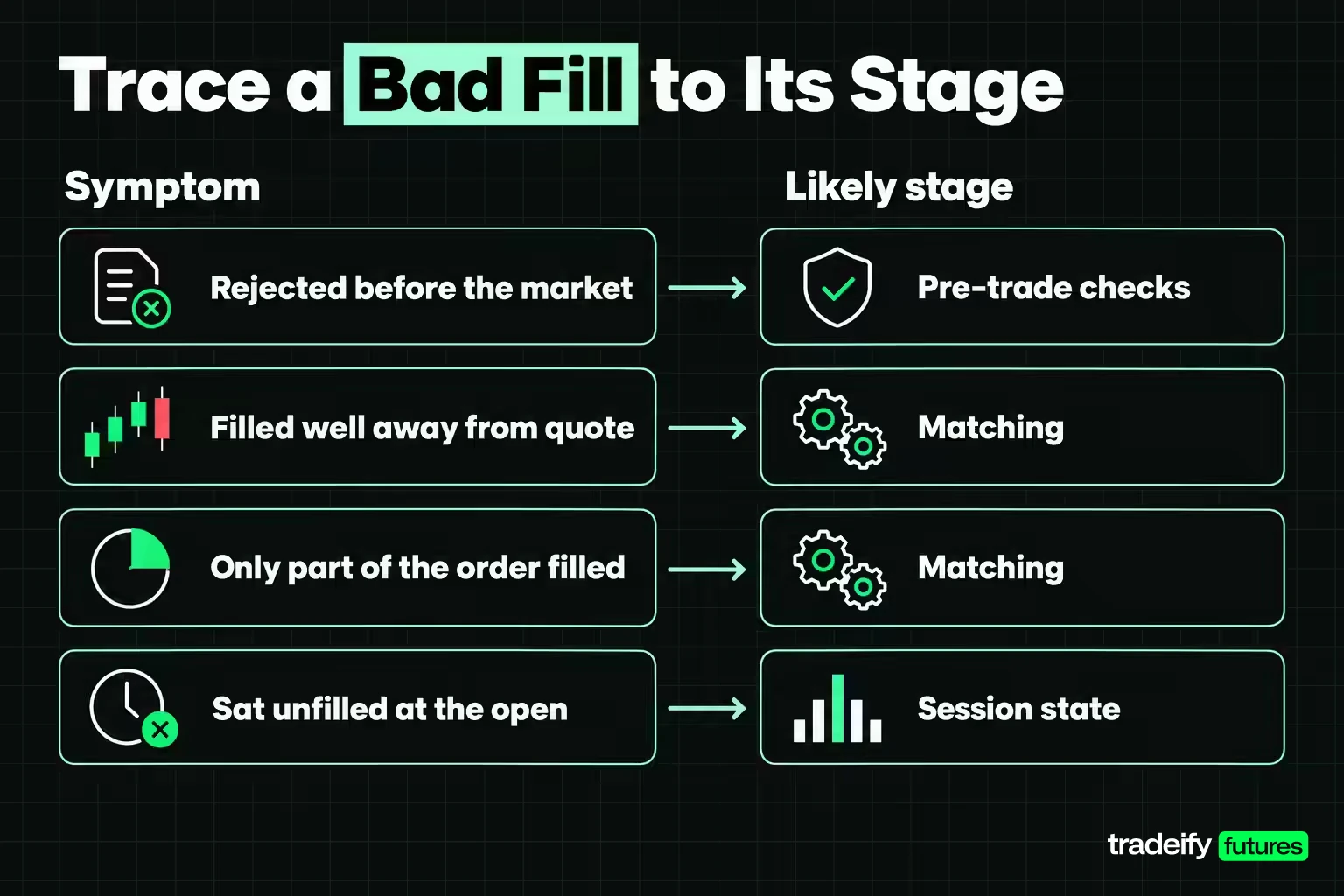
When a fill does not match what you expected, the useful question is which stage produced the surprise. This diagnostic links common execution symptoms to the stage behind them.
| Symptom | Likely stage | What it means | Sensible next step |
|---|---|---|---|
| Order rejected before it reached the market | Pre-trade checks | No order ever worked, so no position changed | Read the rejection reason before resending |
| Rejected at the exchange | Venue validation, such as a price band | The price was outside the venue's accepted range | Reprice inside the band or wait for the market to settle |
| Market order filled well away from the quote | Matching | Your size took several price levels | Rebuild your stop and loss budget from the actual average fill |
| Limit order did not fill | Matching | Nothing traded at your price, or others were ahead of you in the queue | Decide whether the idea still holds before chasing |
| Only part of the order filled | Matching | You hold less than planned, so every size-based figure is wrong | Resize the stop, target and risk to the quantity you hold |
| Order sat without filling at the open | Session state | The market was in Pre-Open or a Pause | Wait for continuous trading or cancel |
| Confirmation differs from the platform display | Reporting and clearing | The confirmed fill is the binding price | Reconcile against the confirmation |
Related lesson: Partial fills
Simulated Fills Versus Live Fills
Simulated fills and live executions can look identical on screen and still mean different things. A simulated order does not reach a real order book, so it does not take real resting size or compete for queue position. The same order could fill in simulation and only partly fill, or not fill, in a live market.
That does not make simulation useless. It is good practice for order entry, platform handling, stops and discipline. It is weaker evidence about fill quality, because the counterparty behind a simulated fill is not the live book. If a strategy depends on tight entries, large size or thin markets, treat its simulated fills as a best case and ask what the same orders would cost against real depth.
On our accounts, evaluations and funded accounts run in a simulated setting, so the fills you see are simulated fills. Our Help Center order-types guide recommends checking the bid-ask spread before using market orders, and our troubleshooting guide lists the common reasons an order is rejected: an unsupported instrument, a drawdown breach that leaves the account in liquidation-only mode, a daily loss limit reached, a position above the account's size limit, or your own platform risk settings. If you use R Trader Pro, its server-side orders keep stops and brackets active on Rithmic's servers even if your internet connection drops.
How to Improve Your Trade Execution
Better execution mostly comes from decisions you make before you click.
- Check depth, not only the quote. Look at how much size rests inside the price you will accept. If your order is larger, expect a partial fill or a walk through the book, and decide now which of the two you would rather have.
- Match the order type to the goal. If you need the position now, accept the price risk of a market order and size it to the depth. If you need the price, use a limit order and accept that it may not fill.
- Price the slippage first. Multiply the expected gap in points by the contract multiplier and by your size. A one-tick gap on 60 MES is $75 before you have done anything wrong.
- Be deliberate around fast moments. The open, major data releases and sharp moves are when slippage risk is highest, so either size down, use limits, or accept the cost knowingly.
- Rebuild the plan from the actual fill. A worse average or a partial fill changes the stop distance, the target and the risk. Do the maths again with the real numbers.
- Judge the process, not one fill. A good fill after a careless order is luck. A poor fill after a well-sized order may just be the market. And a rejected order is information: read the reason before you hit resend.
Related lesson: Position sizing
Directing your own execution
You have more control than most traders use. The SEC says you may be able to ask your broker to direct a trade to a particular exchange, market maker or ECN, although some brokers charge for it, and some offer active traders direct routing. Under FINRA Rule 5310, if you give an unsolicited instruction to route to a particular market, the broker does not have to make its own best execution decision beyond that instruction, but it still has to handle the order promptly and on its terms. Directing your order makes you responsible for the venue choice, so it is only worth doing if you know why that venue is better for this order.
The other lever is information. Read your broker's Rule 606 routing report, ask where your own orders went over the previous six months, and ask how often orders get price improvement. A broker's execution practices are easier to judge when you know where your orders actually go.
How Trade Execution Works FAQ
What is the trade execution process?
The trade execution process is the chain from order entry through pre-trade checks, routing, matching at a venue, the fill report, and clearing and settlement. Execution itself happens at matching, when your order meets a counterparty. The other stages decide whether, where and how it gets there.
How long does trade execution take?
There is no fixed time: electronic execution is usually quick, but no SEC rule requires a trade to be executed within a set period. The time that matters is the gap between the quote you saw and the market when your order arrives. In fast markets that gap can be large even when the system is working normally.
Does a market order always fill at the price on screen?
No. A quote only covers a limited quantity, and the market can move before your order arrives. A market order takes whatever prices are available for its full size, which can mean several price levels.
What does best execution mean?
Best execution is a broker's duty to use reasonable diligence to get the most favourable terms reasonably available for your order. FINRA judges it against factors such as market conditions, order size and type, the markets checked and how accessible the quote was. It is a process standard, not a price guarantee.
When does a trade settle after execution?
Most U.S. stock trades settle T+1, one business day after the trade date. Futures do not settle once; the clearing house marks positions and moves settlement variation at least twice a day.
Why do two traders get different fills on the same setup?
Because the fill depends on the book when each order arrives, not on the chart. Size, order type, route, queue position, the matching algorithm and timing all sit between the same signal and two different average prices.
What is the 3-5-7 rule in trading?
The 3-5-7 rule is an informal risk heuristic: risk no more than 3% of the account on one trade, keep total open risk at or under 5%, and aim for winners of at least 7%. It is not an exchange or regulatory rule, versions differ, and it says nothing about how an order is executed.
This article is education, not investment advice or a recommendation to trade any instrument or use any order type. Futures and other leveraged products carry substantial risk, and losses can exceed what you expect or deposit. Every price in the worked example is a constructed illustration and excludes commissions and fees. Evaluation and funded prop accounts are simulated, and simulated fills may not reflect how the same orders would execute in a live market.


