



TL;DR: Commodity spot vs futures prices differ because spot prices a cash trade now and futures price a contract month later. Financing, storage and insurance usually put futures above spot (contango); tight supply flips it to backwardation. Basis is cash minus the nearest futures, and it narrows as delivery approaches. Always compare the same grade, location, unit and contract month before reading the gap.
On November 3, 2026, a barrel of WTI crude at Cushing, Oklahoma, was quoted at $99.64 in the spot market. The December crude oil futures contract settled at $96.09 the same day, and June 2027 settled at $86.45. Same oil, same delivery hub, three different prices.
None of those numbers is wrong. They answer different questions. The spot price says what a barrel is worth for prompt delivery today. Each futures price says what the market will pay today for a standardized contract that settles in a named month.
That matters before you form any view on direction. You can be right that supply is tight right now and still pick a futures month whose price already reflects that tightness, or one that sits $13 below the spot quote for reasons that have nothing to do with a coming crash.
What a Commodity Spot Price Means
A commodity spot price is the price for the physical commodity bought or sold for immediate delivery. The CFTC defines the spot price as the price at which a physical commodity for immediate delivery is selling at a given time and place. It uses "cash price" for the same idea: the marketplace price for actual commodities delivered through customary market channels. The physical good itself is called the cash commodity, spot commodity or actuals.
"Immediate" does not always mean the barrel, bushel or ounce changes hands this second. Each cash market has its own settlement conventions, and those conventions are part of the price.
What a commodity spot quote must specify
A commodity spot price is defined by the CFTC as the price for immediate delivery at a given time and place. "Given time and place" is the part traders tend to skip, and it causes most bad spot vs futures comparisons. A spot quote only means something when it names:
- The grade or quality of the commodity
- The location where delivery happens
- The unit and currency (dollars per barrel, per troy ounce, per bushel)
- The date and time of the quote
Two real benchmarks show how specific this gets. The EIA's Cushing WTI spot series is the price of WTI crude free on board at Cushing, Oklahoma, in dollars per barrel. The LBMA Gold Price is the global benchmark for unallocated gold delivered in London. Both are spot prices, but each is tied to one place and one form of the metal or oil.
Grain is even more local. A country elevator's cash bid for corn reflects freight to a terminal, handling, storage, quality discounts and how much corn is sitting nearby. Two elevators a hundred miles apart can post different spot prices on the same morning, and both are correct.
What a Commodity Futures Price Means
A commodity futures price is the price of one standardized exchange contract for one delivery month. FINRA describes commodity futures as legally binding agreements to buy or sell a particular commodity at a future date for a fixed price and quantity. The exchange fixes every term except price, so the only thing traders negotiate is the number on the screen.
Those fixed terms are what give the number meaning. For crude oil (CL) the contract is 1,000 barrels of light sweet crude, quoted in dollars and cents per barrel, with a minimum move of $0.01 per barrel worth $10.00 per contract, delivered at Cushing. For gold (GC) it is 100 troy ounces, quoted per troy ounce, with a $0.10 tick worth $10.00.
Every futures month is a separate price
The December crude contract and the June crude contract are different instruments with different prices. A futures quote without a month is incomplete in the same way a spot quote without a location is incomplete.
Most futures positions never reach delivery. The CFTC notes that most contracts, by volume, are closed by an offsetting trade before expiry. The delivery terms still matter, because they are what tie the futures price back to the physical market.
Related lesson: The fields that define quantity, tick value, delivery and settlement
Commodity Spot vs Futures Prices Compared
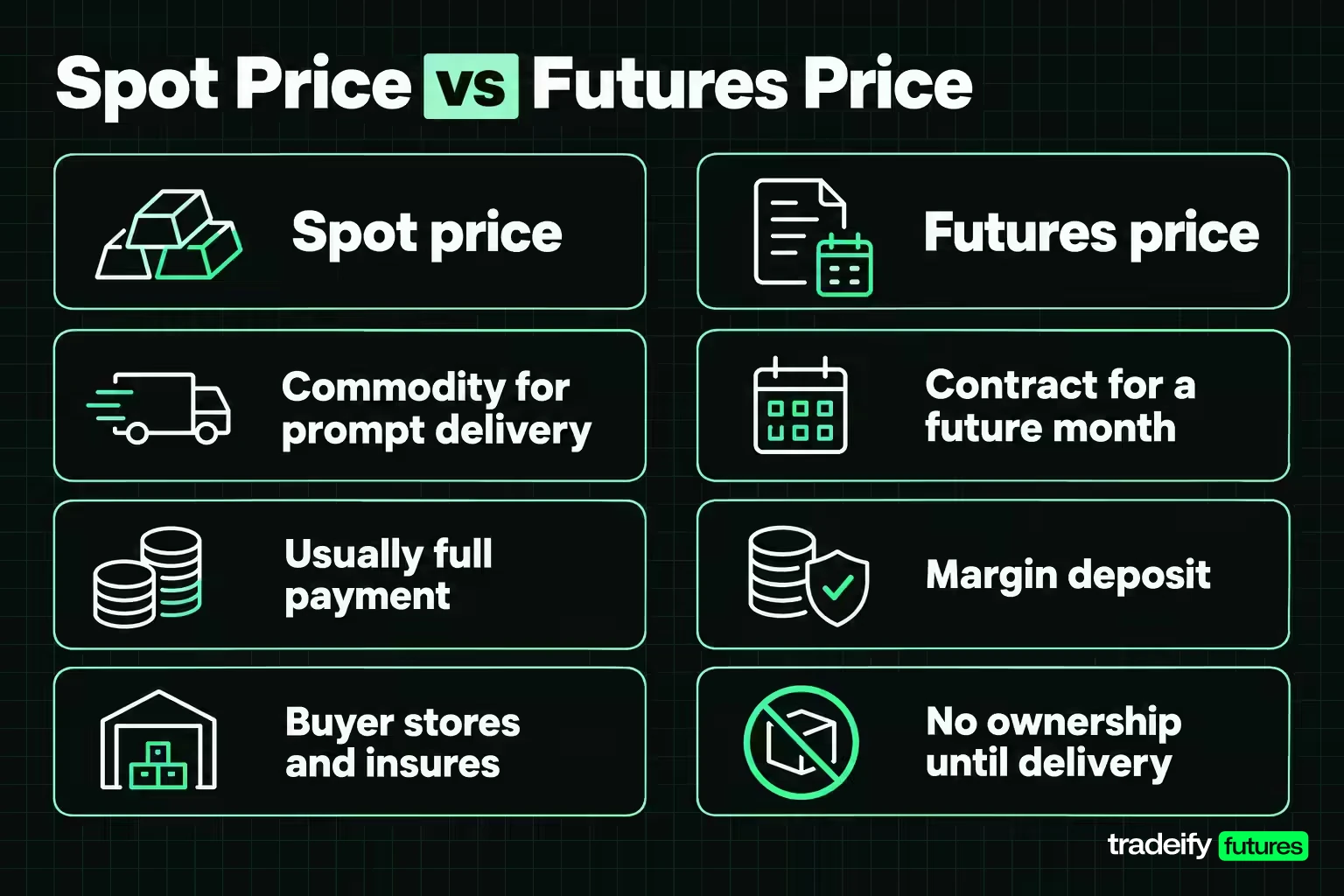
The cleanest way to see the difference between commodity spot and futures prices is to compare what each transaction actually involves.
| Feature | Spot price | Futures price |
|---|---|---|
| What it prices | A physical commodity for prompt delivery | A standardized contract for a named future month |
| Terms | Set by the local cash market or a benchmark | Fixed by the exchange contract specification |
| Where it trades | Dealers, elevators, terminals, OTC markets | A regulated futures exchange, centrally cleared |
| How many prices | One per grade, location and time | One per contract month along the curve |
| Ownership | Buyer owns and must store, insure and move the good | No ownership until delivery, if any |
| Upfront money | Usually full payment | A margin deposit, often 3-12% of notional |
| Typical users | Producers, processors, refiners, jewelers | Hedgers, speculators, spread traders |
| How it ends | Delivery and payment | Offset, cash settlement or physical delivery |
The short version: spot is a price for owning the commodity now, and futures is a price for agreeing today on a transaction later. FINRA points out that holding the physical good means dealing with transportation, storage and insurance. A futures position avoids those chores, but the market prices them into the gap between the two.
A forward contract sits between the two. The CFTC describes it as a cash transaction with a future delivery date and personalized terms. It is private, so it does not produce one public price the way an exchange contract month does.
How Futures Prices Are Set From the Spot Price
Futures prices are anchored to the spot price by the cost of carry. The CFTC defines carrying charges as the cost of storing a physical commodity or holding a financial instrument over time, including insurance, storage and interest on the money tied up. A CFTC staff paper describes the standard link: under no-arbitrage reasoning, spot and futures commodity prices are connected by a net cost-of-carry factor covering the time value of money, storage and a possible convenience yield.
In plain terms:
Futures price ≈ spot price + financing + storage and insurance − convenience yield
Convenience yield is the value of having the physical commodity on hand right now. A refinery that would have to shut down without crude places a high value on barrels in the tank today. When that value is large, it can outweigh storage and financing and pull futures below spot.
Worked example of carry pricing for gold
Here is an illustrative calculation with round numbers.
- Spot gold: $4,000 per ounce
- Financing: 4% a year
- Storage and insurance: 0.2% a year
- Time to the futures month: six months
Carry rate: 4% + 0.2% = 4.2% a year, or 2.1% for six months. Fair value: $4,000 x 1.021 = $4,084. The carry is $84 per ounce, which is $8,400 on one 100-ounce contract.
Gold sits close to this model because it is cheap to store and rarely scarce for immediate use, so convenience yield is small. That is the short answer to why futures are often more expensive than spot: the futures buyer avoids paying to finance and store the metal, and the price includes that saving.
How arbitrage keeps futures prices near spot plus carry
Arbitrage is what stops a futures price drifting far from spot plus carry. Take illustrative spot gold at $4,000 with a six-month fair value of $4,084, and suppose the six-month gold contract traded at $4,120. That is $36 above fair value, or $3,600 per 100-ounce contract. A dealer could buy spot gold, sell the futures, store the metal and deliver it, capturing the $36 before costs. That buying of spot and selling of futures pushes the two prices back toward the carry relationship.
If the gold futures traded at $4,050, $34 below fair value, a holder of physical gold could sell spot and buy futures instead. The reverse trade only works for someone who already owns inventory, which is one reason carry pricing holds more tightly in gold than in commodities that are hard to borrow or store.
Related lesson: What carrying an asset costs and how it sets futures prices
How Spot and Futures Prices Move Together
Spot and futures prices usually move together because the same news drives both. A pipeline outage, a crop report or a shift in interest rates changes the value of the physical good and of the contracts written on it. CME's grain course describes cash and futures prices as highly correlated for this reason.
They do not move by the same amount. The spread between them changes as storage costs, inventories and expectations shift, and different contract months react differently. A short-term supply shock usually hits spot and the front month hardest while deferred months move less.
Convergence as delivery approaches
The link tightens as a contract nears expiry. The CFTC defines convergence as the tendency of physical and futures prices to approach one another, usually during the delivery month. CME explains why: futures positions can be converted into cash commodity at expiration.
If cash grain sits well below futures near delivery, a warehouse approved for delivery can buy the cash grain, sell futures and deliver. If cash sits above futures, a trader can buy futures, take delivery and sell the grain into the cash market. Each trade narrows the gap, and the delivery provision exists to make that pressure real.
When the spot and futures link breaks down
Spot and futures convergence depends on someone being able to make or take delivery. On April 20, 2020, the May WTI futures contract traded as low as -$40.32 per barrel, the first negative price since NYMEX crude trading began in 1983, according to the EIA. Storage at Cushing was scarce and expensive, so holders who could not take delivery paid others to take contracts off their hands.
The EIA noted that longer-dated WTI contracts stayed positive and that the event was driven by the timing of one contract's expiry. The spot and futures relationship did not vanish. It became very expensive to enforce for anyone without access to storage.
Basis Between Spot and Futures Prices
Basis is the number that tracks the gap between spot and futures prices. The CFTC defines it as the spot or cash price minus the price of the nearest futures contract, usually measured against the contract next to expire.
Basis = cash price − nearby futures price
- Negative basis (cash under futures) is common in markets with storage costs.
- Positive basis (cash over futures) shows up when nearby supply is tight.
- A basis that moves up, from −$0.30 to −$0.12, for example, is called strengthening.
- A basis that moves down is called weakening.
Some platforms, and some equity and currency markets, quote basis the other way round (futures minus spot). Always check the convention before comparing two basis numbers.
Worked basis example for wheat
This illustration uses round numbers for a local wheat bid against the nearby Chicago wheat futures contract, which covers 5,000 bushels.
| Observation | Local cash bid | Nearby futures | Basis |
|---|---|---|---|
| First | $5.80 | $6.10 | −$0.30 |
| Closer to delivery | $6.00 | $6.12 | −$0.12 |
The basis strengthened by $0.18 per bushel. On a 5,000-bushel contract, that is $900. A farmer who hedged by selling futures gains from that strengthening, because the cash sale improved more than the futures position lost.
The gap will not always close to zero at a country elevator. Freight to the delivery point and quality differences stay in the local basis even at expiry. Convergence is cleanest at the delivery location and grade written into the contract.
Related lesson: How basis is calculated in each market and why it converges
Contango When Futures Prices Sit Above Spot
Contango is the market state in which futures prices are higher in each later delivery month than in the nearest one. The CFTC also calls this a carrying charge market. It is the normal shape for a commodity that is easy to store and in steady supply, because each extra month adds more financing and storage.
Reading a real contango curve in gold
Here are COMEX gold futures settlements for November 3, 2026. These are a dated snapshot and will have changed by the time you read this.
| Gold contract | Settlement on Nov 3, 2026 |
|---|---|
| December 2026 | $3,940.4 |
| February 2027 | $3,972.5 |
| June 2027 | $4,037.3 |
From December to June the price rises $96.9 per ounce, or $9,690 on one contract. That is about 2.5% over six months, roughly 4.9% a year. With SOFR at 3.97% on the same date, the curve implies a carry about one percentage point above the overnight funding rate, which is the kind of gap storage, insurance and dealer financing costs can explain.
What contango does and does not tell you
Contango does not mean the market expects gold to rise 4.9% a year. Most of that slope is the price of time. Read every upward-sloping curve as a bullish forecast and you end up confusing carry with expectation, which is an easy mistake when the chart simply looks like it is going up.
Contango does matter to anyone who holds futures exposure across many months. Each time a long position is rolled from an expiring contract into a more expensive later one, it pays up. FINRA warns that this is why the long-run performance of a futures investment can diverge significantly from the spot price of the same commodity.
Backwardation When Spot Prices Sit Above Futures
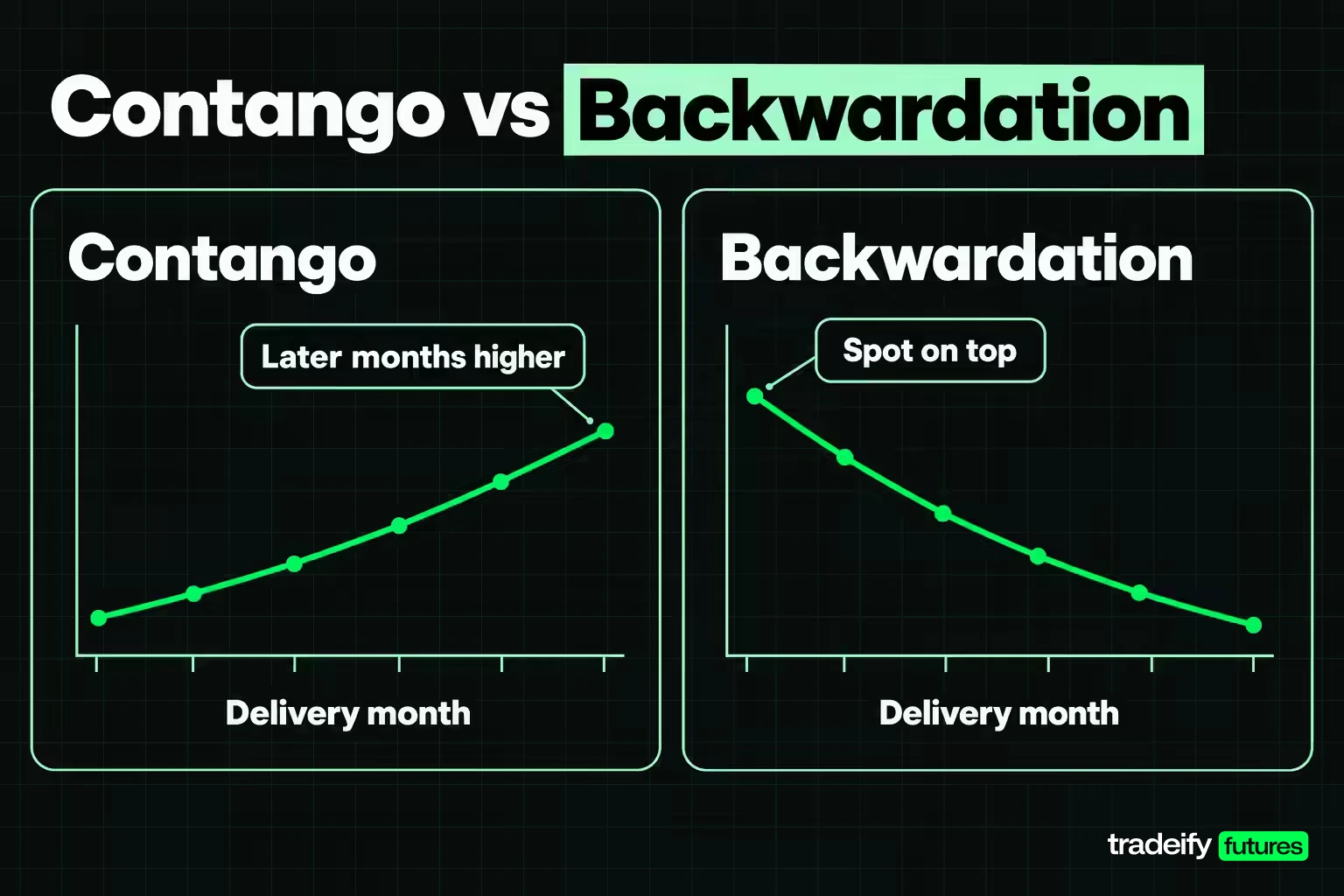
Backwardation is the opposite state: futures prices get lower in more distant delivery months, and nearby prices, including spot, sit on top. The CFTC's own example is January gold at $360.00 and June gold at $355.00, a $5.00 backwardation.
Backwardation usually means physical supply is valuable right now. When inventories are thin, the convenience yield of holding barrels or bushels today outweighs the cost of storing them, so buyers pay more for prompt delivery than for later delivery.
Reading a real backwardation curve in crude oil
The WTI market on November 3, 2026, is a clear case. These figures are a dated snapshot from the EIA spot series and CME settlements.
| WTI price | Nov 3, 2026 |
|---|---|
| Cushing spot | $99.64 |
| December 2026 futures | $96.09 |
| January 2027 futures | $94.77 |
| March 2027 futures | $91.14 |
| June 2027 futures | $86.45 |
The basis, spot minus the nearest futures, was +$3.55 per barrel, or $3,550 on one 1,000-barrel contract. December to June fell $9.64, which is $9,640 per contract. June traded about 13% below spot.
What backwardation does and does not tell you
A falling curve is not a forecast that oil will be $86.45 in June. It says buyers want oil now badly enough to pay a premium for it, and on what they know today, oil delivered later is worth less to them. If supply loosens, the curve can flatten with spot falling, futures rising, or both.
For a holder who rolls long futures exposure, backwardation works the other way from contango: each roll sells an expensive expiring month and buys a cheaper later one. That roll effect is not free money, because the cheaper later contract can still drift up toward spot or fall with it.
Gold Spot Price vs Gold Futures Price
The gold spot price usually means the price of physical gold for immediate settlement, often quoted from the London market, where the LBMA Gold Price is the benchmark for unallocated gold delivered in London. Gold futures prices come from COMEX contracts, such as the 100-ounce GC and the 10-ounce Micro Gold (MGC), each tied to a specific month.
Three things separate them:
- Time. Gold futures normally sit above spot by roughly the cost of financing and storing the metal until the contract month, as the November 3, 2026 curve showed.
- Delivery. COMEX gold is delivered through warrants issued by exchange-approved depositories, while the LBMA benchmark refers to unallocated gold in London. Location and form can open a small gap of their own.
- Size and money. One GC contract at an illustrative $4,000 controls $400,000 of gold; one MGC controls $40,000. A $10 move is $1,000 on GC and $100 on MGC.
When gold futures trade unusually far above or below spot, the cause is usually in the plumbing: financing costs, shipping metal between vaults, or a squeeze around a delivery month. Spot and the nearby contract tend to come back together because dealers can move metal to close the gap.
How Futures Settlement Pulls Prices Back to Spot
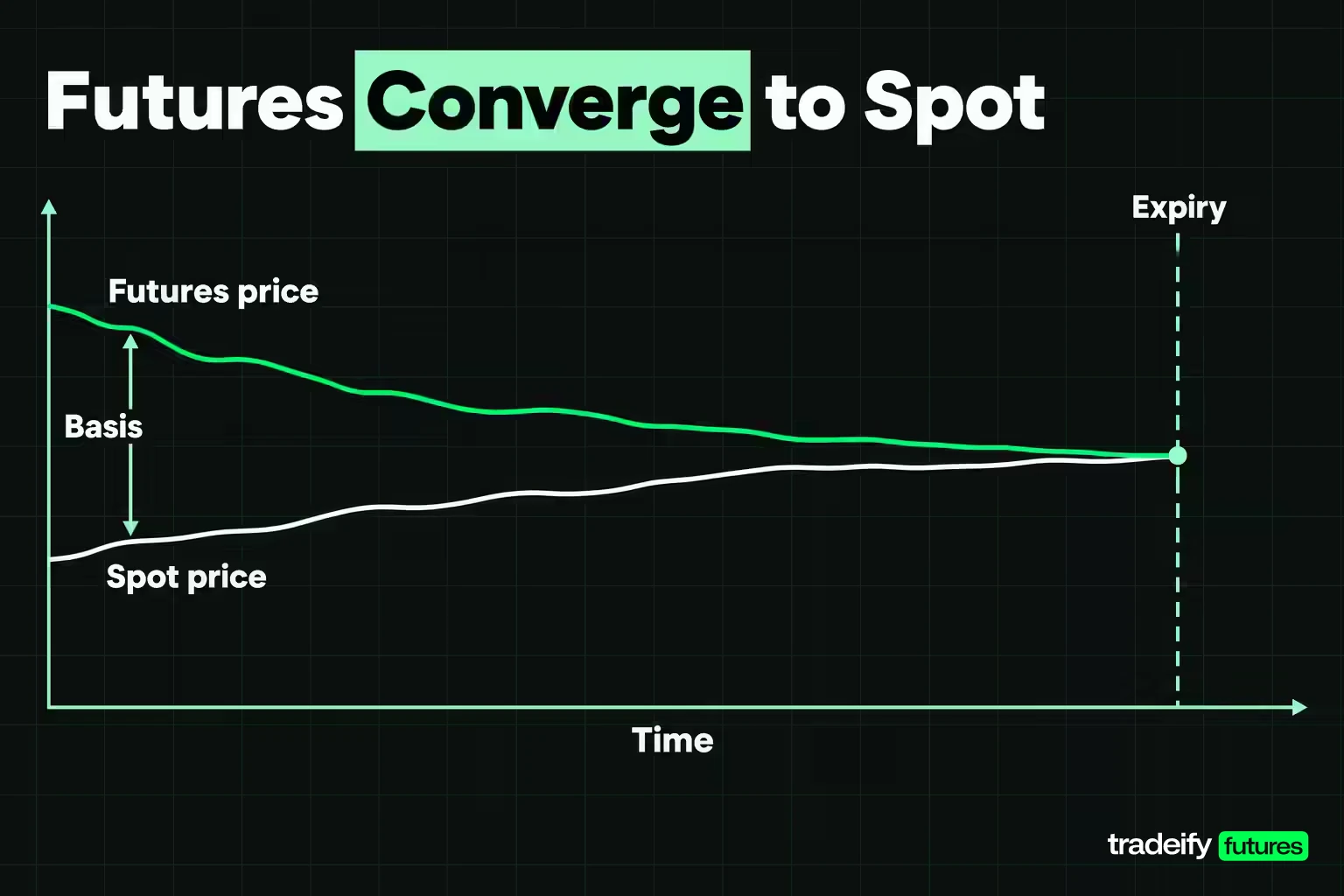
Futures settlement is the mechanism that forces futures prices to meet the spot market at expiry. The CFTC defines delivery as the tender of the actual commodity, its cash value, or a delivery instrument such as a warehouse receipt to settle a futures contract. Contracts end in one of two ways.
- Physical delivery. The short delivers the commodity and the long pays the final settlement price. CL crude is delivered at Cushing, Oklahoma; GC gold is delivered by warrant. Because the long can actually receive the commodity, the futures price has to converge to the cash price at the delivery point.
- Cash settlement. The contract is closed with a payment based on an index or reference price, with no physical good changing hands. Micro WTI (MCL), at 100 barrels, is financially settled against the CL final settlement price.
Why traders exit before delivery
Most speculators close or roll before the delivery period starts. Gold's First Notice Day, the first day the exchange can assign delivery notices, is the last business day of the month before the delivery month. CL trading ends three business days before the 25th calendar day of the month before delivery.
FINRA gives a blunt reason to avoid holding through those dates: a speculator who forgets could end up dealing with a physical commodity, such as accepting delivery of 40,000 pounds of cattle. The April 2020 crude episode showed the other side of the same problem, when holders without storage paid to get out.
Related lesson: How cash-settled and physically delivered contracts finish
Margin and Leverage Behind a Futures Price
A spot purchase usually requires full payment. A futures position requires a margin deposit, and that changes what the futures price means for your account. CME explains that futures margin is money you deposit and keep with your broker, not a down payment, and you do not own the commodity. It typically runs about 3-12% of the contract's notional value.
There are two levels:
- Initial margin is the amount needed to open the position, set by the clearinghouse, and brokers may require more.
- Maintenance margin is the minimum you must keep. Falling below it can bring a margin call back up to the initial level, or the position can be liquidated.
Worked example of futures leverage in crude oil
Take an illustrative crude oil price of $90 per barrel. One CL contract controls 1,000 barrels, so its notional value is $90,000. At CME's typical 3-12% range, margin would sit somewhere between $2,700 and $10,800, and exchanges change these numbers when volatility changes, so treat them as a range, not a quote.
A $1 move in crude is $1,000 on that contract. A move the size of the $3.55 spot-futures gap from the November 2026 example is $3,550, which can be most or all of a low margin deposit. Margin is a performance bond, not the maximum loss.
Using Commodity Spot and Futures Prices in Trading Decisions
The gap between commodity spot and futures prices affects which contract you trade, what a chart shows you and what holding a position costs. Before acting on that gap, run four checks. They take about a minute, and they catch most of the readings that look like a signal but are really a mismatch.
Are the spot and futures quotes comparable?
Match commodity, grade, location, currency, unit and time. A regional cash bid compared with a futures contract that delivers somewhere else will always show a gap, and part of that gap is freight and quality, not market signal.
Which futures contract month is being compared to spot?
"Futures are above spot" means nothing without a month. In the November 2026 crude curve, every listed month was below spot, but by different amounts. In a mixed curve, the front month can sit below spot while later months trade above it.
What can carry or scarcity explain?
List what is known: interest rates, storage costs, inventory levels, season, delivery constraints. If the slope roughly matches carry, as gold's did, there is little extra signal in it. If the slope is far from carry, as crude's steep backwardation was, ask what makes prompt supply so valuable.
What would change the spot vs futures reading?
Any reading of a spot and futures gap needs an exit condition. Name the evidence that would undo the interpretation, such as an inventory report, a storage disruption, weather, or the front contract rolling off. Track the spread over several days instead of building a view from one screenshot.
What the spot and futures gap means for futures traders
For a futures trader, the spot price is context and the contract month is the position.
- Your profit and loss comes from the contract month you trade, not from the spot price on the news.
- Continuous charts stitch contract months together. A jump at the roll can be the gap between two months, not a real move in the commodity.
- Curve shape describes carry and scarcity. It is context, not a trade signal by itself.
- Rolling a position across months adds or subtracts the calendar spread every time.
The November 3, 2026 settlements show both directions. Rolling a long gold position from December to February at those prices meant buying back in $32.1 per ounce higher, $3,210 per contract, which is the cost of carry being paid. Rolling a long crude position from December to January meant re-entering $1.32 per barrel lower, $1,320 per contract, because the curve was in backwardation. Neither number is profit or loss on its own, since the later contract can still move toward spot or away from it.
Related lesson: How continuous futures charts join contract months
Common Mistakes With Spot and Futures Prices
Mistakes with commodity spot and futures prices show up repeatedly, usually because the screen makes two different transactions look like one.
Treating the front month as the spot price
The most active futures contract is liquid and widely quoted, but it is still a named delivery month. On November 3, 2026, December crude was $3.55 below Cushing spot. Calling the front month "the oil price" hides that gap.
Mixing basis conventions
The CFTC uses cash minus futures; equity and currency desks often quote futures minus spot. A "+$3" basis in one report and a "−$3" basis in another can describe the same market.
Calling contango bearish and backwardation bullish
Curve shape reflects carry, inventories and convenience yield. A gold curve rising about 4.9% a year is mostly the price of time, not a forecast.
Sizing from the price instead of the contract
A crude quote of $90 looks small. The contract it belongs to is $90,000 of oil, and each $1 is $1,000. Position size has to come from contract value and stop distance, not from how cheap the number on the screen looks.
Related lesson: Converting a price move and stop distance into contract-level risk
Spot and Futures Prices for Intraday Futures Traders
Intraday futures traders never hold a contract long enough for carry, delivery or convergence to touch the account directly. What they trade is the moment-to-moment futures price of one contract month. Spot and curve structure still matter as context: a steep backwardation tells you prompt supply is tight, which can mean news-driven swings in the front month, and the contract you choose sets your dollar risk per tick.
On our accounts, every position is closed by 4:45 PM ET, with no overnight, weekend or swing holds, so delivery and carry never reach a Tradeify trader's position. A roll for us simply means switching which contract month you trade in the next session. Our supported list includes crude oil (CL, MCL, QM), gold (GC, MGC), silver, copper and grains such as corn and wheat, and accounts are sized by contract limits: a 50K account allows 4 minis or 40 micros, and one GC or one CL counts as one mini. Funded accounts are simulated.
Commodity Spot and Futures Price FAQ
What does "spot price" mean?
The spot price is the price of a physical commodity for immediate delivery at a given time and place. It always refers to a specific grade, location and unit, so two spot prices for the same commodity can differ.
Why are futures more expensive than spot?
For storable commodities, futures usually trade above spot because the price includes financing, storage and insurance until the contract month. The futures buyer avoids those costs, so the market charges for them in the futures price.
What's the difference between gold spot price and gold futures?
Gold spot is the price for physical gold settled now, usually benchmarked in London. Gold futures, such as GC and MGC, price standardized COMEX contracts for a named month and normally sit above spot by the cost of carry.
What is the 80% rule in futures trading?
The 80% rule is a Market Profile heuristic about intraday auctions. If price opens outside the prior session's value area and then holds back inside for two consecutive 30-minute periods, traders watch for a move to the other side of that area. It is not a pricing law and has nothing to do with the spot and futures relationship.
Can futures prices go below spot prices?
Yes. That is backwardation, and it usually means nearby supply is tight. On November 3, 2026, WTI spot was $3.55 a barrel above the December futures contract.
Do futures prices predict spot prices?
Not reliably. A futures price is today's price for a later contract, and it reflects carry as well as expectations. New information can move spot and every futures month before expiry.
Check the Contract Before Reading the Spot vs Futures Gap
Start every comparison by writing down five things: the spot benchmark, the futures symbol, the contract month, the unit, and the basis convention. Then ask whether carry explains the gap or whether scarcity does, and decide what would change your mind.
That routine will not tell you where price goes next. What it does is stop you from building a trade on two numbers that never described the same transaction in the first place.
This article is for education only and is not financial or trading advice. Futures are leveraged, and losses in a live brokerage account can exceed the margin deposited, especially when prices gap around reports or delivery. Prices, curves and margin levels quoted here are dated examples and will change. Evaluation and funded accounts at prop firms are simulated, and simulated results can differ from live trading.


