



TL;DR: Dark pools and off-exchange trading overlap, but off-exchange is the larger category and dark pools are only one slice of it. In 2025, off-exchange trades were 50.6% of US stock volume, and only 18.7% of that ran through dark pools. A dark pool hides orders before the trade, not the trade itself, which still prints on the public tape. The benefit is lower market impact on large orders, and the cost is less public price discovery.
Dark pools and off-exchange trading usually show up at the worst moment: a scanner flags a huge print away from the exchange, a headline says half of all stock trading is now "in the dark," and you start wondering whether someone knows something you don't.
Usually, they don't. Both terms describe venues that are regulated, reported and measurable, and once you know what the data actually records, most of the mystery goes away. This guide covers what each term means, how a dark pool matches orders, who can use one, what FINRA's published numbers show, and how the same idea works in futures.
What Dark Pools and Off-Exchange Trading Mean
The two phrases are often used as if they meant the same thing. They do not.
Off-exchange trading is the category. It covers any stock trade that executes somewhere other than a registered exchange's order book. That includes a match inside a dark pool, a broker-dealer filling a customer order from its own inventory, and a large negotiated trade reported after the fact.
A dark pool is one type of venue inside that category. Regulators call it an alternative trading system, or ATS. Investor.gov describes ATSs as SEC-regulated electronic trading systems that match orders for buyers and sellers of securities, and notes that an ATS is not a national securities exchange. The same glossary goes as far as saying that all current ATSs are dark pools.
The word "dark" describes what is missing before the trade. FINRA explains that dark pools do not broadcast pre-trade data, meaning the presence, price and size of buy and sell orders, the way exchanges do. The trade itself is not hidden. It still has to be reported.
So when you read "dark pool," think of a private matching venue with no public order book. When you read "off-exchange," think of every trade that did not happen on an exchange book. Dark pool trades are a minority of that bigger group, and keeping the two apart will save you from most misreadings of the data.
Related lesson: How the public quote every dark pool prices against is built
The Origin and Purpose of Dark Pools
Dark pools are a newer answer to a very old problem: how do you trade a lot of stock without the market seeing you coming?
FINRA notes that crossing trades away from the exchange has existed almost as long as stock exchanges themselves. Large trades used to be arranged at broker-dealer desks away from the floor. Those desks often sat upstairs from the trading floor, which is why block trading is still sometimes called "upstairs" trading.
The electronic version arrived later. According to FINRA, dark pools took off as an alternative to exchange trading beginning in the late 1990s, as trading technology and regulation changed.
The purpose was specific. Institutional investors such as insurance companies, mutual funds and pension funds often need to buy or sell far more stock than the displayed market can absorb at one price. If everyone can see that size coming, other traders adjust their prices before the order is finished. Dark pools were designed to let those institutions find the other side without advertising their intent first.
That design goal explains both the benefit and the main criticism of dark pools. A venue built to hide intent helps the institution. It also keeps that interest out of the public quote everyone else trades against.
How a Dark Pool Matches Orders
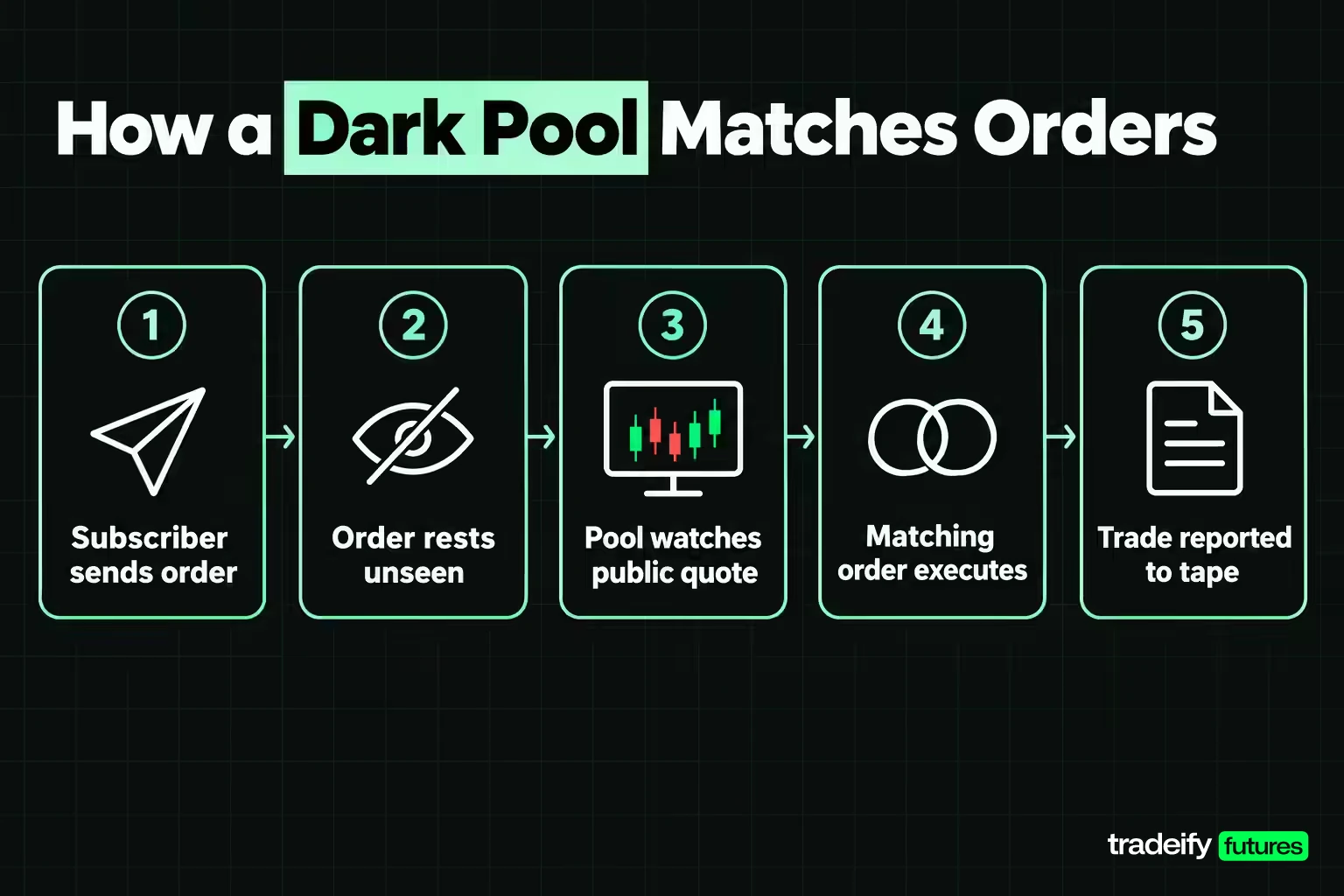
A dark pool works like a matching engine with the screen turned off. Orders go in, matches come out, and nobody watches the book in between.
Here is the basic sequence for an equity dark pool:
- A subscriber, usually a broker-dealer acting for itself or its clients, sends an order to the pool.
- The order rests inside the pool. Other subscribers cannot see its price or size.
- The pool watches the public quote from the exchanges, because that quote sets the reference price.
- When a matching order arrives, the pool executes the trade under its own published rules.
- The trade is reported to a FINRA Trade Reporting Facility and appears on the consolidated tape.
Pricing usually references the public quote. Many pools execute at the midpoint between the best bid and best offer. SIX, the Swiss exchange operator, describes its own dark venues this way, with an example of a buyer bidding 43 Swiss francs and a seller asking 45 settling at 44.
Matching priority varies by venue. SIX says its dark venues in Switzerland and Spain match by trade size and then time, so larger orders meet first. US pools disclose their own priority and order-type rules in their Form ATS-N filings.
Reporting happens quickly. FINRA's trade reporting rules require trades executed during normal market hours, 9:30 AM to 4:00 PM ET, to be reported within 10 seconds of execution. The print shows up on the tape. What it does not show is which dark pool executed it.
Related lesson: What happens to a stock order between your click and the fill
What Stays Hidden in a Dark Pool and What Gets Reported
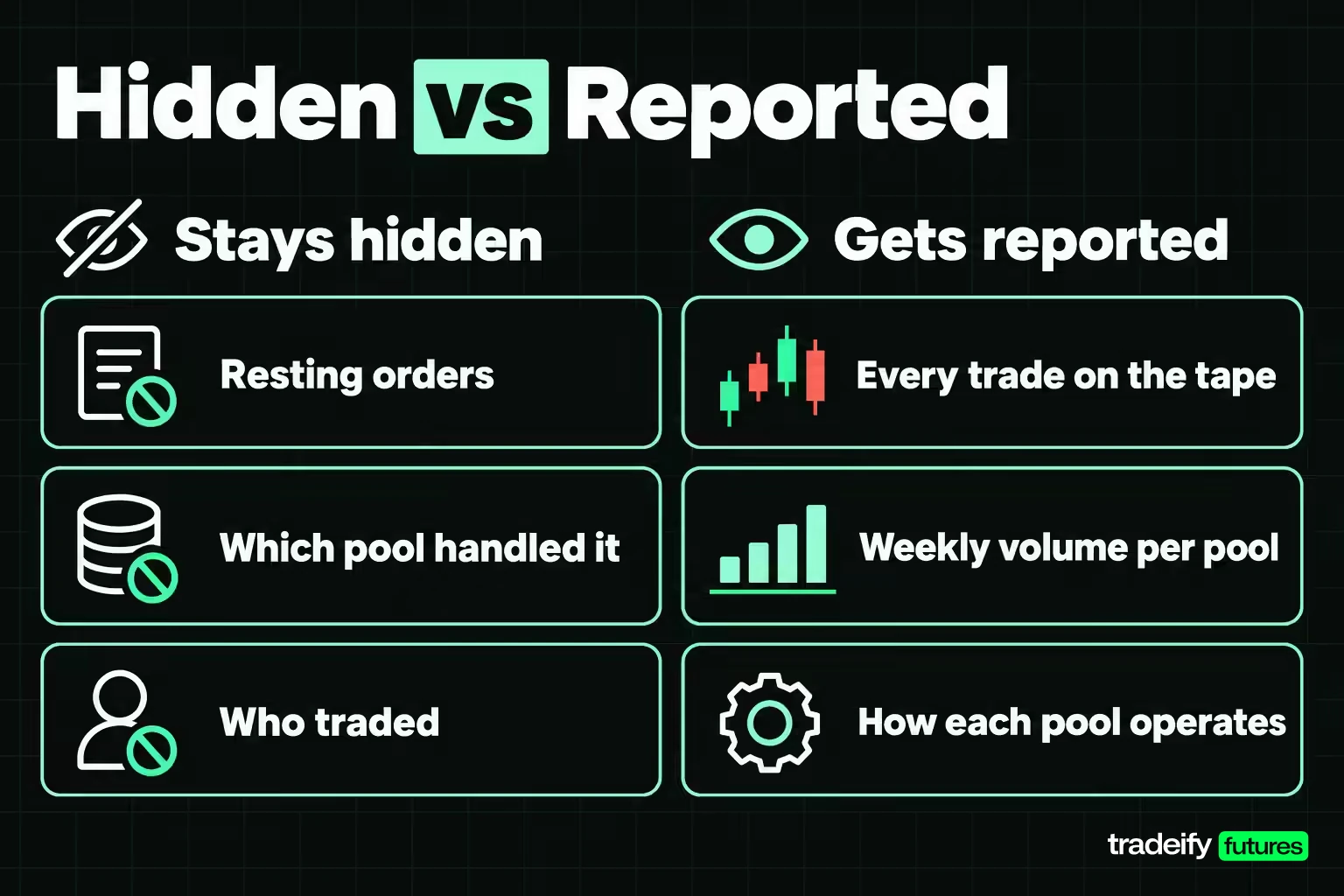
The lack of transparency in a dark pool is narrower than the name suggests. It is worth separating what is never public from what is public later.
What stays hidden:
- Resting orders. Nobody outside the pool sees the price or size of orders waiting to trade.
- The venue on the print. The tape shows that an off-exchange trade happened, not which pool handled it.
- Who traded. Subscribers stay anonymous to each other.
What gets reported:
- Every trade, on the consolidated tape, within 10 seconds during normal hours.
- Weekly trading volume for each equity ATS, which FINRA publishes after a two- to four-week delay depending on the type of stock.
- How each pool operates. Rule 304 of Regulation ATS requires ATSs that trade exchange-listed stocks to publicly file Form ATS-N, which covers the pool's manner of operations and the ATS-related activities of the broker-dealer that runs it.
That split explains why the darkness in a dark pool is mostly a pre-trade issue. After the fact, the trade is about as visible as any other trade. Before the fact, it is invisible, and that is exactly the feature institutions pay for.
Block Trades and Market Impact in Dark Pools
Block trading is the original reason dark pools exist, and market impact is the cost they try to avoid.
FINRA uses a simple example. An institution that wants to sell 500,000 shares on a traditional exchange would likely have to sell in a series of smaller trades. As those trades hit the tape, it becomes obvious that a large seller is present, and that can push the price down before the order is finished.
The arithmetic shows how many clues that can leave. In the second quarter of 2026, the average ATS trade was 79.34 shares, based on FINRA's quarterly data. At that size, a 500,000-share order would be roughly 6,302 separate prints. Each one is a small clue for anyone watching.
A dark pool changes the clue problem. With no public order book, a buyer and seller have a better chance of completing a larger trade without signaling it first. If the institution fills a large part of the order without moving the displayed price, the saving is the difference between the price it got and the price it would have gotten after the market reacted.
The benefit has limits:
- The pool only helps if a matching order is present. If no other side shows up, the order sits unfilled while the market moves.
- Information can still leak. Repeated partial fills, or a pool operator that misuses order data, can reveal intent. Several SEC enforcement cases against dark pool operators turned on exactly that problem.
- Most dark pool volume is not block-sized. FINRA's own data shows small average trades, so "dark pool" does not automatically mean "institutional block."
Related lesson: Why a large order can fill away from the price you expected
Midpoint Fills and Execution Costs in Dark Pools
Execution cost is where a dark pool's appeal becomes concrete. A midpoint fill splits the spread between buyer and seller, and the value of that split is plain arithmetic on the quote.
Take an illustrative sale of 50,000 shares with a bid of $24.98 and an offer of $25.00.
| Execution price | Proceeds on 50,000 shares | Difference from the bid |
|---|---|---|
| Bid at $24.98 | $1,249,000 | Baseline |
| Midpoint at $24.99 | $1,249,500 | $500 better |
| Offer at $25.00 | $1,250,000 | $1,000 better, the full spread |
On a wider six-cent spread, such as an illustrative $99.97 bid and $100.03 offer, the midpoint at $100.00 is worth $1,500 more than the bid on the same 50,000 shares, and the full spread is worth $3,000.
Half-penny midpoints and the tick rule
On a one-cent spread, the midpoint lands on a half penny. With an illustrative quote of $24.98 and $24.99, the midpoint is $24.985, and 50,000 shares at that price come to $1,249,250, which is $250 better than the bid.
That half-penny price is allowed because of how Rule 612 of Regulation NMS is written. The rule bars exchanges, ATSs, vendors and brokers from displaying, ranking or accepting quotes and orders in stocks priced at $1.00 or more in increments smaller than $0.01. It governs quotes and orders, not the execution price of a midpoint match.
Dark pool liquidity and the fill tradeoff
The midpoint is a benchmark, not a promise. To receive it, another subscriber has to be resting on the other side at the same time. Dark liquidity is uncertain by design, because nobody can see how much is there.
That creates a real tradeoff. Crossing the spread on an exchange gets you filled now at a known price. Resting in a dark pool may save half the spread, or it may leave you unfilled while the price walks away from you. For a large institution, the saving often justifies the wait. For a 100-share order on a one-cent spread, the midpoint is worth 50 cents, which is not worth missing a move over.
Related lesson: The increment that decides whether a midpoint fill can land on a half penny
Dark Pools Versus Other Off-Exchange Venues
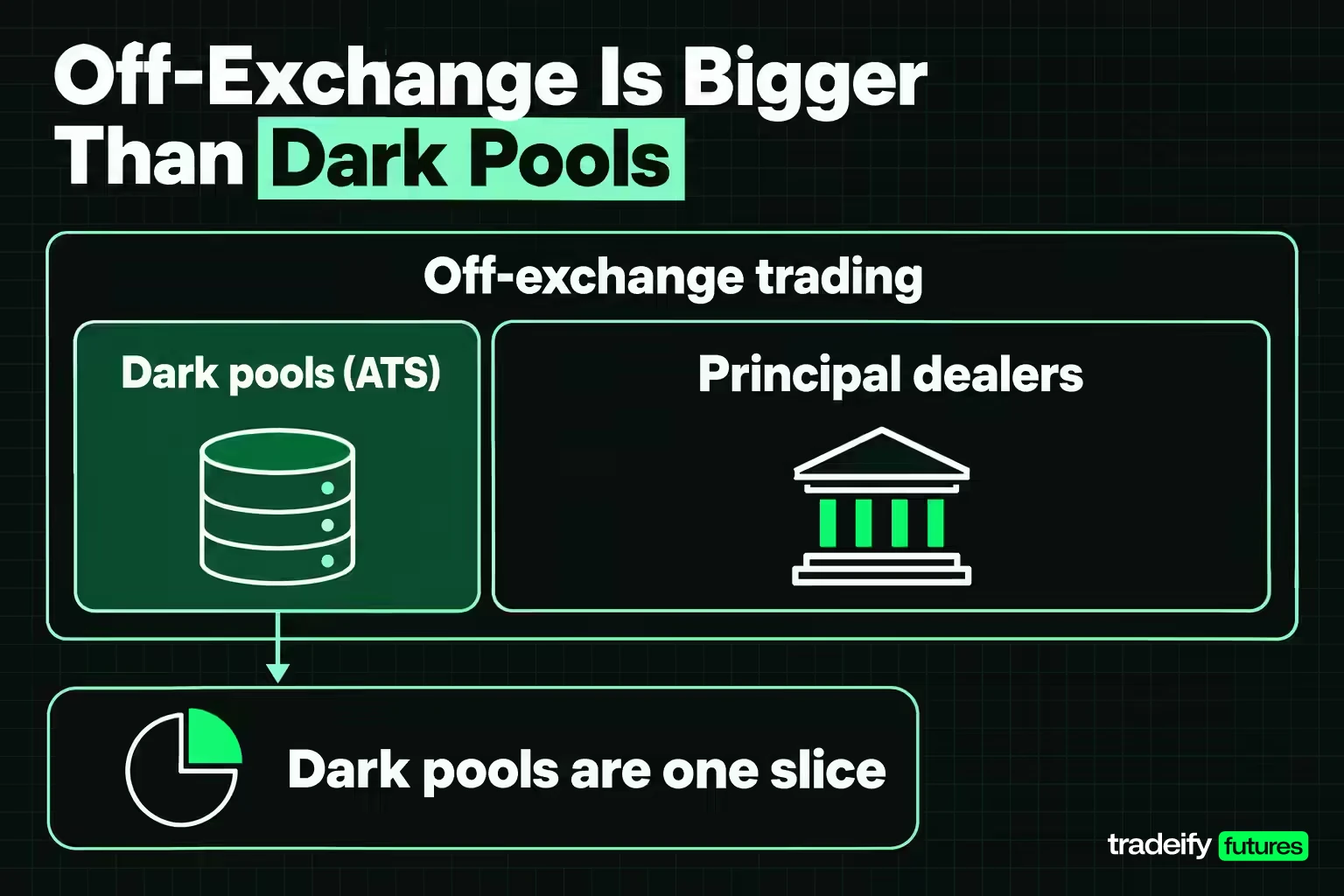
Off-exchange volume and dark pool volume are different numbers. Mixing them up is the most common error in this whole topic, and plenty of headlines make it.
Cboe's 2025 year in review, the latest full-year figures as of November 2026, shows the scale. Off-exchange trading, measured as Trade Reporting Facility market share, rose 361 basis points to 50.6% of total US equities volume, the first year it passed half. But only 18.7% of that off-exchange volume occurred on ATS platforms. The other 81.3% went through principal dealers, meaning broker-dealers trading as principal against customer orders.
Run the math and the dark pool slice gets smaller. About 9.5% of all US stock volume ran through ATSs in 2025 (50.6% times 18.7%). About 41% went through principal dealers (50.6% times 81.3%).
| Venue type | What it is | Who takes the other side | Effect on the public quote |
|---|---|---|---|
| Dark pool (ATS) | Private matching venue with no displayed order book | Another subscriber's order | Prints after the trade; adds nothing to the pre-trade quote |
| Broker-dealer principal trading | A broker-dealer fills the order from its own account, often a wholesaler handling retail flow | The broker-dealer itself | Often priced at or inside the public spread; no displayed order |
| Exchange | Registered exchange with a displayed order book | Another participant in the book | Displayed orders form the public quote |
There is one more wrinkle. Hidden orders can also trade on exchanges. Cboe reports that 17.2% of the volume executed on its own venues in 2025 was non-displayed. So "off-exchange" is not the same as "hidden," and "hidden" is not the same as "dark pool."
Related lesson: Who is on the other side of a typical retail stock order
Who Can Trade in Dark Pools
Dark pools are built for professional participants, and that shapes who uses them.
The direct users are subscribers. These are typically broker-dealers, trading for themselves or routing orders for institutional clients such as mutual funds, pension funds and insurance companies. FINRA notes that SEC regulations generally require ATSs to be operated by FINRA member firms, and that ATSs are subject to fair access requirements.
Retail traders usually reach off-exchange venues indirectly, if at all. FINRA states plainly that most retail investors won't directly interact with dark pools. When you place a stock order, your broker decides where to send it. Depending on the broker and the order type, that destination can be an exchange, a wholesaler trading as principal, or an ATS.
You do not have to guess where your own orders go. Under Rule 606, brokers publish quarterly reports on where they route customer orders, and they must answer customer requests about where that customer's orders were routed over the previous six months. That report tells you more about your own exposure to off-exchange venues than any dark pool headline.
How Dark Pools Affect Price Discovery
Price discovery is the process of finding a fair price through visible buying and selling. Dark pools change who contributes to it.
FINRA lays out the core concern. When large trades happen off exchange, the public price of a stock may not fully reflect supply and demand, because dark pools do not contribute to price discovery the way exchanges do. At the same time, dark pools rely on public prices as the benchmark for their own trades. Under the Order Protection Rule, they generally must execute at prices at least as good as the best publicly available quote.
That combination is why critics call dark pools free riders on the lit market. The pools use the exchange quote without adding their own resting interest to it, and the more volume moves into the dark, the thinner the visible layer that sets the price for everyone.
The counter-argument is just as real. FINRA notes that letting institutions complete large trades without pushing prices around can be good for those investors and potentially for market efficiency overall. A 500,000-share sale that knocks a stock down temporarily also sends a misleading signal.
What would change the conclusion is the share of trading that goes dark. A small dark share leaves plenty of visible orders to set the price. A very large dark share leaves the public quote resting on a thinner layer of displayed orders. That threshold question is exactly what European regulators tried to manage with volume caps.
Dark Pool Criticisms and High-Frequency Trading
The strongest criticisms of dark pools come from enforcement records, not theory. Several SEC cases describe operators who did not run their pools the way they told subscribers they would.
In August 2015, the SEC announced that ITG and its affiliate AlterNet Securities agreed to pay $20.3 million. According to the SEC, ITG ran an undisclosed proprietary trading desk that used live information about subscriber orders to run high-frequency trading strategies, including trading against subscribers in its own dark pool, POSIT. That desk traded about 1.3 billion shares in total, about 262 million of them with subscribers in the pool.
In January 2016, the SEC announced settlements with Barclays and Credit Suisse. Barclays paid $70 million in total to the SEC and the New York Attorney General and admitted wrongdoing. The SEC found that Barclays said a feature would "continuously police" its LX dark pool for predatory trading and did not do so. Credit Suisse paid $84.3 million. Among the findings, its Crossfinder pool executed over 117 million illegal sub-penny orders, and a technology called Crosslink alerted two high frequency trading firms to orders that customers had submitted.
These cases support three specific criticisms:
- Conflicts of interest. The broker-dealer running the pool may also trade, and it holds information its subscribers do not.
- Unequal access. Fast traders with better technology or special arrangements can interact with slower institutional flow on better terms.
- Disclosure gaps. Subscribers relied on marketing claims about protections that were not applied as described.
Keep the cases in proportion. They do not prove that every dark pool is unfair, and they do not show retail traders being harmed directly in every case. They are a large part of why regulators now require detailed public disclosure about how each pool operates.
How Dark Pools Are Regulated in the US
The regulatory framework for US dark pools rests on four pieces.
Regulation ATS. An ATS matches buyers and sellers but is not registered as an exchange. It operates under an exemption from the definition of an exchange, and Investor.gov notes that an ATS can apply to become a national securities exchange. The SEC can suspend for up to twelve months, limit or revoke that exemption.
Broker-dealer oversight. ATSs are generally operated by FINRA member broker-dealers, so they fall under securities laws and FINRA rules, including the trade reporting requirements.
Form ATS-N. ATSs that trade exchange-listed stocks must publicly file Form ATS-N, plus amendments and notices when they stop operating. The SEC can declare a filing ineffective.
Regulation NMS. Rule 611, the Order Protection Rule, requires trading centers to keep written policies reasonably designed to prevent trade-throughs of protected quotations, subject to exceptions. In plain terms, a dark pool generally cannot execute at a price worse than the best displayed quote. Rule 612 sets the minimum increment for quotes and orders.
The result is a set of rules that controls price and disclosure, but not display. Dark pools may keep their orders hidden. They may not hide trades from reporting or hide their own operating rules from the public.
Dark Pool Rule Changes in the US and Europe
Dark pool rules have changed several times in the last decade, and some changes are still in progress.
In the United States:
- July 18, 2018. The SEC adopted Form ATS-N, requiring detailed public disclosures about order types, market data, fees, execution and priority procedures, and any order segmentation. Every ATS also had to adopt written safeguards for subscribers' confidential trading information.
- August 1, 2026. Under amended Rule 605, broker-dealers with 100,000 or more customer accounts must now publish monthly execution quality reports.
- June 11, 2026. The SEC proposed rescinding Rule 611, the trade-through rule. As of November 2026, it is a proposal, not a final rule.
In Europe, the main tool has been a cap on dark trading volume. Under MiFIR's double volume cap, dark trading in a stock could not exceed 4% of EU trading volume on any single venue or 8% across the EU. Regulation (EU) 2024/791 replaced that with a single EU-wide cap of 7%, applied only to trading under the reference price waiver. When the cap is exceeded, venues suspend that waiver for three months.
The two regions take different approaches. The US relies on disclosure and reporting. Europe adds a hard limit on how much trading can go dark.
Reading Dark Pool Data From FINRA
Accessing dark pool information is free. FINRA publishes ATS volume by venue and by stock, both weekly and in quarterly summaries. The quarterly files list total shares and total trades for each ATS, so you can calculate how each venue actually behaves.
What the 2026 FINRA dark pool files show
Dividing total shares by total trades for each venue in the All NMS Stocks files gives the average trade size. Summing the rows reproduces FINRA's published grand totals exactly.
| Measure | 2Q 2026 | 3Q 2026 |
|---|---|---|
| Venues reporting | 32 | 33 |
| Average trade size across all ATSs | 79.34 shares | 72.29 shares |
| Share of ATS volume at the five largest venues | 49.6% | 50.0% |
| Venues averaging 1,000 shares or more per trade | 3 of 32 | 3 of 33 |
| Volume share of those block-sized venues | 0.8% | 0.8% |
Three conclusions come out of the 2Q 2026 file, which covers 169,665,062,510 shares across 2,138,534,995 trades.
Concentration is high. The five largest venues handled 49.6% of ATS volume, led by Intelligent Cross at 26,754,729,458 shares and UBS ATS at 21,041,967,564.
The typical trade is small. 24 of 32 venues averaged under 200 shares per trade, and those venues carried 90.3% of ATS volume. Intelligent Cross averaged 79.2 shares per trade.
True block venues exist but are a sliver of volume. Dealerweb averaged 113,925.5 shares per trade across 5,603 trades. Liquidnet Negotiation ATS averaged 27,394.3 shares across 9,509 trades. Instinet BlockCross averaged 4,355 shares. Together those three venues were 0.8% of ATS volume.
Form ATS-N and Rule 605 and 606 reports
- Form ATS-N filings on the SEC website describe each pool's order types, priority rules and operator conflicts.
- Rule 605 reports describe execution quality, including price improvement and effective spreads.
- Rule 606 reports describe where a broker routes customer orders.
Related lesson: How to measure whether your fill beat the quote
Dark Pools and Short Selling Data
Dark pool and short selling data get combined in many scanners, and the combination is easy to misread.
FINRA's Daily Short Sale Volume Files report aggregated volume by security for short sale trades executed and reported to a FINRA facility during normal market hours. Because those facilities handle off-exchange trades, the files cover short selling that happened off exchange, including in dark pools and with principal dealers.
Short sale volume is not short interest. Short sale volume counts trades marked short on a given day, whoever made them and however briefly the position lasted. Short interest measures open short positions, and under FINRA Rule 4560, member firms report those positions twice a month.
The practical rule is simple. A high daily dark pool short volume ratio does not, on its own, mean large investors are building a bearish position. It is an observation, not confirmation. Check the twice-monthly short interest data before you treat it as a signal.
Off-Exchange Trading in Futures Markets
Futures traders see off-exchange trading too, but the structure is tighter and there are no equity-style dark pools for retail orders.
The main route is the block trade. Under CME Rule 526, a block trade is a privately negotiated futures, options or combination transaction executed apart from the public auction market. Each party must be an Eligible Contract Participant as defined in the Commodity Exchange Act, which generally means institutions, funds, broker-dealers and high-net-worth individuals. Blocks are allowed only in specified products, with minimum sizes that vary by product, transaction type and time of execution.
Blocks are reported on a clock. CME's June 2026 advisory on Rule 526 says block trades must be submitted within 5 or 15 minutes depending on the product. Block prices are reported separately from regular market prices and are not included in the daily trading range.
EFRPs and what futures traders see
The second route for off-exchange futures trading is the Exchange for Related Position, or EFRP. Under CME Rule 538, an EFRP combines a privately negotiated off-exchange futures or options trade with a simultaneous opposite trade of an equivalent quantity of the related cash product or OTC instrument. CME Rule 539 prohibits prearranged and noncompetitive trading, with blocks and EFRPs as the named exceptions.
For an intraday futures trader, that means off-exchange futures activity is limited, reported and mostly institutional. If a block print shows up on your platform, it is a negotiated trade between eligible parties, not a hidden order waiting in the book, and it does not set the day's high or low.
On our accounts, you trade CME Group futures such as ES, NQ, CL and GC through the supported platforms, not cash stocks, so equity dark pools are background knowledge rather than a venue you route to. Every account includes Level 1 CME data. Level 2 depth is a paid add-on bought from Tradovate on Tradovate accounts, and it is not available on Rithmic or WealthCharts accounts. Funded accounts are simulated, and all positions close by 4:45 PM ET.
Common Mistakes When Reading Dark Pool and Off-Exchange Prints
Most trading mistakes around dark pools and off-exchange trading come from misreading the data, not from the venues themselves. The print is real. The story a trader attaches to it often is not.
| Mistake | What it looks like | What to do instead |
|---|---|---|
| Treating off-exchange volume as a live signal | Buying because a scanner flags dark pool prints | Treat it as a record of trades that already happened, then read price and liquidity yourself |
| Assuming dark pool means block trade | Expecting a 79-share average print to be institutional | Divide a venue's shares by its trades before drawing a conclusion |
| Quoting one headline number | Saying half of all trading is dark and stopping there | Split off-exchange volume into ATS and principal dealer portions |
| Expecting midpoint fills on every order | Assuming every fill lands halfway inside the spread | Check the spread and your broker's Rule 605 report |
| Reading short volume as short interest | Treating a high short volume ratio as a bearish bet | Compare it with the twice-monthly short interest data |
Before acting on any off-exchange number, run a quick check:
- Which venue type does the number describe, ATS or all off-exchange volume?
- Is it current? Weekly ATS data runs two to four weeks behind.
- Is it a venue-level figure or an aggregate that hides concentration?
- What is the venue's average trade size?
- What do your own broker's Rule 605 and Rule 606 reports say?
Dark Pool FAQ
Are dark pools legal?
Yes. Dark pools operate as alternative trading systems under SEC regulation, are run by broker-dealers, report every trade to a FINRA facility, and must publicly file Form ATS-N if they trade exchange-listed stocks. Enforcement actions have targeted operator misconduct, not the existence of the venues.
Can you see dark pool trades?
You can see the trades after they happen, because they print on the consolidated tape within 10 seconds during normal hours. You cannot see resting orders before they trade, and the print does not name the pool. FINRA's weekly ATS data adds venue detail after a two- to four-week delay.
Do dark pools affect the price I get on a stock order?
Mostly indirectly. Dark pools price off the public quote, and your broker decides whether your order goes to an exchange, a principal dealer or an ATS. Your broker's Rule 605 and Rule 606 reports show what your orders actually received and where they went.
Are dark pool scanners worth paying for?
That depends on what you expect from them. Any scanner built on public data is working from reported off-exchange prints, which do not name the pool, and FINRA's venue-level data is free but delayed. No scanner can show resting dark orders, so treat one as a description of trades that already happened.
Do futures markets have dark pools?
Not in the equity sense. Futures off-exchange trading happens mainly through block trades and EFRPs, which are limited to eligible participants in specified products and reported to the exchange within set time windows. Retail futures orders trade on the exchange's central order book.
Next Steps for Reading Off-Exchange Data
Next time a dark pool print tempts you into a trade, slow down and check what it actually is. Open FINRA's ATS quarterly statistics page, download the latest All NMS Stocks file, and divide total shares by total trades for one venue you have heard of. That single number tells you more about how the venue behaves than any description of it.
Then find your broker's Rule 605 and Rule 606 reports and read what your own orders received. Off-exchange data is a delayed record of what already happened. Reading it as a live signal is the mistake worth avoiding.
Trading futures, stocks and other leveraged products involves substantial risk, and losses can exceed what you expect. Simulated and funded evaluation accounts are simulated, and their results do not represent live trading. This article is educational only and is not investment, financial, tax or legal advice, and it is not a recommendation to buy or sell any instrument.


