



TL;DR: Tick size and tick value answer two questions: how small a price step can be, and what that step is worth in money. Tick size is the minimum price increment the exchange allows. Tick value is tick size times the contract multiplier. One ES tick is $12.50 and one MES tick is $1.25, even though both move 0.25 points. Read both numbers before you size a stop.
Tick size and tick value sit near the top of every futures contract specification, and they are easy to skim past. That is a mistake. Your chart is in price, your stop is in price, and your account is in dollars. Tick size connects the chart to the order ticket. Tick value connects the order ticket to your balance.
The usual way traders learn this is the expensive way: a stop that looked small on the chart turns out to be a large number on the statement. This guide defines both terms, shows the formula, lists the specs for widely traded contracts, and works through profit, loss and risk math with round, illustrative prices, so the conversion happens before the trade instead of after it.
What Tick Size Means
Tick size is the smallest price increment a contract is allowed to move. Exchanges also call it the minimum price fluctuation or minimum price increment. CME Group's own lesson puts it plainly: every futures contract has a minimum price fluctuation, also known as a tick, and tick sizes are set by the exchange and vary by contract.
Take the E-mini S&P 500 (ES). Its tick size is 0.25 index points. A price of 6,000.00 can move to 6,000.25 or 5,999.75, but 6,000.10 is not a legal price. The exchange will not accept an order there. This is a market rule, not a chart setting.
Who sets the tick depends on the market:
- Futures. The listing exchange sets the tick contract by contract and publishes it on each product's specification page.
- U.S. stocks. Rule 612 of Regulation NMS sets a minimum pricing increment of $0.01 for quotes and orders in NMS stocks priced at or above $1.00, and $0.0001 for those priced below $1.00.
Why should you care about a rule this small? Every price you see, every limit you place and every stop you set lands on a multiple of the tick. If a contract ticks in 0.25, a stop "two points away" is a stop eight ticks away.
Related lesson: How to read a futures quote
What Tick Value Means
Tick value is the money one tick is worth on one contract. It is the profit or loss you book each time price moves one minimum increment for or against your position.
Three examples from CME specifications:
- E-mini S&P 500 (ES): one tick of 0.25 index points is worth $12.50.
- Micro E-mini S&P 500 (MES): the same 0.25 tick is worth $1.25.
- WTI Crude Oil (CL): one tick of $0.01 per barrel is worth $10.00.
Tick value scales with position size. Two contracts double it, ten contracts multiply it by ten. That is why tick value is the number that turns a stop distance on the chart into a dollar risk on the account.
Tick Size and Tick Value Side by Side
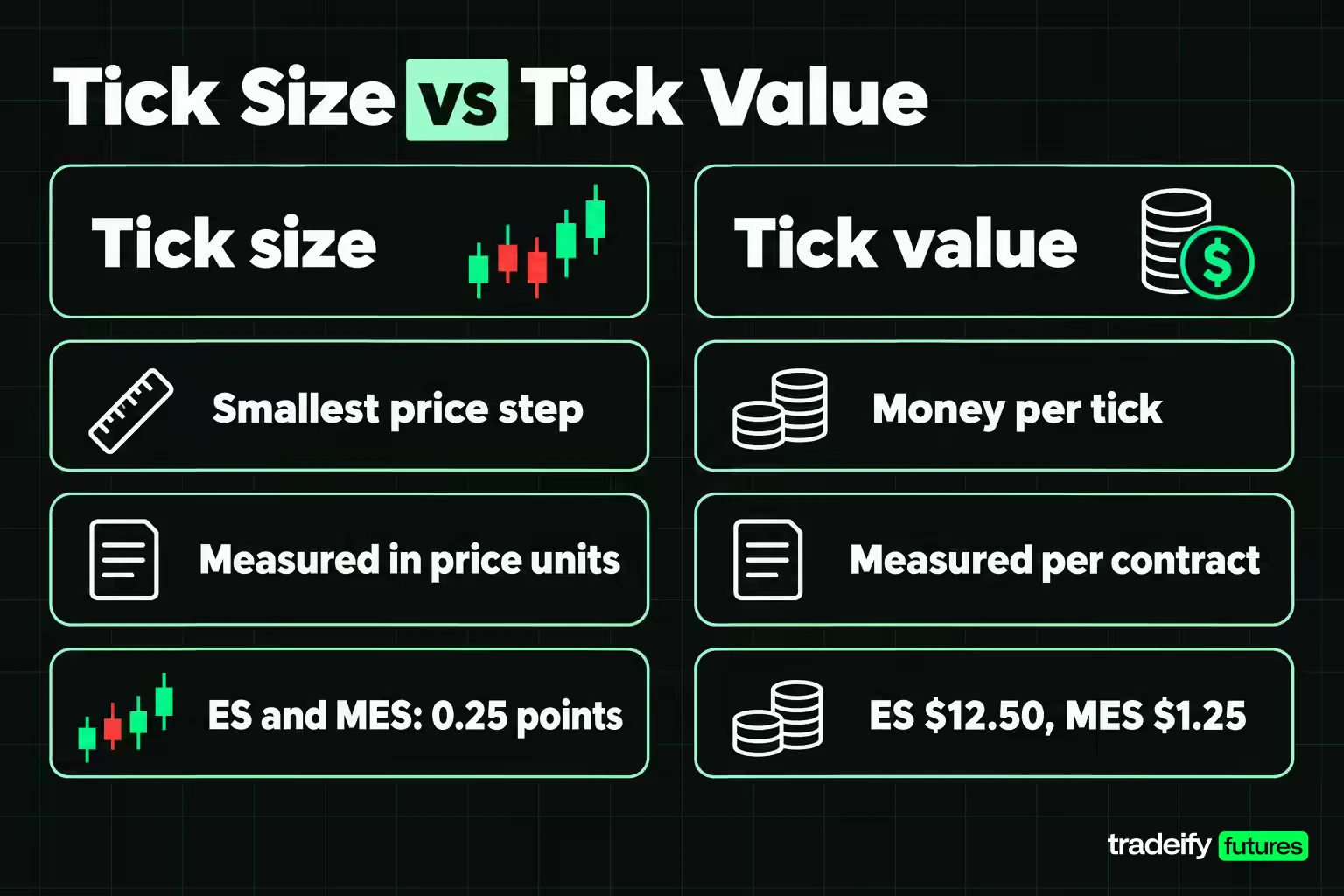
Tick size and tick value are related, but they answer different questions. Tick size is measured in price units, such as index points, dollars per barrel or dollars per ounce. Tick value is measured in money per contract. The contract multiplier is what links them.
Two patterns show why you need both numbers:
- Same tick size, different tick value. ES and MES both tick in 0.25 index points. ES pays $12.50 per tick, MES pays $1.25. On a chart they look identical.
- Different tick size, same tick value. CL ticks in $0.01 per barrel and Gold (GC) ticks in $0.10 per troy ounce. Both ticks are worth $10.00, because the contract sizes differ (1,000 barrels versus 100 troy ounces).
Here is one identical move, 5 index points, priced on four equity index contracts that all tick in 0.25 points. Every row is 20 ticks.
| Contract | Multiplier per index point | Tick value | Ticks in a 5-point move | Result of a 5-point move, one contract |
|---|---|---|---|---|
| Micro E-mini Nasdaq-100 (MNQ) | $2 | $0.50 | 20 | $10.00 |
| Micro E-mini S&P 500 (MES) | $5 | $1.25 | 20 | $25.00 |
| E-mini Nasdaq-100 (NQ) | $20 | $5.00 | 20 | $100.00 |
| E-mini S&P 500 (ES) | $50 | $12.50 | 20 | $250.00 |
The price move is the same. The tick count is the same. The dollar result runs from $10.00 to $250.00, a 25x gap created entirely by the multiplier. If you ever switch from a micro to a mini and keep the same stop, this table is the reason your loss suddenly looks ten times bigger.
Contract Size, Multiplier and Point Value
Contract size, also called the contract unit, is how much of the underlying one futures contract represents. For index futures it is written as a dollar multiplier on the index, such as $50 x S&P 500 Index for ES. For physical and financial contracts it is a quantity: 1,000 barrels for CL, 100 troy ounces for GC, 125,000 euro for Euro FX (6E), and $100,000 face value at maturity for the U.S. Treasury Bond (ZB).
The multiplier gives you point value, which is what a full one-unit move is worth:
- ES: $50 per index point. MES: $5. NQ: $20. MNQ: $2.
- YM (E-mini Dow): $5 per index point. MYM: $0.50.
- RTY (E-mini Russell 2000): $50 per index point. M2K: $5.
- CL: a $1.00 move per barrel is worth $1,000 on CL and $100 on MCL.
- GC: a $1.00 move per ounce is worth $100 on GC and $10 on MGC.
There is no single "standard size" for a futures contract. Each product has its own unit, chosen by the exchange to suit the underlying market. What is standard is that every contract in the same product carries the same unit, so one ES is always $50 times the index, no matter who trades it.
Related lesson: Notional value
How to Calculate Tick Value
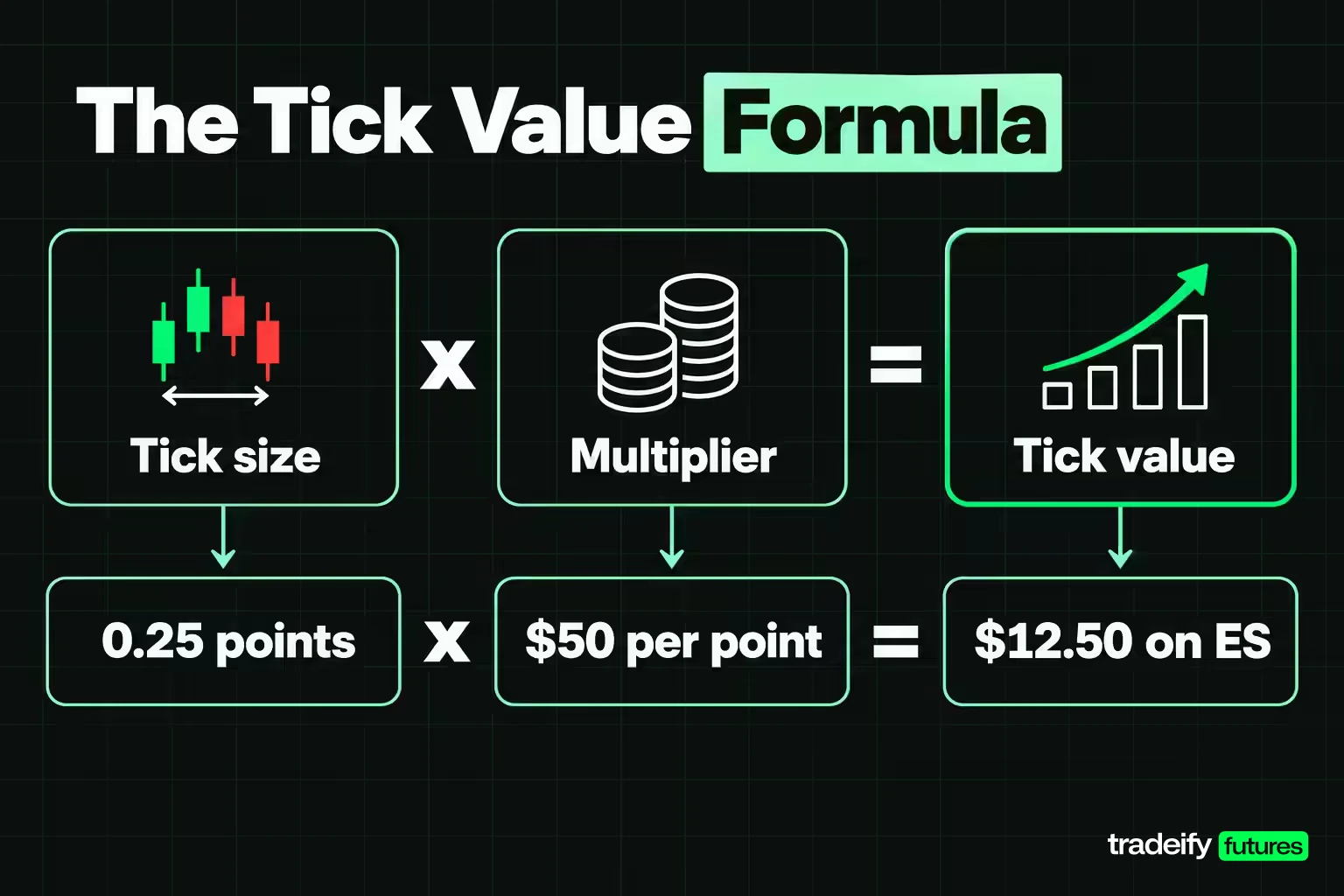
The tick value formula has two inputs, both printed on the contract specification:
Tick value = tick size x contract size (or multiplier)
Worked checks against CME's published specs:
| Contract | Tick size | Contract size or multiplier | Tick value |
|---|---|---|---|
| E-mini S&P 500 (ES) | 0.25 index points | $50 per point | 0.25 x $50 = $12.50 |
| WTI Crude Oil (CL) | $0.01 per barrel | 1,000 barrels | 0.01 x 1,000 = $10.00 |
| Gold (GC) | $0.10 per troy ounce | 100 troy ounces | 0.10 x 100 = $10.00 |
| Euro FX (6E) | 0.00005 per euro | 125,000 euro | 0.00005 x 125,000 = $6.25 |
| Corn (ZC) | 0.0025 per bushel | 5,000 bushels | 0.0025 x 5,000 = $12.50 |
Tick value on fractional Treasury contracts
Treasury futures use one extra step. ZB is quoted in points of par, and one point equals 1% of the $100,000 face value, so one point is $1,000. The tick is 1/32 of a point, so the tick value is 1/32 x $1,000 = $31.25. The 10-Year T-Note (ZN) ticks in half of 1/32, which CME lists as $15.625.
Reverse the formula to check a spec
If a broker or platform shows only the tick value, divide it by the tick size to recover the multiplier. $12.50 divided by 0.25 is $50, which tells you you are looking at the full ES and not the micro. That ten-second check catches the wrong-contract mistake before it costs anything.
Tick Size and Tick Value for Popular Futures Contracts
These tables list tick size and tick value for widely traded CME Group contracts, read from CME's contract specifications on November 4, 2026. Exchanges can revise specs, so confirm on the product page before trading.
Equity index futures tick sizes
| Equity index contract | Index multiplier | Index tick size | Index tick value | Ticks per index point |
|---|---|---|---|---|
| E-mini S&P 500 (ES) | $50 x S&P 500 Index | 0.25 index points | $12.50 | 4 |
| Micro E-mini S&P 500 (MES) | $5 x S&P 500 Index | 0.25 index points | $1.25 | 4 |
| E-mini Nasdaq-100 (NQ) | $20 x Nasdaq-100 Index | 0.25 index points | $5.00 | 4 |
| Micro E-mini Nasdaq-100 (MNQ) | $2 x Nasdaq-100 Index | 0.25 index points | $0.50 | 4 |
| E-mini Dow (YM) | $5 x DJIA | 1.00 index point | $5.00 | 1 |
| E-mini Russell 2000 (RTY) | $50 x Russell 2000 | 0.10 index points | $5.00 | 10 |
Energy and metals futures tick sizes
| Energy or metal contract | Contract unit | Commodity tick size | Commodity tick value | Ticks per $1.00 move |
|---|---|---|---|---|
| WTI Crude Oil (CL) | 1,000 barrels | $0.01 per barrel | $10.00 | 100 |
| E-mini Crude Oil (QM) | 500 barrels | $0.025 per barrel | $12.50 | 40 |
| Henry Hub Natural Gas (NG) | 10,000 MMBtu | $0.001 per MMBtu | $10.00 | 1,000 |
| Gold (GC) | 100 troy ounces | $0.10 per troy ounce | $10.00 | 10 |
| Silver (SI) | 5,000 troy ounces | $0.005 per troy ounce | $25.00 | 200 |
| Copper (HG) | 25,000 pounds | $0.0005 per pound | $12.50 | 2,000 |
Currency, grain and Treasury futures tick sizes
| Currency, grain or rate contract | Contract amount | Minimum tick | Value of one tick | Ticks per 1.00 of price |
|---|---|---|---|---|
| Euro FX (6E) | 125,000 euro | 0.00005 per euro | $6.25 | 20,000 |
| Australian Dollar (6A) | 100,000 Australian dollars | 0.00005 per AUD | $5.00 | 20,000 |
| Corn (ZC) | 5,000 bushels | 0.0025 per bushel | $12.50 | 400 |
| 10-Year T-Note (ZN) | $100,000 face value | 1/2 of 1/32 of a point | $15.625 | 64 |
| U.S. Treasury Bond (ZB) | $100,000 face value | 1/32 of a point | $31.25 | 32 |
Two reading notes on these tick size tables. First, the "ticks per" column is where most sizing errors start: a $1.00 move in crude is 100 ticks, while a 1.00 move in the Dow is one tick. Second, a big tick value does not make a contract riskier on its own. Silver's $25.00 tick and natural gas's $10.00 tick matter only alongside how many ticks those markets typically move in your holding period.
Micro Contract Tick Values Versus Minis
Most micro futures are one-tenth versions of their larger siblings, and their tick values show it. Tick size stays the same, so charts and stop distances read identically. Only the money changes.
| Mini contract | Mini tick value | Micro contract | Micro tick value |
|---|---|---|---|
| ES | $12.50 | MES | $1.25 |
| NQ | $5.00 | MNQ | $0.50 |
| YM | $5.00 | MYM | $0.50 |
| RTY | $5.00 | M2K | $0.50 |
| CL | $10.00 | MCL | $1.00 |
| GC | $10.00 | MGC | $1.00 |
| 6E | $6.25 | M6E | $1.25 |
The index, crude and gold micros are exact tenths. Euro FX is the exception: M6E covers 12,500 euros but ticks in 0.0001 rather than 0.00005, so its tick is worth $1.25 against $6.25 on 6E.
Micros matter for one reason: granularity. With 10 MES you carry the same tick value as one ES (10 x $1.25 = $12.50), but you can also hold 3, 4 or 7. If your risk budget only fits a fraction of an ES, the micro is the only way to size the trade correctly instead of rounding up to a full contract. Commissions are charged per contract, though, so once you are sizing in clean multiples of ten, compare what ten micros cost against one mini on your fee schedule.
Related lesson: Mini and micro futures contracts
Calculating Profit and Loss From Ticks
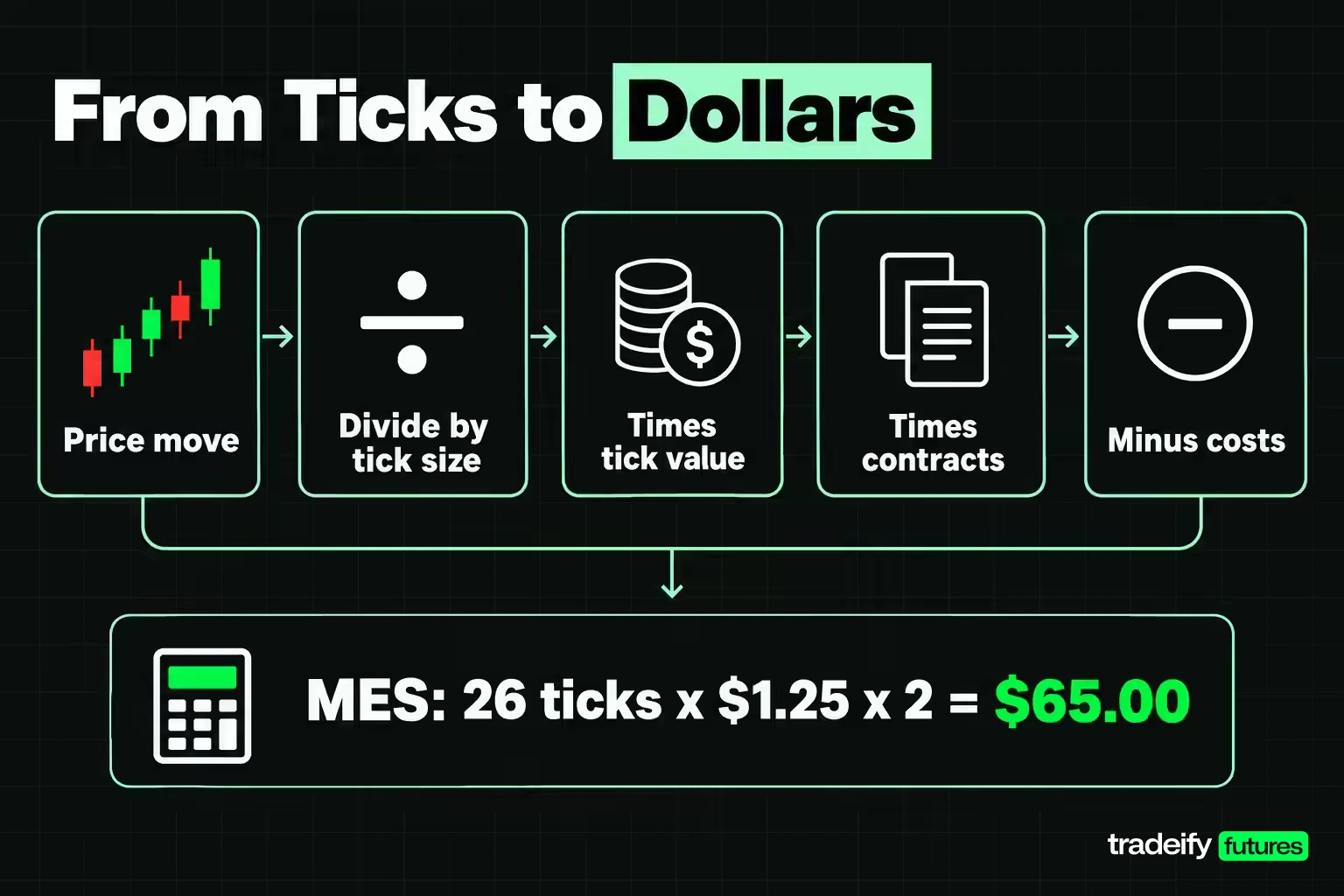
The tick P&L formula works the same on every contract:
Profit or loss = (exit price minus entry price) divided by tick size x tick value x number of contracts
Flip the sign for a short. Then subtract commissions and fees.
Worked tick examples
All prices are round and illustrative.
- MES, long 2 contracts. Buy at 6,000.00, sell at 6,006.50. That is 6.50 points, or 26 ticks. 26 x $1.25 x 2 = $65.00 before costs. The same trade on 2 ES would be $650.00.
- CL, short 1 contract. Sell at 70.00, buy back at 70.35. Price moved $0.35 against you, which is 35 ticks. 35 x $10.00 = $350.00 loss. On MCL the same move costs $35.00.
- MGC, long 1 contract. Buy at 4,000.00, sell at 4,012.30. That is $12.30, or 123 ticks. 123 x $1.00 = $123.00. On GC it would be $1,230.00.
Turning a dollar risk into ticks
The more useful direction is the reverse. Decide the most you are willing to lose on a trade, then divide by tick value to see how much room the market gets.
With a $100 risk budget on one contract:
| Contract | Tick value | Ticks within $100 | Price distance |
|---|---|---|---|
| MNQ | $0.50 | 200 | 50 points |
| MES | $1.25 | 80 | 20 points |
| NQ | $5.00 | 20 | 5 points |
| ES | $12.50 | 8 | 2 points |
| MCL | $1.00 | 100 | $1.00 per barrel |
| CL | $10.00 | 10 | $0.10 per barrel |
| MGC | $1.00 | 100 | $10.00 per ounce |
| GC | $10.00 | 10 | $1.00 per ounce |
The same $100 buys 200 ticks of room on MNQ and 8 ticks on ES. ES is a perfectly normal contract, but a 2-point stop on the S&P 500 is tight. With only $100 to risk on it, you are asking the market to be right almost immediately, and ordinary noise is often enough to take you out. If the stop your setup needs does not fit inside the budget, the honest answer is a smaller contract or no trade, not a tighter stop.
A common question runs the same math on Nasdaq futures: how many ticks is $500 on NQ? At $5.00 per tick, $500 is 100 ticks, or 25 points, on one NQ. On one MNQ it is 1,000 ticks, or 250 points.
Related lesson: Calculating futures P&L
How Tick Size Affects Spreads, Costs and Fills
Tick size shapes trading costs because a spread can never be narrower than one tick. When ES is quoted 6,000.00 bid and 6,000.25 offered, that one-tick spread is the floor. Buy at the offer and sell at the bid right away and you have paid two ticks, or $25.00 per ES contract ($2.50 on MES, $20.00 on CL), before commissions.
That cost lands differently depending on your style:
- Scalpers aim for a few ticks per trade, so a one-tick spread can eat a large share of each target.
- Swing-length trades with stops of dozens of ticks barely notice the same two ticks.
- Stop placement has to respect the tick grid. A stop at a level price cannot trade at is either rejected or rounded, depending on the platform.
The exchange chooses tick size with a tradeoff in mind. CME describes tick sizes as set to provide optimal liquidity and tight bid-ask spreads. A tick that is too large keeps spreads artificially wide. A tick that is too small spreads resting orders thinly across many price levels and makes queue position less meaningful.
Tick size cut in Australian dollar futures
CME's Australian dollar futures give a measured example. The minimum price increment was cut from one pip to 0.5 pips, effective November 23, 2020. CME reported the average top-of-book spread at 1.15 pips before the change, 0.86 the following week and 0.68 pips in the week after Christmas, with the median spread settling at 0.5 pips. Smaller tick, narrower spread, lower round-trip cost.
Related lesson: Bid-ask spread
Ticks, Points and Pips Across Markets
A tick, a point and a pip are three different units, and mixing them up is how risk calculations go wrong.
- Tick: the minimum price increment of a specific contract.
- Point: one full unit of the quoted price. In ES one point is four ticks. In RTY it is ten ticks. In YM a point and a tick are the same thing.
- Pip: a forex convention. On most currency pairs quoted to four decimals, such as EUR/USD, one pip is 0.0001.
Tick versus pip in currency futures
Currency futures use ticks, but the ticks map onto pips. Micro EUR/USD (M6E) ticks in 0.0001, exactly one pip, worth $1.25. The full Euro FX contract (6E) ticks in 0.00005, half a pip, worth $6.25. So one pip on 6E is two ticks, or $12.50. Spot forex traders talk about pip value per lot; futures traders talk about tick value per contract. The arithmetic is the same idea with different labels.
Fractional quotes in Treasury futures
CBOT Treasury futures quote in points and thirty-seconds of a point. A ZB price shown as 115-16 means 115 and 16/32, or 115.50 (illustrative). One tick is 1/32 of a point, $31.25. If you type a decimal price into a fractional contract without converting, the order can land at the wrong price or be rejected.
Calendar Spread Ticks Versus Outright Ticks
Many futures carry two tick sizes: one for the outright contract and a smaller one for calendar spreads (buying one month and selling another as a single order). CME's specs show this directly.
| Contract | Outright tick | Outright tick value | Calendar spread tick | Spread tick value |
|---|---|---|---|---|
| ES | 0.25 index points | $12.50 | 0.05 index points | $2.50 |
| MES | 0.25 index points | $1.25 | 0.05 index points | $0.25 |
| SI | $0.005 per troy ounce | $25.00 | $0.001 per troy ounce | $5.00 |
| ZB | 1/32 of a point | $31.25 | 1/4 of 1/32 of a point | $7.8125 |
The finer spread tick exists because spreads between nearby months usually move in small amounts, and a coarse tick would make them expensive to trade. If you only trade outrights, the spread tick does not change your P&L. If you roll positions with a spread order, or trade spreads deliberately, read the spread line of the spec separately from the outright line.
Why Tick Sizes Change Over Time
Tick sizes are policy decisions, and exchanges and regulators revise them. Remembering a tick value from last year is not the same as checking it today.
Futures examples:
- CME cut the Australian dollar futures tick from one pip to 0.5 pips, effective November 23, 2020.
- CME reduced the minimum price increment for non-consecutive calendar spreads in EUR/USD futures from 0.5 to 0.2 in 2019, which it says contributed to lower roll costs.
Stock market examples:
- The Tick Size Pilot. The SEC approved a plan on May 6, 2015 for a two-year pilot that began October 3, 2016. It tested whether wider ticks would help trading in smaller-company stocks. A control group kept its normal tick and three test groups of about 400 securities each were quoted in $0.05 increments.
- The half-penny tick. On September 18, 2024 the SEC adopted Rule 612 amendments adding a $0.005 minimum increment for stocks whose time-weighted average quoted spread was $0.015 or less. As of November 2026 those amendments are not in force. On June 11, 2026 the SEC extended the compliance date to the first business day of November 2027, and its Chairman directed staff to review Rules 610(c) and 612 by year end.
The lesson for a trader is narrow but useful. Treat tick size as a spec you look up, with a date next to it, not a fact you memorize once and trust forever.
How to Find the Tick Size for Any Contract
Every CME Group contract has a specification page that lists the minimum price fluctuation (tick size and tick value) and the contract unit. Other exchanges publish the same fields under similar names. Here is a method that works for any futures contract:
- Open the listing exchange's product page and go to the contract specifications tab. Use the exchange, not a forum post or an old screenshot.
- Note the contract unit (or multiplier) and the minimum price fluctuation. Check whether there is a separate line for calendar spreads.
- Multiply tick size by contract size and confirm it matches the published tick value.
- Note how price is quoted: decimals, cents, or fractions such as thirty-seconds.
- In your trading platform, open the instrument's details and confirm the tick size and point value match the exchange. Make sure the symbol is the contract you meant, micro or mini.
- Convert your planned stop and target from points into ticks, then into dollars, before the order goes in.
Pre-trade tick size and tick value checklist
- Tick size and tick value written down for this contract today.
- Stop distance in ticks and in dollars, multiplied by the number of contracts.
- Spread in ticks at the moment you plan to enter.
- Micro or mini confirmed on the order ticket.
Related lesson: Futures contract specifications
Tick Value Mistakes That Change Your Risk
Most tick value errors are not about strategy at all. They are small arithmetic slips, usually made in a hurry, that change the size of a loss by a factor of four or ten. Each row below shows how the mistake looks on the order ticket and the number that catches it.
| Mistake | What it looks like | The number that catches it |
|---|---|---|
| Points read as ticks | A 2-point ES stop treated as a 2-tick stop | 2 points = 8 ticks = $100.00 on one ES |
| Micro to mini switch | Same contract count kept after moving from MES to ES | Tick value goes from $1.25 to $12.50 |
| Wrong ticks per point | A $1.00 crude move treated like a 1-point index move | $1.00 on CL = 100 ticks = $1,000 |
| Multiplier assumed | 10 ES ticks assumed to be about $10 | 10 x $12.50 = $125.00 |
| Spread left out | Only the stop counted as risk | One-tick spread in and out = $25.00 on ES |
| Fraction ignored | Decimal price typed into a ZB order | ZB ticks in 1/32 of a point, $31.25 each |
Tick value exposure under prop firm contract limits
Many prop firms cap size by contract count rather than by dollars per tick, so it is worth knowing what a limit means in tick value. On our accounts, a 50K account allows up to 4 minis or 40 micros, with 10 micros counting as one mini. At full size, 4 ES and 40 MES both put $50.00 on every tick (4 x $12.50 and 40 x $1.25). Our Help Center notes that 10 MES cost $18.20 round trip against $5.76 for 1 ES, so once you size in clean multiples of ten micros, the mini carries the same tick value for less commission. Funded accounts are simulated.
Related lesson: Position sizing
Tick Size and Tick Value FAQ
What is tick size in trading?
Tick size is the smallest price increment a market allows. In futures the exchange sets it per contract, such as 0.25 index points on ES. In U.S. stocks priced at $1.00 or more, Rule 612 sets it at $0.01.
What is the tick value of Micro E-mini S&P 500 futures?
One MES tick is 0.25 index points and is worth $1.25 per contract. That is one tenth of the $12.50 tick on the E-mini S&P 500.
What is the standard size of a futures contract?
There is no single standard size. Each product has its own contract unit, such as $50 times the S&P 500 for ES, 1,000 barrels for CL and 100 troy ounces for GC. The exchange sets it on the contract specification.
How many ticks is $500 on NQ?
NQ ticks are worth $5.00, so $500 is 100 ticks, or 25 points, on one contract. On one MNQ, $500 is 1,000 ticks, or 250 points.
Is a tick the same as a point?
Not usually. In ES and NQ one point is four ticks, in RTY it is ten ticks, and in YM a point and a tick are equal. Check ticks per point on the spec before converting a stop.
Can tick size and tick value change?
Yes. Exchanges and regulators revise them, as CME did when it halved the Australian dollar futures tick in 2020. Confirm the current spec on the exchange's product page instead of relying on memory.
This article is educational and is not trading or investment advice. Futures are leveraged, and losses can exceed what you expect when price gaps through a stop or liquidity thins. All prices and trades shown are illustrative calculations from published contract specifications, not records of real trades. Contract specifications can change, so confirm them with the exchange before trading. Evaluation and funded prop accounts are simulated and differ from live brokerage accounts.


