



TL;DR: Payment for order flow is money a market maker pays your broker for the right to fill your stock or options orders. It helps pay for zero-commission trading, but it gives the broker a reason to route for payment, not price. US brokers publish their rates in quarterly Rule 606 reports, and options pay far more per share than stocks. Futures have no payment for order flow because every order goes to one exchange order book.
You hit buy on a commission-free app, the fill comes back a cent above where you thought it would, and the first suspect is payment for order flow (PFOF). Sometimes that suspicion is fair. Often it is the spread.
PFOF lives in two documents most traders never open: the routing report your broker posts every quarter and the account disclosure you clicked through. It decides who fills your order, and who fills your order shapes the price you get.
So skip the good-or-evil debate for a moment. The useful questions are how much money changes hands on the orders you actually place, and whether any of it is a cost you can measure.
What Payment for Order Flow Means
Payment for order flow is compensation a broker receives for sending customer orders to a particular firm for execution, usually a wholesale market maker, instead of sending them to a public exchange. PFOF is simply the acronym for the practice.
The SEC's definition is broader than a cash rebate. Rule 10b-10 counts any monetary payment, service, property or other benefit a broker receives in return for routing customer orders. That includes research, clearance, custody, software, reciprocal order flow agreements, help covering trading errors, and discounts or rebates on fees. A broker does not escape the label by taking the payment in kind.
Two details are worth holding onto:
- The payment is for the routing, not the trade. The market maker is paying for access to your order. It is not a rebate passed to you.
- It is not a fee on your statement. The money moves between the market maker and the broker. Nothing appears on your trade confirmation as a charge.
US brokers have to tell you whether they take it. Rule 607 of Regulation NMS requires a broker to disclose in writing, when you open an account and every year after, whether it receives payment for order flow, what the compensation looks like, and how often orders can execute at prices better than the national best bid and offer.
Related lesson: National best bid and offer
How Order Flow Payments Work Step by Step
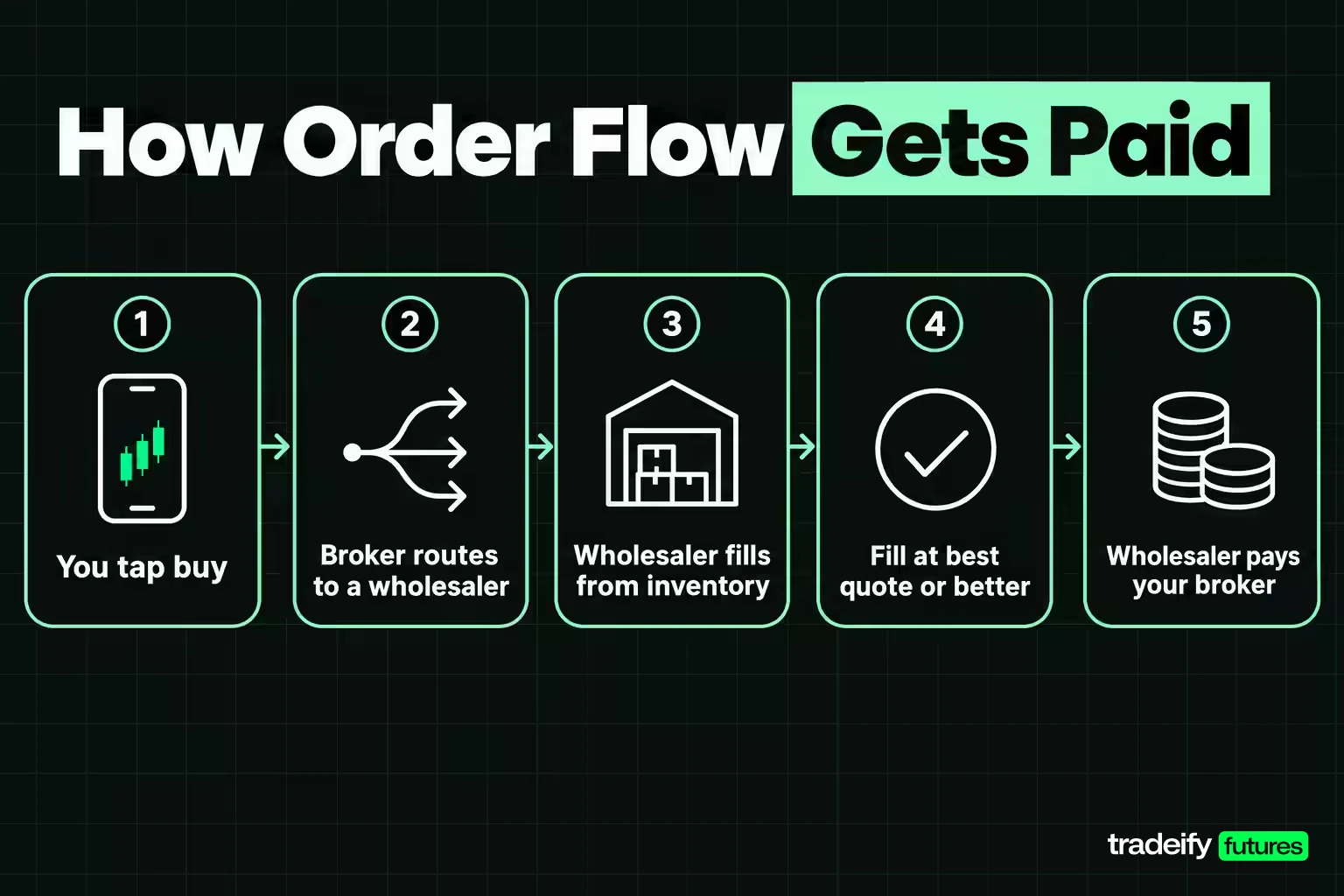
Payment for order flow follows the same path on almost every retail stock order placed through a commission-free app. Here is the chain for a marketable order, meaning a market order or a limit order priced to fill immediately:
- You tap buy on 1,000 shares.
- Your broker routes the order to a wholesale market maker rather than to an exchange such as Nasdaq or the NYSE.
- The wholesaler fills the order itself, selling you shares from its own inventory. This is called internalization.
- The fill has to print at the national best bid or offer or better. The CRS notes that marketable retail orders handled under PFOF must execute at the NBBO or at an improved price.
- The wholesaler earns the spread it captures across thousands of buyers and sellers, and pays your broker a slice of that economics.
The slice is set by contract, and brokers publish it. Some pay a flat rate per share. Fidelity's Q2 2026 Rule 606 report caps marketable equity orders at $0.0008 per share. Others pay a percentage of the spread. Robinhood's Q3 2026 report says it receives 12.35% of the spread between the national best bid and offer during regular hours.
Not every order earns the same rate. Resting orders that do not fill immediately (non-marketable limits) often carry a higher rate per share because they are more useful to the wholesaler, and options pay a per-contract rate covered in the options section.
Related lesson: Price improvement
Market Makers and Wholesalers in Order Flow
Market makers in the PFOF chain are firms that quote both a bid and an offer and stand ready to trade either side. They earn the spread between the price they buy at and the price they sell at, and they carry the risk of holding inventory while prices move. A wholesaler is a market maker that specializes in buying retail order flow from brokers and filling it off-exchange, which is the firm on the paying end of every PFOF arrangement. Without the wholesaler's spread income, there would be nothing to pay the broker with.
The business is concentrated. According to the Congressional Research Service, more than 90% of retail marketable orders in US stocks went to six wholesalers in 2022. At one point the three largest, Citadel Securities (41%), Virtu Financial (26%) and G1 Execution Services (16%), handled more than 80% of US retail equity market orders.
How Wholesalers Make Money From Retail Orders
Wholesalers profit from the spread. They buy at or near the bid, sell at or near the offer, and net the difference across an enormous number of small orders. Retail orders are attractive for a specific reason: an individual buying 50 shares on their phone is rarely trading on information that will move the price against the wholesaler in the next few seconds. That makes the flow cheaper to fill than orders from a fast institutional desk.
That is why a wholesaler can do three things at once:
- Pay the broker for the order.
- Fill you at the public quote or slightly better (price improvement).
- Still keep a profit on the spread.
The tension sits in the second bullet. Every dollar the wholesaler pays the broker is a dollar it could, in theory, have handed to you as a better price instead.
Who Keeps the Payment
The broker keeps it, and brokers can share it internally. Robinhood's Q3 2026 filing, for example, says its clearing broker passes 80% of the revenue to its retail brokerage affiliate. None of it is credited to the customer's account.
Related lesson: Market makers
What Brokers Disclose About Order Flow Payments
Order flow payments in the US are not secret. Rule 606 of Regulation NMS requires every broker that routes customer orders in stocks and listed options to post a quarterly report, broken down by month, showing:
- The top ten venues it routed to, plus any venue that got 5% or more of orders.
- The net payment received from each venue for market orders, marketable limit orders, non-marketable limit orders and other orders, both in total dollars and in cents per hundred shares.
- The material terms of each payment arrangement, including any volume incentives or minimum-flow penalties.
The reports stay public for three years. Here is what three large brokers published for their most recent quarter available on November 4, 2026.
| Broker and report | Marketable stock orders | Marketable single-leg options |
|---|---|---|
| Charles Schwab, Q3 2026 | $0.0015 per share or less | $1.12 per contract or less |
| Fidelity, Q2 2026 | $0.0008 per share or less | $0.30 to $0.40 per contract |
| Robinhood, Q3 2026 | 12.35% of the NBBO spread in regular hours | $0.30 to $1.20 per contract by symbol spread |
These are dated snapshots as of November 4, 2026. Brokers change terms, so check the current filing before relying on any number here.
Disclosed Caps Versus Realized Order Flow Payments
A broker's disclosed order flow payment rate is a ceiling. The monthly tables show what the broker actually collected, and they are worth reading against each other.
- Schwab's July 2026 table shows S&P 500 market orders routed to Citadel Securities earning 9.9377 cents per hundred shares, about $0.00099 per share, roughly 66% of its $0.0015 cap.
- Fidelity's April 2026 table shows the same order type routed to Citadel Securities earning 4.2124 cents per hundred shares, about $0.00042 per share, under its $0.0008 cap.
To convert, divide cents per hundred shares by 10,000 to get dollars per share. On a 1,000-share order those two realized rates are about $0.99 and $0.42.
Does Robinhood Get Paid for Order Flow
Yes. Robinhood's Rule 606 report states that it receives a fixed percentage of the NBBO spread on equity orders, 12.35% in regular hours and 9% in extended hours, and $0.0006 per share for overnight orders between 8:00 PM and 4:00 AM ET. Its options rates run from $0.30 to $1.20 per contract for orders of 1 to 100 contracts, depending on how wide the symbol's average spread is. It takes no payment on index options.
What an Order Flow Payment Is Worth on One Trade
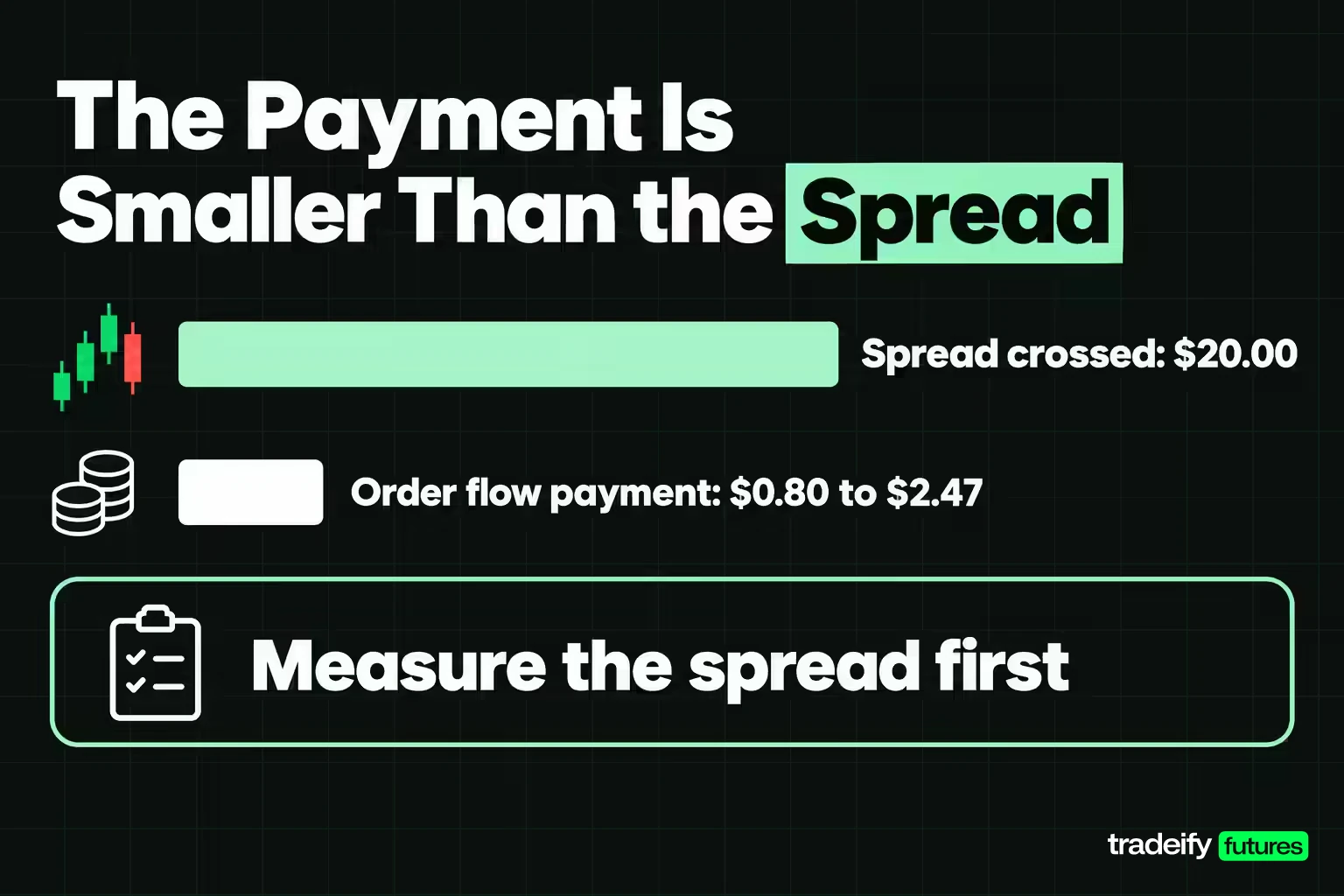
An order flow payment of a fraction of a cent per share sounds like nothing. The useful comparison is against the spread you crossed on the same order.
Take an illustrative order. You buy 1,000 shares of a stock quoted $50.00 bid and $50.02 offer. The spread is $0.02, so the total spread value on your order is $20.00. That $20.00 is what is on the table between you, the wholesaler and the broker.
| Payment model (from the filings) | Payment on 1,000 shares | Share of the $20.00 spread |
|---|---|---|
| Fidelity cap, $0.0008 per share | $0.80 | 4% |
| Schwab cap, $0.0015 per share | $1.50 | 7.5% |
| Robinhood, 12.35% of a $0.02 spread | $2.47 | 12.35% |
Three conclusions come out of this.
First, the payment is small next to the spread. On a liquid stock, the spread you cross is the bigger cost by a wide margin.
Second, a percentage-of-spread contract scales with the spread. If that same stock widens to a $0.10 spread during a fast market, a 12.35% contract pays five times more on the same order, while a flat per-share cap does not move.
Third, the payment is not invisible at size. $1.50 is 1.2 ticks of a Micro E-mini S&P 500 (MES) futures contract, where one tick is worth $1.25. A trader running 1,000-share orders all day is generating real money for someone, even if none of it shows on the statement.
Related lesson: Bid-ask spread
Payment for Order Flow in Options Markets
PFOF in options markets pays far more per share than in stocks, and the reason is in the arithmetic. One standard equity option contract covers 100 shares, so a per-contract payment divided by 100 gives its per-share equivalent:
- Schwab's $1.12 cap per contract is $0.0112 per share, about 7.5 times its own $0.0015 stock cap.
- Fidelity's $0.40 top rate is $0.004 per share, five times its $0.0008 stock cap.
- Robinhood's $1.20 top tier is $0.012 per share.
Options spreads are also wider than stock spreads, because a market maker quoting an option is pricing volatility, time decay and direction at once. A wider spread leaves more room to share, which is why Robinhood's schedule pays more on symbols with wider average spreads.
A Worked Options Order Flow Example
Here is an illustrative options order flow trade. You buy 10 single-leg contracts on a name with a $0.05 spread. The spread value is 10 contracts x 100 shares x $0.05, or $50.00.
- At Fidelity's $0.30 to $0.40 per contract, the broker collects $3.00 to $4.00, which is 6% to 8% of the spread value.
- At Schwab's cap of $1.12, it collects up to $11.20, or 22.4%.
- At Robinhood's range of $0.30 to $1.20, it collects $3.00 to $12.00, or 6% to 24%.
A fifth of the spread moving between two firms is not a rounding error. It explains why options flow is the bigger business. An aggregation of Rule 606 filings by Global Trading, reported by Finance Magnates, put US options payment for order flow at $1.004 billion in the second quarter of 2026 (reported September 1, 2026), the first quarter above $1 billion and up 23.6% from the first quarter.
If you trade options through a commission-free broker, the per-contract rate in its 606 report is the number to check first.
Related lesson: Options liquidity and spreads
Why Order Flow Payments Are Controversial
PFOF is controversial because it puts a broker's revenue and its customer's price on opposite sides of the same decision. A broker has a duty of best execution, meaning it must seek the most favorable terms reasonably available for your order. PFOF gives it a financial reason to send the order where the payment is highest instead.
Brokers acknowledge the tension in their own filings. Robinhood's Rule 606 report states that "the SEC Examination Staff has observed that there is a potential tradeoff between (i) payments received by brokers and (ii) price improvement and/or execution quality," and then states its view that the payment does not interfere with best execution.
The Robinhood Order Flow Payment Case
The clearest case on record is the SEC's December 17, 2020 action against Robinhood Financial. The SEC found that between 2015 and late 2018, Robinhood made misleading statements about payment for order flow, its largest revenue source, and that its unusually high payment rates came with execution prices inferior to other brokers. The order found customers were deprived of $34.1 million even after accounting for the commissions they saved. Robinhood paid $65 million to settle without admitting or denying the findings.
The CRS notes that an analysis cited in the SEC order put the execution loss at $5 per order for orders over 100 shares and $15 for orders over 500 shares.
What Research Says About Order Flow Payments and Fill Quality
Research on whether payment for order flow helps or hurts retail fills has not reached a consensus, according to the Congressional Research Service's 2024 In Focus summary. The CRS cites one study finding that retail trades at the best quoted prices surged after the UK effectively ended PFOF, and a 2022 study of 85,000 simultaneous market orders placed with five brokers that found PFOF did not appear to harm execution. The SEC's own analysis, also cited by the CRS, estimated its proposed order competition rule could save retail investors $1.5 billion a year, and commentators challenged that estimate.
Two more criticisms come up again and again:
- Concentration. A handful of wholesalers see most retail flow, which critics say limits competition for those orders.
- Opacity. The 606 report shows what the broker was paid, but it does not show what price you would have received elsewhere.
How Regulators Abroad Treat Order Flow Payments
UK regulators said in 2012 guidance (FG12/13) that PFOF creates a clear conflict of interest and is unlikely to be compatible with their inducements rules. The European Union went further: Regulation (EU) 2024/791 added Article 39a to MiFIR, prohibiting investment firms from receiving payment for order flow on retail client orders, and member states could only exempt their firms until 30 June 2026. The CRS also lists Australia and Canada among places where PFOF has been banned.
The Case for Order Flow Payments
The case for payment for order flow starts with commissions. According to the CRS, retail commissions ran about $200 per trade in the 1980s and $40 in the 1990s before reaching zero in the 2010s, and PFOF helped make zero-commission trading possible. Supporters argue the revenue keeps trading free and draws in investors who would not pay a ticket charge.
The main defenses run like this:
- Free trades. The broker earns from routing instead of charging you per order.
- Price improvement. A wholesaler that buys retail flow can afford to fill inside the public quote, because retail orders are cheaper to trade against.
- A floor on price. Marketable PFOF orders must fill at the NBBO or better, so the fill is never worse than the price the market was showing.
- Best execution still applies. The broker's legal duty does not disappear because it is paid.
The scale is real too. The CRS reports that the 12 largest US brokerages earned $3.8 billion from PFOF in 2021.
Where the Order Flow Payment Defense Is Weakest
The defense of payment for order flow is strongest on small orders in liquid stocks, where the payment is a tiny share of a tiny spread. It gets weaker in three places: wide-spread names, percentage-of-spread contracts that pay more when markets get fast, and options, where the payment can be a fifth of the spread value. "At or better than the NBBO" is a floor, not proof you got the best available price.
A fair reading holds both ideas at once. Zero commissions did lower the visible cost of trading, and the payment can still be a hidden cost on the orders where spreads are wide.
Where Order Flow Payment Rules Stand Now
Payment for order flow in the US is legal for brokers that meet best execution and disclosure duties. The rules exist to make it visible, not to stop it.
The reform that would have changed it most is off the table for now. The SEC proposed an order competition rule on December 14, 2022, which would have required many retail orders to be exposed to auctions before a wholesaler could fill them. It formally withdrew that proposal, along with several other market structure proposals, as of June 17, 2025.
Other changes are moving:
- Rule 605 execution quality reports. Amendments adopted in 2024 extend monthly execution quality reporting to larger broker-dealers, not only market centers. The compliance date was pushed from December 14, 2025 to August 1, 2026.
- Rules 611 and 610(e). On June 11, 2026, the SEC proposed rescinding the trade-through rule and the locked and crossed quote restrictions. It is a proposal, not a final rule.
Outside the US, the EU ban applies, the UK treats PFOF as largely incompatible with its rules, and the CRS lists Australia and Canada as having banned it. Treat any US proposal as a proposal until a final rule is published.
Why Futures Have No Payment for Order Flow
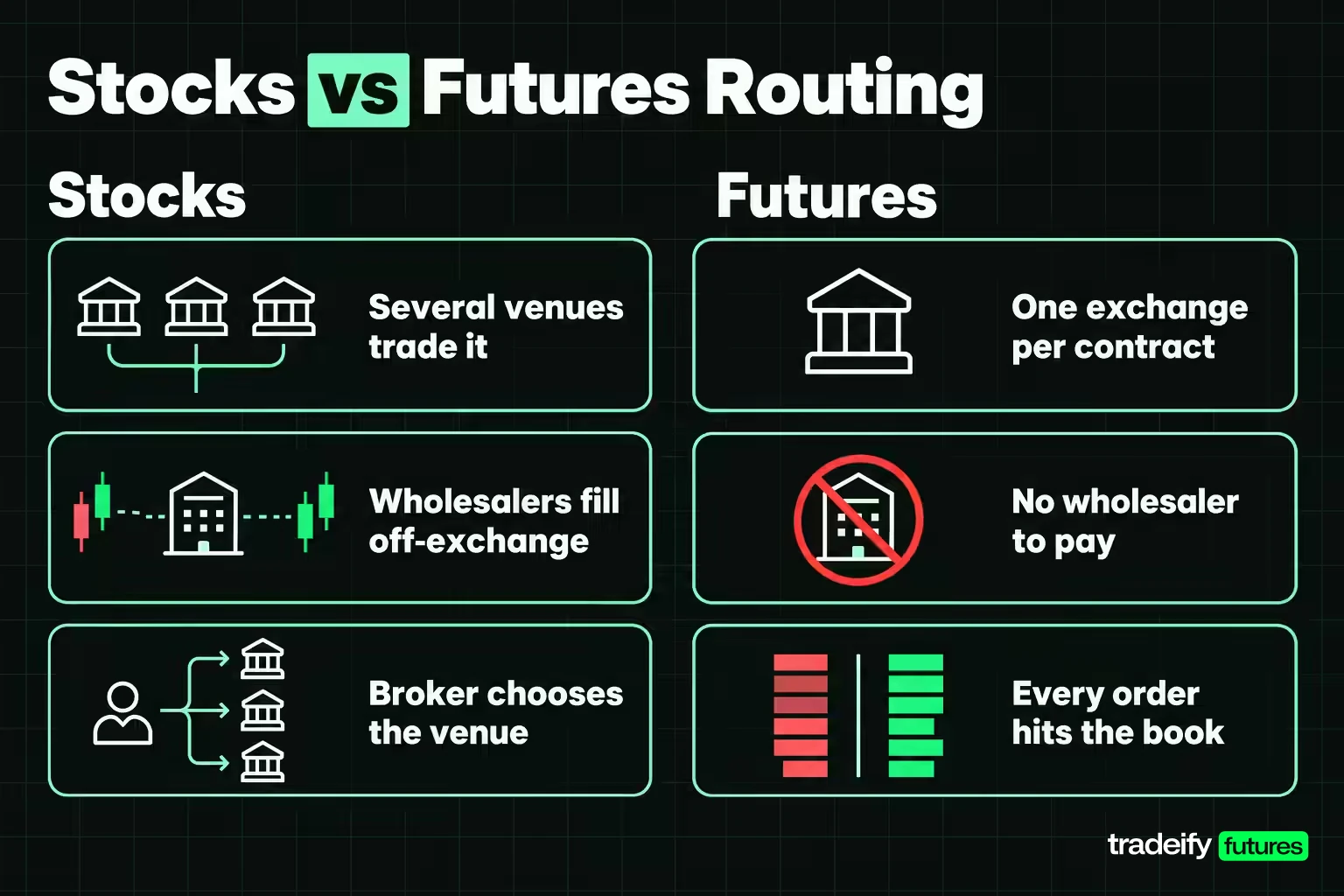
Payment for order flow needs three things: several venues trading the same product, a wholesaler able to fill orders away from the exchange, and a broker choosing where to send them. US futures have none of those for ordinary orders.
Each futures contract trades on one exchange. The E-mini S&P 500 trades on CME Globex and nowhere else, so there is no second venue to route to and no wholesaler to pay for the order. CFTC Regulation 1.38 also requires futures trades on a contract market to be executed openly and competitively, with narrow exceptions under exchange rules such as block trades for large size.
When your order reaches Globex, the matching engine fills it against resting orders in the book using a published algorithm. CME documents FIFO, pro rata, Lead Market Maker (LMM), split, leveling and TOP steps. Exchanges do run market maker programs, and the LMM step is one of them, but that is the exchange rewarding someone for quoting, not a firm paying your broker for your order.
What Futures Traders Pay Instead of Order Flow Payments
Without payment for order flow, futures traders pay a visible commission and cross a visible spread, and a bad fill shows up in ticks. One tick is $1.25 on MES and $12.50 on ES. Two ticks of adverse fill on 5 MES contracts is $12.50, more than eight times the $1.50 Schwab could collect at its cap on a 1,000-share stock order.
On our accounts, orders go through Tradovate, Rithmic or WealthCharts to CME Group futures such as ES and MES, and the commission is listed up front: $5.76 round trip for ES and $1.82 for MES at the time of writing. Our Help Center suggests using limit orders when the spread is wider than 2 ticks and avoiding market orders around major announcements.
Related lesson: Tick size and tick value
Payment for Order Flow FAQ
What does PFOF stand for?
PFOF stands for payment for order flow. It is the money or other benefit a broker receives from a market maker for routing customer orders to that market maker. US brokers must disclose it in quarterly Rule 606 reports.
Is payment for order flow illegal?
Not in the US. It is allowed for brokers that meet their best execution and disclosure duties. The EU prohibited it under MiFIR Article 39a, with national exemptions ending 30 June 2026, and UK regulators treat it as unlikely to fit their rules.
Does the payment come out of my trade?
Not as a charge. The money moves between the market maker and the broker. Whether it affects your fill price is the contested part, which is why brokers must publish their rates and execution data.
Is payment for order flow the same as order flow trading?
No. Order flow trading, including order flow in forex, means reading the buying and selling pressure in the market through tools like the order book or time and sales. Payment for order flow is a business arrangement between brokers and market makers. They share two words and nothing else.
Is payment for order flow going away in the US?
No rule in force bans it. The SEC withdrew its order competition proposal as of June 17, 2025, so the main reform aimed at PFOF is no longer pending. Watch for new proposals, but treat them as proposals until a final rule is adopted.
How to Check Whether Order Flow Payments Cost You
Order flow payments are easy to blame for a bad fill. Most of the time they are the wrong suspect. Before you switch brokers over routing, work through these checks in order.
- Measure the spread first. On a marketable order, the spread you crossed is almost always bigger than the broker's payment. If the spread was $0.10, the payment was not your main cost.
- Read your broker's Rule 606 report for the order type you use. Note whether the deal is a per-share cap or a percentage of the spread. A percentage contract pays more when spreads widen; a cap does not.
- Check whether you trade options. Per-contract rates convert to several times the stock rate per share, so options traders have the most to gain from reading the filing.
- Compare execution quality. Under the amended Rule 605, larger broker-dealers publish monthly execution quality statistics, with an August 1, 2026 compliance date. Compare effective spreads and price improvement across brokers rather than payment rates alone.
- Use limit orders on wide spreads. A limit order caps the price you accept, whoever fills it.
The goal is to find the cost you can actually reduce. Usually that is the spread and your order type, not the routing contract. A broker change fixes neither.
Related lesson: Slippage
This article is educational and describes market structure. It is not investment advice or a recommendation of any broker, venue or order type. Broker payment rates and regulations change, so verify current terms in your broker's own filings. Trading stocks, options and futures carries substantial risk of loss, and futures leverage can lead to losses larger than expected. Evaluation and funded prop accounts are simulated and do not behave exactly like a live brokerage account.


