



TL;DR: Early exercise risk is the cost or surprise created when an option is exercised before expiration, by you or by someone else. Exercising a listed option forfeits its time value, so a $1.10 call worth $0.30 in the money gives up $80 per contract. Sellers face early assignment, most often on deep in-the-money puts or on calls whose time value is below an upcoming dividend. Employees who early exercise must file any 83(b) election within 30 days and can lose the cash if the stock never becomes sellable.
Early exercise sounds like a technicality until it costs you money.
A call holder exercises a winning option and gives up value they could have sold. A put seller wakes up owning 500 shares they did not plan to buy. An employee writes a five-figure check for startup stock, files a tax form within a 30-day window, and then leaves the company two years later with shares nobody will buy.
All three are early exercise problems. The first two come from exchange-listed options. The third comes from employee stock options. The decision logic differs, but the core question is the same: what do you give up, and what position do you end up holding, if the option is used before the last possible moment?
This guide covers both worlds, starting with listed calls and puts and then moving to employee grants, so you can see the risk from whichever side of the contract you sit on.
What Early Exercise Means
Early exercise means using an option's right to buy or sell the underlying asset before the option's expiration date. Who can do it, and what happens next, depends on the type of option.
Early exercise of listed options
All standardized US equity options use American-style exercise. The holder can exercise on any day the market is open before expiration, and the last day to exercise a monthly option is usually the third Friday of the expiration month. Each standard contract covers 100 shares.
The holder makes the decision. A call holder who exercises buys 100 shares per contract at the strike price. A put holder who exercises sells 100 shares per contract at the strike. The instruction is irrevocable, and the account needs the cash or margin to complete the stock trade.
Options exchanges stop accepting exercise notices at 4:30 PM Central Time, and most brokers set an earlier internal cut-off. If you plan to exercise on a given day, the broker's deadline is the one that matters.
Early exercise of employee stock options
Employee stock options are a different contract. A company grants an employee the right to buy company shares at a fixed exercise price, usually after the options vest over several years.
Some private companies allow early exercise, meaning the employee can buy shares before the options vest. The shares arrive unvested, and the company keeps the right to buy back any unvested shares if the employee leaves. The motive here is mostly tax timing, not market timing.
American and European exercise styles
Exercise style decides whether early exercise is even possible. American-style options can be exercised any business day before expiration. European-style options can be exercised only at expiration.
Most, but not all, US index options are European-style. A European-style option can still be sold in the market any day before expiration. It simply cannot be exercised early, so a seller of a European-style option does not face early assignment.
Before trading any option, check its exercise style in the exchange specifications rather than assuming from the ticker.
Related lesson: How options assignment works
Why Early Exercise Usually Costs a Listed Option Holder
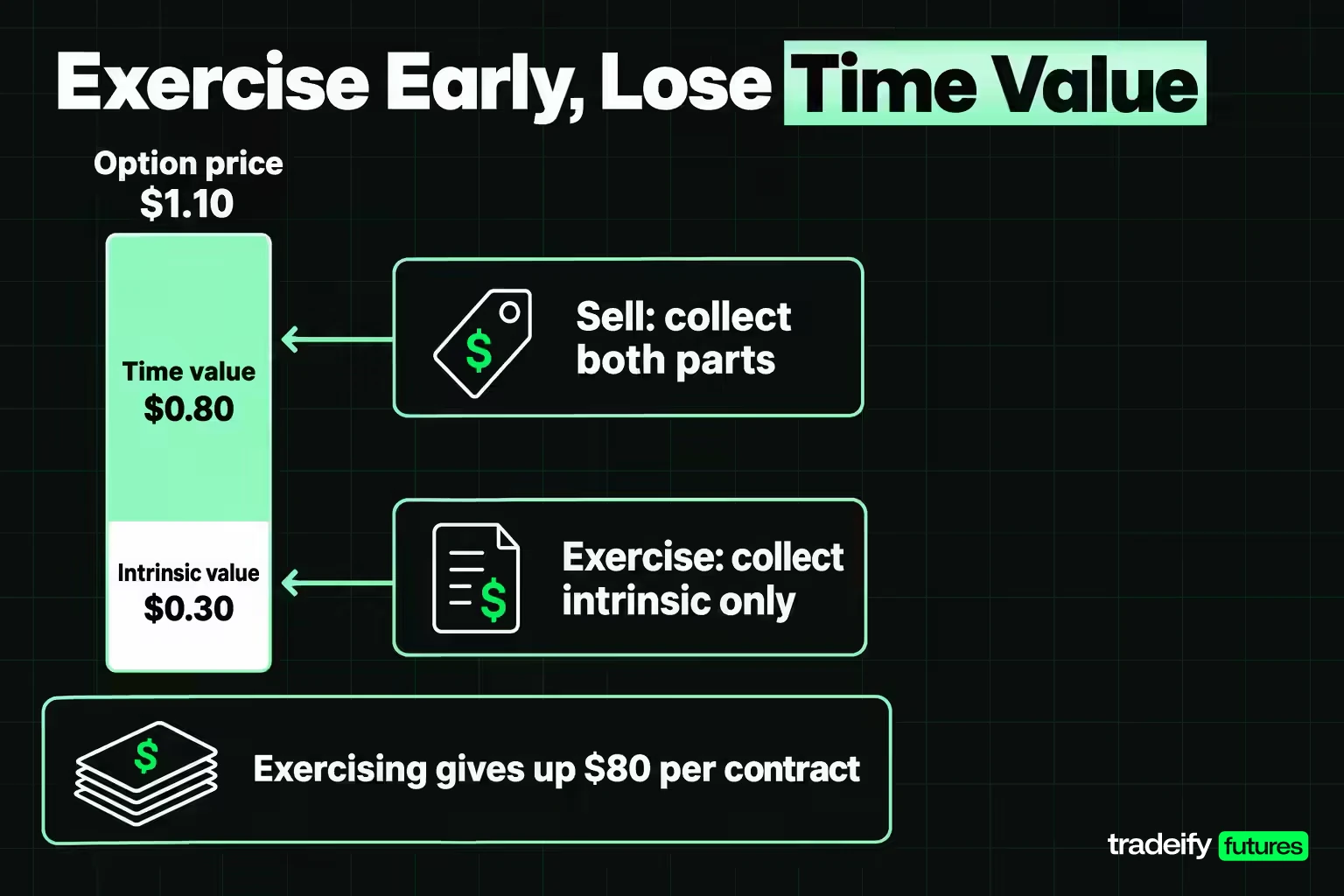
An option's price has two parts. Intrinsic value is how far the option is in the money. Time value (also called extrinsic value) is everything above that, the price of the time and uncertainty left before expiration.
When you exercise, the option disappears and its time value disappears with it. You collect only the intrinsic value through the stock trade.
The Options Industry Council uses this example. Stock OICX trades at $32.80. A two-week call with a $32.50 strike trades at $1.10. The call is in the money by $0.30, so its time value is $0.80.
| Choice | What you collect per share | Per contract |
|---|---|---|
| Exercise the call and sell the stock | $0.30 | $30 |
| Sell the call in the market | $1.10 | $110 |
| Time value given up by exercising | $0.80 | $80 |
Exercising in that example throws away $80 per contract. Even if you want to own the stock, selling the call and buying the shares in the market can leave you better off.
Being right on direction and choosing how to exit are two separate decisions. The call made money either way. Exercising simply collected less of it.
That is why exercise is the exception. The OIC reports that in about 70% of options trades the holder sells to close rather than exercising. Historically, more than 72% of option contracts are closed before expiration, 22% expire worthless and only 6% are exercised.
The working rule for a holder: exercise only when the benefit of exercising today is larger than the time value you would forfeit. If the option still carries meaningful time value and trades in a liquid market, selling is usually the cleaner exit, after the bid-ask spread and fees.
Related lesson: Intrinsic and extrinsic value explained
When Early Exercise Makes Sense on Listed Options
Early exercise of a listed option makes economic sense in a narrow set of cases. Two come up again and again: calls before an ex-dividend date and deep in-the-money puts.
Calls before an ex-dividend date
A call holder does not receive the stock's dividend. Only a shareholder does. A call holder who exercises before the ex-dividend date becomes a shareholder in time and is entitled to the dividend.
So the test is simple: is the dividend larger than the call's remaining time value?
Here is an illustrative case with round numbers. A stock trades at $60 and goes ex-dividend tomorrow with a $0.75 dividend. A $45 call is bid at $15.20.
- Intrinsic value is $15.00, so time value is $0.20, or $20 per contract.
- The dividend is worth $75 per contract.
- Exercising costs $4,500 per contract to buy the shares.
- Exercising today beats selling the call by $55 per contract ($75 minus $20).
Change one number and the answer flips. If the same call were bid at $16.10, time value would be $1.10, or $110 per contract. That is more than the $75 dividend, so exercising would leave the holder $35 worse off than selling.
This is why call sellers watch dividend dates. As the ex-date nears, the odds of assignment rise on in-the-money calls whose time value has shrunk below the dividend.
Deep in-the-money puts
A put holder who exercises sells the stock at the strike and receives cash now instead of later. When a put is so deep in the money that almost no time value is left, the interest that cash can earn may be worth more than the time value given up.
An illustrative case: a $50 put on a stock trading at $30, with three months left, bid at $20.05.
- Time value is $0.05, or $5 per contract.
- Exercising delivers $5,000 in cash per contract today.
- At an illustrative 4% annual rate, $5,000 earns about $50 over three months.
Giving up $5 to start earning roughly $50 is the trade-off that leads holders who already own the shares to exercise deep puts early. The OIC notes that most professional option traders exercise deep in-the-money puts before expiration.
Is early exercise worth it for a listed option?
Usually not, but sometimes clearly yes. Run the comparison before acting: the benefit of exercising now (a dividend, interest on cash, or owning the shares for a specific reason) against the time value you forfeit plus extra costs. If the benefit is bigger, exercise can make sense. If it is not, sell the option.
Related lesson: How ex-dividend dates work
Early Exercise Risk for Option Sellers
Early exercise risk for an option seller is the possibility of being assigned before expiration because a holder somewhere chose to exercise. The seller does not get a vote.
How early assignment is allocated
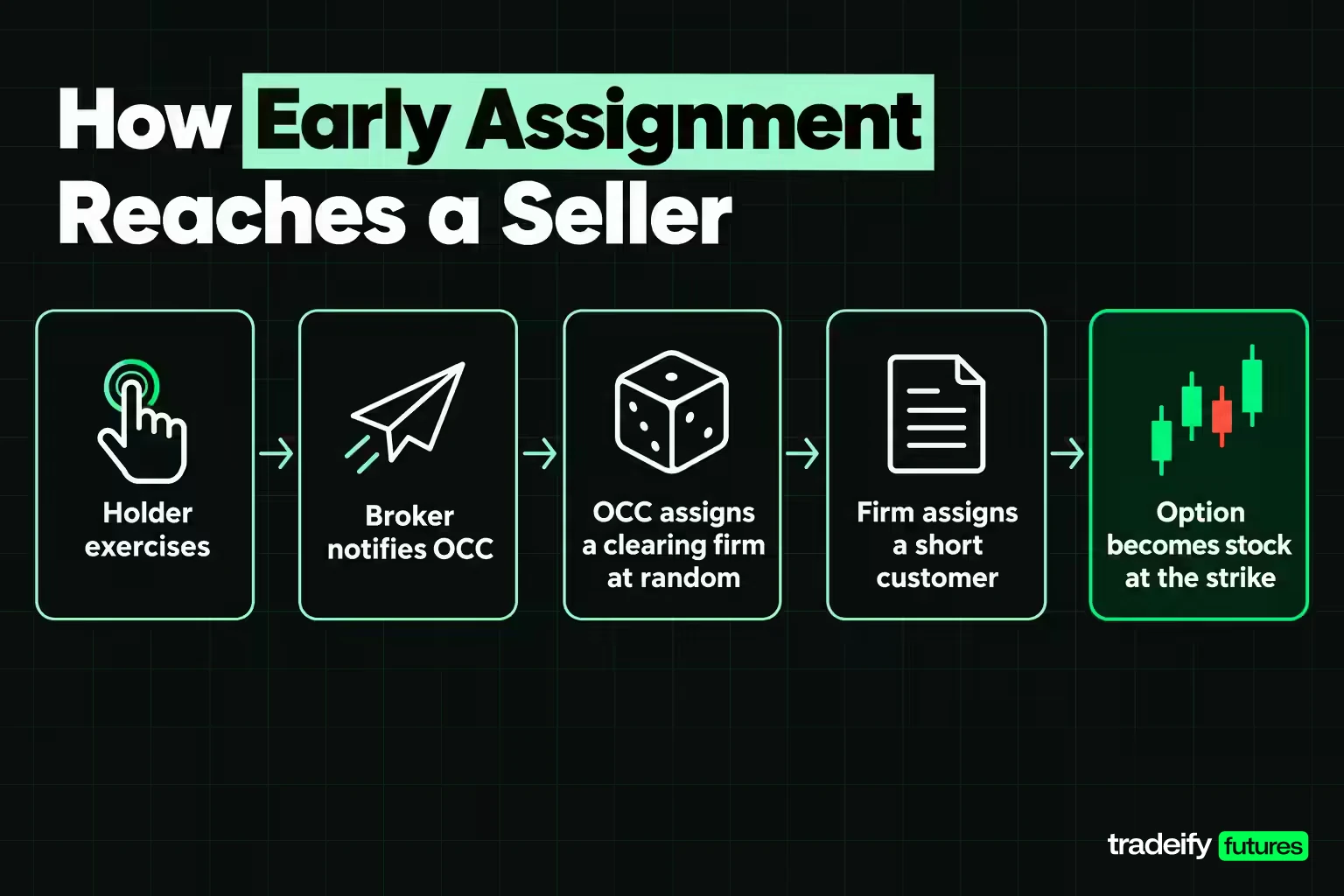
When a holder exercises, the broker notifies the Options Clearing Corporation (OCC). OCC randomly assigns the exercise notice to a clearing firm with short positions in that series. The firm then assigns one of its customers, either at random or first-in, first-out, depending on its procedure.
FINRA notes that only about 7% of options positions are typically exercised. That does not mean a seller will be assigned on 7% of their short options. A seller may have some, all or none of their short positions assigned.
What early assignment puts in your account
Assignment turns an option position into a stock position at the strike price:
- A short call that is assigned requires delivering 100 shares per contract at the strike. If the seller does not own the shares, the account ends up short stock.
- A short put that is assigned requires buying 100 shares per contract at the strike, which needs the full cash or margin.
FINRA gives this example. An investor sells 10 XYZ July 50 calls at $1.00 while the stock trades at $40, collecting $1,000. The stock rises to $60 and the calls are assigned. Without owning shares, the investor must deliver 1,000 shares at $50 while they trade at $60, an unrealized loss of $9,000 after the premium.
Dividends owed after early assignment
An assigned call writer must deliver the stock plus the dividend if the holder exercised before the ex-dividend date. The writer may not even learn of the assignment until after the ex-date.
Using the illustrative $45 call on the $60 stock: a trader short 5 of those calls who is assigned the day before the ex-date ends up short 500 shares at $45. They now owe the $0.75 dividend on 500 shares, or $375, on top of the $15 per share ($7,500 in total) difference between strike and market price, before the premium they collected.
Assignment risk on spreads
Multi-leg positions do not protect the seller from assignment on one leg. FINRA notes that if one short leg is assigned, the investor must perform on it regardless of the protective long leg. Exercising the long leg, or closing it, is the investor's own job.
A spread that looked capped on the risk graph can briefly become a naked stock position with a separate option attached.
Assignment risk at options expiration
Most American-style exercises happen at or near expiration. At expiration, OCC's exercise-by-exception process exercises equity and index options that are in the money by $0.01 or more unless the clearing member instructs otherwise. A broker may use a different threshold.
Expiration brings its own surprises. Holders can exercise based on news after the close, so a short option that finished slightly out of the money can still be assigned, and one slightly in the money may not be. The OIC notes that some writers are assigned on options that expire exactly at the money or even out of the money.
To remove assignment exposure on a given day, close the short option before that day's market close.
How to Manage Early Exercise Risk on Short Options
You cannot stop a holder from exercising an American-style option. You can control how much exposure you carry into the windows where early exercise becomes attractive.
Read the option the way the holder does
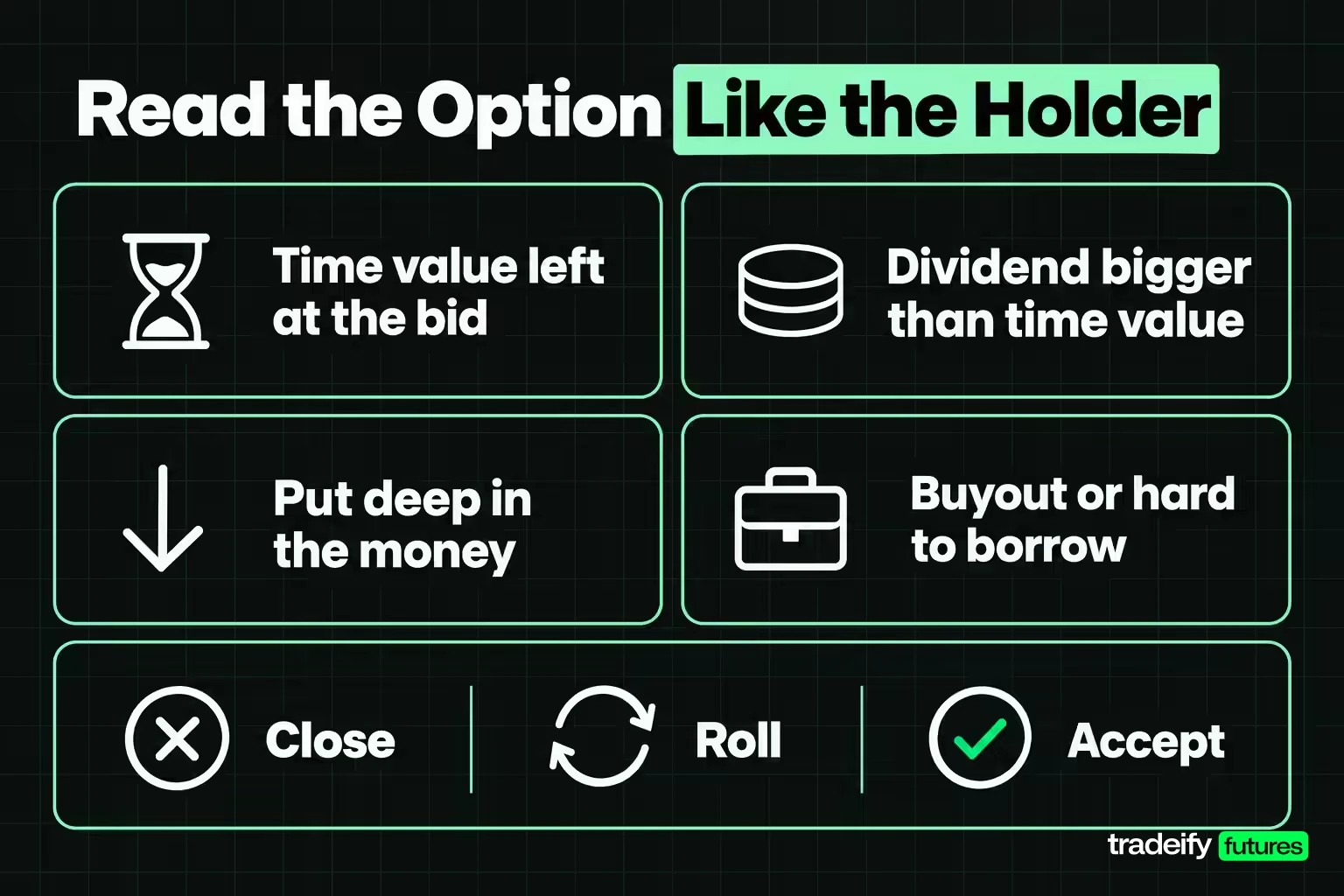
A holder exercises when it pays, not when it feels likely. Look at the option from their side each day it matters:
- How much time value is left at the current bid?
- Is an ex-dividend date close, and is the dividend larger than that time value?
- Is the put so deep in the money that interest on the strike cash beats the time value?
- Is a buyout or a hard-to-borrow situation building in the stock?
FINRA notes that early exercise can also follow a large price move or shares becoming difficult to borrow around a pending corporate action such as a buyout.
Close, roll or accept
You have three practical responses once the conditions line up.
| Response | What it does | Cost to the seller | Best fit |
|---|---|---|---|
| Buy to close | Removes the short option and its assignment exposure once filled | The ask price, spread and fees | You no longer want the stock position assignment could create |
| Roll to a later or different strike | Closes the current option and opens a new one with more time value | A new trade with its own risk and price | You still want the exposure but not the immediate exercise window |
| Accept possible assignment | Keeps the position and plans for the stock | Possible stock position and any dividend owed | The resulting shares fit your plan and account |
A roll is a new trade, not an eraser. The new contract brings its own risk, liquidity and assignment exposure.
Size for the assignment, not the option
Before you leave a short option open through a risk window, model the assignment. A short put on a $50 strike means buying $5,000 of stock per contract. A short call you do not cover means a short stock position that can lose money without a cap as the stock rises.
If the account cannot carry that position, the broker may act for you. Read the account agreement rather than assuming you will have time to react.
Set the triggers in advance
"Assignment is unlikely" is not a plan. Decide ahead of time:
- the amount of time value that triggers a review;
- how many days before an ex-dividend date or expiration you will reassess;
- whether you would accept the shares at the strike;
- the largest stock position the account can carry after assignment.
When the triggers come from a plan you wrote before the trade, an assignment notice becomes a planned outcome rather than a scramble. The notice usually shows up the next morning, after the decision was made by someone else.
Related lesson: Managing and rolling options positions
Early Exercise Before Vesting for Employee Stock Options
Early exercise before vesting is a feature some private companies add to employee option plans. It lets an employee buy the shares behind their options right away, even though the options have not vested yet.
How an early-exercise grant works
The employee pays the exercise price for some or all of the grant. The company issues the shares, but they stay subject to vesting. If the employee leaves before the shares vest, the company can usually buy the unvested shares back, commonly at the price the employee paid. The exact repurchase terms sit in the stock option agreement.
Take an illustrative grant of 20,000 options with a $0.50 exercise price, vesting over four years with a one-year cliff. Early exercise of the whole grant costs $10,000 (20,000 times $0.50).
The 83(b) election and its 30-day window
Unvested shares count as restricted property for tax purposes. Without an election, the employee is taxed on each batch of shares as it vests, based on the value at that time.
Section 83(b) of the tax code lets the employee choose to be taxed on the shares at the moment they are transferred instead. The taxable amount is the fair market value at transfer minus the price paid. If the exercise price equals fair market value, that amount is $0.
The election must be made no later than 30 days after the shares are transferred. The IRS accepts a signed written statement or Form 15620, and a copy goes to the employer. The election cannot be revoked without IRS consent, and there is no extension for missing the window.
One detail trips people up. The IRS says the election cannot be made for the option itself, only for the shares received on exercise. That is why early exercise and the 83(b) election go together: the election only becomes possible once you own unvested shares.
Can ISOs be early exercised?
Yes, if the plan allows it. Incentive stock options (ISOs) can carry an early-exercise feature like any other option. The shares are still unvested, the 83(b) choice is still available for them, and the special ISO tax rules still apply. One catch is the $100,000 annual ISO limit: because an early-exercisable grant can be exercised in full at grant, a large grant can be partly treated as NSOs from day one.
Related lesson: How employee and listed stock options differ
Tax Implications of Early Exercise
Tax is the main reason employees exercise early. The idea is to be taxed on the spread while it is small and let later growth be taxed as capital gain. Whether that works depends on the option type and the timing.
NSOs and ordinary income
Nonqualified stock options (NSOs) usually create no income at grant. At exercise, the spread between fair market value and the exercise price is taxed as ordinary compensation income and reported on Form W-2.
If the shares are unvested at exercise, the IRS treats them as restricted property. Without an 83(b) election, the spread is measured as each batch vests, at the value then. With the election, the spread is measured once, at exercise.
ISOs and the alternative minimum tax
ISOs create no regular income at grant or exercise. The catch is the alternative minimum tax (AMT). For AMT purposes, the spread counts as an adjustment when the shares become transferable or are no longer subject to forfeiture, and it goes on Form 6251, line 2i.
For an early-exercised ISO, that timing rule matters. Without an 83(b) election, the AMT spread is measured as the shares vest, which can be a much larger number if the company's value has grown. Publication 525 points ISO holders to the restricted property rules for this reason. With the election, the AMT spread is measured at exercise.
After an ISO exercise, the employer sends Form 3921 with the dates and values needed to report it.
Holding periods that early exercise can start
To keep ISO tax treatment, the shares cannot be sold within 2 years of the grant date or within 1 year of the shares being transferred. A sale that misses either clock is a disqualifying disposition, and part of the gain becomes ordinary income.
For restricted shares without an 83(b) election, the holding period generally starts when the shares vest. With the election, it can start at exercise. Long-term capital gain treatment requires holding an asset for more than one year, and the IRS taxes most net capital gains at 0%, 15% or 20% depending on income.
Qualified small business stock
Some startup shares qualify as qualified small business stock under section 1202. For stock acquired after July 4, 2025, the law excludes 50% of the gain after 3 years, 75% after 4 years and 100% after 5 years or more, subject to a per-issuer cap of $15,000,000 for that stock.
The clock starts when you hold the stock for tax purposes, so early exercise with an 83(b) election can start it sooner. Whether a specific company qualifies is a question for the company and a tax adviser.
The $100,000 ISO limit and early exercise
ISOs carry a $100,000 annual limit. If the stock behind ISOs that become exercisable for the first time in a calendar year is worth more than $100,000 (valued at grant), the excess is treated as NSOs.
An early-exercisable grant is exercisable in full from the grant date. Treasury regulations give the example of an immediately exercisable ISO on stock worth $150,000 at grant: it is split into an ISO for $100,000 of stock and a nonstatutory option for $50,000. So an illustrative grant of 300,000 early-exercisable ISOs at $0.50 ($150,000 of stock) would be part ISO and part NSO from day one, even though a regular four-year vesting grant of the same size could stay within the limit each year.
Tax outcomes compared with an illustrative grant
The illustrative grant is 20,000 options at a $0.50 exercise price. Each row is a different exercise moment.
| Exercise moment | Fair market value per share | Spread taxed or counted | Cash to exercise |
|---|---|---|---|
| Early exercise at grant with 83(b) | $0.50 | $0 | $10,000 |
| Early exercise after one year with 83(b) | $2.00 | $30,000 | $10,000 |
| Exercise after full vesting | $5.00 | $90,000 | $10,000 |
For an ISO the spread is an AMT adjustment. For an NSO it is ordinary income. The cash to buy the shares is the same in every row. What changes is how much of the gain is taxed before you can sell a single share.
These rules are complex and depend on your plan documents and full tax situation. Treat the numbers as illustrations and confirm your own case with a tax professional before you exercise.
Risks and Disadvantages of Early Exercise
Early exercise of employee stock options moves risk forward. You pay now, and maybe pay tax now, for stock whose value and sale date are unknown. The tax benefit only shows up if the company succeeds; the downside shows up whether it does or not.
Capital locked in illiquid stock
Private company shares usually cannot be sold freely. The $10,000 in the illustrative grant may sit in shares for years with no buyer. Even after an IPO, insiders including employees typically face a lockup, and the SEC notes that most lockups block sales for 180 days.
The company can fail
If the company never reaches a sale or IPO, the shares can end up worth nothing. With early exercise you lose the exercise price you paid. Without it, you would have lost nothing but the option.
Leaving before you vest
If you leave after one year of a four-year schedule with a one-year cliff, 5,000 of the 20,000 illustrative shares have vested. The company can buy back the other 15,000 shares, typically at your cost, returning $7,500.
The money comes back. The tax does not. Section 83(b) says no deduction is allowed when restricted property is later forfeited. In the illustrative case where the spread was $30,000 at exercise, the tax paid on that amount stays paid.
Concentration on top of your paycheck
Your salary, bonus and career already depend on the company. Early exercise adds savings to the same bet. If the company struggles, every part of your finances can be hit at once.
Early exercise disadvantages for listed option holders
For listed options the disadvantage is simpler: exercising early usually gives up time value, and it turns a defined-risk option into a full stock position that needs capital and can fall further.
Is Your Financial Situation Ready for Early Exercise
Early exercise only makes sense with money you could lose entirely without changing your life. A tax win on paper does not help if the exercise drains your emergency fund.
It helps to decide the number before you look at the spreadsheet. Pick the most you would put into this company's stock, then see how many shares that buys.
A readiness test before early exercise
Answer these before you exercise:
- Could you lose the full exercise price and still cover rent, debt payments and an emergency fund?
- If a spread is taxed at exercise, do you have cash for that tax bill in the same year, given that you cannot sell the shares to pay it?
- How much of your net worth would sit in this one company afterwards?
- How long are you likely to stay, and would the repurchase terms leave you whole if you left early?
- Have you read the plan, the option agreement and any repurchase or transfer restrictions?
If the answers are uncomfortable, exercising part of a grant early, or waiting, can be a sound choice.
Ways to pay for an exercise
How you fund the exercise changes the risk.
| Method | How it works | Where it fits |
|---|---|---|
| Cash exercise | You pay the full exercise price and any withholding from your own money and keep all the shares | Private or public companies; the only route for many early exercises |
| Sell-to-cover | Enough shares are sold at exercise to pay the price and taxes | Public companies with a market for the shares |
| Cashless exercise | All shares are sold at exercise and you receive the net cash | Public companies; ends your stake |
| Net exercise | The company withholds shares worth the exercise cost instead of taking cash | Only where the plan allows it |
For early exercise at a private company, cash is often the only option, because there is no market to sell shares into.
Exercise Timing Strategy for Stock Options
Exercise timing is a trade-off between paying less tax and putting less money at risk. The right moment depends on where the company and your career are.
The tempting mistake is to treat the tax saving as the whole decision. A smaller tax bill on stock that never becomes sellable is still a loss of the cash you paid.
Exercising at or soon after grant
The spread is smallest at grant, often zero. Early exercise here, with an 83(b) election filed inside 30 days, keeps the taxable or AMT spread at $0 in the illustrative case and starts holding-period clocks early. The cost is that you put the most money at risk when the least is known about the company.
Exercising before the company's share value is reset
Private companies update the fair market value of their shares over time, often after a funding round. Each increase widens the spread on exercises made afterwards. Some employees time exercises before an expected increase. That can reduce tax, but only if the company keeps growing.
Exercise deadlines when you leave the company
Leaving changes the clock. An ISO keeps its tax status only if it is exercised within 3 months after employment ends (1 year if the employee is disabled). Many plans also give a limited post-termination window to exercise at all. Missing it can mean losing the options entirely.
Leaving often forces the largest exercise decision at the worst time: a large spread, a short window and no paycheck from the company.
Exercising around an IPO or acquisition
An acquisition or IPO can change everything. In an IPO, a lockup usually blocks sales for about 180 days, so shares bought just before the IPO can still fall before you can sell. In an acquisition, the deal terms decide whether options are cashed out, converted or cancelled.
Exercising right before a known liquidity event removes much of the "will this ever be worth anything" risk, but the spread and the tax are usually much larger by then.
Exercising before the options expire
ISOs cannot have a term longer than 10 years, and most grants set a fixed expiration date. Unexercised options are lost after expiration, so mark the date even if you plan to wait.
A Step-by-Step Approach to Exercising Employee Stock Options
A clear order of steps keeps an employee stock option exercise from turning into a rushed decision at a deadline. The work splits into two parts: deciding before you exercise, and handling the paperwork once you do.
Steps before exercising employee stock options
- Read the plan and option agreement. Confirm the option type (ISO or NSO), the vesting schedule, whether early exercise is allowed, the repurchase terms and the post-termination exercise window.
- Get the current fair market value from the company and calculate the spread for the shares you are considering.
- Model the tax. For NSOs, estimate ordinary income on the spread. For ISOs, estimate the AMT effect. Do it with and without an 83(b) election.
- Check affordability. Make sure you can lose the exercise price and pay any tax without touching essential savings.
- Decide how much to exercise. You do not have to exercise the whole grant; a partial exercise caps the money at risk.
Steps when and after exercising employee stock options
- Choose a payment method that fits the company's stage and your cash.
- If you early exercise unvested shares, file the 83(b) election within 30 days of the transfer, give the company a copy and keep proof of the filing date.
- Keep records, including Form 3921 for ISO exercises, the 83(b) election and the fair market value at exercise, so your cost basis can be shown later.
- Recheck the decision at each funding round, job change and liquidity event.
A fee-only tax adviser who works with equity compensation can review the tax model and the 83(b) filing before you sign.
Why Futures Contracts Have No Early Exercise
Futures traders do not face early exercise risk in the options sense, because a futures contract has no exercise right. Both sides of a futures contract carry an obligation from the moment the trade is made, and gains and losses are settled as prices move. There is no holder who can choose to convert the position early.
Options on futures are different. CME's quarterly E-mini S&P 500 options are American-style, and exercising one delivers one E-mini futures contract. CME's weekly and end-of-month E-mini options are European-style and cannot be exercised early. A trader who sells American-style options on futures faces the same early assignment logic described for stock options, with a futures position instead of shares.
On our accounts at Tradeify, early exercise does not come up: we don't offer options of any kind, only futures such as ES, NQ, CL and GC, and every position is closed by 4:45 PM ET with no overnight holds. Our funded accounts are simulated.
Early Exercise FAQ
Is early exercise worth it?
For listed options, usually not, because exercising early gives up time value that selling would keep. It can be worth it when a dividend or interest on cash is larger than that time value. For employee stock options, it can cut future tax when the spread is small, but only if you can afford to lose the money.
Can ISOs be early exercised?
Yes, if the company's plan allows it. The shares are unvested when bought, and an 83(b) election filed within 30 days can lock the AMT spread at exercise. An early-exercisable grant is exercisable in full at grant, so the $100,000 ISO limit can turn part of it into NSOs.
Can an out-of-the-money option be exercised early?
Yes. A holder can exercise an American-style option whether it is in, at or out of the money. It is rarely sensible, but a seller should not treat an out-of-the-money option as immune from assignment.
Can I choose whether my short option is assigned?
No. The holder decides whether to exercise, and assignment is allocated by OCC and your broker. Closing the short option before that day's market close is the direct way to remove the exposure.
What happens if I leave a company after early exercising?
The company can usually buy back your unvested shares, typically at the price you paid. Vested shares stay yours. Any tax you paid on an 83(b) spread for shares later forfeited is not deductible.
Does an 83(b) election ever make sense if the spread is zero?
It often does, because the election costs no tax when fair market value equals the exercise price. The risk is the cash you paid for the shares, not the election itself. Missing the 30-day window cannot be fixed later.
Options and Futures Risk Note
Options trading carries risk and is not suitable for everyone. A long option can lose its full premium, and short options can lose far more than the premium received, especially after an unexpected assignment. Employee stock can become illiquid or worthless, and tax rules depend on your situation. Futures and options on futures use leverage, so losses can grow faster than expected, and simulated or funded accounts are simulated. This article is education only and is not investment, tax or legal advice.


