




TL;DR: Ex-dividend dates decide who gets a declared dividend: buy before the ex-date and you qualify, buy on or after it and the seller does. Under US T+1 settlement, the ex-date is usually the same day as the record date. Selling on the ex-date still keeps the dividend. The share price tends to drop by about the dividend that morning, so the payment is not free money.
A dividend announcement lists several dates, and most people fix on the payment date. That is the wrong one to watch. The date that decides whether you get paid is the ex-dividend date, and it usually passes weeks before the cash shows up.
Buy one trading day late and the dividend belongs to whoever sold you the shares. Sell one day early and you hand it to the buyer. The rules behind ex-dividend dates are short, but the old rule of thumb changed in 2024, the share price adjusts on the day, and a handful of special cases (stock dividends, splits, large payouts, foreign markets and taxes) break the simple version.
What an Ex-Dividend Date Means for Dividend Eligibility
The ex-dividend date, or ex-date, is the first trading day on which a stock trades without the right to its next declared dividend. "Ex" means "without". From that morning on, a buyer is buying the shares minus the upcoming payment.
The SEC's investor education site, Investor.gov, states the entitlement rule plainly:
- Buy before the ex-dividend date and you receive the dividend.
- Buy on the ex-dividend date or later and you do not. The seller receives it instead.
The logic runs through the company's shareholder register. A company pays the people on its books on the record date. A purchase only puts you on the books once it settles, so the ex-date is the cutoff for trades that can still settle in time. In the US, FINRA Rule 11140 and exchange rules set the ex-date once the company has fixed its record date. The company itself picks the record date, not the ex-date.
Is the Ex-Dividend Date the Start or End of the Day
The ex-dividend date applies from the start of that trading day. What counts is the trade date, meaning the day your order executes, not the day the shares or cash move. A purchase in the pre-market session on the ex-date is still a purchase on the ex-date, so it does not carry the dividend.
The flip side matters just as much. If you bought before the ex-date, the dividend is yours even if you sell at the opening bell on the ex-date. Being on the register as of the record date is what the company checks, and your earlier purchase settles in time for that.
Related lesson: How dividends are declared and paid
Record Date vs. Ex-Dividend Date and the Rest of the Dividend Timeline
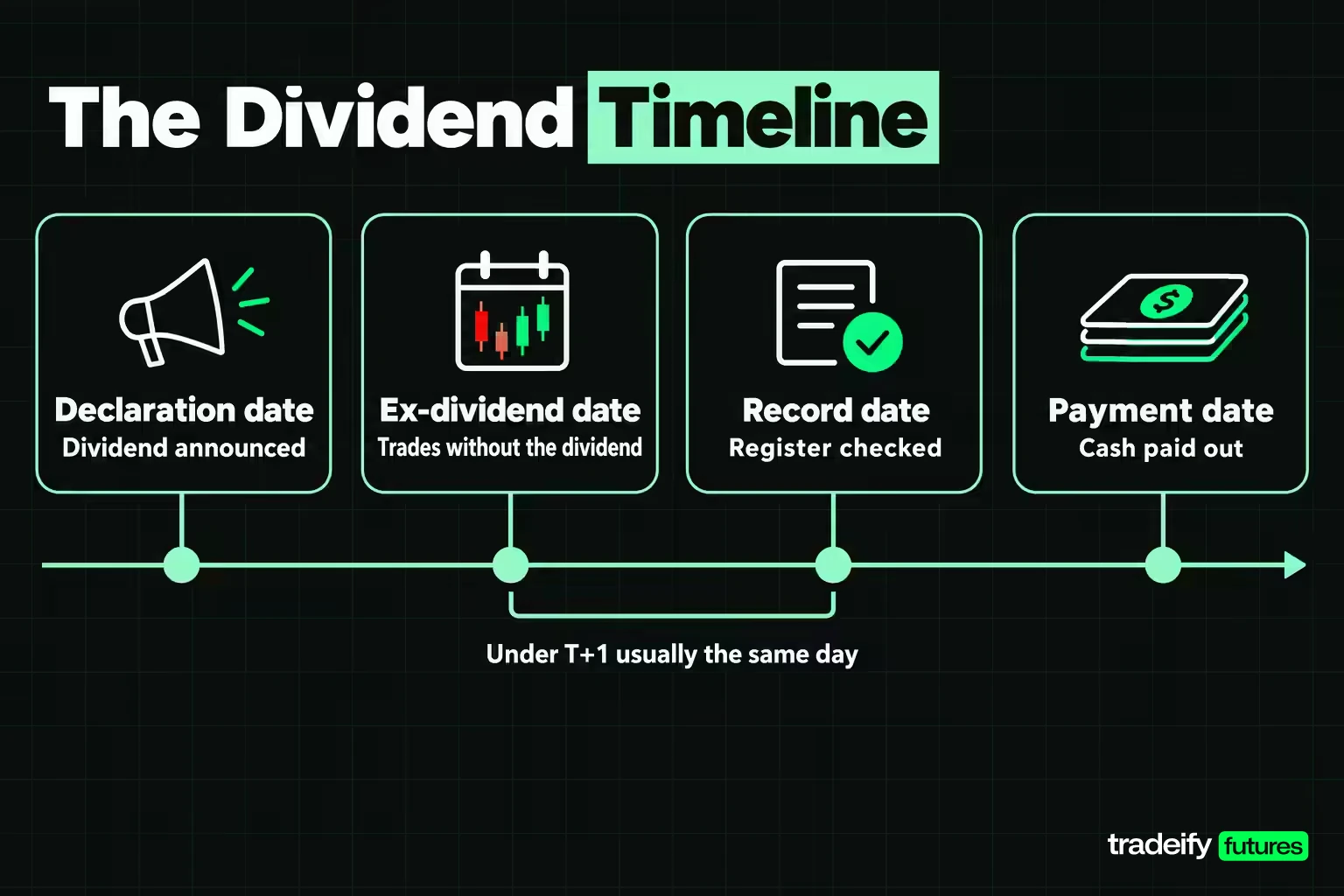
A cash dividend comes with four dates. Each has a different job, and reading only one of them is how people end up surprised.
| Date | What happens | Who sets it | What it means for you |
|---|---|---|---|
| Declaration date | The board announces the amount, record date and payment date | The company | The dividend is now official, though it can still be amended |
| Ex-dividend date | The stock starts trading without the right to this dividend | Exchange and FINRA rules, based on the record date | Buy before this day to qualify; selling on or after it keeps the dividend |
| Record date | The company checks its register for eligible holders | The company | Your purchase must have settled by now |
| Payment date | Cash goes out to holders of record | The company | The money lands, often weeks after the cutoff |
Investor.gov notes that the record date is also used to decide who receives proxy statements, financial reports and other shareholder material. It is a register snapshot, not a trading cutoff. The ex-date is the trading cutoff.
A Worked Dividend Timeline Example
Take an illustrative company that declares a quarterly dividend. None of these dates falls on a market holiday (Juneteenth is observed on Friday, June 18, 2027):
- Declaration date: Tuesday, June 1, 2027
- Record date: Thursday, June 10, 2027
- Ex-dividend date: Thursday, June 10, 2027
- Payment date: Thursday, June 24, 2027
The ex-date and the record date are the same day because the record date is a business day. A buyer on Wednesday, June 9 qualifies: that trade settles on Thursday, June 10, the record date. A buyer on Thursday, June 10 does not, because that trade settles on Friday, June 11, one day too late.
Now move the record date to Saturday, June 12, 2027. Saturday is not a business day, so the ex-date moves back to the business day before it, Friday, June 11. Investor.gov uses the same pattern in its own example: a record date on a Sunday produces a Friday ex-date.
How T+1 Settlement Sets the Ex-Date
Settlement is the step where the shares and the cash formally change hands, even though your account shows the position as soon as the order fills. The ex-date exists because of settlement. It marks the first day a trade can no longer settle in time to put the buyer on the register for the record date.
On February 15, 2023, the SEC adopted a rule shortening the standard settlement cycle for most broker-dealer securities trades from two business days after the trade (T+2) to one business day (T+1). The compliance date was May 28, 2024.
That change moved the ex-date. Under T+2, a trade made the day before the record date would not settle until the day after it, so the ex-date sat one business day before the record date. Under T+1, a trade made the day before the record date settles on the record date itself. So the ex-date is now normally the record date. FINRA Rule 11140 states it directly: for ordinary distributions under 25% of the stock's value, the ex-date is the record date when the record date is a business day, or the business day before it when it is not. The NYSE's ex-date page says the same: under the T+1 cycle, the ex-date for stocks is set on the record date except in specified cases.
Related lesson: How clearing and settlement work
Why Older Ex-Date Explanations Can Mislead You
A lot of dividend guides were written under T+2, and many still say "the ex-date is one business day before the record date." For US stocks, that has been out of date since May 28, 2024. Here is where it bites: count back a day from the record date out of habit and you may sell a day earlier than you needed to, or skip a purchase you thought had missed the cutoff when it had not.
The safer habit is to read the ex-date as published by the exchange or a reliable calendar, not to work it out from the record date yourself.
Settlement Holidays Can Move the Ex-Date
The stock market can be open on a day when nothing settles. FINRA's holiday schedule notes that the exchanges are generally open on Columbus Day and Veterans Day, but those days are not settlement dates because banks are closed. Veterans Day fell on Wednesday, November 11, 2026, and DTCC's notice for that week set Thursday, November 12 as the settlement date for regular-way trades made on both November 10 and November 11.
Dividend calendars showed the effect. On Nasdaq's dividend calendar, read on November 5, 2026, PACCAR ($0.35) and MarketAxess ($0.78) both carried a record date of Wednesday, November 11 and an ex-date of Tuesday, November 10. The ex-date moved back a day because the record date was not a settlement day. A trader counting on "ex-date equals record date" would have bought one day too late.
Buying Before vs. Selling on the Ex-Dividend Date
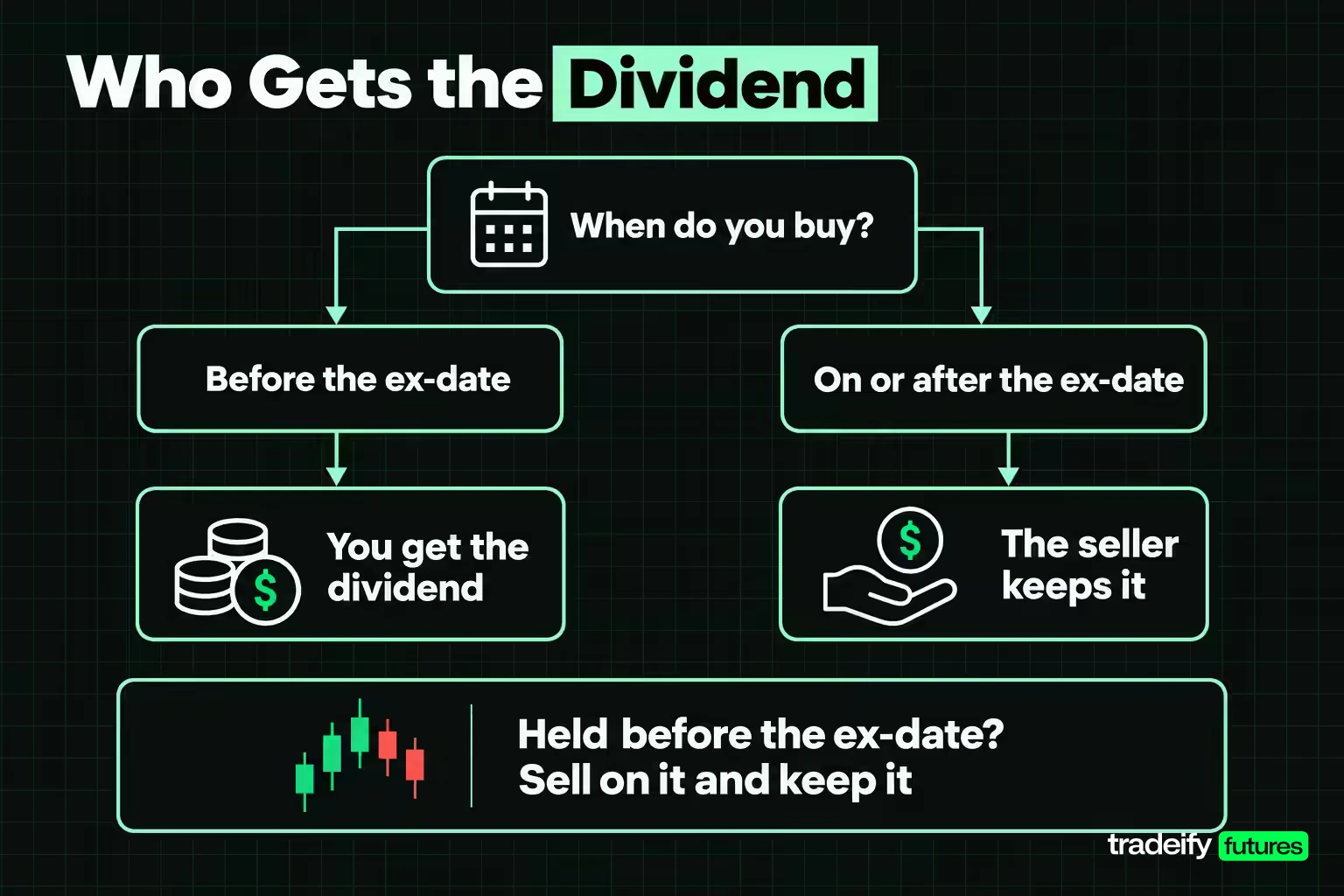
Most questions about ex-dividend dates come down to one of these trades. For an ordinary US cash dividend under T+1:
| Your trade | Trade date | Do you get this dividend |
|---|---|---|
| Buy | Two or more business days before the ex-date | Yes |
| Buy | One business day before the ex-date | Yes, this is the last day to buy |
| Buy | On the ex-date | No, the seller keeps it |
| Buy | After the ex-date | No |
| Sell shares you held before the ex-date | On or after the ex-date | Yes, you keep it |
| Sell | Before the ex-date | No, the buyer gets it |
Will You Get the Dividend if You Buy Two Days Before the Ex-Date
Yes, for an ordinary cash dividend. Any purchase before the ex-date qualifies, so two business days before is comfortably inside the window. Count business days, not calendar days. Two calendar days before a Monday ex-date is a Saturday, when you cannot trade at all.
Can You Sell on the Ex-Dividend Date and Still Get Paid
Yes, for an ordinary cash dividend. If you owned the shares before the ex-date, you can sell them on the ex-date and still receive the dividend on the payment date. The shares will vanish from your account long before the cash arrives, which makes people think the dividend went with them. It did not. Eligibility was fixed when you held through the cutoff.
This is also why the stock trades lower that morning. The buyer on the ex-date is not getting the dividend, so they are not paying for it.
Short Positions Owe the Dividend
Short sellers sit on the other side of the ex-dividend rule. Investor.gov explains that if a borrowed stock pays a dividend, the short seller pays that dividend to the lender. If you are short through the ex-date, you owe the full amount. The price drop on the ex-date offsets it on paper, but the cash comes out of your account.
Related lesson: How short selling works
Dividend Capture and Why It Rarely Works as Planned
Dividend capture means buying just before the ex-date and selling soon after, hoping to collect the dividend without holding the stock for long. The arithmetic shows the problem.
Take an illustrative stock at $40.00 with a $0.40 dividend. You buy 500 shares at the close on the day before the ex-date, a $20,000 position. You are owed $200 in dividends. If the stock opens exactly $0.40 lower on the ex-date at $39.60, your shares are worth $19,800. Shares plus the dividend still add up to $20,000. You have not made anything yet.
From there, every cost works against you:
- The bid-ask spread and any commission on both trades come straight out of the zero.
- The stock can fall by more than the dividend, and a single bad day wipes out several dividends.
- A dividend on shares held only a few days generally misses the qualified-dividend holding period, so in the US it is taxed at ordinary income rates rather than the lower qualified rates.
Capture only works if the stock recovers faster than the dividend predicts, and nothing about the calendar makes that likely. The temptation is to see a $200 payment and stop doing the math. Treat a dividend trade like any other trade: it needs a reason that still holds after you subtract the price drop, and a point where you admit it is not working.
Why a Stock's Price Drops on the Ex-Date
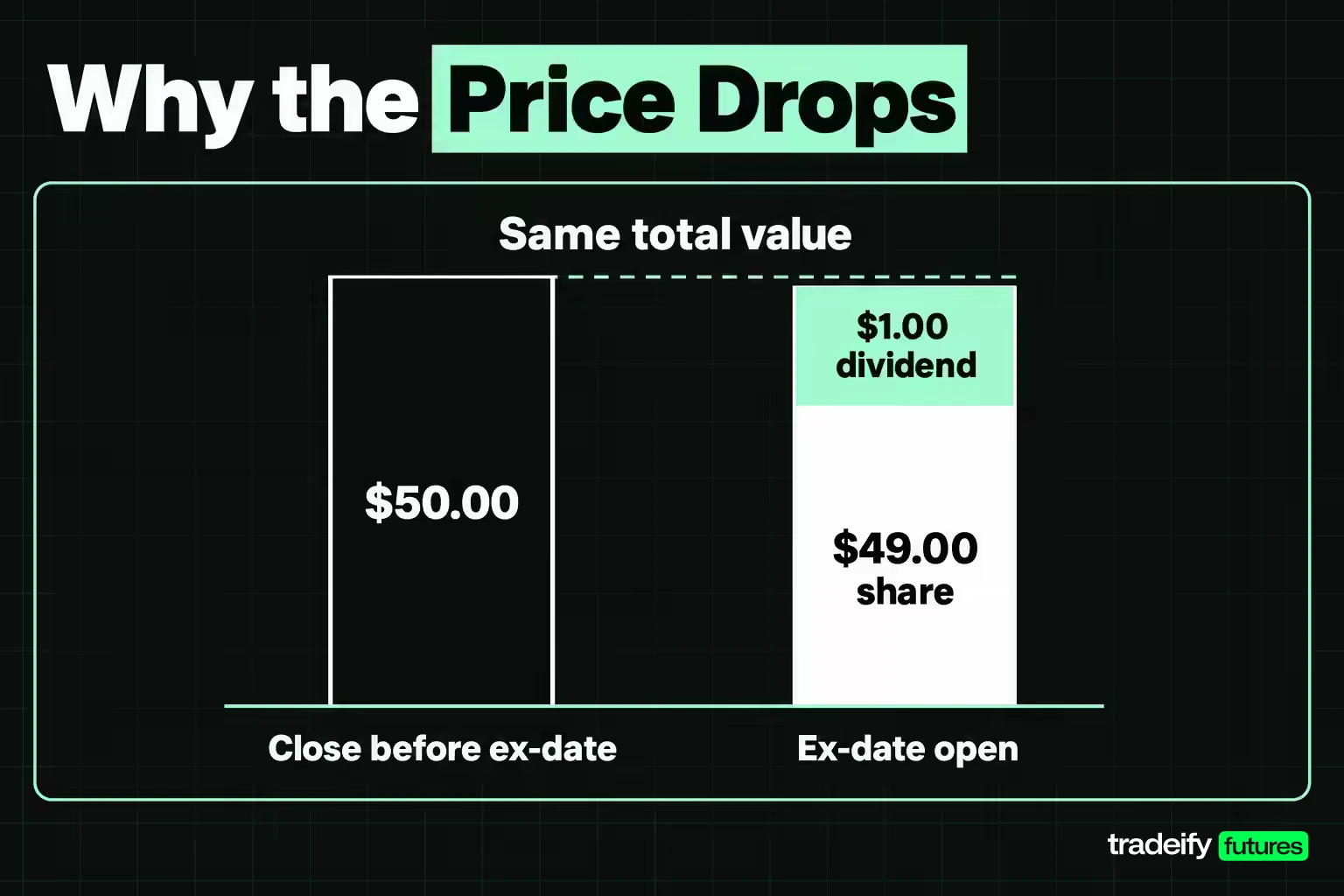
A dividend moves money out of the company and into shareholders' pockets. Once the stock trades ex-dividend, each share no longer carries a claim on that cash, so the share is worth roughly the dividend less. Investor.gov puts it simply: with a significant dividend, the price of a stock may fall by that amount on the ex-dividend date.
A Worked Ex-Date Price Example
Take an illustrative stock that closes at $50.00 the day before its ex-date and pays a $1.00 dividend. You hold 100 shares.
- Value at the close before the ex-date: 100 x $50.00 = $5,000
- Dividend you are owed: 100 x $1.00 = $100
- Theoretical opening price on the ex-date: $50.00 - $1.00 = $49.00
- Share value at $49.00: 100 x $49.00 = $4,900
- Shares plus dividend: $4,900 + $100 = $5,000
You have not gained $100. Your value moved from the share price into a dividend receivable. Real prices then react to the overall market, company news and order flow, so the stock may open at $49.30 or $48.60 instead. The dividend explains the expected drop; it does not explain everything else that happens that day.
So a lower price on the ex-date is not a discount, because the buyer is getting less. And a dividend received does not mean the position made money. Judge it on total return: price change plus dividends.
How Open Orders Are Adjusted on the Ex-Date
The ex-date drop can also move your resting orders. FINRA Rule 5330 requires a member firm holding a customer's open buy order or open sell stop order to reduce its price by the dividend amount on the ex-date, unless the order is marked "Do Not Reduce" or the dividend is less than one cent ($0.01). A good-til-canceled buy limit at $49.80 on a stock paying $1.00 would be reduced to $48.80.
The rule does not apply to sell limit orders, buy stop orders, or orders governed by a national securities exchange's own rules, and brokers handle the details differently. If you keep orders working across an ex-date, check what your broker does with them.
Related lesson: How GTC orders behave over time
Ex-Dividend Dates for Stock Dividends, Splits and Large Payouts
The "ex-date equals record date" rule covers ordinary distributions. Big distributions follow a different rule, and this is where people most often lose a payment they thought they owned.
FINRA Rule 11140 splits distributions by size:
| Distribution | Size versus the stock's value | Normal US ex-date |
|---|---|---|
| Cash dividend, stock dividend or warrants | Less than 25% | The record date (or the business day before it if the record date is not a business day) |
| Cash dividend, stock dividend, split or warrants | 25% or more | The first business day after the payable date |
| Stock dividend or split on ADRs and foreign securities | Any size | Set case by case |
A 2-for-1 stock split is a 100% stock distribution, so it falls in the second group. So does a very large special cash dividend.
Due Bills and the Deferred Ex-Date
When the ex-date comes after the payable date, there is a gap between the record date and the ex-date. Shares still trade with the entitlement attached during that gap. Investor.gov explains that if you sell during that period, you are selling away your right to the distribution. Your sale carries an obligation to deliver the new shares to the buyer, and the seller receives an I.O.U. from the broker, called a due bill, to track it.
The practical rule: for a large distribution, the day you can sell without giving up the distribution is usually the first business day after it is paid, not the day after the record date. The NYSE publishes an Ex-Date Dividends report listing the cases where the ex-date is not set on the record date, such as when due bills are attached.
Nasdaq's dividend calendar showed one of these on November 5, 2026. Vistance Networks listed a $1.50 distribution with a record date of October 26, a payment date of November 6 and an ex-date of Monday, November 9, 2026. An ex-date after the payment date is the deferred-ex-date pattern. Check the exchange record before trading around one, because the ordinary rule gives the wrong answer.
Stock Dividends and Spin-Offs
A stock dividend pays you in shares instead of cash. Investor.gov notes the extra shares can be in the same company or in a subsidiary being spun off, that the procedures can differ from cash dividends, and that the ex-date for a stock dividend is generally the first business day after the shares are paid. FINRA Rule 11140 draws the line at 25%: a stock dividend smaller than that follows the ordinary ex-date, while one of 25% or more uses the deferred ex-date and due bills. For any spin-off, read the ex-date from the exchange record rather than assuming either pattern.
How the Ex-Date Affects Dividend Taxes
US tax rules measure dividend holding periods from the ex-dividend date. This is general information, not tax advice.
IRS Publication 550 (the 2025 edition) says qualified dividends get the same 0%, 15%, or 20% maximum rates as net capital gains, but only if you meet a holding period. For common stock, you must have held the shares for more than 60 days during the 121-day period that begins 60 days before the ex-dividend date. When counting, include the day you sold but not the day you bought.
In the June 2027 example from the timeline section (ex-date Thursday, June 10, 2027), a buyer on Wednesday, June 9 would need to keep the shares into August 2027 for that dividend to count as qualified. A buyer who sells a week later gets an ordinary dividend taxed at regular income rates.
Three more points from Publication 550 matter around the ex-date:
- Preferred stock. If the dividends cover periods totaling more than 366 days, the test is more than 90 days during the 181-day period that begins 90 days before the ex-dividend date.
- Hedged days do not count. Days when you held a put, had an obligation to sell, held a short sale in substantially identical stock, or had sold a call on it do not count toward the holding period.
- Selling after the declaration. If you sell after a dividend is declared but before it is paid, the owner of record (usually the person on the payment) reports the dividend as income.
Related lesson: How dividend yield and payout ratio are measured
Dividend Reinvestment Plans and the Ex-Date
A dividend reinvestment plan (DRIP) uses your cash dividends to buy more shares instead of paying you cash. Investor.gov notes that you sign up through the company or through your brokerage firm, and that plans may charge fees.
The ex-date works the same way for DRIP shares as for any other. If you hold the shares before the ex-date, you are entitled to the dividend. The reinvestment purchase happens after the dividend is paid, often weeks after the ex-date, on the plan's own schedule. So the price you reinvest at is not the ex-date price, and the number of new shares depends on where the stock trades when the plan buys.
Two things to keep in mind:
- Reinvested dividends are still taxable. IRS Publication 550 says that if you use your dividends to buy more stock at fair market value, you must still report the dividends as income.
- Automatic buys and sells keep running. Scheduled purchases or sales in a brokerage account do not check the dividend calendar. A recurring sale set for the day before an ex-date gives the dividend to the buyer. If a dividend matters to you, check standing orders before the ex-date.
Ex-Date and Record Date Timetables Outside the US
Every market sets its own dividend timetable, and the ex-date follows each market's settlement cycle.
The UK Dividend Timetable
The London Stock Exchange publishes a Dividend Procedure Timetable that issuers are expected to follow. Its 2026 edition says the record date should normally be a Friday and, with standard T+2 settlement, the ex-date falls one business day earlier, normally on a Thursday. A dividend must be announced at least six business days before the proposed record date, or the ex-date may be pushed to the following week.
The 2026 timetable's own rows show the pattern. It pairs an ex-date of Thursday, 15 January 2026 with a record date of Friday, 16 January 2026, and a latest announcement date of Thursday, 8 January 2026.
So for UK shares in 2026, the old T+2 shortcut still holds: the ex-date is usually the Thursday before a Friday record date. That trips up investors used to the US rule. Someone who buys a UK share on the Thursday, reasoning that the record date is Friday, has bought on the ex-date and misses the dividend.
UK, EU and Swiss Moves to T+1 Settlement
The FCA says the UK market moves to T+1 settlement on 11 October 2027, the EU moves on the same date, and Switzerland's domestic market is also set to move in October 2027. The US, Canada, Mexico and Argentina moved to T+1 in May 2024. Expect UK and European dividend timetables to change with the new cycle, and check the exchange's published timetable for 2027 rather than reusing the 2026 pattern.
If you hold foreign shares or ADRs, read the ex-date from the market where the shares are listed. FINRA Rule 11140 leaves stock dividends and splits on ADRs and foreign securities to be set case by case.
How to Find and Check Ex-Dividend Dates
Dividend calendars are the quickest way to find upcoming ex-dates. Nasdaq's dividend calendar, for example, lists each stock's ex-dividend date, record date, payment date, dividend amount, annual dividend and announcement date for a given day.
The calendar itself is a useful check on the T+1 rule. On Nasdaq's calendar for November 5, 2026, the ex-date matched the record date for 25 of the 26 listings. The one exception had its ex-date after its record date, the kind of row that deserves a closer look.
A Checklist for Verifying an Ex-Dividend Date
Calendars are for screening. Use this workflow before a date-sensitive trade:
- Find the event on a calendar and note the ticker, amount and all four dates.
- Confirm the ticker and share class, since similar symbols are easy to mix up.
- Open the company's dividend announcement and confirm the amount, currency, record date and payment date.
- Check whether the distribution is a regular dividend, a special dividend or a stock distribution. Anything 25% or more of the share price uses the deferred ex-date.
- Check the exchange's ex-date report for exceptions, and watch for settlement holidays near the record date.
- Apply the rule: buy before the ex-date to qualify; sell on or after it to keep the dividend.
A few warning signs on any calendar: an ex-date later than the record date, a yield that looks far higher than the stock's history, an amount that differs from the company's release, and any record date on or next to a holiday.
How Dividends Show Up in Stock Index Futures
Equity index futures sit on the same companies that go ex-dividend, but a futures position never receives a dividend. CME Group's education material on equity index basis explains that futures holders do not receive dividends, but the value of those dividends is reflected in the futures price.
The basis (the gap between the futures price and the cash index) depends on two things pulling against each other: the financing cost of holding the stocks and the dividend income the stocks pay. Expected dividends between now and expiration lower the fair futures price. The basis shrinks as expiration approaches and disappears at expiration, when the futures and the index settle to the same figure.
For a futures trader, a single company's ex-date is not a payment event. Dividends matter through fair value: when expected index dividends change, so does the level where the futures should trade relative to the cash index. That is why index traders watch fair value and basis, not individual dividend calendars.
On our accounts, traders do not buy cash stocks, options or single-stock futures, so no dividends are paid into or out of a Tradeify account. Traders can trade the equity index futures ES, NQ, YM and RTY and the micros MES, MNQ, MYM and M2K. Every position is closed by 4:45 PM ET, and our evaluation and funded accounts are simulated.
Related lesson: What basis means in futures
Ex-Dividend Date FAQ
Will I get the dividend if I buy two days before the ex-dividend date?
Yes, for an ordinary US cash dividend. Any purchase before the ex-date qualifies, and the last day to buy is the business day before the ex-date. Count business days, not calendar days.
Do I get the dividend if I sell on the ex-dividend date?
Yes, if you owned the shares before the ex-date. The dividend is paid to you on the payment date even though the shares are gone. Large distributions with due bills are the exception, so check those separately.
Is the ex-dividend date the start or end of the day?
The start. The ex-date applies to every trade with that trade date, including pre-market trades. To qualify, your purchase must execute on an earlier trading day.
Is the ex-dividend date the same as the record date?
For most US stocks since May 28, 2024, yes, when the record date is a business day. If the record date falls on a weekend or a settlement holiday, the ex-date is the business day before it. Distributions of 25% or more go ex after the payment date.
Why did my stock fall on the ex-dividend date?
Because buyers that day are not getting the dividend, so the price usually drops by about the dividend amount. Other news and market moves add to or offset that drop. Your dividend still arrives on the payment date.
Can a company change or cancel a declared dividend?
It can. The London Stock Exchange's timetable, for example, expects issuers to notify changes to an announced dividend, including deferral or cancellation of payment. Check the company's latest release before relying on a date or an amount.
Dividends and dates in this guide are illustrative unless dated, and dividend schedules, tax rules and settlement cycles can change. Stock prices can fall by more than a dividend, and futures and other leveraged products can lose more than you expect. Funded and evaluation accounts at prop firms are simulated. This is general education, not investment or tax advice; confirm details with the issuer, the exchange, your broker and a tax professional.


