




TL;DR: Futures trading for beginners starts with one contract and what each tick of it costs you. A micro index contract moves $5 per point, the full-size one $50. Size the stop first, then check the account can carry it, then learn order types and exits. Margin is a deposit, not a cap on losses.
Futures trading for beginners usually gets taught as a glossary: margin, tick, expiry, leverage. You can memorize all of it and still size your first trade wrong, because the decision that actually hurts new traders is simpler. Which contract, how many, and how far away is the stop?
So this guide starts with one contract. Before a strategy, a platform or a market view, you need three numbers: what that contract is worth per point, how far it normally moves in a session, and what that move does to an account your size.
The rest of the guide builds out from there. It explains what a futures contract is, how to read the specification, which contract types exist, how long and short positions work, what leverage and margin mean in dollars, how futures differ from stocks, and where the real risks sit. It then uses twenty years of E-mini S&P 500 sessions to show what a stop distance actually costs, before covering order types, exits, simple strategies and the mental side.
What Futures Trading Is and What You Actually Trade
A futures contract is a standardized agreement to buy or sell a set quantity of something at a price fixed today, for a contract month in the future. The exchange fixes everything except the price: the quantity, the quality, the minimum price move and the delivery terms. Futures trading is buying and selling those contracts on an exchange, almost always without intending to take or make delivery.
The CFTC's consumer guide puts it plainly: most contracts are liquidated before delivery, and some settle in cash rather than goods. A trader who buys a crude oil contract is not planning to take 1,000 barrels. They plan to sell the contract back before it expires, and the gain or loss is the difference in price.
Two groups use the market. Hedgers, such as farmers, airlines or fund managers, use futures to lock in a price for something they already own or need. Speculators take the other side because they want the price exposure. A beginner trading index futures is a speculator, and that is the role this guide is written for.
What you trade is a contract with a contract month, not the index or the commodity itself. That sounds like a technicality until your contract is a week from expiry and the volume has moved to the next month. It is the reason futures have expiry dates, rolls and a price that can differ slightly from the cash market.
Related lesson: How futures contracts work in detail
How to Read a Futures Contract Specification
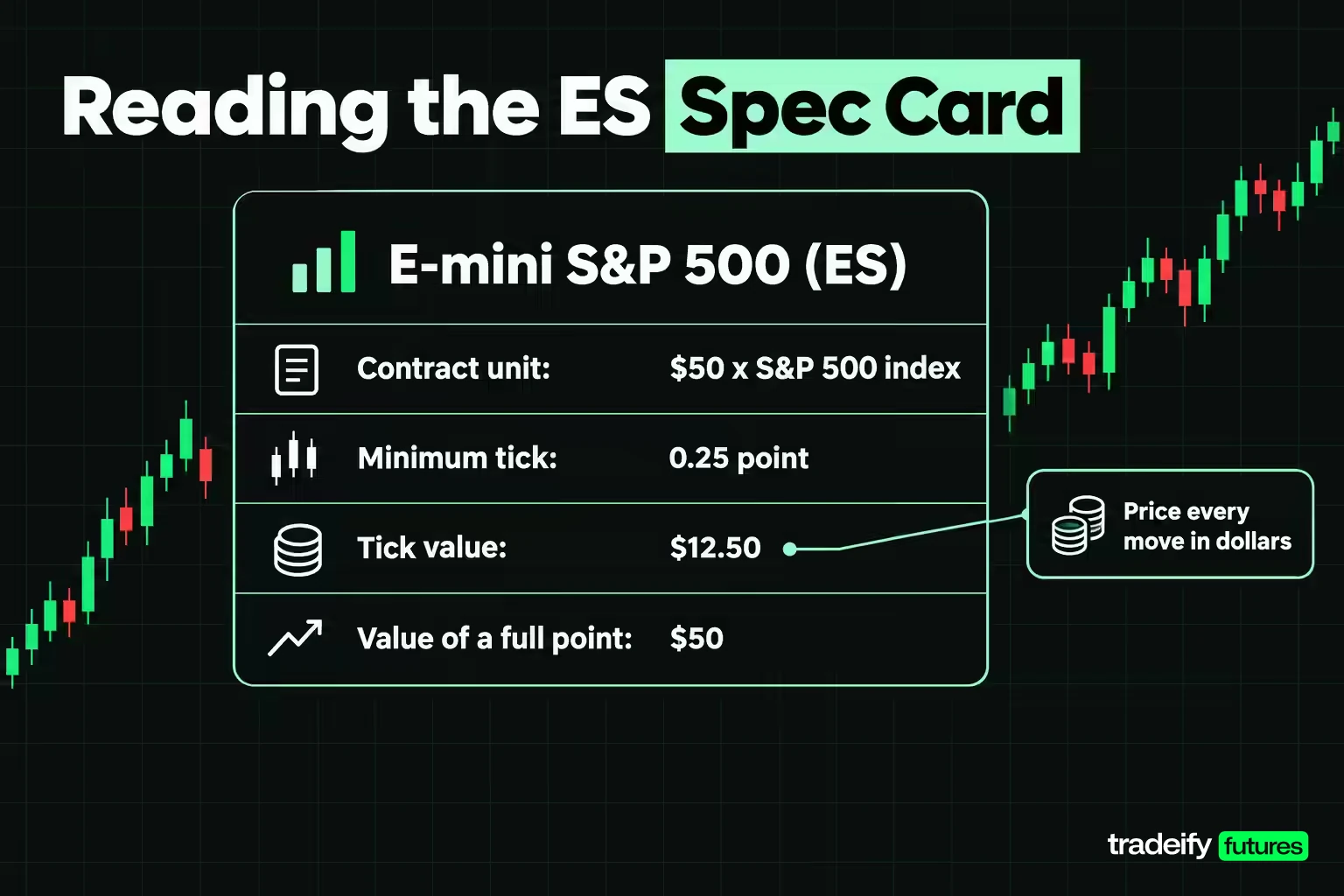
Every futures contract has a specification published by its exchange, and it is the most useful page a beginner can read. Learn to read one spec card and you can price a trade in any market. Five lines matter most.
- Contract unit. How much of the underlying one contract controls, such as $50 times the S&P 500 index or 1,000 barrels of oil.
- Minimum tick. The smallest price change the contract can make, such as 0.25 index points.
- Tick value. The dollar value of one tick, which is the contract unit times the tick size.
- Contract months and last trading day. Which months are listed and when each one stops trading.
- Settlement. Whether an expiring contract settles in cash or by delivery.
A futures contract specification table for ten common contracts
The table below lists ten widely traded CME Group contracts, with the value of one tick and of one full point or one dollar move. Every dollar value is the contract unit multiplied by the price change.
| Contract | Symbol | Contract unit | Minimum tick | Tick value | Value of a full move |
|---|---|---|---|---|---|
| E-mini S&P 500 | ES | $50 x S&P 500 index | 0.25 point | $12.50 | $50 per point |
| Micro E-mini S&P 500 | MES | $5 x S&P 500 index | 0.25 point | $1.25 | $5 per point |
| E-mini Nasdaq-100 | NQ | $20 x Nasdaq-100 index | 0.25 point | $5.00 | $20 per point |
| Micro E-mini Nasdaq-100 | MNQ | $2 x Nasdaq-100 index | 0.25 point | $0.50 | $2 per point |
| Gold | GC | 100 troy ounces | $0.10 per ounce | $10.00 | $100 per $1 |
| Micro Gold | MGC | 10 troy ounces | $0.10 per ounce | $1.00 | $10 per $1 |
| Crude Oil (WTI) | CL | 1,000 barrels | $0.01 per barrel | $10.00 | $1,000 per $1 |
| Micro WTI Crude Oil | MCL | 100 barrels | $0.01 per barrel | $1.00 | $100 per $1 |
| Corn | ZC | 5,000 bushels | 1/4 cent per bushel | $12.50 | $50 per cent |
| Euro FX | 6E | 125,000 euros | 0.00005 | $6.25 | $12.50 per 0.0001 |
Read across the S&P 500 rows and the first lesson is there. The micro and the E-mini track the same index at the same price with the same tick size. The micro is worth one tenth as much per point. The full contract is not a more serious version of the same trade. It is ten times the risk on the same chart.
Futures expiry, settlement and month codes
The E-mini S&P 500 lists quarterly contracts in March, June, September and December, settles financially, and stops trading at 9:30 AM ET on the third Friday of the contract month. Crude oil works differently: it lists every month, is deliverable, and stops trading three business days before the 25th calendar day of the month before the contract month. Corn is deliverable too. Never assume one market's expiry rule applies to another.
Contract symbols combine the root, a month code and the year. The CME codes run F (January), G, H (March), J, K, M (June), N, Q, U (September), V, X and Z (December). ESZ6 is the December 2026 E-mini S&P 500, and ESH7 is March 2027. Some platforms print the full year instead of the last digit, so check how yours displays it before you send an order.
Related lesson: Futures contract specifications
Types of Futures Contracts and Where Beginners Start
Futures exist on almost every traded asset. The main families a beginner will run into are:
- Equity index futures on the S&P 500, Nasdaq-100, Dow and Russell 2000, in E-mini and micro sizes.
- Energy futures such as WTI crude oil and natural gas.
- Metals futures such as gold, silver and copper.
- Agricultural futures on grains such as corn, wheat and soybeans, and on livestock.
- Currency futures such as the Euro FX contract, quoted in US dollars per euro.
- Interest rate futures on government bonds and short-term rates.
- Crypto futures on bitcoin and ether, listed at regulated exchanges.
- Volatility futures on volatility indexes.
The families do not trade alike. The E-mini S&P 500 trades nearly around the clock, from Sunday 6:00 PM to Friday 5:00 PM ET with a one-hour daily break at 5:00 PM ET. Corn trades two separate windows, 7:00 PM to 7:45 AM CT and 8:30 AM to 1:20 PM CT. Oil and grains react to inventory and crop reports that mean nothing to an index trader.
Most beginners start with a micro equity index contract, and the reasons are practical. The index is something they already follow, the market is deep, the micro's $5 point keeps the dollar math small, and the same habits transfer to the E-mini later. Micro gold and micro crude are reasonable alternatives for someone who already follows those markets, because both have a $1.00 tick.
The best market for a beginner is the one whose drivers you understand and whose contract size your account can carry. Whatever is moving most this week fails that test more often than it passes it.
Related lesson: Mini and micro futures contracts
Long and Short Futures Positions
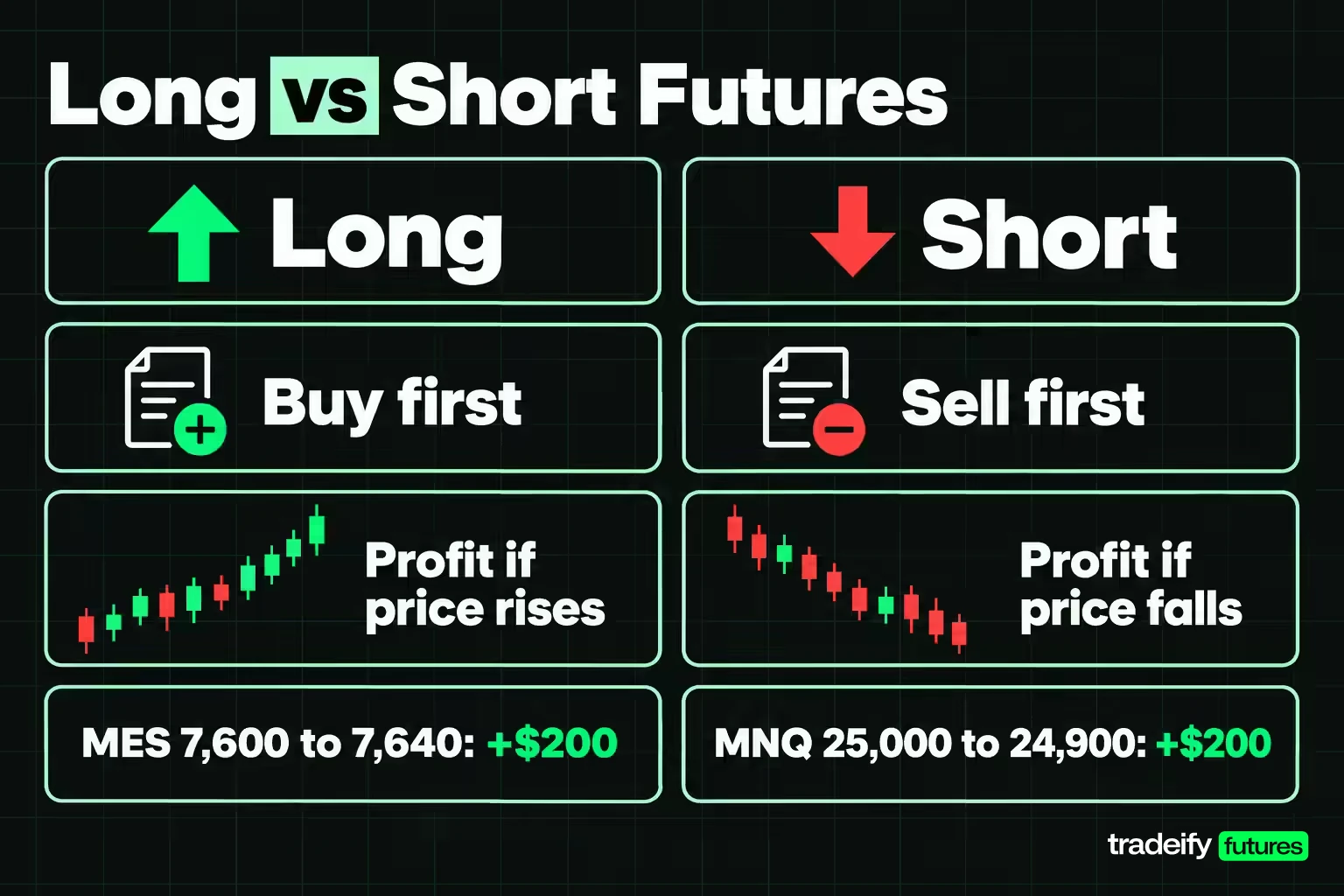
Going long a futures contract means you buy first and profit if the price rises. Going short means you sell first and profit if the price falls. In futures the two are mechanically the same: no borrowing of shares, no locate, and the same margin on each side.
The CFTC glossary defines short selling in futures as selling a contract with the idea of offsetting it, or delivering on it, at a later date. You close a futures position by taking the opposite trade in the same contract month. Buying back one contract offsets one short. Selling one offsets one long.
Two illustrative examples show the arithmetic, using round prices that are not quotes.
- Long one MES at 7,600. The index rises to 7,640. That is 40 points times $5, a $200 gain. The same move on one ES is $2,000.
- Short one MNQ at 25,000. The index falls to 24,900 and you buy it back. That is 100 points times $2, a $200 gain. If the index rose to 25,060 instead and you covered there, the loss would be 60 points times $2, or $120.
Both trades have the same structure. Direction decides which side of the move pays you. The point value and the stop distance decide how much, and those two numbers are where beginners usually go wrong, not the direction call.
Related lesson: Long vs short positions
Futures Leverage and Margin in Dollars
Leverage in futures comes from the gap between what a contract controls and what you deposit to hold it. What it controls is the notional value: the price times the contract unit. One MES at an illustrative 7,600 controls 7,600 times $5, or $38,000 of S&P 500 exposure. One ES at the same price controls $380,000.
You do not pay the notional value. You post margin, and futures margin is not a loan or a down payment. The CFTC glossary says it is not partial payment on a purchase and calls it a performance bond. It is a good faith deposit to cover losses on the position.
CME Group's education course says futures margin typically runs 3% to 12% of a contract's notional value. On $38,000 of notional that range is $1,140 to $4,560. Brokers can require more than the exchange minimum, and CME raises requirements when markets turn more volatile, so treat any margin figure as a moving number.
What 10 to 1 leverage does to a futures account
Imagine a trader holding one MES with $3,800 in the account, an illustrative 10% of the $38,000 notional. That is 10 to 1 leverage. A 1% move in the index is 76 points, which is $380 on one micro, and $380 is 10% of the $3,800 behind it. A 1% index move is an ordinary week. A 10% account move is not.
That is the trade-off in one line. Leverage lets a small deposit carry a large position, and every percentage move in the market arrives multiplied in the account.
Daily mark to market and margin calls
Futures gains and losses are settled in cash every day. The CFTC glossary calls this mark to market: at the end of each session the gain or loss on every position is added to or subtracted from each account balance.
Take an illustrative long MES at 7,600. Day one settles at 7,580, so 20 points times $5, or $100, leaves the account. Day two settles at 7,630, so 50 points, or $250, comes back. The net is $150, which is the 30 points between entry and the day-two settlement.
If losses push the account below the maintenance margin, the account gets a margin call to bring it back up to the initial margin level. Under CME rules, a clearing member that does not get the money within a reasonable time can close the position. A forced exit is the position closing at a price you did not choose, which is why sizing comes before the trade.
Futures vs Stocks for a New Trader
Futures and stocks both let you trade the S&P 500, but the instrument underneath behaves differently. The biggest differences for a new trader are ownership, expiry and how much capital controls a given amount of exposure.
| Feature | Stocks | Futures |
|---|---|---|
| What you hold | A share of a company | A contract with a contract month |
| Expiry | None | Each contract has a last trading day |
| Capital for $38,000 of exposure | $38,000 in cash, or $19,000 under 50% Reg T margin | A performance bond, typically 3% to 12% of notional |
| Gains and losses | Realized when you sell | Settled in cash every day |
| Shorting | Borrow shares through a margin account | Sell the contract, no borrowing |
| Trading hours for S&P 500 exposure | Exchange session plus limited extended hours | Nearly 23 hours a day, Sunday to Friday |
| Day trading rule | Pattern day trader rule being replaced | Never subject to the pattern day trader rule |
| US tax treatment | Short-term or long-term by holding period | Generally 60% long-term and 40% short-term under Section 1256 |
Two rows need context. The stock pattern day trader rule, with its $25,000 minimum equity, is being replaced. FINRA Regulatory Notice 26-10 took effect on June 4, 2026 with a phase-in that ends on October 20, 2027, so some brokers may still apply the old rule. Futures were never subject to it.
On tax, US law generally treats regulated futures contracts as Section 1256 contracts, taxed 60% long-term and 40% short-term regardless of holding period, with open positions marked to market at year end. Personal circumstances vary, so confirm with a tax professional.
For a beginner the practical gap is sizing. A stock trader who buys $1,000 of shares risks part of $1,000. A futures trader who buys one micro controls tens of thousands of dollars of exposure, and the account has to be sized for that.
Related lesson: Futures vs stocks
Benefits of Futures Trading and the Catch Behind Each
Futures have real advantages for an active trader, and almost every one of them is the same feature as a matching risk. Here is each benefit with the cost that comes attached.
- Capital efficiency. A performance bond carries a large position. The catch is that the position's losses are not limited to the bond.
- Nearly 24-hour access. Index futures trade almost around the clock on weekdays. The catch is that news from other time zones can move price while you sleep, if you hold.
- Shorting is as simple as buying. No borrow, no locate. The catch is that a short has no natural ceiling on its loss if price keeps rising.
- Published, standardized contracts. Every tick value is on the exchange's spec page, so the math is checkable before the trade. The catch is that you have to actually do it.
- Micro contracts. A micro is one tenth of the E-mini, so a beginner can trade the same market at a tenth of the dollar risk. The catch is that ten micros mean ten sets of per-contract fees, so holding E-mini-sized exposure in micros can cost more.
- Central clearing. A clearing house stands between buyer and seller and settles every account daily. The catch is that daily settlement also means daily margin calls.
- Tax treatment in the US. Section 1256 can be favorable for short-term traders. The catch is that it depends on your situation and jurisdiction.
The benefits are real, and they all point the same way: futures make it easy to take a large position quickly. That is exactly what a beginner needs to be careful with.
Risks of Futures Trading Beginners Underestimate
The CFTC's own consumer page says speculating in futures is rarely suitable for individual investors, and that many individuals lose all of their money and can be required to pay more than they invested. That warning comes from the regulator, not from a competitor trying to sell you something.
The specific risks that catch beginners:
- Losses larger than the deposit. Margin is a deposit, not a limit. A gap or a fast move can take the account below zero, and the trader owes the difference.
- Stops are not guaranteed prices. On CME Globex a triggered stop becomes a market order with a protection limit. In a fast market it can fill well beyond your level, and any quantity that cannot fill inside the protection range rests at the protection price instead of getting you out.
- Volatility changes the size of normal. A stop that was wide five years ago may sit inside today's ordinary noise. In this guide's own measurement of Yahoo Finance E-mini S&P 500 daily bars, the median session range over the 250 sessions to November 3, 2026 was 80.50 points, against 27.75 points over twenty years.
- Margin requirements rise when you least want them to. CME raises margins as volatility rises, which can force traders to cut positions in exactly the conditions where they wanted to hold.
- Overnight and weekend holds. Anything held through a close can open at a very different price.
- Thin contract months. Deferred months and less active products can have wide spreads and few resting orders.
- Overtrading. A market open almost 23 hours a day invites more trades than any plan needs.
None of these risks is exotic. Each one is a normal consequence of trading a leveraged, standardized contract. You can plan for every one of them before the order goes in, and very few of them can be fixed after.
Futures Risk Management Starts With the Stop Distance
Futures risk management for a beginner comes down to one calculation. Decide how much of the account one trade may lose, divide by the contract's value per point, and the answer is the stop distance you can afford. Then check whether the market normally moves further than that.
On one MES, a 50-point stop risks $250. That is 1% of a $25,000 account, or 2% of $12,500. On one ES the same 50-point stop risks $2,500, which is 1% of a $250,000 account. Same chart, same stop, ten times the account requirement.
How far an E-mini S&P 500 session moves against a position
To show whether a stop is realistic, this guide ran its own measurement on Yahoo Finance's front-month continuous E-mini S&P 500 (ES) daily bars from November 6, 2006 to November 3, 2026: 5,031 completed sessions. For a long opened at the session open, the worst point of the day is the distance from the open down to the low. Daily bars cannot show whether the high or the low came first, so these are one-sided counts of how often a distance was reached, not strategy results.
In this guide's ES measurement over the full twenty years, the median session ranged 27.75 points from high to low. The 25th percentile was 16.50 points, the 75th 52.38 and the 95th 112.50. A long from the open went at least 10 points underwater on 54.40% of sessions, at least 25 points on 25.64% and at least 100 points on 2.42%.
The same measurement on the last 250 sessions, November 5, 2025 to November 3, 2026, looks very different. The median range was 80.50 points, and the 95th percentile was 164.41. A 25-point adverse move from the open happened on 61.20% of those sessions, a 50-point move on 36.40% and a 100-point move on 12.00%. Index points have grown with the index level, so a stop that looked wide in older tutorials now sits inside ordinary noise.
What stop a futures account can afford
The table converts a 1% risk budget into the stop it buys on one MES at $5 per point, then shows how often a long from the open travelled at least that far in this guide's measurement of Yahoo Finance ES daily bars (November 6, 2006 to November 3, 2026, and the last 250 of those sessions).
| Account size | 1% risk budget | MES stop it buys | Reached in 20 years | Reached in last 250 sessions |
|---|---|---|---|---|
| $2,500 | $25 | 5 points | 74.36% | 92.80% |
| $5,000 | $50 | 10 points | 54.40% | 83.60% |
| $10,000 | $100 | 20 points | 31.82% | 66.80% |
| $25,000 | $250 | 50 points | 10.06% | 36.40% |
| $50,000 | $500 | 100 points | 2.42% | 12.00% |
Start with the top row, because it is where a lot of first accounts sit. A $2,500 account risking 1% has $25, which buys a 5-point stop on one micro. In this guide's ES measurement for the last 250 sessions, a long from the open went 5 points against it on 92.80% of sessions. That stop is not protecting the trade. It is a near-certain exit on noise, and the trader will likely blame the setup rather than the size.
This is not a target account size and not a forecast. It shows that the same 1% rule produces a workable stop at one account size and an unworkable one at another, and that the answer has moved as volatility changed. The fix for a stop that is too tight is a smaller contract, a larger account or no trade. A tighter stop is not a fix.
Related lesson: Position sizing futures contracts
Futures Order Types to Learn First
Four futures order types cover almost everything a beginner needs, plus one combination.
- Market order. Buys or sells at the best available price now. It almost always fills, at whatever price the market is showing.
- Limit order. Sets the worst price you will accept. It never fills at a worse price, and it may not fill at all.
- Stop order. Sits dormant until price reaches your level, then triggers. On CME Globex it enters as a market order with a protection limit, so it can fill beyond your level in a fast market.
- Stop-limit order. Triggers like a stop but goes on the book as a limit order. It controls the price and gives up the guarantee that you get out.
- Bracket order. An entry with a stop and a target attached, where filling one exit cancels the other. The exit exists before the position does.
The order types are not where beginners get hurt. The two expensive habits are placing the stop only after the trade is running, and treating a stop as a guaranteed price. The first turns a planned loss into a live decision under pressure. The second makes every risk calculation wrong on the days that matter most.
Related lesson: Order types overview
Managing and Exiting a Futures Position
A futures position needs three exits decided before entry: where you are wrong, where you take profit, and when you stop waiting.
- The invalidation exit. The price that proves the trade idea wrong. This is the stop, and it should sit where the idea fails, sized so the dollar loss fits the account.
- The profit exit. A target, a trailing stop or a rule such as closing at a set level. Decide which before the trade, because choosing in the moment tends to cut winners early.
- The time exit. If the trade has not worked by a set time or by the end of the session, close it. Many beginners hold a flat position for hours hoping it turns into the planned trade.
Two adjustments are reasonable once a trade is working. Moving a stop toward breakeven after a meaningful move locks in part of the gain, at the cost of being stopped out on a normal pullback. Scaling out of part of a position at a first target reduces risk and also caps the payoff. Moving a stop further away to avoid a loss is not an adjustment. It is a new and larger trade nobody planned.
Closing or rolling a futures contract before expiry
Every futures position also has a calendar exit. A contract held to its last trading day settles, in cash for the E-mini S&P 500 and by delivery for deliverable contracts such as crude oil or corn. Retail traders close or roll well before then.
Rolling means closing the expiring month and opening the next one, for example moving from ESZ6 to ESH7. It is two trades with two sets of costs, and the two months trade at slightly different prices. A day trader who closes every position each session does not roll a position at all. They just switch which contract month they trade once the next month becomes the active one.
Related lesson: Futures rollover
Simple Futures Strategies to Learn First
Futures strategies for beginners should be simple enough to write on one line and test on past data. A few common approaches:
- Trend following. Trade in the direction of the established move, for example only long above a rising moving average. It loses in choppy, sideways markets.
- Breakouts. Enter when price leaves a defined range, such as the first hour's high or low. It fails when the breakout reverses straight back into the range.
- Range or mean reversion. Fade moves back toward the middle of a well-defined range. It fails badly when the range breaks.
- Avoiding scheduled news. Not a strategy on its own, but standing aside before major releases removes the fills that do the most damage to new traders.
The 80% rule comes from Market Profile, the charting method developed by J. Peter Steidlmayer. If a session opens outside the prior session's value area and then trades back inside it for two consecutive 30-minute periods, the rule says there is roughly an 80% chance price reaches the opposite edge of that value area. Treat the 80% as a claim to test, not a probability you can rely on.
Pick one approach, one market and one session. A strategy only means something after a sample of trades large enough to separate the rule from luck. One rough week is not a verdict on a strategy, and one great week is not proof of one.
Trading Psychology for Your First Futures Trades
First futures trades give instant dollar feedback. Every tick on the screen is money, and that changes behavior in ways a simulator rarely reproduces. If your first live loss felt bigger than the number on the screen, that is normal.
The patterns that follow are predictable. A loss arrives and the urge is to win it back, so the next trade is larger or less selective. An entry gets missed and the trader chases it, but missing the entry does not make the next price a good entry. It makes it a different trade. A position goes against the plan and the stop gets moved, because taking the planned loss feels worse than risking a bigger one. A few good days lead to more contracts before the sample justifies it.
Each of these has a precommitted fix.
- Set a daily loss limit and stop when you hit it. The rule exists because the trade after a big loss is the one most likely to break your plan.
- Write the entry, stop and target before you click. A plan written in advance is harder to rewrite in the moment.
- Never widen a stop once the trade is live. Tighten it if your rule says so, but never widen it.
- Change size on a schedule, not on a feeling. For example, only after a set number of trades reviewed against the plan.
Losses are part of the process even with a sound plan. The goal in the first months is not to avoid losing trades. It is to make sure every loss is the size you planned, so that your review is about decisions rather than damage.
Related lesson: Trading psychology
How Beginners Get Started With Futures Trading
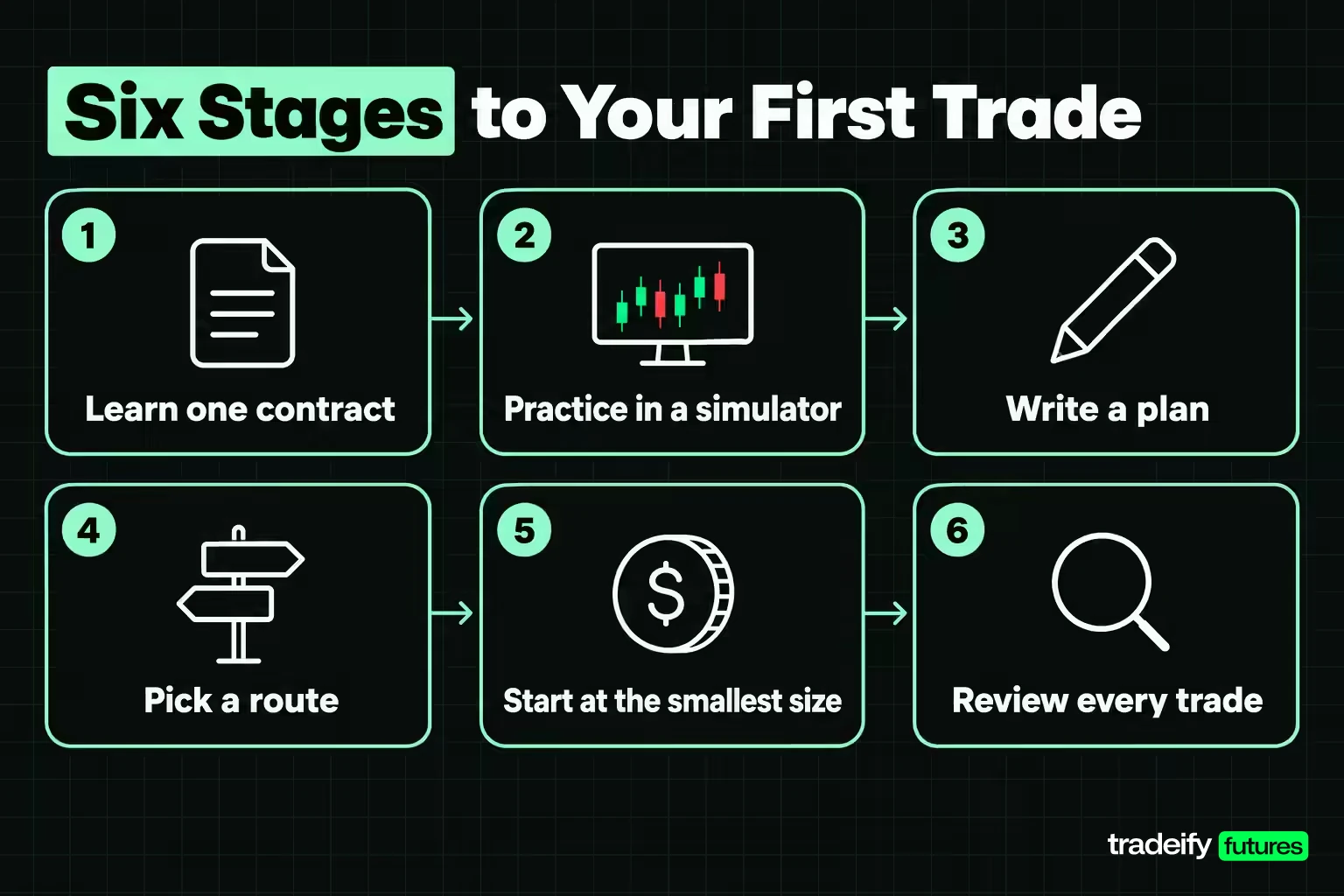
Getting started with futures trading goes better in stages than all at once. A sensible order:
- Learn one contract. Write down its unit, tick size, tick value, trading hours and last trading day from the exchange's specification page.
- Practice order entry in a simulator. Place, modify and cancel brackets, and watch a stop trigger. Order entry is a skill separate from knowing what to trade.
- Write a plan. One market, one setup, a fixed risk per trade, a daily loss limit and the times you will trade.
- Pick a route. A futures brokerage account, through a firm registered with the NFA, means trading your own money and posting margin. A prop firm evaluation means trading a simulated account under the firm's rules, such as drawdown limits and position caps, for a chance at a funded account that is usually also simulated. Read the rules of whichever you choose before the first trade.
- Start at the smallest size. One micro contract, sized with the 1% math, until the stop distance and the costs feel routine.
- Review every trade. Entry reason, exit reason, whether the plan was followed. Change one thing at a time.
On our accounts at Tradeify, you size by contract limits rather than margin. A 50K account allows 4 minis or 40 micros, with 10 micros counting as one mini, and every position must be closed by 4:45 PM ET. Our funded accounts are simulated. Because 10 MES cost $18.20 round trip against $5.76 for one ES, once you are sizing in multiples of ten micros the mini is the cheaper way to hold the same exposure.
Related lesson: New to futures learning path
Futures Trading Questions From Beginners
What are the key differences between stocks and futures?
A stock is a share of ownership with no expiry date. A futures contract is a standardized agreement with a contract month, settled in cash every day and held with a performance bond rather than the full price. Futures make shorting as simple as buying and trade nearly 23 hours a day, but a small deposit controls a much larger position.
What is the 80% rule in futures trading?
It is a Market Profile idea, from the charting method developed by J. Peter Steidlmayer. When a session opens outside the prior session's value area and then holds back inside it for two consecutive 30-minute periods, price is said to reach the opposite edge of the value area roughly 80% of the time. Treat it as a hypothesis to test on your market, not a reliable win rate.
Can you make $200 per day in day trading?
It is possible on some days and not something to plan around. On paper, $200 is 40 points on one MES, 4 points on one ES or 100 points on one MNQ, before costs, and the same distance against you is a $200 loss. A fixed daily dollar target tends to push traders into forcing trades, so set risk per trade first and let the result follow.
How much money do I need to trade futures?
There is no single number, because margin is set by the exchange and the broker and changes with volatility. A more useful test is the stop: a 50-point stop on one MES risks $250, which is 1% of $25,000. If your account cannot carry a realistic stop at your chosen risk, trade a smaller contract or wait.
Which type of futures trading is best for beginners?
The best market for a beginner is one you understand and can size properly. For futures that usually means one micro equity index contract, traded in one session with a written plan. Whatever you choose, start in a simulator and move to real risk only when the process is routine.
Futures are leveraged and losses can exceed the money in your account. Funded and evaluation accounts at prop firms are generally simulated, and their rules differ from a brokerage account. The price study in this guide describes past E-mini S&P 500 sessions and does not predict future moves. This guide is educational and is not investment, tax or financial advice.


