



TL;DR: Leverage in trading means controlling a position worth more than the cash behind it, so the real decision is how much to use. A 100:1 ratio is a 1% deposit, so a 1% move against a full-size position erases it. One MES contract at 7,000 is $35,000 of exposure, or 3.5x on a $10,000 account. Size from your stop, and recheck effective leverage as equity falls.
Leverage in trading is the reason a $10,000 account can carry $35,000 of S&P 500 exposure, or $350,000 of it. Whether leverage exists in the product you trade is rarely the question, because it almost always does. The question is how much of it you switch on, and whether you can see that number before the market shows it to you.
This guide works through leverage the way it hits an account: what it multiplies, how ratios convert into deposits, how the arrangement differs across stocks, forex, futures, CFDs and crypto, what triggers a margin call or a liquidation, and how to size a position so the ratio on your platform stops being the number that runs your risk.
What Leverage in Trading Means and How It Works
Leverage in trading means your market exposure is larger than the money you have committed. You put up a deposit, a loan, or a performance bond, and the position you control is worth several times that amount.
The arithmetic is the whole mechanism. Profit and loss are calculated on the full position, not on the cash you posted. So a percentage move in the market becomes a bigger percentage move in your account.
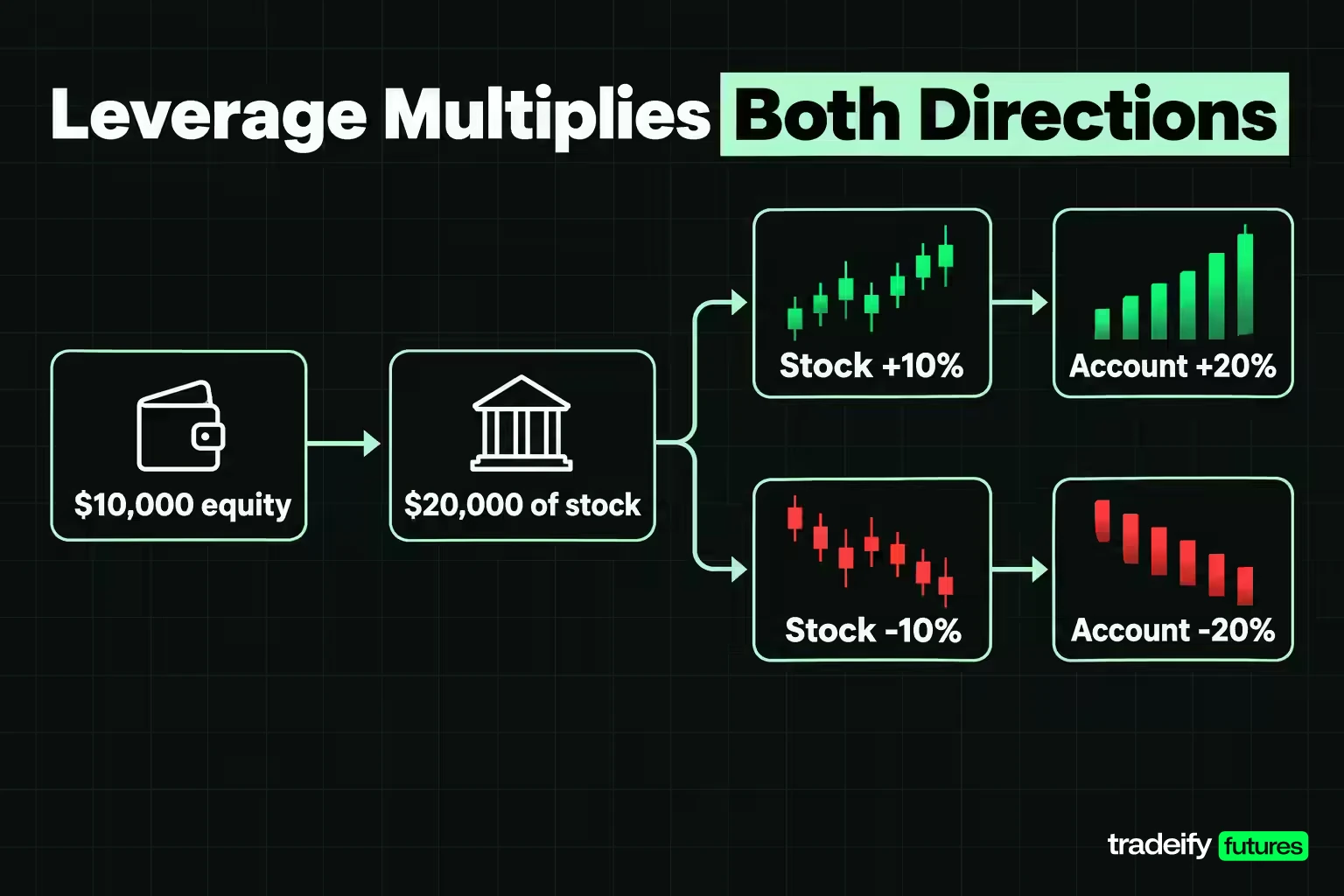
Here is a simple version with stock. Take a $10,000 account in a US margin account. Under Regulation T you can buy up to $20,000 of a marginable stock, using $10,000 of your own money and $10,000 borrowed from the broker. Call it 200 shares at an illustrative $100.
- If the stock rises 10%, the position gains $2,000. That is 20% of your $10,000 equity.
- If the stock falls 10%, the position loses $2,000. That is also 20% of your equity, and you still owe the full $10,000 loan.
Notice what did not change. Leverage did not make the stock more likely to rise. It did not improve your entry or your read of the market. It changed how many units of the same decision your account was carrying.
That is the most useful way to hold the idea in your head. Leverage is a size multiplier. If a setup is only worth one unit of risk, borrowing capacity does not make it worth five.
Related lesson: How margin works in a brokerage account
Effective Leverage Is the Number That Describes Your Position
The simplest measure is effective leverage: the notional value of everything you hold divided by your account equity. Notional value is the full market value of the position, which for a futures contract is the price times the contract multiplier.
One Micro E-mini S&P 500 (MES) contract is worth $5 times the index. At an illustrative index level of 7,000, one contract controls $35,000. Hold it in a $10,000 account and your effective leverage is 3.5x. A 1% move in the index (70 points) is worth $350, which is 3.5% of the account.
That one division answers most leverage questions. It works the same way for stock, forex, futures and crypto, because it ignores the label on the product and looks only at exposure versus equity.
Leverage Ratios and Effective Leverage
A leverage ratio such as 30:1, 100:1 or 500:1 is a statement about the minimum deposit. It tells you the largest position the venue will let you open for each dollar posted. It does not tell you how much leverage you are using.
To convert a ratio into a deposit, divide 100 by the ratio. At 50:1 the deposit is 2% of notional. At 100:1 it is 1%. That deposit percentage is also the adverse move that would wipe out the deposit on a position opened at the full ratio.
| Leverage ratio | Deposit as a share of notional | Deposit for a $100,000 position | Adverse move that consumes the whole deposit |
|---|---|---|---|
| 2:1 | 50% | $50,000 | 50% |
| 5:1 | 20% | $20,000 | 20% |
| 10:1 | 10% | $10,000 | 10% |
| 20:1 | 5% | $5,000 | 5% |
| 30:1 | 3.33% | $3,333 | 3.33% |
| 50:1 | 2% | $2,000 | 2% |
| 100:1 | 1% | $1,000 | 1% |
| 200:1 | 0.5% | $500 | 0.5% |
| 500:1 | 0.2% | $200 | 0.2% |
Read the right-hand column carefully. At 100:1 a 1% move against a fully levered position erases the deposit. Major currency pairs and stock index futures can move that much in a single session. That is why the maximum ratio is best treated as a ceiling you almost never touch.
Maximum Leverage Versus the Leverage You Actually Use
Two traders can both hold accounts that "offer 100:1" and run completely different risk. A trader with $10,000 who opens a $20,000 position is running 2x effective leverage. A trader with $1,000 who opens a $100,000 position is running 100x. Same platform ceiling, very different consequences.
The table below runs one $10,000 account through five positions. Prices are round illustrative levels, not quotes.
| Position on a $10,000 account | Notional controlled | Effective leverage | Cost of a 1% adverse move | Share of the account |
|---|---|---|---|---|
| $5,000 of stock in a cash account | $5,000 | 0.5x | $50 | 0.5% |
| $20,000 of stock at the Regulation T maximum | $20,000 | 2.0x | $200 | 2% |
| 1 MES contract at 7,000 | $35,000 | 3.5x | $350 | 3.5% |
| 1 standard lot of EUR/USD at 1.1000 | $110,000 | 11x | $1,100 | 11% |
| 1 E-mini S&P 500 (ES) contract at 7,000 | $350,000 | 35x | $3,500 | 35% |
The bottom row is the one that surprises people. An ES contract is $50 times the index, so a single contract at 7,000 is $350,000 of exposure. On a $10,000 account, an ordinary 1% day costs more than a third of the balance. Nothing about the order ticket warns you. The ratio only becomes visible when you do the division.
Is 30 to 1 or 100 to 1 Leverage Better
Neither is better in the abstract, because neither describes your risk. A 1:30 ceiling requires a $3,333 deposit per $100,000 of exposure. A 1:100 ceiling requires $1,000. If you size every position to the same effective leverage, say 3x, the two accounts behave identically.
The difference shows up when you size to the ceiling. Lower maximum leverage forces more deposit per position, which caps how big a mistake you can make on one order. That is the reasoning behind regulators setting lower retail limits. For a newer trader, a lower ceiling is a guardrail. It is not a substitute for choosing size deliberately.
Related lesson: Notional value and how to calculate it
How Leverage Works in Stocks, Forex, Futures, CFDs and Crypto
The word leverage covers several arrangements that behave differently. Most confusion about leverage in trading comes from mixing them up, so it is worth separating them before looking at rules or costs.
Stock margin is a loan. In a US margin account, the broker lends you cash and holds your securities as collateral. You pay interest on the loan, and the broker can sell your holdings if equity falls too far.
Retail forex uses a security deposit. You are not buying euros with borrowed dollars. You post a deposit against a position held with your dealer, and the dealer is usually your counterparty. In the US the CFTC sets the minimum deposit at 2% of notional for major currency pairs and 5% for all other pairs, which works out to 50:1 and 20:1 at most.
Futures use a performance bond. The CFTC glossary is explicit that futures margin "is not partial payment on a purchase" and is also called a performance bond. CME Group's education material says the same thing in plainer words: futures margin is not a down payment, and you do not own the underlying. Nothing is borrowed, both buyer and seller post a bond, and no interest is charged on it. CME describes futures margin as typically 3-12% of notional per contract, compared with up to 50% for securities bought on margin.
CFDs are contracts with a provider. A contract for difference pays the change in an asset's price without you owning the asset. The provider sets margin within whatever limits apply in its jurisdiction, and in the EU retail leverage on CFDs is capped by regulation.
Crypto perpetual futures use exchange-set margin. Perpetuals have no expiry, so exchanges use periodic funding payments to keep the contract price near the spot index. Many venues also let you choose a margin mode. In isolated margin, only the margin allocated to that position is at risk if it is liquidated. In cross margin, the position draws on the shared balance across your account, which can delay a liquidation but puts more of the account behind one bad trade.
Comparing Leverage Arrangements Side by Side
The five arrangements differ in what you post, whether anything is borrowed, and what it costs to hold a leveraged position open.
| Arrangement | What you post | Is money borrowed | Ongoing financing cost | Who sets the minimum |
|---|---|---|---|---|
| US stock margin | Cash or securities as collateral for a broker loan | Yes | Interest on the loan | Federal Reserve (Regulation T), FINRA, plus broker house rules |
| US retail forex | A security deposit with your dealer | No asset is bought; dealer is usually the counterparty | Rollover credits or debits on positions held past the daily rollover | CFTC minimum deposits of 2% and 5% |
| Futures | A performance bond held by your clearing firm | No | No interest on the bond | Exchange clearinghouse, plus your broker's own requirement |
| CFDs | Margin with the CFD provider | No asset is owned | Overnight financing set by the provider | National regulator; ESMA limits in the EU |
| Crypto perpetuals | Margin in isolated or cross mode | No | Funding payments between longs and shorts | The exchange, within its jurisdiction's rules |
A practical test whenever you read about leverage: ask which of these arrangements the writer means. A rule about a 50:1 forex deposit tells you nothing about a stock margin call, and a crypto funding payment has no equivalent on a futures bond.
Margin Requirements and Margin Calls
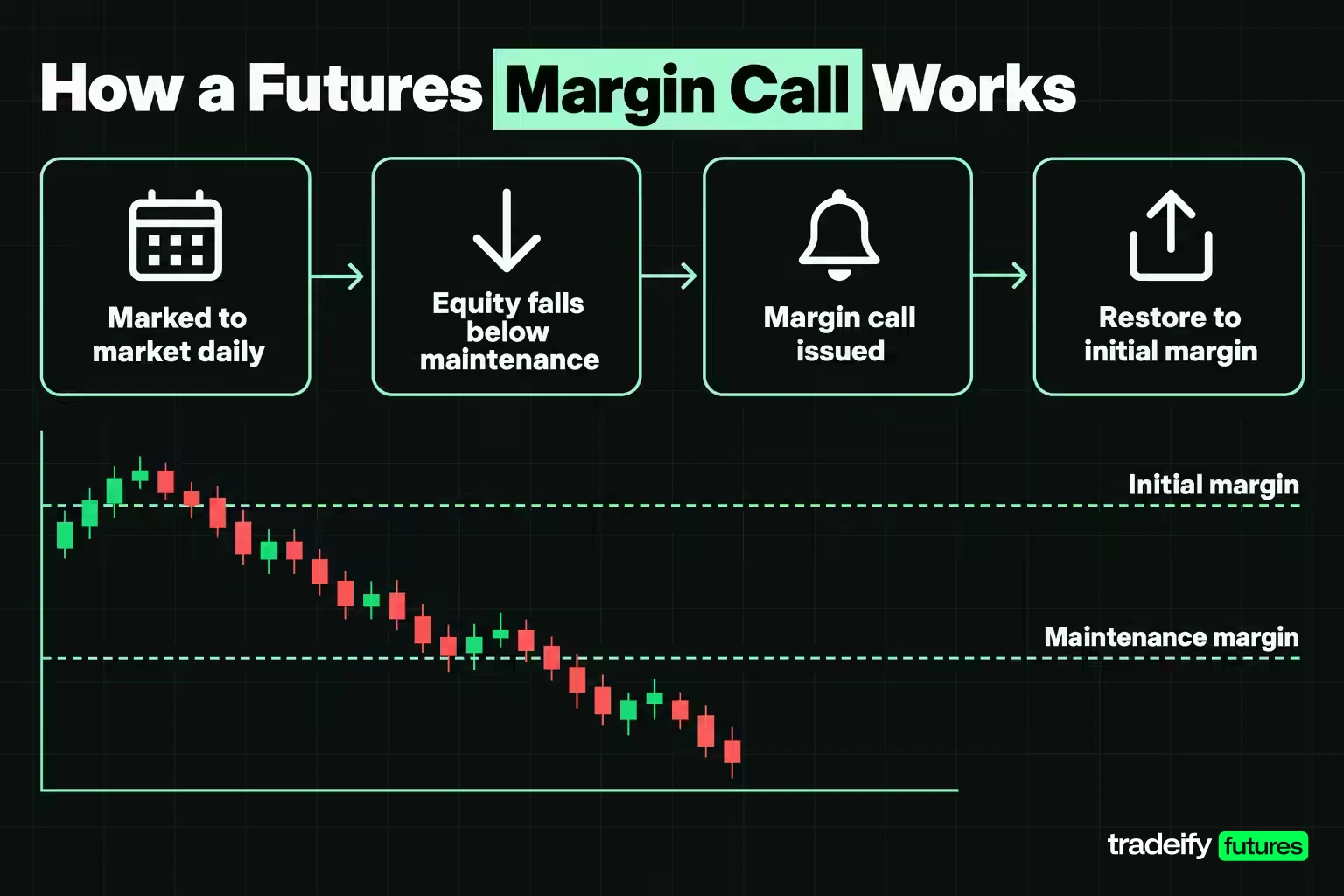
Margin requirements are the floor under every leveraged position. There are usually two of them. Initial margin is what you need to open the position. Maintenance margin is the minimum equity you must keep while it is open.
How a Margin Call Works on a Stock Account
For US stocks, Regulation T sets initial margin at 50% of the purchase value for marginable securities. FINRA Rule 4210 then sets the maintenance floor at 25% of current market value for long positions, and a margin account needs at least $2,000 of equity. Brokers can and often do require more.
Go back to the $10,000 account holding $20,000 of stock with a $10,000 loan. Equity is the market value minus the loan. At a 25% maintenance requirement, the call comes when market value falls below $13,333.33, because at that point the $3,333 of remaining equity is exactly 25% of the position. With 200 shares, that is a price below $66.67, a 33.3% drop from $100.
What happens next is less forgiving than many traders expect. According to the SEC's Investor.gov glossary, the firm can demand cash or securities immediately or sell your holdings without telling you first. The firm picks which securities to sell, may sell before any deadline it quoted, and can change the threshold at any time.
How a Margin Call Works on a Futures Account
Futures accounts are marked to market every trading day, so gains and losses move as cash while the position stays open. CME Group describes the sequence plainly: if funds drop below the maintenance level, you may receive a margin call requiring funds immediately to bring the account back up to the initial margin level, not just to maintenance. If you cannot meet it, you may be able to reduce the position, or it may be liquidated.
That detail matters for planning. A futures margin call is not a request to cover the shortfall below maintenance. It is a request to restore the full initial amount, which can be considerably larger.
Related lesson: Initial and maintenance margin compared
Benefits of Trading With Leverage
Leverage is not only a hazard. Used deliberately, it does useful work, and almost every professional trading desk relies on it in some form. The benefits are real, but each one comes with a condition.
- Capital efficiency. Holding one MES contract at 7,000 gives $35,000 of S&P 500 exposure. With an illustrative bond of $1,500 per contract, $8,500 of a $10,000 account is not tied up as margin. That cash stays available as a buffer. The condition: unused cash is a buffer only if you do not spend it on more contracts.
- Access with a smaller account. Leverage lets a trader participate in index, energy, metal or currency markets without the full notional in cash. The condition: the account must be large enough to absorb a normal day's move at the chosen size.
- Fine-grained sizing. Micro contracts at one tenth of the standard size let you scale exposure in smaller steps, so leverage can be dialed down as well as up. The condition: you have to actually use the smaller step when the stop is wide.
- Symmetric long and short exposure. In futures, selling short is as simple as buying, with the same bond either way. The condition: losses on a short have no natural ceiling if price keeps rising.
- Amplified returns. A 1% rise in the index on that single MES contract adds $350, which is 3.5% of the account. The condition, and it is the whole point of this guide: the same 1% against you subtracts 3.5%.
Every benefit on that list is a benefit of having the option. None of them is a benefit of using the maximum. Capital efficiency in particular is often misread. Freeing up cash is useful because it gives you room to be wrong, not because it lets you open more size.
Leverage Risks and How Liquidation Happens
The obvious risk of leverage is that losses are magnified in the same proportion as gains. The less obvious risks are the ones that close accounts: effective leverage drifts upward during a losing trade, margin requirements can rise while you are in a position, and fast markets can push losses past the cash you posted.
Effective Leverage Rises as Equity Falls
Effective leverage is not fixed at entry. The notional value of your position barely changes, but your equity moves with every tick. As the account loses, the same position becomes a bigger multiple of what is left.
Take two MES contracts at 7,000 in a $10,000 account. Each index point is worth $10 across the two contracts. Assume an illustrative bond of $1,500 per contract, so the account needs $3,000 of equity to keep both open. The bond figure is a round teaching number, not a current exchange requirement.
| S&P 500 level | Points from entry | Index decline | Notional controlled | Loss on 2 MES | Account equity | Effective leverage |
|---|---|---|---|---|---|---|
| 7,000 | 0 | 0.00% | $70,000 | $0 | $10,000 | 7.0x |
| 6,900 | 100 | 1.43% | $69,000 | $1,000 | $9,000 | 7.7x |
| 6,800 | 200 | 2.86% | $68,000 | $2,000 | $8,000 | 8.5x |
| 6,700 | 300 | 4.29% | $67,000 | $3,000 | $7,000 | 9.6x |
| 6,600 | 400 | 5.71% | $66,000 | $4,000 | $6,000 | 11.0x |
| 6,500 | 500 | 7.14% | $65,000 | $5,000 | $5,000 | 13.0x |
| 6,400 | 600 | 8.57% | $64,000 | $6,000 | $4,000 | 16.0x |
| 6,300 | 700 | 10.00% | $63,000 | $7,000 | $3,000 | 21.0x |
Three things happen in that worksheet that a fixed ratio never shows you. Effective leverage triples from 7.0x to 21.0x without a single contract added. A 10.00% index decline removes 70% of the account. And at 6,300 the equity left is exactly the bond, so any further move forces a top-up or a reduction on the clearing firm's timeline rather than yours.
This is where the temptation sits. Halfway down that table, the position still feels "the same size" as when you entered, and holding on feels like patience. Measured against what is left, it is nearly twice as large, and every further point costs a bigger share of the account.
Margin Increases Shorten the Distance to Liquidation
A margin increase can push a leveraged position closer to liquidation without any change in size. CME Group notes that futures margin requirements move with volatility and can rise when daily price moves become more volatile.
Take two MES contracts bought at 7,000 in a $10,000 account, worth $10 per index point together. With an illustrative bond of $1,500 per contract, the floor is $3,000 and the account can absorb a 700 point decline before it reaches it. Raise the bond to $2,000 per contract and the floor becomes $4,000, the cushion becomes $6,000, and the account reaches the floor 600 points down instead of 700.
Your size did not change. Your stop did not change. The market simply has less room to move before you have to act. A margin increase is best read as a reason to reduce, not as a fee to absorb.
Losing More Than Your Deposit
On some leveraged products, losses can exceed the money in the account. The CFTC warns that many individuals who speculate in futures lose all of their money and can be required to pay more than they invested. The SEC makes the parallel point for stock margin: you can lose your entire investment and still owe the loan plus interest.
The futures arithmetic shows how quickly it can happen. One ES contract at 7,000 in a $10,000 account is 35x effective leverage. A 200 point fall, under 3% in the index, costs $10,000. Anything beyond that is a debit balance you owe. A stop order does not prevent this in a fast market or a gap, because a stop becomes a market order when triggered and fills at the next available price.
Related lesson: How margin calls turn into forced liquidation
Leverage Limits and Regulation by Market
Leverage limits differ by market because different regulators wrote them for different products. Knowing which rule applies tells you what the ceiling is and what protection, if any, sits underneath it.
Leverage Limits in US Stocks, Forex and Futures
US stocks. Regulation T sets initial margin at 50% for marginable equities, which is the familiar 2:1 maximum on overnight positions. FINRA Rule 4210 adds the 25% maintenance floor and the $2,000 minimum equity, and firms may set stricter house rules. The day-trading margin rules are being replaced: FINRA Regulatory Notice 26-10, published April 20, 2026, adopts new intraday margin standards effective June 4, 2026, replacing the old pattern day trader framework including its $25,000 minimum, with a phase-in that ends October 20, 2027. During the phase-in, some brokers may still run the old rules, so check which framework yours uses.
US retail forex. The CFTC's minimum security deposit is 2% of notional on major currency pairs and 5% on others. That caps US retail forex at 50:1 and 20:1, whatever a marketing page elsewhere advertises.
Futures. There is no statutory leverage ratio. Exchange clearinghouses set performance bond levels by product and adjust them with volatility, and brokers can require more. The CFTC requires customer funds to be kept separate from the firm's own money and accounts to be adjusted to each day's market value at the close.
Leverage Limits on EU CFDs and Crypto
EU retail CFDs. In 2018 the European Securities and Markets Authority (ESMA) agreed retail CFD restrictions with leverage limits ranging from 30:1 to 2:1:
- 30:1 for major currency pairs
- 20:1 for non-major currency pairs, gold and major indices
- 10:1 for commodities other than gold and non-major equity indices
- 5:1 for individual equities and other reference values
- 2:1 for cryptocurrencies
The same package added a margin close-out rule at 50% of minimum required margin and negative balance protection per account, which limits retail losses to the money in the account. ESMA cited national regulators' findings that 74-89% of retail CFD accounts typically lose money.
Crypto. Leverage on crypto perpetuals is set by each exchange within the rules of the jurisdiction it operates in, and it varies widely. Before trading, confirm whether the venue is permitted to serve you and what happens to your balance in a liquidation.
Financing Costs, Swaps and Funding Rates
Leverage has a carrying cost in most markets, and it is easy to miss because it rarely appears on the order ticket. The cost depends on the arrangement.
- Stock margin interest. The SEC reminds investors that the firm charges interest on the money you borrow, and that the interest is owed whether the trade works or not. On a losing position, interest adds to the loss.
- Forex rollover. Positions held past the daily rollover are typically credited or debited based on the interest rate difference between the two currencies and the dealer's markup. On a highly levered position, the charge is figured on the full notional, not the deposit.
- Crypto funding. On perpetual futures, longs and shorts pay each other a funding amount equal to the position's nominal value times the funding rate. On Binance the default interval is every 8 hours, and a positive rate means longs pay shorts. At high leverage, funding is a cost on a notional many times your margin.
- Futures. No interest is charged on the performance bond itself. The ongoing costs are commissions and exchange fees, which are charged per contract.
The common thread: financing is charged on exposure, not on the cash you put down. The more leverage you run, the larger the cost becomes relative to your account.
Risk Management Rules for Leveraged Trading
Good risk management for leveraged trading starts from the opposite end of the order ticket. Instead of asking how big a position the platform allows, ask how much a single loss may cost and work backward.
A Four-Step Sizing Method
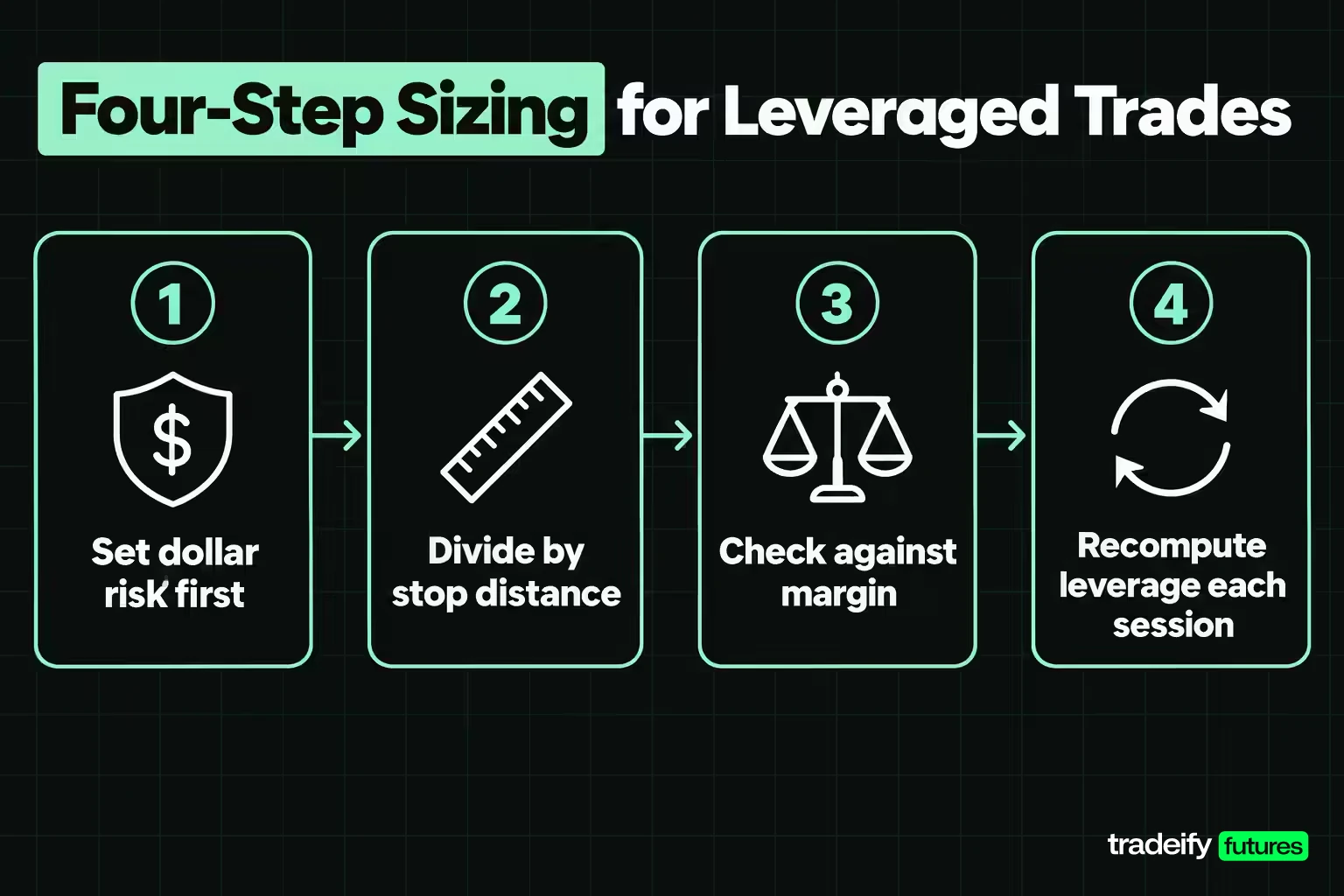
- Set the dollar risk first. Fix what one losing trade may cost as a share of the account before you choose an instrument. That number has to survive a losing streak, not just one bad trade.
- Divide by the stop distance. On MES, a 20 point stop costs $100 per contract. On ES, the same 20 points cost $1,000 per contract. With a $200 risk budget and a 20 point stop, the answer is 2 MES, and ES is simply too large.
- Check the result against the margin requirement. If the size your stop allows needs more margin than you have, the margin is the binding limit and the size comes down. Do not widen or remove the stop to fit.
- Recompute effective leverage after every session. As equity falls, the same size becomes more leverage. A position that was 7x last week can be 11x today without a new order.
Step 4 is the one traders skip, and it is the one that decides whether a bad week becomes a closed account.
Why Small Risk per Trade Matters More With Leverage
Leverage makes each loss bigger, and losses compound. Six losing trades in a row is an ordinary streak for most strategies, not a disaster. Here is what that streak does to an account at three levels of risk per trade.
| Risk per trade | Drawdown after six straight losses |
|---|---|
| 1% | 5.9% |
| 2% | 11.4% |
| 5% | 26.5% |
The second problem is that drawdowns are harder to climb out of than to fall into, because the recovery is earned on a smaller balance.
| Drawdown | Gain needed to get back to even |
|---|---|
| 10% | 11.1% |
| 25% | 33.3% |
| 50% | 100% |
| 75% | 300% |
Put the two tables together and the case for small risk per trade makes itself. A trader risking 5% a trade is one bad week from a hole that needs a one-third gain to repair. High effective leverage is how traders end up risking 5% without ever deciding to.
Leverage Guardrails Worth Writing Down
- Set a maximum effective leverage for the account, and treat it as a hard cap, not a target.
- Place the stop where the trade idea is wrong, then size to the stop. Never move the stop to make a bigger size fit.
- Cut size after a run of losses, because the same contracts are now a larger share of a smaller account.
- Treat a margin increase or a volatility spike as a signal to reduce exposure.
- Avoid holding a highly levered position through scheduled news unless you have sized for slippage.
Related lesson: How to size a position from your stop
Is Leverage Suitable for Beginners
Leverage is not automatically wrong for a beginner, but most beginners use far more of it than they realize. The CFTC describes speculating in futures and options as a volatile, complex and risky venture that is "rarely suitable" for individual investors. In the EU, regulators found most retail CFD accounts lose money. Those warnings are about leveraged products in general, not one platform.
A reasonable test before using leverage with real money is whether you can answer these questions without looking anything up:
- What is the notional value of one contract or lot of the instrument you want to trade?
- What does a 1% move cost at your intended size, in dollars and as a share of the account?
- Where is your stop, and what does it cost if it fills a few ticks worse than planned?
- What is your effective leverage at entry, and what will it be after a 20% drawdown?
- Who can close your position, at what level, and do you owe money if the market gaps past it?
If any answer is "I'm not sure", the leverage is ahead of the knowledge. The practical route is to start with the smallest unit available (micro futures or micro lots), keep effective leverage low, and practice the sizing process on a simulated account until it is automatic. A demo account will not teach you how a loss feels, but it will show whether your arithmetic holds up.
Trading Psychology and Magnified Losses
Leverage changes how a trade feels long before it changes the outcome. When each tick moves the account by a meaningful amount, ordinary noise starts to look like a threat, and decisions get made on P&L rather than on the chart.
The common reactions are recognizable. Freezing at a planned stop because the dollar loss looks large. Closing a good trade early because the open profit feels fragile. Doubling size after a loss to "get it back". Each one is a sizing problem showing up as an emotional one.
The fix is mostly mechanical. Decide size, stop and maximum daily loss before the session, when nothing is moving. Size small enough that a full stop-out is uncomfortable but not alarming. Use your platform's own risk settings, such as daily loss limits or lockouts, to enforce the plan when the impulse arrives. If a position size makes you watch every tick, it is too large for you right now, whatever the platform allows.
What LTCM Shows About Borrowed Money
Long-Term Capital Management is the textbook case of leverage turning a sophisticated strategy into a near collapse. The hedge fund, run by experienced traders and academics, earned small returns per dollar on convergence trades and used heavy borrowing to make those returns meaningful.
According to the Federal Reserve's history of the episode, by the end of 1997 LTCM held about $30 in debt for every $1 of capital. When markets were shaken in 1998, the spreads it had bet would narrow widened instead. The fund lost 44% of its value in August 1998 alone. On September 23, 1998, fourteen banks and brokerage firms put up $3.625 billion in a rescue arranged at the New York Fed, which did not lend its own money, in exchange for 90% of the fund.
The lesson for a small account is not about bond spreads. It is that leverage turns a strategy that is right most of the time into one that only has to be wrong once. High leverage removes the time you need to be right eventually.
Leverage on Prop Firm and Simulated Accounts
Proprietary trading firm evaluations and funded accounts handle leverage differently from a brokerage account. Most futures prop firms run evaluations and funded accounts in a simulated setting and cap position size with contract limits rather than an exchange margin requirement. The real liquidation line is usually a drawdown rule: touch the maximum loss level and the account fails.
That changes the useful question. On a prop account, the leverage that matters is the drawdown distance at your chosen size. Divide the allowed loss by the dollar value of a point at your size, and you get the market move that ends the account. A trader who sizes to the contract limit instead of to that distance is repeating the oldest leverage mistake, sizing to permission rather than to risk.
On our accounts, size is set by contract limits rather than margin. A 50K account can hold up to 4 minis or 40 micros, and a 50K Growth funded account has a $2,000 trailing drawdown. At the full 4-contract ES limit, that $2,000 is a 10 point move (4 x $50 x 10), which is why the limit works as a ceiling rather than a suggested size. All positions close by 4:45 PM ET, and our funded accounts are simulated.
Leverage in Trading FAQ
What does leverage mean in trading?
Leverage means controlling a position worth more than the money you have committed. Profit and loss are calculated on the full position, so a small market move becomes a larger move in your account. It applies in both directions.
What are leverage ratios?
A leverage ratio states the maximum position per dollar of deposit. 50:1 means a 2% deposit and 100:1 means a 1% deposit. The ratio is a ceiling set by the venue or regulator, not a measure of the leverage you are actually using.
What is better leverage, 1/30 or 1/100?
Neither ratio changes your risk if you size each position the same way. 1:30 needs a $3,333 deposit per $100,000 of exposure and 1:100 needs $1,000. A lower ceiling simply limits how large a position you can open by mistake.
Can you make $200 per day in day trading?
It is arithmetically possible, but no amount is reliable or guaranteed. $200 is 40 points on one MES contract, 4 points on one ES contract, or 20 pips on a standard lot of EUR/USD. The same move against you costs the same $200, so the target only makes sense if your risk per trade fits the account.
Is leverage the same as borrowing money?
Only on some products. A stock margin account is a real loan with interest. A futures performance bond is a good-faith deposit, nothing is borrowed, and no interest is charged on it. Retail forex uses a security deposit held by the dealer.
Can you lose more than you deposit with leverage?
Yes, on some products. The CFTC warns futures traders can owe more than they invested, and stock margin losses can exceed equity while the loan is still owed. EU retail CFD accounts have negative balance protection, but that is a specific regulatory rule, not a general one.
How much leverage should a beginner use?
Low enough that a 1% market move costs only a small share of the account, though no single number suits everyone and a figure for your situation would be individual advice. A sound approach is to set dollar risk per trade first, size from your stop, and keep effective leverage low enough that a 1% market move costs a small share of the account.
Is leverage trading the same as gambling?
No, leverage itself is a tool that hedgers, banks and funds use every day. It starts to resemble gambling when size is chosen by hope rather than by a defined risk, a stop and a plan. The difference is in how the position is sized, not in the product.
Trading futures, forex, CFDs, crypto and other leveraged products involves substantial risk, and losses can exceed what you expect and, on some products, what you deposit. All prices, bond amounts and account figures here are round illustrations, not live market data or current margin requirements, which change with volatility and venue policy. Simulated and funded prop accounts are simulated and do not reflect live execution. This article is education, not investment advice.


