



TL;DR: Interest rate futures are exchange-traded contracts that let you hedge or trade expected changes in borrowing costs and bond yields. Short-term contracts such as SOFR and fed funds futures track policy rates, while Treasury futures track government bond prices. Prices move opposite to rates, so a rise in expected rates pushes these futures lower. Size every position from the dollar value of one basis point or one tick, not from the chart.
Interest rate futures are the contracts banks, fund managers and traders use to take a position on where interest rates are heading without making a loan or buying a bond. Simple enough, until you open a rates watchlist. SOFR futures, fed funds futures, 2-year notes, 10-year notes and ultra bonds all sit side by side, and each one answers a different question about rates.
That is where traders get caught. You can be right that rates will fall and still lose money because you picked a contract that tracks the wrong part of the curve, or misread which way the price moves. This guide covers what interest rate futures are, the main contract types, the specs that turn a price move into dollars, why prices fall when rates rise, and how the contracts are traded and used for hedging.
What Are Interest Rate Futures
Interest rate futures are standardized exchange-traded contracts whose price depends on an interest rate or on a debt instrument whose value moves with rates. Each contract fixes the size, the quote convention, the minimum price move, the expiry and the settlement method, so every buyer and seller trades the same thing.
There are two broad designs. Short-term interest rate futures settle against an average of a published benchmark rate over a set period. CME's Three-Month SOFR futures, for example, settle at 100 minus the compounded Secured Overnight Financing Rate over a three-month reference quarter. Government bond futures instead track the price of a basket of deliverable bonds. CME's 10-Year T-Note futures cover $100,000 face value of Treasury notes and end in delivery of actual notes.
SOFR itself is a broad measure of the cost of borrowing cash overnight with Treasury securities as collateral, published each business day by the New York Fed. Fed funds futures use a different benchmark, the effective federal funds rate, which is the rate banks charge each other for unsecured overnight loans.
As with any futures contract, a buyer (long) profits if the price rises and a seller (short) profits if it falls. Neither side has to own a loan or a bond to take the position. Gains and losses are settled in cash every day through the clearing house.
Types of Rate Futures Contracts

Rate futures split into two families. Before you look at a chart, decide which family your idea belongs to, because the two react to different news.
Short-Term Interest Rate Futures
Short-term interest rate futures, often called STIRs, track overnight or short-term benchmark rates. They answer the question "what average rate does the market expect over this future month or quarter?"
- Three-Month SOFR futures (SR3) settle on compounded SOFR over a three-month reference quarter. They are listed quarterly for 39 consecutive quarters plus the nearest 6 monthly contracts, so the strip reaches roughly ten years out.
- One-Month SOFR futures (SR1) settle on the simple average of SOFR during the contract month, with 25 consecutive months listed.
- 30-Day Federal Funds futures (ZQ) settle on the average daily effective federal funds rate during the contract month, with 60 consecutive months listed.
Because these contracts track what the central bank does with overnight rates, they react most directly to Federal Reserve meetings and to data that changes expectations for those meetings.
Government Bond Futures
Government bond futures track the price of longer-dated government debt. They answer a different question: "what price does the market put on government debt around this maturity?"
- CME Treasury futures cover the curve from 2-Year (ZT) and 5-Year (ZF) notes through the 10-Year (ZN) and Ultra 10-Year (TN) notes to the Treasury Bond (ZB) and Ultra Bond (UB).
- Eurex lists the German government bond family: Euro-Schatz (FGBS, 1.75 to 2.25 years), Euro-Bobl (FGBM, 4.5 to 5.5 years), Euro-Bund (FGBL, 8.5 to 10.5 years) and Euro-Buxl (FGBX, 24.0 to 35.0 years).
Longer bond futures respond to policy expectations too, but they also carry inflation expectations, growth expectations, government borrowing needs and the extra yield investors demand for lending long. A view on the next Fed meeting fits a STIR. A view on long-term inflation fits a bond future. Mix them up and a correct call can still show a red P&L.
Rate Futures Contract Specifications Compared
The features that define a rate futures contract are the contract unit, the quote convention, the minimum price move (tick), the dollar value of that tick, the settlement method and the last trading day. The table shows them for the most traded contracts, read from CME and Eurex specifications in November 2026.
| Contract | Underlying | Quote | Minimum tick | Settlement |
|---|---|---|---|---|
| Three-Month SOFR (SR3) | Compounded SOFR over a reference quarter | 100 minus rate | 0.0025 = $6.25 near expiry, 0.005 = $12.50 otherwise | Cash |
| One-Month SOFR (SR1) | Average SOFR over the month | 100 minus rate | 0.005 = $20.835 in deferred months | Cash |
| 30-Day Fed Funds (ZQ) | Average effective fed funds rate over the month | 100 minus rate | 0.005 = $20.835, 0.0025 = $10.4175 in the spot month | Cash |
| 2-Year T-Note (ZT) | $200,000 face of 2-year Treasury notes | Points and 32nds | 1/8 of 1/32 = $7.8125 | Physical delivery |
| 5-Year T-Note (ZF) | $100,000 face of 5-year Treasury notes | Points and 32nds | 1/4 of 1/32 = $7.8125 | Physical delivery |
| 10-Year T-Note (ZN) | $100,000 face of 6.5 to 8 year Treasury notes | Points and 32nds | 1/2 of 1/32 = $15.625 | Physical delivery |
| Treasury Bond (ZB) | $100,000 face of 15 to 25 year Treasury bonds | Points and 32nds | 1/32 = $31.25 | Physical delivery |
| Euro-Bund (FGBL) | EUR 100,000 of 8.5 to 10.5 year German government debt, 6 percent coupon | Percent of par | 0.01 = EUR 10 | Physical delivery |
Rate Futures Attributes That Set Dollar Risk
Three attributes of a rate futures contract decide what a move costs you.
- Dollar value per basis point. For SR3, one basis point (0.01 index points) equals $25 per contract, because the contract unit is $2,500 times the index. For ZQ and SR1 the unit is $4,167, so one basis point is $41.67.
- Dollar value per point. For ZN, ZF and ZB one full price point is $1,000 on $100,000 face. ZT is $2,000 per point because its face value is $200,000. The Euro-Bund is EUR 1,000 per point.
- Expiry and settlement. STIRs settle in cash against a published rate. Treasury and Bund futures end in delivery of real bonds, which is why most short-term traders close or roll them well before the delivery period.
Related lesson: Tick size and tick value
How Interest Rate Futures Work
Interest rate futures work like other futures contracts: two parties agree on a price today for a contract that settles on a future date, the exchange's clearing house stands between them, and profits and losses are marked to market at the end of every session.
Quoting and the Trading Session
STIRs use the IMM index convention, so the price is 100 minus the rate. A fed funds futures price of 92.75 means an average rate of 7.25 percent, which is the example CME gives in its own specification. Treasury futures quote in points and fractions of 32nds of a point, the same way cash Treasuries trade. A ZN quote of 110-16 means 110 and 16/32, or 110.5.
On CME Globex, SOFR, fed funds and Treasury futures trade Sunday to Friday from 6:00 PM to 5:00 PM ET, with a 60-minute break each day starting at 5:00 PM ET. That near round-the-clock session means a position can react to overseas news at any hour.
Daily Marking to Market
Each day the clearing house sets a settlement price and moves money between accounts. If you are long one SR3 contract and it settles 4 basis points lower than the prior day, $100 leaves your account that evening. Nobody waits for expiry to settle up. That daily cash flow is why a futures account needs margin even though no one pays the full contract value up front, and why a losing position costs real cash long before the thesis is proven wrong.
Cash Settlement for SOFR and Fed Funds Futures
STIRs cannot deliver a rate, so they settle in cash. A 30-Day fed funds contract settles on the first business day after its last trading day, against the month's average daily effective federal funds rate as calculated by the New York Fed. A Three-Month SOFR contract stops trading on the business day before the third Wednesday of its delivery month and settles on the compounded SOFR for the reference quarter.
Physical Delivery for Treasury Futures
Treasury futures end in delivery. A short who holds ZN after the last trading day must deliver Treasury notes with at least 6.5 and less than 8 years remaining. Because several notes qualify, CME uses a conversion factor, set as the note's price to yield 6 percent, to make them comparable. The invoice price equals the futures settlement price times the conversion factor, plus accrued interest. The short chooses which eligible note to deliver and generally picks the cheapest one, known as the cheapest-to-deliver.
ZN trading in an expiring month ends at 12:01 PM CT, seven business days before the last business day of the contract month. Most traders who never intend to deliver close or roll the position before the delivery period begins.
Related lesson: Cash vs physical settlement
Why Rate Futures Prices Move Opposite to Rates

Rate futures prices move opposite to interest rates. When expected rates rise, rate futures fall. When expected rates fall, they rise. It sounds obvious written down, and it is still the most common order-entry error in rates: a trader expecting higher rates clicks buy because "rates are going up." Write both sides in the plan before entry, for example "if expected rates rise, this SOFR price should fall."
For STIRs the reason is built into the quote. The price is 100 minus the rate, so a contract at 96.00 implies 4.00%. If expectations rise to 4.10%, the price must fall to 95.90. A trader who expects the Fed to cut buys SOFR futures. A trader who expects hikes sells them.
For Treasury futures the reason is bond math. An existing bond pays a fixed coupon. When new bonds start paying higher yields, the old bond is only worth buying at a lower price, so bond prices and yields move in opposite directions. Treasury futures track those bond prices, so rising yields push them down.
Two refinements matter in practice.
- Expectations move prices, not decisions. Futures price the expected path of rates ahead of time. If a 25 basis point hike is fully expected, the announcement itself may barely move SOFR futures. The price moves on the gap between what happened and what was priced.
- Different maturities can move by different amounts. A strong inflation report can push front-month SOFR futures down sharply while long bond futures barely move, or the reverse. "Rates went up" can mean very different things for the 2-year and the 30-year.
Related lesson: Bond prices vs yields
Interest Rate Futures Example With SOFR and Treasury Math
These two interest rate futures examples, one SOFR trade and one 10-year Treasury note trade, use round illustrative prices, not live quotes. Each shows the step that matters most before entry: converting a rate or price move into dollars.
SOFR Futures Example
A trader buys 2 Three-Month SOFR contracts at 96.00, which implies an expected rate of 4.00% for that quarter. One basis point is worth $25 per contract.
- If expectations rise and the price falls to 95.90 (implied 4.10%), the move is 10 basis points. The loss is 10 x $25 x 2 = $500 before costs.
- If expectations fall and the price rises to 96.08 (implied 3.92%), the gain is 8 x $25 x 2 = $400 before costs.
In ticks, a 10 basis point move is 40 ticks of 0.0025 in a contract close to expiry, or 20 ticks of 0.005 in a deferred month. The dollar result is the same either way, which is why rates traders usually think in basis points rather than ticks.
10-Year Treasury Futures Example
A trader buys 1 ZN at 110-16 (110.5), which is a notional value of $110,500 against $100,000 of face value. One full point is worth $1,000 and one tick (half of a 32nd) is $15.625.
- If yields fall and ZN rises to 111-00, the gain is 16/32 of a point, or 32 ticks, which is $500.
- If yields rise and ZN falls to 109-16, the loss is one full point, $1,000.
A one-point loss in ZN is not an extreme case for an actively traded note contract, especially on a heavy data day. Work out the dollar loss at your stop before you place the order, and expect a stop to fill worse than its trigger when the market gaps. The math gives you an estimate, not a ceiling.
Reading Expectations From the Rate Futures Curve
A strip of rate futures prices is a forecast you can read. Subtract each price from 100 and you get the average rate the market is pricing for that month or quarter.
Here is the fed funds futures strip from CME's settlement prices as of November 4, 2026, when the Fed's target range was 3.75% to 4.00% and the effective fed funds rate was 3.88%.
| Fed funds futures month | Settlement price | Implied average rate |
|---|---|---|
| November 2026 | 96.12 | 3.88% |
| December 2026 | 95.975 | 4.025% |
| January 2027 | 95.905 | 4.095% |
| March 2027 | 95.785 | 4.215% |
| June 2027 | 95.595 | 4.405% |
The November contract sits right on the current effective rate, which is what you would expect with no meeting in the month. December implies an average 14.5 basis points higher than November. With the next FOMC meeting on December 8-9, 2026, that gap says the market leans toward a higher rate after the meeting, though not a certain one. By June 2027 the strip implies 52.5 basis points more than November.
SOFR futures told a similar story on the same day. The December 2026 Three-Month SOFR contract settled at 95.835 (implied 4.165%), March 2027 at 95.64 (4.36%) and June 2027 at 95.525 (4.475%), while SOFR itself printed 3.97% for November 3, 2026.
These are dated numbers. They change every session, and the useful skill is the method, not the snapshot. When a data release hits, watch which months reprice most. If the nearest contracts move and the deferred ones do not, the market changed its view on timing. If the whole strip moves, it changed its view on the destination. And if a number lands exactly where the strip already sat, expect very little, however dramatic the headline looks.
How to Trade SOFR and Treasury Rate Futures
Trading rate futures starts with a precise thesis. "Rates are going down" is too vague to trade. A usable thesis names the point on the curve, the catalyst, the expected price reaction and the level that proves the idea wrong.
Match the Contract to the View
Pick the contract that expresses the view most directly. A view about the next one or two Fed meetings fits fed funds or near SOFR futures. A view about where policy settles over two years fits SOFR futures a year or more out, or 2-year note futures. A view about inflation or long-term government borrowing fits 10-year or bond futures. A correct view in the wrong contract can still lose money.
Know the Catalyst Calendar
Rate futures react to scheduled events: FOMC decisions, CPI and other inflation data, jobs reports and Treasury auctions. As of November 4, 2026, the next CPI release (October data) is on November 10, 2026 at 8:30 AM ET and the next FOMC meeting is December 8-9, 2026. Before each event, write down what the curve already prices, because the reaction depends on the surprise.
Size From Basis-Point Value
Convert the stop into dollars before entry. On SR3, a 6 basis point stop costs $150 per contract. On ZN, a stop of 12/32 is 24 ticks, or $375 per contract. Put the stop where the idea is proven wrong, then let the dollar figure set the size, not the other way round. If one contract already risks more than your plan allows, the right size is zero. Passing on that trade is a decision, not a missed opportunity.
Plan Around Data Gaps and Expiry
Order books thin out right before major releases, and the first move after a number can skip through stops. Either reduce size into the event, stand aside, or accept that the fill may be worse than planned. The market will still be there after the first reaction. Check the last trading day of the month you trade, and roll before delivery or settlement mechanics become your problem. "I planned to exit earlier" is not a control.
Hedging With Rate Futures
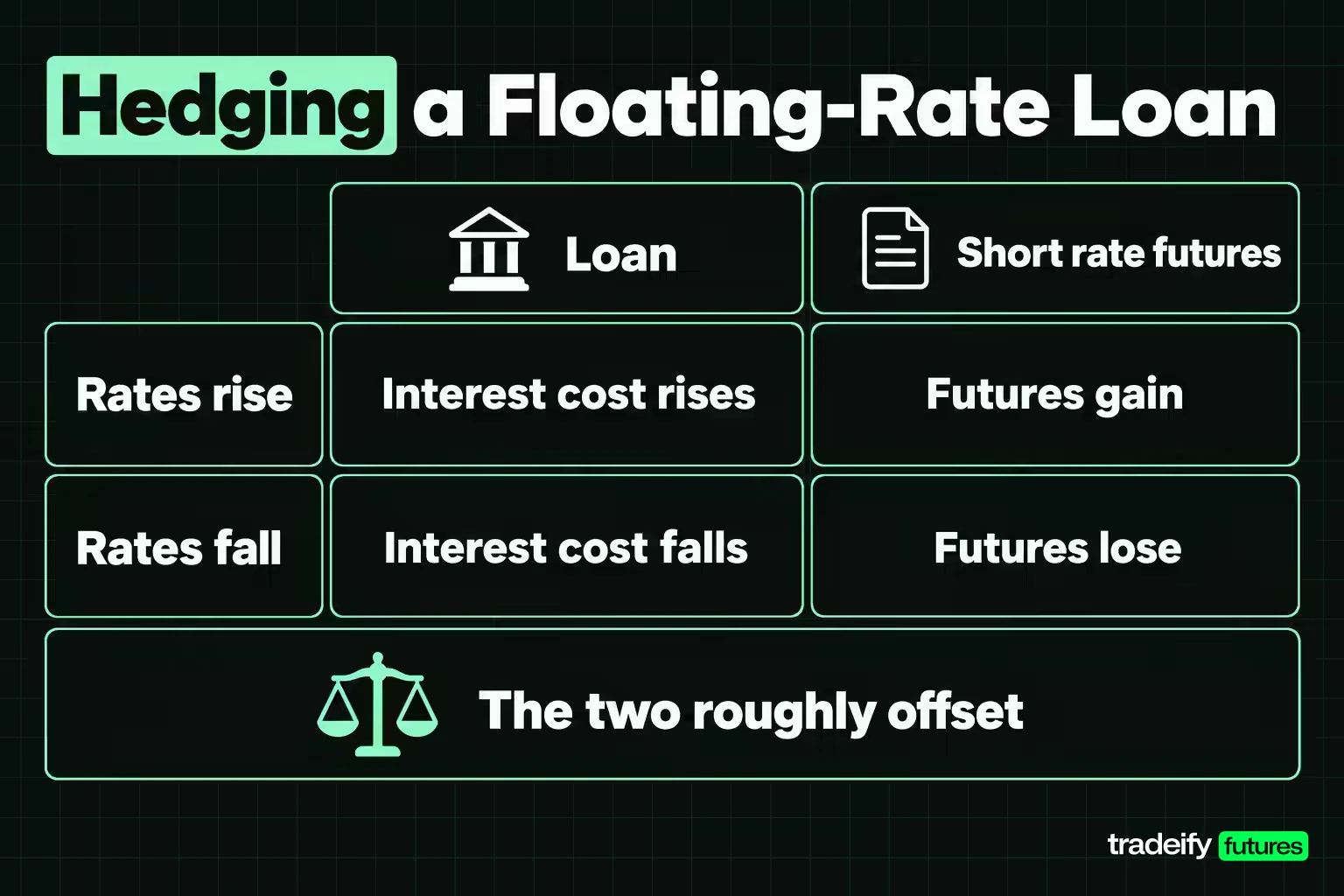
Hedging is the original job of rate futures. A hedger takes a futures position that gains when the existing exposure loses, so the two roughly offset.
Hedging a Floating-Rate Loan
Imagine a company with a $10 million floating-rate loan that resets every quarter against SOFR. If rates rise, its interest bill rises. One basis point on $10 million for a quarter is about $10,000,000 x 0.0001 x 0.25 = $250. Each SR3 contract moves $25 per basis point, so the hedge is $250 / $25 = 10 contracts, sold short.
If expected rates rise 25 basis points, the loan costs about $6,250 more for the quarter. The short futures gain 10 x 25 x $25 = $6,250. If rates fall instead, the futures lose about $6,250 and the loan costs about $6,250 less. The hedge does not make money. It fixes the cost so the company can plan.
Hedging a Bond Portfolio
A bond fund that worries about rising yields can sell Treasury futures. The number of contracts is set by matching the portfolio's dollar sensitivity to a one basis point yield change against the futures contract's sensitivity, which depends on the cheapest-to-deliver bond and its conversion factor. Fund managers use the same idea in reverse to add duration quickly without buying cash bonds.
Basis Risk and Other Hedge Limits
No hedge is perfect. The loan may reset on a slightly different date or rate than the futures settle on, and a bond portfolio's yields never move exactly in line with Treasury futures. That gap is basis risk. Hedgers also need cash for daily variation margin on the futures, even when the hedged position's offsetting gain only shows up later as lower interest costs.
Related lesson: Hedging risk
Who Uses Rate Futures
Rate futures have a broad user base because almost every financial institution has interest rate exposure.
- Banks hedge the mismatch between what they pay on deposits and what they earn on loans, and manage funding costs.
- Asset managers and pension funds adjust portfolio duration quickly and cheaply, or hedge bond holdings ahead of an expected rise in yields.
- Corporate treasurers lock in borrowing costs on floating-rate debt or on bonds they plan to issue.
- Dealers hedge the bonds and swaps they hold while serving clients.
- Speculators and relative-value traders take directional views on the Fed path or yields, trade spreads between maturities, and provide liquidity to hedgers.
Benefits and Drawbacks of Rate Futures
Every benefit of rate futures has a matching drawback, and the table pairs them so you can judge both together.
| Benefit | Matching drawback |
|---|---|
| Deep liquidity in the main contracts | Liquidity drops sharply in far-dated months |
| Margin controls a large notional value | The same margin magnifies losses |
| Transparent exchange pricing of the expected rate path | Prices react to surprises, so data releases can gap through stops |
| Central clearing reduces counterparty risk | Daily marking to market demands cash during losing streaks |
| Precise exposure to one point on the curve | Choosing the wrong point can lose even when the rate view is right |
| Easy to go short | Treasury futures carry delivery mechanics to manage |
For a speculator, the main benefit is a clean, liquid way to express a view on the Fed or on yields. The main drawback is size. A single ZT contract covers $200,000 of face value, and even small rate moves add up quickly across several contracts. A move that looks tiny on the screen, a few hundredths of a point, can still be a meaningful dollar loss. Small-looking moves are not the same as low risk.
Related lesson: What is notional value
Does Time Decay Affect Rate Futures
Rate futures do not have time decay in the options sense. An option loses value as expiry approaches because its time value shrinks. A futures contract has no time value to lose. Time still changes how rate futures behave in four ways.
- Convergence. As a contract approaches its last trading day, its price converges toward the final settlement value. For a fed funds contract that is the month's average effective rate, so uncertainty narrows as each day's rate is published.
- Reference-period accrual. Once a SOFR contract's reference quarter begins, every published SOFR fixing becomes part of the final settlement. Midway through the quarter, half the outcome is already known, so the contract becomes less sensitive to new expectations.
- Finer ticks near expiry. SR3 contracts with four months or less to their last trading day trade in 0.0025 increments ($6.25), half the size of the 0.005 ($12.50) tick in later months. Fed funds futures switch to a 0.0025 tick ($10.4175) in the spot month.
- Carry in Treasury futures. A Treasury futures price reflects the cheapest-to-deliver bond's price adjusted for the income it earns and the cost of financing it until delivery. As delivery nears, that carry adjustment shrinks and the futures price tracks the bond more closely.
Related lesson: Cost of carry
Rate Futures Available on a Prop Trading Account
On our accounts, US rate futures (Treasury, SOFR and fed funds contracts such as ZN, ZB, SR3 and ZQ) are not on the supported product list. The rate futures we list are the Eurex German government bond futures (Euro-Bund FGBL, Bobl FGBM, Schatz FGBS and Buxl FGBX), available on Tradovate accounts only with a paid Eurex data add-on bought from Tradovate. These four form one product group, so holding opposing positions across them counts as prohibited hedging, and every position must be closed by 4:45 PM ET.
Interest Rate Futures FAQ
What are interest rate futures in simple terms?
Interest rate futures are exchange-traded contracts whose price depends on an interest rate or a government bond. Buyers profit if rates fall and prices rise. Sellers profit if rates rise and prices fall.
What happens to interest rate futures when rates rise?
Interest rate futures prices fall when expected rates rise. SOFR and fed funds futures are quoted as 100 minus the rate, and Treasury futures track bond prices, which fall as yields rise.
What is the difference between SOFR futures and fed funds futures?
SOFR futures settle on the Secured Overnight Financing Rate, which is the cost of overnight borrowing backed by Treasury collateral. Fed funds futures settle on the effective federal funds rate for unsecured overnight bank lending. Fed funds futures are the closer read on the Fed's target, while SOFR futures extend much further out the curve.
How are Treasury futures settled?
Treasury futures settle by physical delivery of eligible Treasury notes or bonds. The invoice price is the futures settlement price times a conversion factor plus accrued interest. Most traders close or roll positions before the delivery period.
Are interest rate futures risky?
Yes. They use margin, can move sharply around Fed decisions and inflation data, and contract size, gaps and expiry rules can make losses larger than a trader expected.
Futures and other margined products can lose more than you expect, including more than the margin posted, and rate futures can gap through stop orders around economic releases. Funded and evaluation prop accounts are simulated, and this article is education, not investment advice or a recommendation to trade any contract.


