




TL;DR: Notional value is the full dollar exposure a contract controls, and it is not the amount you can lose. One Micro E-mini S&P 500 contract at an illustrative 7,000 carries $35,000 of notional, yet a 10-point stop risks $50. Use notional to compare exposure and size hedges, and use your stop, tick value and position size to measure risk.
Four Micro E-mini S&P 500 contracts can control $140,000 of the index while a tight stop risks $200. Both numbers describe the same trade. The first is notional value. The second is risk.
Most sizing mistakes start when a trader reads one as the other. Treat $140,000 as risk and you freeze on a trade that was sized sensibly. Treat it as meaningless and you stop noticing how fast a missing stop turns that exposure into real damage.
This guide explains what notional value is, how to calculate it on any contract, how it works in futures, options, swaps, forex and crypto, and where it helps or misleads. Every price used here is a round illustrative level chosen so you can check the arithmetic, not a market quote.
What Is Notional Value
Notional value is the total value of the asset a financial contract is tied to, even when you only pay part of that amount to enter the trade. It shows the full market exposure of the position. The standard formula is contract size multiplied by the underlying price.
The word "notional" means existing as an idea or a reference rather than as money that actually moves. That is the right sense here. In an interest rate swap, the notional principal is the amount the interest payments are calculated on, and it never changes hands. In a futures contract, nobody hands over the full contract value at the open either. You post collateral, and your profit or loss is calculated against the full notional.
So notional value answers one question: how big is the exposure you are carrying? It does not answer how much cash you posted, what the position could be sold for, or how much you lose if your stop is hit. Those are different numbers with different names, and keeping them apart is most of what this page is about.
Notional value matters for three practical reasons.
- It is the common unit for comparing positions in different markets, such as an index contract against a crude oil contract.
- It is the number a hedge is sized on, because a hedge offsets exposure.
- It is the headline figure in derivatives reporting, which is easy to misread as risk.
How to Calculate Notional Value

The notional value formula for a single contract is contract size multiplied by the current price of the underlying. For a position, multiply by the number of contracts.
Notional value = contract size x price x number of contracts
The contract size (also called the contract unit or multiplier) comes from the exchange specification. It is either a quantity, such as 1,000 barrels of crude oil or 100 troy ounces of gold, or a dollar multiplier on an index, such as $50 times the S&P 500.
Notional value calculation step by step
Here is the method on a Micro E-mini S&P 500 (MES) contract with the index at an illustrative 7,000.
- Find the contract unit in the exchange specification. For MES it is $5 x S&P 500 Index.
- Multiply the unit by the price. 7,000 x $5 = $35,000 of notional per contract.
- Multiply by the number of contracts. Four contracts carry $140,000 of notional.
- Recalculate whenever the price moves. At 7,700 the same four contracts carry $154,000.
The step traders skip is the first one, usually when they move to a new market and assume it works like the last one. A wrong multiplier makes the notional wrong by a factor of ten or more, and the error carries into every sizing decision built on it.
Related lesson: Futures contract specifications
Notional value per contract across futures markets
The same formula gives very different numbers depending on the contract unit. The table uses CME contract units and illustrative prices: S&P 500 at 7,000, Nasdaq-100 at 28,000, crude oil at $70, gold at $4,000, EUR/USD at 1.1000 and the 10-Year T-Note at 110-16.
| Contract | Contract unit | Illustrative price | Notional value | Minimum tick value | Value of a 1% move |
|---|---|---|---|---|---|
| Micro E-mini S&P 500 (MES) | $5 x S&P 500 Index | 7,000 | $35,000 | $1.25 | $350 |
| E-mini S&P 500 (ES) | $50 x S&P 500 Index | 7,000 | $350,000 | $12.50 | $3,500 |
| Micro E-mini Nasdaq-100 (MNQ) | $2 x Nasdaq-100 Index | 28,000 | $56,000 | $0.50 | $560 |
| E-mini Nasdaq-100 (NQ) | $20 x Nasdaq-100 Index | 28,000 | $560,000 | $5.00 | $5,600 |
| Micro WTI Crude Oil (MCL) | 100 barrels | $70 | $7,000 | $1.00 | $70 |
| Light Sweet Crude Oil (CL) | 1,000 barrels | $70 | $70,000 | $10.00 | $700 |
| Micro Gold (MGC) | 10 troy ounces | $4,000 | $40,000 | $1.00 | $400 |
| Gold (GC) | 100 troy ounces | $4,000 | $400,000 | $10.00 | $4,000 |
| Euro FX (6E) | 125,000 euros | 1.1000 | $137,500 | $6.25 | $1,375 |
| 10-Year T-Note (ZN) | $100,000 face value | 110-16 | $110,500 | $15.625 | about $1,105 |
Two patterns stand out. Each micro contract is one tenth of its full-size or E-mini sibling, so ten micros carry the same notional as one larger contract. And tick value does not track notional in any tidy way. A 10-Year T-Note carries about $110,500 of notional with a $15.625 tick, while Micro Gold carries $40,000 with a $1.00 tick. Notional tells you size. The tick value tells you how fast that size turns into dollars.
Related lesson: Tick size and tick value
Notional Value in Futures and Options
Notional value in derivatives works the same way everywhere: it is the size of the underlying exposure the contract references, not the price of the contract itself. What changes from one derivative to the next is how far the notional sits from the money you put up and the money you can lose.
Notional value of a futures contract
A futures contract is an agreement on a fixed quantity at a fixed price, so its notional is simply that quantity at today's price. One E-mini S&P 500 contract at 7,000 is $350,000 of index exposure. Profit and loss track the full notional. If the index rises 1%, the contract gains $3,500, exactly as if you held $350,000 of the index.
The difference is what you pay to hold it. You post margin, which is collateral, not a down payment on the $350,000. That gap is why futures feel cheap to open and can be expensive to be wrong in. Opening the trade costs little. Holding it through a bad move costs whatever the full notional moved.
Micro contracts exist largely to make notional smaller. Moving from one ES to one MES cuts notional from $350,000 to $35,000 at the same index level, and every dollar of profit and loss shrinks by the same factor of ten.
Related lesson: Mini and micro futures contracts
Notional value of an options contract
One standard equity option contract generally represents 100 shares of the underlying stock. The notional value is 100 times the share price. The price of the option, the premium, is a separate and much smaller number.
Take a stock at an illustrative $200 and a call option with a $3.00 premium.
- Notional value is 100 x $200 = $20,000.
- The premium paid is 100 x $3.00 = $300.
- The notional is about 67 times the premium.
For the buyer, the largest possible loss on that long option is the $300 premium. Calling $20,000 the buyer's risk would overstate it badly. For the seller, it flips. A short call has open-ended loss if the stock keeps rising, and the notional is a far better guide to how large that loss can become than the $300 collected. The same notional figure means very different things depending on which side of the contract you hold.
Notional Value in Swaps
Notional value in swaps is the reference amount the payments are calculated on. In an interest rate swap, two parties agree to exchange interest payments on an agreed principal, and that principal never changes hands. Only the payment difference moves. This is where the word notional fits most literally.
How an interest rate swap uses notional
Take an illustrative swap with a $1,000,000 notional for one year. One side pays a fixed 4%. The other pays a floating rate that averages 3.5%.
- The fixed leg is $1,000,000 x 4% = $40,000.
- The floating leg is $1,000,000 x 3.5% = $35,000.
- Payments are netted, so only $5,000 actually changes hands.
The $1,000,000 is notional. The $5,000 is actual. That is the plain answer to the difference between notional and actual: notional is the base the contract is written against, and actual is the money that moves.
Currency swaps and equity swaps use the same idea with a different base. A currency swap references principal amounts in two currencies. An equity swap, often called a total return swap, references the value of a stock or index position, and one side pays the return on that notional while the other pays a fixed or floating rate.
Why aggregate swap notional overstates risk
Notional totals are the headline number in derivatives reporting, and they are enormous. The Bank for International Settlements reported that the notional value of outstanding over-the-counter (OTC) derivatives was $846 trillion at end-June 2025, while their gross market value was $21.8 trillion, about 2.6% of the notional figure.
A CFTC staff research paper made the same point about interest rate swaps directly. It found that for US reporting entities as of December 15, 2017, notional amount across the main swap products was $179 trillion. After converting to risk equivalents and netting offsetting longs and shorts between counterparties, the measure the authors proposed came to $15 trillion, just over 8% of notional. Their opening line was that notional amount is not a good measure of the size of the swap market or of the risk it transfers.
When a headline quotes a derivatives notional total, read it as a measure of contract volume on paper, not as money at risk.
Notional Value in Forex and Crypto Markets
Notional value in forex is the size of the currency position, usually expressed in the quote currency. In crypto derivatives it is the coin quantity times the coin price. The formula never changes. Only the contract unit does.
Forex lots, pips and notional value
A standard forex lot is 100,000 units of the base currency. A mini lot is 10,000 units, a micro lot 1,000 and a nano lot 100. On EUR/USD at an illustrative 1.1000, one standard lot has a notional value of 100,000 x 1.1000 = $110,000.
US rules for retail forex require a security deposit of at least 2% of notional on major currency pairs and 5% on other pairs. On the standard lot, 2% is $2,200, which caps leverage at 50 to 1 on majors. A one-pip move (0.0001) on that lot is worth $10.
So three numbers sit on one forex position: $110,000 of exposure, a $2,200 deposit, and a loss set by how many pips you let it run against you. Exchange-traded currency futures follow the same logic with a fixed unit. One Euro FX futures contract (6E) is 125,000 euros, which is $137,500 of notional at 1.1000.
Notional value in crypto and other asset classes
Crypto futures and perpetual swaps quote notional as coin quantity times price. A position of 0.5 bitcoin at an illustrative $100,000 has $50,000 of notional. If a venue lets you open it at 10 times leverage, the margin is $5,000. The notional, not the margin, is what drives profit and loss, and crypto prices can move several percent in hours, so a 10% move against that position would be $5,000, the entire margin.
The same structure holds across asset classes.
- Equity index futures use a dollar multiplier on the index level.
- Commodities use a physical quantity, such as barrels, ounces or bushels.
- Bond futures use a face value scaled by the quoted price.
- Currency contracts use a fixed amount of one currency.
Notional Value vs Market Value, Face Value and Nominal Value
Notional value is often confused with four other terms. Each one answers a different question, and mixing them up is how a trader ends up treating exposure as money or money as risk.
| Term | What it measures | Example from this page |
|---|---|---|
| Notional value | Full exposure the contract controls | 4 MES at 7,000 is $140,000 |
| Market value | What the position could be bought or sold for now | A long call worth its $300 premium |
| Face value | Fixed amount stated on the instrument | ZN unit of $100,000 at maturity |
| Nominal value | Stated or par value, or a figure not adjusted for inflation | A bond's $1,000 par amount |
| Actual value | Money that really changes hands | The $5,000 net swap payment |
Notional value vs market value
Market value is the price at which a position can be bought or sold in the market right now. For a stock you own outright, notional and market value nearly match, because you paid the full amount. For a derivative they separate, because the contract controls far more than it costs. The option example shows it clearly: $20,000 of notional, a market value of about $300.
Notional value vs face value
Face value is printed on the instrument and does not move with the market. The 10-Year T-Note futures contract has a face value at maturity of $100,000. Its notional at a quoted price of 110-16 (110.5% of par) is $110,500. Face value is stated. Notional is calculated from the current price, so the two drift apart whenever yields move.
Notional value vs nominal value
Nominal value usually means a stated or par amount, such as the $1,000 face of a bond, or a figure not adjusted for inflation, as in nominal versus real returns. Notional is a reference amount for calculating exposure or payments. The words sound alike and are sometimes used loosely, but nominal describes how a number is stated, while notional describes what a contract is written against.
Notional Value, Margin and Leverage
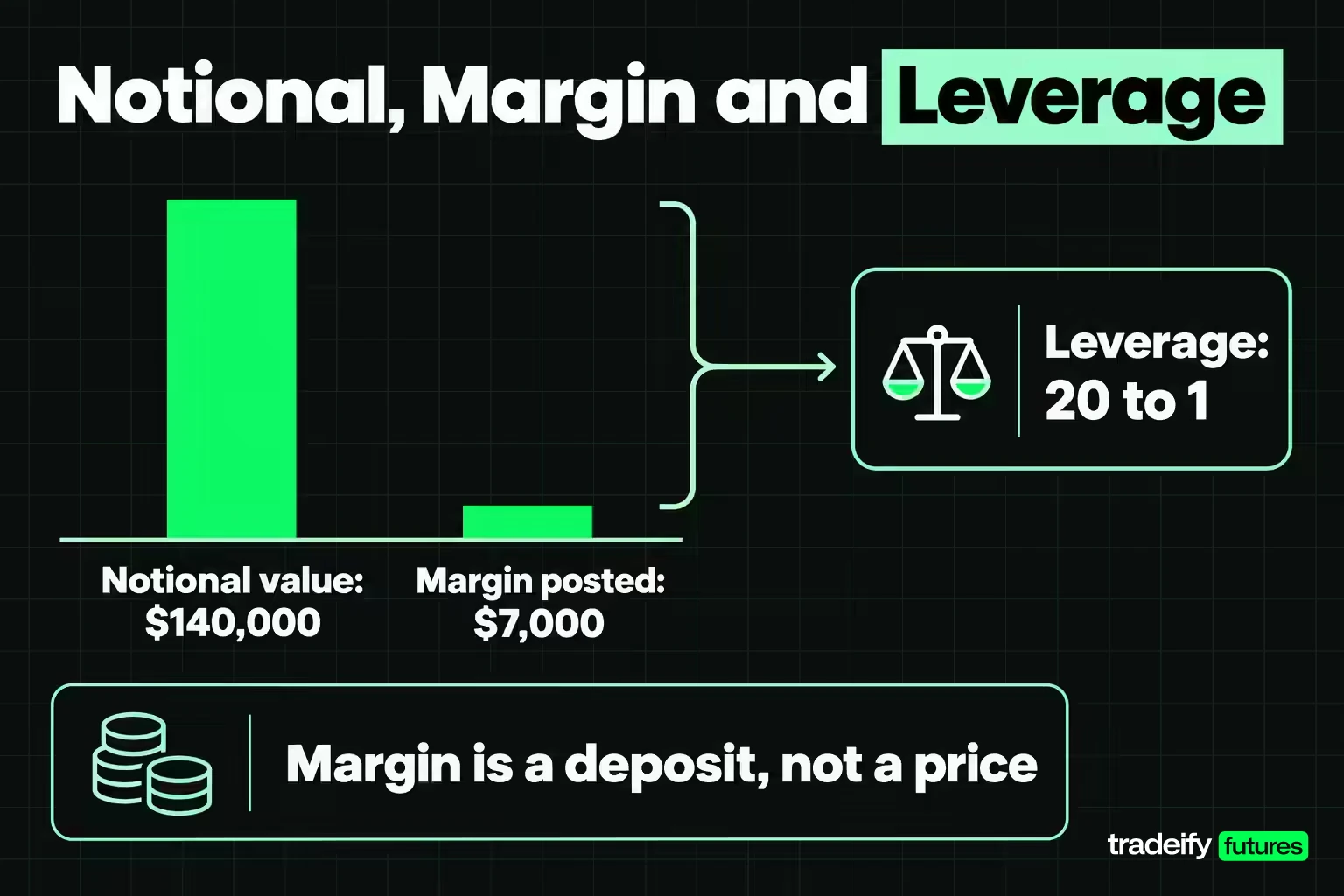
Margin is the collateral a broker or exchange requires you to hold against a position. It is a deposit, not a price, and it is set by the exchange and your broker, so it changes and differs from one account to another. Notional value is the exposure that collateral supports.
Leverage connects the two. Leverage is notional value divided by the margin or capital committed.
Take four MES contracts at 7,000, which carry $140,000 of notional. Assume, for the arithmetic only, that your broker requires $1,750 per contract, or $7,000 in total. That is not a quote. Replace it with your own broker's figure.
- Notional value is $140,000.
- Margin posted is $7,000.
- Leverage is $140,000 divided by $7,000, or 20 to 1.
That ratio is true and nearly useless on its own. It describes the arrangement between you and your broker. It does not say what a bad session costs, because two traders with the same 20 to 1 can risk $200 or $2,000 depending on where their stops sit. A trader who sizes by how much leverage is available has chosen the position before deciding what the position is allowed to do to the account.
Margin also fails as a loss limit. Losing more than the margin posted is possible in futures, especially through a gap or a fast market, and a margin requirement can rise without warning when volatility rises. Treat margin as the entry fee for holding the exposure, never as the ceiling on what the exposure can cost.
Related lesson: Leverage explained
Using Notional Value to Compare Exposure and Size Hedges
Notional value is the best tool available for three jobs: comparing exposure across markets, sizing a hedge, and keeping an honest record of how large your positions really were.
Comparing notional exposure across markets
Contract counts are not comparable across markets. Four MES contracts and twenty MCL contracts sound like very different positions. At an index level of 7,000 and crude at $70, both carry $140,000 of notional, as do two full-size CL contracts. Notional puts them on the same scale.
The comparison also exposes awkward sizes. Matching $140,000 with Micro Gold at $4,000 would take 3.5 contracts, which you cannot hold, so the exposure has to round up or down. Knowing that before entering is better than discovering it in the journal.
Equal notional does not mean equal risk, because crude oil and the S&P 500 move by different amounts on a normal day. If crude is swinging twice as much in percentage terms, the same $140,000 in crude carries roughly twice the day-to-day risk. Notional sets the exposure. Volatility and your stop set what that exposure can cost.
Sizing a hedge with notional value
A hedge offsets exposure, so it is sized on notional. The hedge ratio is the cash exposure divided by the notional value of one contract.
Suppose you want to offset a fixed $350,000 of S&P 500 exposure with MES contracts.
- At 7,000, one MES is $35,000 of notional, so $350,000 divided by $35,000 is exactly 10 contracts.
- At 7,700, one MES is $38,500, so the same $350,000 needs 9.09 contracts.
- Nine contracts cover $346,500, leaving $3,500 (1%) unhedged. Ten contracts cover $385,000, which is $35,000 (10%) too much.
The hedge ratio is a moving target. Because notional changes with price, a count set once and left alone drifts away from the exposure it was meant to match, and rounding is a real decision with a real cost. A hedge of a stock portfolio also needs a beta adjustment if the portfolio does not move one for one with the index.
Related lesson: Hedging risk
Why Notional Value Is Not Your Risk
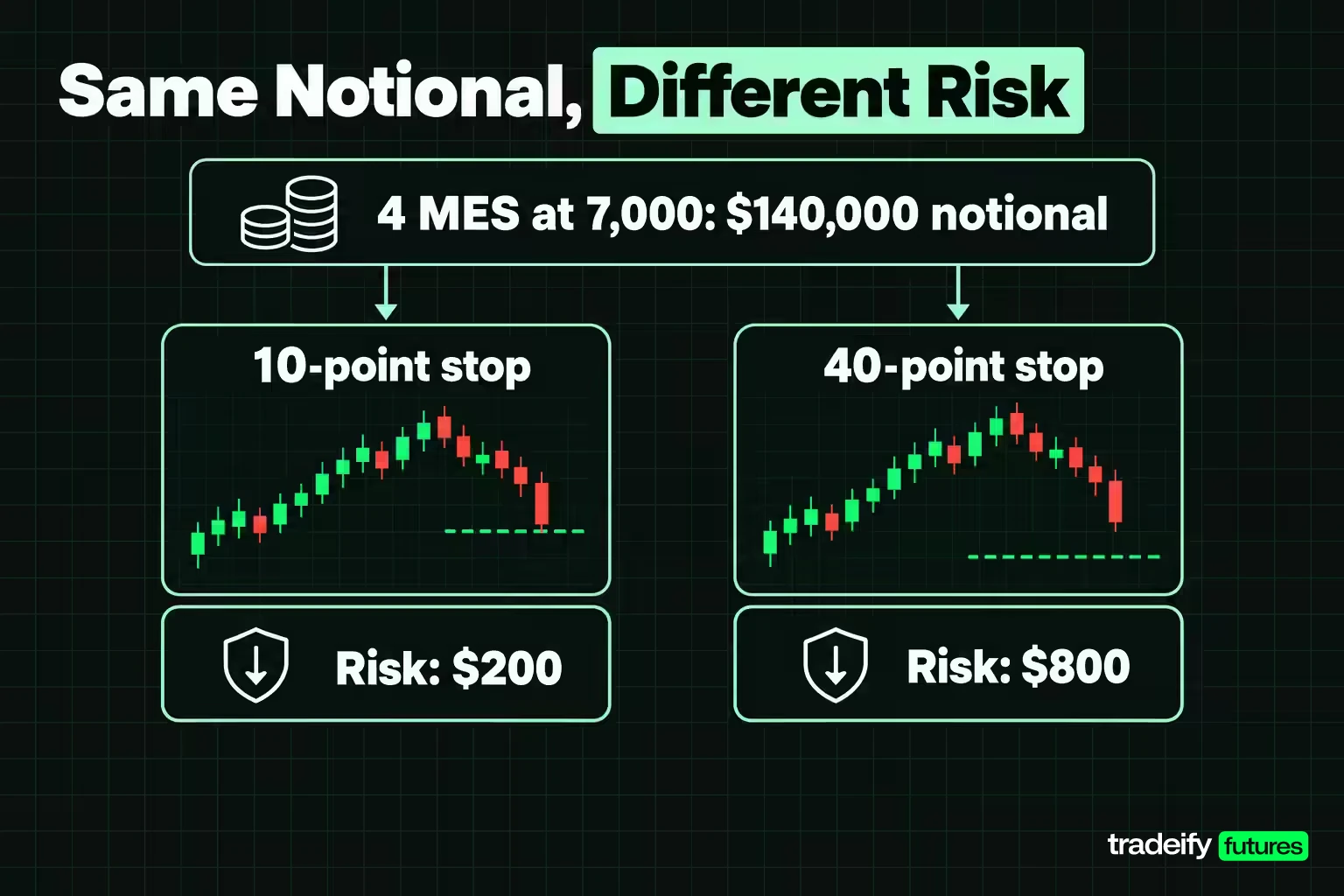
Notional value measures exposure. Risk is what you lose if your exit is hit. The clearest way to see the gap is one position carried through every number.
One position, four different numbers
Four MES contracts are bought at 7,000. The margin row uses the same illustrative $1,750 per contract assumption, not a quote.
| Line | Calculation | Amount |
|---|---|---|
| Notional value | 4 x 7,000 x $5 | $140,000 |
| Assumed margin | 4 x $1,750 | $7,000 |
| Notional to margin | $140,000 / $7,000 | 20 to 1 |
| Risk with a 10-point stop | 10 x $5 x 4 | $200 |
| Notional to risk, tight stop | $140,000 / $200 | 700 to 1 |
| Risk with a 40-point stop | 40 x $5 x 4 | $800 |
| Notional to risk, wide stop | $140,000 / $800 | 175 to 1 |
| A 1% index move | 70 x $5 x 4 | $1,400 |
Read each row as its own question. Exposure is $140,000. Collateral is $7,000. Risk is $200 with a tight stop and $800 with a wide one. A 1% move in the index is worth $1,400, which is 2.8% of a $50,000 account.
The notional never changed across those rows. The risk quadrupled because the stop moved. That is why notional value cannot be read as a risk measure: risk lives in the stop distance, the tick value and the number of contracts.
Three ways notional value misleads traders
Notional value gets misused in three common ways.
- Treating notional as a loss forecast. A trader with no stop on $140,000 of notional is not risking $200. They are risking whatever the market does before they act, and a 10% index move on four MES contracts is $14,000.
- Treating a big notional as automatically dangerous. A large notional with a tight, honored stop can risk less than a small notional with no stop. The size of the exposure and the size of the danger are separate decisions.
- Comparing percentages built on different bases. A $400 gain on the worked position is 0.29% of the notional, 0.8% of a $50,000 account and 200% of the $200 risked. All three are correct. Comparing one trade's percent of notional with another trade's percent of risk is a category error.
The temptation is easy to recognize. After a few good sessions, a trader may add contracts because the account "can handle the margin." The margin was never the question. The stop, multiplied by the new size, is the question, and it is worth answering before the order goes in rather than after the loss.
Related lesson: Maximum risk per trade
A Notional Value Check Before You Size Up
A notional value check takes a few minutes with a calculator and the contract specification open. Run it before any position that is larger than your usual size or in a market you do not trade every day.
- Write down the contract unit, such as $5 x S&P 500 Index, 100 barrels or 10 troy ounces. If you cannot state it in one line, look it up before sizing anything.
- Multiply the unit by the current price and the number of contracts. That is the notional value of the position.
- Multiply your stop distance by the tick or point value and the number of contracts. That is the dollars at risk.
- Divide notional by dollars at risk. A low ratio means the stop is wide relative to the exposure, and a high ratio means it is tight. Neither is good or bad, but it should be a choice rather than a surprise.
- Divide dollars at risk by your account balance. That percentage is the number your risk rules are written in.
- If you are hedging, recalculate the contract count from today's price instead of reusing last week's.
One habit makes this stick. For your next twenty trades, record notional value, dollars at risk and percent of account in the same journal row. Twenty rows is a small sample, but it is usually enough to spot a pattern, such as stops that quietly widen on the markets with the largest notional.
Notional value and contract limits on funded accounts
On our accounts, position size is capped by contract limits rather than a margin figure: a 50K account can hold up to 4 minis or 40 micros, with 10 micros counting as 1 mini. Four ES contracts at an illustrative 7,000 would be $1,400,000 of notional, while a 50K Growth funded account has a $2,000 trailing drawdown, so the stop and the size, not the notional, decide whether a bad trade ends the account. Our funded accounts are simulated, and all positions are closed by 4:45 PM ET each day.
Related lesson: Position sizing
Notional Value FAQ
What does the term notional mean in finance?
Notional means a reference amount rather than money that changes hands. A swap's notional principal is the base the interest payments are calculated on, and it is never exchanged. A futures contract's notional is the full value of the underlying it controls, while you only post margin.
What is an example of notional value?
One E-mini S&P 500 contract with the index at an illustrative 7,000 has a notional value of 7,000 x $50, which is $350,000. One Micro E-mini S&P 500 contract at the same level is $35,000. One crude oil contract (CL) at $70 is 1,000 barrels x $70, or $70,000.
What is the difference between notional and actual value?
Notional is the base a contract is written against. Actual value is the money that really moves. In a $1,000,000 swap where one side pays 4% and the other 3.5%, only the $5,000 difference is paid. In futures, the actual amount is your profit or loss.
Does a higher notional value mean more risk?
Not by itself. Notional measures exposure, while risk is your stop distance times tick value times position size. Four MES contracts carry $140,000 of notional whether the stop risks $200 or $800.
Is notional value the same as leverage?
No. Leverage is notional value divided by the margin or capital committed. $140,000 of notional on $7,000 of margin is 20 to 1. The ratio shows exposure per dollar of collateral, not what the position can lose.
Why does notional value change during the day?
Notional is calculated from the current price, so it moves whenever the market does. Four MES contracts are $140,000 of notional at 7,000 and $154,000 at 7,700. That drift is why hedge counts need recalculating.
This page is educational and not financial advice. Futures, options, forex and crypto derivatives are leveraged, and losses can exceed the margin you post and happen faster than expected. All prices, margins and contract values above are illustrative examples, contract specifications can change, and funded or practice accounts are simulated trading accounts, not live brokerage accounts.


