



TL;DR: Long vs short positions come down to direction: a long profits when price rises, and a short profits when price falls. A stock short sells borrowed shares, needs 150% Regulation T margin, and pays borrow interest and dividends. A long can lose at most its full value, while a short has no price ceiling, and that tail is the real difference. In futures you sell to open with no borrow, and one MES contract is $5 per point long or short.
Every trade starts with one question before entry, stop or size: do you want price to go up or down? Answer "up" and you go long. Answer "down" and you go short.
That much fits in a sentence. The part that costs traders money is everything that follows, because long and short positions look like mirror images on a chart and behave differently in an account. One side has a floor under its worst loss and the other does not. One side can run up borrow fees and dividend bills while it sits open. Under the standard US margin minimums, a stock long bought on 50% margin can take about a 33% drop before a margin call, while a stock short gets about a 15% rise.
This guide builds both directions from the ground up: what each position is, how you open and close it in stocks and in futures, worked examples using the actual margin rules, where the risk really differs, and how traders pair the two to hedge.
What Long and Short Positions Mean
A long position is a bet that price will rise. A short position is a bet that price will fall. Traders call a long view bullish and a short view bearish.
The US Securities and Exchange Commission's investor site, Investor.gov, puts it plainly. Having a long position in a security means you own it, and you hold it expecting the price to rise. A short position is generally the sale of a stock you do not own, made by someone who expects the price to fall.
In futures the language is about which side of a contract you hold. The CFTC Glossary defines a long as one who has bought a futures contract to establish a position, and a short as the selling side of an open futures contract.
So "going long" means buying first and selling later. "Going short" means selling first and buying later. Both trades end the same way: you close the position by doing the opposite of what opened it.
The simplest way to explain long and short to someone new is this. A long trader wants to buy something now and sell it for more later. A short trader wants to sell something now and buy it back for less later. The profit in both cases is the gap between the two prices; only the order of the steps changes.
What a Long Position Is
A long position means you hold exposure that gains value when price rises. In a stock account, that usually means outright ownership. Buy 100 shares and you are long 100 shares, with any dividends the company pays and, for common stock, shareholder voting rights.
Long is the default direction for most people. A retirement account full of index funds is a long position in hundreds of companies. Someone who buys gold coins is long gold. A business holding inventory is long whatever that inventory is worth, which is the third meaning in the CFTC Glossary's definition of "long": one who owns an inventory of commodities.
What a long position gives you, before any margin is involved:
- A known worst case. The most a cash long can lose is its full purchase value, because price cannot fall under zero.
- No built-in time limit. A fully paid stock position can be held indefinitely. Nobody can recall shares you own.
- No carrying charge on a cash purchase. You pay commissions and spread to get in and out, but a fully paid long does not accrue interest.
How going long works in stocks and futures
In a stock account, going long is a buy order. You choose a market order to buy at the current offer or a limit order to buy at your price or better. Once filled and settled, the shares are yours. You close the position with a sell order for the same quantity.
You can also go long on margin, which means borrowing part of the purchase price from your broker. Under the Federal Reserve's Regulation T, the initial requirement for a margin equity security held long is 50% of its current market value. FINRA Rule 4210 then sets a minimum maintenance level of 25% of current market value for long margin securities, and brokers may set higher house levels. A margined long still profits when price rises, but now it can trigger a margin call before price gets anywhere near zero.
In futures, going long means buying a contract to open. You are not buying the underlying asset. You are taking the buy side of a standardized agreement whose value moves with the underlying. One Micro E-mini S&P 500 (MES) contract, for example, is worth $5 for every point the S&P 500 index moves, so a long MES position gains $5 per point the index rises and loses $5 per point it falls. You close it by selling the same contract.
Related lesson: How futures contracts work
What a Short Position Is
A short position means you hold exposure that gains value when price falls. How you get that exposure depends on the instrument, and the difference matters more here than anywhere else in this topic.
In stocks, a short sale is the sale of shares you do not own. Investor.gov describes it as a sale settled by delivering a borrowed security. Your broker lends you the shares, you sell them at today's price, and later you close the position by buying the same number of shares in the open market and returning them to the lender.
Where do the borrowed shares come from? Investor.gov lists three sources: the broker's own inventory, the margin account of another of the broker's customers, or another lender. That is why a stock short can only exist in a margin account, and why it comes with obligations a long never has:
- Interest on the stock loan. Investor.gov notes that short sellers are subject to margin rules and that other fees may apply, including interest on the stock loan.
- Dividends owed. If the borrowed stock pays a dividend while you are short, you pay that dividend to the lender. The company pays its shareholder; you make the lender whole.
- Recall risk. The lender can ask for the shares back. If your broker cannot find replacements, you may have to buy the stock back early, at whatever price the market offers.
Short selling is not only speculation. Investor.gov notes that market makers short stock to supply liquidity when buyers arrive unexpectedly, and that investors use shorts to hedge a long position in the same or a related security.
Short positions in futures
In futures, a short position is simpler. You sell a contract to open. Nothing is borrowed, because a futures contract is an agreement rather than a share that exists in limited supply. The CFTC Glossary defines short selling as selling a futures contract or other instrument with the idea of delivering on it or offsetting it at a later date. A short MES position gains $5 per index point the S&P 500 falls and loses $5 per point it rises.
Related lesson: Short selling mechanics
How a Short Position Reverses Buy Low Sell High
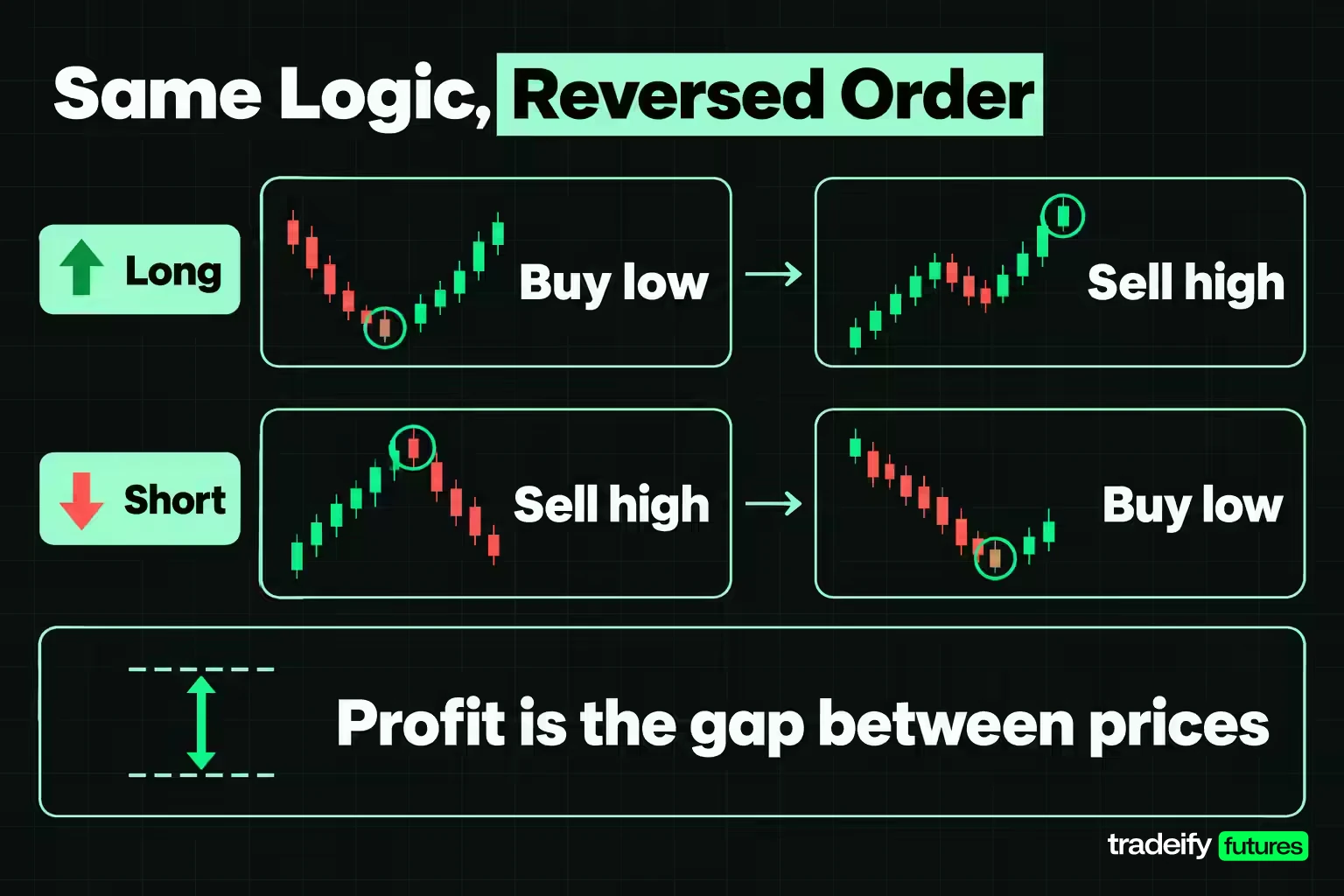
"Buy low, sell high" is the oldest line in trading, and it is the entire logic of a long position. You buy at one price, sell at a higher one, and keep the difference.
A short position runs the same logic in reverse order: sell high, then buy low. The profit is still the gap between a higher sale price and a lower purchase price. The only thing that changes is which transaction happens first.
Put the two side by side with illustrative round prices:
- Long: buy 100 shares at $40, sell them at $46. Sale proceeds $4,600 minus cost $4,000 equals a $600 gain.
- Short: sell 100 borrowed shares at $50, buy them back at $44. Sale proceeds $5,000 minus buyback cost $4,400 equals a $600 gain.
Same profit, same arithmetic. That symmetry is where most explanations stop, and it is only half the story.
The reversal does change how the trade feels and where it can go wrong. A long trader's loss grows as price falls toward zero, and the falling price also shrinks the position. A short trader's loss grows as price rises, and the rising price makes the position larger. A short that started as $5,000 of borrowed stock becomes $6,500 of stock you owe if the price climbs to $65, so the position gets heavier exactly when it is hurting you.
That is the first practical lesson of shorting. Sell high, buy low works exactly like buy low, sell high on paper. In an account, a losing short grows while you hold it, and a losing long shrinks.
How to Open and Close a Short Position
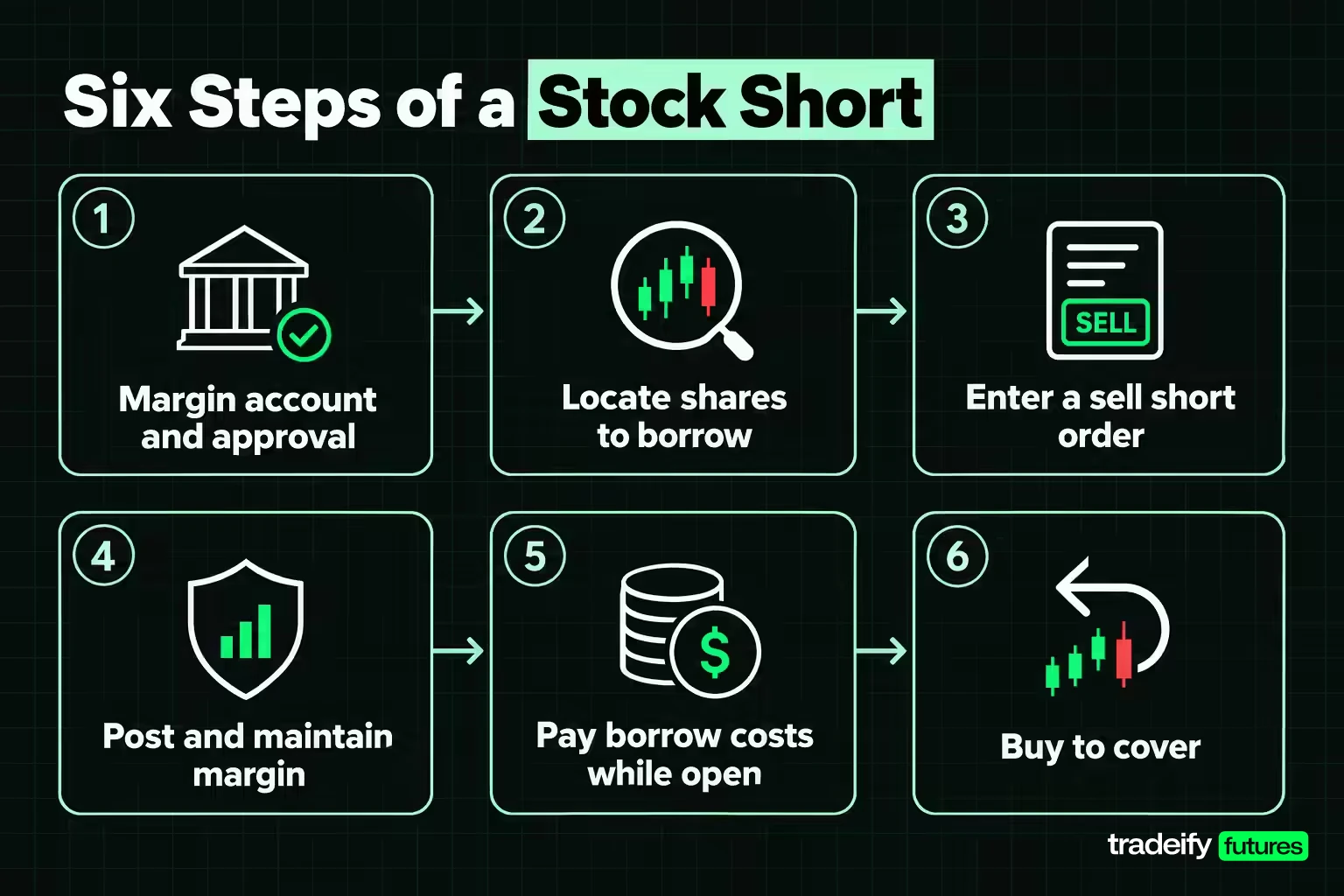
Opening and closing a short position in stocks takes more steps than a long, and several of them are set by regulation rather than by your broker. In order:
- Open a margin account and get approved for short selling. A short sale requires borrowed shares, so it cannot happen in a cash account.
- Locate shares to borrow. Your broker must have the stock available or reasonable grounds to believe it can borrow it.
- Enter a sell short order. It is marked short, not long, so your broker knows to borrow rather than sell shares you own.
- Post and maintain margin. The sale proceeds stay in your account as collateral, plus your own deposit, and the requirement moves with the stock price.
- Pay carrying costs while open. Stock-loan interest accrues daily, and any dividend paid while you are short is charged to your account.
- Buy to cover. You close by buying the same number of shares, which are returned to the lender. The CFTC Glossary calls this covering, the purchase that offsets a short position.
Short sale rules that shape the position
Two SEC rules under Regulation SHO decide whether and where you can short a stock.
The locate rule. Rule 203(b)(1) says a broker-dealer may not accept a short sale order in an equity security unless it has borrowed the security, entered a bona fide arrangement to borrow it, or has reasonable grounds to believe it can be borrowed for delivery when due, and it must document that. In practice, this is why some stocks show as "hard to borrow" or unavailable to short: the broker cannot meet the locate.
The price test, or circuit breaker. Rule 201 applies once a stock falls 10% or more from the prior day's closing price. From that point, trading centers must prevent a short sale from executing or displaying at or under the current national best bid, for the rest of that day and the following day. With an illustrative prior close of $50.00, the restriction switches on at $45.00. Long sellers can still hit the bid; short sellers have to offer above it and wait for a buyer.
Margin on a short position
Shorts carry a heavier margin requirement than longs from the first minute.
Regulation T sets the initial requirement for a short sale of a nonexempted security at 150% of its current market value. Short 100 shares at an illustrative $50 and the $5,000 of sale proceeds stay in the account, plus a deposit of $2,500, for $7,500 in total. Your equity at entry is $2,500.
FINRA Rule 4210 then sets the maintenance minimum for a stock short trading at $5.00 or more at the greater of $5.00 per share or 30% of current market value. For a stock short under $5.00 it is the greater of $2.50 per share or 100%. Brokers can and often do require more.
Run the numbers on the $50 short. Equity is the $7,500 in the account minus what it would cost to buy the shares back. A margin call arrives when that equity falls under 30% of the shares' market value, which happens once the 100 shares are worth more than $5,769.23. That is a price over $57.69, a rise of roughly 15% from entry, and earlier if your broker's house requirement is above the FINRA minimum.
Investor.gov's description of margin calls applies to both directions: the firm can demand more cash or sell positions without telling you first, it picks which positions to close, and it can change its threshold at any time. On a short, "sell" means buying your shares back at the market, often at the worst moment.
Long vs Short Positions Compared
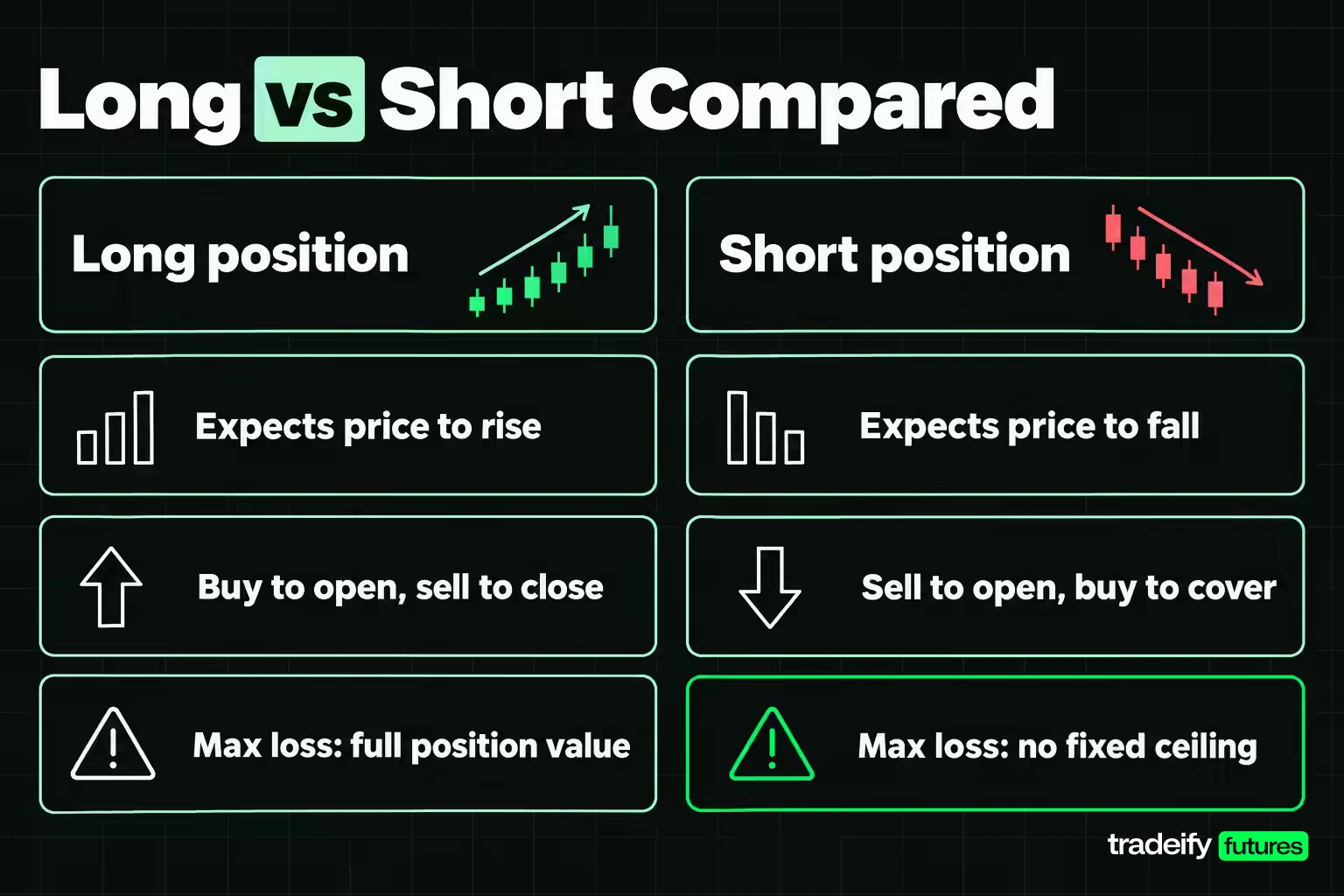
Long and short positions share a goal, profiting from a price move, and differ on almost everything else once you leave the chart. This comparison uses cash equities for the long and short columns, because that is where the two directions diverge most, and notes where futures differ.
| Feature | Long position | Short position |
|---|---|---|
| Market view | Bullish, expects price to rise | Bearish, expects price to fall |
| Order sequence | Buy to open, sell to close | Sell to open, buy to cover |
| Maximum gain | No fixed ceiling | Capped at the entry price if the stock went to zero |
| Maximum loss | The full position value if price goes to zero | No fixed ceiling, because price can keep rising |
| Account needed for stocks | Cash or margin account | Margin account with short approval |
| Initial margin under Regulation T | 50% if bought on margin, none if fully paid | 150% of market value |
| FINRA maintenance minimum | 25% of market value | Greater of $5.00 per share or 30% at $5.00 and up |
| Carrying costs | Margin interest only if borrowed | Stock-loan interest plus any dividends owed |
| Who can end it early | Only you, unless a margin call forces a sale | You, a margin call, or a share recall |
| Regulatory price test | None | Rule 201 restriction after a 10% one-day drop |
| In futures | Buy a contract, no borrow | Sell a contract, no borrow, same margin basis |
The short version of the table: a long position has limited downside and open-ended upside, while a short position has limited upside and open-ended downside. A short's best case is the stock going to zero, which captures the whole entry price and no more. Its worst case has no number.
The futures row is the exception. In a futures account, buying and selling to open use the same contract, the same margin basis and the same dollars per point, so the cost and rule differences in the stock columns largely disappear. The open-ended loss tail on the short side does not.
Long Position Example From Entry to Exit
A worked long trade shows the whole life of the position. The prices are illustrative round numbers, not quotes.
The setup. A trader expects a stock trading at $40 to rise and decides the idea is wrong if price trades at $37. They buy 100 shares at $40, a $4,000 position, and place a stop at $37.
The winning exit. Price rises to $46 and the trader sells. Proceeds are $4,600, so the gain is $600, or 15% on the $4,000 position, before commissions.
The stopped exit. Price instead falls to $37 and the stop sells the shares. The loss is 100 x $3 = $300. A stop order becomes a market order once triggered, so in a fast drop the fill can come in under $37 and the loss can be larger than planned.
The theoretical worst case. If the company fails and the shares go to zero with no stop, the loss is the entire $4,000. That figure is the ceiling on what a fully paid long can lose, and it is known before the trade starts.
The same long on margin. Suppose the trader buys the same 100 shares with 50% Regulation T margin: $2,000 of their own money and $2,000 borrowed. Under FINRA's 25% maintenance minimum, a margin call comes once the shares are worth less than $2,666.67, which is a price under $26.67, or about 33% under the entry. Margin did not change the direction of the trade. It changed how far price can fall before someone else gets a say in when you exit.
The habit worth taking from the long example carries to every trade: decide the exit that proves you wrong before you enter, then convert it to dollars.
Short Position Example From Entry to Cover
The short example uses the same structure so the differences stand out. Prices, borrow rate and dividend are illustrative assumptions.
The setup. A trader expects a stock trading at $50 to fall. Their broker locates shares, and they sell short 100 shares at $50, receiving $5,000. Under Regulation T's 150% requirement, the account holds $7,500: the $5,000 of proceeds plus a $2,500 deposit.
Carrying costs while open. The broker charges an assumed 3% annual borrow rate. Held for 30 days, that is $5,000 x 3% x 30/365 = $12.33. The stock also pays an assumed $0.50 per share dividend during the trade, so the short seller owes the lender $50.
The cover. Price falls to $44 and the trader buys 100 shares to cover. The gross gain is 100 x $6 = $600, or 12% of the $5,000 short. After borrow interest and the dividend, the net is $600 - $12.33 - $50 = $537.67, before commissions.
A comparable fully paid long would not have paid either charge. On a hard-to-borrow stock the annual rate can be many times higher than the assumed 3%, and it can change while you hold the position, which is why short sellers price the carry in before entry rather than after.
When the short position goes wrong
Take the same illustrative short of 100 shares sold at $50, with $7,500 held in the account under Regulation T's 150% requirement, and let price rise instead of fall.
- Price rises to $57.69. Under FINRA's 30% maintenance minimum, the account hits a margin call. The loss is about $769, and the broker can close the position if the trader does not add funds.
- Price rises to $65. The loss is 100 x $15 = $1,500.
- Price rises to $100. The loss is $5,000, the same as the absolute worst case on a $5,000 long.
- Price rises to $150. The loss is $10,000, twice the original position value.
There is no price at which the list stops. That is what "unlimited loss" means in practice: no single number describes the worst case, so the protection has to come from a stop, position size and margin limits rather than from the structure of the trade.
Long vs Short Position Risks
The risk difference between long and short positions is not that shorting is mysteriously more dangerous. It is that the two directions share the same planned risk and very different tails.
The same futures trade run long and short
Futures make this easiest to see, because the costs and rules are the same in both directions. Take one MES setup traded both ways at an illustrative index level of 7,000. MES moves in 0.25-point ticks worth $1.25 each.
| Setup element | Long MES | Short MES |
|---|---|---|
| Entry | 7,000 | 7,000 |
| Stop | 6,988 | 7,012 |
| Target | 7,024 | 6,976 |
| Stop distance | 12 points, 48 ticks | 12 points, 48 ticks |
| Risk per contract | $60 | $60 |
| Reward per contract | $120 | $120 |
| Reward to risk | 2 to 1 | 2 to 1 |
| Risk on 2 contracts | $120 | $120 |
| Reward on 2 contracts | $240 | $240 |
| Notional per contract | $35,000 | $35,000 |
Every planned number matches. If the stop works, a long and a short of the same size lose the same $60 per contract.
Now send each side through a bad session. Suppose price runs 300 points against the position before the trader exits, because a stop was moved, skipped or slipped. That is 1,200 ticks, or $1,500 per contract, 25 times the planned $60. The damage is identical long or short. It comes from size and from abandoning the exit, not from direction.
The difference appears only at the far end. A long MES contract at 7,000 has a theoretical floor: the index cannot go under zero, so the most one contract can lose is its $35,000 notional value. A short MES contract has no equivalent ceiling, because there is no index level above which price becomes impossible. Exchange price limits and halts can pause a move; they do not cap where it ends.
Short squeezes and crowded short positions
A short squeeze is the short side's distinct failure mode. When a heavily shorted stock rises, short sellers buy to cover, that buying pushes price higher, and the higher price forces more short sellers to buy. The SEC staff report on the early 2021 meme-stock episode describes the same loop: buy-to-cover volume raising prices and leading to further buys to cover is often referred to as a short squeeze.
The GameStop (GME) case in that report shows how fast it can move. GME short interest reached 122.97% of float in January 2021, which is possible because the same shares can be lent more than once. The stock closed at a high of $347.51 on January 27, 2021, a more than 1,600% increase from its January 11 close, and hit an intraday high of $483.00 the next day (prices before the company's later stock split).
The same report adds a correction that matters for anyone trading the next squeeze headline. SEC staff concluded that positive sentiment, not buying to cover, sustained the weeks-long rise. A crowded short can be the spark, but it is not the whole fire, and a short seller who assumes the covering will end the move quickly can be wrong for a long time.
The practical rule: before shorting a stock, check how crowded the short side already is and how hard the shares are to borrow. A short that many others already hold has more potential buyers waiting to cover against you.
Margin-call distance in each direction
Long and short stock positions also differ in how quickly margin turns against you. With illustrative prices, a long bought at $40 on 50% margin reaches FINRA's 25% maintenance minimum after about a 33% drop, at $26.67. A Regulation T short at $50 reaches the 30% short minimum after about a 15% rise, at $57.69. The short side gets less room before the broker can act, and its position grows heavier as the move continues.
Managing Risk in Long and Short Trades
Most risk control is the same in both directions. If you already manage a long properly, you have most of the tools a short needs; the extra work is carry, margin and crowding.
Measure risk in dollars, not chart distance. A stop of 12 ticks is not a fixed amount of money. On MES it is $15 (12 x $1.25). On Micro Gold (MGC), where a tick is $0.10 per ounce on 10 ounces, it is $12. On Micro WTI Crude Oil (MCL), with a $0.01 tick on 100 barrels, it is also $12. Convert the stop to dollars before deciding on size.
Size from the stop. Divide the dollars you are willing to lose by the dollar risk per contract or share, and round down. A $250 risk budget against the $60 per contract on the MES example gives 4.17 contracts, so the size is 4 and the actual risk is $240. Rounding up is how a planned loss becomes a larger one.
Stops, volatility and margin in either direction
Place the stop where the idea is wrong, not where the loss feels comfortable. For a long, that is a price under which the reason for buying no longer holds. For a short, it is a price over which the reason for selling no longer holds. Then size so that hitting it costs what you planned.
Respect volatility. A stop that fits a calm week can sit inside normal noise during a busy one. If the range expands, either widen the stop and cut size, or wait.
Know what margin does to your exit. On a margined stock long or any stock short, a margin call can close the position for you. Treat the margin-call price as a level you never want to reach, and keep your own stop well inside it.
Watch overlapping positions. Two longs in closely related markets, or a long and a short that offset each other, change your total exposure even if each trade looks fine alone.
The 3-5-7 rule for long and short trades
The 3-5-7 rule is one informal way traders frame position risk in either direction. In its common form it says risk no more than 3% of the account on one trade, keep total open risk across all positions at or under 5%, and aim for winners at least 7% (some versions treat the 7 as a profit target, others as a win-to-loss size ratio). On a $50,000 account that means $1,500 per trade and $2,500 of total open risk. It is a rule of thumb, not a regulatory or exchange rule, and many traders use smaller per-trade figures. The useful part is the idea underneath it: cap the single trade, cap the total, and make sure the winners can pay for the losers.
Related lesson: Position sizing
Long and Short Positions in Futures and Options
Long and short positions work differently once you leave the stock market, and the derivatives versions remove some of the stock-short complications while adding others.
Futures positions without a borrow
A futures contract is an agreement between two sides, so every open contract has exactly one long and one short. The CFTC Glossary defines open interest as the total number of futures contracts long or short in a market that have been entered into and not yet closed by an offsetting trade or delivery. Each new contract creates a buyer and a seller at the same moment.
That structure removes the stock short's mechanics. There is nothing to borrow, no locate, no stock-loan interest, no dividend owed and no recall. To go short you sell a contract; to cover you buy it back. A short MES position and a long MES position use the same contract, the same $5 per point and the same tick size.
Futures margin also works differently from stock margin. The CFTC Glossary is explicit that futures margin is not partial payment on a purchase; it is a performance bond, collateral posted to guarantee you can cover losses. Both directions post it, because either side can lose. Positions are marked to market daily: at the end of each session the gain or loss on every position is added to or subtracted from the account balance.
What does not change is the tail. A short future still has no price ceiling, and futures losses can exceed the money in the account. The CFTC warns that many retail speculators lose all their money and can owe more than they invested.
Long and short in options
In options, "long" and "short" usually describe which side of the contract you hold, not which way you think the market will move. Buy an option and you are long that option. Sell one to open, which the CFTC Glossary calls being the option writer or grantor, and you are short it.
Direction then depends on the option type as well:
- Long call: bullish. You have the right to buy at the strike.
- Long put: bearish. The CFTC Glossary defines a put as the right, not the obligation, to sell at the strike price.
- Short call: bearish to neutral. You collect the premium and may have to sell the underlying at the strike.
- Short put: bullish to neutral. You collect the premium and may have to buy the underlying at the strike.
This is where new traders most often misread their own exposure. A trader who is "long puts" is positioned for a fall, and a trader who is "short puts" is positioned for a rise.
Related lesson: Long vs short options
Long and short positions in CFDs and swaps
Contracts for difference (CFDs), where brokers offer them, let a trader go long or short on a price change without owning or borrowing the underlying, settled in cash with the broker. Swaps and forwards work on the same principle: one party is long the exposure and the other is short it. In each case the borrow mechanics of a stock short drop away, and the counterparty, margin and financing terms of the specific contract take their place.
When to Go Long or Short
Whether to go long or short is a decision a trading plan should make before the order ticket opens, not one the screen makes for you. The questions are the same in both directions; only the answers point different ways.
Conditions for a long position
Traders typically look for a long when the evidence lines up on the buy side:
- Trend and structure. Price is making higher highs and higher lows, or has broken out of a range to the upside and held.
- Location. The entry sits near a level where buyers have stepped in before, so the stop can sit close under it.
- Context. The broader market or sector is not fighting the trade, and no scheduled event is about to decide the move for you.
- Invalidation. There is a clear price that proves the idea wrong. If you cannot name it, there is no trade yet.
Conditions for a short position
A short needs the mirror-image evidence plus a few extra checks a long does not:
- Trend and structure. Lower highs and lower lows, or a failed breakout that falls back into the range.
- Location. The entry sits near a level where sellers have appeared before, with a stop close over it.
- Carry and crowding. For a stock, check borrow availability, the borrow rate, any upcoming dividend and how heavily shorted the name already is.
- Rules. Check whether Regulation SHO's Rule 201 restriction is already active after a 10% drop, which limits where your short order can execute.
The temptation to watch for runs in both directions. A trader who has been short all week can keep shorting a market that has quietly turned, and a trader who only ever buys can miss that a short was the cleaner read. Being wrong about direction is ordinary, and a stop handles it. Refusing to check the other side is the expensive habit.
Related lesson: Bull vs bear markets
Hedging With Long and Short Positions
Hedging means holding one position to offset the risk of another, and it almost always pairs a long with a short. You give up some potential profit in exchange for a smaller loss if the market moves against your main exposure.
Futures markets were built around this. The CFTC Glossary describes a long hedge, or buying hedge, as buying futures to protect against a possible rise in the cost of a commodity, such as a food processor locking in the price of grain it will need. A short hedge, or selling hedge, is the reverse: a producer sells futures to protect the value of a crop or inventory it already holds. The CFTC contrasts hedgers with speculators, traders who do not hedge and aim to profit from anticipating price moves.
Investors use the same idea. Imagine an investor holding a $35,000 stock portfolio that tracks the S&P 500 closely. One short MES contract at an illustrative 7,000 index level carries $35,000 of notional exposure. If the index drops 2%, or 140 points, the portfolio loses about $700 and the short MES gains 140 x $5 = $700. If the index rises 2%, the gain and loss swap places. The hedge did its job both times: it removed most of the market's effect on the combined position.
Limits of a long and short hedge
A hedge built from long and short positions has limits worth knowing before you build one:
- Imperfect match. A portfolio that does not track the index closely will not be offset dollar for dollar.
- Cost. A hedge reduces gains in good markets as well as losses in bad ones, and it adds commissions and, for stock shorts, carry.
- Same instrument, both directions. In an ordinary brokerage account, being long and short the same instrument at once mostly cancels out while you pay both sides' costs, so it is rarely useful.
Hedging rules in funded trading accounts
Some trading programs ban hedging outright, so the long and short pairing that works at a broker can be a rule breach elsewhere.
On our accounts, hedging is not allowed. Opposing positions on the same instrument, or on two products from the same Product Group, are a violation whether they sit in one account or across several of your accounts. ES, MES, NQ and the other equity index futures share one group, so long ES and short NQ counts as a hedge, as does a mini on one side and a micro on the other. We also do not offer cash stocks or options, and every position is closed by 4:45 PM ET, so the borrow, dividend and recall mechanics of a stock short never come up; you simply buy or sell the futures contract within the session.
Common Mistakes With Long and Short Positions
Most errors with long and short positions come from assuming the two directions behave identically, or from treating a label as a market view.
| Mistake | What it looks like | Correction |
|---|---|---|
| Assuming full symmetry | Treating a short as the same trade with the arrow flipped | Planned risk can match, but the loss tail, carry and margin differ |
| Ignoring carry on a stock short | Holding a short for weeks without counting borrow interest and dividends | Price the carry in before entry or shorten the hold |
| Shorting without a locate | Expecting a sell short order to fill on a hard-to-borrow stock | Check borrow availability and the rate first |
| Forgetting the price test | Placing a short at the bid after a stock has fallen 10% in a day | Rule 201 blocks it; the order must sit over the best bid |
| Misreading options labels | Thinking a short put is a bearish position | Ask whether you bought or sold, and whether it is a call or a put |
| Treating notional as risk | Thinking one MES contract at 7,000 means $35,000 at stake on every trade | Risk is size times stop distance; notional is the full exposure |
| Letting margin set the exit | Waiting for a margin call to end a losing trade | Keep your own stop well inside the margin-call price |
| Doubling down on a losing short | Adding to a short as price rises because it now looks "more overvalued" | A rising price makes a short larger; cut, do not add |
Before any short, write down two things: what the position costs to hold, and what you will do if price rises to your stop. If you cannot state both, the trade is not ready.
Long vs Short Positions FAQ
What is the difference between taking a long position and a short position in trading?
A long position profits when price rises, and a short position profits when price falls. A long buys first and sells later; a short sells first and buys back later. In stocks, a short also requires borrowed shares, margin and carrying costs, and its potential loss has no fixed ceiling.
How to explain long and short?
Going long means buying something now to sell it for more later. Going short means selling something now to buy it back for less later. Both profit from the gap between two prices, just in opposite order.
What is the 3-5-7 rule in trading?
The 3-5-7 rule is an informal risk guideline: risk no more than 3% of the account per trade, keep total open risk at or under 5%, and aim for winners at least 7%. It is not an official rule, versions differ, and many traders use smaller per-trade risk.
What does going long or going short mean?
Going long means opening a position that gains if price rises, usually by buying. Going short means opening a position that gains if price falls, by selling borrowed shares or selling a futures contract to open. You close a long by selling and a short by buying to cover.
Is shorting riskier than going long?
In one specific sense, yes. A long can lose at most its full value, while a short has no price ceiling, and stock shorts add borrow costs, dividends and recall risk. With a working stop and proper size, though, a short can risk the same planned amount as a long.
How long can you hold a short position?
A stock short has no fixed time limit, but it lasts only as long as the shares stay borrowable and your margin holds. The lender can recall the shares, and interest accrues the whole time. A futures short lasts until the contract expires unless you close or roll it.
Can you be long and short at the same time?
At a typical broker, yes, and on different instruments it is ordinary, such as long one stock and short another. Long and short the same instrument mostly cancels out while you pay both sides' costs. Some trading programs prohibit opposing positions in related products altogether.
A Long and Short Position Checklist
Before your next trade in either direction, write down five numbers or statements:
- Direction and reason. Long or short, and the one-sentence reason.
- Invalidation price. The level that proves the idea wrong.
- Dollar risk. Stop distance converted to dollars per share or per contract, times your size.
- Worst case. For a long, the loss if price went to zero. For a short, the plain statement that there is no ceiling, and the stop that is standing in for one.
- Carry and rules. For a stock short, the borrow rate, any dividend due and whether Rule 201 is active. For futures, the contract month and session times.
Then take one setup you would normally trade long and write it out as a short on paper, or the reverse. Running the numbers on the side you use less often is the quickest way to find where your understanding of long and short positions is thin.
This article is educational and is not financial advice or a recommendation to buy or sell any instrument. Trading stocks, futures and options involves substantial risk. Short positions can lose more than their initial value, and leveraged futures losses can exceed the money in your account. Evaluation and funded trading accounts are simulated, and simulated results do not predict live results. All prices in the examples are illustrative round numbers, not quotes.


