




TL;DR: Micro futures are smaller copies of standard contracts that track the same price, usually at one tenth the size. One MES pays $5 per S&P 500 point, while one E-mini (ES) pays $50, so ten micros equal one mini. Choose the size that lets your stop sit where the market needs it without breaking your risk budget. Micros fix size, not leverage, and they cost more in fees per dollar of exposure.
What Micro Futures Are
Most traders find micro futures the same way: the setup is right, the stop it needs is wide, and one standard contract would risk more than the account should lose on one idea. A micro futures contract is an exchange-listed futures contract on the same underlying as a larger contract, with a smaller multiplier. The multiplier is the dollar value of one full point of the underlying. Shrink the multiplier and every tick, every stop and every profit shrinks with it.
Everything else about the product works the same way. A micro has its own symbol and its own order book, but it tracks the same index or commodity, follows the same kind of contract months and is cleared by the same clearing house as its larger sibling.
CME Group listed the first four micro equity index contracts on May 6, 2019: the Micro E-mini S&P 500 (MES), Micro E-mini Nasdaq-100 (MNQ), Micro E-mini Dow (MYM) and Micro E-mini Russell 2000 (M2K). Each has a multiplier 1/10 the size of its E-mini counterpart. CME's stated reason was simple: the E-mini S&P 500 had grown from a notional value of about $47,000 when it launched in 1997 to about $145,000 by April 22, 2019, and that size had become a barrier for many individual traders.
Micro contracts now exist across equity index, energy, metals, currencies, grains and crypto. The real decision micro futures put in front of you is not which market to trade. It is how much of that market one contract should represent.
Related lesson: What each field on a contract specification means
Micro Futures vs E-mini Futures
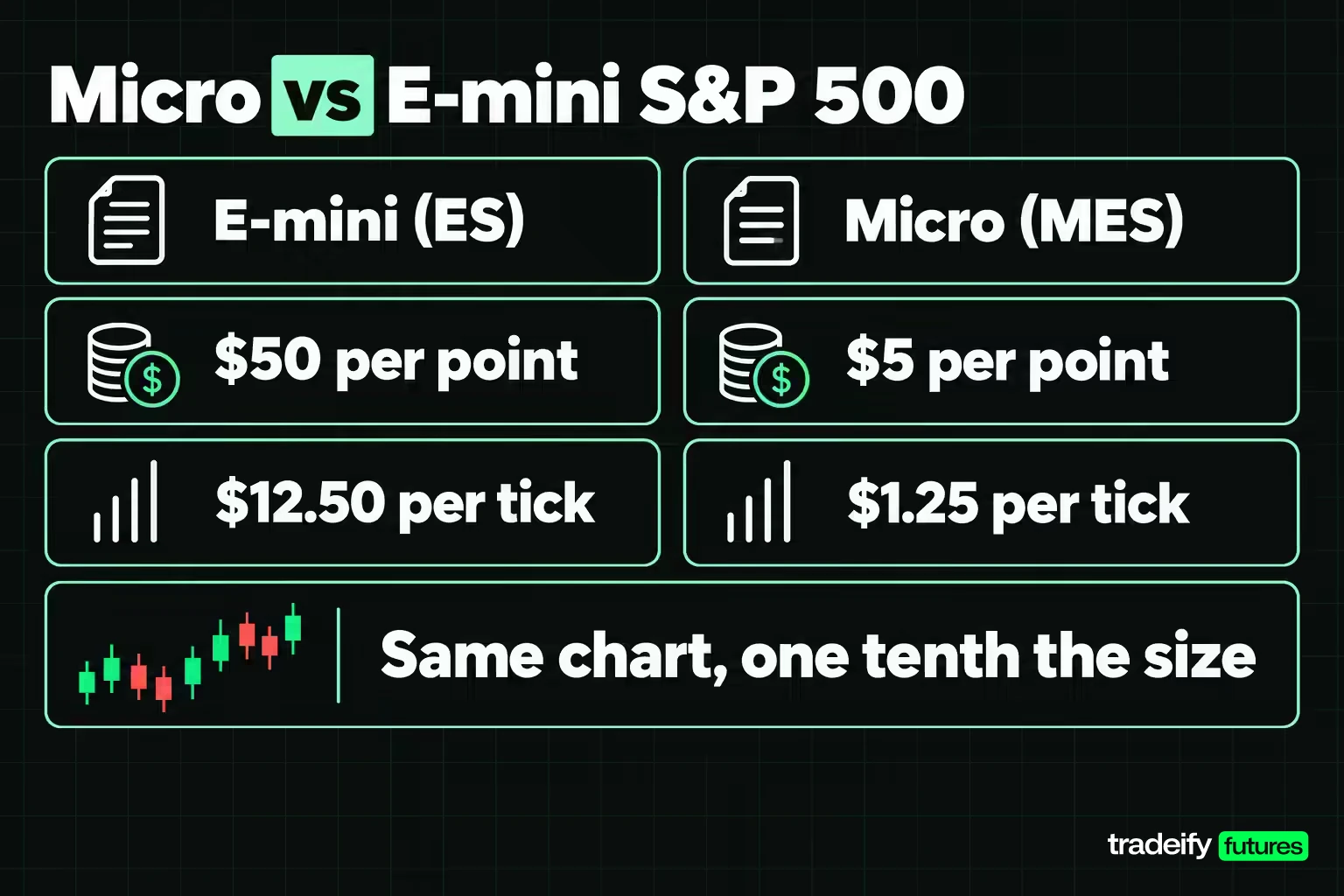
On the exchange, the standard-size equity index contracts are called E-minis (ES, NQ, YM and RTY), and the one-tenth versions are Micro E-minis (MES, MNQ, MYM and M2K). When traders say "minis" they almost always mean the E-minis. When they say "micros" they mean the Micro E-minis.
So mini futures and micro futures are two sizes of the same market. A chart, a level or a written plan built on one works on the other. Only the dollar value per point changes.
| Index | E-mini symbol | E-mini per point | E-mini tick value | Micro symbol | Micro per point | Micro tick value |
|---|---|---|---|---|---|---|
| S&P 500 | ES | $50 | 0.25 point = $12.50 | MES | $5 | 0.25 point = $1.25 |
| Nasdaq-100 | NQ | $20 | 0.25 point = $5.00 | MNQ | $2 | 0.25 point = $0.50 |
| Dow Jones Industrial Average | YM | $5 | 1.00 point = $5.00 | MYM | $0.50 | 1.0 point = $0.50 |
| Russell 2000 | RTY | $50 | 0.10 point = $5.00 | M2K | $5 | 0.10 point = $0.50 |
All eight contracts are financially settled, list quarterly in March, June, September and December, and stop trading at 9:30 AM ET on the third Friday of the contract month, per CME's contract specifications.
A micro vs mini example at an illustrative 7,000
Take an illustrative S&P 500 futures price of 7,000 (a round number, not a quote).
- One ES controls $350,000 of index exposure (7,000 x $50).
- One MES controls $35,000 (7,000 x $5).
- A 20-point move is worth $1,000 on one ES and $100 on one MES.
Ten MES equal one ES exactly, because 10 x $5 is $50. That ratio is the conversion you use most: five ES is the same exposure as 50 MES.
When one E-mini beats ten micro futures
The mini is the better tool once your normal size is a round multiple of ten micros. At that point ten micros only add order tickets and per-contract fees. The micro earns its place when your stop, your budget or your plan needs a size between zero and one mini, or between one mini and two.
The E-nano rung below the micro
CME added a third rung in 2026. Its listing notice SER-9789R put the E-nano S&P 500 (NES), E-nano Nasdaq-100 (NNQ), E-nano Russell 2000 (N2K) and E-nano Dow (NDOW) on CME Globex from trade date August 24, 2026. NES has a $0.50 multiplier, one tenth of MES, with a minimum tick of 0.50 points worth $0.25. At the illustrative 7,000, one NES controls $3,500 and a 20-point move is worth $10.
Contract Specifications for the Main Micro Contracts
Outside the equity index family, the micro is usually one tenth of the standard contract, but not always, and the settlement method does not always match. The table below compares the micros most traders meet first with their standard contracts, using CME's published specifications.
| Market | Micro contract | Micro unit and tick | Standard contract | Standard unit and tick | Size ratio | Settlement (micro vs standard) |
|---|---|---|---|---|---|---|
| WTI crude oil | MCL | 100 barrels, 0.01 = $1.00 | CL | 1,000 barrels, 0.01 = $10.00 | One tenth | Financial vs physical delivery |
| Gold | MGC | 10 troy ounces, 0.10 = $1.00 | GC | 100 troy ounces, 0.10 = $10.00 | One tenth | Both deliverable |
| Silver | SIL | 1,000 troy ounces, 0.005 = $5.00 | SI | 5,000 troy ounces, 0.005 = $25.00 | One fifth | Both deliverable |
| Copper | MHG | 2,500 pounds, 0.0005 = $1.25 | HG | 25,000 pounds, 0.0005 = $12.50 | One tenth | Financial vs physical delivery |
| Euro FX | M6E | 12,500 euros, 0.0001 = $1.25 | 6E | 125,000 euro, 0.00005 = $6.25 | One tenth | Both deliverable |
Where micro contracts are not one tenth
The one-tenth rule is a habit, not a law, and three micro contracts break it in ways that catch traders out.
- Micro Silver is one fifth. SIL is 1,000 ounces against 5,000 for SI, so a $0.50 silver move is $500 on one SIL and $2,500 on one SI. A "micro" can still carry a heavier tick than another market's standard contract.
- Micro Euro FX has a coarser tick. On CME Globex, 6E trades in 0.00005 steps worth $6.25, while M6E trades in 0.0001 steps worth $1.25. The micro's tick is twice as wide in price. A 0.0010 move is $12.50 on M6E and $125.00 on 6E, so the one-tenth rule holds for size but not for tick count.
- Settlement can differ. MCL and MHG are financially settled while CL and HG are physically delivered, so the micro and the standard contract are separate products that cannot be offset against each other.
The habit worth building is reading the contract unit and the tick value off the specification page for every new micro. Treat the word "micro" as a naming convention, not a size guarantee.
Micro futures trading hours and expiry
Most micros trade nearly around the clock on CME Globex. The equity index micros run from Sunday 6:00 PM to Friday 5:00 PM ET with a daily maintenance break from 5:00 PM to 6:00 PM ET. MCL and MGC trade Sunday to Friday from 6:00 PM to 5:00 PM ET with a 60-minute break starting at 5:00 PM ET.
Expiry follows each product's own calendar. The index micros expire quarterly on the third Friday, while MCL stops trading one business day before the matching CL contract and MGC on the third last business day of the contract month. Check the product calendar before you trade a contract close to expiry.
Related lesson: Converting ticks and points into a dollar result
Leverage and Dollar Risk on a Micro Contract
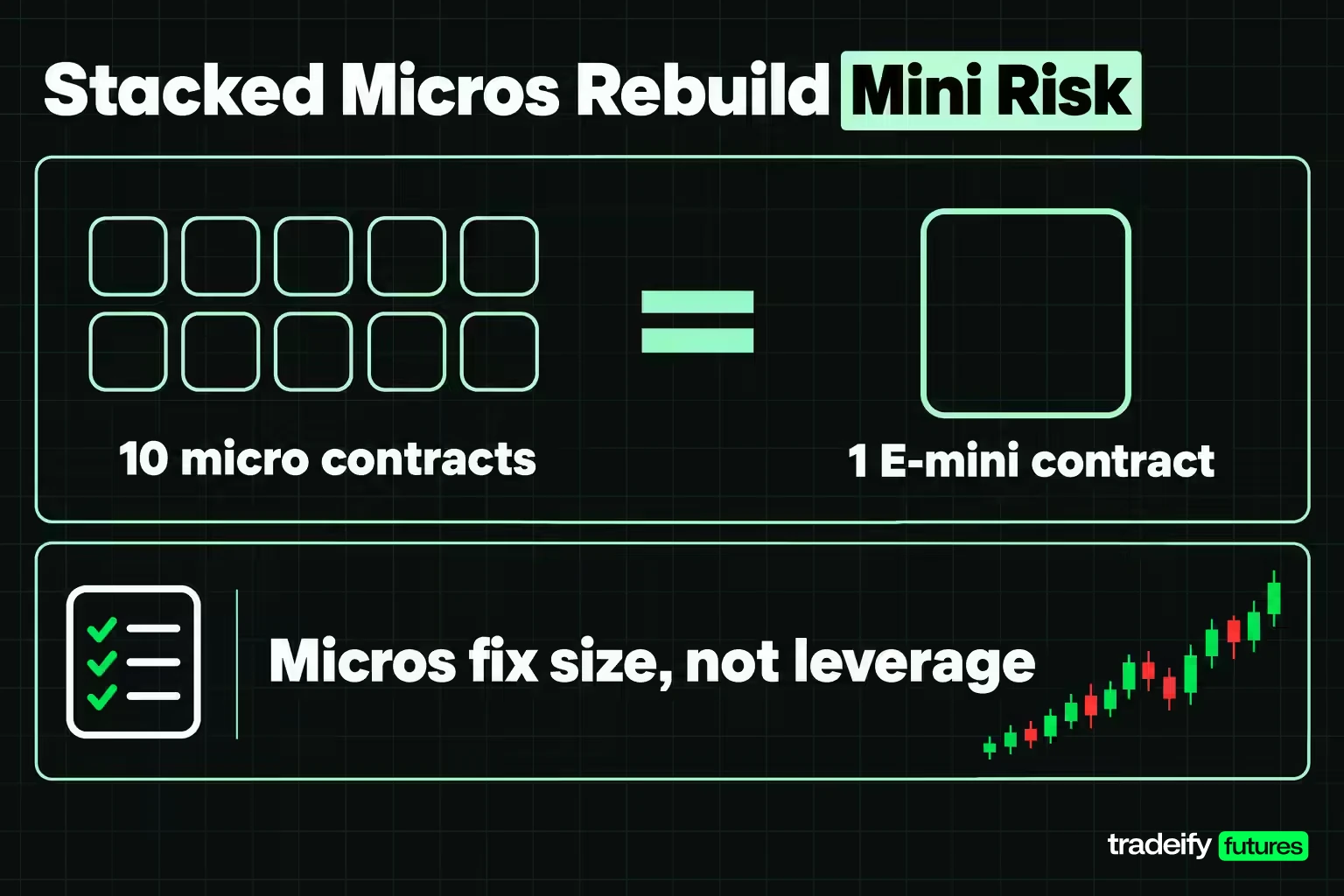
A micro contract does not reduce leverage. It reduces the size of the bet, and that difference matters as soon as the small size starts to feel safe. Per dollar of exposure, one MES carries exactly the same leverage as one ES, because margin and notional value both shrink by roughly the same factor.
Leverage in futures is notional value divided by the money backing the position. Using an illustrative margin of $2,000 on one MES at 7,000:
- Notional value is $35,000, so the position is 17.5 to 1 leverage on that margin.
- A 1% index move is 70 points, worth $350 on one MES.
- That $350 is 17.5% of the $2,000 margin.
How stacking micros rebuilds mini-sized risk
The protection a micro offers disappears the moment you buy more of them. Small tick values make five or ten contracts feel harmless, and that is exactly how a micro account ends up carrying mini-sized risk. Imagine a trader with an illustrative $20,000 account who holds four MES at 7,000. That is $140,000 of notional exposure, seven times the account. A 2% index move against the position (140 points) costs $2,800, which is 14% of the account in one move.
The fix is to size from the stop, not from the margin you can post. Decide the dollar loss you accept, measure the stop distance the setup needs, then divide. A 20-point stop on MES risks $100 per contract, so a $500 budget buys five contracts, and the same stop on ES risks $1,000, so it buys none.
Micro Futures Margin Requirements
Margin on micro futures is a good-faith deposit, not a down payment. CME describes futures margin as money you keep with your broker while the position is open, and says you do not own the underlying. It typically runs 3-12% of the contract's notional value, against up to 50% for stocks bought on margin.
There are three numbers to keep apart.
- Exchange initial and maintenance margin. CME Clearing sets these, and they change with volatility.
- Broker margin. Brokers can require more than the exchange minimum, and some set their own lower day-trading margins for positions closed before the session ends.
- Your actual risk. That is the stop distance times the dollar value per point, and it has nothing to do with the margin number.
As a dated example, CME's maintenance margin for the December 2026 contracts was $2,037 for Micro Gold (MGC) and $20,365 for Gold (GC) as of November 4, 2026. That is roughly the same 10 to 1 relationship as the contract sizes. Check the live figure on CME's margin page and your broker's site before you trade, because both change without notice.
The trap is treating a low day-trading margin as permission to hold more contracts. It reads like a limit, so it feels like one. A broker may let you open several MES on a small deposit, but the market does not care what you posted. A 70-point S&P 500 move still costs $350 per MES.
Related lesson: What intraday and overnight margins mean
Benefits of Trading Micros and the Catch Behind Each
The case for trading micro futures comes down to four advantages, and each one has a cost attached.
- A stop that respects the market. A micro lets you put the stop where the setup is invalidated and still keep the loss small. The catch is that a small loss per trade can tempt you to take more trades than your plan has.
- Finer sizing. Ten micros per mini means your size can track your budget closely. The catch is more contracts and more per-contract fees.
- Scaling in and out. You can split a position into parts and manage each one. The catch is more decisions per trade, and more room to improvise.
- Cheap practice with real fills. A one-contract MES position with an 8-point stop risks $40, against $400 for the same stop on ES. The catch is that small losses can feel like no losses, which builds habits that break at larger size.
What ten years of S&P 500 ranges say about one contract
The strongest case for micros is that the index grew while the E-mini contract stayed the same size. To show it, this guide ran a simple study on E-mini S&P 500 continuous front-month daily bars from November 1, 2016 to November 4, 2026 (2,517 sessions). For each session it took the 14-session average of the daily high-to-low range, rounded to the 0.25 tick, and treated that as a one-range stop. That gives 2,504 readings. The high-to-low range is used instead of true range so that contract-roll gaps do not inflate the numbers.
| Period | Median one-range stop | Risk on one ES | Risk on one MES | Sessions one ES fit a $1,000 budget | Sessions one MES fit a $1,000 budget |
|---|---|---|---|---|---|
| 2017 | 15.50 points | $775 | $77.50 | 91.2% | 100.0% |
| November 2016 to November 2026 | 54.50 points | $2,725 | $272.50 | 11.4% | 99.1% |
| 2026 to November 4 | 83.25 points | $4,162.50 | $416.25 | 0.0% | 100.0% |
In this guide's study, the median stop in 2026 is 5.4 times the 2017 figure, while the median close rose 3.1 times, from 2,434.50 to 7,446.25. A trader with a $1,000 risk limit could take one E-mini at a one-range stop on 91.2% of sessions in 2017 and on none in 2026. On a $500 budget, one MES still fit on 69.3% of 2026 sessions, and one ES on none.
What the range study means for micro futures sizing
On the most recent session in the S&P 500 range study, November 4, 2026, the close was 7,720.50 and the one-range stop was 105.00 points: $525 on one MES and $5,250 on one ES. Nothing about the contract changed. The market under it did.
Rounding is the second effect the study measured. With a $1,000 budget and whole contracts rounded down, the median share of the budget left unused in 2026 was 22.1% on MES and 100.0% on ES, because ES did not fit at all. The micro does not make sizing exact, but it turns "none" into a usable number.
These are past daily ranges for one instrument, not a forecast, and a one-range stop is one method among many.
Related lesson: Sizing from volatility rather than a fixed stop
Are Micro Futures Good for Beginners
For most new futures traders, micro futures are the sensible first contract, because they make each mistake smaller. They do not make the mistakes less likely, and it helps to be honest with yourself about which of those two problems you have.
What a micro fixes:
- The cost of being wrong while you learn order entry, stops and contract months.
- The jump from a simulator to real fills, since the dollar swings stay small.
- The pressure to tighten a stop just to make one contract affordable.
What a micro does not fix:
- Leverage. Micros carry the same leverage per dollar of exposure as minis.
- Overtrading. Cheap trades are easy to repeat.
- A missing plan. A small loss repeated twenty times a day is still a large loss.
A reasonable starting routine with micro futures is one MES or MNQ contract, one session, a written stop for every trade and a fixed maximum daily loss. Add contracts only after a meaningful sample of trades shows the process holds. If losses at one micro still feel unbearable, going smaller is rarely the answer. Look at the plan or the budget first.
Related lesson: The full beginner path through futures
What You Need to Trade Micro Futures
To trade micro futures with your own money, you need an account at a futures broker (a futures commission merchant or an introducing broker clearing through one) with futures trading approved. Expect to answer questions about income, experience and risk tolerance, sign risk disclosures, and fund the account above the broker's margin for the products you trade.
A few practical points:
- Data. Real-time CME data usually needs a market data agreement, and most retail traders sign as non-professional subscribers. Depth of book often costs extra.
- The pattern day trader rule. It never applied to futures. For stock accounts, FINRA Regulatory Notice 26-10 is replacing the day-trading margin rules, including the $25,000 minimum, with a phase-in that ends October 20, 2027.
Micro futures trading platforms and data feeds
Any platform that connects to a futures broker can usually trade the micro futures that broker carries, but a few settings deserve a check before the first live order.
- The symbol and month. Confirm the platform carries the exact micro (MES, MNQ, MYM, M2K, MCL, MGC or a currency micro) and that the order ticket points at the contract month you mean, not a continuous chart symbol.
- The tick value. Make sure the platform's P&L and risk displays use the micro's dollar value per tick. A platform set up for ES will overstate MES risk tenfold, and the reverse mistake understates it.
- Order types. Bracket orders (a stop and a target attached to the entry) matter more with micros, because scaling out of several contracts means managing several exits.
- Data. Delayed data is fine for study but not for live orders. Check whether your feed is real-time and whether depth of book is included or extra.
- Simulation. Most platforms offer a simulated mode. Use it to confirm the micro's tick value and your order templates before risking real money.
Micro futures tax treatment in the US
In the US, regulated futures contracts, micros included, generally fall under Section 1256 of the Internal Revenue Code. Gains and losses are treated as 60% long-term and 40% short-term regardless of how long you held the position. Open positions are marked to market at year end, and the totals are reported on IRS Form 6781. Rules depend on your situation, so check with a tax professional. This is not tax advice.
Micro Futures Trading Strategies Built on Size
Micro futures do not create new setups. They let you run the setups you already trust with more control over size, which is where most of the edge in using them comes from. Three uses come up most.
Scaling out of a micro futures position
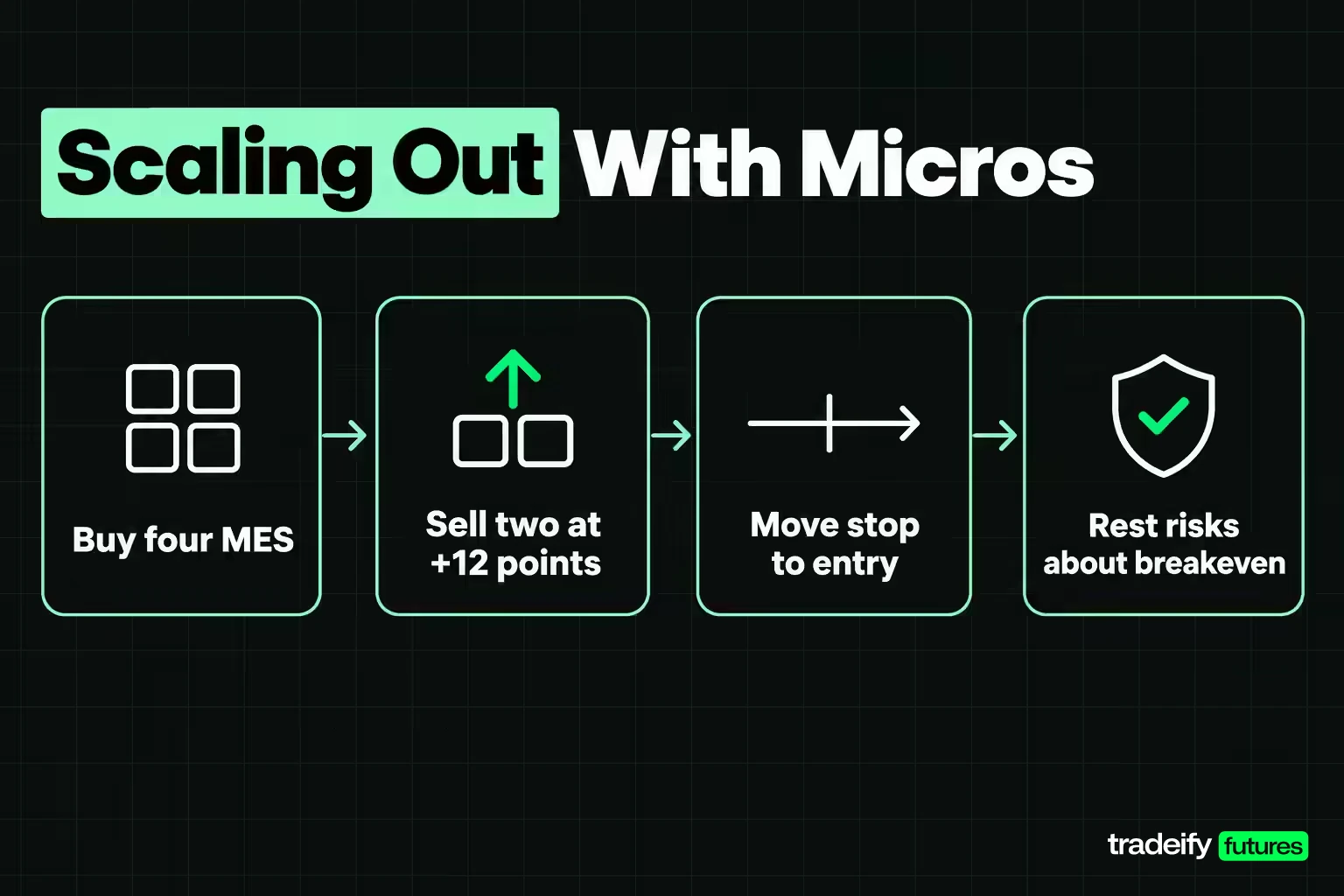
Say you buy four MES with a 12-point stop, risking $240 in total. At +12 points you sell two contracts for $120 and move the stop on the other two to your entry. The worst case on the rest of the trade is now roughly breakeven (slippage aside), with the first half's gain banked. Doing the same on ES needs four contracts and $2,400 of initial risk.
Scaling in and testing size
You can start a position at part size and add only if price confirms the idea, keeping the total within your planned risk. You can also trade a new setup at one micro for a few weeks to measure it with real fills before trusting it with more.
Matching micro futures risk across markets
Micros make it easier to keep risk similar across different products. If a crude oil setup needs a $1 stop, that is $100 on one MCL and $1,000 on one CL. A $10 gold stop is $100 on one MGC and $1,000 on one GC. The micros let both trades carry the same $100 risk.
What micros never change is the setup's quality. A strategy that loses on the mini loses on the micro too, just in smaller pieces.
Related lesson: Scaling a position in and out in steps
Commissions and Fees on Micro Futures
Fees are the quiet cost of trading micro futures, and they rarely show up until you add them across a month. Brokers and exchanges charge per contract, not per dollar of exposure. Ten micros mean ten per-contract charges where one mini means one, so if a micro's all-in fee is more than one tenth of the mini's, the same exposure costs more in micros.
Exchange fees show the pattern. In its E-nano listing notice, CME set the non-member CME Globex exchange fee at $0.35 per contract on a contract one hundredth the size of the E-mini. Fixed per-contract costs barely shrink as contracts get smaller, which is why the smallest sizes cost the most per dollar controlled.
The practical rule follows from that. Use micros for the part of your size that is not a round multiple of ten, and switch to the mini once your normal position reaches ten micros or more. A trader holding 20 MES pays twenty sets of fees for the exposure of two ES.
On our accounts, contract limits are written in minis with 10 micros counted as 1 mini: 1 mini or 10 micros on a 25K, 4 or 40 on a 50K, 8 or 80 on a 100K and 12 or 120 on a 150K, and minis and micros can be held together within that combined limit. Our round-trip commission is $1.82 per MES and $5.76 per ES, so 10 MES cost $18.20 against $5.76 for the one ES they equal. Opposite positions in MES and ES count as prohibited hedging, because both sit in the same Equity Index Product Group.
Micro Futures FAQ
How much margin do you need to trade micro futures?
Exchange margin on micro futures typically runs 3-12% of the contract's notional value, per CME, and it changes with volatility. Some brokers set lower day-trading margins for positions closed the same session. Budget for the stop you will use, not just the margin.
Is there an SPX mini?
Yes, but "SPX mini" usually means an option, not a future: Cboe lists Mini-SPX (XSP) index options at 1/10th the size of standard SPX options. On the futures side, the S&P 500 comes in three sizes: the E-mini (ES), the Micro E-mini (MES) and the E-nano (NES). Both families let a smaller account trade the S&P 500 at a fraction of the standard size.
What is the value of a tick in micro crude oil futures?
One tick on Micro WTI Crude Oil (MCL) is $0.01 per barrel, worth $1.00 per contract. The standard CL contract's same tick is worth $10.00. A $1 move in crude is $100 on one MCL.
What is MES in trading?
MES is the CME Globex symbol for the Micro E-mini S&P 500 futures contract. It pays $5 per S&P 500 index point, with a 0.25-point tick worth $1.25. It is a futures contract, not a stock, though traders often use it to express a view on the S&P 500.
What are gold mini futures?
CME lists E-mini Gold (QO) at 50 troy ounces, half of the 100-ounce GC contract, with a 0.25 tick worth $12.50, financially settled. Micro Gold (MGC) is 10 ounces with a $1.00 tick. A $10 gold move is $1,000 on GC, $500 on QO and $100 on MGC.
Can you hold micro and mini futures at the same time?
Yes, where your broker or account rules allow it, because MES and ES are separate contracts on the same index. The exposures simply add up, so one ES plus five MES is the exposure of 1.5 ES.
Futures are leveraged, and losses can exceed the money in your account. Funded and evaluation accounts at prop firms are simulated and come with their own rules. The S&P 500 range study in this guide describes past sessions and does not predict future moves. This guide is educational and is not investment, tax or financial advice.


