




TL;DR: Realized vs unrealized P&L is the split between profit on closed trades, which is final, and profit on open trades, which can reverse. The formula is (price minus average entry) × size × multiplier, using exit price once realized. For example, 4 MES long at 7,000.00 sat $200 down at 6,990.00, then closed $172 net. Drawdown rules usually read equity, so that $200 open loss counts before you exit. US stock gains are taxed when realized; open futures are marked at year end.
Imagine you are long 4 contracts and the trade is down $200. Twenty minutes later it is up $240, you scale out, and it closes green. On your journal it is a winner. On an account rule measured in real time, it may already have been a breach at the low.
That gap is the whole reason realized and unrealized P&L deserve more than a glossary line. One number is a result. The other is a live measurement that can still change. Your account rules read them differently, so you need to know which one is in charge at every moment of the trade.
Realized vs Unrealized P&L Defined
Realized P&L is the profit or loss on a position you have closed. You bought and then sold, or sold short and then bought back, and the difference between the two prices (minus costs) is booked. No later price move can change it.
Unrealized P&L is the profit or loss on a position that is still open. It is calculated from your entry price against the current market price, and it changes every time that price changes. That is why it is often called a paper gain or paper loss: it exists on the screen, but nothing has been exchanged yet.
An illustrative stock example makes the split concrete. Buy 100 shares at $50.00. If the stock trades at $58.00, you have an unrealized gain of $800. If you sell all 100 shares at $58.00, the $800 becomes realized. If you keep holding and the stock falls back to $50.00, the unrealized gain is gone and you never realized any of it.
The quickest test is one question: does the position still exist? If you are flat, the number is realized. If you still hold any part of the position, that part carries unrealized P&L.
Related lesson: How to read a trade confirmation
Key Differences Between Realized and Unrealized P&L
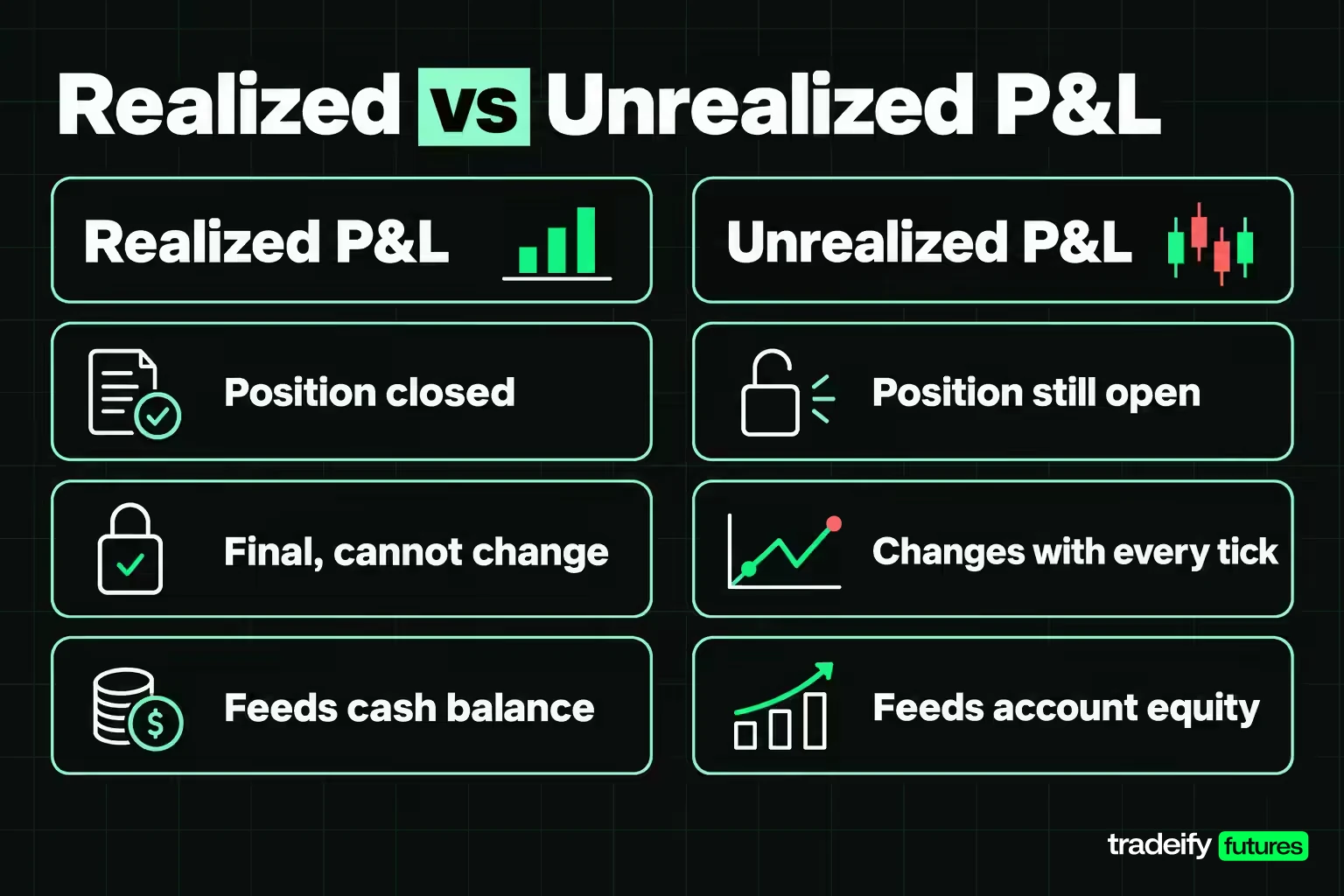
Realized and unrealized P&L describe the same trade at different stages, so most of the differences come down to certainty and timing.
| Feature | Realized P&L | Unrealized P&L |
|---|---|---|
| Position status | Closed | Still open |
| Can it change | No, it is final | Yes, with every price change |
| Common names | Closed P&L, booked P&L | Open P&L, floating P&L, paper P&L |
| Where it shows | Trade history, account balance, statements | Positions panel, account equity |
| Account figure it feeds | Cash balance | Equity or net liquidation value |
| US tax timing for stocks | Generally taxable in the year you sell | Generally not taxed until you sell |
| Best use | Judging whether a plan works, net of costs | Managing the open trade and its risk |
Two details in that table catch people out.
First, equity is balance plus unrealized P&L. When a platform shows "net liquidation value" or "net liquidity", it means what the account would be worth if every open position were closed at the current price. That is the number most risk limits watch.
Second, the tax row has exceptions. Regulated US futures are taxed under a year-end mark-to-market rule, so open futures positions can create taxable gain or loss before you close them, under section 1256 of the US tax code.
How to Calculate Unrealized and Realized P&L
The arithmetic for both numbers is the same. The only difference is which price you plug in: the current price for unrealized P&L, your exit price for realized P&L.
For a long position:
- Unrealized P&L = (current price − average entry price) × quantity × multiplier
- Realized P&L = (exit price − average entry price) × quantity closed × multiplier − commissions and fees
For a short position, reverse the subtraction: (entry price − current or exit price) × quantity × multiplier. The multiplier is 1 for shares and the contract multiplier for futures.
Stock P&L Example With a Partial Exit
Take the same illustrative 100 shares bought at $50.00.
| Step | Action | Realized P&L | Unrealized P&L |
|---|---|---|---|
| 1 | Stock trades at $58.00 | $0 | +$800 (100 × $8.00) |
| 2 | Sell 60 shares at $58.00 | +$480 (60 × $8.00) | +$320 on 40 shares |
| 3 | Stock falls to $46.00 | +$480, unchanged | −$160 on 40 shares |
At step 3 the total trade is up $320: $480 realized plus −$160 unrealized. The realized part is locked. The unrealized part can still recover or get worse. The $800 at step 1 was a 16% gain on the $5,000 position, but only part of it was ever banked.
Average entry matters when you add to a position. Buy 100 shares at $50.00 and another 100 at $54.00, and your average entry is $52.00. At $55.00, the 200 shares carry $600 of unrealized gain, even though the first lot alone is up $5.00 a share.
A short works the same way in reverse. Sell short 100 shares at $50.00, and a drop to $44.00 is a $600 unrealized gain, while a rise to $55.00 is a $500 unrealized loss.
Futures P&L With a Contract Multiplier
Futures use the contract multiplier instead of a share count. The Micro E-mini S&P 500 (MES) is $5 times the S&P 500 Index, with a minimum tick of 0.25 index points, so one tick is $1.25 and one full point is $5 per contract.
At an illustrative price of 7,000.00, long 4 MES that move to 7,012.00 carry 12 points × $5 × 4 = $240 of unrealized gain. If the price drops to 6,990.00 instead, the same 4 contracts show 10 points × $5 × 4 = −$200. Nothing is realized until contracts are sold.
Related lesson: Calculating futures P&L
Events That Turn Unrealized P&L Into Realized P&L
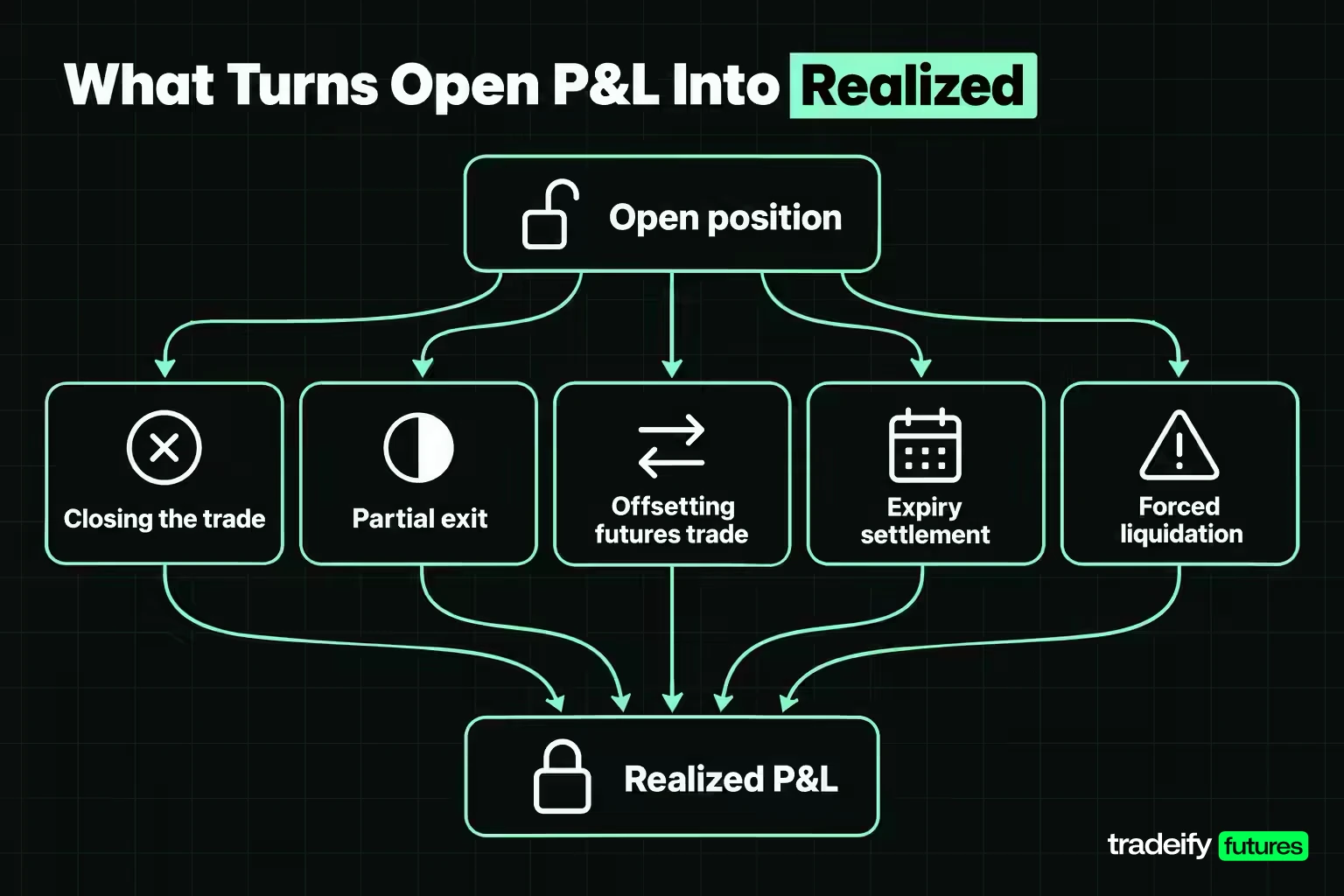
Unrealized P&L turns into realized P&L when the exposure ends. That can happen in more ways than "I clicked sell".
- Closing the position. Selling a long or buying back a short realizes the whole result.
- A partial exit. Closing part of a position realizes P&L on that part only. The rest stays unrealized: sell 60 of 100 shares and only those 60 are booked.
- An offsetting futures trade. In futures you close by taking the opposite trade in the same contract month. Selling 2 MES you are long realizes those 2 contracts.
- Expiry or final settlement. A futures contract held to expiry is settled by the exchange, which ends the position and realizes the result.
- A forced liquidation. If a broker or venue closes your position because margin ran out, the loss is realized at the liquidation price, whether or not you agreed with the timing.
- An automatic close at a cutoff. Some accounts, such as prop-firm accounts with a daily flat time, close open positions at a set time. The P&L is realized at whatever fill the close gets, slippage included.
Two exceptions blur the line.
In futures, daily mark-to-market settles gains and losses in cash every session, even while the position stays open. The CFTC describes mark-to-market as the daily system that calculates each position's gain or loss from price changes at the end of each trading session and adds or subtracts it from account balances.
In US tax, a regulated futures contract still open at year end is treated as sold at its fair market value on the last business day of the tax year. The gain or loss counts for that year even though you never closed the trade.
Related lesson: Scaling in and scaling out
What Moves Unrealized P&L
Unrealized P&L changes whenever one of its inputs changes. Keep this list short in your head, because each item can surprise you mid-trade.
- Price. The obvious one. Every tick against you is an unrealized loss.
- Size. Doubling the position doubles how fast unrealized P&L moves. On 4 MES, each tick is worth $5.00; on 1 MES, $1.25.
- The contract multiplier. One point on MES is $5 per contract. The same point on a larger contract is worth far more.
- Which price the platform marks to. Platforms differ: some use the last trade, others a bid, ask or separate mark price, as many crypto venues do. In a thin market the mark can sit away from the last print you saw.
- Currency. A foreign asset can gain in its own currency and lose in yours.
- Time, for options. Option prices decay as expiry nears, so an option's unrealized P&L can fall even when the underlying does not move.
Related lesson: Tick size and tick value
Futures P&L and Daily Mark-to-Market
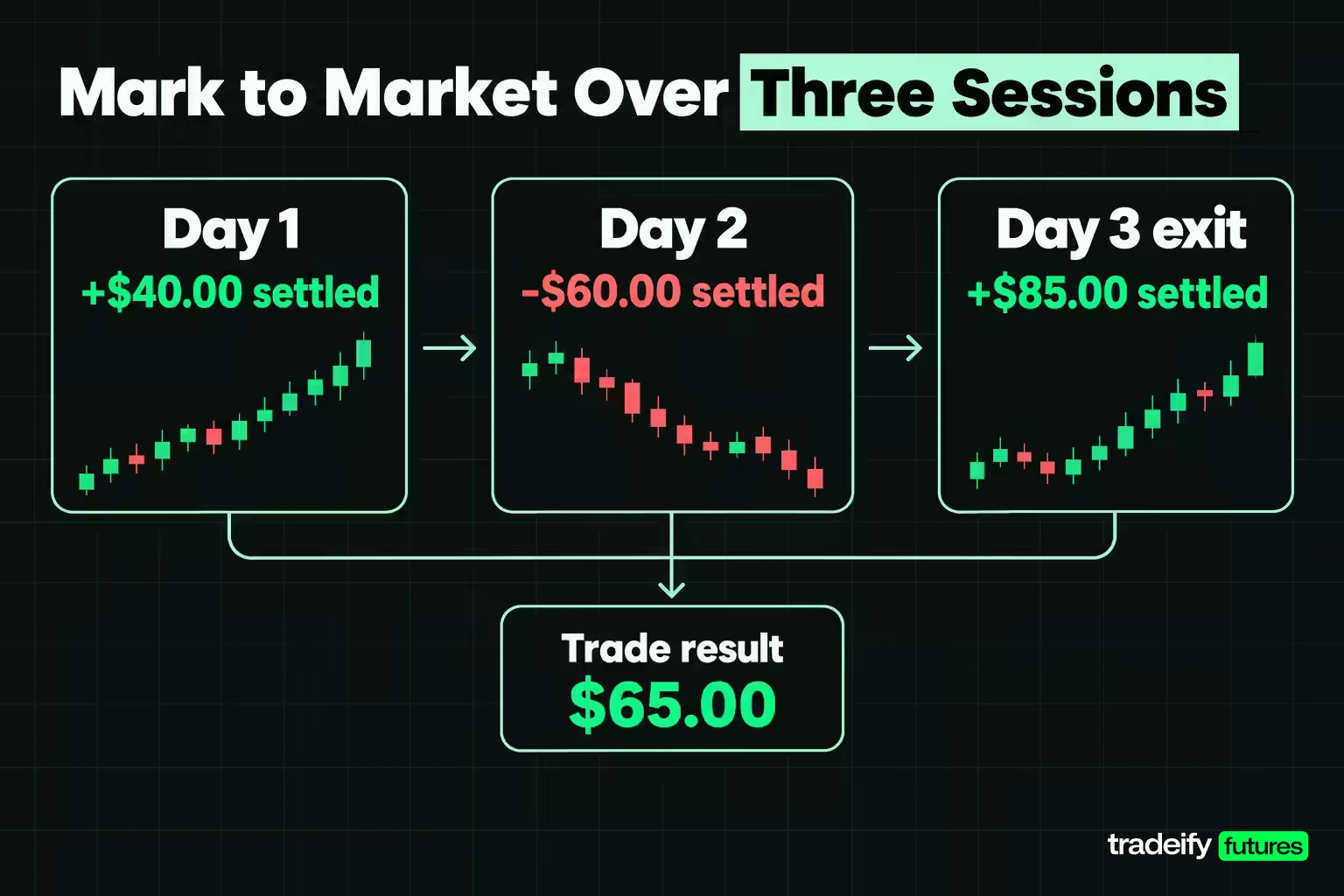
Futures are where realized and unrealized P&L overlap most, because the exchange settles gains and losses every day. A stock trader's cash balance does not change until the shares are sold. A futures trader's balance changes every session the position is open.
Take an illustrative position held across three sessions in a standard futures brokerage account: long 2 MES at 7,000.00, starting with a $2,000.00 balance. On 2 contracts, one point is $10.00.
| Session | Settlement or exit price | Change from prior mark | Variation settled | Unrealized P&L vs 7,000.00 entry | Balance |
|---|---|---|---|---|---|
| Day 1 | 7,004.00 | +4.00 points (16 ticks) | +$40.00 | +$40.00 | $2,040.00 |
| Day 2 | 6,998.00 | −6.00 points (24 ticks) | −$60.00 | −$20.00 | $1,980.00 |
| Day 3 exit | 7,006.50 | +8.50 points (34 ticks) | +$85.00 | Flat | $2,065.00 |
On Day 1 nothing has been sold, yet the account has been credited $40.00 of settled variation. On Day 2 the position is underwater by $20.00 against entry, and $60.00 has left the balance. On Day 3 the trade closes.
The daily slices add up to the trade result: +$40.00 − $60.00 + $85.00 = $65.00. Entry to exit is 6.50 points, or 26 ticks, × $1.25 × 2 = $65.00. Daily settlement does not create extra profit or loss. It cuts the same result into daily pieces and moves the cash sooner.
The practical consequence: in futures, your balance already includes settled variation, while the open position still carries unrealized P&L from the last settlement. Watch only the balance and Day 2 looks worse than it is. Watch only the open P&L and Day 1 seems to have paid you nothing.
Prop-firm accounts that require you to be flat before the daily close never see this multi-session pattern. Every trade there is realized within the session, and the open number only matters intraday.
Related lesson: Mark-to-market in futures
Why Unrealized P&L Matters for Investors and Traders
Unrealized P&L is where risk lives. A realized loss is history. An unrealized loss is still growing or shrinking, and most risk controls are built to react to it.
For a long-term investor, tracking unrealized gains and losses shows how much of a portfolio's value is committed to positions that have not been tested by a sale. It shows concentration (one holding carrying most of the paper gain), it flags positions that have drifted far from the original plan, and it tells you how much tax a sale might trigger before you make it.
For a trader on margin, unrealized P&L is part of equity, and equity is what margin and drawdown limits measure. A floating loss reduces the margin you have left, and it can trigger a margin call or a rule breach before you choose to close.
An Intraday MES Trade That Closed Green and Still Broke a Limit
Here is an illustrative intraday trade, rounded so you can follow it.
- Buy 4 MES at 7,000.00.
- Price drops to 6,990.00. Unrealized P&L is −$200.
- Price recovers to 7,012.00. Unrealized P&L peaks at +$240.
- Sell 2 contracts at 7,012.00. Realized P&L is +$120.
- Sell the last 2 at 7,006.00. Realized P&L on that half is +$60.
Gross realized P&L is $180. With an illustrative $2.00 round-turn cost per contract (substitute your own fee schedule), 4 contracts cost $8.00, and net realized P&L is $172.
Now add one condition. Suppose the account has an illustrative loss limit measured on equity, and the limit sits $150 below where equity started the trade. At step 2 the open loss of $200 crosses that limit. On a rule that reads equity, the account is in breach at 6,990.00, even though the trade later closed for a $172 net gain.
The realized view says this was a good trade. The equity view says it broke a rule. Both are true, and only one of them decides whether you keep the account.
The lesson is not to avoid drawdown inside a trade. It is to size the position so the worst open loss you are prepared to sit through stays inside the limit, with room to spare for slippage.
Using Realized and Unrealized P&L in Trading Decisions
The cleanest way to use the two numbers is to give each one a job.
- Use unrealized P&L to manage the open trade. It tells you how far the position has moved for or against you, how close you are to your stop, and how much room is left before a risk limit.
- Use realized P&L, net of costs, to judge the plan. Only closed trades tell you whether a setup made money. An open winner has not proved anything yet.
A precommitted exit is how traders stop the unrealized number from making decisions for them. Decide where the trade is wrong before you enter, then let the stop turn an unrealized loss into a realized one at that level.
The temptation arrives when the open loss is close to the stop and the chart "looks like it might turn". Moving the stop there is not a new analysis. It is the open number asking for more time, and that is how small losses get large.
The 7% Rule as a Realized Loss Trigger
The 7% rule is a stock-market version of a precommitted exit. Investor's Business Daily attributes it to its founder William O'Neil: sell a stock when it is down 7% or 8% from your purchase price, no exceptions. On a stock bought at $50.00, that means selling by $46.50 at 7%, or $46.00 at 8%. It is a rule for converting an unrealized loss into a realized one before it grows, and it is one investor's method, not a universal law.
Scaling Out and the Disposition Effect
Scaling out uses the realized and unrealized split on purpose. Selling part of a winner realizes some gain and leaves the rest open. A trader long 4 MES at 7,000.00 who sells 2 at 7,012.00 banks $120 while the other 2 stay exposed. That reduces how much the open part can give back, and it also caps how much the full position could have made.
The behavior to watch for is the reverse: selling winners quickly to "lock something in" while holding losers to avoid admitting the loss. Researchers Hersh Shefrin and Meir Statman named it the disposition effect in 1985. In a journal it shows up as many small realized gains and a few large realized losses that sat unrealized for too long. If your average loser is bigger than your average winner on a strategy designed for the opposite, check this first.
Related lesson: Loss aversion
How to Track Realized and Unrealized P&L
Most platforms show both numbers, but they label them differently and put them in different places. Learn your platform's names once so you never read the wrong column under pressure.
- Open P&L, UPL or floating P&L is unrealized. It sits on the positions panel or account module.
- Closed P&L, RPL or realized P&L is the total from trades closed today, or over a chosen period.
- Net liquidation value or net liquidity is balance plus unrealized P&L. It is the equity figure most risk limits watch.
- Balance usually includes realized results and, in futures, settled variation. It does not include the open position's move since the last settlement.
An End-of-Session P&L Routine
A short routine at the end of each session keeps realized and unrealized P&L honest:
- Record realized P&L for the day, gross and net of commissions.
- Record the worst open loss and the best open gain each trade showed, so the unrealized swing is written down instead of remembered.
- Check that realized P&L in your journal matches the platform's trade history and, for futures, the daily statement.
- If anything is still open, write down its unrealized P&L at the close and the price used to mark it.
The P&L journal fields that matter: entry, exit, size, gross realized, costs, net realized, largest open loss, largest open gain. The last two let you see whether your winners routinely went deep into the red first.
Tax Treatment of Realized vs Unrealized Gains
For most investors, tax follows realization. The IRS describes a capital gain or loss as the difference between your adjusted basis in an asset and the amount you realized when you sold it. An unrealized gain on shares you still hold is generally not taxed until you sell. This section describes US federal rules in general terms, and it is not tax advice.
Once a gain or loss is realized, holding period decides the treatment. Per IRS Topic 409, an asset held more than one year produces a long-term gain or loss, and one held one year or less produces a short-term gain or loss. Net short-term gains are taxed at ordinary income rates. Long-term gains get separate capital gains rates.
Realized losses offset realized gains. If losses exceed gains, the excess you can deduct against other income in one year is the lesser of $3,000 ($1,500 if married filing separately) or your net loss, and the rest carries forward.
Wash Sales and Cost Basis
Two rules decide which realized loss counts and how big it is.
- Wash sales. IRS Publication 550 says a wash sale occurs when you sell stock or securities at a loss and, within 30 days before or after the sale, buy substantially identical stock or securities. The loss is disallowed for now and generally added to the basis of the new shares.
- Cost basis. If you bought shares at different times and prices and cannot identify which ones you sold, Publication 550 says to use the basis of the shares acquired first (first in, first out). The method you use changes the realized gain on the same sale.
Futures Under the Section 1256 Rules
Regulated futures contracts follow different rules. Under 26 U.S.C. section 1256, a contract still held at year end is treated as sold at fair market value on the last business day of the tax year, so its unrealized gain or loss is taxed for that year. Gains and losses on these contracts are treated as 60% long-term and 40% short-term, whatever the holding period, and they are reported on IRS Form 6781.
So for futures, "unrealized gains are not taxed" is not quite right. An open futures position at December's last business day is marked for tax just as it is marked for margin every day. Rules change and personal situations differ, so check current IRS guidance or a qualified tax professional before relying on any of this.
Crypto Unrealized P&L, Mark Price and NUPL
Crypto adds two twists to unrealized P&L: the price used to mark open positions, and on-chain measures of how much profit the whole market is sitting on.
On crypto perpetual futures, many venues mark open positions to a separate mark price rather than the last trade. Binance, for example, says its Futures mark price draws on the contract's last price, the best bid and ask, the funding rate and a composite of spot prices from major exchanges, and it explains that unrealized PnL is the key factor in triggering liquidations. That means the unrealized number on a perpetual is not just a display. It decides when the position is closed for you.
On the spot side, analysts measure realized and unrealized profit across a whole network. Glassnode defines Net Unrealized Profit/Loss (NUPL) as the difference between relative unrealized profit and relative unrealized loss, and notes it relates to the Market Value to Realized Value ratio (MVRV) by NUPL = 1 − 1 / MVRV. An MVRV of 2 gives a NUPL of 0.5, meaning the market's value is twice what holders paid in aggregate on that measure. An MVRV of 0.8 gives −0.25, meaning holders as a group sit on unrealized losses.
These are sentiment gauges for a whole market, not P&L on your own account. They describe the same split, though: value that has been realized on-chain versus value that exists only at today's price.
Common Realized and Unrealized P&L Mistakes
Most P&L mistakes come from reading one number as if it were the other.
| Mistake | What it looks like | Why it costs |
|---|---|---|
| Scoring the session on open P&L | Feeling up $240 with nothing closed | The number can reverse before you exit, and it was never a result |
| Holding a loser to avoid realizing it | Calling it only a paper loss | The loss is real exposure, and it keeps growing until you close |
| Quoting gross as the result | Reporting $180 on a trade that netted $172 | Commissions and fees come out of the account either way |
| Treating settled variation as profit | Sizing up after a strong mark-to-market day | Settled cash on an open futures trade can be given back the next session |
| Reading drawdown on closed trades only | Assuming a floating loss does not count | Equity-based limits include unrealized P&L in real time |
| Ignoring average entry after adding | Judging the trade on the first lot's price | Unrealized P&L is calculated from the blended entry |
| Forgetting cost basis and wash sales | Expecting a realized loss to cut this year's tax | A repurchase within 30 days can disallow the loss for now |
The common thread: unrealized P&L is a good input for decisions about the open trade and a bad scoreboard. Realized P&L, net of costs, is the scoreboard.
Related lesson: Margin calls and liquidation
Which P&L Number Your Account Rules Use
Account rules usually read one P&L number, not both. Knowing which one each rule reads is the difference between a rule you can plan around and a rule that surprises you.
| Rule type | Number it usually reads | What that means for you |
|---|---|---|
| Maximum or trailing drawdown | Equity, including unrealized P&L, often in real time | An open loss can breach the limit before your stop fills |
| Daily loss limit | Equity or realized results, depending on the program's wording | A flat-looking closed-trade day can still be a breach on equity |
| Profit target | Usually balance from closed trades | An open winner does not count until it is closed |
| Consistency rule | Usually daily profit from closed trades | A large open gain does not move the percentage until realized |
| Minimum trading days | Days with completed trades | Positions have to be opened and closed to count |
| Margin and liquidation | Equity, including unrealized P&L | A floating loss reduces margin left and can force a close |
Daily Loss Limits on Equity vs Realized P&L
A daily loss limit can produce opposite answers depending on which P&L number it reads. Take illustrative numbers: a $500 daily limit. You have closed trades for −$350 and hold an open position down $200. On a realized-only rule, you are $150 away from the limit. On an equity rule, you are $50 past it.
Checking Which P&L Number Your Own Rules Read
The rule patterns for drawdown, daily loss, profit targets and consistency are common, not any one firm's rules. Before you trade an evaluation or funded account, find the exact wording for each rule and note which number it reads, whether it is checked in real time or at the close, and whether commissions count.
On our accounts, the trailing drawdown level updates from your end-of-day balance, but it is enforced in real time against net liquidation value, which is your balance plus unrealized P&L on open positions. An open losing trade can fail the account the moment it touches the level, even if it recovers before the close. All positions must also be closed by 4:45 PM ET, so every trade ends the session as realized P&L.
FAQ About Realized vs Unrealized P&L
What is realised and unrealised p & l?
Realised P&L is the profit or loss on positions you have closed, and it no longer changes. Unrealised P&L is the profit or loss on positions still open, measured against the current price. The spelling differs between British and American English, but the meaning is the same.
What are unrealized capital gains and how are they taxed?
An unrealized capital gain is the increase in value of an asset you still own. For stocks and most investments in the US, it is generally not taxed until you sell and realize it. Regulated futures are an exception: open contracts are treated as sold at fair market value on the last business day of the tax year under section 1256.
What is the 7% rule in stocks?
The 7% rule is a sell discipline popularized by William O'Neil: sell a stock when it falls 7% or 8% below your purchase price. It turns an unrealized loss into a realized one while it is still small. It is a personal method, not a regulation or a guarantee.
What is realized income?
Realized income is income you have actually received or locked in, such as a closed trade's profit, interest paid or a dividend paid. Appreciation on an asset you still hold is unrealized until a sale or settlement turns it into realized income.
Does unrealized P&L affect my account balance?
For stocks and spot crypto, the cash balance does not change until you sell. For futures, daily settlement moves the balance every session while the position is open. On margin and perpetual futures, unrealized P&L counts toward equity and can trigger a margin call or liquidation.
Should I judge my trading on realized or unrealized P&L?
Judge your strategy on realized P&L net of costs, because closed results cannot be revised by the market. Use unrealized P&L to manage the open trade and to see how close you are to a stop or a rule limit.
Next Step for Tracking Your P&L
Your next step takes ten minutes. Find your platform's realized and unrealized columns, add "largest open loss" to your journal, and write down which number each of your account rules reads before your next session. If you know the rule before you trade, it does not surprise you later.
This guide is educational and is not financial, tax or legal advice, or a recommendation to trade any instrument. Futures, crypto derivatives and other leveraged products carry substantial risk, and losses can exceed what you expect or deposit. All prices, fees and account limits in the examples are illustrative assumptions, not quotes or any firm's rules. Evaluation and funded prop-firm accounts are simulated, and simulated or past results do not predict future results.


