



TL;DR: When to roll a futures contract depends on which deadline comes first, whether liquidity, holding period, account rules or exchange dates. Equity index futures usually roll on the Monday before the third Friday of the expiry month. Deliverable contracts like crude oil and gold need an earlier exit, because delivery dates come first. The price gap between months is not a cost, but spreads, slippage and commissions are.
Rolling a futures contract sounds mechanical. You close one contract month and open another. The hard part is the timing, because each contract carries several dates and only one of them is the real deadline for your position.
Roll too early and you leave the deepest market for a thinner one. Roll too late and the old month can lose its liquidity, run into a broker cutoff or put a long position in line for delivery.
Imagine a trader who buys December 2026 crude oil on Wednesday, November 18, planning to hold it for a week. The setup can be right and the trade still has a problem, because that contract stops trading two sessions later, on Friday, November 20. The question was never only where crude was going. It was which month could hold the trade for a week.
So the answer is never just "on rollover day." It is the first point at which something that matters to your position stops working in the current month.
What Rolling a Futures Contract Means
Rolling a futures contract means closing a position in one delivery month and opening the same position in a later month. The CFTC glossary describes a roll-over as lifting a near futures position and re-establishing it in a more deferred delivery month.
For a long position, that is two trades. You sell the expiring month and buy the later one. A short position does the reverse: buy back the expiring month, sell the later month.
Futures need rolling because every contract has a fixed end. Exchanges set standardized terms that include the delivery months and the last trading day, according to the CFTC's guide to how futures markets work. That standardization is what makes a contract liquid enough to hedge with. It also means a position cannot simply be held forever the way a share of stock can.
Most traders never take delivery. The CFTC notes that most futures contracts, by volume, are closed by offsetting trades rather than delivery. A roll is just an offset paired with a new entry.
Here is what a roll keeps and what it does not:
- It keeps your direction and your size, if you choose the same quantity.
- It does not keep your entry price. The later month is its own market with its own price.
- It does not keep your stop or target levels. Those have to be recalculated on the new contract.
- It creates two fills, each with its own spread, slippage and commission.
Related lesson: How the front month and later months differ
How Futures Contract Expiration Sets the Roll Deadline
Futures contract expiration is not a single date. A contract calendar can list several, and the one that matters for your roll depends on how the contract settles and whether you are long or short.
The dates you will see on an exchange calendar:
- First position day. For many deliverable contracts, a long still open after the close on this day can be matched for delivery.
- First notice day. The first day notices of intent to deliver can be issued, per the CFTC glossary. It varies by commodity and exchange.
- Last trading day. The final session the contract can be traded. After it, open positions settle under the contract's rules.
- Final settlement. The price every remaining position is settled at, in cash or as the invoice price for delivery.
- Delivery period. For deliverable contracts, the window in which the product actually changes hands.
The order of these dates changes by contract. On CME's calendar as of November 4, 2026, December 2026 gold (GCZ26) has its first position day on Friday, November 27, its first notice day on Monday, November 30, and its last trading day on Tuesday, December 29. Delivery notices on gold can start 29 days before trading ends.
December 2026 crude oil (CLZ26) runs the other way. Its last trading day is Friday, November 20, and its first notice day is Tuesday, November 24. For crude, the last trading day is the binding date.
December 2026 E-mini S&P 500 futures (ESZ26) have no notice days at all. The contract is financially settled and stops trading at 9:30 AM ET on Friday, December 18, 2026.
Futures contract months and listing cycles
Each contract month has a letter code (H for March, M for June, U for September, Z for December, and so on). The listing cycle decides which month you roll into. ES lists quarterly months only (March, June, September, December). Crude oil lists every calendar month. Corn lists March, May, July, September and December.
So "roll to the next month" can mean the next calendar month in crude oil and the next quarter in ES. In corn, December rolls to March.
Related lesson: How first notice day and last trading day differ
When to Roll a Futures Contract Using Four Checks
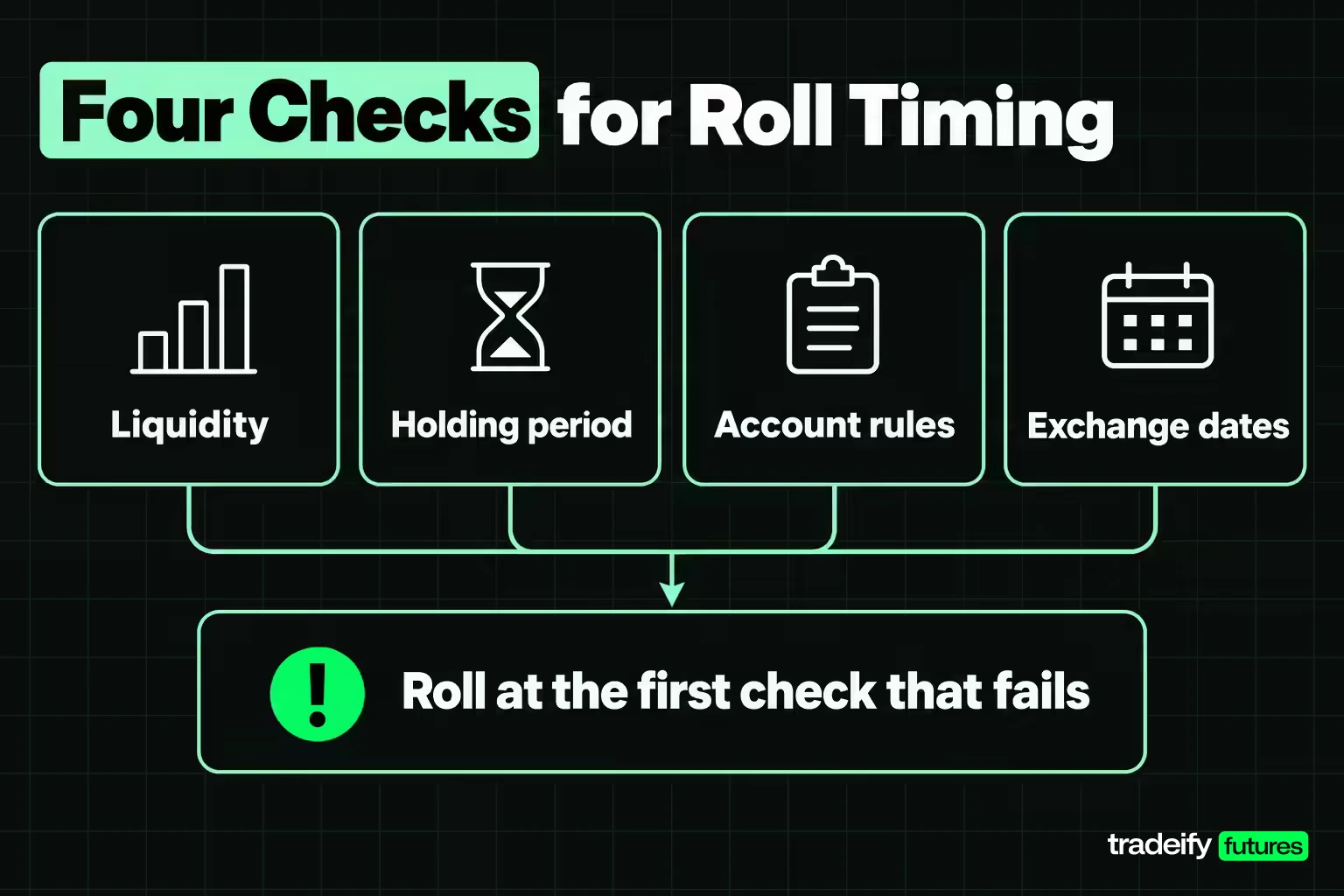
A calendar reminder helps, but it is not a rule. A better approach is to run four checks and roll at the first one that makes the current month unsuitable for your position.
The liquidity check
Watch where trading activity is moving. Compare the current month and the next active month on daily volume, open interest, bid-ask spread and depth near the prices you trade.
Volume is usually the clearest signal for a short-term trader, because it shows where trades are happening now. Open interest lags, because it counts positions still open. A month can still hold large open interest after most new trading has moved on.
One quiet session where the next month briefly trades more is an observation, not a migration. Confirmation is the later month holding the activity through the hours you trade, session after session, with a spread and depth that work for your order size.
The position horizon check
Ask whether the current month will stay usable for the full life of the trade.
A trade that is flat by the end of the session has a short clock. A swing position with a two-week plan has a long one. If the planned holding period runs past the liquidity shift or a cutoff, opening the trade in the old month just schedules a second decision. The later month can be the cleaner place to start, even while the old month is still slightly busier.
This is where habit catches traders. The platform loads the familiar symbol, the setup appears, and the calendar only becomes part of the trade after the fill. Put the holding period next to the contract's dates before you enter, not after.
The broker or program check
A broker, clearing firm or trading program can set a cutoff earlier than the exchange's. Charles Schwab Futures and Forex, for example, does not let clients take physical delivery and tells them to roll ahead of first notice day and last trading day.
Treat that kind of rule as binding. A liquid contract is still off-limits if your account must be out of it. Read the current written rule rather than assuming last cycle's rule still applies.
The exchange deadline check
Every contract has a last trading day, and deliverable contracts also have notice and position days. Take the earliest of those that applies to your side of the trade, then add any earlier broker or program cutoff. That is your hard boundary.
Never infer the date from the month code. A code tells you the delivery month, not the last safe day to hold. December crude oil, for instance, stops trading in November.
How the four roll checks combine on E-mini S&P 500 futures
Liquidity, holding period, account rules and exchange dates often point to different roll dates. In equity index futures, CME treats the Monday before the third Friday of the expiration month as the roll date, which was Monday, December 14, 2026 for the December contract. A day trader can still trade December after that if it remains the busier month in their session. A swing trader whose position would cross that week may move to March earlier. A broker can force the move earlier still.
The decision is conditional. If the current month is still clearly dominant, your trade ends today and no account rule is close, staying put is reasonable. If activity has moved or your holding period crosses a cutoff, roll even though the contract has not expired.
Reading Volume and Open Interest Before a Futures Roll
Volume and open interest are the two numbers that show a futures roll happening in real time. Volume is the number of contracts traded in a period. Open interest is the number of contracts still open, not yet offset or delivered (both per the CFTC glossary).
During a roll, both shift from the old month to the new one, but not at the same speed. Volume moves first, because new trades go to the next month. Open interest follows as existing holders close out the old month.
Crude oil volume and open interest during the December roll
CME's settlement data for crude oil shows the pattern clearly. These are the December 2026 (CLZ26) and January 2027 (CLF27) figures for five sessions, as of CME's November 4, 2026 settlement report. CLZ26 stops trading on November 20.
| Session | Dec volume | Jan volume | Jan as % of Dec | Dec open interest | Jan open interest |
|---|---|---|---|---|---|
| October 29, 2026 | 262,537 | 112,316 | 43% | 268,720 | 181,244 |
| October 30, 2026 | 272,385 | 115,733 | 42% | 261,778 | 184,114 |
| November 2, 2026 | 390,924 | 200,625 | 51% | 257,459 | 184,832 |
| November 3, 2026 | 376,081 | 201,939 | 54% | 236,239 | 193,732 |
| November 4, 2026 | 454,113 | 219,870 | 48% | 231,146 | 203,974 |
Here is how to read it. December still had more volume every day, so for a trade that ends the same session it was still the deeper market. But the open interest gap shrank from 87,476 contracts to 27,172 in five sessions, as December open interest fell by 37,574 and January's rose by 22,730. Positions were leaving December. A trader planning to hold crude for more than a few days at that point was already better served in January.
Gold and E-mini S&P 500 volume across contract months
Gold shows why "front month" by the calendar can be the wrong month. On November 4, 2026, November gold (GCX26) traded 17 contracts with 61 open, while December gold (GCZ26) traded 232,561. November's first notice day had passed on October 30, and its open interest had already fallen from 3,111 on October 29. The busy gold month was December, and the next active one was February, which traded 22,896 contracts that day against 355 for January.
The E-mini S&P 500 was nowhere near its roll on the same date. December traded 2,329,405 contracts and March 6,882, about 0.3% of December's volume, with expiration still 44 days away.
What to watch in the numbers
- Compare volume in the hours you actually trade, not just the daily total.
- Treat a narrowing open interest gap as a sign holders are moving.
- Check the bid-ask spread and depth on the later month before you rely on it.
- Do not use a continuous chart for this comparison. It already picked a month for you.
Related lesson: How to identify the active contract from trading activity
How Cash Settlement and Physical Delivery Change Roll Timing
Settlement method decides how much room you have at the end of a futures contract's life, and so how late you can roll. A cash-settled contract ends with a payment based on a final price. A physically delivered contract can end with the product itself changing hands, which brings delivery dates forward of the last trading day.
| Settlement feature | Cash-settled futures | Physically delivered futures |
|---|---|---|
| What happens at expiry | Positions are marked to a final settlement price and paid in cash | Shorts deliver and longs take delivery of the product |
| Examples at CME | ES, NQ, MES, MNQ, MCL | CL, GC, MGC, NG, ZC, 6E |
| Date that binds a roll | Last trading day, with liquidity usually leaving earlier | First position or first notice day for longs, or the last trading day when notices come after it |
| Risk of holding too long | Thin trading and a final price that can gap from the prior close | Delivery obligations, or forced liquidation by the broker |
| Typical roll timing | Around the exchange roll date, as volume moves | Before the earliest delivery-related date |
Cash-settled contracts
A cash-settled contract ends with money, not goods. E-mini S&P 500 (ES), E-mini Nasdaq-100 (NQ) and Micro E-mini contracts are financially settled. ES is settled at a special opening quotation of the S&P 500 on the third Friday, under CME Rule 35803. Micro WTI crude oil (MCL) is also cash settled and stops trading one business day before the matching CL contract.
With a cash-settled contract, holding to the last trading day carries no delivery risk. The risks are liquidity and the final price. Volume drains from the expiring month in its last week, and the final settlement price comes from the opening of the underlying index, which can differ from the futures price at the prior close. For most traders, that is reason enough to roll before the final days.
Physically delivered contracts
A deliverable contract can end with an actual transfer of the product. Crude oil (CL), gold (GC and MGC), natural gas (NG), corn (ZC) and euro FX (6E) are deliverable at CME.
For these, the practical deadline comes before the last trading day in many cases:
- Gold and corn. First position day and first notice day fall before the last trading day. A long still open after the close on first position day can be matched for delivery. For GCZ26 and ZCZ26 that was November 27, 2026.
- Crude oil. Notices come after trading ends. Under NYMEX Rule 200105, holders file their notices by 3:00 PM on the first business day after the final day of trading. So a CL position still open at the end of the last trading day is headed for delivery.
- Natural gas. NGZ26 stopped trading on Wednesday, November 25, 2026, with first notice two days later.
Some brokers, Charles Schwab Futures and Forex among them, do not allow clients to take delivery at all. For accounts like that, the deadline arrives earlier than the last trading day suggests.
How long futures settlement takes
Every open futures position settles daily. The CFTC describes how positions are marked to market each day, with gains credited and losses debited. Final settlement happens at expiry: in cash on the last day for ES, or through the delivery month for crude oil, where NYMEX Rule 200107 sets payment for the twentieth day of the month after delivery.
Related lesson: Cash versus physical settlement in futures
When to Roll Futures by Contract
Each market has its own roll rhythm. Start from the exchange calendar for the contract you trade, then check liquidity, your holding period, account rules and the exchange deadline.
December 2026 roll checkpoints
These dates come from CME's product calendars, read on November 4, 2026. Confirm them again before you rely on them, because exchanges can change calendars.
| Contract | Settlement | Earliest delivery date | Last trading day | Roll into |
|---|---|---|---|---|
| ESZ26 and NQZ26 | Cash | None | Friday, December 18, 2026 | March 2027 |
| MCLZ26 | Cash | None | Thursday, November 19, 2026 | January 2027 |
| CLZ26 | Physical | First notice Tuesday, November 24, 2026 | Friday, November 20, 2026 | January 2027 |
| NGZ26 | Physical | First notice November 27, 2026 | Wednesday, November 25, 2026 | January 2027 |
| GCZ26 | Physical | First position Friday, November 27, 2026 | Tuesday, December 29, 2026 | February 2027 |
| ZCZ26 | Physical | First position Friday, November 27, 2026 | Monday, December 14, 2026 | March 2027 |
| 6EZ26 | Physical | Delivery Wednesday, December 16, 2026 | Monday, December 14, 2026 | March 2027 |
When to roll equity index futures
ES, NQ, MES and the other CME equity index futures expire quarterly on the third Friday. CME's standard roll date is the Monday before that Friday: December 14, 2026 for the December contracts and, by the same rule, March 15, 2027 for March.
CME treats the next quarter as the lead month after the roll date, because the expiring contract will have a less liquid market. Watch the March contract's volume climb through that week. The expiring month still trades until 9:30 AM ET on the final Friday, but by then most activity has left it.
When to roll crude oil futures
Crude oil rolls every month, and it rolls early. The December contract stops trading in November. CME's own settlement procedure treats the expiring crude contract as non-active two business days before it expires, which tells you where the exchange expects activity to be.
CME settlement data from November 4, 2026 showed January crude already trading 48% of December's volume, with 16 days still left before CLZ26 stopped trading. MCL follows CL but stops one business day earlier, so check the micro's date separately.
When to roll gold futures
Gold lists many months, but trading concentrates in a few. On November 4, 2026, December gold carried the volume while January barely traded, and February was the next busy month. CME's gold settlement procedure treats the active month as non-active on its first position day. That makes first position day, not the last trading day, the practical roll point for gold. Micro Gold (MGC) lists only February, April, June, August, October and December.
When to roll corn and grain futures
Corn rolls across five contract months. With first position day for December corn on November 27, 2026 and trading continuing until December 14, a long holder has to be out before the delivery window opens, more than two weeks before the contract stops trading.
When to roll currency futures
Euro FX futures (6E) are physically delivered and stop trading two business days before the third Wednesday of the contract month. For December 2026 that was Monday, December 14, with delivery on December 16.
How to Calculate the Cost of a Futures Roll
The most common confusion about rolling is treating the price gap between months as a cost. On the screen it can look like you just paid 74.75 points to stay in the trade. You did not.
The calendar gap is not a cost
As of November 4, 2026, March ES settled at 7,795.25 and December at 7,720.50, a 74.75-point gap worth $3,737.50 per contract. If you roll a long position, you sell December at its market price and buy March at its market price. Your profit or loss on December is already realized. March simply starts from a higher number.
The gap matters in other ways. It shifts every chart level, stop and target, and for longer-term holders it shows up as roll yield. But the roll itself did not cost you 74.75 points.
What the roll actually costs
The real costs are execution costs:
- The bid-ask spread on each leg.
- Slippage if the market moves between the two fills.
- Commission and exchange fees on both trades.
Investopedia describes the cost of rolling as the price difference plus trading and commission fees. For an active trader, the useful part of that formula is the fees and the fills.
Legged roll vs calendar spread order
There are two ways to execute the roll.
A legged roll closes the old month and opens the new month as two separate orders. It is simple, but the market can move between the fills. If each leg gives up one tick, an ES roll costs 2 x $12.50 = $25 before commissions (illustrative). An MES roll costs 2 x $1.25 = $2.50.
A calendar spread order buys one month and sells the other as a single quoted spread. The CFTC defines a calendar spread as the purchase of one delivery month and simultaneous sale of another month of the same contract. On ES, the calendar spread trades in 0.05-point ticks worth $2.50, against $12.50 for an outright tick. On MES, the spread tick is $0.25. A spread order removes the risk of one leg filling while the other does not, but you still need to check the direction, the ratio and both contract years. Not every platform or account supports spread orders.
Translating stops to the new contract month
Suppose you are long December ES at 7,000.00 with a stop at 6,980.00 (illustrative prices). That is 20 points, or $1,000 of risk per contract. You roll into March at 7,060.00.
If you copy the 6,980.00 stop onto March, your risk is now 80 points, or $4,000. The stop that keeps the same 20-point risk is 7,040.00. Recalculate the stop distance, the dollar risk and every chart level on the new contract before you send the order.
Related lesson: How futures spreads between months work
Contango, Backwardation and Roll Yield When You Roll
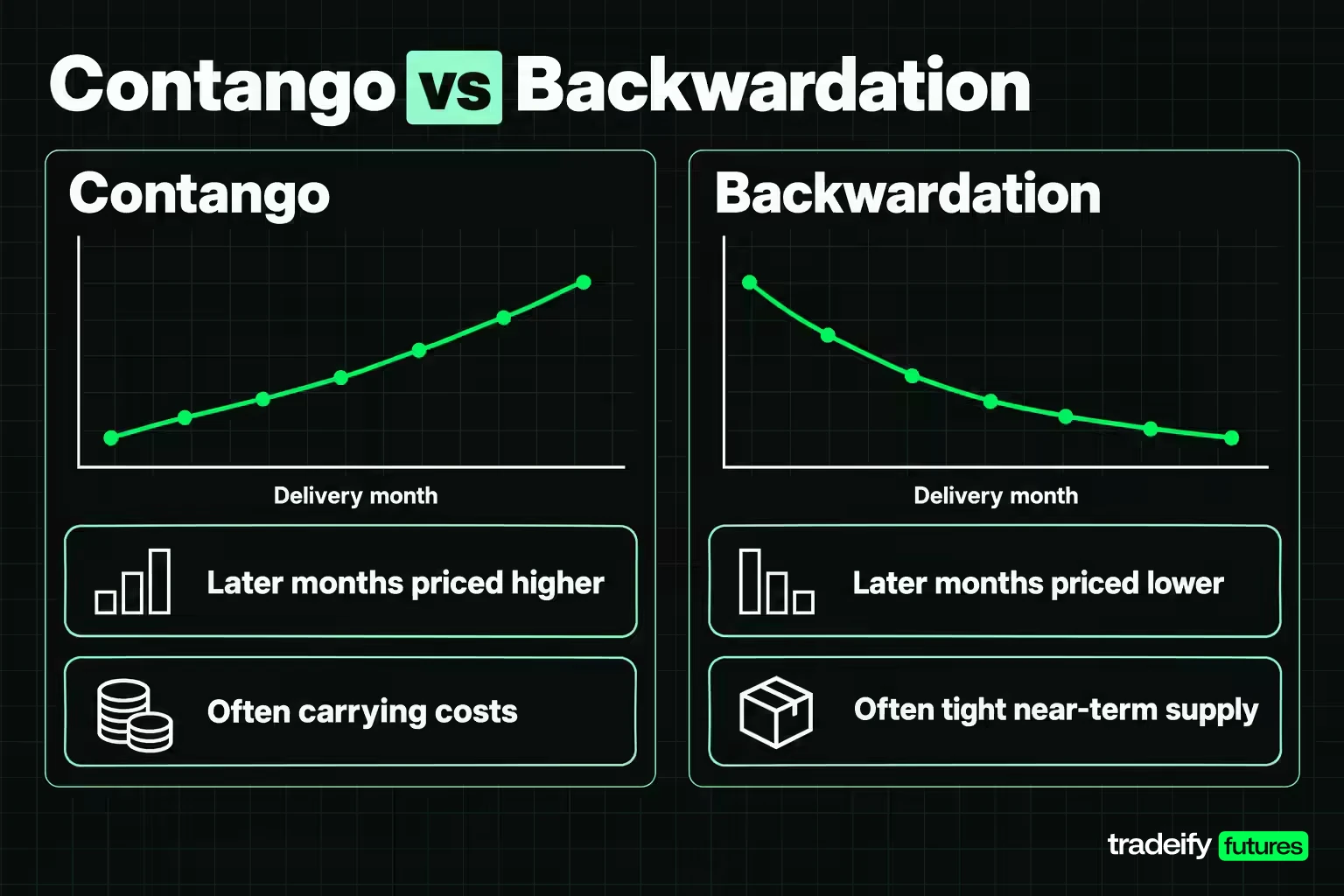
The shape of the futures curve decides whether rolling a long position means buying the next month higher or lower.
Contango and backwardation
The CFTC glossary defines contango as later delivery months priced progressively higher than the nearest month, and backwardation as the opposite. Contango usually reflects carrying costs, such as storage, insurance and interest. Backwardation often shows up when supply for near delivery is tight.
On November 4, 2026, CME settlements showed both shapes:
- ES: March 74.75 points above December (contango).
- Gold: February $33.80 per ounce above December, or $3,380 per contract (contango).
- Corn: March 14 cents per bushel above December, or $700 per contract (contango).
- Crude oil: December $1.02 per barrel above January, or $1,020 per contract (backwardation).
Roll yield
Roll yield is the part of a futures return that comes from the curve, not from the underlying price. Investopedia gives the formula as the total change in futures prices minus the total change in the spot price. In backwardation, roll yield is positive for a long position. In contango, it is negative.
Two illustrative cases:
- An index sits at 7,000.00 for three months. You roll a long into a March contract at 7,060.00, and by expiry March converges to the index at 7,000.00. The futures price fell 60 points while the index went nowhere, a roll yield of minus 60 points, or $3,000 per ES.
- Crude oil is in backwardation, with the front month at $70.00 and the next at $69.00. If spot stays at $70.00, the later contract rises $1.00 into expiry, a gain of $1,000 per CL contract from the curve alone.
Roll yield for long-term holders vs day traders
Roll yield adds up for anyone who rolls the same position month after month: hedgers, long-term holders and funds that track commodities with futures. For an intraday trader who is flat every night, roll yield never accrues. The curve still matters to that trader, though, because it changes price levels on the chart when the active month switches.
Futures Roll Week Risks and How to Manage Them
Roll week is when routine contract changes turn into costly mistakes. Most of the risks come from liquidity moving and from orders pointed at the wrong month.
Liquidity thins in the expiring month
As volume leaves the old month, its spread can widen and depth can fall. A market order that filled cleanly a week earlier may now slip. Check the spread on the old month before you close it, and use limit orders if it has widened.
Triple witching and equity index futures expiration
Quarterly equity index futures expire on the third Friday of March, June, September and December. That same day is known as triple witching, when stock options, stock index futures and stock index options all expire, and volatility can rise as traders settle or roll positions (Britannica). December 18, 2026 is one of those days. Holding an expiring ES or NQ position into that final morning adds settlement price risk to an already busy session.
Order and position errors
These are the mistakes that create real losses during a roll:
- Wrong month on the order ticket. The platform still shows the old month, or the destination month has a different year code at year end.
- Half a roll. The old month never gets closed, leaving a long in one month and a short in another. That is a calendar spread you did not intend.
- Orphaned orders. Stops and targets stay working in the old month after the position moves.
- Unchanged stops. Old price levels copied onto a month that trades at a different price.
Controls that prevent roll errors
- Set your roll date in advance from liquidity, holding period, account rules and exchange dates, not on the day.
- Read the full symbol, month and year on both legs before sending.
- Cancel all working orders in the old month after you exit it.
- After the fill, confirm the old month is flat and the new month shows the intended size.
How Platforms and Continuous Charts Handle a Futures Roll
Most charting and trading platforms do part of the roll for you, which is useful right up until you assume they did all of it.
Continuous charts
A continuous chart stitches contract months together into one long series. TradingView's "1!" symbol, for example, shows the nearest contract, and the platform switches months mainly when the next contract's daily volume exceeds the current one, using a rule set per symbol from historical averages. That means the chart can switch while the old contract is still the busier one, or the reverse.
The switch also creates a price jump if the months trade at different levels. Back-adjustment removes the jump by shifting older history by the gap. On TradingView it is turned off by default. Sierra Chart offers date-based and volume-based rollover, each with a back-adjusted version. NinjaTrader 8 stores a rollover date and an offset for each contract month.
The practical rule: a continuous chart tells you which month the data vendor picked, not which month you should trade. Your order still goes to a specific contract.
Platform auto-roll
Many platforms roll your chart and order modules to the new contract automatically. That changes what you are looking at, not necessarily what you hold. Whether an auto-roll touches an open position depends on the platform, so check its documentation before roll week.
Rolling futures in automated trading systems
If you run an automated strategy, write the roll into the system. Decide the trigger (a calendar rule, a volume crossover or a set number of days before the first relevant date), how the strategy closes the old month and opens the new one, and whether it re-sends protective orders. Backtests built on continuous data should use the same roll rule and adjustment method as live trading, or the results will include price jumps that could never have been traded.
Related lesson: How continuous futures charts adjust across contract changes
How to Roll a Futures Position Step by Step
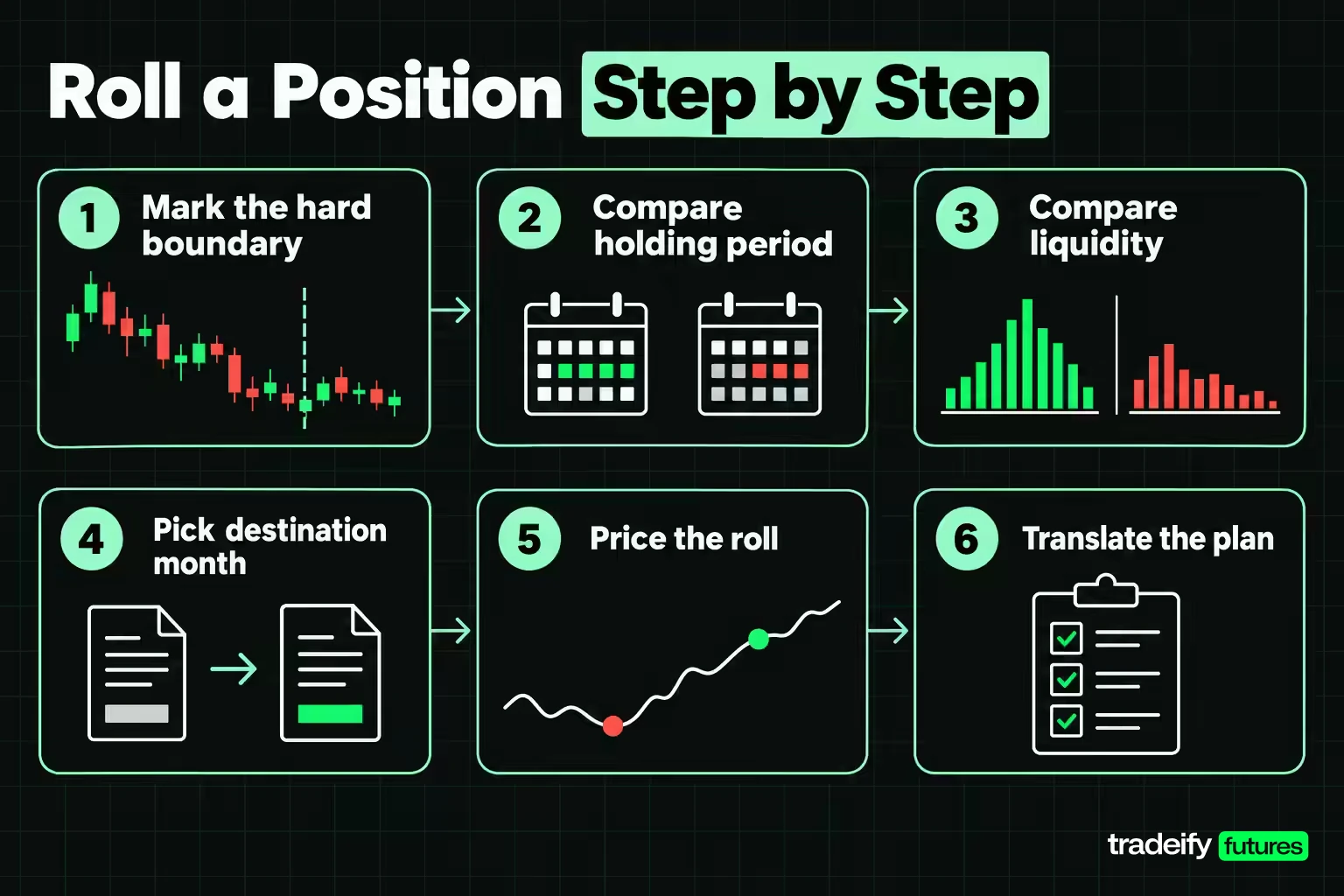
Use this checklist before roll week, not when the order ticket is already open.
- Mark the hard boundary. Note the last trading day, plus first notice and first position days if the contract is deliverable, then any earlier broker or program cutoff. Use the earliest one that applies.
- Compare the trade's holding period with that boundary. If the trade could run past it, start in the later month or shorten the plan.
- Compare liquidity. Check volume, open interest, spread and depth for the current and next active month during your trading hours.
- Pick the destination month. It is the next active month, which is not always the next calendar month.
- Price the roll. Note the gap between months, the spread on each leg and the commissions on both trades.
- Translate the plan. Recalculate stop, target and dollar risk on the new contract's price.
- Execute. Use a calendar spread order where available, or leg in with limit orders.
- Confirm. Check that the old month is flat, the new month shows the right size and no orders remain in the old month.
Common Mistakes When Rolling Futures Contracts
Waiting for expiration
Expiration is the last event in a contract's life, not the signal to plan around. Liquidity and account eligibility usually change before it.
Rolling because the calendar says so
A roll-date reminder should trigger a check of volume and depth, not an automatic order. Confirm where the volume and usable depth are during your session before you switch months.
Choosing the next calendar month
The nearest later month may be listed but thin. On November 4, 2026, January gold traded 355 contracts while December traded 232,561. Roll into the month the market is actually trading.
Treating the price gap as a loss
The gap between months is not money lost. The costs are the spreads, slippage and commissions on the two trades.
Ignoring the year code
At year end, the month letter can look familiar while the year changes. Read the full symbol on both legs.
Futures Roll Timing FAQ
What is rollover in futures?
Rollover is closing a position in an expiring contract month and opening the same position in a later month. It keeps your market exposure going past the old contract's expiration. The two trades are separate fills with their own prices and costs.
How many days before expiration should you roll a futures contract?
Roll equity index futures about four days before expiration, on the Monday before the third Friday, unless volume moves sooner. Roll deliverable contracts like gold and corn before first position day, which can come weeks before trading ends. Your broker's cutoff and your holding period can make the date earlier.
Do I need $25,000 to trade futures?
No. The $25,000 figure comes from the pattern day trader rule for stock margin accounts, which never applied to futures. FINRA Regulatory Notice 26-10 is replacing that stock rule, with a phase-in ending October 20, 2027. Futures brokers set their own account minimums and margin requirements.
What is the point of a futures contract?
The point of a futures contract is to let producers and users of a commodity lock in a price and hedge against price changes. The CFTC explains that exchanges standardize the terms, including delivery months and the last trading day, so many participants can trade the same instrument. Those fixed delivery months are also the reason positions have to be rolled.
How long do futures contracts take to settle?
Futures settle daily through mark-to-market, with gains and losses posted each day. Final settlement happens at expiry. Cash-settled ES settles on the third Friday, while delivered crude oil settles through the delivery month.
Can you hold a futures contract through expiration?
A cash-settled contract can be held to expiration and settles in cash at the final price. A deliverable contract held too long can lead to delivery, which many brokers do not allow. Unless settlement is intentional and permitted, roll or close before the earliest cutoff.
Roll Timing for Intraday Futures Traders
A day trader who is flat at every close never carries a position through a roll. The roll decision still exists. It just becomes a choice about which contract month to trade next session.
That makes liquidity the check that matters most. Trade the month with the most volume and the tightest spread in your session, switch when the next month takes over, and update your charts, saved symbols and hotkeys on the same day so nothing points at the old contract.
The practical next step is small. Before the next roll week, write down the binding date for each contract you trade and the full symbol you will move to, so the switch is a plan you already made rather than a decision you make mid-session.
On our accounts, every position has to be closed by 4:45 PM ET and nothing is held overnight, so a roll for you just means changing which contract month you trade from the next session. Our Help Center suggests switching 1-2 weeks before expiration or when volume starts moving, and avoiding contracts expiring within two weeks, trading under about 1,000 contracts a day or showing spreads wider than 1-2 ticks. In the Tradovate Web App, automatic rollovers update your chart and SuperDOM to the current contract, but they never move an open position, and our funded accounts are simulated.
Futures trading involves substantial risk of loss and is not suitable for everyone. Leverage means losses can exceed what you expect, and roll week can add slippage and gap risk. Contract dates, listing cycles and broker rules change, so confirm current dates with the exchange and your broker before trading. Results in simulated or funded evaluation accounts are simulated and do not reflect live trading. Nothing here is investment advice.


