.svg)

.svg)
.svg)



TL;DR: The best backtesting software depends on whether you test visually, code mechanical rules, or need both. TradingView is a practical starting point for chart replay and Pine Script strategies. NinjaTrader is a strong fit for futures traders who want replay, strategy analysis, and an execution platform in one workflow. FX Replay suits browser-based manual practice, TradeZella combines guided, manual, and no-code testing with review tools, MultiCharts supports more advanced automated systems, and Backtrader gives Python users control over custom research. Choose the method first, verify data quality and costs, then judge the tool by whether it produces trades you can audit rather than an impressive equity curve you cannot explain.
Backtesting software can calculate thousands of trades and still give you the wrong answer.
The problem is usually not the calculation. It is the test design. A trader changes a rule halfway through, ignores commissions, tests only the market period that looked favorable, or accepts an entry that would have been impossible in real time. The final report looks precise because the software produced decimals. The assumptions underneath it are not precise at all.
The best backtesting software makes rules visible, lets you review individual trades, and fits the way you will execute. This comparison focuses on futures traders, but the decision process applies to most rule-based trading research.
What Backtesting Software Must Do
Every useful platform should answer four questions:
- What exact conditions created the entry?
- What price and cost assumptions were used?
- What happened across different markets and conditions?
- Can you inspect the trades that produced the result?
A tool should support the testing method you need. Manual replay is useful for discretionary setups that depend on context. Automated testing is better for objective rules that can be coded without interpretation. A hybrid workflow uses automated results to find patterns, then manual review to check whether those patterns make sense on the chart.
Do not choose based only on the number of features. Choose the smallest tool that can test your actual rules without hiding important assumptions.
Best Backtesting Software by Use Case
There is no honest single winner for every trader. These are the strongest fits by workflow.
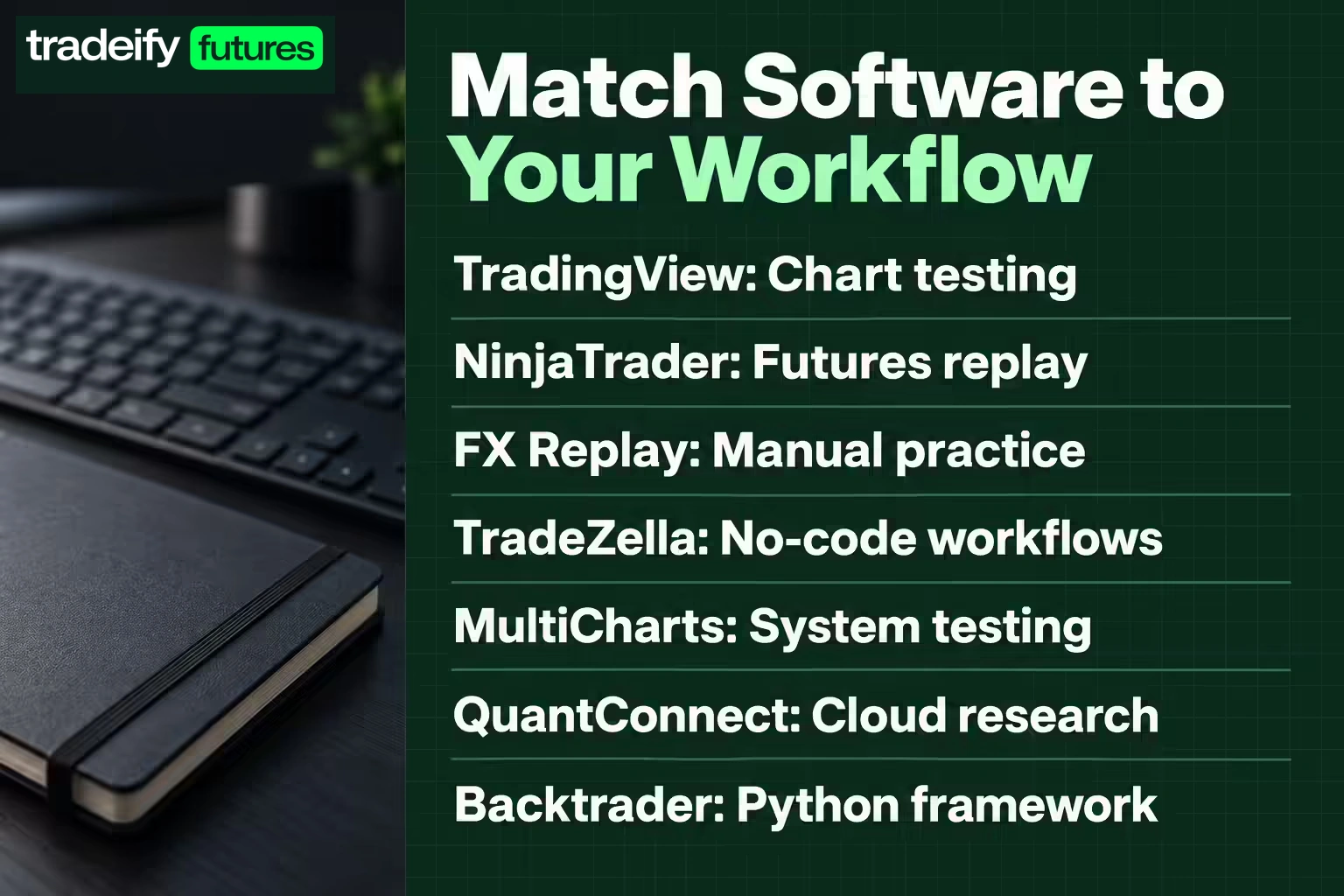
TradingView for accessible chart testing
TradingView is a practical choice for traders who already chart in a browser and want a low-friction place to start. Bar Replay supports manual practice, while Pine Script strategies can produce automated historical results through the Strategy Tester.
It is best for:
- Visual replay on familiar charts
- Testing indicator-based ideas
- Writing or modifying Pine Script strategies
- Sharing chart layouts and scripts across devices
The limitation is that a visual replay and a coded strategy answer different questions. Clicking trades during replay measures your decisions. A Pine strategy measures the rules in the code. Do not combine those results as if they came from the same process.
TradingView is also not a substitute for checking contract specifications, session settings, and data availability. Verify that the chart, session, and contract history match the market you intend to test.
NinjaTrader for futures replay and automation
NinjaTrader is a strong fit when futures are the main market. Its Strategy Analyzer supports historical strategy testing, and Market Replay can reproduce recorded market activity for simulated practice. Traders can test automated logic, inspect executions, and keep research closer to the platform used for futures analysis and order entry.
It is best for:
- Futures-focused strategy development
- Market replay with platform tools
- Automated strategies built in NinjaScript
- Testing order handling and execution logic
The learning curve is higher than a simple browser replay. That is not automatically a weakness. More control creates more settings that must be understood. Before trusting a result, verify fill resolution, commissions, slippage assumptions, session templates, and how the strategy handles multiple orders on the same bar.
FX Replay for manual browser practice
FX Replay focuses on replay-based practice across several markets, including futures. It works well for traders who want to move through historical price action, mark decisions, and review manual performance without building code.
It is best for:
- Discretionary price-action practice
- Session-by-session replay
- Repeating the same setup across historical days
- Traders who do not want to program
Manual replay is only useful when the rules are recorded before the test. If the definition of a valid setup changes after each losing trade, the sample is measuring hindsight instead of a strategy.
TradeZella for guided and no-code workflows
TradeZella combines trading review tools with manual, guided, and no-code backtesting workflows. It is suited to traders who want testing and journaling close together, especially when the next step is reviewing why a setup worked or failed.
It is best for:
- No-code strategy definitions
- Manual replay tied to review
- Guided practice scenarios
- Traders who want testing and journaling in one process
The key question is whether the rule builder can represent your setup without simplifying away an important condition. No-code does not mean no judgment. Check the generated logic and review sample trades before accepting summary statistics.
MultiCharts for advanced system testing
MultiCharts is built for traders who want deeper automated analysis, portfolio testing, and strategy development through PowerLanguage. It is more appropriate for systematic research than casual chart replay.
It is best for:
- Mechanical futures systems
- Multi-market and portfolio research
- Walk-forward and optimization workflows
- Traders comfortable with code and detailed settings
Optimization is where discipline matters. Testing hundreds of parameter combinations will always find something that looked good in the past. The question is whether the result remains stable when parameters, markets, and dates change.
QuantConnect and Backtrader for custom code research
QuantConnect is the most complete fit in this list for traders who want cloud research, backtesting, and a path to deployment in one workflow. Its open-source LEAN engine supports Python and C#, streams historical data without exposing future points, and covers futures alongside other markets. Backtrader remains useful for traders who want a lighter open-source Python framework and full control over their own data and infrastructure.
It is best for:
- Python- or C#-based strategy development
- Managed or custom data pipelines
- Reproducible research in code
- Traders who need full control over assumptions
The tradeoff is responsibility. QuantConnect can manage more of the infrastructure and dataset workflow, while Backtrader leaves more of it to you. In either case, you must model costs, validate calculations, control look-ahead bias, and maintain the research code. Flexibility is useful only when the process is tested as carefully as the strategy.
Manual and Automated Backtesting Software
Manual replay answers questions about recognition and execution:
- Did you see the setup before the move?
- Could you follow the rule without future information?
- Did hesitation or impatience change the entry?
Automated testing answers questions about a fixed rule set:
- How often did the conditions occur?
- What was the distribution of wins and losses?
- How sensitive was the result to costs and parameter changes?
Use manual testing when the setup includes context that cannot yet be defined precisely. Use automation when every required decision can be expressed as data and rules. If you cannot explain what the code does on a specific bar, the backtest is not ready to guide a live decision.
Backtesting Software Metrics That Matter
Net profit alone is a poor selection metric. It can hide a long drawdown, a few unusually large trades, or a risk level that would be difficult to execute.
Review at least:
- Number of trades
- Average win and average loss
- Win rate
- Profit factor
- Maximum drawdown
- Longest losing sequence
- Expectancy per trade
- Results by market, session, and year
- Sensitivity to commissions and slippage
Also inspect the equity curve and the individual trade list. A stable-looking curve built from unrealistic same-bar fills is still unreliable.
The number of trades has to be large enough to expose the strategy to different conditions. There is no universal count that proves validity. A setup that occurs twice a month takes longer to evaluate than one that occurs several times a day. Judge the sample in the context of frequency and market variation.
How Backtesting Software Can Mislead You
Software cannot protect a trader from a weak research process.
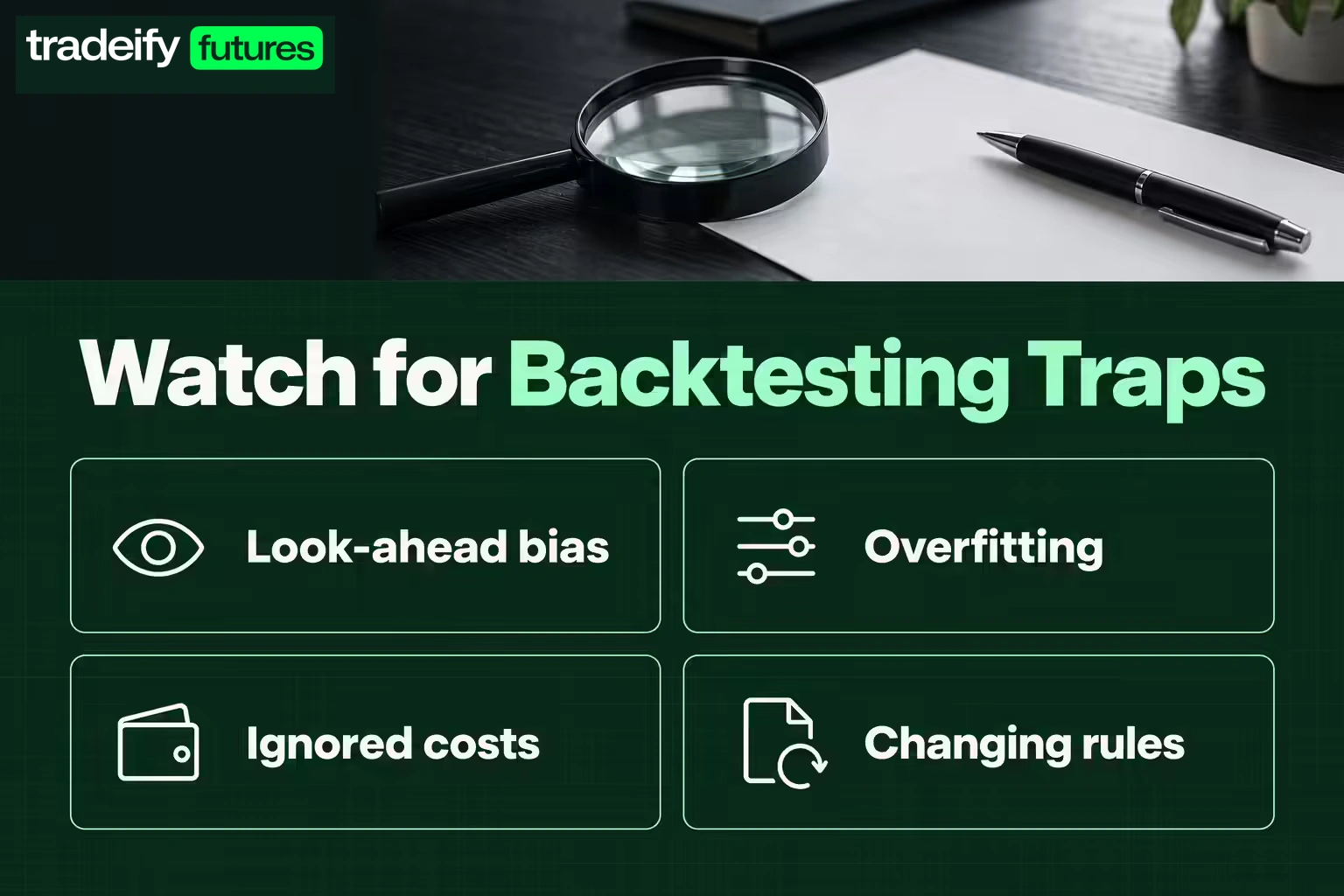
Common failure modes include:
- Look-ahead bias from using information not available at the decision time
- Survivorship bias from testing only markets or contracts that remained successful
- Overfitting parameters to one historical period
- Ignoring commissions, exchange fees, slippage, and spread
- Using continuous futures data without understanding contract adjustments
- Changing rules after seeing the result
- Testing only favorable volatility conditions
One small change can reveal a fragile strategy. Increase assumed costs. Shift the entry by one tick. Test a different year. Try another related contract. If the result collapses immediately, the apparent edge may depend on precision that real execution cannot reproduce.
Choosing the Best Backtesting Software
Use this short selection process.

- Write the setup in plain language before opening a platform.
- Decide whether each rule is objective or discretionary.
- Choose manual replay, automated testing, or a hybrid approach.
- Confirm the tool supports your futures data, sessions, and contract history.
- Check whether commissions, slippage, and order behavior can be modeled.
- Run a small test and inspect every trade before scaling the sample.
- Save the rules, settings, and test dates so the result can be reproduced.
TradingView or FX Replay can be enough for a discretionary trader starting with manual review. NinjaTrader is a natural fit for futures-focused replay and system analysis. TradeZella can suit a trader who wants no-code testing tied to journaling. MultiCharts or Backtrader may be better when advanced automation and custom research matter.
The Best Backtesting Software Is Auditable
Do not ask which platform produces the highest backtest return. Ask which platform lets you understand the trades, challenge the assumptions, and repeat the test without quietly changing the rules.
Pick one setup. Define it before the replay starts. Test it across several conditions, include realistic costs, and review the losing trades as closely as the winners. Futures trading involves substantial risk, and historical or simulated performance does not guarantee future results. Backtesting is evidence for a decision process, not permission to ignore risk.
.svg)
.svg)
.svg)
.svg)




.webp)