.svg)

.svg)
.svg)



Key Findings Comparing Futures Prop Firms and Forex Prop Firms
- Regulatory Arbitrage is Ending: The Seychelles FSA has increased capital requirements for securities dealers from $50,000 to $100,000, signaling a tightening of the offshore "grey zone" that many forex prop firms rely on.
- The "Hidden Tax" of Spreads: Forex traders pay a variable cost through widening spreads and slippage, often manipulated by B-Book brokers. Futures traders pay fixed commissions on a centralized exchange, ensuring price transparency.
- Structural Integrity: Futures trading on the CME offers a "Depth of Market" (DOM) that provides visibility into real order flow, a tool unavailable in the decentralized spot forex market.
- Prop Firm Stability: The collapse of major forex prop firms in 2024 due to platform licensing issues (MetaQuotes crackdown) has highlighted the operational risks of the CFD model. Futures firms, utilizing established platforms like Tradovate, offer greater infrastructure security.
The Brutal Truth About the Forex Prop Firms Industry
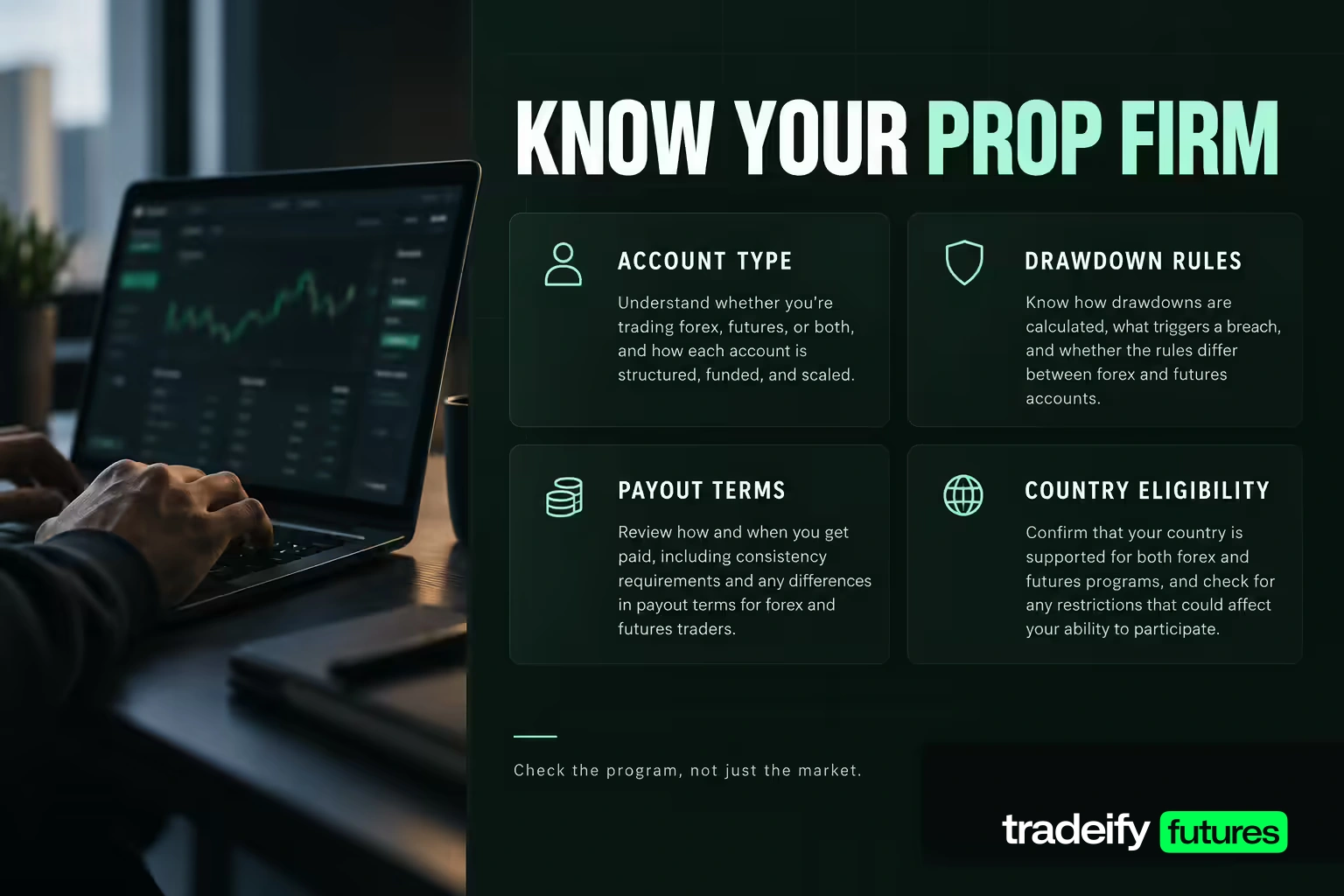
The allure of forex prop firms has historically been their low barrier to entry and high buying power. However, the industry is built on a structural conflict of interest that many retail traders fail to recognize until they are consistently profitable.
The B-Book Model Conflict in Forex Prop Firms
The vast majority of forex prop firms operate on a "B-Book" or "bucket shop" model. In this arrangement, the firm does not route trader orders to a real liquidity provider (A-Book). Instead, the firm acts as the counterparty to every trade. When a trader loses, the firm wins; when a trader wins, the firm loses. This creates a direct financial incentive for the firm to see its traders fail. This model explains the prevalence of "slippage" and "server freezes" during high-impact news events in the forex prop space. Unlike a centralized exchange where buyers are matched with sellers, the B-Book broker controls the data feed. They can artificially widen spreads to trigger stop-losses, a practice often referred to as "stop hunting," without the price ever actually reaching those levels on the interbank market.
Regulatory Loopholes and Licensing in Forex Prop Firms
Many forex prop firms claim to be "regulated," but a thorough investigation into their licensing reveals a different reality. A common tactic is to register a shell company in a jurisdiction with lax oversight, such as the Comoros Islands or St. Vincent and the Grenadines, while operating the prop firm from a different location entirely. Even jurisdictions previously seen as standard "offshore" hubs are tightening their grip. The Seychelles Financial Services Authority (FSA), a popular regulator for offshore brokers, recently implemented significant changes to its regulatory framework. The minimum paid-up capital requirement for a securities dealer license was raised from $50,000 to $100,000. This 100% increase serves as a barrier to entry for undercapitalized "pop-up" prop firms, potentially signaling a consolidation or exodus of smaller, riskier firms from the market.
The 2024 Platform Crackdown Impacting Forex Prop Firms
The fragility of the forex prop model was exposed in February 2024, when MetaQuotes (the developer of MT4 and MT5) abruptly terminated licenses for numerous prop firms serving US clients. This "Grey Label" crackdown forced dozens of firms to pause operations, migrate to inferior platforms, or shut down entirely, leaving thousands of traders without access to their accounts or payouts. This event underscored a critical weakness: forex prop firms are often at the mercy of third-party software providers and regulatory pressure in a way that futures firms, which connect directly to regulated exchanges, are not.
The Centralized Advantage of Futures Prop Firms Over Decentralized Models
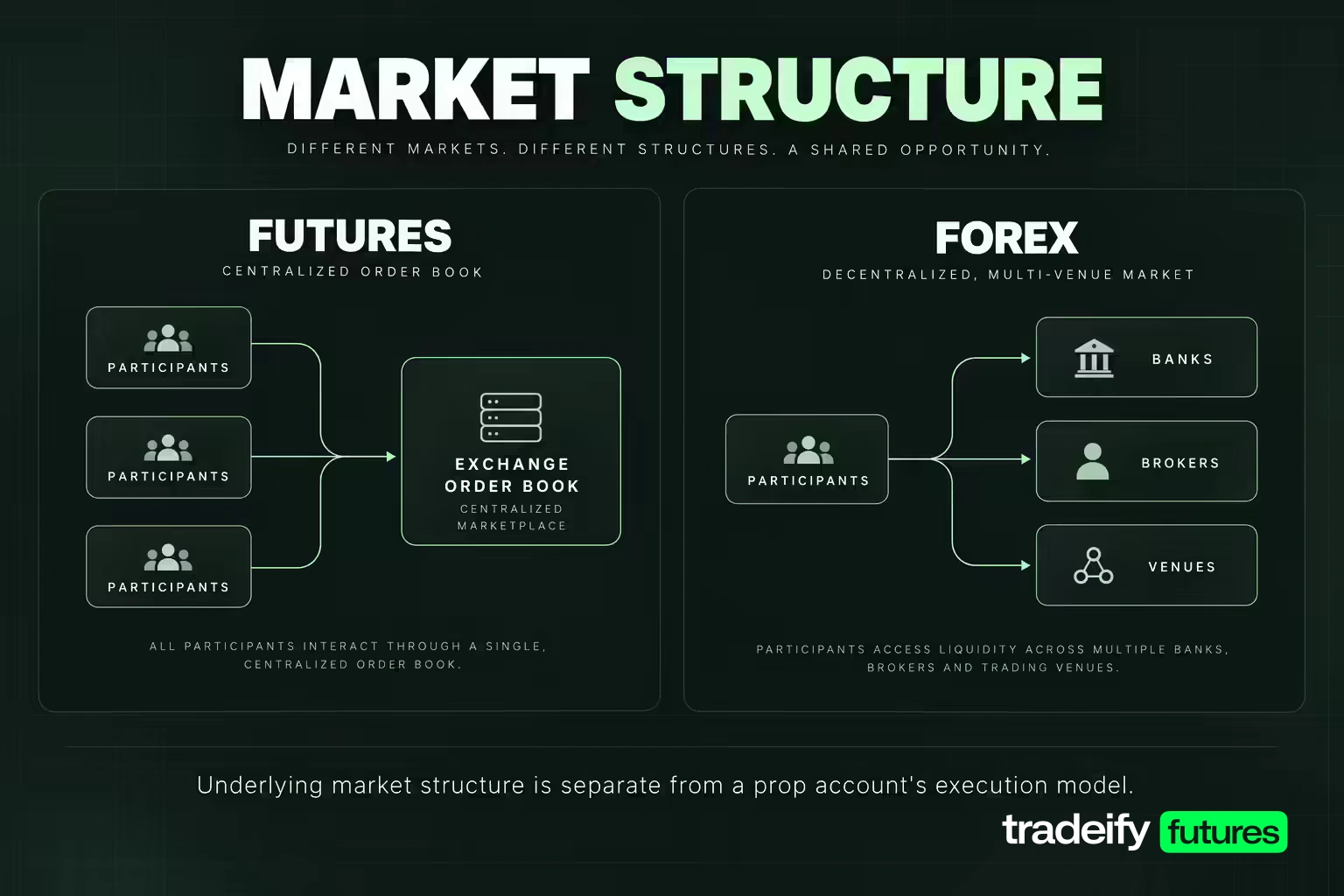
The primary argument for transitioning to futures is the structural superiority of a Centralized Exchange.
CME Group Price Transparency
When you trade futures (e.g., E-Mini S&P 500 or Nasdaq 100), you are trading on a centralized marketplace like the CME Group or the Chicago Board of Trade (CBOT). Every participant, from the retail trader to the institutional hedge fund, sees the exact same price and the exact same volume data.
- No Spread Manipulation: The bid and ask prices are determined solely by the limit orders resting in the order book. A broker cannot artificially widen the spread to stop you out because they do not control the price feed.
- Real Volume Data: In futures, volume is a factual record of contracts traded. In forex, "volume" is merely tick volume (the number of price updates), which varies from broker to broker and does not represent true liquidity.
Depth of Market (DOM)
Professional futures traders rely heavily on the Depth of Market (DOM), which displays the limit orders resting at each price level. This allows traders to see "walls" of support and resistance before price even reaches them.
- Forex Limitation: Because the spot forex market is fragmented across banks and brokers, there is no "central" order book. Forex traders are forced to rely on lagging technical indicators or price action patterns that only show what has happened, not what is about to happen.
- Futures Edge: Order flow analysis using the DOM or footprint charts provides a real-time edge, allowing traders to spot absorption (where aggressive buyers are met with passive sellers) and iceberg orders.
Cost Structure Analysis and the Hidden Tax in Forex Prop Firms
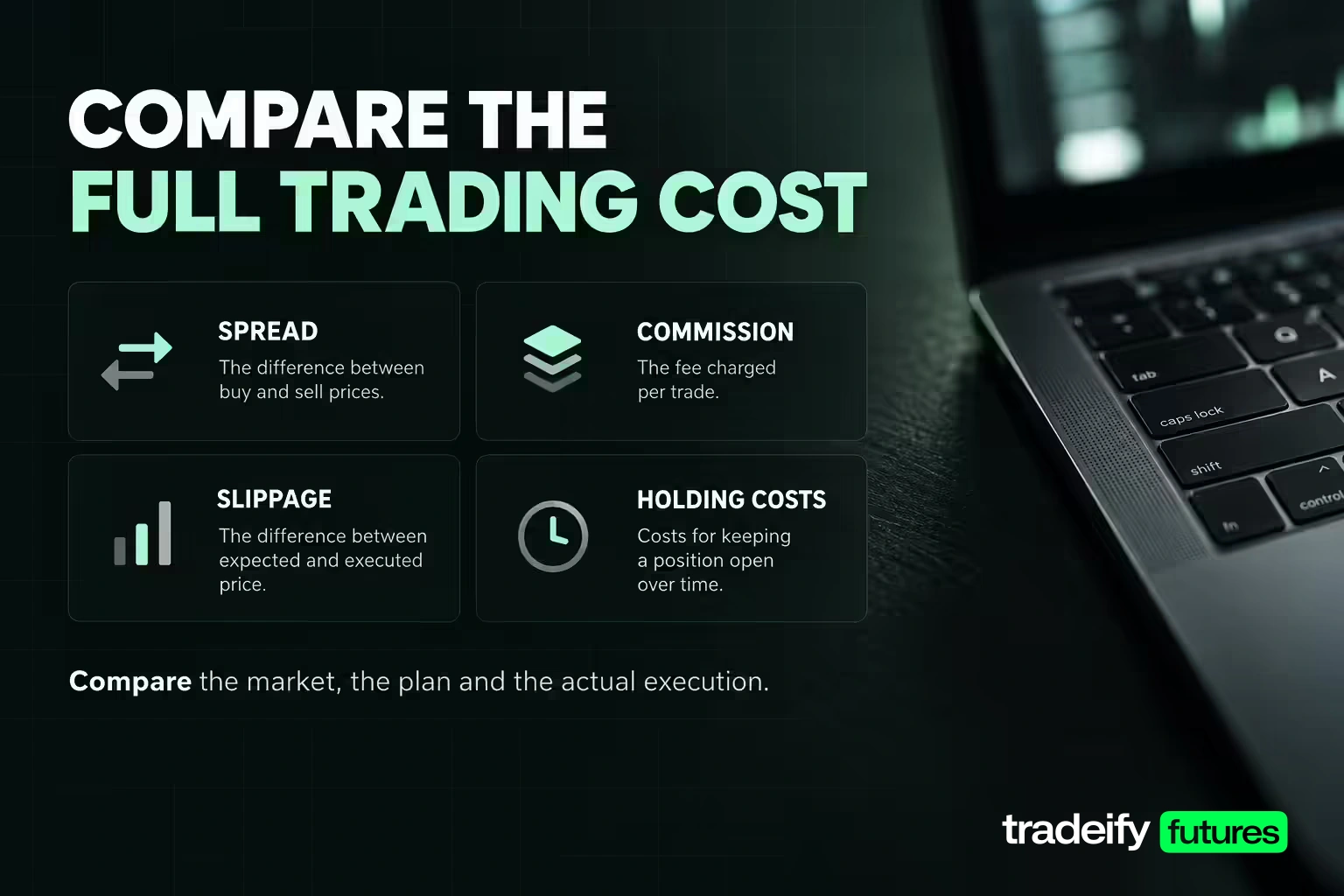
Traders often mistakenly believe forex is "cheaper" because many brokers offer "commission-free" accounts. This is a marketing illusion.
Spreads as a Hidden Tax Within Forex Prop Firms
In forex, the cost of trading is baked into the spread. During volatile sessions, spreads can expand significantly. If a trader is scalping for 10 pips and the spread widens by 2 pips, they have effectively paid a 20% tax on their potential profit. Over thousands of trades, this variable cost creates a massive drag on expectancy.
Fixed Commissions and Cost Certainty in Futures Prop Firms
Futures trading involves a fixed commission per contract (e.g., roughly $4-$5 round trip for an E-Mini contract, depending on the broker). While this is an explicit cost, it is fixed. A futures trader knows exactly what their transaction cost will be, regardless of market volatility. This predictability is crucial for modeling risk and return.
Carrying Cost Differences Between Futures Prop Firms and Forex Swaps
Forex traders holding positions overnight are subject to swap rates (interest rate differentials), which can be negative and eat into profits. Futures contracts do not have daily swap fees; they have an expiration date, and the cost of carry is priced into the contract itself.
Comparing Tradeify Against the Field of Futures and Forex Prop Firms
The operational models of futures and forex prop firms differ significantly in terms of evaluation rules, risk management, and payout reliability.
Evaluation Model Differences in Futures Prop Firms vs Forex
Forex prop firms often lure traders with "no time limit" evaluations and very high buying power (1:100 leverage). However, they frequently employ hidden rules like "relative drawdown" or "consistency rules" that are applied retroactively to deny payouts.
Futures prop firms typically use more transparent, structured evaluations. Tradeify offers multiple evaluation paths designed for different trading styles:
The fastest path to funding. Can be passed in as few as 1 trading day with no consistency rule. Includes a Daily Loss Limit during evaluation (soft breach - trading pauses for the day but account is not failed). Fixed payout policy after passing. Ideal for speed-focused traders.
Requires a minimum of 3 trading days due to the 40% consistency rule (no single day can exceed 40% of total profit). Has NO Daily Loss Limit during evaluation, providing maximum intraday flexibility. After passing, traders choose between two distinct funded paths (Daily or Flex).
For traders who want frequent access to profits. Offers daily payout eligibility with a $1,000 cap (50K accounts) and includes a Daily Loss Limit. Best for traders who prefer smaller, more regular withdrawals.
For traders who want maximum intraday flexibility. Features a 5-day payout cycle with higher caps ($3,000 on 50K accounts) and NO Daily Loss Limit—your only risk limit is the EOD trailing drawdown.
Instant funding with no evaluation required. Bypasses the evaluation process entirely for traders willing to pay a premium for immediate access. Includes gradually increasing consistency requirements (20%, 25%, 30%) and a Daily Loss Limit.
This tiered approach provides transparency forex firms typically lack. Traders know exactly what rules apply to their chosen path, with no retroactive policy changes.
Risk Management and Daily Loss Limits in Futures Prop Firms
Futures firms often enforce Daily Loss Limits as professional risk management tools designed to prevent account blowups. While some traders view this as restrictive, it instills discipline that prevents catastrophic losses.
Tradeify addresses the varied needs of different trading styles through its product structure:
- Growth Evaluation: Includes Daily Loss Limit during evaluation ($1,250 for 50K, $2,500 for 100K, $3,750 for 150K). This is a soft breach - if hit, trading pauses for the day but the account continues. After passing, the funded account maintains the Daily Loss Limit.
- Select Flex: Removes the Daily Loss Limit entirely for funded traders, catering to swing traders who need room for intraday volatility. This addresses a common complaint among forex traders transitioning to futures who find rigid Daily Loss Limits restrictive.
- Select Daily: Maintains a Daily Loss Limit ($1,000 for 50K accounts) but offers daily payout eligibility for traders who prefer rapid access to profits.
This flexibility allows traders to choose the risk framework that matches their strategy, rather than forcing everyone into a one-size-fits-all model.
Payout Reliability in Futures Prop Firms Compared to Forex
A harsh reality of the industry is that payout denials are rampant in the forex prop space, often justified by vague "risk team" assessments or "abusive trading" clauses. Futures firms, operating in a regulated environment with US-based banking partners, have a much higher track record of reliability.
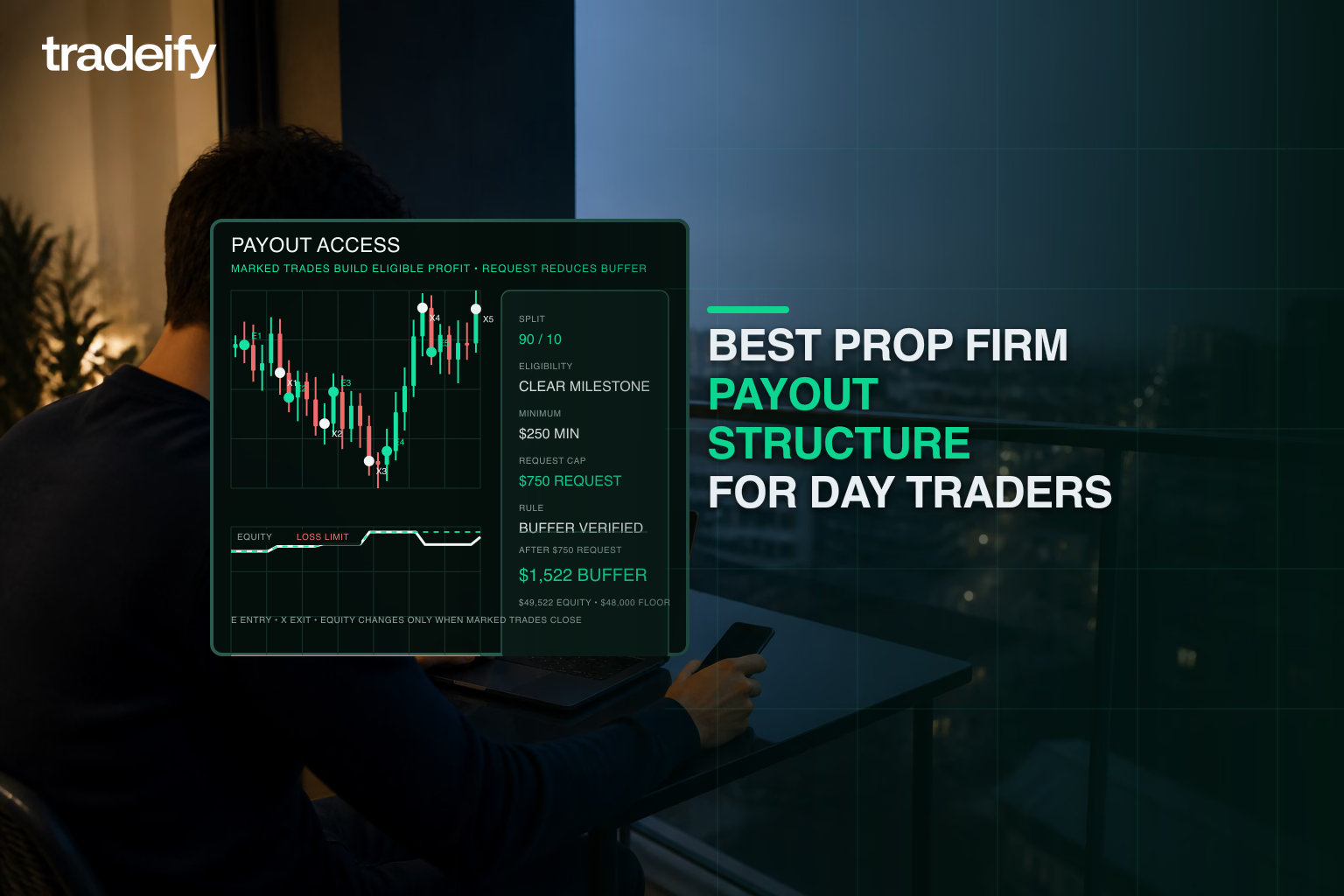
- 90% Profit Split: Industry-leading profit sharing across all funded account types (Growth, Select Daily, Select Flex, and Lightning Funded).
- Streamlined Processing: Payout requests are typically processed within hours, not weeks.
- Transparent Policies: Clear payout frequency rules (5-day cycle for Growth and Select Flex, daily eligibility for Select Daily) with no ambiguous "risk team" reviews that plague forex firms.
- Multiple Payout Methods: Processed via Riseworks and Plane, with options including bank transfer and cryptocurrency.
Operating on the Tradovate platform with direct CME Group exchange access, Tradeify provides infrastructure stability that forex firms dependent on offshore liquidity providers cannot match.
Skill Transfer From Forex Prop Firms to Futures Trading

Can a forex trader's skills transfer to the futures market? The answer is a resounding yes, but with necessary adjustments.
Technical Analysis Transferability Between Forex and Futures Prop Firms
Price action concepts like Support and Resistance, Momentum, and Trend Structure apply universally. In fact, many traders find that these technical levels are more respected in futures markets because of the centralized volume. A support level in the S&P 500 (ES) is backed by billions of dollars in real orders visible on the DOM, whereas a support level in EUR/USD is a composite of various broker feeds.
Adapting Trading Strategies for Futures Prop Firms
- Scalping: Forex scalpers accustomed to MT4/MT5 will need to adapt to DOM-based execution on Tradovate. The speed of execution in futures is generally superior, with no "requotes." Tradeify's Growth Evaluation can be passed in 1 day, making it ideal for scalpers who can quickly demonstrate profitability. Select Daily offers daily payout eligibility for scalpers who want rapid access to profits.
- Intraday Flexibility: Forex traders used to holding positions through volatility will appreciate Tradeify's Select Flex account, which removes the Daily Loss Limit entirely. This means larger intraday drawdowns won't trigger a soft breach—your only risk limit is the End of Day trailing drawdown. The 5-day payout cycle gives you time to build consistent profits between withdrawals.
- Day Trading: Day traders benefit from futures' fixed commission structure versus forex's variable spreads. Both Growth and Select evaluations accommodate day trading styles, with Select offering more intraday flexibility due to the absence of Daily Loss Limits during evaluation.
The Regulatory Framework Safety Net for Futures Prop Firms
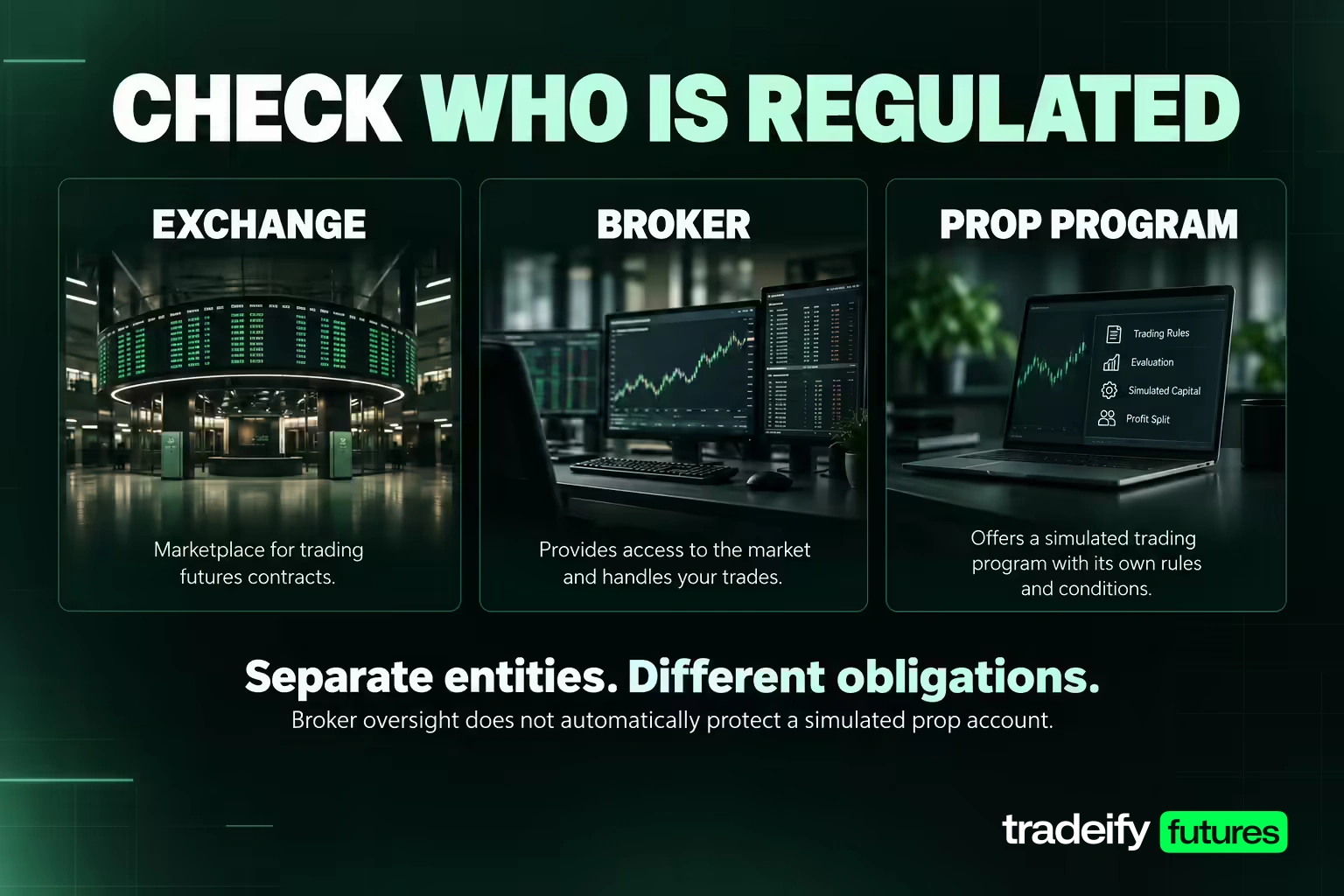
The disparity in regulation is perhaps the most critical differentiator between futures and forex prop trading.
US Regulation Standards for Futures Prop Firms
Futures trading in the United States is overseen by the Commodity Futures Trading Commission (CFTC) and the National Futures Association (NFA). These bodies enforce strict segregation of client funds and fair trading practices. While prop firms themselves are often educational entities, the underlying brokers they use (like Tradovate, which powers Tradeify accounts) are heavily regulated. This regulatory framework provides:
- Mandatory fund segregation
- Regular audits and reporting requirements
- Dispute resolution mechanisms
- Capital adequacy requirements far exceeding offshore standards
Offshore Vulnerability of Forex Prop Firms
In contrast to the US model, the forex prop ecosystem relies on a web of offshore entities. Even with the Seychelles FSA tightening capital requirements to $100,000, the protection offered to a trader in a dispute is minimal compared to US standards. The "reviews less than" search query often reveals horror stories of traders unable to seek legal recourse against entities registered in jurisdictions like St. Lucia or the Marshall Islands. When a forex prop firm collapses (as many did following the 2024 MetaQuotes crackdown), traders have virtually no avenue for recovering funds or challenging payout denials.
Deciding When to Graduate from Forex Prop Firms to Futures
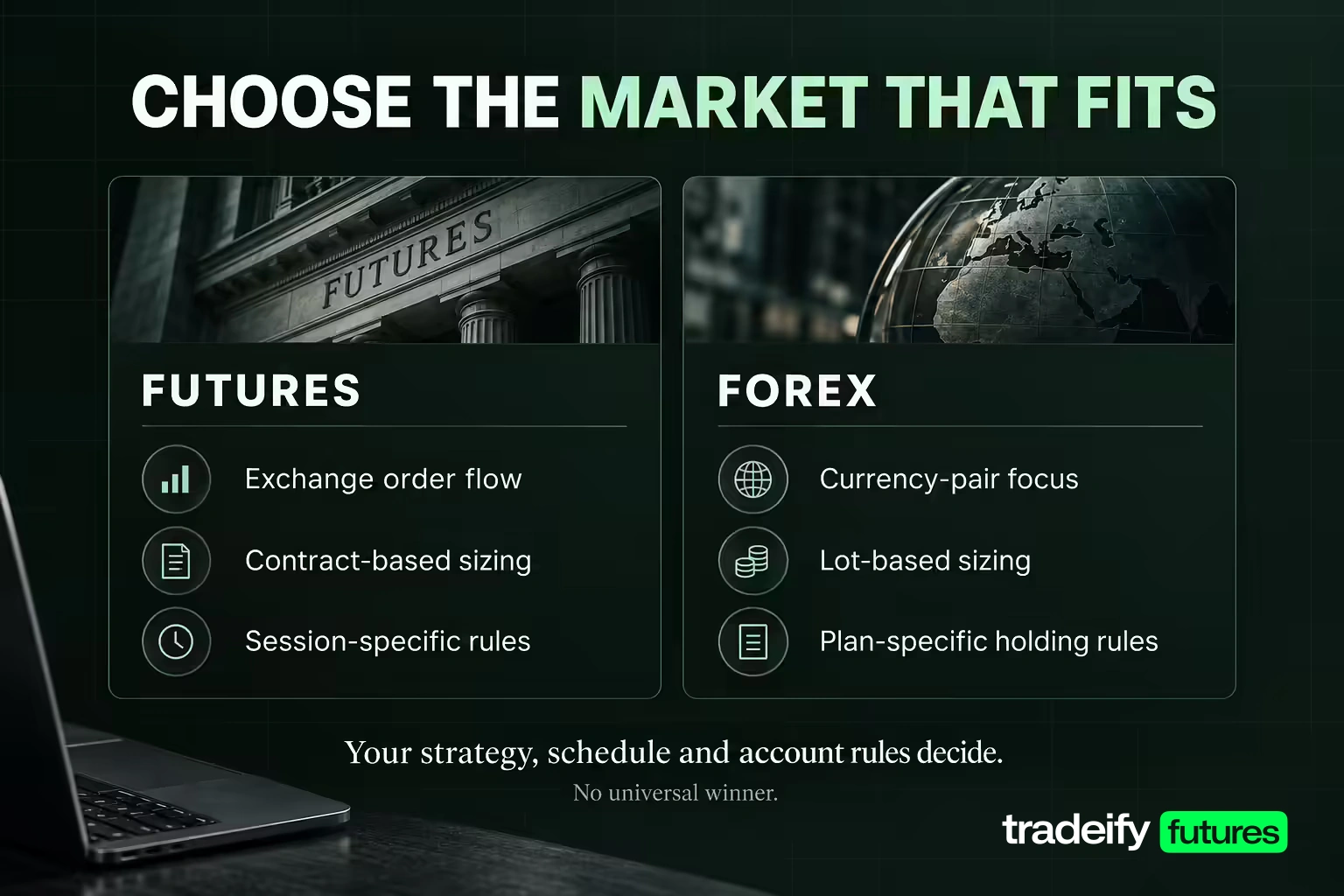
The transition from forex to futures is not just a change of asset class; it is a graduation to a professional trading environment.
Reasons to Remain
- You are trading with micro-accounts (under $500) and require the ability to trade nano-lots.
- You require 24/5 continuous trading without the 1-hour daily maintenance break found in futures (CME Group markets close from 5:00 PM to 6:00 PM EST for settlement).
- Your strategy specifically relies on currency correlations or forex-specific fundamentals.
Prefer currency pairs? Explore Tradeify FX and review its account rules and country eligibility before choosing a program.
Reasons to Graduate
- Transparency: You want to see real volume and trade on a centralized exchange where the broker cannot manipulate price. Tradeify operates on Tradovate, Rithmic, and TradeSea, providing direct CME Group access.
- Reliable Payouts: You are tired of "payout denials" based on vague terms of service violations. Tradeify offers clear, transparent payout policies with 90% profit splits.
- Professionalism: You understand that paying a fixed commission is better than paying a variable, hidden spread tax.
- Stability: You want a platform that won't disappear overnight due to software licensing crackdowns.
- Flexibility: You want evaluation options that match your trading style—from the 1-day speed of Growth to instant Lightning funding.
.svg)
.svg)
.svg)
.svg)






.webp)