.svg)

.svg)
.svg)


TL;DR: Successful prop firm trading requires mastering intraday futures volatility. Data confirms a liquidity sequence: Gold (08:20 ET) → Oil (09:00 ET) → Equities (09:30 ET). Traders must avoid the "Dead Zone" (11:30-13:30 ET) where intraday futures volatility drops 40%, increasing false breakout risks. Prop candidates should favor the S&P 500 (ES) over the Nasdaq-100 (NQ), as NQ exhibits 7x the volatility range, endangering drawdown limits. Intraday trading simply means opening and closing inside the same session, and on futures that same-session focus removes overnight gap risk while concentrating the opportunity into a few liquid windows.
Key Takeaways on Intraday Futures Volatility
- Timing Protects Drawdown: Understanding intraday futures volatility allows prop traders to avoid low-liquidity periods that cause "chop" and unnecessary losses. Trading the wrong asset at the wrong time (e.g., NQ during the midday lull) statistically increases failure rates.
- The Liquidity Sequence: Intraday futures volatility arrives in waves: Gold (GC) at 8:20 AM ET, Crude Oil (CL) at 9:00 AM ET, followed by the Equity Indices (ES/NQ) at 9:30 AM ET.
- Asset Selection: The Nasdaq-100 (NQ) has an extreme intraday futures volatility profile compared to the S&P 500 (ES). NQ requires distinct risk management strategies for evaluation accounts.
- The Dead Zone: Volume and intraday futures volatility drop significant between 11:30 AM and 1:30 PM ET, a high-risk zone for trend-following strategies due to a 60% probability of false breakouts.
Introduction to Intraday Futures Volatility Cycles
"Market timing" is a survival skill for passing prop firm evaluations. If you trade during the wrong intraday futures volatility cycle, you increase the probability of hitting your daily loss limit.
Global markets do not move linearly. They have distinct "heartbeats" pulsing with liquidity. This report analyzes 13 years of data to map intraday futures volatility for the Nasdaq-100 (NQ), S&P 500 (ES), Crude Oil (CL), and Gold (GC), helping Tradeify candidates align their execution with institutional flow.
What Intraday Trading Means
Intraday trading means opening a position and closing it inside the same trading session instead of carrying it overnight. The CFTC glossary defines a day trader as a trader who takes positions and then offsets them during the same trading session prior to the close of trading, and draws the line against a position trader who holds contracts for an extended period.
Futures make that definition concrete. ES, NQ, CL, and GC trade on a nearly round-the-clock CME Globex session, and each product moves through documented market states that CME Group publishes as pre-open, open, paused, and closed. A futures intraday trade therefore lives inside a long session that still has a defined close and a defined maintenance window, which is why the same-session rule needs a clock rather than a date.
In the share market the idea is the same but the risk framing is blunter. The SEC's investor education site describes day trading as rapidly buying, selling, and short-selling throughout the day in the hope that price keeps moving the trader's way for the seconds or minutes they hold, and states plainly that day trading is extremely risky and can result in substantial financial losses in a very short period. The futures version adds a fixed tick value and a daily loss rule, so the risk has to be defined before the session starts rather than managed after the first loss.
For a prop trader the practical meaning is narrower than the dictionary one. You are not trading simply because the market is open. You are trading the specific windows where a mapped contract has enough participation to fill you cleanly, and sitting out the rest of the session is part of the same plan.
The Tradeoffs of Intraday Trading
The case for trading intraday is a risk-shape argument, and the case against it is a cost-and-noise argument. Both are real, and the honest read is that the style suits some accounts and setups better than others. The advantages first.
- No overnight gap risk. A position that is flat at the close cannot be gapped against before the next session opens. On an account with a trailing drawdown, that removes a class of loss you cannot manage from the desk.
- More repetitions. A full session offers several defined windows to work one setup, so a small statistical edge can be sampled often enough to show up in a record.
- Same-day feedback. P&L, rule compliance, and execution quality are visible before you close the platform, which makes a written log useful immediately rather than weeks later.
- Smaller capital per idea. Index and energy futures let a starter account take a meaningful position without tying up a large balance.
The disadvantages sit on the other side of the same trade.
- Costs add up fast. Commission plus even one tick of slippage on every round turn becomes material when the number of trades rises.
- Noise is the default condition. The SEC's own warning that day trading is extremely risky and can produce substantial losses quickly is a fair description of an unprepared trader's first month.
- Presence is mandatory. The windows that pay are a small part of the day, so the work happens on the market's schedule rather than yours.
- Rules bite harder. A daily loss limit turns an ordinary losing morning into a hard stop for the session, which is the point but is still uncomfortable.
The choice between the two columns is not philosophical. If your edge depends on a slow, multi-day trend, intraday execution cuts it off at the close. If your edge depends on reacting to order flow in a liquid window, holding overnight only adds risk you were not being paid for.
Intraday Trading Compared With Other Styles
Intraday trading is one point on a spectrum that runs from seconds to years, and the CFTC's glossary names the neighbouring styles precisely. A scalper buys and sells rapidly and holds for only a short time inside a session, often buying just below the last price and selling just above it. A day trader offsets the position before the close of the same session. A position trader buys or sells and holds for an extended period, which is the opposite end of the same scale.
- Scalping. Same-session like intraday trading, but measured in minutes and looking for a fraction of the day's range, with far more round turns.
- Day trading. The intraday case this post covers, opened and offset within one session.
- Swing trading. The middle ground, where a position is held across several sessions and the overnight moves are part of the plan rather than a risk to avoid.
- Position trading. Buys or sells and holds for an extended period, judging the trade on a weekly or monthly horizon where a single session's range is noise.
- Investing or delivery. Taking ownership and holding across many sessions, which does not use intraday volatility at all.
Which style fits a funded futures account depends on what the rules and the drawdown can absorb. A same-session approach keeps the risk inside the hours you can watch, and the windows below are the part of the day where that approach has the most participation behind it.
Research Context on Intraday Futures Volatility
Academic research has documented intraday futures volatility patterns for over three decades. Chan, Chan, and Karolyi (1991), writing in the Review of Financial Studies, established the canonical U-shape intraday pattern across stock index and stock index futures markets and documented intermarket dependence between cash and futures returns. Daigler (1997), in the Journal of Futures Markets, extended this work to test broader theories of intraday futures volatility behavior across equity, energy, and metals contracts. These foundational papers anchor the framing used throughout this report: intraday volatility is not random, it follows a predictable institutional rhythm that prop traders can read and respect.
Methodology for Quantifying Intraday Futures Volatility
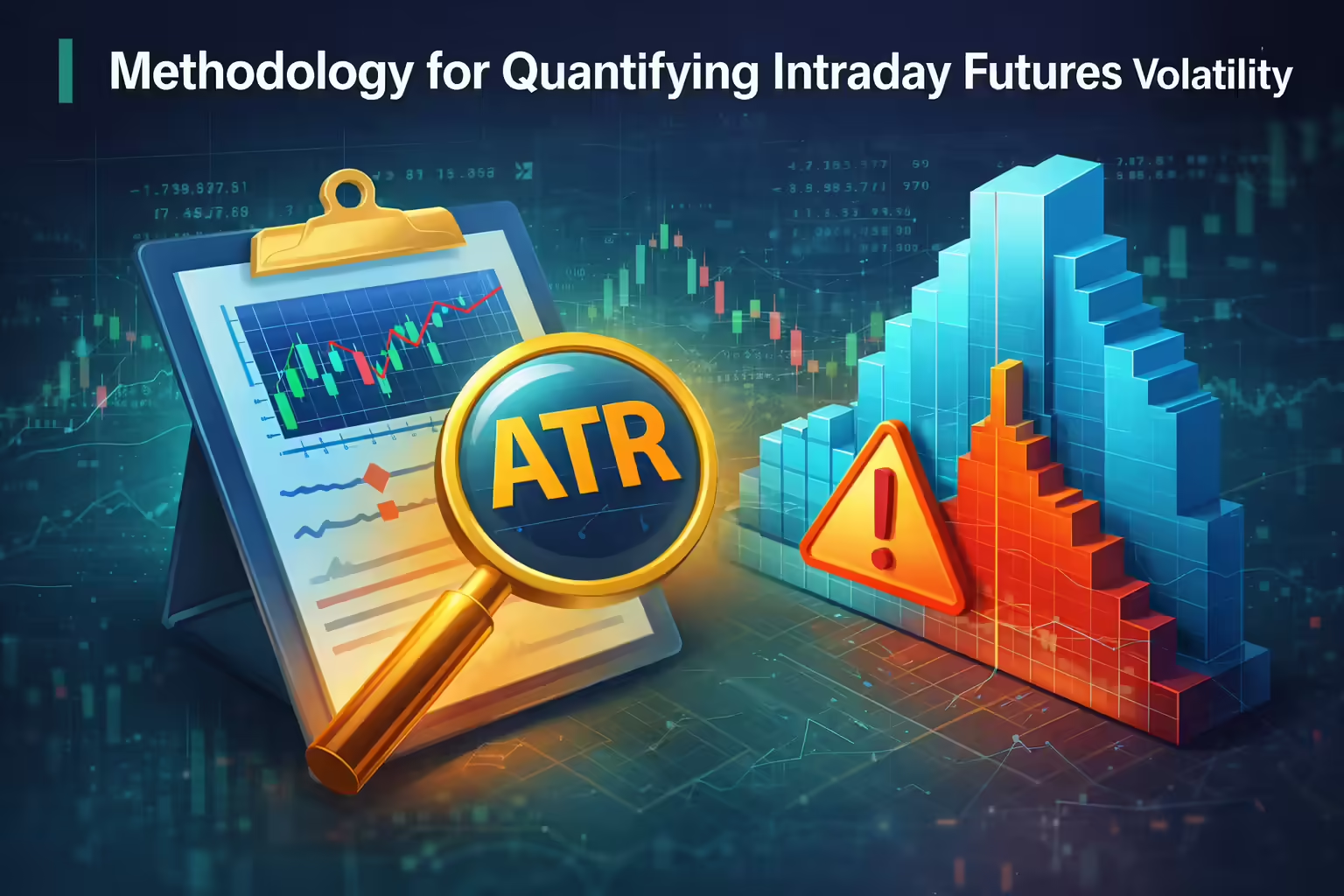
To establish authority, we define how intraday futures volatility is measured in the context of risk management and opportunity cost.
Average True Range (ATR) and Volatility
Standard deviation measures dispersion, but for the prop trader, the ATR is the best metric for intraday futures volatility. It measures the "tradable space" of a contract, helping you calculate stop-loss width relative to your account size. We analyze hourly ATR to determine expected ranges.
Volume Profile Analysis
Volatility without volume is dangerous. It leads to slippage. We cross-reference intraday futures volatility spikes with Volume Profiles to distinguish between "healthy volatility" (trend potential) and "thin volatility" (stop runs) often found in the Dead Zone.
The Baton Pass Across the Morning Session
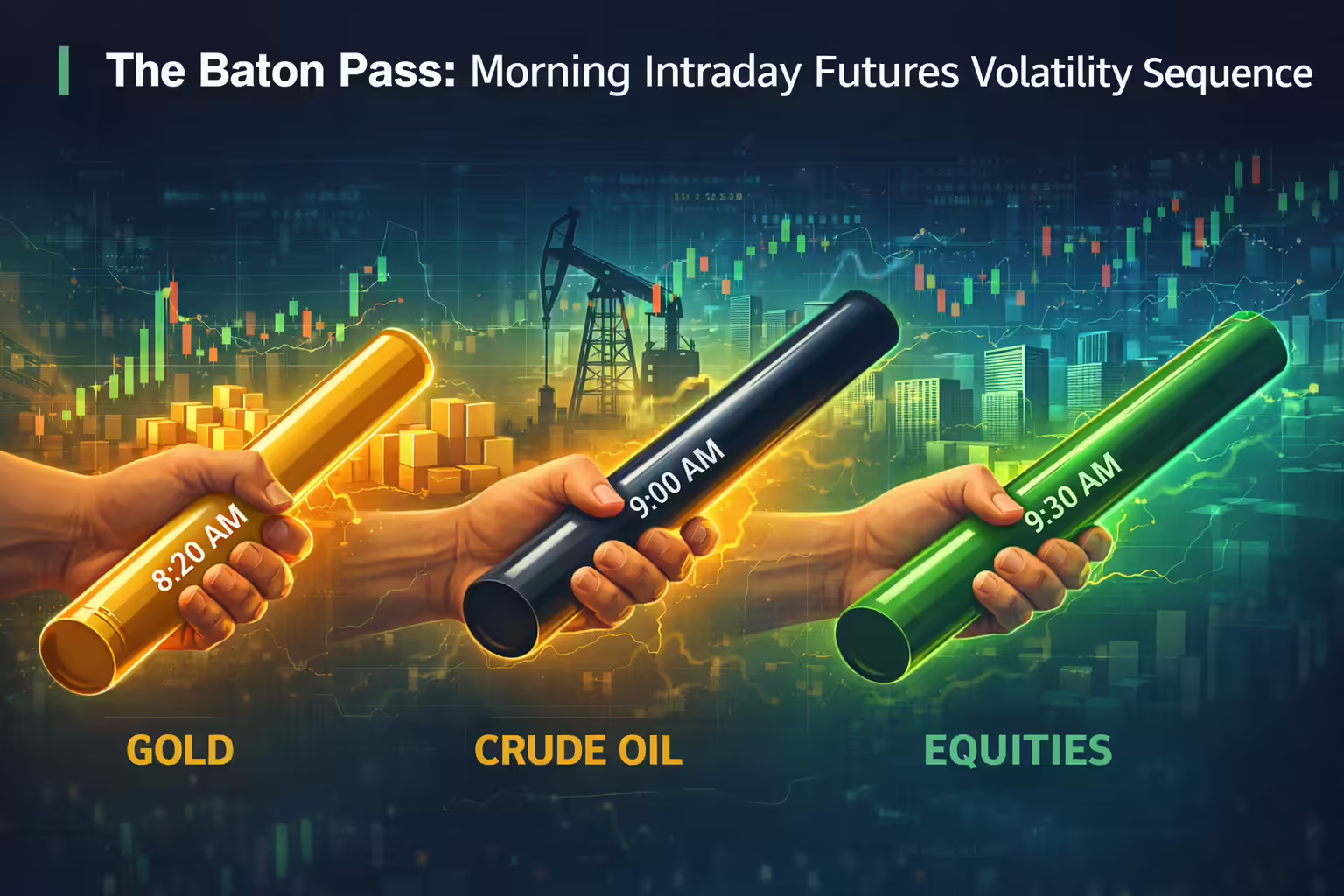
Liquidity arrives in a sequence. Understanding this "Baton Pass" of intraday futures volatility helps traders rotate their focus to the most active asset.
Gold (GC) and the Early Metals Open
The session begins with the COMEX open. A spike in intraday futures volatility here often acts as a leading indicator for broader market sentiment. Strategic Insight: The 8:20 AM to 9:00 AM window offers a "clean" look at risk sentiment without equity noise.
Crude Oil (CL) and the Energy Sector Open
As Gold stabilizes, Crude Oil intraday futures volatility ignites at the NYMEX open. This is the ideal time to shift focus from metals to energy.
Warning: Be aware of WTI Inventories on Wednesdays at 10:30 AM ET, a massive volatility event.
Equity Indices and the Peak Morning Open
The NYSE open triggers the highest intraday futures volatility of the day. For prop traders, this "Amateur Hour" (9:30-10:00 AM) is dangerous due to erratic whipsaws. A volatility spillover often occurs here; if equities gap down, expect instant reaction in Gold and Oil.
Intermarket Dependence and Volatility Spillover
The "Baton Pass" pattern aligns with what the academic literature calls intermarket dependence. Chan, Chan, and Karolyi (1991) showed that price innovations in either the cash or futures markets help predict future volatility in the other, meaning a gap in S&P 500 cash on the NYSE open does not stay quarantined in ES; it produces an immediate volatility response in GC and CL as well. For prop traders, this means the rotation order (GC → CL → ES) is bidirectional after the cash open, and an unexpected move in one contract can shift the volatility regime in the others within minutes.
Intraday Futures Volatility Profiles for NQ and ES
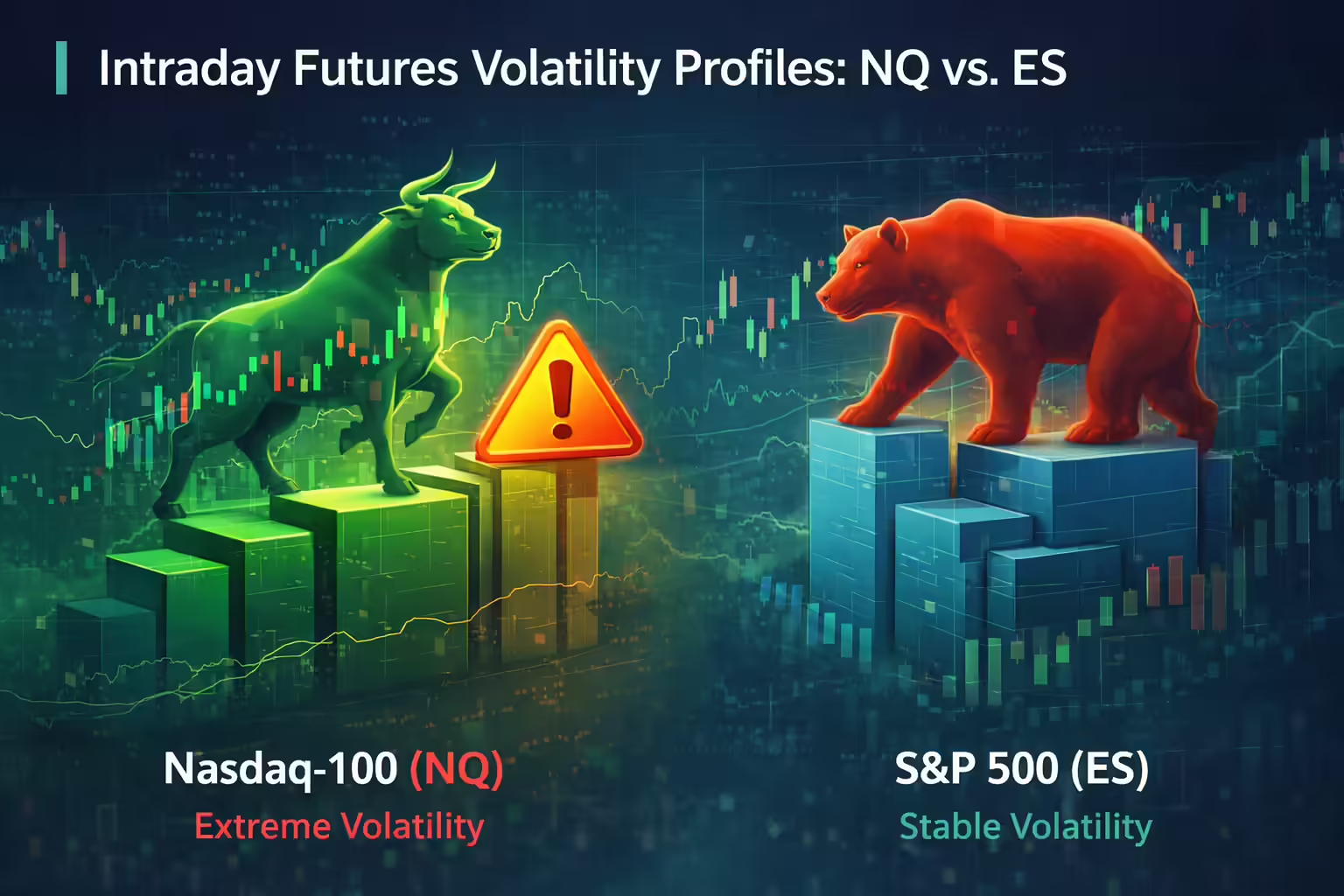
Choosing between NQ and ES is a choice between two distinct intraday futures volatility profiles, directly impacting your evaluation's trailing drawdown.
The Drawdown Danger Zone
- Nasdaq-100 (NQ): Extreme intraday futures volatility. Data shows it moves ~7x the point range of ES. A standard move can trigger a $500+ swing in seconds, endangering daily loss limits.
- S&P 500 (ES): Stable intraday futures volatility. "Thicker" liquidity makes it safer for holding trades without violating risk rules.
Comparison of Intraday Futures Volatility Ranges
| Asset | Symbol | Tick Value | Avg Daily Range (Points) | Avg Daily Range ($ Value) | Volatility Profile |
|---|---|---|---|---|---|
| Nasdaq-100 | NQ | $5.00 | ~250 - 350 | $5,000 - $7,000 | Extreme / Whipsaw |
| S&P 500 | ES | $12.50 | ~40 - 60 | $2,000 - $3,000 | High / Stable |
| Crude Oil | CL | $10.00 | ~1.50 - 2.50 | $1,500 - $2,500 | High / Event-Driven |
| Gold | GC | $10.00 | ~20 - 30 | $2,000 - $3,000 | Moderate / Trending |
Strategic Recommendation: If you are struggling with drawdown management, switch to ES. The NQ's $5,000+ daily range requires reduced contract sizing to survive its aggressive intraday futures volatility.
The Dead Zone in Intraday Futures Volatility
Over-trading during low intraday futures volatility is a primary cause of failure. The period between 11:30 AM and 1:30 PM ET is known as the "Dead Zone."
The Drop in Intraday Futures Volatility
- Volume Drop: Intraday futures volatility and volume drop 30-40% as institutional desks break for lunch.
- Prop Firm Risk: Breakouts fail frequently here (False Breakouts > 60%). Trading this zone statistically increases the chance of "death by a thousand cuts" (small accumulated losses).
- The Rule: Protect your morning gains. Flatten positions or reduce risk significantly during this window.
The Power Hour and Closing Intraday Futures Volatility
As the low-volume midday session concludes around 2:00 PM ET, institutional desks return, and the session's intraday range reopens. Intraday futures volatility spikes into the close (3:00 PM - 4:00 PM ET) as Mutual funds execute "market-on-close" (MOC) orders. Interestingly, volatility in the opening hour (9:30) often predicts the intensity of this closing hour.
VIX and VX Futures as Pure Volatility Instruments
The instrument most often discussed alongside intraday futures volatility is the Cboe Volatility Index (VIX) and its tradable derivative, VX futures, the only listed futures contract that gives traders direct exposure to expected 30-day S&P 500 volatility. According to Cboe, VX futures trade on the Cboe Futures Exchange (CFE) with both standard monthly and weekly VIX expirations, and settle to a Special Opening Quotation (SOQ) of the VIX Index. Cboe also lists Variance Futures for traders looking to isolate realized variance from option-implied volatility.
Why Prop Traders Typically Stay in ES and NQ
While VX is the cleanest expression of volatility itself, most prop firm evaluations and funded accounts focus on the more liquid equity index contracts (ES, NQ) and energy/metals (CL, GC) discussed in the rest of this report. VX has thinner intraday volume than ES, wider spreads than NQ at most times of day, and a term-structure profile that punishes traders who hold positions through SOQ settlement without understanding contango and backwardation. For a prop candidate working a tight trailing drawdown, the same volatility signal can be read through the VIX level as a regime indicator while execution stays in ES or NQ.
Regime Filter: Use VIX as a daily filter. Elevated VIX calls for smaller size in NQ and tighter stops in ES. Compressed VIX reinforces the case for avoiding the Dead Zone, where suppressed volatility produces the highest false breakout rate.
Visualizing Intraday Futures Volatility Data
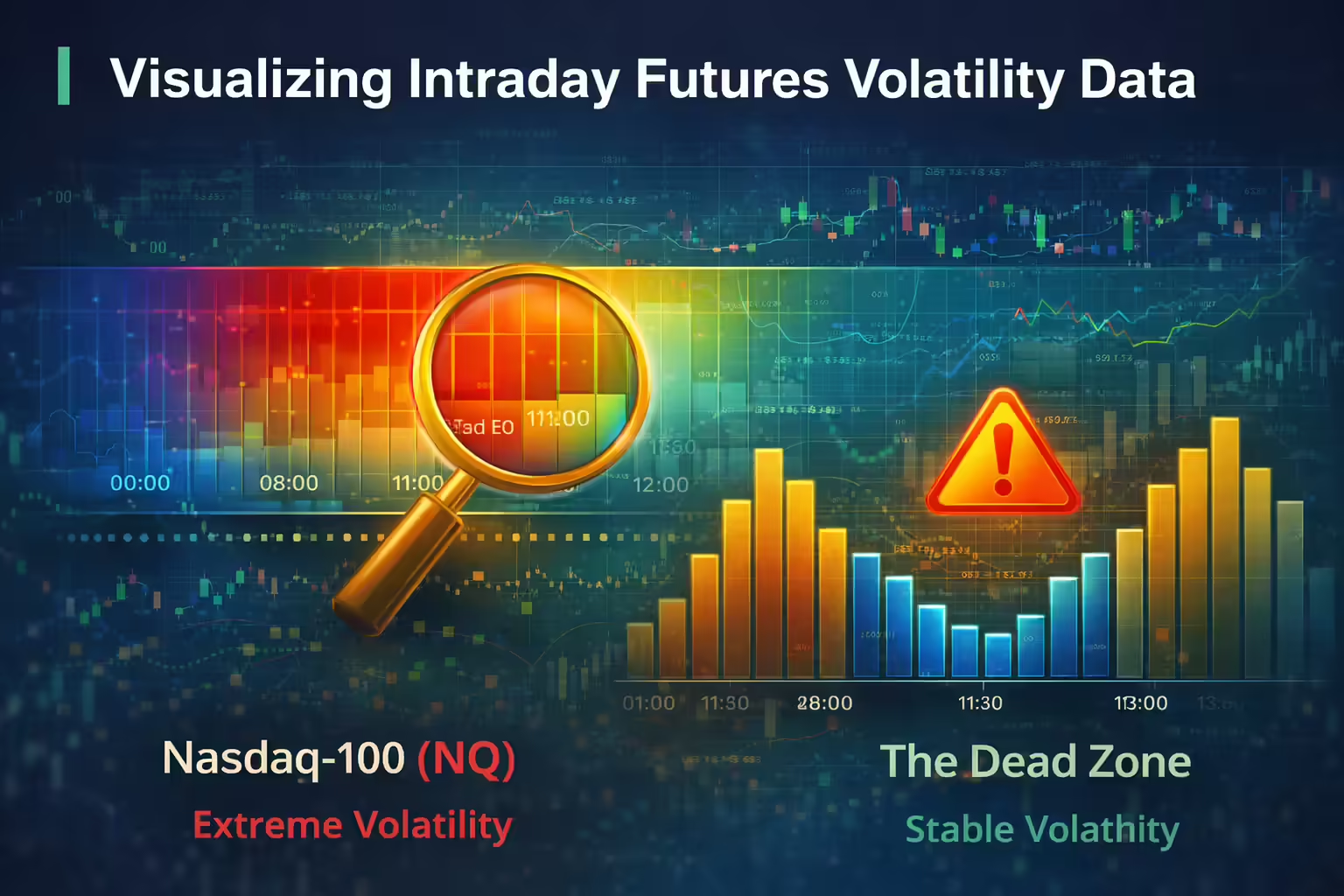
Two visualization concepts summarize the intraday futures volatility cycle for traders working a prop evaluation:
The Heat Map for Intraday Volatility
- Visual: A color-coded timeline (00:00 – 24:00 EST).
- Data: Highlight the overlap of GC, CL, and ES opens (08:20-11:00 AM) in Red (High Volatility) vs the Lunch Lull in Blue (Low Volatility).
The Dead Zone Bar Chart
- Visual: Vertical bars representing hourly volume showing a "U-shape" valley midday.
- Insight: Visually proves the drop in intraday futures volatility that leads to false breakouts.
Applying Intraday Futures Volatility to Prop Strategies
To pass your Tradeify evaluation, use this intraday futures volatility analysis to create strict rules, the same way a one-trade-a-day plan reduces decisions:
Avoid the Dead Zone: Stop trading when intraday futures volatility drops at 11:30 AM ET.
Size for Volatility: If trading NQ, reduce size to account for its higher intraday futures volatility ($ value per range).
Respect the Sequence: Don't force NQ trades at 8:30 AM; liquidity is in Gold. Rotate your watch list.
Wait for the Setup: Let the initial 9:30 AM intraday futures volatility settle (Amateur Hour) before entering trend positions.
A Step-by-Step Intraday Futures Walkthrough
The analysis above is only useful if it turns into a repeatable sequence. This is one version of that sequence for a single trade, using the windows and ranges already mapped in this post.
- Read the calendar before the session. Mark scheduled releases and the contract's maintenance window so you are not holding size into a known event.
- Pick the window before you pick the contract. Gold at 8:20 AM ET, Crude Oil at 9:00 AM ET, and the equity indices at 9:30 AM ET are the liquid opens this post maps. Choose the window first, then the contract that belongs to it.
- Size to the day's range, not to a round number. The comparison table lists NQ at roughly 250 to 350 points of average daily range against 40 to 60 points for ES. The same contract count is not the same risk in the two markets.
- Let the opening burst settle. The 9:30 AM ET open produces the widest swings of the day. Waiting for the first move to resolve is the difference between trading a level and trading an impulse.
- Put the stop where the idea is wrong, then leave it. A stop inside the normal noise of the window you chose converts ordinary movement into a loss.
- Reduce through the Dead Zone. The stretch between 11:30 AM and 1:30 PM ET is where breakouts fail most often in this data. Protecting the morning result is the rule, not the exception.
- Log the trade against the rule you used. The next session's size should come from that record rather than from how the last trade felt.
A worked example makes the sizing step concrete. Take a trader whose plan allows one ES trade a day at the 9:30 AM ET open and whose stop is a fixed number of points. Because the table puts ES at roughly 40 to 60 points of average daily range against roughly 250 to 350 for NQ, that same fixed stop is a far larger share of an NQ day than of an ES day. A trader who sizes by contract count rather than by the day's range is taking close to seven times the dollar risk on the NQ version of what looks like the same trade.
The second example is a timing decision rather than a sizing one. A trader who is still holding the opening NQ position at 11:30 AM ET is now trading into the window where this post's data shows volume and volatility dropping 30 to 40 percent and breakouts failing more often. Flattening into that window protects the morning's result, and the same choice repeated across a month is what keeps a funded account inside its loss limits.
Frequently Asked Questions About Intraday Futures Volatility
What is the VIX and how does it relate to intraday futures volatility?
The Cboe Volatility Index (VIX) measures the market's expectation of 30-day S&P 500 volatility implied by SPX options. Intraday spikes in VIX typically coincide with intraday spikes in ES and NQ volatility, but VIX itself is an index, so to trade it directly you use VX futures, weekly VIX futures, or Variance futures on the Cboe Futures Exchange. For prop traders, the VIX level acts as a regime filter: high VIX days call for smaller size in ES and NQ; low VIX days reward patience around the Dead Zone.
Why is intraday futures volatility U-shaped?
The U-shape of high volatility at the open, a midday lull, and a second spike into the close was documented in Chan, Chan, and Karolyi (1991) and confirmed in subsequent literature. The pattern reflects overnight information getting priced in at the open, the lunchtime drop in institutional participation, and the return of mutual-fund and rebalancing flow into the close.
Which futures contract is most volatile intraday?
Among the contracts analyzed in this report, the Nasdaq-100 (NQ) shows the most extreme intraday futures volatility on a dollar-range basis, roughly seven times the point range of the S&P 500 (ES) per the comparison table above. Crude Oil (CL) becomes the most volatile on Wednesdays around the 10:30 AM ET EIA inventories release. Gold (GC) is the most subdued of the four during the regular cash session.
What is intermarket dependence?
Intermarket dependence is the empirical finding from Chan, Chan, and Karolyi (1991) that price innovations in either the cash or futures markets help predict future volatility in the other. In practical terms for a prop trader, this means a gap in S&P 500 cash on the NYSE open typically triggers an immediate volatility response in ES, GC, and CL, not just SPX.
Should prop firm candidates trade VX futures during an evaluation?
Most prop firm evaluations focus on the more liquid equity index and energy/metals contracts because their intraday volatility profiles are easier to size against a trailing drawdown. VX futures can spike or collapse on event days in ways that are difficult to control on a small account. Reading VIX as a regime indicator while executing in ES or NQ is the more conservative path through an evaluation.
What Does Intraday Mean?
Intraday means inside a single trading day. For a futures trader it describes a position that is opened and closed within the same session rather than held overnight, so the trade is judged on the movement available between the open and the close.
What Is the Difference Between Daily and Intraday?
Intraday covers everything that happens within one session. Daily describes the summary of that session, such as a daily bar or a daily range. A daily trader holds across sessions and accepts overnight risk, while an intraday trader is flat before the close.
What Is an Example of Intraday Trading?
A single ES trade taken at the 9:30 AM ET equity open and closed before the 11:30 AM ET Dead Zone is a clean example. The position exists only inside the most liquid window of the session, uses a stop sized to the day's range, and carries no overnight gap risk.
Final Thoughts on Intraday Futures Volatility Analysis
By respecting the natural cycles of intraday futures volatility, you transform market movement from a risk into an edge. Use this data to protect your capital and pass your evaluation.
.svg)
.svg)
.svg)
.svg)






.webp)