



TL;DR: Accountability for traders means checking every trade against a rule you wrote first, then acting on the gap. It is hard because a broken rule often pays for a while. In 20 years of E-mini data, buying breakouts a rule refused lost 0.17R each yet stayed in the green for 203 straight breaks. Count your breaks, keep the running total and give the count to someone.
Price pokes through the level you have been watching all morning. Your rule says wait for the close. The move is already running, nobody is looking over your shoulder, and the buy button is right there.
When you trade alone, nobody fines you for that click. Nobody asks why you dragged a stop or bought a level the plan said to skip. The rule is enforced by memory, and memory is generous about a decision that felt reasonable at the time.
That is the real problem behind accountability for traders. Most people who look it up already have rules. What they are missing is a system that notices when a rule breaks and puts a price on it before the account does, because the account is slow to send the bill.
This guide covers what trading accountability means, why it slips, how to write rules you can be held to, what one broken rule cost on 20 years of E-mini S&P 500 futures data, and the journals, reviews, partners, communities and tools that keep the record honest.
What Accountability Means for Traders
Accountability for traders is the practice of measuring what you actually did against what your written rule said you would do, and owning the difference. It has three parts: a rule written before the trade, a record of every decision against that rule, and a consequence when the two disagree.
It is not the same as discipline. Discipline is following the rule in the moment. Accountability is the system that tells you whether your discipline is holding, and what to do when it is not.
It is also not blame. Personal trading responsibility means the market, the news, the platform and the other traders in the room are all inputs you planned for, or should have. A slippage fill on a news spike is a cost of a decision you made to be in that position. That framing is useful because it puts every fix inside your control.
Owning a loss looks like this in practice:
- "The trade lost because the market reversed" is a description.
- "I entered before my confirmation rule triggered, and that break cost 1R" is accountability.
- "My rule took the trade, the stop was hit, and that is a normal loss" is also accountability, and it needs no fix.
The third line matters. An accountable trader does not punish every loss. A loss taken exactly as planned is a correct decision with a bad outcome. A win taken by breaking a rule is the opposite, and it is the one that quietly trains the next break.
Related lesson: The discipline this record checks
Why Trading Accountability Slips When Nobody Is Watching
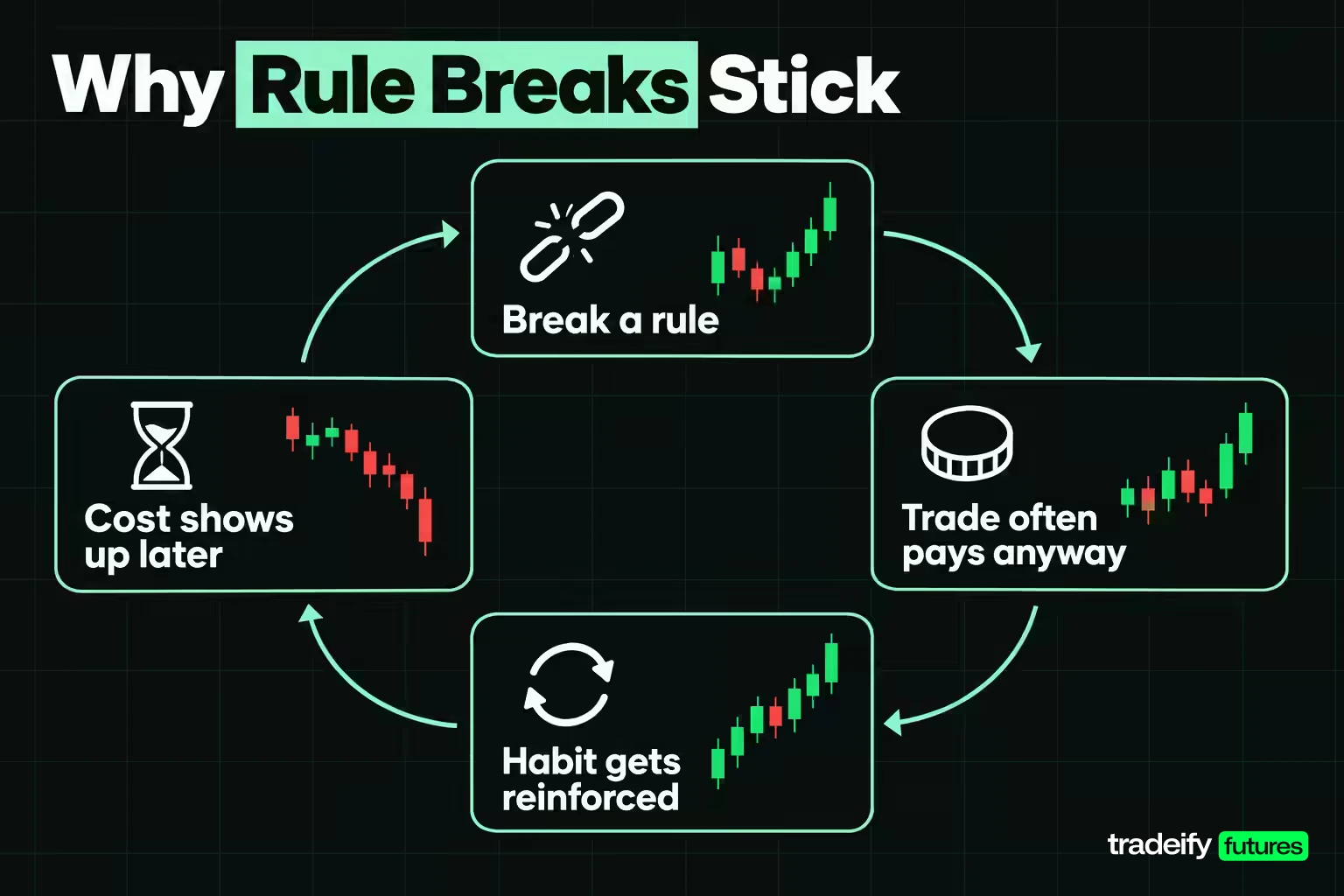
Trading accountability slips for reasons that have little to do with character. A trader at a desk has a manager who knows the limits. A solo trader has a rule, a screen and a story they tell themselves afterwards. Four forces work on that story.
Delayed Consequences Traders Rarely Feel
Most rule breaks do not cost money on the trade where they happen. A stop dragged lower often recovers. A breakout bought early often runs. The cost shows up later and only on average, so the feedback that would correct the habit arrives months after the habit has formed. In a 20-year test of one E-mini S&P 500 breakout rule, a losing rule break stayed net positive for 203 breaks in a row before the running total turned.
Outcome Bias and a Trader's Memory
Traders, like everyone, tend to credit wins to skill and losses to bad luck. That bias is quiet when nobody else reads your record. It also pairs with outcome bias: judging a decision by how it turned out rather than by whether it followed the rule. A rule break that paid gets remembered as good judgment.
Fatigue at the End of a Trader's Session
Late in a trading session, after a string of decisions and a loss or two, the rule starts to feel like a suggestion. That is when a trader adds one more trade to get back to even, or widens a stop to avoid a second red day. More willpower rarely fixes it. A decision made in advance, while calm, about what happens at a given trigger usually does.
An Accountable Trading Mindset
A trading mindset that supports accountability treats the plan as the decision and the live trade as execution. Research on "if-then" plans backs this up: a meta-analysis by Gollwitzer and Sheeran covering 94 independent tests found that implementation intentions, plans in the form "if situation Y occurs, I will do X", had a medium-to-large effect on reaching goals. For a trader, that means writing "if price closes below my stop level, I exit at the next open" rather than "I will respect my stops".
Related lesson: The psychology behind these lapses
Personal Trading Rules You Can Be Held Accountable To
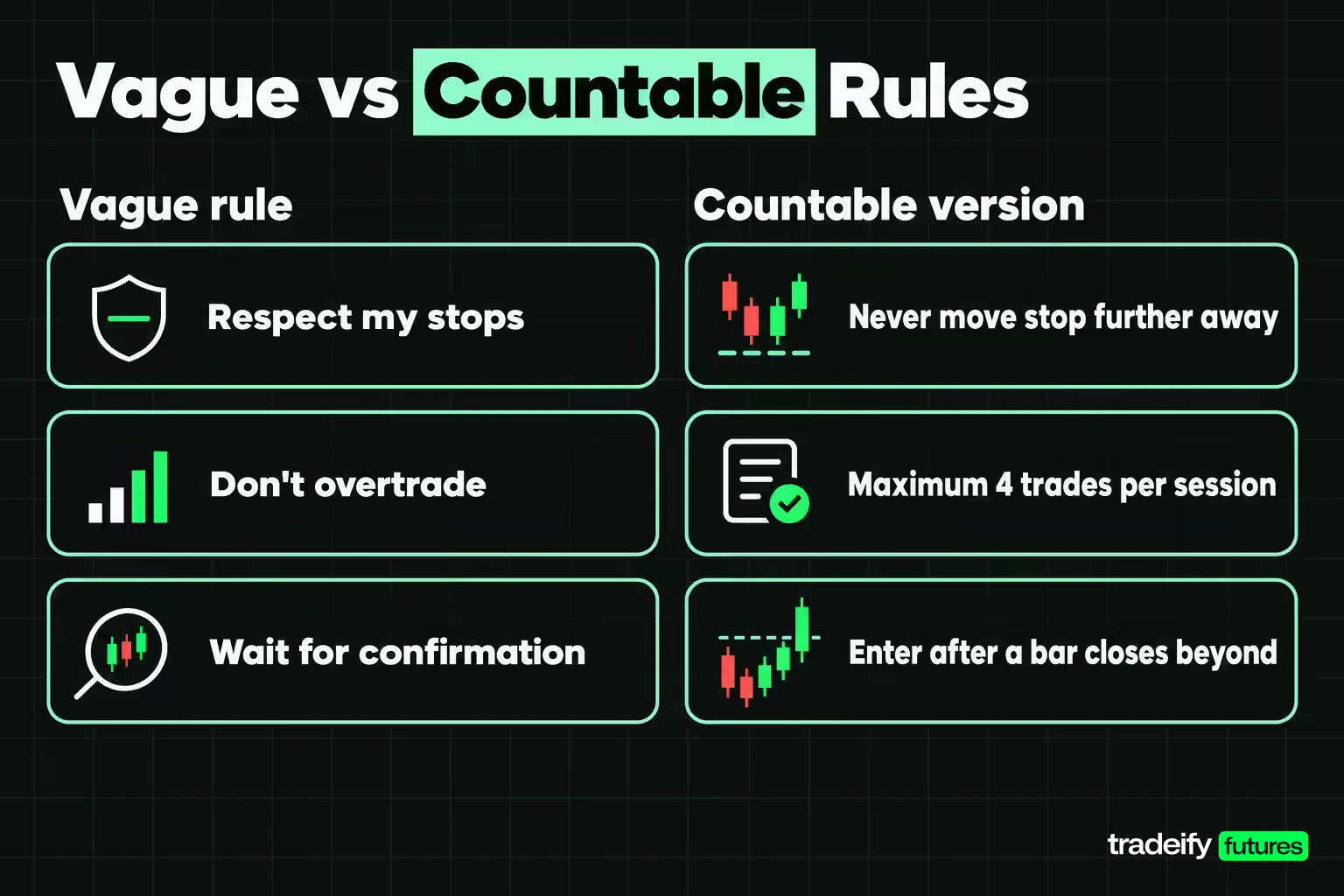
Personal trading rules only support accountability when a break can be counted. "Trade with patience" cannot be counted. "No entry until a 5-minute bar closes beyond the level" can. Every rule should let a stranger read your log and say yes or no.
| Vague rule | Countable version |
|---|---|
| Respect my stops | Stop placed with the entry; never moved further from entry |
| Don't chase | No entry more than 2 ticks beyond the planned price |
| Trade smaller when unsure | Half size after two consecutive losses in a session |
| Don't overtrade | Maximum 4 trades per session |
| Quit when tilted | Session ends at a loss of 2R or after one rule break |
| Wait for confirmation | Entry only after a bar closes beyond the level |
A good personal rule set has a few properties:
- Each rule has a trigger and an action, written as if-then.
- Each rule names a number: ticks, R, trades, minutes or dollars.
- Rules cover entry, exit, size and when to stop for the day.
- There are few enough rules that you can check all of them at the end of a session in a couple of minutes.
Informal heuristics can be a starting point. The 3-5-7 rule, for example, is commonly described as risking at most 3% of the account on one trade, keeping total open risk at 5% or less, and aiming for winners at least 7% larger than losers. It is a rule of thumb, not an exchange or regulatory rule, and many traders choose a much smaller per-trade figure. Its value for accountability is that every part of it is a number you can check.
Related lesson: Where these rules live
What Breaking One Rule Cost Over 20 Years of E-mini Data
The cost of a rule break is easy to assert and rarely measured. This illustrative study measures one break on front-month continuous E-mini S&P 500 futures (ES) daily bars: 5,067 sessions from 18 September 2006 to 4 November 2026. It is a historical test of one mechanical rule on one market, not a prediction or a trading recommendation.
The Breakout Rule and the Rule Break Tested
The written rule in this test: when an ES session closes above the highest high of the prior 20 sessions, buy at the next session's open. The stop is 1 ATR (Wilder's 14-session average true range) below entry, the target is 2 ATR above, and the trade closes after 20 sessions if neither is hit. A cost of 0.5 index points per round turn is charged on every trade, and results are measured in R, where 1R is the amount risked.
The break is the one an impatient trader makes. Price trades above the 20-session high during the session, the trader buys the level, and the session closes back below it. The written rule never had a signal, because it waits for the close. The break uses the same stop, target and time limit, so the only difference is the decision to skip the confirmation.
Across the sample in this guide's own calculation on Yahoo Finance ES daily data, 1,149 sessions reached the level. 592 closed above it and became plan trades. 557 closed back below it, and those are the breaks. Breaks made up 48.5% of all setups, about 27.7 a year against 29.4 plan trades a year. A trader who takes those setups is not deviating now and then. They are running a second rule they never wrote down.
Results for the Breakout Rule and the Rule Break
The table compares the written breakout rule with the rule break, as calculated for this guide on Yahoo Finance ES daily bars from 2006 to 2026.
| Measure | Rule as written | Rule break |
|---|---|---|
| Trades | 592 | 557 |
| Average result | +0.13R | -0.17R |
| 95% interval of the average | 0.02R to 0.24R | -0.28R to -0.06R |
| Win rate | 40.2% | 29.8% |
| Total | +77.02R | -93.99R |
The rule breaks won less often and lost more in total. They produced 139 targets against 378 stops. The plan's own edge is modest too: its interval sits just above zero, so even the disciplined version needs a long record before it proves anything.
Why the Cost of a Rule Break Stays Hidden
Buying the breakouts the written rule refused lost money overall in this E-mini test, yet a trader taking them could go years without seeing it. Starting with break 80 in March 2010, there was a stretch of 203 consecutive breaks whose running total never dipped below zero. That run ended in July 2017, about 7.3 years later.
Shorter windows of the same Yahoo Finance ES data, calculated for this guide, tell the same story. 34.9% of 20-break windows were net positive, and the best one made +23.30R. Four of the 21 calendar years with breaks were net positive. The longest winning streak of breaks was 8. Even across 100 breaks, 19.7% of windows still came out ahead.
A trader inside one of those stretches is not being careless with their eyes open. They are being paid to keep the habit. If the account is the only thing keeping score, the lesson can take most of a decade to arrive, which is why the score has to be kept somewhere else.
What the Rule Break Does to a Trader's Account
In the E-mini breakout test, risking 1% of equity per R and compounding from 100, the written rule and the rule break separate slowly and then a lot. The figures are this guide's calculation on Yahoo Finance ES daily bars. The median risk unit on the breaks was 25.84 points, which is $129.20 on one Micro E-mini S&P 500 (MES) contract at $5 a point.
| Trades taken | Rule break path |
|---|---|
| 25 breaks | 84.45 |
| 100 breaks | 64.55 |
| 200 breaks | 72.64 |
| All 557 breaks | 37.19 |
The rule as written finished all 592 trades at 203.46. The break path's worst peak-to-trough drawdown was 64.6%. Look at the rows between 100 and 200 breaks: the account recovered from 64.55 to 72.64. A trader living through that stretch would have had every reason to believe the habit was working.
Rule Breaks in January and Spring 2026
Two stretches from 2026 show the rule break (buying a 20-session high before the close confirms it) from both sides. On 7 January 2026 the ES 20-session high was 6994.00. ES traded to 7006.75 and closed at 6963.25, so a trader who bought the level was buying a breakout the rule refused. Breaks followed on 9, 12 and 13 January as price pushed into the same area. All four were stopped out on 14 January, for a combined -4.03R, or 267.31 points after cost. On one MES per break that is $1,336.55 lost in a single session.
A few months later the same rule break looked brilliant. Breaks on 10 April, 28 April, 5 May and 7 May 2026 all reached their 2 ATR targets, for a combined +7.98R. A trader who only remembered spring would conclude that skipping confirmation was an edge. The 20-year record says it is not.
A Trading Journal Built for Accountability
A trading journal supports accountability when it records decisions against rules, not just prices and P&L. A diary that says "felt good about this one" cannot answer whether you broke a rule. A journal with a yes-or-no column can.
| Journal field | What to record | Why it matters for accountability |
|---|---|---|
| Rule fired | Yes or no, from the written rule | Separates plan trades from improvised ones |
| Rule followed | Yes or no for entry, stop, size and exit | Produces your compliance rate |
| Break type | Early entry, moved stop, oversize, extra trade | Shows which rule you break most |
| Result in R | Using the stop the rule would have set | Makes breaks comparable over time |
| Pre-trade note | One line written before the order | Catches hindsight edits |
| State | Tired, rushed, after a loss | Links breaks to conditions |
Two habits keep the journal honest. First, record the trade the same day, before you know how the following sessions turn out. Second, score breaks in R using the rule's own stop, even if you used a different one, so a break taken with a wider stop does not look smaller than it was.
An example entry: "ES, long at the 20-session high, rule fired: no. Break type: early entry. Result: -1R. State: second trade after a loss." That line takes thirty seconds and answers more than a paragraph of reflection.
Related lesson: How to set the journal up
Honest Self-Review and the Weekly Accountability Check
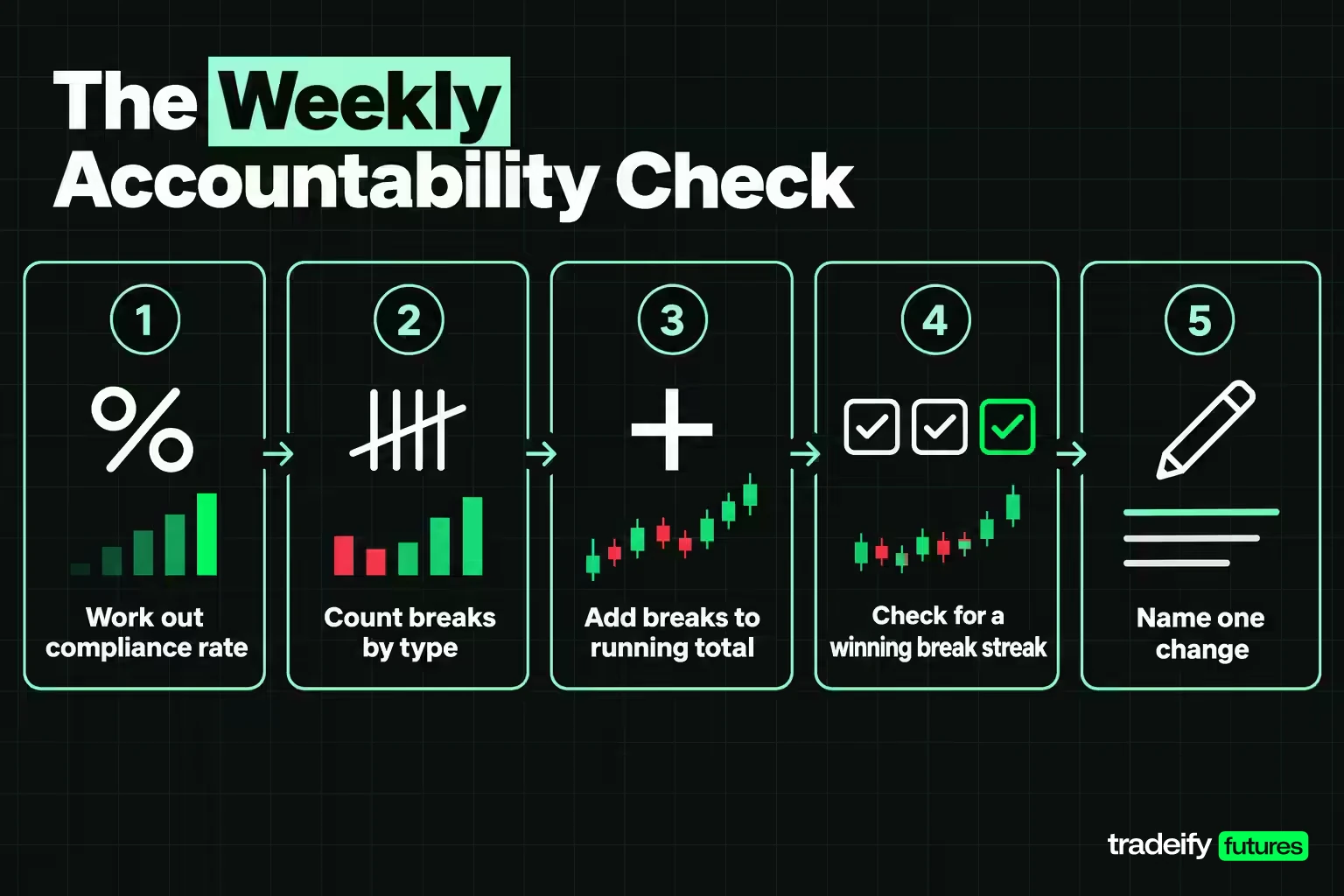
A self-review supports accountability when it judges decisions before outcomes. The weekly check below takes about ten minutes and works from the journal alone.
- Count the sessions where you followed every rule, and divide by sessions traded. That is your compliance rate for the week.
- Count the breaks by type. One type usually dominates.
- Add the R result of every break, then add it to the running total since you started recording. Look at the running total, not just this week.
- Check whether you are inside a winning streak of breaks. If you are, write that down, because a streak like that is the moment the wrong lesson gets learned.
- Name one change for next week, either to a rule or to your setup, such as a hard stop on new trades after a loss.
Two traps catch most weekly reviews. Judging the week by P&L rewards lucky breaks and punishes correct losses. Reviewing only losing trades hides the winning breaks, and those do the most damage, because they are the ones you want to repeat.
How Fast an Accountability Record Becomes Useful
A behavior record pays off faster than a performance record. A compliance rate near 85%, measured to within plus or minus 5 points, needs about 196 sessions, less than a year of daily trading. Tightening that to plus or minus 3 points needs about 545 sessions.
Proving that a rule break costs money takes much longer. In a 20-year E-mini S&P 500 breakout test, telling the -0.17R break cost apart from zero needed about 236 breaks, or about 8.5 years at 27.7 a year. That gap is why self-review should lead with the compliance rate. You can trust it within months, and it tells you what to fix.
Related lesson: A full review routine
Trusting Your Own Trading System
Trust in a personal trading system has to come from your own record, not from someone else's confidence. That trust is what lets you follow the rule through a losing stretch without looking for a new one every week.
Earned trust has a cost in patience. In a 20-year test of one E-mini S&P 500 breakout rule, showing that the written rule's edge was above zero needed about 459 trades, about 15.6 years of signals on a daily chart. Most traders do not have that long on one rule, so trust usually rests on three things together:
- A rule with a logical reason to work, written down before testing.
- A backtest or replay sample large enough to show the range of outcomes, including the worst losing streak.
- A live or simulated record showing your results match the test when you follow the rule, which only a high compliance rate can show.
Cutting a Trader's External Dependencies
Eliminating external dependencies means auditing what else you lean on for decisions. A trader who enters because a chat room called the trade, waits for a mentor's approval or changes bias after a social post has handed accountability to someone who is not accountable for their account.
A simple audit: for one week, tag every trade with its trigger. "My rule" is one tag. "Someone else's call", "news headline" and "felt like it" are the others. Any trade not tagged "my rule" is a break, even if it made money. Keep outside input for education and review, and keep the decision inside the rule.
Related lesson: Measuring the process, not the P&L
Finding an Accountability Partner
An accountability partner works because they shorten the delay between a rule break and its consequence. A break that would have gone unnoticed for months becomes visible the same evening if someone is reading your count.
Good candidates:
- Another trader at a similar stage who keeps their own written rules.
- A former colleague or friend who is organized and will ask questions, even if they do not trade.
- A mentor or coach, if they will review your record rather than give you trades.
What to share is more important than who. Send the compliance rate, the break count by type and the running break total. Do not send P&L screenshots alone, because they invite judging outcomes.
A short agreement keeps it working:
- A fixed check-in, such as a message every Friday with the week's numbers.
- One question the partner always asks: "Which rule did you break most, and what are you changing?"
- A rule for silence: if you miss a check-in, the partner follows up.
Partnerships usually fail in one of three ways: they turn into trade-calling, both partners go quiet after a bad week, or the partner starts praising results instead of process. The bad-week silence is the one to plan for, since that is the week the check-in matters most. Widely repeated statistics about how much partners raise goal completion are often attributed to a training association, but no original study has been found for them, so treat them as folklore. The reason to have a partner is the shorter feedback delay, which is real without any statistic.
Trading Communities, Groups and Events
Trading communities and groups support accountability when members post their plans before the session and their compliance after it. Forums, Discord servers, subreddits and live trading rooms can all do this. Some traders call their trades aloud in a room or narrate their session as if a mentor were listening, which makes improvisation harder to hide.
The risk is the opposite of accountability. A community becomes a dependency when members trade each other's calls, chase the loudest winner or post only good days. Signs a group is helping:
- Members share rules and records, not just screenshots of wins.
- Losing days and rule breaks get posted and discussed without mockery.
- Nobody is expected to copy anyone else's trades.
Trading conferences, meetups and local trader groups can turn online contacts into longer-term accountability partners. The value is in finding one or two traders with similar rules and a similar schedule, not in the talks themselves.
To get that value from an event:
- Go with a question about your own process, such as how others record rule breaks, rather than a hunt for setups.
- Swap contact details with traders who trade the same market and session, because their check-ins will line up with yours.
- Agree on a first check-in date before leaving, since most event contacts fade within a few weeks without one.
- Treat speakers selling courses or signals as education at best, not as accountability.
Accountability Tracking Tools
Accountability tracking tools fall into a few categories, and each catches a different kind of break.
| Tool type | What it tracks | What it misses |
|---|---|---|
| Spreadsheet | Compliance rate, break count, running R total | Needs manual entry every day |
| Journal software | Fills, tags, P&L by setup | Rule compliance unless you tag it |
| Platform loss limits | Stops trading at a set loss | Rule breaks that do not hit the limit |
| Personal lockouts | Blocks orders for a set time | Breaks before the lockout starts |
| Screen recording | What you saw at entry | Nothing until you watch it |
A practical setup uses one from each half: a record (spreadsheet or journal software with a "rule followed" tag) and a hard stop (a platform loss limit or a lockout). The record shows the habit. The hard stop caps how many breaks one bad session can contain.
On our accounts, some of that structure is built in. On a Growth evaluation, hitting the daily loss limit is a soft breach that puts the account in liquidation-only until the next trading day, and every position is closed by 4:45 PM ET. Tradovate's Risk Settings and Tradesea's personal lockouts also work on our evaluation and Sim Funded accounts. Those settings are your own limits and do not replace our account rules, which is exactly what makes them a personal accountability tool.
Related lesson: Setting a hard limit for the day
Accountability for Traders FAQ
What is accountability in trading?
Accountability in trading is measuring what you did against what your written rule said you would do, then acting on the difference. It needs a countable rule, a record of every decision and a consequence for breaks. It differs from discipline, which is following the rule in the moment.
How to become a disciplined trader?
Write rules as if-then statements with numbers, record whether you followed each one every session, and review the count weekly. Add a hard daily loss limit so one bad session cannot hold many breaks. Discipline usually follows a good record, not the other way round.
What is the 3-5-7 rule in trading?
The 3-5-7 rule is an informal guideline: risk at most 3% of the account per trade, keep total open risk at 5% or less, and aim for winners at least 7% larger than losers. It is not an exchange or regulatory rule. Many traders use a much smaller per-trade risk.
Does an accountability partner help traders?
A partner helps by making a rule break visible the same week instead of months later. It works best when you share your compliance rate and break count, not P&L. It fails when the partnership turns into trade-calling.
How do I stop breaking my own trading rules?
Define each break so it can be counted, record every break in R using the rule's stop, and track the running total rather than the last few trades. Decide in advance what ends a session, such as one break or a 2R loss. If a rule keeps losing over a large sample, rewrite it on purpose instead of breaking it quietly.
Trading futures involves substantial risk of loss, and leveraged products can lose more than expected. The study here uses historical data for one rule on one market and is not a prediction, a performance claim or advice for any account. Evaluation and funded accounts are simulated, and results there differ from a live brokerage account. Nothing here is individual financial advice.


