




TL;DR: Day trading goals work best when they measure what you control, like rule adherence, instead of daily dollars. A rule winning 45% of trades at 1.5R can still lose on 57.5% of sessions, so a daily profit target grades noise. An 85% adherence goal gets a first read in about 49 trades, while proving a profit edge can take about 380. Set risk limits first, then pick two or three process goals with a review date.
Most traders write their first goal as a number of dollars. Make $200 a day. Hit $4,000 a month. Replace a salary by next year.
That is a fair place to start. Money is why most people open a trading account, and pretending otherwise helps nobody. The problem is that a dollar goal gives you almost no information on the day you check it, and it quietly changes how you trade when you are short of it. This guide shows you why, with worked numbers, and then gives you a different set of goals: ones you can actually measure, review and improve.
What Day Trading Goals Should Measure
Day trading goals come in two kinds, and the difference decides whether a goal helps you or just grades you.
- Outcome goals count results: dollars per day, profit per month, win rate, return on the account. The market has a vote in every one of them.
- Process goals count behavior you control: whether you took only setups from your written plan, whether your stop was in place before entry, whether you stopped at your daily loss limit, whether you wrote the journal entry.
Both kinds are legitimate. They are not equally useful on a short timeline. A process goal can be scored on a single session with a yes or no. An outcome goal needs a large sample before a good month means anything more than a lucky one.
Daily, weekly, monthly and long-term trading goals
A workable goal list uses different horizons for different jobs.
- Daily goals should be process only. Followed the plan, respected the loss limit, journaled the session. A daily dollar number is the one goal type day trading results cannot support, because a single session's P&L is mostly noise, even for a rule that makes money over time.
- Weekly goals can track rates: plan adherence across the week's trades, number of trades taken outside the plan, average loss compared with planned loss.
- Monthly and quarterly goals can start to include outcome measures in R (risk units), such as average R per trade, once you have enough trades for the number to settle.
- Long-term goals (six to twelve months and beyond) are where profit targets, account growth and career decisions belong.
The test that makes a goal usable
Before a goal goes on your list, give it three things: a unit (a yes or no, a rate, an R value or dollars), the number of readings it needs before a change is real, and a review date. If you cannot name all three, the goal is a wish. It might be a good wish. It is still not something you can grade.
How Day Trading Works and Where the Pattern Day Trader Rule Applies
Day trading means opening and closing positions within the same trading session, so you carry no position overnight. Each trade lives and dies inside the session, which is why a day trader collects results quickly and why short-term goals feel natural. It is also why a day trader faces more noise per decision than someone holding for weeks.
Futures are a common day trading market because a single contract gives a defined dollar value per point. Per CME Group's contract specifications, the E-mini S&P 500 (ES) moves $50 per index point, and the Micro E-mini S&P 500 (MES) moves $5 per index point. Both tick in 0.25 points, worth $12.50 on ES and $1.25 on MES. Those two numbers let you turn any dollar goal into the market move it needs, which is the first reality check most goal lists skip.
What the pattern day trader rule means for your goals
In US stock margin accounts, FINRA rules define a pattern day trader as a customer who makes four or more day trades within five business days, provided those trades are more than six percent of the account's trades in that period. A pattern day trader must keep at least $25,000 in the account and trade in a margin account.
That rule is being replaced. FINRA has adopted new intraday margin standards, effective June 4, 2026, with a transition period until October 20, 2027, so some brokers may still run the old rule for now. If you day trade stocks, ask your broker which standard applies to your account. Futures were never subject to the pattern day trader rule, so a futures day trader's goals are shaped by the account's own risk limits rather than a minimum equity figure.
Related lesson: What the pattern day trader rule covers and what replaces it
What a Daily Profit Goal Looks Like in Real Numbers
A daily profit goal sounds precise, but the daily result of even a profitable day trading rule is mostly noise. The easiest way to see it is with a worked example.
Imagine a hypothetical day trader on a $50,000 account who risks 1% per trade, so one risk unit (1R) is $500. The rule wins 45% of the time. Winners make +1.5R, losers lose -1R, and the trader takes 3 trades a session. These figures are illustrative, not a claim about any real strategy.
That rule has a real edge. Each trade is worth 0.45 x 1.5 - 0.55 x 1 = +0.125R on average, or $62.50. The break-even win rate at 1.5R winners is 40%, so a 45% win rate is comfortably above it. Over a session the average is 0.375R, or $187.50.
Now set a $200 daily goal, which is 0.4% of the account. Here is what a session actually looks like.
| Wins out of 3 trades | Session result in R | Session result in dollars | Chance of this session |
|---|---|---|---|
| 0 | -3R | -$1,500 | 16.6% |
| 1 | -0.5R | -$250 | 40.8% |
| 2 | +2R | +$1,000 | 33.4% |
| 3 | +4.5R | +$2,250 | 9.1% |
Three things jump out of that table.
- No session ever lands near $200. The rule averages $187.50, yet every single day is either a loss or a gain of $1,000 or more. A daily goal sits in a gap the trading never visits.
- The trader loses money on 57.5% of sessions. A rule with a genuine edge still finishes red more often than green, because one win and two losses is the most common day.
- Reaching $100, $200 or $500 all happen on the same 42.5% of sessions. The goal size does not change how often you hit it. Only the market and your setups decide that.
How often a profitable rule still loses a week or a month
Take the same hypothetical rule: a 45% win rate, +1.5R winners, -1R losers, 3 trades a session and $500 of risk per trade. This guide's own exact probability arithmetic on that rule shows the noise shrinking over longer windows, but slowly. At 15 trades a week, 26.1% of weeks still lose money. At 60 trades a month, 18.2% of months lose. Even a quarter of 180 trades loses 7.7% of the time.
A monthly version of the daily goal does not fix it either. On the same arithmetic, a $4,000 month ($200 a day over 20 sessions) is reached in only 44.7% of months, while the expected month is $3,750. The chance of a run of 3 or more losing sessions somewhere in a 20-session month is 90.1%, and a run of 4 or more shows up 66.1% of the time.
So a trader with a working rule and a daily dollar goal will "fail" that goal on most days and in most months. The natural response is to fix the strategy, and the strategy was never the problem. That is the strongest argument against fixed daily profit targets: they grade the dice, not the decisions.
Related lesson: The number a goal should track instead of a win rate
How a Dollar Goal Changes Your Trading Psychology
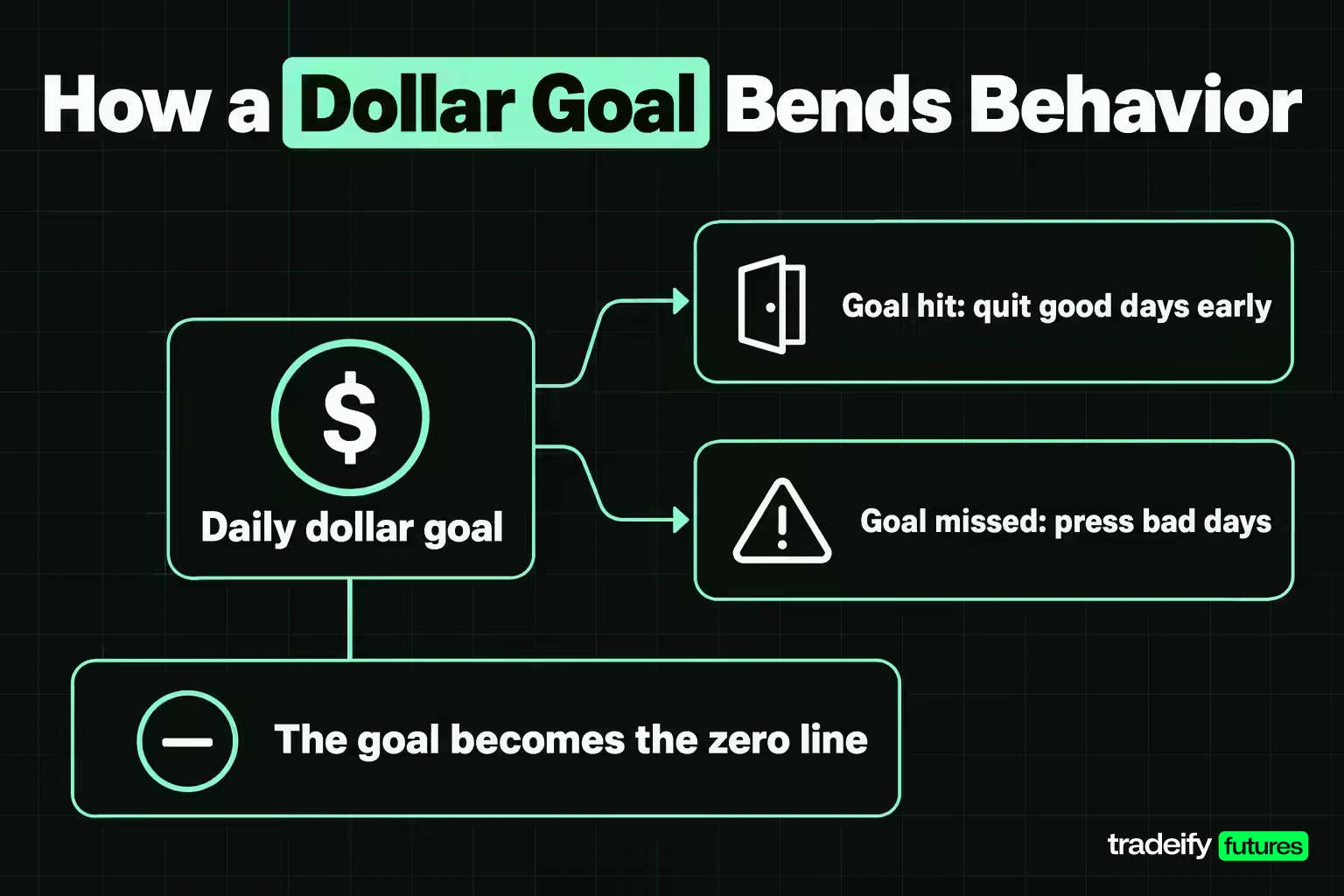
A daily dollar goal does more than mismeasure. It changes behavior in two directions, and research on goals outside trading shows both.
The first is quitting good days early. In a 1997 study of New York City cabdrivers, Camerer, Babcock, Loewenstein and Thaler found that drivers, especially inexperienced ones, made decisions "one day at a time" and appeared to "set a loose daily income target and quit working once they reach that target." They worked less on the busy days when earning was easy. A trader with a daily target does the same thing: stops after reaching $200 on a day when the setups are clean and plentiful.
The second is pressing bad days. Heath, Larrick and Wu, in "Goals as Reference Points" (1999), argue that a goal acts like the zero line on a scorecard, and that "specific goals should make people more risk seeking when they are below their goal." In trading terms, that is the session where you are down $250 at 11 AM with a $200 goal hanging over you. The goal has turned a normal loss into a $450 hole, and the setups you would usually skip start looking good enough.
Trading discipline when the goal is behind you
Recognize the moment. You are behind the number, the session is getting late, and you can feel your standards loosening. Almost every trader has sat in that seat. The feeling is not a character flaw, but it is exactly the moment a rule you wrote in advance has to make the call for you.
- Replace the dollar line with a stop line. Your daily loss limit is the only daily dollar number you need. It ends the session; it never invites one more trade.
- Score the session before the P&L. Write down whether each trade matched the plan before you look at what it made. The order matters, because the result colors the memory of the decision.
- Treat a missed goal as a non-event. Even a rule with a genuine edge can lose on more than half of its sessions. A red day with clean execution is a good day's work.
Related lesson: How discipline holds a rule in place when the session goes wrong
Process Goals and How Many Readings Each One Needs
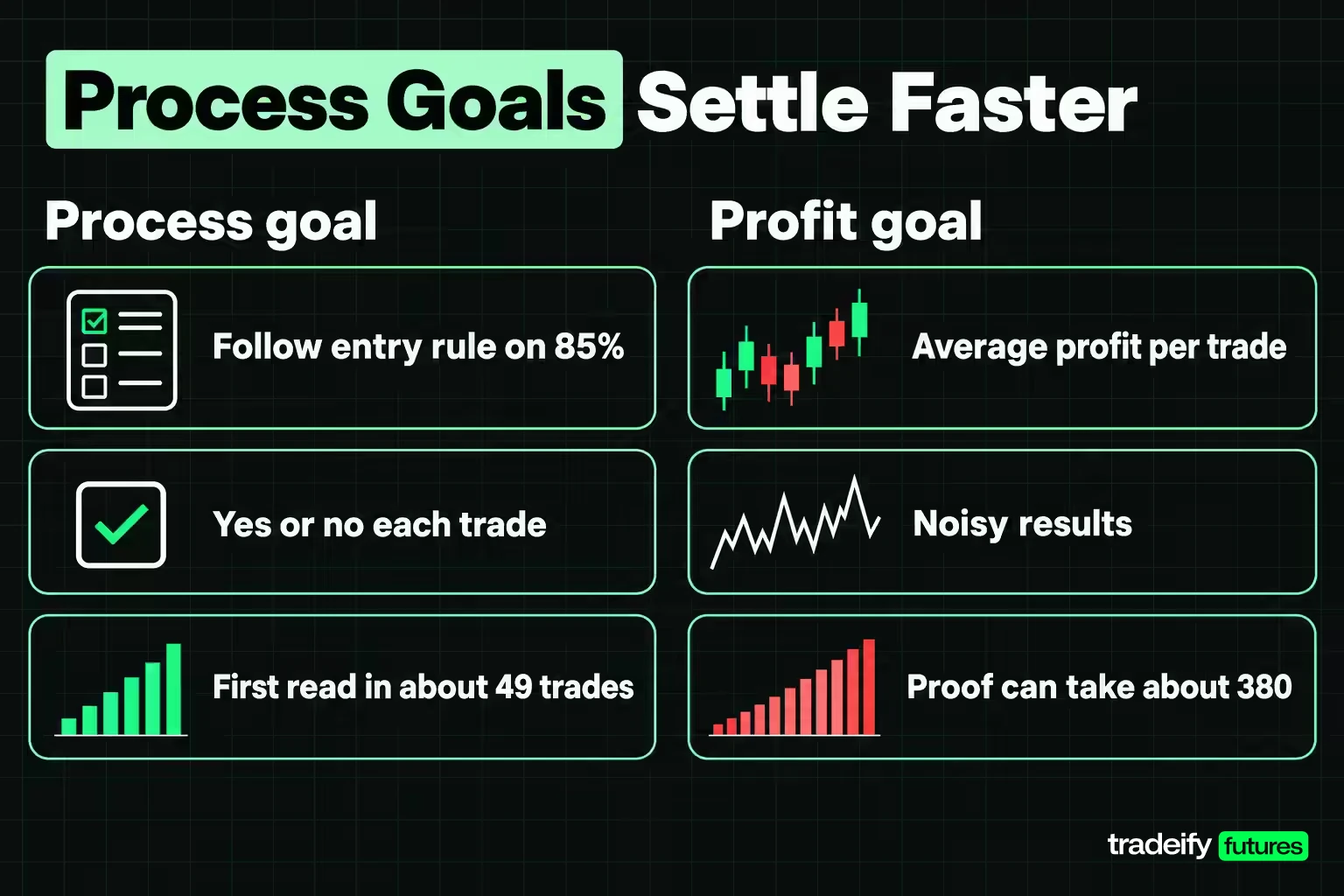
A process goal is useful because it settles fast. Each session or trade gives you a yes or no reading, and a rate built from yes or no readings needs far fewer observations than an average profit figure built from noisy results.
Take a goal of following your entry rule on 85% of trades. Standard sample-size arithmetic for a rate (1.96 squared, times the rate, times one minus the rate, divided by the square of the margin you want) gives these counts.
| Goal type | Precision wanted | Readings needed | Weeks at 15 readings a week |
|---|---|---|---|
| Plan adherence near 85% | plus or minus 10 points | about 49 | about 3 |
| Plan adherence near 85% | plus or minus 5 points | about 196 | about 13 |
| Journal completion near 90% | plus or minus 5 points | about 138 | about 9 |
| Average profit per trade, edge of +0.125R | edge distinguishable from zero | about 380 trades | about 25 |
The last row uses a hypothetical rule that wins 45% of the time, makes +1.5R on winners and loses -1R on losers, which works out to +0.125R per trade with a standard deviation of 1.24R. Even with a real edge of 0.125R, it takes about 380 trades before the average is clearly above zero. A smaller edge needs many more.
How fast a process rate settles
The margin on a rate shrinks fast at first and then flattens. At 85% adherence, 20 readings give a margin of 15.6 points, so a 70% stretch and a perfect one look the same. At 50 readings the margin is 9.9 points, at 100 it is 7.0 points, and at 200 it is 4.9 points.
The practical rule: judge a process goal after about 50 readings, refine it after about 200, and do not judge profit per trade until you have several hundred trades on one version of your rules.
Related lesson: The record a process rate is counted from
Risk Limits That Come Before Any Profit Target

Risk limits are not goals. They are the floor every goal stands on, and they get written first because they are the only part of your plan that protects the account on a day when everything else goes wrong.
Three limits cover most day traders.
- Risk per trade. A fixed fraction of the account, often 1% or less. On a $50,000 account, 1% is $500.
- Daily loss limit. The amount that ends your session, set as a multiple of your per-trade risk. When it is hit, you stop, whatever the goal says.
- Maximum drawdown. The point at which you stop trading the plan and review it, rather than adjusting it mid-slide.
The 3-5-7 rule, priced
The 3-5-7 rule is a popular rule of thumb with no official source. In its common form it says: risk no more than 3% on one trade, keep total exposure across open trades under 5%, and make winners at least 7% larger than losers. Versions differ, especially on the 7 leg.
Price it on a $50,000 account. Three percent is $1,500 per trade, against $500 at 1%. Then run a losing streak, which every trader meets eventually. Ten straight 3% losses leave 73.7% of the account, a 26.3% drawdown. Ten straight 1% losses leave 90.4%, a 9.6% drawdown.
For a day trader the useful parts are the ceiling and the exposure cap. The 3% ceiling is high for an account with a daily loss limit or a drawdown rule, because a few losses can consume the whole allowance. The 7 leg is a payoff target, which is an outcome measure and needs hundreds of trades before you can tell whether you are meeting it.
Why the account size check comes before the goal
A $200 a day goal on $50,000 is 0.4% a day. Compounded over 252 sessions, that is about 173% a year. Seeing the yearly figure is often the fastest way to tell that a daily goal was set by hope rather than by the account's risk limits.
Related lesson: The session-ending limits that belong above any goal
Learning Goals for Newer Day Traders
For a newer trader, the best goals are learning goals, not income goals. Day trading is a complex task, and goal-setting research has a specific finding about complex tasks.
Locke and Latham's 2002 review of 35 years of goal-setting research notes that, when a task is complex, a performance goal "can make people so anxious to succeed" that they search for strategies "in an unsystematic way and fail to learn what is effective." The antidote they give is "specific challenging learning goals," meaning goals about how many strategies or skills you acquire. They cite Winters and Latham (1996), where a specific, difficult learning goal beat the general instruction to "do your best" on a complex task.
That maps neatly onto the first months of trading. Learning goals look like this.
- Study goals. Review 20 historical examples of your one setup this week and write down where each would have been invalidated.
- Practice goals. Complete five chart-replay sessions where you mark entries and stops before the bar closes.
- Rule-writing goals. By Friday, have an entry rule written clearly enough that someone else could find the same trades on your chart.
- Review goals. Tag every trade in the journal with the setup name and whether it followed the rule.
None of those depends on the market cooperating. Each one builds a skill that later outcome goals will need.
When to add outcome goals
Add an outcome goal once you have one written rule, a few hundred trades logged under it, and a plan adherence rate you trust. Before that point, a profit number mostly measures luck and the patience of whoever is checking it.
How Day Trading Strategies Change Your Goals
Different day trading strategies produce different trade counts, win rates and payoffs, so the same goal does not fit every style. The process goals stay the same in spirit; the specific metric and how fast it settles change.
| Strategy | Typical trade pattern | Process goal that fits | What makes the goal hard |
|---|---|---|---|
| Momentum | Enters in the direction of a strong move, often early in the session | Entries taken only after the defined trigger, not on anticipation | Chasing a move after missing the trigger |
| Breakout | Buys or sells as price leaves a range | Stop placed at the planned invalidation level on every trade | Low win rates mean long losing runs that test adherence |
| Range or mean reversion | Fades moves toward the edges of a range | Trades skipped when the range has clearly broken | Holding a fade after the range fails |
| Scalping | Many short trades with small targets | Maximum trades per session respected | High trade counts make one sloppy hour cost a lot |
| News-based | Trades around scheduled releases | No orders placed in the minutes the plan marks as off-limits | Slippage and spread spikes around the release |
Two patterns come out of that table. Strategies with many trades, like scalping, collect readings fast, so goals can be reviewed weekly. Strategies with low win rates, like breakouts, produce long losing runs, so the goal should reward holding the rule through a streak rather than the streak's result.
Algorithmic trading changes the question again. When code executes the rule, adherence is automatic, and the process goal shifts to research hygiene: one version of the rules at a time, and changes logged with a date.
Goals in Day Trading Compared With Swing Trading and Investing
Goals behave differently across trading styles because each style collects results at a different pace. Day trading produces many readings, swing trading produces fewer, and long-term investing produces very few per year.
| Style | Holding period | Readings collected | Where goals fit best |
|---|---|---|---|
| Day trading | Minutes to hours, closed the same session | Many per week | Daily and weekly process goals; outcome goals reviewed quarterly |
| Swing trading | Days to weeks | A few per week or month | Weekly process goals on entries and exits; outcome goals reviewed over many months |
| Investing | Months to years | A handful per year | Allocation and contribution goals; returns judged over years |
The table explains a common mistake. Day traders often borrow an investor's annual return target and divide it by 252 to get a daily goal. The daily figure looks tidy, but the investor's goal was never meant to be graded daily, and the day trader's results are far noisier at that scale.
Related lesson: How day and swing trading differ in practice
Building Goals Into a Trading Plan and Journal
Goals belong inside a written trading plan, next to the rules they measure. A goal that lives on a sticky note drifts; a goal written beside the entry rule gets checked against it.
A plan that supports process goals has five parts, and the rules come first.
- The rules. Markets, session hours, setups with entry triggers, stops and exits, and position size.
- The risk limits. Per-trade risk, daily loss limit and the drawdown level that triggers a review.
- The goals. Two or three process goals, each with a unit, a reading count and a review date, plus any long-horizon outcome goal.
- The journal fields. One field for each goal, so every trade or session produces a reading without extra work.
- The change rule. How many trades must pass before a rule can change, and who or what decides.
The order matters. Rules come first because goals measure rules. If you change a rule, start a fresh count for any goal that depends on it, or you will be averaging two different strategies.
Tools that record goal readings
You do not need special software to track process goals, but the tool should make each reading cheap to record.
- A spreadsheet or journal app with a row per trade and yes or no columns for each goal (followed the setup, stop placed before entry, size within plan).
- Your platform's trade reports, which most futures platforms provide, for trade counts, win rate and P&L by date.
- Platform risk settings, where offered, that lock the account at a daily loss limit, so the loss limit becomes automatic rather than a goal you try to remember.
- Screenshots or chart replay for reviewing whether an entry matched the written trigger.
Related lesson: The plan the goals sit inside
Day Trader Profitability and What the Studies Show
Income goals deserve a reality check, because the research on day traders is sobering.
In "Day Trading for a Living?", Chague, De-Losso and Giovannetti studied everyone who began day trading Brazilian equity index futures between 2013 and 2015. Of the 1,551 who persisted for more than 300 days, 97% lost money. Only 1.1% earned more than the Brazilian minimum wage. A study of Taiwan day traders from 1992 to 2006 by Barber, Lee, Liu, Odean and Zhang found that less than 1% of the day-trading population predictably earned profits.
Those numbers do not mean profit is impossible. They mean an income goal set before you have evidence of an edge is a guess, and the base rate is against the guess. The honest first goal is to find out whether you have an edge at all, which is a process question.
Is $100 a day a realistic goal?
Making $100 a day is a modest-sounding goal. On one ES contract, $100 is a 2-point move after you reach your target. On one MES contract it is 20 points. Neither tells you whether your setup will appear today or whether you will be right.
Here is the catch. A hypothetical rule that wins 45% of the time at +1.5R, taking 3 trades a session with $500 risk each, averages $187.50 a session, yet 57.5% of its sessions lose and none finishes near $100. A $100 day is possible on some days. A $100-every-day goal does not describe how day trading results arrive.
Related lesson: What day trading is and how it works
A Day Trading Goal Sheet You Can Fill In This Week
A goal sheet puts every goal on one line with its unit, its reading count and its review date. Here is an example filled in for a hypothetical trader taking about 15 trades a week.
| Goal | Unit | Readings a week | Readings needed | Review date |
|---|---|---|---|---|
| Take only setups from the written plan on 85% of trades | Yes or no per trade | 15 | About 49 for a first check | After 3 weeks |
| Stop placed before entry on every trade | Yes or no per trade | 15 | Each miss reviewed the same day | Weekly |
| Stop trading at the daily loss limit every time | Yes or no per session | 5 | Each breach reviewed the same day | Weekly |
| Journal entry finished on 90% of sessions | Yes or no per session | 5 | About 138 for plus or minus 5 points | Quarterly |
| Average profit per trade above zero | R per trade | 15 | About 380 trades | After about 25 weeks |
Notice how the outcome line sits at the bottom with the longest review date. It is not banned. It is just honest about how long it takes to read.
To build your own sheet, write each goal you currently have, then fill in the unit and the readings you collect per week. If a goal's review date is further away than you would realistically wait before changing something, move it to a long-term list and check it only for direction.
On our accounts, a 50K Growth evaluation has a $1,250 daily loss limit, and hitting it puts the account in liquidation-only mode until the next trading day. Tradovate's Risk Settings let you add your own daily and weekly loss limits and profit triggers on evaluation and Sim Funded accounts, and its Performance report shows win rate and trade stats for any date range. Those are your own limits and do not replace our rules. Our funded accounts are simulated.
Related lesson: The review that turns a goal into a decision
Day Trading Goals FAQ
Can I make $100 a day day trading?
Some days, possibly; every day, no. On one MES contract $100 is a 20-point move, and even a rule with a real edge can lose on most sessions. A $100 goal works better as a long-run average you check over hundreds of trades.
What is the 3-5-7 rule for day trading?
The 3-5-7 rule is a popular rule of thumb that caps risk at 3% per trade, keeps total exposure under 5%, and asks for winners at least 7% larger than losers. It has no official source. Many day traders keep the exposure cap but use a lower per-trade limit, such as 1%.
Is it true that 97% of day traders lose money?
Yes, in one widely cited study: Chague, De-Losso and Giovannetti found that 97% of Brazilian futures day traders who persisted more than 300 days lost money. It is one market and one period, but Barber, Lee, Liu, Odean and Zhang's study of Taiwan day traders points the same way.
What are the best goals for a trader?
The best goals measure behavior you control: following your plan, placing stops before entry, stopping at your daily loss limit and journaling every session. Add outcome goals in R once you have several hundred trades under one set of rules.
Should a day trader set a daily profit target?
A daily profit target is the least informative goal a day trader can set, because daily results are mostly noise. It can also push you to quit good sessions early and take extra risk on bad ones. A daily loss limit is the daily dollar number worth keeping.
Trading futures involves substantial risk of loss, and because futures are leveraged, losses can exceed what you expect or deposit. The worked examples in this guide use a hypothetical rule and illustrative numbers; they are not a prediction, a performance record or a recommendation. Prop firm evaluation and funded accounts are simulated, and their rules differ from a live brokerage account. This guide is educational and is not individual investment, financial, legal or tax advice.


