




TL;DR: A daily loss limit caps what one session can cost, then stops trading until the next session opens. It does not stop the trade that crosses it, so every entry still needs its own stop. In a 580-entry test on ES and NQ, a 3R limit cut the worst session from -6.00R to -3.50R. It did not improve the average session, and 11 of 29 stopped days would have finished above the limit. A weekly limit at two to three times the daily figure catches the slow bleed a daily cap misses.
What a Daily Loss Limit Is
You are down three trades, the next setup looks fine, and the only thing between you and a fourth loss is a number you set this morning. That number is the point. A daily loss limit is the most money one trading day is allowed to lose before trading stops for that day. It works like a circuit breaker for the session: once the running loss reaches the line, open positions are closed or locked, new entries are blocked, and the next session opens with a fresh budget.
The rule exists for one reason. Most accounts are not ended by a slow string of small losses. They are ended by one session where the trader stops following the plan, keeps adding, and turns a normal red day into a deep one. A session cap puts a ceiling on that day before the trader has to decide anything under pressure.
Be clear about what the limit cannot do. It is measured on a running total after a loss has happened, so it cannot prevent the entry that crosses it. It prevents everything after that entry. That is why it sits on top of a stop on every trade, never in place of one.
The limit can come from three places:
- A firm's rulebook, on a prop or evaluation account, where breaking it has a stated consequence.
- A platform or broker setting, which liquidates and locks the account automatically. Tradovate, for example, describes its daily loss limit as automatically liquidating and locking the account when the limit is reached, until the session ends or the setting is changed.
- A personal rule in a written trading plan, which only works if something other than willpower enforces it.
Daily Loss Limit vs Stop Loss and Maximum Drawdown
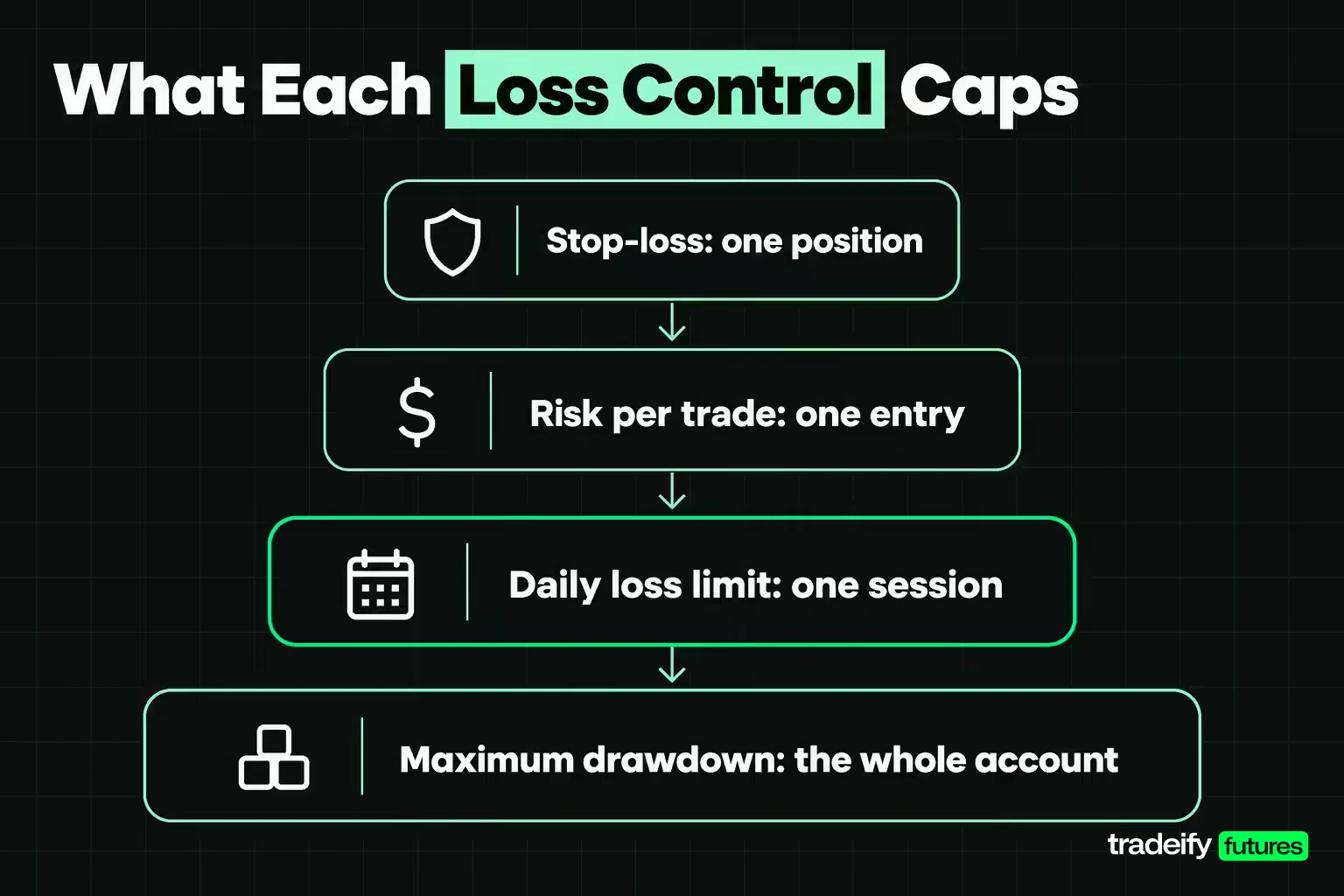
A daily loss limit gets confused with three other controls, because all four are measured in dollars and all four end something. What they end is different.
| Control | What it caps | Measured on | When it is hit |
|---|---|---|---|
| Stop-loss order | One position | A price level | The position closes, the session continues |
| Risk per trade | One entry, before it is placed | Size times stop distance | Nothing triggers, it sets the size |
| Daily loss limit | One session | Running session profit and loss | Trading stops until the next session |
| Maximum or trailing drawdown | The account's whole life | Balance against a floor | The account usually fails or closes |
The difference shows up in the order of events. A stop sits at a price and acts before the loss grows. A session cap sits at a running total and acts after the loss is booked. A drawdown floor sits under the whole account and, on most prop accounts, ends the account rather than the day.
The two also interact. If the drawdown floor is closer than the daily limit, the account can fail before the daily limit ever fires. A trader with a $1,500 daily limit and only $1,000 left above the drawdown floor has a $1,000 daily limit in practice, whatever the rulebook says.
Related lesson: Maximum drawdown
How a Daily Loss Limit Is Calculated
A daily loss limit is calculated as the session's starting reference minus the stated amount, but the rulebook decides what goes into the running total. Three questions settle it.
- Does it count only closed trades (realized profit and loss), or open positions too (floating or unrealized profit and loss)?
- Is the starting reference the session's opening balance, or the highest point the session reached?
- Do commissions and fees count against it?
The same number can therefore mean four different budgets. An illustrative test run for this guide, on 580 trade entries across 50 ES and 50 NQ sessions of 5 minute bars (every result in R, the risk on one entry), ran a 3R limit under each definition and counted which sessions it stopped.
| Definition of the same 3R limit | ES sessions stopped | NQ sessions stopped | ES stopped that never breached on closed P and L | NQ stopped that never breached on closed P and L |
|---|---|---|---|---|
| Closed P and L only | 15 of 50 | 14 of 50 | 7 | 4 |
| Closed P and L plus the open position's worst mark | 16 of 50 | 14 of 50 | 8 | 5 |
| Drop of 3R from the session's own best point | 23 of 50 | 25 of 50 | 15 | 16 |
| Three consecutive losing entries | 25 of 50 | 25 of 50 | 17 | 15 |
Closed versus open profit and loss
A limit on closed profit and loss is the most forgiving: a position that is deep against you does not count until it closes. A limit that includes open positions counts the floating loss in real time, so a trade that dips hard and then recovers can still end the day. In the test, ES on 2026-08-19 closed at -1.00R but its intraday equity touched -3.03R, and two NQ sessions (2026-07-20 and 2026-08-10) touched -3.35R and -3.45R on closed results of -1.00R. An equity-based 3R limit ends all three of those days. A closed-only limit ends none of them.
Trailing from the session high
A trailing daily limit measures the drop from the best point of the day, not from the open. It fires far more often. On ES it stopped 23 of 50 sessions against 15 for the closed version, and 15 of the 23 never reached -3R on closed profit and loss at all. Of the 50 ES sessions, 15 were stopped by all three running-total definitions, 27 by none and 7 only by the trailing one.
The takeaway matters before the first trade: the phrase on its own is not enough detail to plan around. Read the clause for the words closed, realized, floating, unrealized, equity and high, and plan for the definition you actually have.
Common Loss Limit Structures and Sizes
Loss limits come in a handful of structures. Each answers the same question, how much can today cost, in a different way.
- Fixed dollar. One number for the life of the account, such as $1,500. Simple to track and easy to automate.
- Percentage of the starting balance. For example 3% of a $50,000 account, which is also $1,500, and stays $1,500 as the balance moves.
- Percentage of the current or prior-day balance. 3% of $47,000 is $1,410, and 3% of $53,000 is $1,590, so the limit shrinks after losses and grows after gains.
- Trailing from the session high. The limit follows the best point of the day. If a session is up $900 and a $1,500 trailing limit is in force, it fires at -$600 on the day, where a fixed $1,500 limit would wait until -$1,500.
- Scaling. Some rulebooks raise the limit once the account reaches a profit threshold, so the cap grows with the cushion.
- Consecutive losses. Stop after a stated number of losing trades in a row, regardless of dollars.
None of these is better in the abstract. A fixed limit is the easiest to plan around. A percentage limit protects a shrinking account automatically. A trailing limit protects an open profit but stops many more sessions.
Choosing a daily loss limit size
A sensible size comes from your own record and from the account's hard floor, not from a round number. Work through it in this order.
- Measure the worst session in R. Express every session result in units of your normal risk per trade, so the figure survives a change in size. In the 580-entry ES and NQ test, the worst of 100 sessions was -6.00R and the 5th percentile was -5.00R.
- Convert to dollars at your risk unit. At a $500 risk unit, 1R is 1% of a $50,000 account, so a 3R limit is $1,500, or 3% of the account.
- Count sessions to the drawdown. At $1,500 per bad session on $50,000, it takes 1 session to lose 3%, 2 to lose 5% or 6%, 3 to lose 8% and 4 to lose 10%. A daily limit that reaches the account's drawdown floor in one or two sessions is bigger than the account can carry.
- Check it against a month. In the test, a 3R closed limit stopped 30% of ES sessions. Over 20 sessions that is 6 stopped days on average, and a binomial count puts it between 3 and 9 about 94% of the time, with a month of zero stops at 0.08%. If that many stopped days is unacceptable, the limit is too tight or the per-trade risk is too large.
- Fit the trades under it. Decide how many full losses you are willing to take in one session, usually two to four, and size each trade so that number fits under the limit.
Related lesson: Maximum risk per trade
When Loss Limits Reset
A daily loss limit resets at the start of the next trading session, and on futures that is not midnight. The trading day follows the exchange session, so an evening trade belongs to the next day's budget.
On CME Globex, equity index futures such as ES and NQ trade from Sunday 6:00 PM to Friday 5:00 PM ET, with a daily maintenance break from 5:00 PM to 6:00 PM ET. A limit tied to that session resets when trading reopens at 6:00 PM ET. A trader who hits the limit at 11:00 AM on Tuesday can trade again at 6:00 PM Tuesday, because that is the start of Wednesday's session.
Spot forex follows a different clock. By market convention, 5 PM New York time is the beginning and end of the forex trading day, the same cutoff dealers use for overnight rollover. Forex-based prop accounts usually reset their daily figure on a server clock tied to that rollover, so the reset hour depends on where the trader lives and on daylight saving changes.
A weekly loss limit resets at the start of the next trading week, which for CME futures is the Sunday 6:00 PM ET open. Three practical points follow:
- Write the reset time into your plan in your own time zone, including the daylight saving weeks when it shifts.
- A loss taken in the evening session counts toward the next calendar day's limit, not today's.
- Holiday sessions can be shortened or merged, so check the exchange calendar around holidays rather than assuming a normal reset.
What Happens When You Hit a Daily Loss Limit
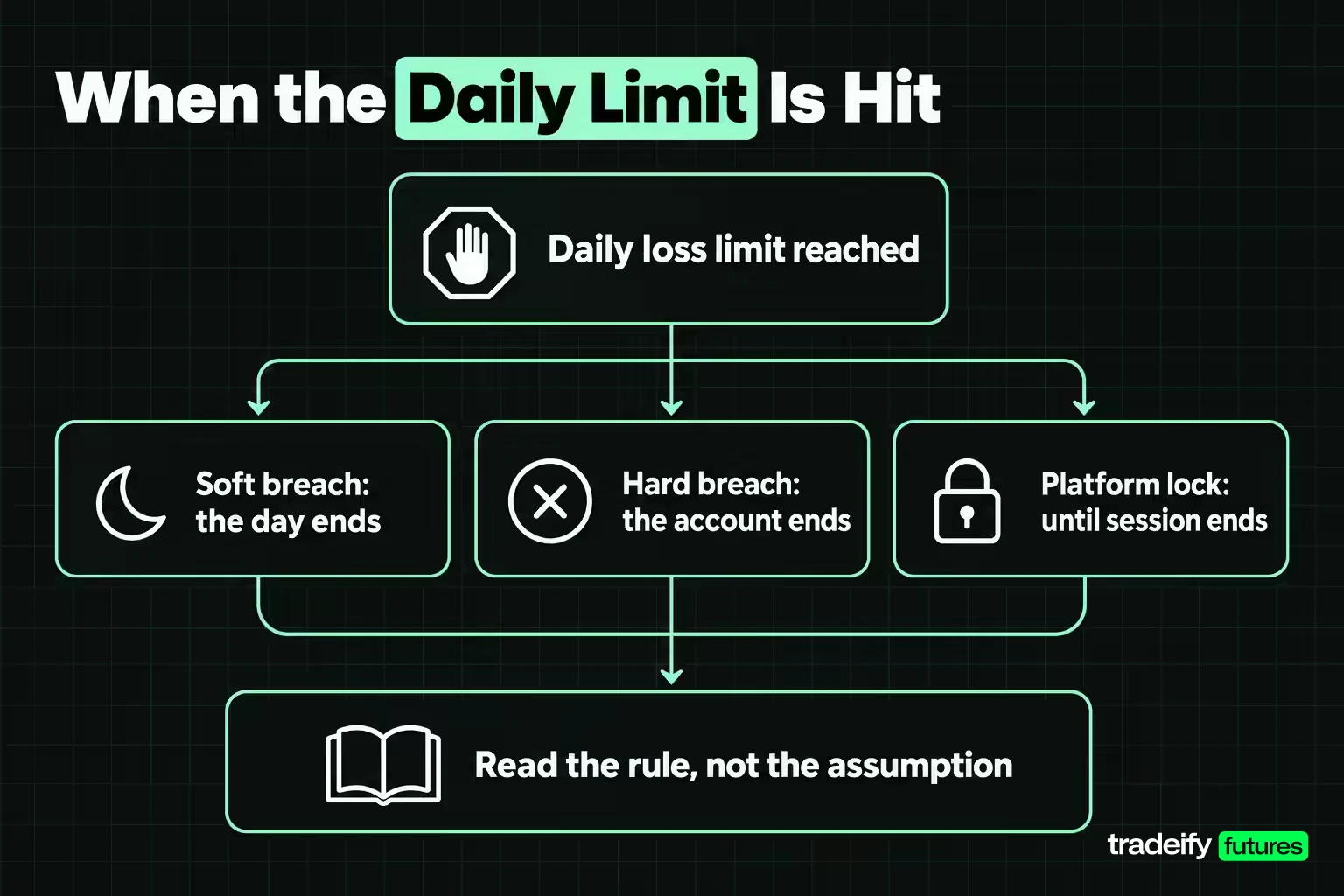
When the limit is reached, trading stops for the rest of the session. How it stops, and what it costs, depends on whether the limit is a soft breach or a hard breach.
- Soft breach. Open positions are closed or the account goes to liquidation-only, new orders are rejected, and the account is active again at the next session. The day is over, the account is not.
- Hard breach. Reaching the limit violates the account's rules and ends the evaluation or the funded account. Some rulebooks treat the daily limit this way, so read the clause rather than assuming a pause.
- Platform lock. On a personal account, a platform setting liquidates and locks the account until the session ends or the trader changes the setting.
Slippage past the limit
A loss limit is not a guaranteed exit price. The system notices the breach, then closes positions at market, so a fast move can carry the loss past the line before the order fills. That is the reason not to trade right up to the limit: an overshoot on a soft-breach daily limit can be enough to touch a hard-breach drawdown floor that sits close behind it.
Loss limit breaches in evaluation and funded accounts
The same breach can be treated differently in an evaluation and on a funded account. Some account types carry a daily limit in one phase and not the other, some raise it as profit builds, and some treat a breach as a pause in one phase and a failure in another. Check both phases before you buy or trade an account, because the habits you build in the evaluation carry straight into the funded phase.
A Daily Loss Limit Tested on 580 Entries
Most articles argue for a daily loss limit in words. This guide's own test counts what one actually does. It is an illustrative study of a deliberately simple, edge-free rule, built to show what a limit does to the shape of a session, not to suggest a strategy.
How the 580-entry loss limit test was built
- Data. Front-month E-mini S&P 500 (ES) and E-mini Nasdaq-100 (NQ) 5 minute bars, 50 complete regular sessions (9:30 AM to 4:00 PM New York) per product, from 2026-07-08 to 2026-09-16.
- Entries. On each hour from 10:00 AM to 3:00 PM, one entry at the bar close in the direction that bar closed.
- Exits. Stop one entry-bar range away, target 1.5 times that range. The first level touched decides the trade, and a bar touching both is scored as a loss. Entries touching neither were set aside (7 on ES, 5 on NQ), leaving 285 resolved entries on ES and 295 on NQ, 580 in all.
- Units. Every result is in R, the entry-bar range, so a loss is 1.00R and a win is 1.50R by construction. At an illustrative $500 risk unit, 1R is 1% of a $50,000 account.
The rule has no edge: the pooled loss rate was 60.86%, against the 40% win rate a 1.5 to 1 target needs just to break even before costs. That is useful here, because it shows what a limit does to an ordinary, slightly losing stream of trades.
ES and NQ sessions with no loss limit
| Measure | ES | NQ | Both pooled |
|---|---|---|---|
| Complete sessions | 50 | 50 | 100 |
| Resolved entries | 285 | 295 | 580 |
| Loss rate | 59.30% | 62.37% | 60.86% |
| Median session | 0.00R | -1.00R | -1.00R |
| Worst session | -6.00R | -6.00R | -6.00R |
| 5th percentile session | -4.33R | -4.33R | -5.00R |
| Sessions at or beyond -3R | 16% | 20% | 18% |
| Sessions at or beyond -4R | 6% | 6% | 6% |
At a 1% risk unit, the worst session in the sample was a 6% day, and nearly one session in five lost 3R or more.
ES and NQ sessions under four daily loss limits
The rule applied was the plain one: once the session's closed result reaches the limit, no more entries are taken that day, and the entry that crossed the line keeps its loss.
| Daily limit at a $500 risk unit | Sessions stopped | Entries given up | Mean session with limit | Worst session with limit | Stopped sessions that closed above the limit | Paired mean difference and 95% interval |
|---|---|---|---|---|---|---|
| None | 0 of 100 | 0 of 580 | -0.12R | -6.00R | Not applicable | Not applicable |
| 2R, $1,000 | 49 of 100 | 145 of 580 | -0.28R | -2.50R | 28 of 49 | -0.15R (-0.46 to +0.14) |
| 3R, $1,500 | 29 of 100 | 56 of 580 | -0.21R | -3.50R | 11 of 29 | -0.09R (-0.32 to +0.12) |
| 4R, $2,000 | 10 of 100 | 16 of 580 | -0.09R | -4.00R | 4 of 10 | +0.04R (-0.07 to +0.14) |
| 6R, $3,000 | 3 of 100 | 0 of 580 | -0.12R | -6.00R | 0 of 3 | +0.00R |
Three results are worth separating.
- The worst day shrinks. The worst session fell from -6.00R to -3.50R at a 3R limit and to -2.50R at 2R. That is what the limit is for, and on this data it did it.
- The average day does not improve. The paired differences sit between -0.15R and +0.04R and every interval spans zero. The sample shows the limit reshaping the bad tail. It cannot show the limit making money.
- Some stopped days would have recovered. At 3R, 11 of the 29 stopped sessions would have closed above the limit. At 2R it was 28 of 49. A tighter limit removes more deep days and more recoveries at the same time.
Loss limits and drawdown across the test
A session cap limits one day, not a losing stretch. With no limit, the ES path ran from a peak on 2026-07-31 to a trough on 2026-08-25, an 18.50R drawdown. A 4R limit left that unchanged at 18.50R, and a 3R limit made it worse at 23.00R, because the entries it skipped included winners. On NQ, a 4R limit trimmed the 31.00R drawdown to 29.00R.
One detail should shape the buffer you keep. The entry that crossed a 3R limit landed exactly on it in 73.3% of ES stops and 71.4% of NQ stops, and the largest overshoot was 0.50R, because every entry had a resting stop. The study fills every stop at its price, so it cannot price a gap through one. Real buffers exist for the day a stop does not hold.
The Session a Loss Limit Ended Early
The ES session of 2026-08-18, from a 580-entry test on ES and NQ 5 minute bars with every result in R, shows the cost side of a loss limit. The first three entries lost in a row, and the third loss closed at 12:25 PM with the session's closed result at exactly -3.00R. The next three entries won 1.50R each.
| Clock (New York) | Closed result in R | Session equity in R |
|---|---|---|
| 10:00 AM | +0.00 | -0.73 |
| 10:30 AM | -1.00 | -1.00 |
| 11:00 AM | -1.00 | -1.89 |
| 11:30 AM | -2.00 | -2.00 |
| 12:05 PM | -2.00 | -2.93 |
| 12:25 PM | -3.00 | -3.00 |
| 1:10 PM | -3.00 | -3.71 |
| 1:30 PM | -3.00 | -2.50 |
| 2:00 PM | -1.50 | -2.06 |
| 2:30 PM | +0.00 | +0.00 |
| 3:00 PM | +0.00 | -0.60 |
| 3:30 PM | +1.50 | +1.50 |
| 3:55 PM | +1.50 | +1.50 |
With a 3R closed limit, the session ends at 12:25 PM with -3.00R booked, and the last three entries (worth 4.50R together) are never taken. Without a limit, the day closes at +1.50R. At a $500 risk unit, the limit turned a $750 gain into a $1,500 loss.
The equity column adds a second lesson. At 1:10 PM the open entry was 0.71R against the trade, so session equity printed -3.71R on a position that later closed as a full 1.50R winner. An equity-based limit would have ended the day there.
None of that makes the limit wrong. Hindsight is doing the work here. A trader taking the same three losses on a different day has no way of knowing the next three entries will win, and on the days they keep losing, the limit is what stops a -3R day from becoming a -6R day. The case shows the price of the rule, so you can judge it with both sides on the table.
Weekly Loss Limits on Top of a Daily Limit
A weekly loss limit is a second running total across the sessions of one week. A daily limit handles one bad session. It says nothing about four mediocre sessions in a row, each one stopped just short of the daily line, that add up to a week the account cannot absorb.
This guide's illustrative 580-entry test on ES and NQ 5 minute bars grouped each product's 50 sessions into 10 blocks of 5 and stacked weekly limits on top of daily limits. The worst week with no limits at all was -12.50R on ES and -9.00R on NQ.
| Daily and weekly pairing | Weeks stopped | Sessions given up | Worst week with both limits |
|---|---|---|---|
| ES, 2R daily, 2R weekly | 7 of 10 | 22 of 50 (44%) | -3.00R |
| ES, 2R daily, 4R weekly | 2 of 10 | 3 of 50 (6%) | -5.00R |
| ES, 3R daily, 6R weekly | 1 of 10 | 2 of 50 (4%) | -7.50R |
| ES, 3R daily, 9R weekly | 1 of 10 | 1 of 50 (2%) | -10.50R |
| NQ, 2R daily, 2R weekly | 7 of 10 | 16 of 50 (32%) | -3.50R |
| NQ, 2R daily, 4R weekly | 5 of 10 | 9 of 50 (18%) | -6.00R |
A weekly limit equal to the daily one stops most weeks and gives up nearly half the sessions, which is no longer a safety rule but a different trading plan. At two to three times the daily figure, the weekly loss limit stopped one or two weeks in ten, gave up a handful of sessions and still cut the worst ES week from -12.50R to -7.50R. Every weekly stop gave up between 1 and 3 sessions, always in the back half of a week that had already gone badly.
That gives a workable starting ratio: a weekly loss limit of two to three daily limits, both running at once, with whichever fires first ending the trading.
Managing a Loss Limit During the Session
A daily loss limit does its best work on the days you never touch it. The habits that keep a trader away from the line matter more than the line itself.
- Set a personal limit inside the imposed one. With an imposed $1,500 limit and a $500 stop, a personal limit at $1,200 leaves $300 of room, 0.60 of one full stop, for slippage and fees. The personal line fires first, so the imposed one is never tested.
- Size so the losses you accept fit. If you are willing to take three full losses in a day, three losses of $400 equal $1,200 and fit under that personal line. Sizing from the limit downward is cleaner than discovering mid-session that two more losses would breach it.
- Pause after two losses. Two losses in a row is a natural checkpoint. Step away, re-read the plan and ask whether the next setup meets it or whether you want the money back.
- Cut size after a loss, not after a win. Dropping to a smaller size after a red start keeps the remaining budget alive for more attempts.
- Protect a green day. If the day is up meaningfully, decide in advance how much of it you are willing to give back, and stop when you reach that figure.
How to handle losses during a trading day
The loss itself is rarely the problem. What happens next is. A trader who takes a clean loss at the planned size and then takes the next qualified setup at the same size is trading the plan. A trader who doubles size to win it back is trading the last loss. Treat each stop as a cost already paid, check the journal for whether the setup was valid, and let the limit make the decision you would rather not make in the moment.
Related lesson: How to keep a trading journal
Tools That Enforce a Loss Limit
A loss limit written in a plan stops nothing on its own. The tools that enforce it best are the ones that act without asking you.
- Platform risk settings. Many futures platforms let a trader set a session limit that liquidates open positions and blocks new orders when it is reached. Tradovate, for example, liquidates and locks the account when its daily loss limit is hit, and unlocks it at the end of the session or when the setting is raised or disabled. Set the figure before the session, not after a loss.
- Lockout timers. Some platforms offer a manual lockout that pauses trading for a set period. It is useful after a fast loss when you know your next decision is unlikely to be a good one.
- Server-side bracket orders. A stop and target attached to every entry, held on the broker's servers, keep the per-trade loss defined even if your connection drops, which keeps the daily total predictable.
- Firm rules. On a prop account, the firm's own limit is enforced automatically, but it is the outer wall, not the one you want to lean on.
- A written rule with an accountability check. A line in the plan plus a journal entry for every session that came close. Weakest on its own, useful alongside the others.
The list runs from most automatic to least, and that order is the point: the less a tool depends on in-the-moment willpower, the more reliable it is on the days you need it.
Why Traders Break Their Loss Limits
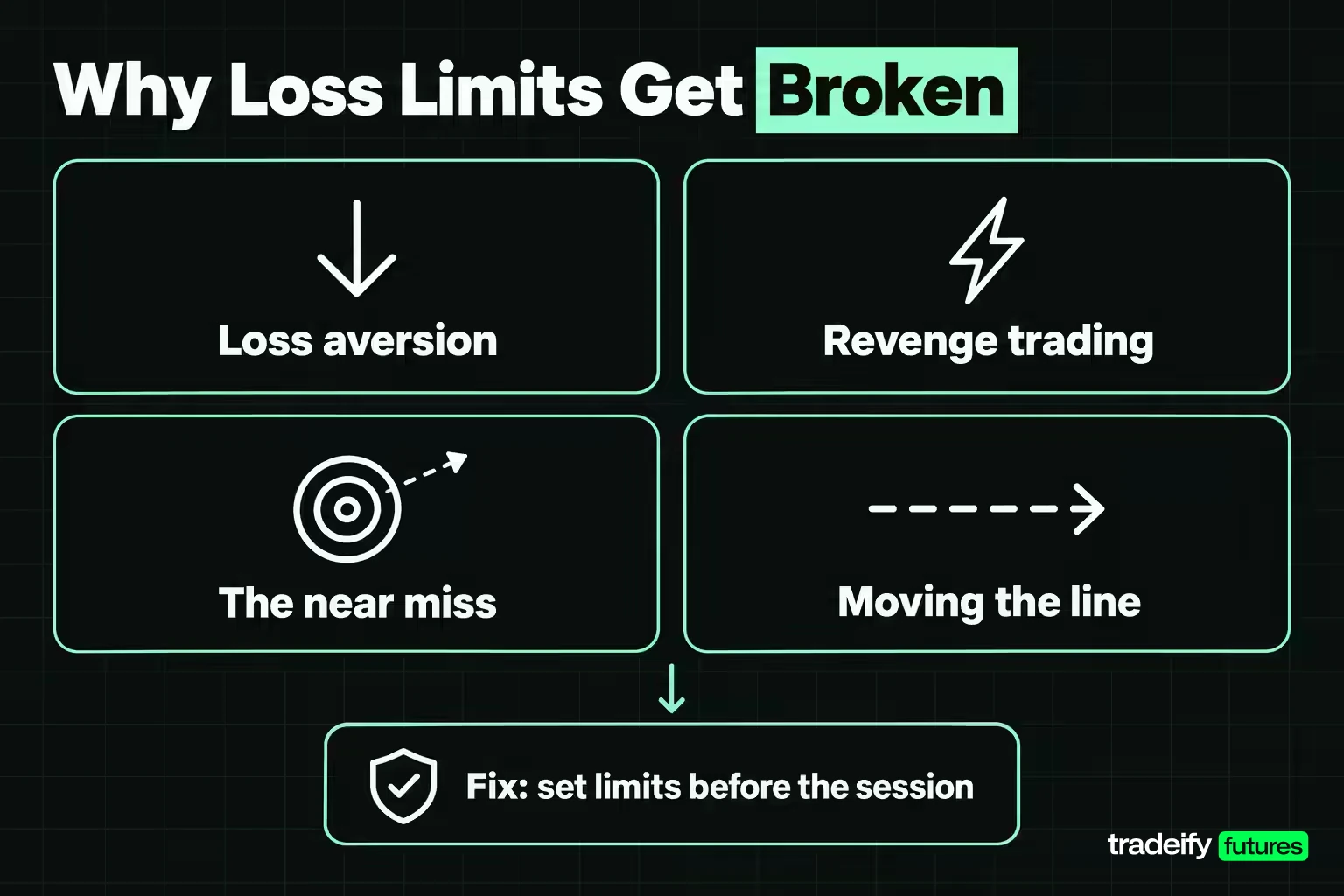
Traders do not break a loss limit because they forgot it. They break it because the moment near the limit is built to feel like the wrong time to stop.
- Loss aversion. A loss feels heavier than a gain of the same size, so a trader down 2.8R wants to get back to even far more than they wanted the original profit. The urge is to take one more trade at a larger size.
- Revenge trading. After a stop-out, the next trade becomes about the last one. The setup gets less important than the score.
- The near miss. Being just short of the limit makes the remaining room look like free attempts, when it is actually the most expensive part of the day.
- Moving the line. Raising a limit mid-session always points the same way, and it lands on the worst days.
The fix for each is a decision made before the session opens. Set the limit while you are calm, let a platform enforce it, and treat a stopped day as the rule working rather than as a failure to repair tomorrow.
Related lesson: Avoiding trading tilt
Common Loss Limit Mistakes
Most loss limit failures repeat, and almost none of them is about the number being wrong.
| Mistake | How it looks in the moment | Why the limit does not catch it | The check that does |
|---|---|---|---|
| Using the limit as a stop loss | The next trade goes on because the limit is still open | A limit acts after the loss, a stop acts at a price | Give every entry its own resting stop |
| Counting closed trades when the rule counts equity | A position runs past the limit while still open | The two definitions stop different sessions | Read the clause for closed, floating and equity |
| Setting a personal limit too close to the imposed one | Both fire on the same trade | The buffer has to absorb slippage and fees | Leave at least one average stop of room |
| Raising a trailing limit after a good morning | The limit is quietly moved to keep trading | A trailing limit measures from the session high | Fix the figure for the whole day |
| Treating two products as two budgets | ES and NQ positions are open at once | Each looks allowed while both express one view | Sum the session loss across every product |
| Amending the weekly limit mid-week | The limit goes up after a losing Monday | The change always points the same way | Change limits only in the journal, between weeks |
The first row costs the most. A limit used as a stop has already been passed by the time it acts, and the size of the overshoot depends on whatever the last position happened to be.
Related lesson: Stop-loss orders and placement
Loss Limits Across Multiple Accounts
A daily loss limit applies per account, but the risk does not stop at the account boundary. When a trader copies the same trade across several accounts, each account has its own limit and all of them can be hit by the same move.
Imagine a trader running three accounts, each with a $1,000 daily loss limit, with every trade copied to all three. One bad session can cost up to $3,000 across them, and because the positions are identical, the three limits tend to fire together. Three accounts, one trade, one bad day.
A few rules keep multiple accounts honest:
- Set a combined daily figure across all accounts and treat it as the real limit.
- Remember that each account's drawdown floor sits at a different distance, so the same loss can be a soft breach on one account and a failure on another.
- Treat correlated products as one position. Long ES on one account and long NQ on another is close to one bet.
- Check each firm's rules on copy trading and on opposite positions across accounts before running a copier.
Related lesson: Correlation risk
Why Prop Firms Use Daily Loss Limits
Prop firms use daily loss limits for the same reason traders should: one session should not be able to do account-ending damage. For the firm, a daily cap separates a bad day from a failed account and keeps a trader's worst session at a size the firm's drawdown rules were designed around.
Rulebooks differ a lot. Some firms set a fixed dollar figure, some a percentage, some trail from the session high, some raise the limit as profit builds, and some account types carry no daily limit at all and rely on the overall drawdown alone. Some treat a breach as a pause, others as a failure. That variety is why comparing accounts on headline figures alone is misleading: a larger trailing limit can stop more sessions than a smaller fixed one.
On our accounts, hitting the daily cap is a soft breach. Our Growth evaluations cap the day at $600 on 25K, $1,250 on 50K, $2,500 on 100K and $3,750 on 150K, and reaching it puts the account in liquidation-only until the next trading day, which runs 6:00 PM to 5:00 PM ET. Select evaluations have no daily loss limit. The end-of-day trailing drawdown is separate, enforced in real time, and touching it fails the account, so we ask traders never to use the daily limit as a stop loss. Personal Tradovate risk settings work on our accounts as an extra layer, but they are your limits and do not replace our rules. Funded accounts are simulated.
Daily Loss Limit FAQ
Is it true that 97% of day traders lose money?
For persistent day traders in one well-known study, yes: Chague, De-Losso and Giovannetti found that 97% of Brazilian equity index futures day traders who kept going lost money. Of the 1,551 people who kept day trading for more than 300 days, 97% lost money, and only 1.1% earned more than the Brazilian minimum wage. It is one market and one period, but it is a strong reason to treat risk limits as survival rules rather than optional extras.
Can I day trade with $2000?
You can day trade futures with $2,000, because futures were never subject to the pattern day trader rule, but the risk budget is thin. At 1% risk per trade, $2,000 allows $20 per trade, which on a Micro E-mini S&P 500 at $5 per point covers only a 4-point stop. For US stock margin accounts, FINRA Regulatory Notice 26-10 replaces the $25,000 pattern day trader minimum with new intraday margin standards, effective June 4, 2026, with firms allowed to phase in until October 20, 2027. Ask your broker which rules apply to your account today.
What is the 7% stop loss rule?
The 7% stop loss rule is a stock-investing guideline from Investor's Business Daily: always sell a stock if it falls 7% to 8% below what you paid for it. On a $100 purchase, that means selling at $93 or $92. It is a per-position stop for stock investors, not a session cap, and it does not translate directly to intraday futures, where stops are usually set by the chart and sized by the dollar risk.
Do open positions count toward a daily loss limit?
They can, depending on how the rule is written. Some limits count only closed trades, others count floating losses on open positions in real time, and some trail from the session's high. Read the clause before the session, because the definition decides which days get stopped.
Can you trade after hitting your daily loss limit?
Not on the same session. On a soft-breach limit the account becomes tradeable again at the next session open, which on CME futures is 6:00 PM ET. On a hard-breach limit the account itself may be closed, so check which kind applies.
Trading futures involves substantial risk of loss and is not suitable for every investor. Futures are leveraged, so losses can exceed what you expect, and a loss limit does not guarantee an exit price or prevent loss. Evaluation and funded prop accounts are simulated. The 580-entry study is an illustrative measurement of a simple rule on past data, and past results do not predict future results. Nothing here is investment advice.


