



TL;DR: An all or none order fills your entire quantity at your limit or better, or fills nothing at all. It protects position size, not price, and it can sit unfilled while enough size trades across several venues. Fill or kill adds an immediate deadline; immediate or cancel keeps any partial fill. CME Globex lists no all or none qualifier, so futures traders use minimum quantity or fill or kill.
An all or none order, usually shortened to AON, is a limit order with one extra rule attached: fill the whole quantity or fill none of it. The rule sounds tidy, and it is, right up until the size you asked for trades in pieces at your price while your order sits there untouched.
That moment is the real decision behind AON. You are choosing between being partly in and being fully out, and most traders tick the box without pricing either side.
This guide covers what an AON order actually does, how it differs from fill or kill, immediate or cancel and minimum quantity, why AON orders go unfilled, what the futures exchanges offer instead, and how to decide whether a partial fill is really the bigger problem.
What Is an All or None Order
An all or none order is an order to buy or sell that must be executed in its entirety or not executed at all. That is the SEC's investor education definition, and it adds one more detail that matters: an AON order that cannot be executed immediately remains active until it is executed or cancelled.
So the instruction has two parts.
- A quantity rule. Partial fills are refused. If you ask for 1,000 shares, 900 shares is the same as zero.
- No deadline of its own. The order keeps waiting. How long it waits comes from the time in force you attach, such as a day order or good 'til canceled.
Nasdaq's glossary describes AON as a limited price order, which is the part beginners miss. The AON condition sits on top of a limit order. The limit price still decides the worst price you accept, and the AON condition only decides how much of the order is allowed to trade.
AAII gives the clean illustration. Enter an AON order for 5,000 shares at $15.00, and if the broker can get 4,500 shares at $15.00 but the last 500 only at $15.15, nothing trades. A plain limit order at $15.00 would have taken the 4,500 and kept working on the rest.
Related lesson: Limit orders
AON as an Order Condition, Not an Order Type
AON is not an order type in the way a market order or a stop order is. It is a condition you attach to an order type, and keeping those two layers apart makes every order ticket easier to read.
The order type answers "at what price, and when does this become live?"
- Market order. Trade now at the best available price. FINRA notes market orders typically receive the highest priority, followed by limit orders.
- Limit order. Trade at your price or better, or wait. An order that has not traded, been cancelled or expired is an open order, still working.
- Stop order. Dormant until a trigger price trades, then it becomes a market order.
- Stop-limit order. Dormant until the trigger, then it becomes a limit order that may not fill.
- Trailing stop. A stop whose trigger moves with price by a set amount or percentage.
The conditions answer "for how long, and how much?"
- Time in force. Day orders expire at the end of the trading day; good 'til canceled orders stay in effect until executed or canceled, subject to your broker's own limit.
- Quantity qualifiers. All or none, minimum quantity, and the immediate-execution pair fill or kill and immediate or cancel.
- Routing instructions. Directed or non-directed, which decides which venue sees the order.
AON belongs in the quantity layer. That is why it normally rides on a limit order: a market order with an all or none rule would ask for unlimited price tolerance and perfect size at the same time.
Availability is a broker and venue question. Interactive Brokers, for example, lists the AON attribute for US stocks, ETFs, options, bonds and EFPs. CME Globex, the main US futures platform, lists no all or none qualifier at all; its closest tools are minimum quantity and fill or kill.
Related lesson: Order types overview
All or None vs Fill or Kill, IOC and Minimum Quantity
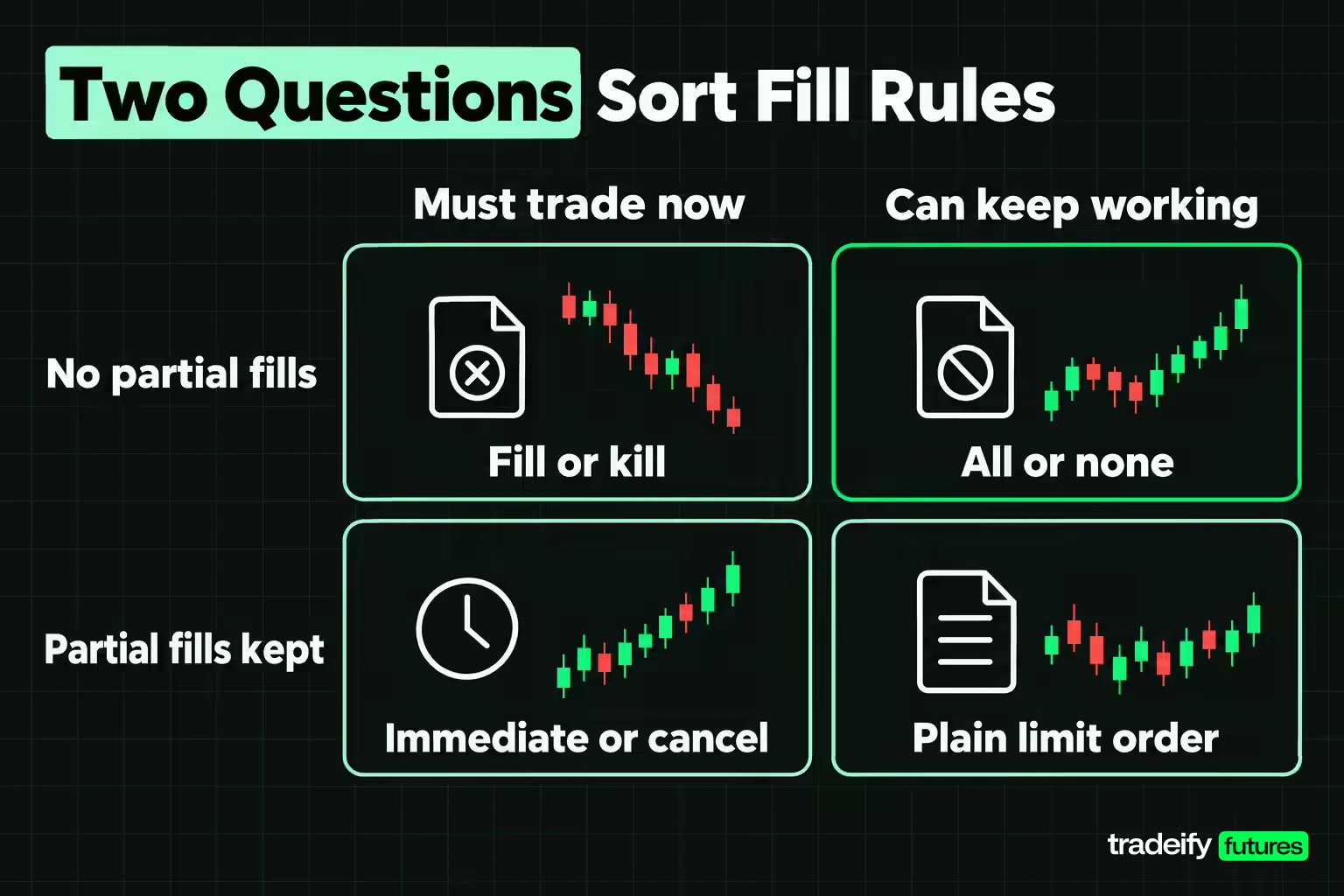
All or none gets confused with three other instructions because they all deal with partial fills. They separate cleanly once you ask two questions: does a partial fill count, and does the order have to trade right now?
| Instruction | Partial fill allowed | Must trade immediately | What happens to unfilled size |
|---|---|---|---|
| All or none (AON) | No | No | The whole order keeps working until filled, cancelled or expired |
| Fill or kill (FOK) | No | Yes | The whole order is cancelled at once |
| Immediate or cancel (IOC) | Yes | Yes | Whatever fills is kept and the rest is cancelled |
| Minimum quantity | Only at or above the floor you set | Depends on the venue | Nothing trades unless the floor can be met |
FINRA's description of the key pair is the one to remember. AON orders prevent partial filling but don't have the immediacy of an FOK order; the firm keeps trying to fill the entire order until you cancel it or it reaches any expiration date the firm sets. FOK demands both at once: the whole size, right now, or nothing.
Run one order through all four and the differences become concrete. A Series 7 study example uses a buy of 1,000 shares at $50 when only 500 shares are available at $50.
- AON does not execute. It waits until all 1,000 shares are available at $50 or less, and the firm keeps trying.
- FOK is cancelled immediately, because 500 is not 1,000.
- IOC buys the 500 available and cancels the other 500.
- Minimum quantity depends on the floor. With a 500-share minimum it can take the 500; with a 600-share minimum it trades nothing.
Schwab's minimum-quantity example shows why that last instruction exists. An order to buy 5,000 shares with a 1,000-share minimum avoids a token 100-share fill but still accepts a meaningful partial. If 700 shares of a 1,000-share order would still be useful to you, AON is the wrong tool and a minimum quantity is the closer fit.
Related lesson: Fill or kill orders
Why AON Orders Sit Unfilled
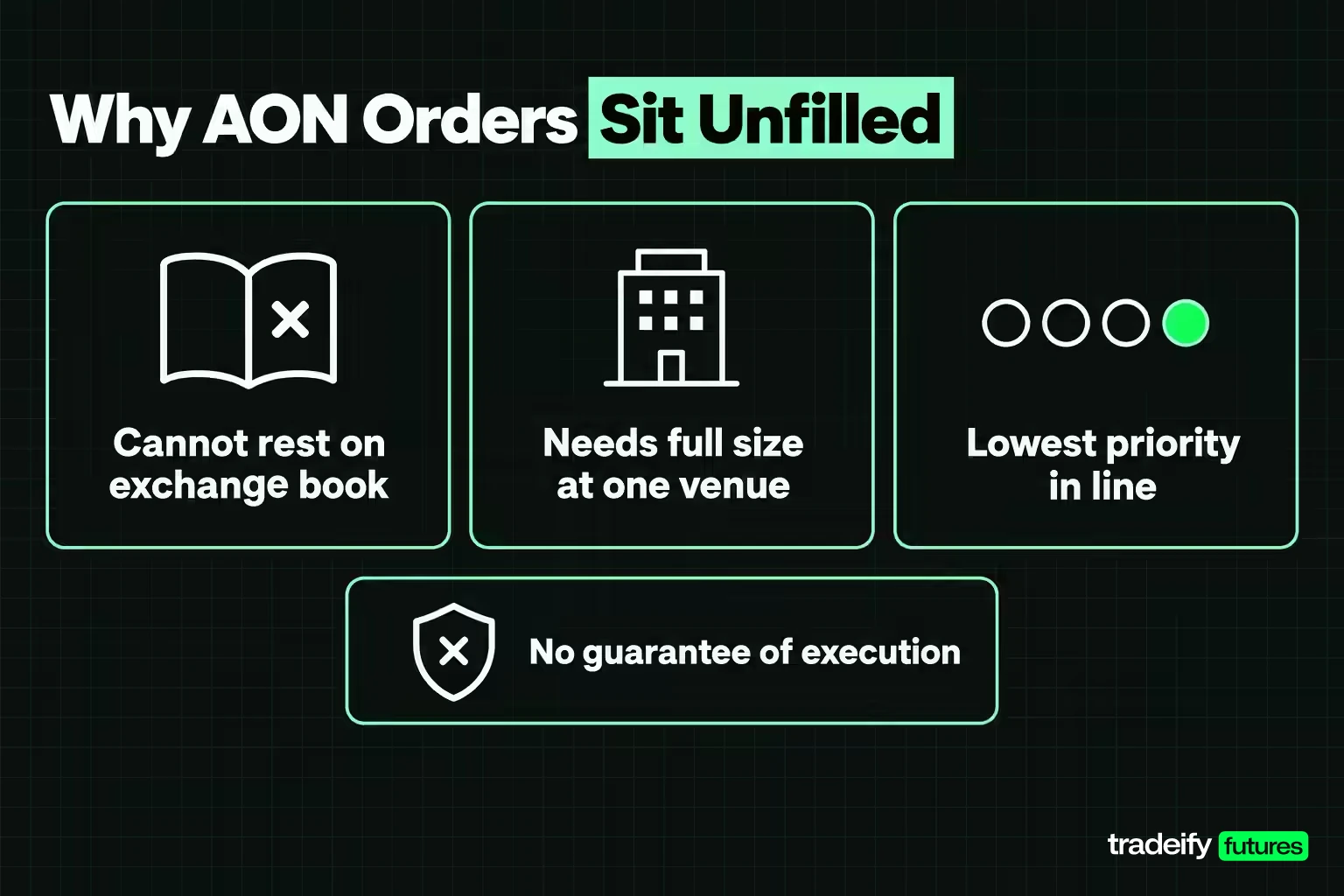
An AON order does not guarantee execution, and in stock markets it is harder to fill than a plain limit order at the same price. Several published rules explain why.
It usually cannot rest on the exchange book. Schwab states that AON orders cannot be held on the exchange limit order book. They also require the entire order to execute at a single venue, even when enough shares might be available if the order were broken up across venues. US stocks trade on many venues at once, so the size you need can be on screen in total and still not be on any one venue.
It sits at the back of the line. Fidelity describes all or none orders as the lowest priority orders on the market floor because of the restrictions they carry. AAII makes the same point from the broker side: brokers give priority to orders without trade conditions.
Your broker may be simulating it. Interactive Brokers routes AON orders to the native exchange where the venue supports them and otherwise holds and simulates the order. For a held US stock order, the national best offer has to be at or better than your limit and show at least your order size plus 1,000 shares. Its own example is an AON buy of 1,500 shares at $10.00, which waits until the best offer is $10.00 or less with 2,500 shares or more showing.
Size relative to the day's volume decides most of it. AAII notes that large AON orders in illiquid stocks are harder to execute because they represent a bigger share of what trades that day. Fidelity also notes that some securities need at least two round lots, generally 200 shares, before an AON condition is accepted.
Put together, an AON order has a price condition, a size condition, a venue condition and a priority handicap. Each one alone is manageable. Stack all four and an order that looks reasonable on the chart can wait all session while the tape prints your price again and again.
AON Order Example With Stock Venues
The cleanest way to see what an AON condition costs is to run the same order with and without it. Every price and size here is illustrative, not market data.
You want to buy 1,500 shares with a $24.00 limit. At that moment the displayed offers at $24.00 are 700 shares on one venue, 500 on a second and 400 on a third, which adds up to 1,600 shares. The largest single venue shows 700.
| Order | What fills now | Shares held | Cost against the $24.00 plan |
|---|---|---|---|
| Plain limit at $24.00, routed across venues | 700 + 500 + 300 at $24.00 | 1,500 | $0.00 |
| AON limit at $24.00 | Nothing, no single venue shows 1,500 | 0 | No position yet |
| AON, re-entered after price lifts to $24.30 | 1,500 at $24.30 | 1,500 | $450.00 |
The plain limit order is done in one pass. Your planned position is worth $36,000 and you paid exactly your price.
The AON order is still waiting, even though more than 1,500 shares were offered at your price. That is the single-venue rule at work, and it is the most common way an AON order "costs you a fill."
The third row is what happens next if the stock moves. Lift the price to $24.30 before one venue shows 1,500 shares, and buying the full block now costs 1,500 x $0.30, or $450.00 more than the plan. That is 1.25% of the $36,000 position, paid for the privilege of one clean print.
When a Partial Fill Costs More Than a Missed AON Order
The AON comparison is not always one-sided. Take the same illustrative 1,500-share buy at $24.00, but this time only 1,200 shares are available at that price anywhere.
A plain limit order takes 1,200 shares, 80% of the plan, and leaves 300 working. If the stock rises $0.30, the 1,200 shares gain $360.00 and the missing 300 shares cost you $90.00 of move you did not get. If the stock falls $0.30 instead, those 1,200 shares lose $360.00, and an AON order that never filled lost nothing.
So the AON condition is a bet that being partially in is worse than being out. Sometimes it is. Make that bet on purpose, with the numbers in front of you, rather than because the box was ticked last time.
Related lesson: Partial fills
All or None on Futures Exchanges
Futures traders who go looking for an all or none checkbox often do not find one, and there is a reason. CME Globex documents three order qualifier attributes, duration, minimum quantity and display quantity, and its supported qualifiers are day, good till cancel, good till date, fill and kill, fill or kill, minimum quantity and display quantity. All or none is not on that list.
What CME offers instead are two tools that cover part of the job.
- Minimum quantity. At least the minimum must fill immediately when the order arrives, or the entire order is cancelled. If the minimum or more fills, the rest rests on the book according to the order's time in force.
- Fill and kill, and fill or kill. A fill and kill order trades whatever it can immediately and cancels the balance. A fill or kill order is a fill and kill order with the minimum quantity set equal to the total quantity, so it fills completely at once or not at all. Both are accepted only while the market is in its open state.
The gap is the waiting part. A stock AON order can rest and wait for the full size; the CME tools decide on arrival. There is no exchange-level way to leave a futures order working with a "whole size or nothing" rule attached.
Five E-mini Contracts Worked Through Each Route
Here is one illustrative E-mini S&P 500 (ES) order, using the published contract value of $50 per index point and a minimum tick of 0.25 points, or $12.50. You want to buy 5 contracts. The offer shows 4 contracts at 7,000.25 and 6 contracts at 7,000.50.
| Route | What fills | Average price | Result |
|---|---|---|---|
| Day limit at 7,000.25 | 4 at 7,000.25 | 7,000.25 | 4 of 5, one contract left working |
| Fill or kill at 7,000.25 | Nothing | None | Cancelled, no position |
| Fill or kill at 7,000.50 | 4 at 7,000.25 and 1 at 7,000.50 | 7,000.30 | Full 5, one tick worse on one contract |
| Day limit at 7,000.25 with minimum quantity 3 | 4 at 7,000.25 | 7,000.25 | Minimum met, one contract left working |
| Day limit at 7,000.25 with minimum quantity 5 | Nothing | None | Cancelled, minimum not met on arrival |
The fill or kill at 7,000.50 is the futures version of insisting on the whole block. You get all 5, and the price of that certainty is one tick on one contract, $12.50 in total. On a liquid contract that is often cheap. On a thin contract month, or in a fast market where the next level is several ticks away, the same insistence gets expensive quickly. In micro terms, 10 Micro E-mini S&P 500 (MES) contracts paying one extra tick also cost $12.50, because each MES tick is $1.25.
It is worth being precise about what a 4-of-5 fill changes on a futures trade. Your risk per contract is the same; your total size is 80% of the plan. If your exits were built around 5 contracts, for example scaling out at two targets, a partial fill breaks the exit plan more than the entry.
Related lesson: Immediate or cancel orders
AON Order Benefits and Disadvantages
The AON condition buys you size certainty, and the currency is fill certainty. Laid out side by side:
| Factor | Benefit of AON | Disadvantage of AON |
|---|---|---|
| Position size | You hold exactly the planned quantity or nothing | You may hold nothing while the move happens |
| Price records | One execution price instead of several | You may chase to a worse single price to get filled |
| Risk math | Stop, target and dollar risk match the plan | A missed entry means no risk taken, and no trade either |
| Queue and priority | No odd remainder left working | Lowest-priority handling and slower fills |
| Venues | No fragmented fills across venues | Needs one venue to show the whole size |
| Costs | Fewer separate fills where each fill carries a commission | Waiting can cost more than the fees saved |
AAII's verdict is blunt: for the average individual investor, the drawbacks of an AON order may outweigh the benefits. The reason is lopsided exposure. The benefits only matter on trades where exact size changes the plan, while the main disadvantage, a missed or late fill, can hit any AON order you send.
When to Use an All or None Order
Start with one question: what does a partial fill do to this specific trade? If the honest answer is "nothing much," you do not need an AON condition.
AON tends to fit when:
- The size is the point. A position built to a fixed ratio, such as two legs that must match, becomes a different trade if only one leg fills completely.
- You are not on a clock. Interactive Brokers frames AON for traders who are not time sensitive about the fill but want the whole order or nothing.
- The order is small relative to displayed size. If any single venue routinely shows several times your quantity, the AON penalty is small.
- A tiny remainder would be a nuisance. Odd leftover shares that cost a separate commission, or a remainder that changes how you manage the exit.
AON tends to fail when:
- The entry is time-sensitive. Breakouts, news releases and fast markets reward getting in, and partial size is usually better than none. EBC's guide notes traders usually avoid AON orders in fast-moving markets.
- The order is large relative to volume. The bigger your share of the day's trading, the longer an AON order waits.
- You trade futures. CME has no resting all or none qualifier, so the realistic choices are a plain limit, a minimum quantity, or fill or kill.
How Technical and Fundamental Analysis Change the AON Decision
The way you found the trade usually tells you whether AON fits.
A technical entry tied to a level, such as a breakout above a range, is a trade with a clock. If price leaves the level, the reason for the trade is gone or has changed, and an AON order that is still waiting has turned into a chase. Partial size at the level is usually the better outcome.
A valuation-based entry, where you would be happy to buy at your price today, next week or next month, has no such clock. That is where a resting AON order makes the most sense, because a missed fill costs you time rather than the setup itself.
Is an AON Order Suitable for Newer Traders
Usually not as a default. Newer traders get more from understanding plain limit orders, partial fills and time in force first, because those decide most fills. AON earns its place later, for a specific job, once you know why a partial fill would hurt that trade.
Common AON Order Mistakes
Most AON problems are not mysterious. They come from forgetting one of the conditions stacked on the order.
| Mistake | What happens | Fix |
|---|---|---|
| Sizing the block bigger than any single venue shows | The order waits all session while your price trades in pieces | Split the order into sizes you would accept, or use a minimum quantity |
| Forgetting the time in force | A day AON order expires quietly at the close | Set the duration on purpose and check it before you walk away |
| Raising the limit just to force the fill | You get the whole block at a price you never planned | Decide your maximum price before sending the order |
| Assuming the broker sends it to the exchange | A held, simulated order waits for extra displayed size | Ask whether your broker routes AON natively or simulates it |
| Expecting an AON checkbox on futures | You fall back to a plain limit and get a partial fill you did not plan for | Use minimum quantity or fill or kill where your platform offers them |
| Never pricing the wait | The setup expires while the order sits unfilled | Give the order an end time that matches your reason for the trade |
The common thread is that AON shifts risk from "wrong size" to "no trade." That is fine when you meant to make that swap. It is a problem when the condition was ticked out of habit.
Related lesson: Good-til-canceled orders
A Pre-Trade Checklist for AON Orders
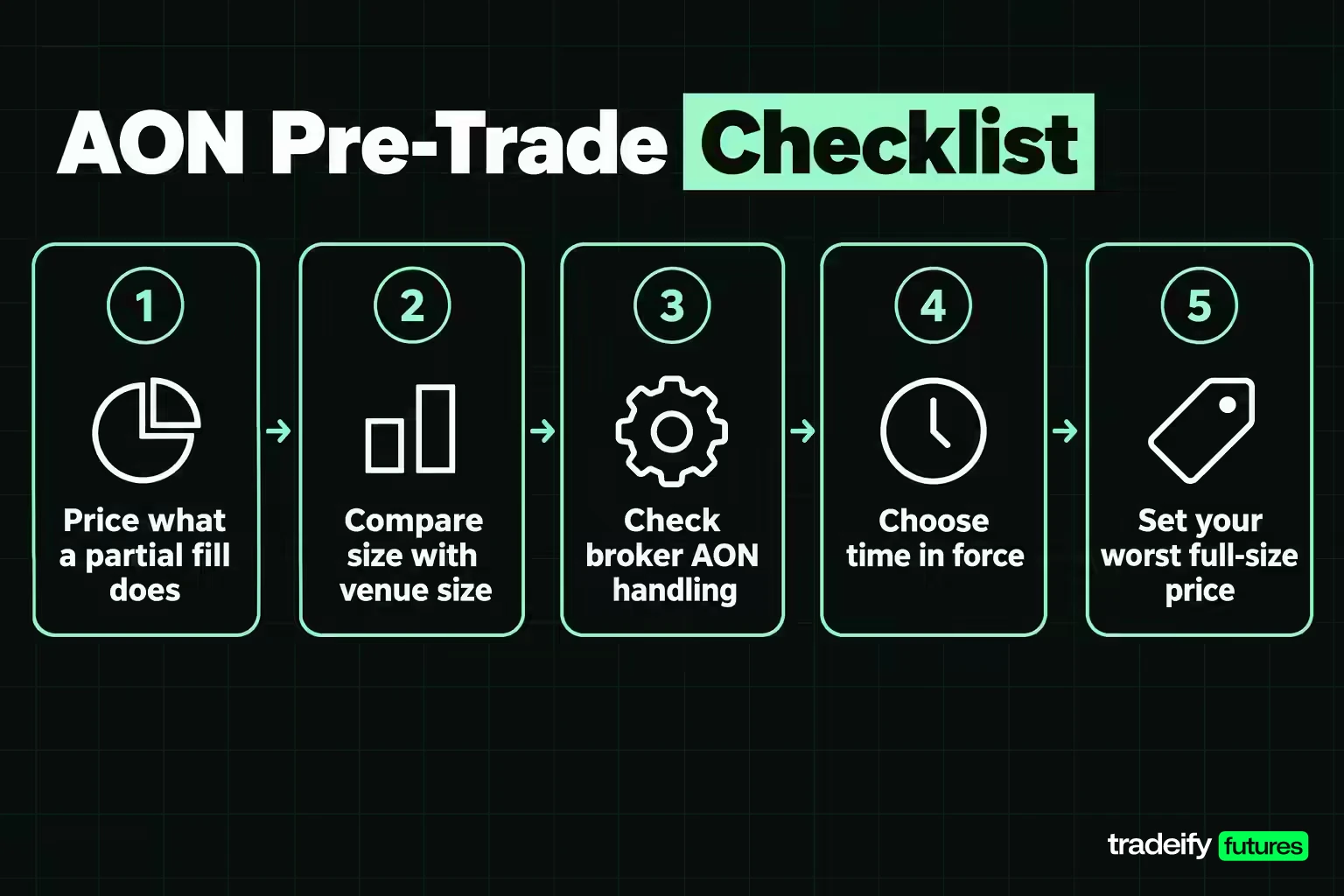
Use these steps in order before sending an all or none order, or any instruction that refuses partial fills.
- Write down what a partial fill would do to the trade. If it changes nothing important, use a plain limit order.
- Compare your size with the largest size a single venue shows at your price. Near or above it, expect to wait.
- Check what your broker does with AON: native routing to a venue that supports it, or a held and simulated order.
- Pick the time in force deliberately and note when the order expires.
- Set the highest price you would pay, or lowest you would sell at, to get the full size, and treat anything beyond it as no trade.
- On futures, decide between a plain limit, a minimum quantity and fill or kill, because there is no resting AON qualifier on CME Globex.
- If the order has not filled by the time your reason for the trade expires, cancel it rather than chasing.
On our accounts, the order types covered in our Order Types Explained guide are market, limit, stop, stop-limit, trailing stop, OCO and OSO, and an all or none instruction is not among them. So when you enter several contracts at once with us, plan for a limit that may fill partially or a market order that fills but may slip. Our funded accounts are simulated.
Frequently Asked Questions About AON Orders
Does an all or none order guarantee a fill?
No. It only rules out a partial fill. If the full size never becomes available at your limit, at a single venue for stocks, the order can stay unfilled until it expires or you cancel it.
What is the difference between AON and fill or kill?
Timing. Both refuse partial fills, but an AON order keeps working until filled, cancelled or expired. A fill or kill order must fill completely at once or it is cancelled.
Can a market order be all or none?
Usually not. The AON condition is normally attached to limit orders, because a market order promises execution at whatever price is available, so adding an all or none rule would demand unlimited price tolerance and the full size at the same time. Check your broker's ticket for what it accepts.
What is a limit order?
A limit order is an order to buy or sell at a set price or better: a buy limit fills at or below its price, a sell limit at or above. It controls price but does not promise a fill, and an AON order is a limit order with a whole-quantity rule added.
What does an open order mean?
An open order is one that has been placed but has not yet been filled, cancelled or expired. A resting AON or limit order is an open order until one of those happens.
What is the difference between a trailing stop-loss and a trailing stop limit order?
The difference is what the order becomes once its trigger is hit. Both move their trigger as price moves in your favor, but a trailing stop-loss becomes a market order when triggered, so it should fill but can slip. A trailing stop limit becomes a limit order when triggered, so it controls price but may not fill in a fast move.
Do futures exchanges accept all or none orders?
CME Globex does not list an all or none qualifier. Its published tools are minimum quantity, fill and kill, and fill or kill, which is a fill and kill order with the minimum set to the full quantity.
This guide is educational and is not financial or trading advice. Futures and other leveraged products can lose more than you expect, and losses can exceed the money in your account. All prices, order books and fills shown are illustrative examples, not market data. Funded and evaluation accounts at prop firms are simulated, and order types, qualifiers and routing vary by exchange, broker and platform, so confirm what your own account supports before relying on any of them.


