



TL;DR: An IOC order fills whatever it can right now at your price or better and cancels the rest. It never rests on the book, so a partial fill or a zero fill is normal. FOK needs the full size at once; a day order lets the remainder wait. On CME futures it is called Fill and Kill and is accepted only in the Open market state.
An IOC order is the instruction for the moment when waiting is the thing you want to avoid. You send it, the venue matches it against whatever liquidity is resting at your price or better, and anything left over is cancelled on the spot. No queue position, no second chance later in the session.
That sounds simple until the first partial fill lands, you hold 47 contracts instead of 60, and you have to decide what to do with the shortfall while price keeps moving. This guide covers the definition, how the matching actually works on a priced futures book, how IOC compares with day, GTC and FOK instructions, and the edge cases that catch traders out.
What Is an IOC Order
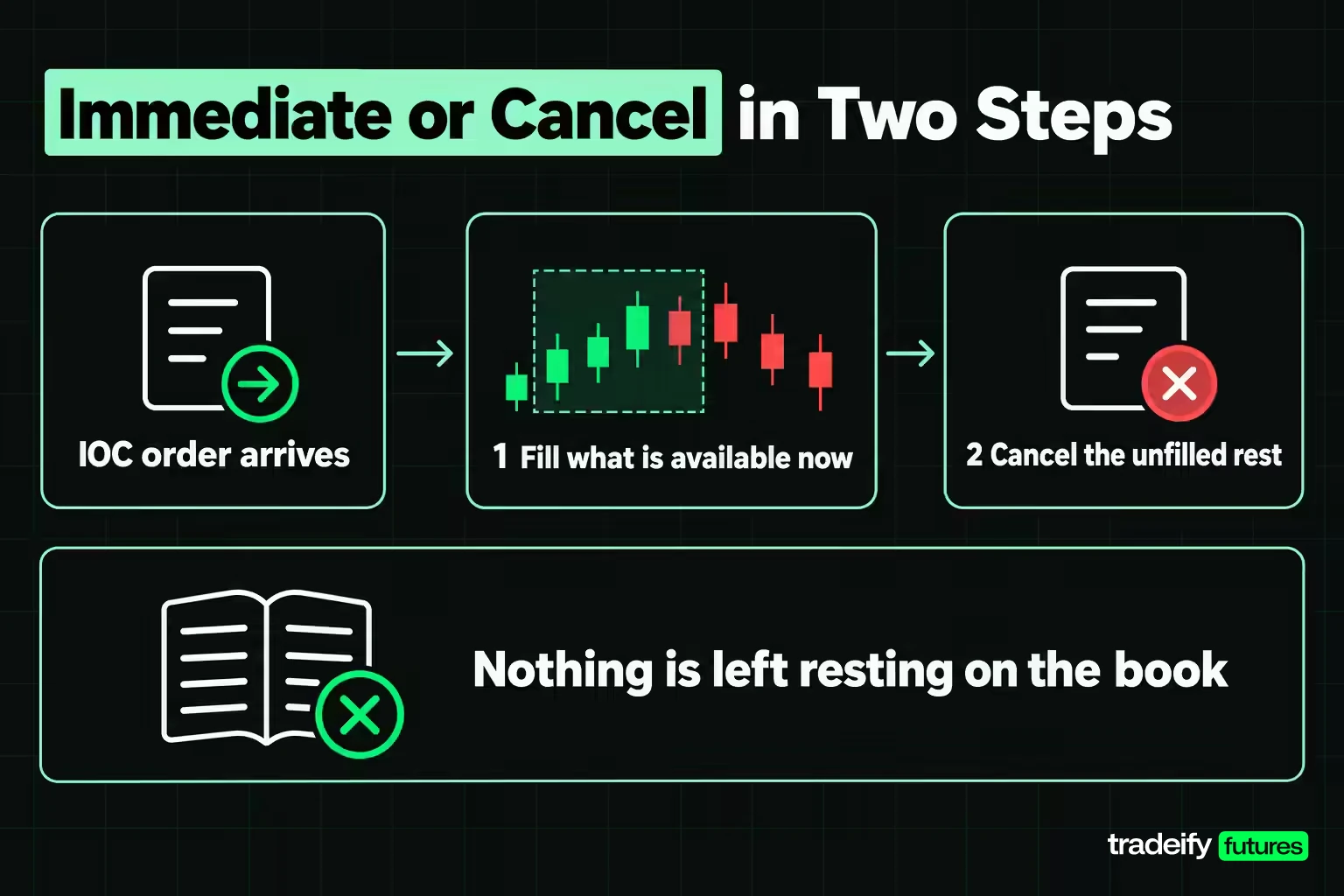
An IOC order, short for immediate-or-cancel, is an order that must execute immediately, with any portion that cannot be filled immediately cancelled. That is the SEC's investor education definition, and the Investor.gov glossary words it the same way. Investopedia adds the useful detail that an IOC can fill all or part of the order before the cancel happens.
So IOC stands for immediate or cancel, and the instruction has two halves:
- Fill now. The order is matched against liquidity that is already resting on the book at your price or better.
- Cancel the rest. Whatever did not match in that first pass is removed. It never becomes a working order.
The difference between an IOC order and an ordinary limit order is persistence. A standard limit order that cannot fill rests on the book and waits for price to come to it. An IOC order refuses to wait. If the matching pass finds nothing, the whole order is cancelled and you hold exactly what you held before.
Futures traders will meet the same idea under another name. CME Globex calls it Fill and Kill (FAK): orders are immediately executed against resting orders, and if the order cannot be fully filled, the remaining balance is cancelled.
Related lesson: Order types overview
How an IOC Order Executes Against the Order Book
An IOC order's execution is easiest to follow on real contract math, so here is one illustrative book. The instrument is the Micro E-mini S&P 500 (MES), which CME specifies at $5 per index point with a 0.25 point minimum tick, so one tick is worth $1.25 per contract.
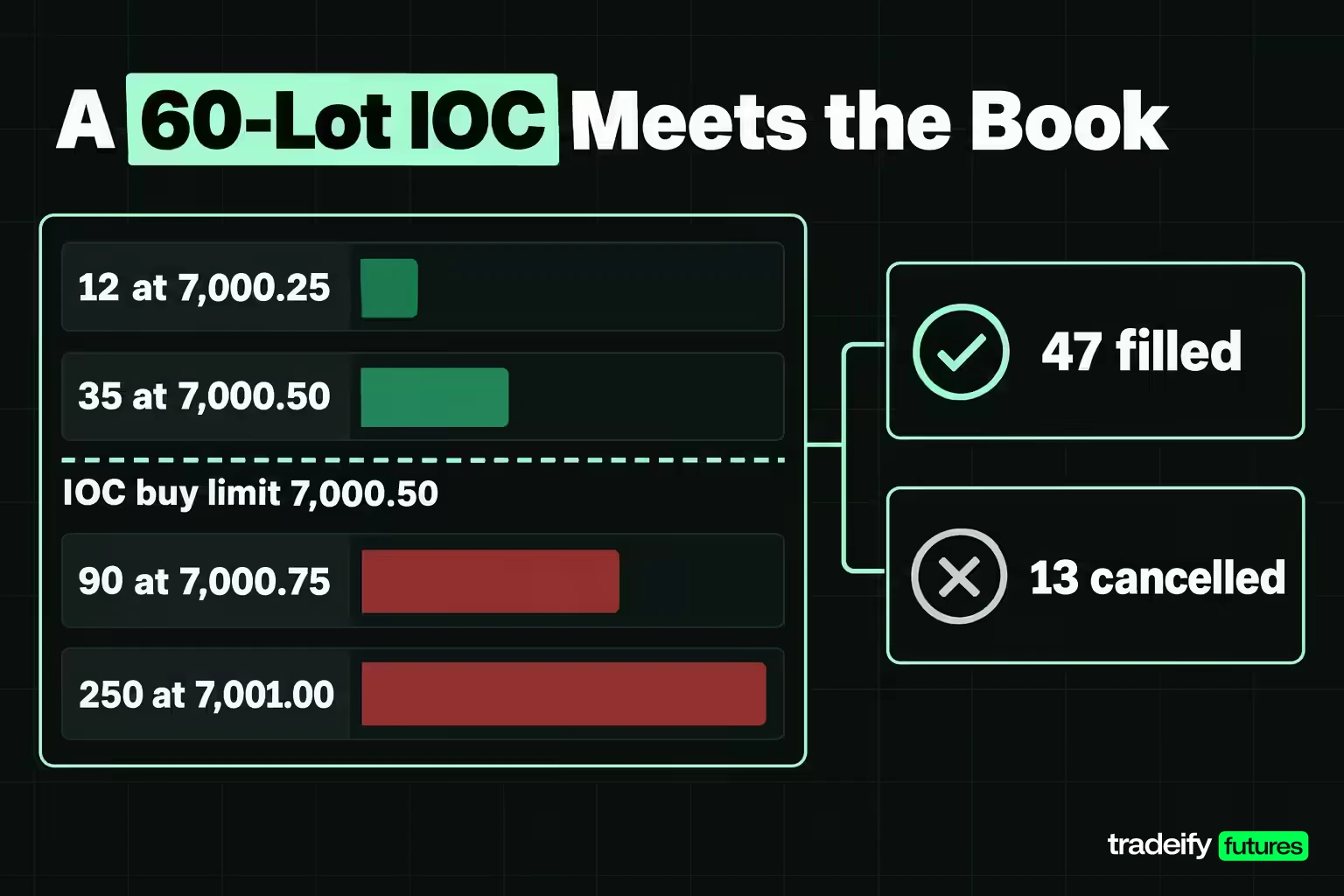
Suppose you want to buy 60 MES and the offer side of the book shows this (illustrative prices, not a quote):
- 12 contracts at 7,000.25
- 35 contracts at 7,000.50
- 90 contracts at 7,000.75
- 250 contracts at 7,001.00
The best offer is 7,000.25. Only 47 contracts sit at or below 7,000.50, while 137 sit at or below 7,000.75. Now send the same 60-lot buy as an IOC with three different limit prices.
| IOC limit price | Filled | Cancelled | Average fill | Cost above the 7,000.25 best offer |
|---|---|---|---|---|
| 7,000.75 | 60 | 0 | 7,000.5042 | $76.25 total, about 1 tick per contract |
| 7,000.50 | 47 | 13 | 7,000.4362 | $43.75 on the 47 filled |
| 7,000.00 | 0 | 60 | No fill | Nothing filled, nothing owed |
Full fill, partial fill and zero fill
The 7,000.75 limit is marketable for the whole size. It takes 12 at 7,000.25, all 35 at 7,000.50 and 13 of the 90 at 7,000.75. The average fill is 7,000.5042, a shade over one tick above the best offer, or $76.25 across the position.
The 7,000.50 limit fills the 47 contracts resting at or below that price and cancels the other 13. You now own 47 contracts, which is 78% of the plan, and nothing is working for the rest.
The 7,000.00 limit sits below the best offer, so nothing can match it. The venue cancels the order on arrival. No position, no working order, and depending on your platform, maybe nothing more than a line in the order log telling you it happened.
What the cancelled remainder costs to repair
In the illustrative 60-lot MES buy, an IOC order limited to 7,000.50 filled 47 contracts and cancelled 13, while a single IOC at 7,000.75 would have filled all 60 for $76.25 above the 7,000.25 best offer. Those 13 cancelled contracts are where the real decision sits. If you still want them, you need a new order, and by then the book may have moved.
- Repair with a second IOC one tick higher. Say the 7,000.75 offers have gone and the best offer is now 7,001.00. Buying the 13 there blends the whole position to an average of 7,000.5583, a total of $92.50 above the original best offer. That is $16.25 worse than the single 7,000.75 IOC, exactly one tick on 13 contracts.
- Repair with a market order into a running market. Say price is moving and the 13 fill at 7,003.50. The blended average becomes 7,001.1000, $255.00 above the original best offer and $178.75 worse than the single-pass IOC.
Same instrument, same size, same idea. The limit you put on the first IOC order decided what the repair cost, and the repair is usually paid in a market that has just shown you it is moving away. On the full-size E-mini S&P 500 (ES), where a tick is $12.50, every dollar figure here is ten times larger: the $76.25 single-pass cost becomes $762.50.
Related lesson: Tick size and tick value
IOC Limit Orders and Price Control
An IOC limit order is a limit order with the immediate-or-cancel rule attached. The limit sets the worst price you accept (a ceiling for a buy, a floor for a sell), and the IOC rule stops any unfilled part from resting. Bybit's help center describes it the same way: the order must be filled immediately at the order limit price or better, and contracts that cannot fill are cancelled.
The trap is that an IOC limit looks like a patient limit order and behaves like a one-shot instruction. Investopedia's example makes the point well. An investor places an IOC limit to buy 1,000 Apple shares at $169 at the open while the stock is offered at $170. Nothing is available at $169, so the order cancels. That afternoon a seller offers 700 shares at $169, and the order still does not fill, because it stopped existing in the morning.
The price came to the trader and the trade still did not happen. Being right about the level and having an order at the level are two different things, and an IOC limit only gives you the first one.
Setting the price on an IOC limit order
Setting an IOC limit comes down to one question: how far into the book are you willing to reach for the size you want?
- At the best offer (or bid). You take only the touch. On an illustrative MES book offering 12 contracts at 7,000.25, 35 at 7,000.50 and 90 at 7,000.75, a 60-lot IOC buy limited to 7,000.25 fills 12 and cancels 48.
- A level or two through the touch. You pay more for more size. On that same book, a 7,000.50 limit fills 47 and a 7,000.75 limit fills all 60.
- Below the best offer on a buy. The order is not marketable and cancels on arrival. Binance's documentation states it directly: if no quantity is available at the chosen price, the order is cancelled immediately.
A useful habit is to price an IOC order's limit at the worst level you would honestly accept for the whole size, not the level you hope to get. If that price leaves you uncomfortable, the size is probably too large for the visible book.
Related lesson: Limit orders
IOC Market Orders Versus IOC Limit Orders
An IOC can sit on either a market order or a limit order, and Investopedia notes both forms exist. The rule is the same in both cases. What changes is what limits the fill.
An IOC limit order is bounded by your price. It will happily fill nothing if the book is above your limit, and it never pays more than you named. Investopedia's framing is that IOC limit orders protect against a bad fill in a fast-moving or thin market.
An IOC market order drops the price boundary and keeps only the immediacy. It takes what the book offers on arrival and cancels whatever cannot be filled. In practice it can only fall short when there is not enough visible liquidity, which is exactly the moment when an unbounded market order is most dangerous.
| Instruction | What bounds the fill | Typical failure | Leftover quantity |
|---|---|---|---|
| IOC limit | Your limit price | Fills little or nothing in a fast move | Cancelled |
| IOC market | Visible liquidity only | Fills at poor prices in a thin book | Cancelled |
| Plain limit (day) | Your limit price | Rests unfilled while price leaves | Rests until filled, cancelled or session end |
| CME market with protection | A protection price limit set by the venue | Stops filling at the protection limit | Rests at the protection price limit |
How futures venues handle IOC market orders
Futures venues tend to bound market orders on their own. CME Globex documents a market order with protection, which is filled within a protected range: protection points are added to the best offer for a buy (subtracted from the best bid for a sell), and any quantity that cannot fill inside that range rests on the book at the protection price limit. A market-limit order on CME fills at the best available price and turns any remainder into a resting limit at that price.
Notice that both of those leave a resting remainder. An IOC instruction on top of the order is the piece that removes it. If your platform offers a time-in-force choice on market orders, that is the practical difference between "fill what you can and stop" and "fill what you can and leave the rest working."
Related lesson: Market orders
IOC Order Time in Force Compared With Day, GTC and GTD
Every order ticket asks two separate questions. The first is about price: any price inside the market, or only your price or better? That is market versus limit. The second is about persistence: if the order cannot fill right now, how long should it stay alive? That second question is time in force, and IOC is one of the answers.
The separation shows up in the plumbing. Tradovate's partner API, for example, has an orderType field (Market, Limit and so on) and a separate timeInForce field whose allowed values are Day, FOK, GTC, GTD and IOC.
| Time in force | Can partially fill | Rests on the book | Ends when |
|---|---|---|---|
| Day | Yes | Yes | Filled, cancelled, or the trading day ends |
| GTC (good till cancel) | Yes | Yes | Filled, cancelled, or the contract expires |
| GTD (good till date) | Yes | Yes | Filled, cancelled, the chosen date, or expiry |
| IOC (immediate or cancel) | Yes | No | Immediately after the first matching pass |
| FOK (fill or kill) | No | No | Immediately, filled in full or not at all |
| AON (all or none) | No | Yes | Filled in full or cancelled |
A few details from the primary sources are worth knowing. CME Globex treats every order as a day order unless you specify otherwise, and day orders do not carry over to the next trade date. On CME a GTC order stays on the book until it is fully executed, cancelled, or the instrument expires. Stock brokers set their own GTC limits: Fidelity keeps a GTC order active for up to 180 days. And the SEC describes all-or-none as the patient cousin of FOK: it must fill in full, but unlike FOK it can stay active until it executes or is cancelled.
Against that list, the IOC order is the shortest-lived instruction that still accepts a partial fill.
Related lesson: Good til canceled orders
IOC vs Day Order
A day order and an IOC order can carry the same limit price and still produce different positions. The difference is entirely in what happens to the part that does not fill right away.
Take an illustrative MES book with 12 contracts offered at 7,000.25 and 35 at 7,000.50, and a 60-lot buy limited to 7,000.50. Only 47 contracts are available at or below that price.
- As an IOC: 47 fill, 13 are cancelled, and nothing is left working.
- As a day order: 47 fill, and the other 13 rest as a bid at 7,000.50. They join the queue at that price and fill only if sellers come down to it before the trading day ends or you cancel.
Which is better depends on what the remainder means for your trade. Choose the day order when the price is the point: your level is a real level, you are happy to own more if price returns to it, and you will be watching the order. Choose the IOC when the timing is the point: the trade only makes sense now, and a fill 40 minutes later at the same price would be a different trade with a different reason.
The risk on each side is easy to name. A resting day order can fill after the idea behind it has died, and a forgotten one can fill when you are not watching. An IOC can leave you under-sized, and the temptation is to chase the missing contracts at worse prices. Decide which of those two problems you would rather manage before you send the order.
IOC vs FOK Orders
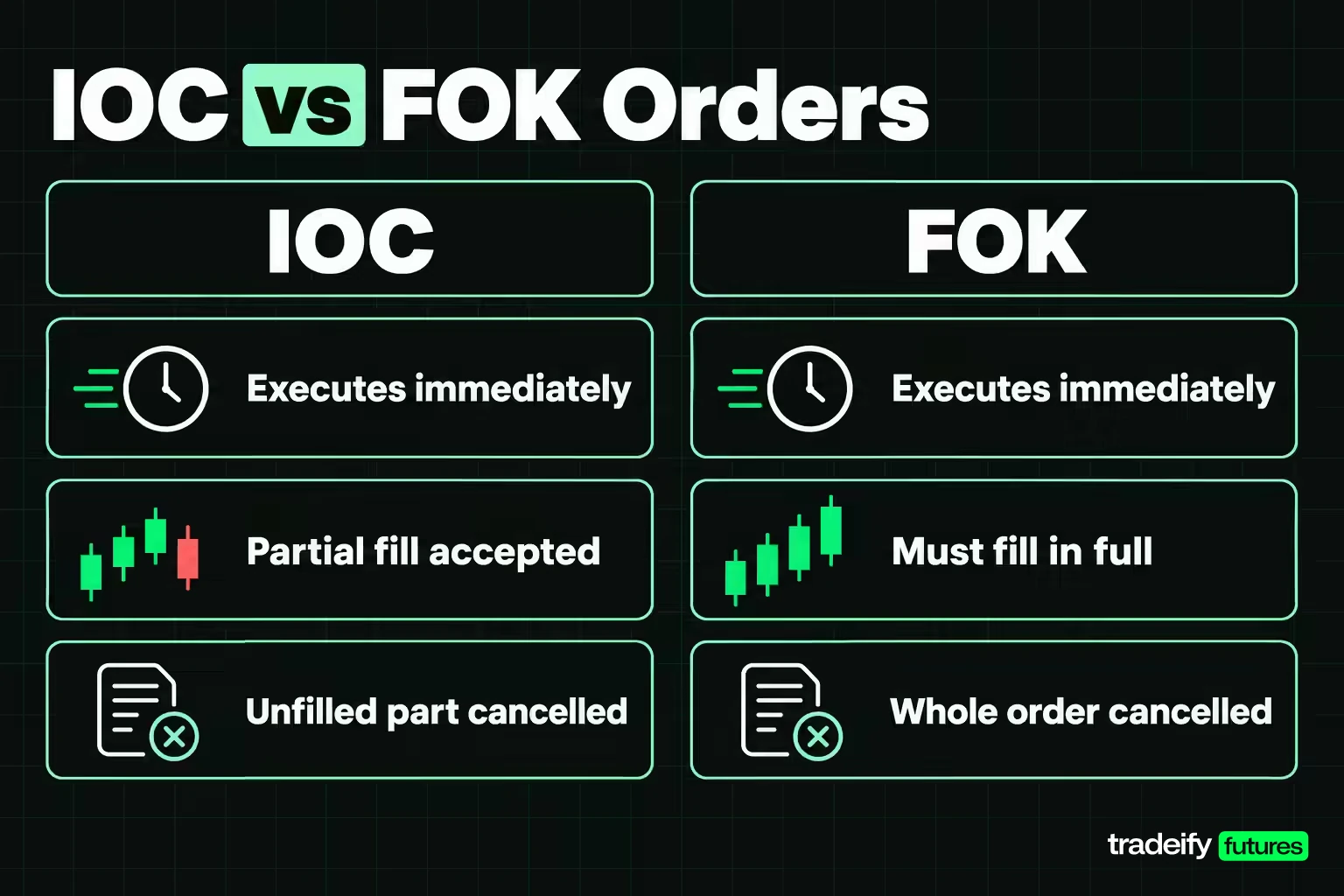
IOC and FOK are both immediate instructions, and both cancel anything that cannot fill on arrival. The difference is completeness. An IOC accepts a partial fill. A fill-or-kill (FOK) order must fill in its entirety immediately; otherwise the whole order is cancelled, with no partial execution allowed, in the SEC's wording.
CME Globex makes the relationship explicit. An FOK order is created by using the Fill and Kill qualifier and setting the minimum quantity equal to the total order quantity. The minimum quantity rule says that if at least the minimum cannot be filled immediately, the entire order is cancelled. So FOK is simply an IOC with a completeness condition attached, and a minimum quantity smaller than the full size gives you something in between.
Bybit's help center shows all three side by side. A trader wants to buy 10,000 contracts at no more than $8,001, and only 5,000 are offered at that price:
- GTC: 5,000 fill immediately and the other 5,000 rest on the book.
- FOK: nothing fills, because fewer than 10,000 are available, and the whole order is cancelled.
- IOC: 5,000 fill at $8,001 and the other 5,000 are cancelled.
A futures example tells the same story. On an illustrative MES book offering 12 contracts at 7,000.25, 35 at 7,000.50 and 90 at 7,000.75, a 60-lot FOK limited to 7,000.50 fills nothing, because only 47 contracts are available at that price or better. An IOC order at the same limit would have filled those 47. Raise the FOK limit to 7,000.75 and it fills all 60, exactly like the IOC.
Pick FOK when a fraction of the size is useless to you, for example when the trade only works at full size or the remaining quantity would leave a mismatched position. Pick IOC when some of the size right now is better than none.
Related lesson: Fill or kill orders
When an IOC Order Makes Sense
An IOC order earns its place in a handful of situations, all built around one preference: you would rather miss quantity than leave an order behind.
- Taking visible size without joining the queue. If you want the contracts resting on the offer now, not a place behind them, an IOC says so. Whatever is there gets taken, and you are not left bidding in front of the whole market.
- Avoiding stale fills. A resting order can fill long after the reason for it has gone. An IOC cannot. This matters most for entries tied to a specific moment, such as a break of a level or a reaction to a data release.
- Capping how far a large order travels. Bybit notes IOC is usually used to avoid large orders being executed at a price that deviates from the ideal price. The limit caps the price and the IOC caps the time.
- Automated strategies. Systems that send many self-contained attempts do not want an old attempt filling against a new signal. Tradovate's API even carries an isAutomated flag that must be true for orders not placed directly by a human, which tells you how often these instructions come from software.
- Exits that should not sit on the book. A resting exit is visible on the depth ladder. An IOC exit either happens or it does not.
When an IOC order is the wrong tool
An IOC is a poor fit when you need the full position to manage risk correctly, when the book is thin enough that most of your size will be cancelled, or when you are exiting and an unfilled remainder leaves you exposed. On a protective exit, being out matters more than avoiding a resting order. A partial IOC exit means you are still in the trade, with the reason you wanted out still working against you.
IOC Order Edge Cases and Surprises
Most IOC order surprises come from expecting it to behave like a limit order with a safety switch. A few specific cases come up again and again.
- The silent zero fill. A buy IOC priced below the best offer, or a sell priced above the best bid, cancels on arrival. Some platforms show this only as a cancelled order in the log, so it is easy to believe you are in a trade you never entered.
- Rejection outside the open session. On CME Globex, FAK and FOK orders are accepted during the Open market state only and rejected in any other market state. An IOC that works mid-session may be refused around the open or during a halt.
- Partial fills that break the risk math. If an IOC order for 60 contracts fills only 47, then the stop distance, loss budget and target were all sized for a position you do not hold. Re-size them to the fill you got, not the one you wanted.
- Immediate is not a speed promise. The order is matched against whatever is resting when the venue processes it. Liquidity you saw on the screen a moment earlier may be gone by then.
- IOC does not prevent slippage. It prevents a resting remainder. A 60-lot MES IOC buy that sweeps three illustrative offer levels from 7,000.25 to 7,000.75 still pays $76.25 over the best offer. A wide limit on an IOC order can fill at every level up to that limit.
- One venue's book only. Where the same product trades on several venues, as with many stocks and crypto pairs, an IOC sees only the liquidity on the venue that receives it.
The most expensive edge case is behavioral. After a partial fill, the cancelled quantity starts to feel like something you are owed. Chasing it with a string of new orders turns one decision into several, each at a worse price. If the remainder is worth having, decide the most you will pay for it before you send anything.
Related lesson: Partial fills
IOC Orders on Futures, Stock and Crypto Venues
The IOC order is close to universal, but the name and the rules around it vary by venue.
- CME Globex futures. The qualifier is Fill and Kill (FAK). A minimum quantity can be set, and setting it to the full size turns the order into fill or kill. FAK and FOK are accepted in the Open market state only.
- US stocks. The SEC's investor bulletin defines IOC for stock orders in the standard way, alongside day, GTC, FOK and all-or-none. Brokers decide which of these their tickets offer and set their own limits, such as how long GTC lasts.
- Crypto exchanges. Bybit supports time-in-force selection in spot trading and in perpetual and expiry contracts, with GTC, IOC and FOK. Binance's spot help page lists GTC, IOC and FOK.
The opposite of an IOC on most crypto venues is the post-only order. Binance describes a post-only limit as one that will never match with orders already on the book; if it would execute immediately, the system cancels it instead. IOC only takes liquidity, while post-only only adds it. Both cancel, for opposite reasons.
Because the rules are venue-specific, check the documentation for the exchange and platform you actually use before relying on IOC behavior in a new market.
Related lesson: The order book
How to Place an IOC Order
Placing an IOC order works much the same on any platform that offers it, because time in force is a separate setting from order type.
- Choose the order type and price. Pick limit or market. For a limit, set the worst price you will accept for the whole size and check that it is marketable against the side you are taking.
- Set time in force to IOC. Look for a time-in-force, duration or order-flag selector on the ticket. Fidelity's order ticket, for example, has you choose the order type and limit price, then time in force, then any conditions, then preview and place.
- Size against visible depth. Compare your quantity with what is resting inside your limit, and decide now what you will do if only part fills.
- Read the fill report, not just the order status. Confirm the filled quantity and average price, and that the remainder shows as cancelled.
For automated traders, the API is where IOC usually lives. On Tradovate's partner API it is the timeInForce value IOC on the place-order request, set separately from the order type.
Not every retail platform shows IOC on its manual ticket. On our accounts, our Help Center documents the Tradovate chart's order-flag selector as DAY/GTC and lists Day and GTC as the time-in-force choices in WealthCharts; it does not document an IOC option on either ticket, so check your own platform before planning a trade around one. Every position on our accounts is closed by 4:45 PM ET on regular days, so whichever time in force you choose, the trade itself is intraday.
IOC Order Fees, Taker Costs and Trade Records
An IOC order can only trade against orders already resting on the book, so every fill it gets is a liquidity-taking fill. That matters on venues that charge different maker and taker rates.
As of November 4, 2026, Bybit's published fee table lists a 0.0550% taker rate and a 0.0200% maker rate on perpetual and futures contracts for its base VIP 0 tier. On $100,000 of filled notional, that is $55 as a taker versus $20 as a maker. An IOC always pays the taker side on what it fills; a resting limit that gets hit can earn the maker rate. Many futures brokers instead charge a flat per-contract commission, in which case the IOC changes nothing about the fee and the cost difference is all in the fill price.
Logging IOC orders for review
For record keeping, an IOC order leaves a slightly odd footprint: one order, a filled quantity, and a cancelled quantity, often logged within the same moment. On CME Globex, fills come back from the exchange as execution reports, and CME's order-type documentation shows a separate partial-fill report for each price level an order trades at. A 60-lot IOC that sweeps three price levels can therefore show up as three fills plus a cancelled balance, and a platform's order view may summarize all of that as a single line marked cancelled.
That is why the fills report, not the order status, is the record that matters for review. Brokers and platforms keep their own order and execution histories, so check which report shows partial fills and cancelled balances on yours. When you review trades, record these for every IOC:
- Quantity sent versus quantity filled.
- Average fill price versus the best bid or offer when you sent it.
- Whether you repaired the remainder, and at what price.
Over a few weeks, that log shows whether IOC is saving you from stale fills or simply leaving you under-sized and chasing. A feeling that IOC "works" is not evidence; the fill log is.
Related lesson: Slippage explained
IOC Order FAQ
What does IOC stand for in trading?
IOC stands for immediate or cancel. It tells the venue to fill whatever it can right away at your price or better and cancel anything left over. The order never rests on the book.
What is an IOC limit order?
It is a limit order with the immediate-or-cancel rule attached. Your limit sets the worst acceptable price, and any quantity that cannot fill at that price right away is cancelled. If price reaches your limit later, the order is already gone.
Which is better, IOC or day?
Neither is better in general. A day order rests until it fills, you cancel it, or the trading day ends, so it suits a real price level you are willing to wait for. An IOC suits a trade that only makes sense right now.
Can an IOC order be partially filled?
Yes. A partial fill is a normal IOC result: the filled part becomes your position and the rest is cancelled. That is the main difference from a fill-or-kill order, which fills in full or not at all.
Do IOC orders work on futures?
Yes, under a different name. On CME Globex the qualifier is Fill and Kill, and it is accepted only while the market is in its open state. Whether you can choose it depends on your platform's order ticket or API.
A Pre-Trade IOC Order Checklist
Run this before an IOC order goes out, not after a partial fill surprises you.
- Name the order type the IOC is modifying, and for a limit, confirm the price is marketable right now.
- Compare your size with the depth resting inside your limit, and decide whether a partial fill still makes a valid trade.
- Write one sentence on what happens to an unfilled remainder, including the most you will pay or accept for it.
- Confirm the venue accepts the instruction in the current session, since futures exchanges can reject FAK outside the open market state.
- Re-size your stop and loss budget to the fill you actually got before you manage the position.
Related lesson: Position sizing
This page is general education, not trading advice or a recommendation to use any order type. Futures, crypto and other leveraged products can lose more than you expect, quickly, and no order instruction removes that risk. Every book, price and fill in the examples is an illustration, not a quote or forecast, and excludes commissions and fees. Evaluation and funded accounts at prop firms are simulated, and fills there may differ from a live market.


