.svg)

.svg)
.svg)



TL;DR: Choose a prop firm by measuring the loss room you can actually use, not the account size printed on the plan. Compare the starting maximum drawdown, daily loss limit, drawdown type, calculation basis, real-time enforcement, lock point, and payout effects. Then calculate the profit-target-to-drawdown ratio and divide usable drawdown by your planned risk per trade. A smaller account with a slower-moving or static loss floor may fit your strategy better than a larger account with less practical room.
A $100,000 prop firm account looks twice as useful as a $50,000 account. That comparison falls apart when the larger account has $3,000 of usable drawdown and the smaller account has $2,500.
The account labels differ by $50,000. The actual difference in loss capacity is only $500.
This is where traders get caught. They compare buying power, profit splits, and maximum contracts while treating drawdown as one more number in a pricing table. Drawdown is the rule that determines how much room the strategy has to be wrong before the account closes.
If you want to choose a prop firm based on drawdown, start with the loss floor. Then work backward into position size, daily risk, likely losing streaks, and the amount of profit required to pass.
In This Guide
- Why Prop Firm Account Size Can Mislead
- Measure Usable Prop Firm Drawdown
- Compare Static and Trailing Drawdown
- Check How Prop Firm Drawdown Is Calculated
- Compare Daily Loss With Maximum Drawdown
- Calculate Prop Firm Drawdown Efficiency
- Match Drawdown to Your Trading Strategy
- Check Funded Account and Payout Drawdown
- Compare Account Cost With Drawdown
- Use a Prop Firm Drawdown Scorecard
- A Current Prop Firm Drawdown Example
- Prop Firm Drawdown Questions
Why Prop Firm Account Size Can Mislead

The account size is usually a nominal balance used for margin, contract limits, profit targets, and program structure. It is not the amount of capital you can lose.
Suppose two programs offer these plans:
Plan | Advertised account size | Starting maximum drawdown | Drawdown as a share of account size |
|---|---|---|---|
Plan A | $100,000 | $3,000 | 3% |
Plan B | $50,000 | $2,500 | 5% |
Plan A has twice the headline balance but only $500 more starting loss room. Plan B provides more drawdown relative to its account size.
That does not automatically make Plan B better. Contract limits, the way drawdown moves, daily loss rules, and payout terms still matter. It does show why account size cannot be the main comparison.
The better question is not, "How large is the account?"
Ask, "How much controlled risk can my strategy take before the hard loss floor is reached?"
Measure Usable Prop Firm Drawdown

Start by finding the current hard loss floor. This is the balance or equity level the account cannot touch.
Then calculate usable drawdown:
Usable drawdown = current account equity − current hard loss floor
At the beginning of a new account, this may equal the advertised maximum drawdown. It can change after profitable days, losses, stage transitions, or payouts.
For example:
- Current equity: $52,400
- Current hard loss floor: $50,100
- Usable drawdown: $2,300
The account may still be labeled $50,000, but $2,300 is the number that matters for risk planning.
Do not assume every dollar of that $2,300 should be used. A trader needs room for commissions, slippage, open-trade movement, and mistakes. A personal shutdown level should sit inside the firm's hard boundary.
You can also measure drawdown as a percentage:
Effective drawdown percentage = starting drawdown ÷ advertised account size × 100
This ratio helps compare plans with different account labels. Dollar drawdown still matters more for position sizing, but the percentage shows how much loss room is attached to each nominal dollar.
Compare Static and Trailing Drawdown

Two accounts with the same $3,000 drawdown can behave very differently.
Static Prop Firm Drawdown
A static drawdown floor stays at the same balance unless the program specifies a later change. If a $100,000 account has a static floor at $97,000, profits can create more room above that floor.
After the account reaches $104,000, the distance to the floor is $7,000. The original loss limit did not follow the new high.
Static drawdown is usually easier to model because the hard floor is predictable. It may come with a smaller starting allowance, a higher program price, or other tradeoffs.
Trailing Prop Firm Drawdown
A trailing drawdown floor rises as the account reaches new balance or equity highs. It normally does not move down after losses.
If a $100,000 account begins with a $3,000 trailing drawdown, the starting floor is $97,000. If the rule follows the balance to $102,000, the floor may rise to $99,000. A later loss does not necessarily return the floor to $97,000.
Some trailing drawdowns stop moving after reaching a stated lock point. Others continue to trail. That difference can matter more than a small change in the starting drawdown amount.
When comparing prop firms, record:
- Whether the drawdown is static or trailing
- What causes a trailing floor to rise
- Whether the floor can lock
- The exact lock balance and final floor
- Whether the funded stage uses the same method
Check How Prop Firm Drawdown Is Calculated

"Trailing drawdown" is not a complete rule. You still need to know what data moves the floor and when the floor is enforced.
Balance-Based Prop Firm Drawdown
A balance-based rule generally uses closed trade results. Unrealized profit may not raise the floor, although unrealized losses can still count when the firm enforces the current boundary.
This structure can give a winning trade more room to retrace before it is closed because open profit has not necessarily moved the floor.
Equity-Based Prop Firm Drawdown
An equity-based rule can use net liquidation value, including unrealized profit and loss. If an open trade moves sharply into profit, the trailing floor may rise with it. A fast retracement can then reach the new floor before the trade closes.
This is often the most sensitive form of trailing drawdown. Traders who scale into positions, hold through volatile swings, or use wide stops need to understand it before placing a trade.
End-of-Day Prop Firm Drawdown
An end-of-day drawdown usually recalculates from a completed session balance rather than every intraday high.
That can be more forgiving during a profitable trade that retraces before the close. It does not mean the current loss floor is checked only after the session. A firm can update the floor at end of day and enforce the existing floor in real time.
Ask two separate questions:
- When does the drawdown floor update?
- When is the current floor enforced?
Mixing those questions is one of the fastest ways to misread an account.
Compare Daily Loss With Maximum Drawdown

Maximum drawdown controls the life of the account. A daily loss limit controls how much loss can occur within one trading session. The rules may overlap, but they are not interchangeable.
Assume an account has:
- $3,000 maximum drawdown
- $1,500 daily loss limit
- $1,000 remaining above the current hard floor
The trader does not have $1,500 of room for the day. The hard floor is only $1,000 away, so it is the closer boundary.
Also check the consequence of reaching each limit. A daily loss hit may pause trading until the next session, or it may close the account. A maximum drawdown hit is commonly a hard breach.
Record these details for the daily loss rule:
- Starting daily limit
- Calculation basis
- Whether open losses count
- Reset time and time zone
- Soft or hard breach
- Whether the amount changes after profit
- Whether the rule exists in every account stage
An account with no daily loss limit is not automatically safer or better. It gives the trader more responsibility for setting a personal daily stop.
Calculate Prop Firm Drawdown Efficiency

The profit target and drawdown should be compared as a pair. A large profit target with a small loss allowance demands more return from each dollar of permitted drawdown.
Use this formula:
Profit-target-to-drawdown ratio = profit target ÷ starting maximum drawdown
Consider two hypothetical evaluations:
Evaluation | Profit target | Maximum drawdown | Target-to-drawdown ratio |
|---|---|---|---|
Evaluation A | $6,000 | $3,000 | 2-to-1 |
Evaluation B | $4,000 | $2,500 | 8-to-5 |
Evaluation A has more drawdown in dollars. Evaluation B asks the trader to produce less profit for each dollar of loss capacity.
This ratio does not capture every rule. A trailing floor, consistency requirement, or minimum trading-day rule can change the difficulty. It is still a useful first filter.
Next, calculate how many full-risk losses the account can theoretically absorb:
Loss capacity in trades = usable drawdown ÷ planned risk per trade
If usable drawdown is $2,400 and planned risk is $200 per trade, the result is 12 planned losses. The practical number is lower after allowing for costs and slippage.
This calculation exposes poor fits quickly. If your normal setup risks $500 and the account offers $2,000 of drawdown, four full losses can consume the entire allowance. The account label does not change that math.
Match Drawdown to Your Trading Strategy

The best drawdown structure is the one that can support your existing strategy without forcing reckless size or unnatural stops.
Review at least 30 to 50 recent trades and record:
- Average planned loss
- Largest normal loss
- Longest losing streak
- Maximum intraday equity decline
- Typical open-profit retracement
- Average contracts used
- Number of trades per session
Then stress-test the account.
Prop Firm Drawdown for Scalpers
A scalper may care most about the daily loss limit, commissions, and the number of planned attempts. Small losses can add up quickly when trade frequency is high.
An intraday equity-based floor can also react to unrealized gains and fast reversals. Execution costs need to be included in every risk estimate.
Prop Firm Drawdown for Trend Traders
A trend trader may allow winning positions to retrace before the next push. An intraday trailing floor that follows open profit can conflict with that approach.
An end-of-day or balance-based method may provide a better match, depending on how the firm enforces unrealized losses.
Prop Firm Drawdown for Traders Who Scale
Scaling into a position increases exposure while the trade develops. The trader needs to model total risk at the final planned size, not just the first entry.
Contract caps do not answer whether the account can support the scale plan. The loss floor does.
Check Funded Account and Payout Drawdown

Evaluation rules are only the first part of the comparison. The funded stage may change the drawdown amount, trailing method, lock point, contract size, or daily loss limit.
Create a separate row for each stage:
Account stage | Starting floor | Drawdown method | Lock point | Daily loss | Payout effect |
|---|---|---|---|---|---|
Evaluation | Record rule | Record rule | Record rule | Record rule | Not applicable |
Simulated funded | Record rule | Record rule | Record rule | Record rule | Record change |
Live funded | Record rule | Record rule | Record rule | Record rule | Record change |
Payouts can reduce the cushion above the hard floor. If an account has $5,000 of equity above its floor and the trader withdraws $4,000, only $1,000 may remain for future losses.
Calculate the account after the request:
Post-payout drawdown cushion = expected remaining equity − post-payout loss floor
A favorable profit split does not help if the payout leaves too little room to trade the next cycle at a sensible size.
Compare Account Cost With Drawdown

Fees should be compared with usable drawdown, not only account size.
A simple measure is:
Cost per $1,000 of drawdown = total expected entry cost ÷ starting drawdown × 1,000
Suppose one evaluation costs $80 and provides $2,000 of starting drawdown. Its cost is $40 per $1,000 of drawdown.
Another costs $120 and provides $4,000 of drawdown. Its cost is $30 per $1,000 of drawdown, even though the upfront price is higher.
Include costs that are likely for the path you expect to take:
- Initial evaluation fee
- Monthly renewals
- Activation fees
- Reset fees
- Data or platform fees
- Expected number of attempts
Do not treat the lowest fee as the best value. A cheap account with an unsuitable drawdown rule can cost more after repeated resets.
Use a Prop Firm Drawdown Scorecard
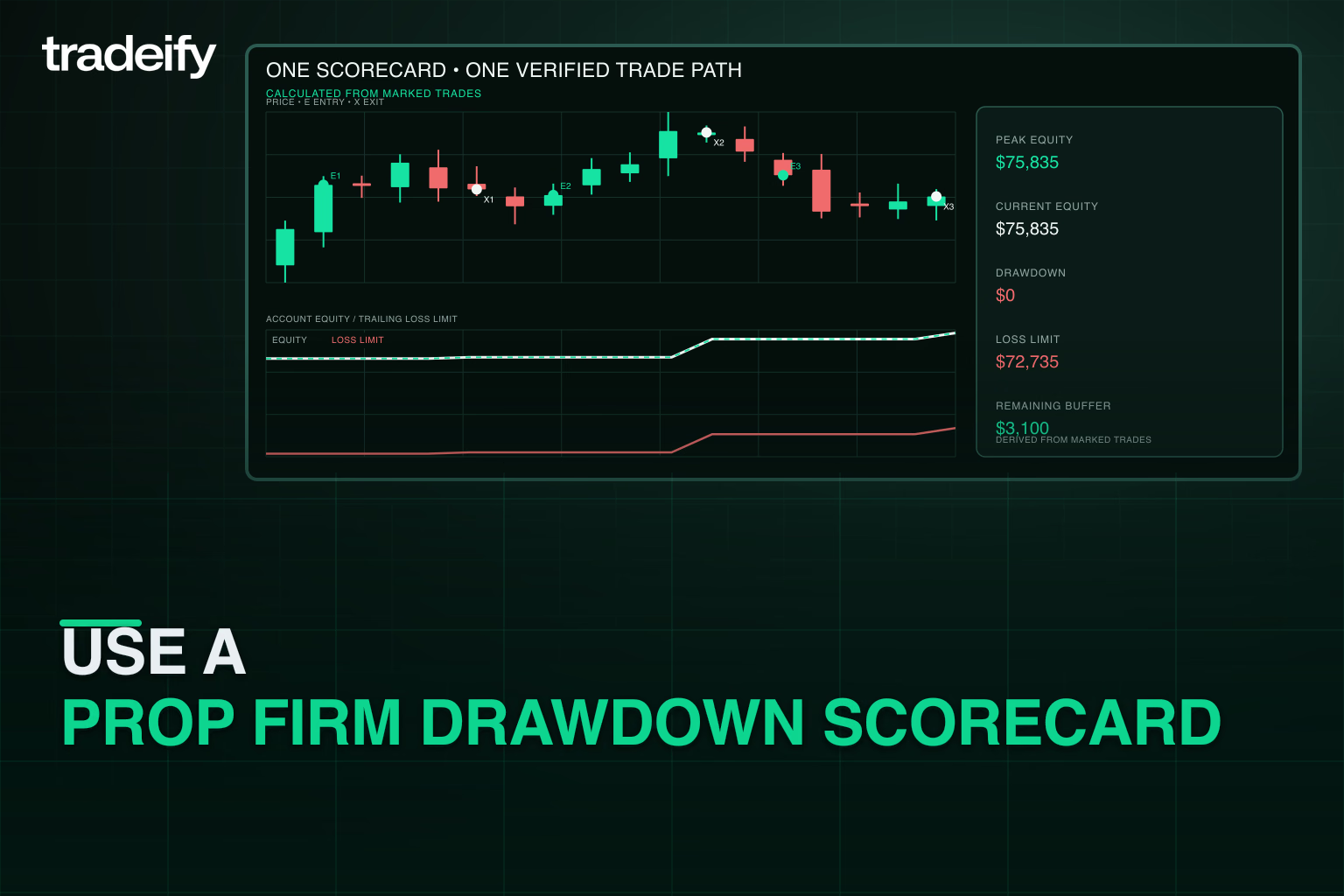
Use the same scorecard for every account you are considering.
Drawdown factor | Account A | Account B |
|---|---|---|
Advertised account size | ||
Starting maximum drawdown | ||
Effective drawdown percentage | ||
Static, intraday trailing, or end-of-day trailing | ||
Balance or equity calculation | ||
Real-time enforcement | ||
Drawdown lock point | ||
Daily loss limit | ||
Soft or hard daily breach | ||
Profit target | ||
Target-to-drawdown ratio | ||
Planned risk per trade | ||
Estimated loss capacity in trades | ||
Funded-stage drawdown | ||
Post-payout floor change | ||
Expected total entry cost | ||
Cost per $1,000 of drawdown |
Put the official rule link next to every answer. If a rule is unclear, ask support before paying. Screenshots and social posts can become outdated, while the current agreement and help center control the account.
A Current Prop Firm Drawdown Example
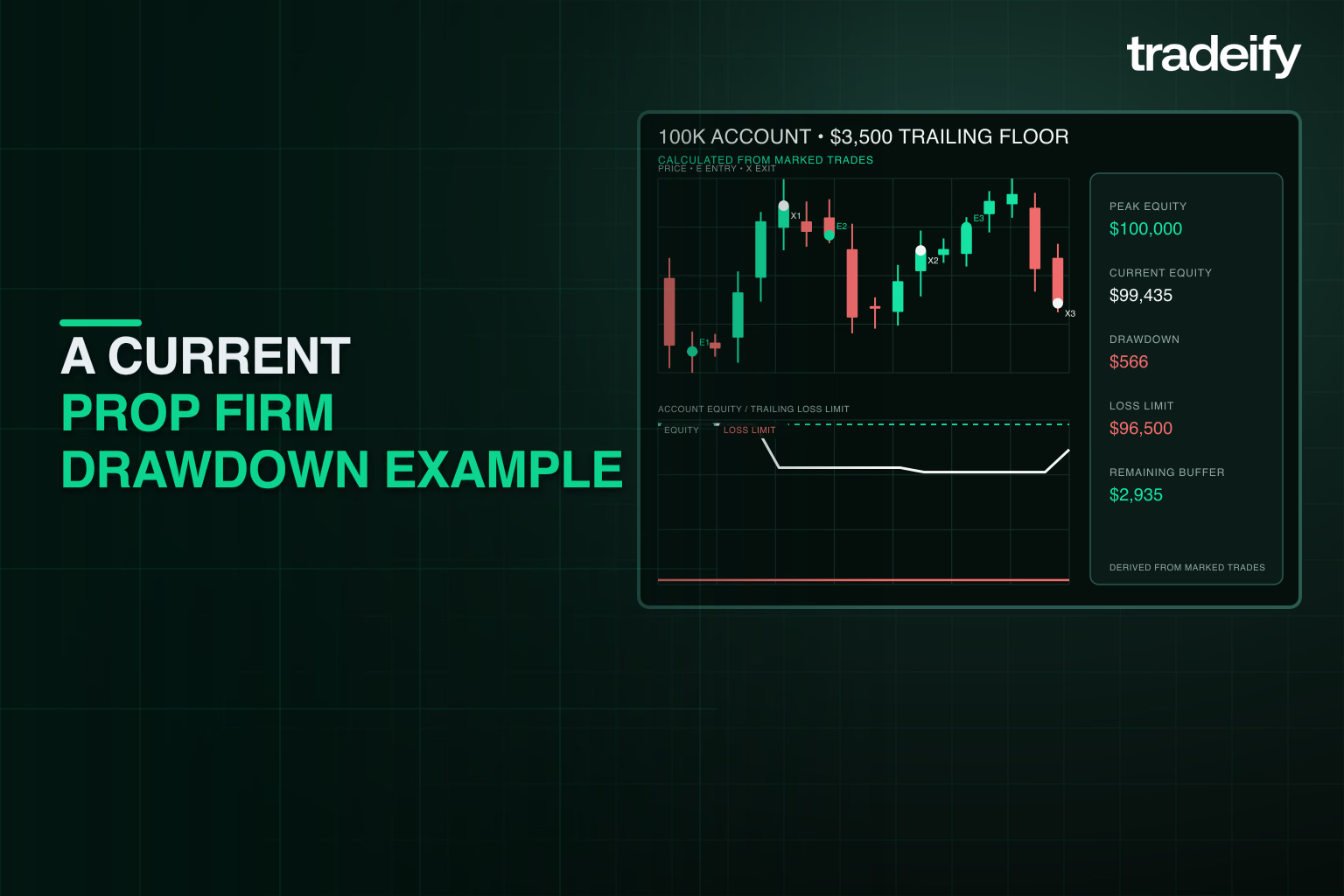
On our current 100K Growth account, the headline balance is $100,000, but the starting hard loss capacity is the $3,500 trailing drawdown. The account also begins with a $2,500 daily loss limit. That means the useful comparison numbers are $3,500 for the account floor and $2,500 for the session limit, not $100,000.
Our current trailing drawdown rules use an end-of-day update and real-time enforcement: the drawdown limit only moves at the end of each trading day, but the current limit is enforced live throughout the session, so hitting it intraday fails the account immediately. Our published trailing max drawdown guidance also explains the funded-stage lock point, where the drawdown becomes a fixed floor once the account profits past its drawdown amount by $100. Our daily loss limit is a session pause rather than an account failure, while the trailing drawdown remains the hard boundary that can end the account.
This example shows why four fields belong together: account size, hard drawdown, daily loss, and drawdown method. Reading only the first field leaves out the account's real risk structure.
Prop Firm Drawdown Questions
Are There Prop Firms Without Drawdown Rules?
A prop trading program needs some form of risk boundary, even if it does not use the word "drawdown." The rule may appear as maximum loss, account stop, liquidation threshold, or a broker-level risk limit. Read the full loss policy instead of searching only for one label.
Is Balance-Based Drawdown Better Than Equity-Based Drawdown?
Balance-based drawdown can be easier for traders whose open profits regularly retrace because unrealized gains may not move the floor. Equity-based drawdown can react faster to changes in an open position. The better fit depends on trade duration, scaling, stop placement, and how the firm enforces unrealized losses.
Is a 20% Drawdown Bad?
The percentage alone does not say whether a rule is good or bad. Confirm what the percentage is measured against, whether it is static or trailing, and whether a separate daily limit applies. A 20% static floor behaves very differently from a 20% intraday trailing rule.
Is a Larger Prop Firm Account Always Better?
No. A larger account may provide more contracts but only slightly more drawdown. Compare dollar loss capacity, drawdown method, profit target, daily loss, and cost before choosing the larger plan.
How Much Drawdown Should a Prop Firm Account Have?
There is no universal amount. The account should provide enough room for your planned risk per trade, normal losing streak, costs, and a safety buffer. Use your own trade history instead of selecting a fixed percentage from someone else's strategy.
Should You Choose Static or Trailing Drawdown?
Static drawdown is simpler because profits can build space above a fixed floor. Trailing drawdown may offer different pricing or account options but requires closer monitoring as the floor moves. Compare the complete program, not the drawdown label alone.
Choose the Loss Room Before the Account Label
The largest prop firm account is not always the account with the most practical room. The number that controls survival is the distance between current equity and the hard loss floor.
Start there. Compare drawdown type, calculation basis, enforcement timing, daily loss, target efficiency, funded-stage changes, and payout effects. Then test those rules against your actual risk per trade and losing streaks.
The right account should fit the way you already manage risk. If the plan only works after you tighten normal stops, increase size, or assume a perfect run, the account is too small where it matters.
Rules and program terms can change. Verify the current official agreement and help-center guidance for the exact account type before purchasing, trading, or requesting a payout.
Risk disclosure: Futures and other leveraged trading involve substantial risk and are not suitable for every trader. Prop firm accounts may use simulated funds, and simulated results do not guarantee future performance, live funding, or payouts. This article is educational and is not financial advice.
.svg)
.svg)
.svg)
.svg)









.webp)