.svg)

.svg)
.svg)




TL;DR: There is no single trustworthy prop firm pass rate for the whole industry, so this guide does not pretend one headline percentage applies to every trader. Public estimates often mix purchased evaluations, unique traders, resets, completed challenges, funded accounts, and payouts. Use a rate only when the firm, program, time period, denominator, and account stage are disclosed. Then compare it with a more useful personal readiness test: rule-compliant backtesting, drawdown math, consistent execution, and a hard cost cap for attempts.
You see a prop firm pass rate, compare it with the profit target, and start doing the math on your own attempt. That is where the number can pull you in the wrong direction.
One page may report a tiny pass rate. Another may show something far higher. The contradiction may be real, or the pages may be counting different things. One counts every purchased evaluation. Another counts only traders who finished. Resets, repeat buyers, multi-step programs, inactive accounts, and payout rules widen the gap.
Here is the decision that matters. Does the statistic describe the same program, rules, account stage, and type of trader you are trying to assess?
If not, it is context at best. Do not let it talk you into trading faster, sizing up, or assuming the challenge is easy.
A funded-account evaluation tests more than whether your strategy can make money. It tests whether you can follow its rules while wins and losses arrive in an inconvenient order. A positive strategy can still fail after one misunderstood threshold, one oversized recovery trade, or one entry outside permitted conditions.
What a Prop Firm Pass Rate Measures
At its cleanest, a pass rate is:
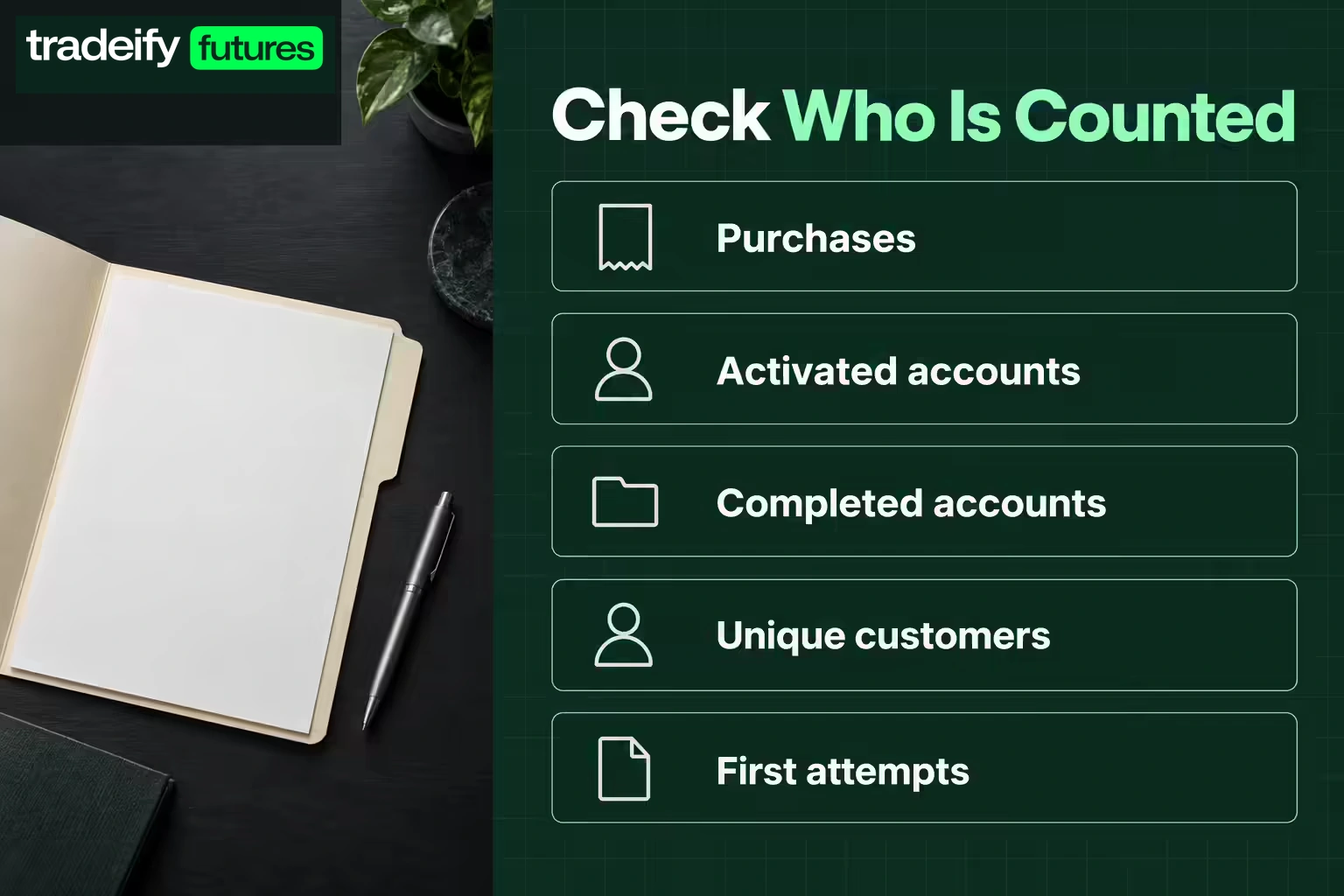
- The number of evaluations that met every required objective
- Divided by the number of evaluations included in the sample
The trouble starts with “included in the sample.” A firm could use purchases, activated accounts, completed accounts, unique customers, or first attempts. Those are not interchangeable.
Imagine 1,000 evaluations are purchased, but only 600 are completed. Some traders reset several times. Others reach a target and later violate a rule. A pass rate based on all 1,000 purchases will look lower than one based on 600 completed attempts, even though nothing about the underlying performance changed.
Observation: the percentages disagree. Interpretation: the programs may not be different at all. Condition: the denominators must match before you compare them. Action: find the counting method. Invalidation: if the publisher does not provide it, do not treat the percentage as a personal benchmark.
A useful disclosure should identify:
- The firm and program type
- The measurement dates
- One-step or multi-step evaluation status
- The denominator used
- Whether resets count as new attempts
- Whether the accounts were simulated, live, or a mix
- Whether “success” means passing, receiving a funded account, or receiving a payout
Without those details, the number is a marketing claim or a rough estimate, not a benchmark for your own probability.
Why Prop Firm Pass Rate Estimates Conflict
Current search results include firm articles, calculators, community posts, videos, and statistical roundups. That mix explains the confusion. Much of the available data is self-reported, repeated from another source, or built from assumptions the reader cannot see.
The number may still be useful. It just has to survive a few questions before it earns your trust.
Prop Firm Attempts Are Not Unique Traders
One trader may purchase several evaluations. If every purchase becomes a new record, a 10 percent evaluation pass rate does not mean 10 percent of people passed. It means 10 percent of the counted attempts passed.
Think about the behavior behind that denominator. A trader fails, feels close, buys a reset, and tries to recover the prior fee through more aggressive sizing. Four failed attempts and one pass create five account records but one person. The statistic sees attempts. Your budget feels every fee.
Prop Firm Programs Use Different Rules
A one-step evaluation with no time limit cannot be compared cleanly with a two-step program that uses different targets, loss limits, consistency rules, or minimum trading days. The same strategy may survive one rule set and fail another before its edge has enough trades to show up.
Even the drawdown method changes the task. A fixed end-of-day threshold creates a different risk problem from an intraday trailing threshold. The label “prop challenge” does not make those programs statistically equivalent.
Prop Firm Passing Is Not the Same as a Payout
Passing an evaluation is one checkpoint. Maintaining the account, meeting payout conditions, and receiving a payout are separate checkpoints.
That distinction protects you from outcome-only thinking. A fast pass may look impressive, but it tells you little about whether the same risk can survive the funded stage. If the question is payout access, stop reading at the pass rate and you are measuring the wrong finish line.
This is why a pass-rate article should not stop at the evaluation target. Ask for the full funnel:
- Evaluations purchased
- Evaluations completed
- Evaluations passed
- Funded accounts activated
- Funded accounts still active after a defined period
- Traders who requested a payout
- Traders who received a payout
Each step answers a different question. Combining them into one “success rate” hides the decision you are trying to make.
How to Read a Prop Firm Pass Rate Claim
Use a five-part check before repeating any percentage or changing your plan because of it.

Check the Prop Firm Source
Prefer a dated disclosure from the firm or a regulatory filing over an affiliate roundup. A community post can raise a useful question, but it cannot prove an industry-wide number by itself.
If the original source cannot be found, your conclusion should get weaker, not louder.
Regulatory records can also clarify how a specific business described its accounts. For example, a CFTC complaint involving Traders Global discussed customer fees, simulated stages, commissions, and advertised profit splits. That case is evidence about one set of allegations and one business model, not a universal pass-rate dataset.
Check the Prop Firm Denominator
Look for language such as “accounts,” “attempts,” “customers,” or “completed challenges.” If the denominator is missing, do not convert the claim into “percentage of traders.” That small wording change can turn an account statistic into a claim about people.
Check the Prop Firm Time Window
A monthly sample can be distorted by a promotion, a rule change, or a surge of new customers. A longer period is more useful, but only if the program stayed comparable throughout it.
Check the Prop Firm Account Stage
Confirm whether the number covers phase one, all evaluation phases, funded activation, or payouts. A high phase-one completion rate can coexist with a much lower rate through the full process.
Check the Prop Firm Conflict of Interest
Firms, affiliates, educators, calculators, and traders may all frame the statistic differently. That does not make every claim false. It does mean you should ask what the publisher gains if the number looks unusually high or low.
What Actually Affects Your Prop Firm Pass Rate
An industry estimate cannot tell you whether your method fits a specific evaluation. Your own evidence can get closer because it includes the part a headline cannot see: how you size, how often you trade, and what you do after a loss.
Prop Firm Rule Fit
Write every rule in operational terms before trading. “Daily loss limit” is not enough. Record when it resets, what equity value it uses, whether open profit and loss counts, and how commissions affect the threshold.
Why? Because the platform applies the actual calculation, not the version you remembered. If your replay uses a fixed limit while the account trails, the test is answering the wrong question.
Apply the exact rules to the historical trade sequence. A setup that is profitable before constraints may become unworkable when realistic loss limits and transaction costs are added. That is a program mismatch, not a reason to force the strategy harder.
Prop Firm Risk per Trade
Risk should be small enough that an ordinary losing streak does not end the account. If your test shows five consecutive losses are plausible, your position size must leave room for that sequence plus execution costs.
This is where pressure bends the plan. The profit target is visible, so you size around how fast you want to reach it. The failure boundary is less exciting, but it ends the attempt first.
Size from the losing streak and drawdown limit. If that size makes the target unrealistic for the available sample, the conclusion may be that the program does not fit right now.
Prop Firm Trade Frequency
More trades create more opportunities and more chances to make an error. A low-frequency strategy may take longer but reduce exposure to marginal setups. A high-frequency strategy may reach a target faster while paying more spread and commission and encountering more intraday noise.
Neither is automatically better. Use the frequency your tested edge actually supports.
Prop Firm Execution Discipline
A backtest assumes every qualified setup is taken and every invalid setup is skipped. Evaluation pressure can reverse that behavior. You hesitate after a clean loss, chase the entry you missed, or increase size because the target finally looks close.
That is why rule adherence needs its own score. A red day with perfect execution can be useful data. A green day built on an unplanned trade is a warning because the result rewarded the behavior you are trying to remove.
Prop Firm Cost Control
Set a maximum budget before buying an evaluation. Include the entry fee, resets, activation charges if applicable, data or platform costs, and the opportunity cost of preparation time.
Precommit to the next decision too. A failed attempt does not automatically justify a reset. Review what failed, repair it in simulation, and decide again with the fee out of the emotional equation.
Build Your Own Prop Firm Readiness Estimate
You cannot know your true probability from a handful of trades, but you can make a better decision than relying on a headline percentage. Build an estimate that can be challenged.

- Choose the exact program and save its current rules.
- Translate every rule into a testable constraint.
- Run a meaningful historical sample across different market conditions.
- Include commissions, spreads, slippage, and realistic fill assumptions.
- Record how often the strategy reaches the loss boundary before the target.
- Forward-test in simulation without changing the rules mid-sample.
- Review both financial results and execution errors.
- Start an evaluation only when the process is repeatable and the attempt fits your budget.
Hypothetical results have limits. The CFTC’s discussion of simulated-performance disclosures notes that simulated results do not represent actual trading and may not fully reflect liquidity, execution, or the effect of financial risk. A backtest is evidence, not a promise.
Prop Firm Pass Rate Questions
What percent of traders pass a prop firm challenge?
There is no verified industry-wide percentage that cleanly covers all firms, account types, time periods, resets, and unique traders. Use firm-specific disclosures only when the denominator and account stage are clear.
Is a low prop firm pass rate proof the rules are unfair?
No. A low rate may reflect difficult rules, weak preparation, repeat attempts, poor measurement, or several of those factors. Review the actual rule math and disclosure method before drawing a conclusion.
Does passing a prop firm mean a trader is profitable?
Not necessarily. Passing shows that an account met a defined evaluation during a limited sample. It does not prove long-term profitability, future payouts, or performance under different market conditions.
How can a trader improve a prop firm pass rate?
Focus on controllable inputs: exact rule knowledge, tested position sizing, realistic costs, a limited setup list, and consistent execution. Do not respond to a low published statistic by taking more risk.
Use the Prop Firm Pass Rate as Context
The best use of a pass-rate statistic is to ask better questions. Who was counted? What program did they trade? Did they pass every phase? Were the accounts simulated? Did the result continue through a payout?
Then put the percentage down and open your own records. Save the current rules. Run the trade sequence through the actual constraints. Check the losing streak, rule errors, and full attempt cost.
If that evidence is not ready, the next action is not another evaluation. It is another clean simulated sample. Futures and leveraged trading can produce substantial losses, and funded-account rules add another failure boundary. No pass-rate estimate guarantees that a strategy or trader will pass.
.svg)
.svg)
.svg)
.svg)







.webp)